
Cookeite
A valid IMA mineral species - grandfathered
This page is currently not sponsored. Click here to sponsor this page.


About Cookeite

Josiah Parsons Cooke
Formula:
(LiAl4◻)[AlSi3O10](OH)8
Colour:
White, yellowish green, greenish, pink, brown, grey, rarely lilac
Lustre:
Waxy, Greasy, Pearly
Hardness:
2½ - 3½
Specific Gravity:
2.58 - 2.69
Crystal System:
Monoclinic
Member of:
Name:
Named in honor of Josiah Parsons Cooke Jr. (12 October 1827, Boston, Massachusetts, USA - 3 September 1894, Newport, Rhode Island, USA), Harvard mineralogist and chemist. A largely self-taught chemist, he was one of the first Americans to teach laboratory chemistry. He made significant contributions to the measurement of atomic weights.
Co-Type Localities:
Isostructural with:
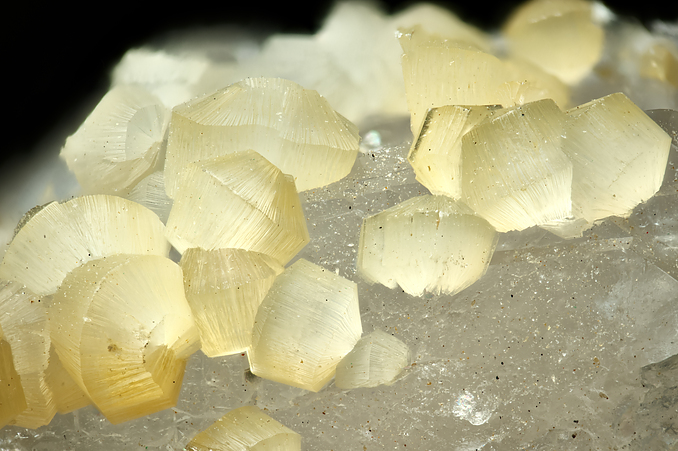
Characteristic botryoidal to worm-like aggregates show radial pattern of plates, occasionally showing pearly lustre of basal cleavage.
Forms a solid-solution series with (Li-free) donbassite.
A natural Na analogue may exist (see 'UM1969-13-SiO:AlHNa').
See also borocookeite.
Forms a solid-solution series with (Li-free) donbassite.
A natural Na analogue may exist (see 'UM1969-13-SiO:AlHNa').
See also borocookeite.
Unique Identifiers
Mindat ID:
1121
Long-form identifier:
mindat:1:1:1121:7
Similar Names
| Cokeite | A rock classification type |
IMA Classification of Cookeite
Approved, 'Grandfathered' (first described prior to 1959)
IMA Formula:
LiAl4(Si3Al)O10(OH)8
First published:
1866
Type description reference:
Classification of Cookeite
9.EC.55
9 : SILICATES (Germanates)
E : Phyllosilicates
C : Phyllosilicates with mica sheets, composed of tetrahedral and octahedral nets
9 : SILICATES (Germanates)
E : Phyllosilicates
C : Phyllosilicates with mica sheets, composed of tetrahedral and octahedral nets
71.4.1.2
71 : PHYLLOSILICATES Sheets of Six-Membered Rings
4 : Sheets of 6-membered rings interlayered 1:1, 2:1, and octahedra
71 : PHYLLOSILICATES Sheets of Six-Membered Rings
4 : Sheets of 6-membered rings interlayered 1:1, 2:1, and octahedra
16.1.5
16 : Silicates Containing Aluminum and other Metals
1 : Aluminosilicates of Li
16 : Silicates Containing Aluminum and other Metals
1 : Aluminosilicates of Li
Mineral Symbols
As of 2021 there are now IMA–CNMNC approved mineral symbols (abbreviations) for each mineral species, useful for tables and diagrams.
Please only use the official IMA–CNMNC symbol. Older variants are listed for historical use only.
Please only use the official IMA–CNMNC symbol. Older variants are listed for historical use only.
| Symbol | Source | Reference for Standard |
|---|---|---|
| Ckt | IMA–CNMNC | Warr, L.N. (2021). IMA–CNMNC approved mineral symbols. Mineralogical Magazine, 85(3), 291-320. doi:10.1180/mgm.2021.43 |
| Ckt | The Canadian Mineralogist (2019) | The Canadian Mineralogist (2019) The Canadian Mineralogist list of symbols for rock- and ore-forming minerals (December 30, 2019). download |
| Ckt | Warr (2020) | Warr, L.N. (2020) Recommended abbreviations for the names of clay minerals and associated phases. Clay Minerals, 55, 261–264 doi:10.1180/clm.2020.30 |
Pronunciation of Cookeite
Pronunciation:
| Play | Recorded by | Country |
|---|---|---|
| Jolyon Ralph | United Kingdom |
Physical Properties of Cookeite
Waxy, Greasy, Pearly
Transparency:
Translucent
Comment:
Pearly luster on basal cleavage
Colour:
White, yellowish green, greenish, pink, brown, grey, rarely lilac
Comment:
Colorless when pure.
Streak:
White
Hardness:
2½ - 3½ on Mohs scale
Tenacity:
Flexible
Cleavage:
Perfect
on {001}
on {001}
Fracture:
Micaceous
Density:
2.58 - 2.69 g/cm3 (Measured) 2.968 g/cm3 (Calculated)
Optical Data of Cookeite
Type:
Biaxial (+)
RI values:
nα = 1.572 - 1.576 nβ = 1.579 - 1.584 nγ = 1.589 - 1.6
2V:
Measured: 35° to 60°
Birefringence:
0.014
Max. Birefringence:
δ = 0.017 - 0.024
Based on recorded range of RI values above.
Based on recorded range of RI values above.
Interference Colours:
The colours simulate birefringence patterns seen in thin section under crossed polars. They do not take into account mineral colouration or opacity.
Michel-Levy Bar The default colours simulate the birefringence range for a 30 µm thin-section thickness. Adjust the slider to simulate a different thickness.
Grain Simulation You can rotate the grain simulation to show how this range might look as you rotated a sample under crossed polars. Each grain retains its interference colour (retardation) while its brightness falls to black at extinction and reaches a maximum between extinction positions.
The colours simulate birefringence patterns seen in thin section under crossed polars. They do not take into account mineral colouration or opacity.
Michel-Levy Bar The default colours simulate the birefringence range for a 30 µm thin-section thickness. Adjust the slider to simulate a different thickness.
Grain Simulation You can rotate the grain simulation to show how this range might look as you rotated a sample under crossed polars. Each grain retains its interference colour (retardation) while its brightness falls to black at extinction and reaches a maximum between extinction positions.
Surface Relief:
Moderate (positive)
Relative to Canada balsam mounting medium (n ≈ 1.537).
Relative to Canada balsam mounting medium (n ≈ 1.537).
This shows the grain boundary and Becke line effect under plane-polarised
light, based on the contrast between this mineral's average refractive
index and the mounting medium. It does not take into account mineral
colouration.
In focus
Interference Figure:
This shows the idealized biaxial acute bisectrix (Bxa) interference figure
- the conoscopic view for a grain cut perpendicular to the acute bisectrix, using
this mineral's 2V. The two small white dots mark the melatopes - the points
where the two optic axes emerge - and are shown only when they fall within the
field of view. The coloured bands are isochromatics, and the dark bands are
isogyres.
Rotate the stage: at 0°/90° the isogyres form a cross through the melatopes; at 45° they pull apart into curved hyperbolas. That splitting on rotation - absent in a uniaxial figure - is the standard diagnostic test for telling biaxial minerals from uniaxial ones. If 2V is large, the melatopes may fall outside the field of view, as they often do at the microscope too.
Rotate the stage: at 0°/90° the isogyres form a cross through the melatopes; at 45° they pull apart into curved hyperbolas. That splitting on rotation - absent in a uniaxial figure - is the standard diagnostic test for telling biaxial minerals from uniaxial ones. If 2V is large, the melatopes may fall outside the field of view, as they often do at the microscope too.
Dispersion:
r < v
Pleochroism:
Visible
Comments:
X=Y= pale green to pink
Z= colorless to pale yellow
Z= colorless to pale yellow
Chemistry of Cookeite
Mindat Formula:
(LiAl4◻)[AlSi3O10](OH)8
Element Weights:
Common Impurities:
Fe,Mn,Mg,Ca,Na,K
Chemical Analysis
Oxide wt%:
| 1 | 2 | 3 | 4 | 5 | 6 | 7 | 8 | |
|---|---|---|---|---|---|---|---|---|
| SiO2 | 34.00 % | 34.81 % | 34.08 % | 34.15 % | 35.49 % | 34.92 % | 34.7 % | 33.4 % |
| Al2O3 | 45.06 % | 45.90 % | 45.30 % | 46.35 % | 44.36 % | 46.29 % | 48.4 % | 46.8 % |
| Fe2O3 | 0.45 % | 0.72 % | 0.19 % | 0.02 % | 0.12 % | 0.07 % | 0.1 % | 1.13 % |
| CaO | 0.04 % | 0.57 % | 0.16 % | 0.26 % | 0.30 % | 0.12 % | ||
| Li2O | 4.02 % | 3.59 % | 3.09 % | 3.18 % | 2.74 % | 2.67 % | 2.45 % | 3.15 % |
| Na2O | 0.19 % | 0.52 % | 0.07 % | 0.10 % | 1.12 % | 0.14 % | 1.01 % | 0.10 % |
| K2O | 0.14 % | 0.14 % | ||||||
| H2O | 14.95 % | 14.1 % | ||||||
| F | 0.46 % | 0.13 % | 0.35 % | |||||
| H2O+ | 14.87 % | 14.22 % | 14.06 % | 13.84 % | 14.12 % | 14.45 % | ||
| TiO2 | 0.02 % | 0.02 % | ||||||
| MgO | 1.02 % | 1.32 % | 0.24 % | 0.05 % | ||||
| H2O- | 0.38 % | 0.42 % | 0.55 % | 0.28 % | 0.50 % | |||
| B2O3 | 0.38 % | 0.18 % | ||||||
| BeO | 1.06 % | |||||||
| FeO | 0.24 % | |||||||
| MnO | 0.13 % | |||||||
| Total: | 99.31 % | 100.54 % | 98.94 % | 100.25 % | 100.18 % | 99.16 % | 100.93 % | 99.71 % |
Sample references:
| ID | Locality | Reference | Notes |
|---|---|---|---|
| 1 | Mount Rubellite Quarries, Mount Rubellite, Hebron, Oxford County, Maine, USA | Wet chemical analysis from Penfield 1894 from a sample found in a pegmatite cavity. The results from the analysis corresponds well with modern analyses. | |
| 2 | Buckfield, Oxford County, Maine, USA | Wet chemical analysis by Landes 1925 on cookeite from pegmatite vug, associated with quartz, minor apatite and herderite. The results from the analysis corresponds well with modern analyses. | |
| 3 | Dobrá Voda, Žďár nad Sázavou District, Vysočina Region, Czech Republic | Wet chemical analyses, with contamination less than 1%. Sample from cavity lining in pegmatite associated with quartz, apatite, tourmaline and cassiterite | |
| 4 | Muiâne pegmatite, Muiane-Naipa group, Gilé District, Zambezia Province, Mozambique | Wet chemical analysis from Sahama et al., 1968. Sample from cavity lining in pegmatite with quartz. No admixtures in the analysed material. | |
| 5 | Lipovka Mine, Lipovsk pegmatite field, Rezhevsky District, Sverdlovsk Oblast, Russia | Wet chemical analysis from Ginzburg (1953). Sample form pegmatite. | |
| 6 | Manono-Kitotolo mine, Tanganyika, DR Congo | Wet chemical analysis from Herman et al. (1961) from pegmatite. | |
| 7 | North Little Rock, Pulaski County, Arkansas, USA | Averaged values from a series of wet chemical analyses from Miser and Milton (1964). Samples from a pegmatite. | |
| 8 | Alto Ligonha Pegmatite Field, Zambezia Province, Mozambique |
Crystallography of Cookeite
Polytype:
Formula:
Crystal System:
Class (H-M)
Space Group:
Space Group Setting:
Cell Parameters:
Ratio:
Unit Cell Volume (calc):
Z:
Comment:
| Cookeite-1A | Cookeite-2M |
|---|---|
| (LiAl4◻)[AlSi3O10](OH)8 | (LiAl4◻)[AlSi3O10](OH)8 |
| Triclinic | Monoclinic |
| 2/m - Prismatic | |
| B2/m | |
| C2/m | |
| a = 5.14 Å, b = 8.90 Å, c = 14.15 Å α = 90.5°, β = 96.2°, γ = 90.0° | a = 5.39 Å, b = 9.33 Å, c = 14.10 Å β = 97.3° |
| a:b:c = 0.578 : 1 : 1.59 | a:b:c = 0.578 : 1 : 1.511 |
| V 643.49 ų (Calculated from Unit Cell) | V 703.32 ų (Calculated from Unit Cell) |
| 2 | 2 |
| Space group C-1. |
Crystal Structure
Load
Unit Cell | Unit Cell Packed
2x2x2 | 3x3x3 | 4x4x4
Unit Cell | Unit Cell Packed
2x2x2 | 3x3x3 | 4x4x4
Show
Big Balls | Small Balls | Just Balls | Spacefill
Polyhedra Off | Si Polyhedra | All Polyhedra
Remove metal-metal sticks
Big Balls | Small Balls | Just Balls | Spacefill
Polyhedra Off | Si Polyhedra | All Polyhedra
Remove metal-metal sticks
Display Options
Black Background | White Background
Perspective On | Perspective Off
2D | Stereo | Red-Blue | Red-Cyan
Black Background | White Background
Perspective On | Perspective Off
2D | Stereo | Red-Blue | Red-Cyan
View
CIF File Best | x | y | z | a | b | c
CIF File Best | x | y | z | a | b | c
Rotation
Stop | Start
Stop | Start
Labels
Console Off | On | Grey | Yellow
Console Off | On | Grey | Yellow
Data courtesy of the American Mineralogist Crystal Structure Database. Click on an AMCSD ID to view structure
| ID | Species | Reference | Link | Year | Locality | Pressure (GPa) | Temp (K) |
|---|---|---|---|---|---|---|---|
| 0001949 | Cookeite | Zheng H, Bailey S W (1997) Refinement of the cookeite "r" structure American Mineralogist 82 1007-1013 |  | 1997 | 0 | 293 |
CIF Raw Data - click here to close
X-Ray Powder Diffraction
Powder Diffraction Data:
| d-spacing | Intensity |
|---|---|
| 14.1 Å | (40) |
| 7.05 Å | (30) |
| 4.71 Å | (100) |
| 4.45 Å | (30) |
| 3.53 Å | (60) |
| 2.51 Å | (40) |
| 2.32 Å | (60) |
| 1.96 Å | (35) |
Comments:
38-416; known in several polytypes.
Geological Environment
Paragenetic Mode(s):
| Paragenetic Mode | Earliest Age (Ga) |
|---|---|
| Near-surface Processes | |
| 23 : Subaerial aqueous alteration by non-redox-sensitive fluids (see also #47) | |
| Stage 4b: Highly evolved igneous rocks | >3.0 |
| 34 : Complex granite pegmatites |
Geological Setting:
Late stage hydrothermal alteration product in pegmatites, hydrothermal veins.
Type Occurrence of Cookeite
Co-Type Localities:
General Appearance of Type Material:
Pearly and micaceous, somewhat resembling nacrite. In hemispherical aggregations or more rarely in distinct six-sided prisms, that are bent into a vermicular form like some varieties of chlorite.
Place of Conservation of Type Material:
Yale University, New Haven, Connecticut, USA, 2.3728.
Geological Setting of Type Material:
Late stage mineralization in granite pegmatites, also in veins, or hydrothermally altered sedimentary rocks.
Associated Minerals at Type Locality:
Synonyms of Cookeite
Other Language Names for Cookeite
Relationship of Cookeite to other Species
Member of:
Other Members of Chlorite Group:
| Baileychlore | Zn5Al(AlSi3O10)(OH)8 | Tric. 1 |
| Borocookeite | (LiAl4◻)[BSi3O10](OH)8 | Mon. m : Bb |
| Chamosite | Fe2+5Al(AlSi3O10)(OH)8 | Mon. 2/m : B2/m |
| Clinochlore | Mg5Al(AlSi3O10)(OH)8 | Mon. 2/m : B2/m |
| Donbassite | Al4.33(AlSi3O10)(OH)8 | Mon. 2 : B2 |
| Franklinfurnaceite | Ca2Fe3+Mn2+3Mn3+(Zn2Si2O10)(OH)8 | Mon. 2 : B2 |
| Glagolevite | Na(Mg,Al)6(AlSi3O10)(OH,O)8 | Tric. 1 : P1 |
| Gonyerite | Mn2+5Fe3+(Fe3+Si3O10)(OH)8 | Orth. |
| Nimite | Ni5Al(AlSi3O10)(OH)8 | Mon. 2/m : B2/m |
| Pennantite | Mn2+5Al(AlSi3O10)(OH)8 | Tric. |
| Sudoite | Mg2Al3(AlSi3O10)(OH)8 | Mon. 2/m : B2/m |
| Vakhrushevaite | Mg5Cr(AlSi3O10)(OH)8 | Tric. 1 |
Common Associates
Associations Based on Photo Data:
| 327 photos of Cookeite associated with Quartz | SiO2 |
| 189 photos of Cookeite associated with Elbaite | Na(Li1.5Al1.5)Al6(Si6O18)(BO3)3(OH)3(OH) |
| 90 photos of Cookeite associated with Albite | Na(AlSi3O8) |
| 89 photos of Cookeite associated with Lepidolite | |
| 67 photos of Cookeite associated with 'Cleavelandite' | Na(AlSi3O8) |
| 53 photos of Cookeite associated with Fluorapatite | Ca5(PO4)3F |
| 35 photos of Cookeite associated with Microcline | K(AlSi3O8) |
| 33 photos of Cookeite associated with Tourmaline | AD3G6(T6O18)(BO3)3X3Z |
| 29 photos of Cookeite associated with Hydroxylherderite | CaBe(PO4)(OH) |
| 28 photos of Cookeite associated with 'Schernikite' | KAl2(AlSi3O10)(OH)2 |
Related Minerals - Strunz-mindat Grouping
| 9.EC. | Meifuite | KFe6(Si7Al)O19(OH)4Cl2 |
| 9.EC. | Balestraite | KLi2V5+Si4O12 |
| 9.EC.05 | Talc | Mg3Si4O10(OH)2 |
| 9.EC.05 | Minnesotaite | Fe2+3Si4O10(OH)2 |
| 9.EC.05 | Willemseite | Ni3Si4O10(OH)2 |
| 9.EC.9.EC. | Voloshinite | Rb(LiAl1.5◻0.5)(Al0.5Si3.5)O10F2 |
| 9.EC.10 | Fluorluanshiweiite | KLiAl1.5(Si3.5Al0.5)O10F2 |
| 9.EC.10 | Garmite | CsLiMg2(Si4O10)F2 |
| 9.EC.10 | Gorbunovite | CsLi2(Ti,Fe)Si4O10(F,OH,O)2 |
| 9.EC.10 | Ferripyrophyllite | Fe3+Si2O5(OH) |
| 9.EC.10 | Manganiceladonite | K(MgMn3+◻)(Si4O10)(OH)2 |
| 9.EC.10 | Luanshiweiite | KLiAl1.5(Si3.5Al0.5)O10(OH)2 |
| 9.EC.10 | Pyrophyllite | Al2Si4O10(OH)2 |
| 9.EC.15 | Paragonite | NaAl2(AlSi3O10)(OH)2 |
| 9.EC.15 | Ferroaluminoceladonite | K(Fe2+Al◻)(Si4O10)(OH)2 |
| 9.EC.15 | Nanpingite | CsAl2(AlSi3O10)(OH,F)2 |
| 9.EC.15 | Ferroceladonite | K(Fe2+Fe3+◻)(Si4O10)(OH)2 |
| 9.EC.15 | Ganterite | Ba0.5(Na,K)0.5Al2(Si2.5Al1.5)O10(OH)2 |
| 9.EC.15 | Kreiterite | CsLi2Fe3+(Si4O10)F2 |
| 9.EC.15 | Roscoelite | KV3+2(AlSi3O10)(OH)2 |
| 9.EC.15 | Aluminoceladonite | K(MgAl◻)(Si4O10)(OH)2 |
| 9.EC.15 | Tobelite | (NH4)Al2(AlSi3O10)(OH)2 |
| 9.EC.15 | Tainiolite | KLiMg2(Si4O10)F2 |
| 9.EC.15 | Celadonite | K(MgFe3+◻)(Si4O10)(OH)2 |
| 9.EC.15 | Chromceladonite | K(MgCr◻)(Si4O10)(OH)2 |
| 9.EC.15 | Montdorite | KFe2+1.5Mn2+0.5Mg0.5Si4O10(F,OH)2 |
| 9.EC.15 | Chromphyllite | KCr2(AlSi3O10)(OH)2 |
| 9.EC.15 | Boromuscovite | KAl2(BSi3O10)(OH)2 |
| 9.EC.15 | 'UM1988-22-SiO:AlCaFFeHKLiMg' | KLiMgAl2Si3O10F2 |
| 9.EC.15 | Chernykhite | (Ba,Na)(V3+,Al,Mg)2((Si,Al)4O10)(OH)2 |
| 9.EC.15 | Muscovite | KAl2(AlSi3O10)(OH)2 |
| 9.EC.20 | Masutomilite | K(LiAlMn2+)[AlSi3O10]F2 |
| 9.EC.20 | Oxyphlogopite | K(Mg,Ti,Fe)3[(Si,Al)4O10](O,F)2 |
| 9.EC.20 | 'Chloroferrokinoshitalite' | (Ba,K)(Fe2+,Mg)3(Al2Si2O10)(Cl,OH,F)2 |
| 9.EC.20 | Siderophyllite | KFe2+2Al(Al2Si2O10)(OH)2 |
| 9.EC.20 | Sokolovaite | CsLi2Al(Si4O10)F2 |
| 9.EC.20 | Hendricksite | KZn3(Si3Al)O10(OH)2 |
| 9.EC.20 | Tetraferriphlogopite | KMg3(Si3Fe3+)O10(OH)2 |
| 9.EC.20 | Fluorannite | KFe2+3(Si3Al)O10F2 |
| 9.EC.20 | Aspidolite | NaMg3(AlSi3O10)(OH)2 |
| 9.EC.20 | Suhailite | (NH4)Fe2+3(AlSi3O10)(OH)2 |
| 9.EC.20 | Ephesite | NaLiAl2(Al2Si2O10)(OH)2 |
| 9.EC.20 | Norrishite | KLiMn3+2(Si4O10)O2 |
| 9.EC.20 | Phlogopite | KMg3(AlSi3O10)(OH)2 |
| 9.EC.20 | Yangzhumingite | KMg2.5(Si4O10)F2 |
| 9.EC.20 | Orlovite | KLi2Ti(Si4O10)OF |
| 9.EC.20 | Tetraferriannite | KFe2+3(Si3Fe3+)O10(OH)2 |
| 9.EC.20 | Shirokshinite | K(NaMg2)(Si4O10)F2 |
| 9.EC.20 | Trilithionite | K(Li1.5Al1.5)(AlSi3O10)(F,OH)2 |
| 9.EC.20 | Polylithionite | KLi2Al(Si4O10)(F,OH)2 |
| 9.EC.20 | Shirozulite | KMn2+3(Si3Al)O10(OH)2 |
| 9.EC.20 | Preiswerkite | NaMg2Al(Al2Si2O10)(OH)2 |
| 9.EC.20 | Fluorophlogopite | KMg3(Si3Al)O10F2 |
| 9.EC.20 | Wonesite | (Na,K,◻)(Mg,Fe,Al)6(Si,Al)8O20(OH,F)4 |
| 9.EC.20 | 'UM2004-49-SiO:AlCsFHKLi' | (Cs,K)(Al,Li)2.6((Si,Al)4O10)(F,OH)2 |
| 9.EC.20 | Fluorotetraferriphlogopite | KMg3(Fe3+Si3O10)F2 |
| 9.EC.20 | Annite | KFe2+3(AlSi3O10)(OH)2 |
| 9.EC.20 | Eastonite | KMg2Al(Al2Si2O10)(OH)2 |
| 9.EC.22 | 'Pimelite' | Ni3Si4O10(OH)2 · 4H2O |
| 9.EC.30 | Margarite | CaAl2(Al2Si2O10)(OH)2 |
| 9.EC.35 | Kinoshitalite | (Ba,K)(Mg,Mn2+,Al)3(Al2Si2O10)(OH)2 |
| 9.EC.35 | Ferrokinoshitalite | (Ba,K)(Fe2+,Mg)3(Al2Si2O10)(OH,F)2 |
| 9.EC.35 | Clintonite | CaAlMg2(SiAl3O10)(OH)2 |
| 9.EC.35 | Oxykinoshitalite | (Ba,K)(Mg,Ti,Fe3+,Fe2+)3((Si,Al)4O10)(O,OH,F)2 |
| 9.EC.35 | Fluorokinoshitalite | BaMg3(Al2Si2O10)F2 |
| 9.EC.35 | Bityite | CaLiAl2(AlBeSi2O10)(OH)2 |
| 9.EC.35 | Anandite | (Ba,K)(Fe2+,Mg)3((Si,Al,Fe)4O10)(S,OH)2 |
| 9.EC.40 | Montmorillonite | (Na,Ca)0.33(Al,Mg)2(Si4O10)(OH)2 · nH2O |
| 9.EC.40 | Beidellite | (Na,Ca0.5)0.3Al2((Si,Al)4O10)(OH)2 · nH2O |
| 9.EC.40 | Volkonskoite | Ca0.3(Cr,Mg,Fe)2((Si,Al)4O10)(OH)2 · 4H2O |
| 9.EC.40 | Nontronite | Na0.3Fe2((Si,Al)4O10)(OH)2 · nH2O |
| 9.EC.40 | Kurumsakite | (Zn,Ni,Cu)8Al8V5+2Si5O35 · 27H2O (?) |
| 9.EC.40 | Yakhontovite | (Ca,Na)0.5(Cu,Fe,Mg)2(Si4O10)(OH)2 · 3H2O |
| 9.EC.45 | Swinefordite | Li(Al,Li,Mg)3((Si,Al)4O10)2(OH,F)4 · nH2O |
| 9.EC.45 | Hectorite | Na0.3(Mg,Li)3(Si4O10)(F,OH)2 |
| 9.EC.45 | Zincsilite | Zn3Si4O10(OH)2 · 4H2O (?) |
| 9.EC.45 | Hanjiangite | Ba2CaV3+Al(H2AlSi3O12)(CO3)2F |
| 9.EC.45 | Spadaite | MgSiO2(OH)2 · H2O (?) |
| 9.EC.45 | Ferrosaponite | Ca0.3(Fe2+,Mg,Fe3+)3((Si,Al)4O10)(OH)2 · 4H2O |
| 9.EC.45 | Stevensite | (Ca,Na)xMg3-x(Si4O10)(OH)2 |
| 9.EC.45 | Saponite | Ca0.25(Mg,Fe)3((Si,Al)4O10)(OH)2 · nH2O |
| 9.EC.45 | Sauconite | Na0.3Zn3((Si,Al)4O10)(OH)2 · 4H2O |
| 9.EC.50 | Vermiculite | Mg0.7(Mg,Fe,Al)6(Si,Al)8O20(OH)4 · 8H2O |
| 9.EC.52 | 'Tarasovite' | near NaKAl11Si13O40(OH)9 · 3H2O |
| 9.EC.55 | Clinochlore | Mg5Al(AlSi3O10)(OH)8 |
| 9.EC.55 | Borocookeite | (LiAl4◻)[BSi3O10](OH)8 |
| 9.EC.55 | Franklinfurnaceite | Ca2Fe3+Mn2+3Mn3+(Zn2Si2O10)(OH)8 |
| 9.EC.55 | Pennantite | Mn2+5Al(AlSi3O10)(OH)8 |
| 9.EC.55 | Vakhrushevaite | Mg5Cr(AlSi3O10)(OH)8 |
| 9.EC.55 | Nimite | Ni5Al(AlSi3O10)(OH)8 |
| 9.EC.55 | Gonyerite | Mn2+5Fe3+(Fe3+Si3O10)(OH)8 |
| 9.EC.55 | Chamosite | Fe2+5Al(AlSi3O10)(OH)8 |
| 9.EC.55 | 'Orthochamosite' | (Fe2+,Mg,Fe3+)5Al(AlSi3O10)(OH,O)8 |
| 9.EC.55 | Baileychlore | Zn5Al(AlSi3O10)(OH)8 |
| 9.EC.55 | Sudoite | Mg2Al3(AlSi3O10)(OH)8 |
| 9.EC.55 | Glagolevite | Na(Mg,Al)6(AlSi3O10)(OH,O)8 |
| 9.EC.55 | Donbassite | Al4.33(AlSi3O10)(OH)8 |
| 9.EC.60 | Dozyite | Mg7Al2(Al2Si4O15)(OH)12 |
| 9.EC.60 | Rectorite | (Na,Ca)Al4((Si,Al)8O20)(OH)4 · 2H2O |
| 9.EC.60 | Corrensite | (Mg,Fe)9((Si,Al)8O20)(OH)10 · nH2O |
| 9.EC.60 | Aliettite | Ca0.2Mg6((Si,Al)8O20)(OH)4 · 4H2O |
| 9.EC.60 | Karpinskite | (Ni,Mg)2Si2O5(OH)2 (?) |
| 9.EC.60 | Lunijianlaite | Li0.7Al6.2(AlSi7O20)(OH,O)10 |
| 9.EC.60 | Tosudite | Na0.5(Al,Mg)6((Si,Al)8O18)(OH)12 · 5H2O |
| 9.EC.60 | Hydrobiotite | K(Mg,Fe2+)6((Si,Al)8O20)(OH)4 · nH2O |
| 9.EC.60 | Saliotite | (Li,Na)Al3(AlSi3O10)(OH)5 |
| 9.EC.60 | Kulkeite | Mg8Al(AlSi7O20)(OH)10 |
| 9.EC.60 | Brinrobertsite | Na0.3Al4(Si4O10)2(OH)4 · 3.5 H2O |
| 9.EC.65 | Macaulayite | (Fe,Al)24Si4O43(OH)2 |
| 9.EC.70 | Burckhardtite | Pb2(Fe3+Te6+)[AlSi3O8]O6 |
| 9.EC.75 | Niksergievite | (Ba,Ca)2Al3(AlSi3O10)(CO3)(OH)6 · nH2O |
| 9.EC.75 | Ferrisurite | (Pb,Ca)2.4Fe3+2(Si4O10)(CO3)1.7(OH)3 · nH2O |
| 9.EC.75 | Surite | (Pb,Ca)3(Al,Fe2+,Mg)2((Si,Al)4O10)(CO3)2(OH)2 |
| 9.EC.80 | Kegelite | Pb8Al4(Si8O20)(SO4)2(CO3)4(OH)8 |
Fluorescence of Cookeite
May fluoresce creamy yellow SW
Other Information
Health Risks:
No information on health risks for this material has been entered into the database. You should always treat mineral specimens with care.
Internet Links for Cookeite
mindat.org URL:
https://www.mindat.org/min-1121.html
Please feel free to link to this page.
Please feel free to link to this page.
Search Engines:
External Links:
Mineral Dealers:
References for Cookeite
Reference List:
Sahama, Th.G., Knorring, Oleg v., Lehtinen, Martti (1968) Cookeite from the Muiane pegmatite, Zambezia, Mozambique. Lithos, 1 (1) 12-19 doi:10.1016/s0024-4937(68)80031-3
Černý, P, Povondra, P, Staněk, J (1971) Two cookeites from Czechoslovakia: A boron-rich variety and a IIb polytype. Lithos, 4 (1) 7-15 doi:10.1016/0024-4937(71)90111-3
Flehmig, W.; Menschel, G. (1972) Über die Lithiumgehalte und das Auftreten von Cookeit (Lithiumchlorit) in permischen Sandsteinen von Nordhessen. Contributions to Mineralogy and Petrology, 34 (3). 211-223 doi:10.1007/bf00373293
Goffé, Bruno (1977) Présence de cookéite dans les bauxites métamorphiques du Dogger de la Vanoise (Savoie). Bulletin de Minéralogie, 100 (5). 254-257 doi:10.3406/bulmi.1977.7145
Goffé, Bruno, Azañon, Jοsé Miguel, Bouybaouene, Mοhamed Larbi, Jullien, Michel (1996) Metamorphic cookeite in Alpine metapelites from Rif, northern Morocco, and the Betic Chain, southern Spain. European Journal of Mineralogy, 8 (2) 335-348 doi:10.1127/ejm/8/2/0335
Zheng, Hong, Bailey, Sturges W. (1997) Refinement of the cookeite "r" structure. American Mineralogist, 82 (9) 1007-1013 doi:10.2138/am-1997-9-1017
Mata, M. Pilar, Peacor, Donald R., López-Aguayo, Francisco (2004) Polytypism of cookeite in low-grade metapelites of the Cameros Basin, Spain: Lack of correlation of well-ordered polytypes with pressure. American Mineralogist, 89 (10) 1510-1515 doi:10.2138/am-2004-1020
Novák, Milan, Čopjaková, Renata, Dosbaba, Marek, Galiová, Michaela VAŠINOVÁ, Všianský, Dalibor, Staněk, Josef (2015) Two Paragenetic Types of Cookeite From the Dolní Bory-Hatě Pegmatites, Moldanubian Zone, Czech Republic: Proximal and Distal Alteration Products of Li-Bearing Sekaninaite. The Canadian Mineralogist, 53 (6) 1035-1048 doi:10.3749/canmin.1400090
Ding, Xin, Li, Jiankang, Chou, I-Ming, Chen, Zhenyu, Li, Shenghu (2020) Raman spectroscopic identification of cookeite in the crystal-rich inclusions in spodumene from the Jiajika lithium pegmatite deposit, China, and its geological implications. European Journal of Mineralogy, 32 (1) 67-75 doi:10.5194/ejm-32-67-2020
Localities for Cookeite
Showing 262 localities.
 symbol to view information about a locality.
The
symbol to view information about a locality.
The Locality List
 - This locality has map coordinates listed.
- This locality has estimated coordinates.
ⓘ - Click for references and further information on this occurrence.
? - Indicates mineral may be doubtful at this locality.
- This locality has map coordinates listed.
- This locality has estimated coordinates.
ⓘ - Click for references and further information on this occurrence.
? - Indicates mineral may be doubtful at this locality.
 - Good crystals or important locality for species.
 - World class for species or very significant.
(TL) - Type Locality for a valid mineral species.
(FRL) - First Recorded Locality for everything else (eg varieties).
- World class for species or very significant.
(TL) - Type Locality for a valid mineral species.
(FRL) - First Recorded Locality for everything else (eg varieties).
All localities listed without proper references should be considered as questionable.
Quick NavTopAbout CookeiteUnique IdentifiersSimilar NamesIMA Classification Classification Mineral SymbolsPronunciation Physical Properties Optical Data Chemistry Chemical AnalysisCrystallography Crystal StructureX-Ray Powder DiffractionGeological EnvironmentType Occurrence SynonymsOther LanguagesRelationshipsCommon AssociatesStrunz-MindatFluorescence Other InformationInternet Links References Localities Locality List

Pulsifer Quarry & Dionne extension, West Mount Apatite Mining District, Auburn, Androscoggin County, Maine, USA