
Pennantite
A valid IMA mineral species - grandfathered
This page is currently not sponsored. Click here to sponsor this page.



About Pennantite

Thomas Pennant
Formula:
Mn2+5Al(AlSi3O10)(OH)8
Colour:
Orange-red, red-brown, brown, dark red, dark green, black
Lustre:
Waxy, Greasy
Hardness:
2 - 2½
Specific Gravity:
2.89 - 3.07
Crystal System:
Triclinic
Member of:
Name:
Named in 1946 by Walter Campbell Smith, Frederick Allen Bannister, and Max Hutchinson Hey in honor of Thomas Pennant [14 June {Old Style}, 1726 Whitford, Flintshire, Wales, United Kingdom - 16 December 1798 Whitford, Flintshire, Wales], author, naturalist, and antiquary.
Type Locality:
Forms solid solution series with clinochlore and chamosite.
However, Abrecht (1989) gave evidence for a miscibility gap between pennantite and clinochlore.
Compare also gonyerite, a chemically similar, but Al-free Mn-member of the chlorite group.
However, Abrecht (1989) gave evidence for a miscibility gap between pennantite and clinochlore.
Compare also gonyerite, a chemically similar, but Al-free Mn-member of the chlorite group.
Unique Identifiers
Mindat ID:
3150
Long-form identifier:
mindat:1:1:3150:5
Similar Names
| Tennantite Subgroup | A group of related mineral species | Cu6(Cu4C22+)As4S12S |
| Tennantite-(Cd) | A valid IMA mineral species | Cu6(Cu4Cd2)As4S12S |
| Tennantite-(Cu) | A valid IMA mineral species | Cu6(Cu4Cu2)As4S12S |
| Tennantite-(Fe) | A valid IMA mineral species | Cu6(Cu4Fe22+)As4S12S |
| Tennantite-(Hg) | A valid IMA mineral species | Cu6(Cu4Hg2)As4S12S |
| Tennantite-(In) | A valid IMA mineral species | Cu6(Cu5In)As4S13 |
| Tennantite-(Mn) | A valid IMA mineral species - pending publication | Cu6(Cu4Mn2)As4S12S |
| Tennantite-(Ni) | A valid IMA mineral species | Cu6(Cu4Ni2)As4S12S |
| Tennantite-(Zn) | A valid IMA mineral species | Cu6(Cu4Zn2)As4S12S |
IMA Classification of Pennantite
Approved, 'Grandfathered' (first described prior to 1959)
IMA Formula:
(Mn2+,Al)6(Si,Al)4O10(OH)8
First published:
1946
Classification of Pennantite
9.EC.55
9 : SILICATES (Germanates)
E : Phyllosilicates
C : Phyllosilicates with mica sheets, composed of tetrahedral and octahedral nets
9 : SILICATES (Germanates)
E : Phyllosilicates
C : Phyllosilicates with mica sheets, composed of tetrahedral and octahedral nets
71.4.1.8
71 : PHYLLOSILICATES Sheets of Six-Membered Rings
4 : Sheets of 6-membered rings interlayered 1:1, 2:1, and octahedra
71 : PHYLLOSILICATES Sheets of Six-Membered Rings
4 : Sheets of 6-membered rings interlayered 1:1, 2:1, and octahedra
16.16.7
16 : Silicates Containing Aluminum and other Metals
16 : Aluminosilicates of Mn
16 : Silicates Containing Aluminum and other Metals
16 : Aluminosilicates of Mn
Mineral Symbols
As of 2021 there are now IMA–CNMNC approved mineral symbols (abbreviations) for each mineral species, useful for tables and diagrams.
Please only use the official IMA–CNMNC symbol. Older variants are listed for historical use only.
Please only use the official IMA–CNMNC symbol. Older variants are listed for historical use only.
| Symbol | Source | Reference for Standard |
|---|---|---|
| Pnn | IMA–CNMNC | Warr, L.N. (2021). IMA–CNMNC approved mineral symbols. Mineralogical Magazine, 85(3), 291-320. doi:10.1180/mgm.2021.43 |
| Whitney & Evans (2010) | Whitney, D.L. and Evans, B.W. (2010) Abbreviations for names of rock-forming minerals. American Mineralogist, 95, 185–187 doi:10.2138/am.2010.3371 | |
| Pnn | Warr (2020) | Warr, L.N. (2020) Recommended abbreviations for the names of clay minerals and associated phases. Clay Minerals, 55, 261–264 doi:10.1180/clm.2020.30 |
Physical Properties of Pennantite
Waxy, Greasy
Transparency:
Translucent, Opaque
Comment:
Pearly on cleavage
Colour:
Orange-red, red-brown, brown, dark red, dark green, black
Hardness:
2 - 2½ on Mohs scale
Tenacity:
Flexible
Cleavage:
Perfect
on {001}
on {001}
Fracture:
Micaceous
Density:
2.89 - 3.07 g/cm3 (Measured) 3.18 g/cm3 (Calculated)
Optical Data of Pennantite
Type:
Biaxial (-)
RI values:
nα = 1.615 - 1.664 nβ = 1.661 nγ = 1.622 - 1.673
Birefringence:
0.015
Max. Birefringence:
δ = 0.007 - 0.009
Based on recorded range of RI values above.
Based on recorded range of RI values above.
Interference Colours:
The colours simulate birefringence patterns seen in thin section under crossed polars. They do not take into account mineral colouration or opacity.
Michel-Levy Bar The default colours simulate the birefringence range for a 30 µm thin-section thickness. Adjust the slider to simulate a different thickness.
Grain Simulation You can rotate the grain simulation to show how this range might look as you rotated a sample under crossed polars. Each grain retains its interference colour (retardation) while its brightness falls to black at extinction and reaches a maximum between extinction positions.
The colours simulate birefringence patterns seen in thin section under crossed polars. They do not take into account mineral colouration or opacity.
Michel-Levy Bar The default colours simulate the birefringence range for a 30 µm thin-section thickness. Adjust the slider to simulate a different thickness.
Grain Simulation You can rotate the grain simulation to show how this range might look as you rotated a sample under crossed polars. Each grain retains its interference colour (retardation) while its brightness falls to black at extinction and reaches a maximum between extinction positions.
Surface Relief:
High (positive)
Relative to Canada balsam mounting medium (n ≈ 1.537).
Relative to Canada balsam mounting medium (n ≈ 1.537).
This shows the grain boundary and Becke line effect under plane-polarised
light, based on the contrast between this mineral's average refractive
index and the mounting medium. It does not take into account mineral
colouration.
In focus
Dispersion:
weak
Pleochroism:
Visible
Comments:
X = pinkish orange, orange-buff, reddish brown
Y = Z = orange, yellowish orange, very dark brown
Y = Z = orange, yellowish orange, very dark brown
Comments:
Absorption: Y = Z > X.
Chemistry of Pennantite
Mindat Formula:
Mn2+5Al(AlSi3O10)(OH)8
Element Weights:
Common Impurities:
Fe,Zn,Mg,Ba,H2O
Crystallography of Pennantite
Crystal System:
Triclinic
Cell Parameters:
a = 5.45 Å, b = 9.50 Å, c = 14.40 Å
α = 90°, β = 97.3°, γ = 90°
α = 90°, β = 97.3°, γ = 90°
Ratio:
a:b:c = 0.574 : 1 : 1.516
Unit Cell V:
739.52 ų (Calculated from Unit Cell)
Z:
2
Morphology:
Lamellar crystals and flakes.
Comment:
Point Group: 1 or 1; Space Group: P1 or P1.
X-Ray Powder Diffraction
Powder Diffraction Data:
| d-spacing | Intensity |
|---|---|
| 14.3 Å | (40) |
| 12.6 Å | (5) |
| 7.1 Å | (100) |
| 4.75 Å | (30) |
| 3.57 Å | (80) |
| 2.85 Å | (20) |
| 2.70 Å | (40) |
| 2.60 Å | (10) |
| 2.43 Å | (80) |
| 2.30 Å | (20) |
| 2.10 Å | (5) |
| 2.03 Å | (40) |
| 1.908 Å | (15) |
| 1.683 Å | (30) |
| 1.585 Å | (20) |
| 1.574 Å | (30) |
| 1.537 Å | (20) |
| 1.440 Å | (5) |
| 1.428 Å | (5) |
| 1.361 Å | (5) |
| 1.335 Å | (10) |
| 1.322 Å | (5) |
| 1.300 Å | (5) |
| 1.246 Å | (5) |
| 1.150 Å | (10) |
| 1.117 Å | (10) |
| 1.059 Å | (15) |
Comments:
ICDD 29-884.
Geological Environment
Paragenetic Mode(s):
| Paragenetic Mode | Earliest Age (Ga) |
|---|---|
| High-? alteration and/or metamorphism | |
| 32 : Ba/Mn/Pb/Zn deposits, including metamorphic deposits |
Geological Setting:
Hydrothermal alteration of manganese minerals
Type Occurrence of Pennantite
General Appearance of Type Material:
Very poorly crystallized as patches and small specks in the matrix. Less commonly it occurs as minute flakes in the ore and sometimes as a constituent of very thin veins which traverse the ore. In some specimens the mineral is better developed forming orange-brown micaceous flakes to 0.5 mm. Patches of the mineral in the matrix frequently enclose very small garnets.
Place of Conservation of Type Material:
The Natural History Museum, London, England, 1947,295-296.
Harvard University, Cambridge, Massachusetts, USA, 104705.
National Museum of Natural History, Washington, D.C., USA, 105855.
Harvard University, Cambridge, Massachusetts, USA, 104705.
National Museum of Natural History, Washington, D.C., USA, 105855.
Geological Setting of Type Material:
Hydrothermal alteration of manganese deposits.
Associated Minerals at Type Locality:
Synonyms of Pennantite
Other Language Names for Pennantite
Varieties of Pennantite
| Fe-pennantite | "Pennantite" with Fe>Mn (thus possibly chamosite). Not submitted to the IMA. Originally reported from Ushkatan I (Ushkatyn I) deposit, Atasu - Karazhal - Zhayrem area, Kazakhstan. |
Relationship of Pennantite to other Species
Member of:
Other Members of Chlorite Group:
| Baileychlore | Zn5Al(AlSi3O10)(OH)8 | Tric. 1 |
| Borocookeite | (LiAl4◻)[BSi3O10](OH)8 | Mon. m : Bb |
| Chamosite | Fe2+5Al(AlSi3O10)(OH)8 | Mon. 2/m : B2/m |
| Clinochlore | Mg5Al(AlSi3O10)(OH)8 | Mon. 2/m : B2/m |
| Cookeite | (LiAl4◻)[AlSi3O10](OH)8 | Mon. 2/m |
| Donbassite | Al4.33(AlSi3O10)(OH)8 | Mon. 2 : B2 |
| Franklinfurnaceite | Ca2Fe3+Mn2+3Mn3+(Zn2Si2O10)(OH)8 | Mon. 2 : B2 |
| Glagolevite | Na(Mg,Al)6(AlSi3O10)(OH,O)8 | Tric. 1 : P1 |
| Gonyerite | Mn2+5Fe3+(Fe3+Si3O10)(OH)8 | Orth. |
| Nimite | Ni5Al(AlSi3O10)(OH)8 | Mon. 2/m : B2/m |
| Sudoite | Mg2Al3(AlSi3O10)(OH)8 | Mon. 2/m : B2/m |
| Vakhrushevaite | Mg5Cr(AlSi3O10)(OH)8 | Tric. 1 |
Forms a series with:
Common Associates
Associations Based on Photo Data:
| 10 photos of Pennantite associated with Ganophyllite | (K,Na)xMn2+6(Si,Al)10O24(OH)4 · nH2O (x = 1-2; n = 7-11) |
| 8 photos of Pennantite associated with Hancockite | (CaPb)(AlAlFe3+)O[Si2O7][SiO4](OH) |
| 5 photos of Pennantite associated with Prehnite | Ca2Al2Si3O10(OH)2 |
| 5 photos of Pennantite associated with Charlesite | Ca6(Al,Si)2(SO4)2[B(OH)4](OH,O)12 · 26H2O |
| 4 photos of Pennantite associated with Axinite-(Mn) | Ca2Mn2+Al2BSi4O15(OH) |
| 4 photos of Pennantite associated with Datolite | CaB(SiO4)(OH) |
| 4 photos of Pennantite associated with Quartz | SiO2 |
| 3 photos of Pennantite associated with Roeblingite | Pb2Ca6Mn2+(Si3O9)2(SO4)2(OH)2 · 4H2O |
| 3 photos of Pennantite associated with Hendricksite | KZn3(Si3Al)O10(OH)2 |
| 3 photos of Pennantite associated with Willemite | Zn2SiO4 |
Related Minerals - Strunz-mindat Grouping
| 9.EC. | Meifuite | KFe6(Si7Al)O19(OH)4Cl2 |
| 9.EC. | Balestraite | KLi2V5+Si4O12 |
| 9.EC.05 | Talc | Mg3Si4O10(OH)2 |
| 9.EC.05 | Minnesotaite | Fe2+3Si4O10(OH)2 |
| 9.EC.05 | Willemseite | Ni3Si4O10(OH)2 |
| 9.EC.9.EC. | Voloshinite | Rb(LiAl1.5◻0.5)(Al0.5Si3.5)O10F2 |
| 9.EC.10 | Fluorluanshiweiite | KLiAl1.5(Si3.5Al0.5)O10F2 |
| 9.EC.10 | Garmite | CsLiMg2(Si4O10)F2 |
| 9.EC.10 | Gorbunovite | CsLi2(Ti,Fe)Si4O10(F,OH,O)2 |
| 9.EC.10 | Ferripyrophyllite | Fe3+Si2O5(OH) |
| 9.EC.10 | Manganiceladonite | K(MgMn3+◻)(Si4O10)(OH)2 |
| 9.EC.10 | Luanshiweiite | KLiAl1.5(Si3.5Al0.5)O10(OH)2 |
| 9.EC.10 | Pyrophyllite | Al2Si4O10(OH)2 |
| 9.EC.15 | Paragonite | NaAl2(AlSi3O10)(OH)2 |
| 9.EC.15 | Ferroaluminoceladonite | K(Fe2+Al◻)(Si4O10)(OH)2 |
| 9.EC.15 | Nanpingite | CsAl2(AlSi3O10)(OH,F)2 |
| 9.EC.15 | Ferroceladonite | K(Fe2+Fe3+◻)(Si4O10)(OH)2 |
| 9.EC.15 | Ganterite | Ba0.5(Na,K)0.5Al2(Si2.5Al1.5)O10(OH)2 |
| 9.EC.15 | Kreiterite | CsLi2Fe3+(Si4O10)F2 |
| 9.EC.15 | Roscoelite | KV3+2(AlSi3O10)(OH)2 |
| 9.EC.15 | Aluminoceladonite | K(MgAl◻)(Si4O10)(OH)2 |
| 9.EC.15 | Tobelite | (NH4)Al2(AlSi3O10)(OH)2 |
| 9.EC.15 | Tainiolite | KLiMg2(Si4O10)F2 |
| 9.EC.15 | Celadonite | K(MgFe3+◻)(Si4O10)(OH)2 |
| 9.EC.15 | Chromceladonite | K(MgCr◻)(Si4O10)(OH)2 |
| 9.EC.15 | Montdorite | KFe2+1.5Mn2+0.5Mg0.5Si4O10(F,OH)2 |
| 9.EC.15 | Chromphyllite | KCr2(AlSi3O10)(OH)2 |
| 9.EC.15 | Boromuscovite | KAl2(BSi3O10)(OH)2 |
| 9.EC.15 | 'UM1988-22-SiO:AlCaFFeHKLiMg' | KLiMgAl2Si3O10F2 |
| 9.EC.15 | Chernykhite | (Ba,Na)(V3+,Al,Mg)2((Si,Al)4O10)(OH)2 |
| 9.EC.15 | Muscovite | KAl2(AlSi3O10)(OH)2 |
| 9.EC.20 | Masutomilite | K(LiAlMn2+)[AlSi3O10]F2 |
| 9.EC.20 | Oxyphlogopite | K(Mg,Ti,Fe)3[(Si,Al)4O10](O,F)2 |
| 9.EC.20 | 'Chloroferrokinoshitalite' | (Ba,K)(Fe2+,Mg)3(Al2Si2O10)(Cl,OH,F)2 |
| 9.EC.20 | Siderophyllite | KFe2+2Al(Al2Si2O10)(OH)2 |
| 9.EC.20 | Sokolovaite | CsLi2Al(Si4O10)F2 |
| 9.EC.20 | Hendricksite | KZn3(Si3Al)O10(OH)2 |
| 9.EC.20 | Tetraferriphlogopite | KMg3(Si3Fe3+)O10(OH)2 |
| 9.EC.20 | Fluorannite | KFe2+3(Si3Al)O10F2 |
| 9.EC.20 | Aspidolite | NaMg3(AlSi3O10)(OH)2 |
| 9.EC.20 | Suhailite | (NH4)Fe2+3(AlSi3O10)(OH)2 |
| 9.EC.20 | Ephesite | NaLiAl2(Al2Si2O10)(OH)2 |
| 9.EC.20 | Norrishite | KLiMn3+2(Si4O10)O2 |
| 9.EC.20 | Phlogopite | KMg3(AlSi3O10)(OH)2 |
| 9.EC.20 | Yangzhumingite | KMg2.5(Si4O10)F2 |
| 9.EC.20 | Orlovite | KLi2Ti(Si4O10)OF |
| 9.EC.20 | Tetraferriannite | KFe2+3(Si3Fe3+)O10(OH)2 |
| 9.EC.20 | Shirokshinite | K(NaMg2)(Si4O10)F2 |
| 9.EC.20 | Trilithionite | K(Li1.5Al1.5)(AlSi3O10)(F,OH)2 |
| 9.EC.20 | Polylithionite | KLi2Al(Si4O10)(F,OH)2 |
| 9.EC.20 | Shirozulite | KMn2+3(Si3Al)O10(OH)2 |
| 9.EC.20 | Preiswerkite | NaMg2Al(Al2Si2O10)(OH)2 |
| 9.EC.20 | Fluorophlogopite | KMg3(Si3Al)O10F2 |
| 9.EC.20 | Wonesite | (Na,K,◻)(Mg,Fe,Al)6(Si,Al)8O20(OH,F)4 |
| 9.EC.20 | 'UM2004-49-SiO:AlCsFHKLi' | (Cs,K)(Al,Li)2.6((Si,Al)4O10)(F,OH)2 |
| 9.EC.20 | Fluorotetraferriphlogopite | KMg3(Fe3+Si3O10)F2 |
| 9.EC.20 | Annite | KFe2+3(AlSi3O10)(OH)2 |
| 9.EC.20 | Eastonite | KMg2Al(Al2Si2O10)(OH)2 |
| 9.EC.22 | 'Pimelite' | Ni3Si4O10(OH)2 · 4H2O |
| 9.EC.30 | Margarite | CaAl2(Al2Si2O10)(OH)2 |
| 9.EC.35 | Kinoshitalite | (Ba,K)(Mg,Mn2+,Al)3(Al2Si2O10)(OH)2 |
| 9.EC.35 | Ferrokinoshitalite | (Ba,K)(Fe2+,Mg)3(Al2Si2O10)(OH,F)2 |
| 9.EC.35 | Clintonite | CaAlMg2(SiAl3O10)(OH)2 |
| 9.EC.35 | Oxykinoshitalite | (Ba,K)(Mg,Ti,Fe3+,Fe2+)3((Si,Al)4O10)(O,OH,F)2 |
| 9.EC.35 | Fluorokinoshitalite | BaMg3(Al2Si2O10)F2 |
| 9.EC.35 | Bityite | CaLiAl2(AlBeSi2O10)(OH)2 |
| 9.EC.35 | Anandite | (Ba,K)(Fe2+,Mg)3((Si,Al,Fe)4O10)(S,OH)2 |
| 9.EC.40 | Montmorillonite | (Na,Ca)0.33(Al,Mg)2(Si4O10)(OH)2 · nH2O |
| 9.EC.40 | Beidellite | (Na,Ca0.5)0.3Al2((Si,Al)4O10)(OH)2 · nH2O |
| 9.EC.40 | Volkonskoite | Ca0.3(Cr,Mg,Fe)2((Si,Al)4O10)(OH)2 · 4H2O |
| 9.EC.40 | Nontronite | Na0.3Fe2((Si,Al)4O10)(OH)2 · nH2O |
| 9.EC.40 | Kurumsakite | (Zn,Ni,Cu)8Al8V5+2Si5O35 · 27H2O (?) |
| 9.EC.40 | Yakhontovite | (Ca,Na)0.5(Cu,Fe,Mg)2(Si4O10)(OH)2 · 3H2O |
| 9.EC.45 | Swinefordite | Li(Al,Li,Mg)3((Si,Al)4O10)2(OH,F)4 · nH2O |
| 9.EC.45 | Hectorite | Na0.3(Mg,Li)3(Si4O10)(F,OH)2 |
| 9.EC.45 | Zincsilite | Zn3Si4O10(OH)2 · 4H2O (?) |
| 9.EC.45 | Hanjiangite | Ba2CaV3+Al(H2AlSi3O12)(CO3)2F |
| 9.EC.45 | Spadaite | MgSiO2(OH)2 · H2O (?) |
| 9.EC.45 | Ferrosaponite | Ca0.3(Fe2+,Mg,Fe3+)3((Si,Al)4O10)(OH)2 · 4H2O |
| 9.EC.45 | Stevensite | (Ca,Na)xMg3-x(Si4O10)(OH)2 |
| 9.EC.45 | Saponite | Ca0.25(Mg,Fe)3((Si,Al)4O10)(OH)2 · nH2O |
| 9.EC.45 | Sauconite | Na0.3Zn3((Si,Al)4O10)(OH)2 · 4H2O |
| 9.EC.50 | Vermiculite | Mg0.7(Mg,Fe,Al)6(Si,Al)8O20(OH)4 · 8H2O |
| 9.EC.52 | 'Tarasovite' | near NaKAl11Si13O40(OH)9 · 3H2O |
| 9.EC.55 | Clinochlore | Mg5Al(AlSi3O10)(OH)8 |
| 9.EC.55 | Borocookeite | (LiAl4◻)[BSi3O10](OH)8 |
| 9.EC.55 | Franklinfurnaceite | Ca2Fe3+Mn2+3Mn3+(Zn2Si2O10)(OH)8 |
| 9.EC.55 | Vakhrushevaite | Mg5Cr(AlSi3O10)(OH)8 |
| 9.EC.55 | Nimite | Ni5Al(AlSi3O10)(OH)8 |
| 9.EC.55 | Cookeite | (LiAl4◻)[AlSi3O10](OH)8 |
| 9.EC.55 | Gonyerite | Mn2+5Fe3+(Fe3+Si3O10)(OH)8 |
| 9.EC.55 | Chamosite | Fe2+5Al(AlSi3O10)(OH)8 |
| 9.EC.55 | 'Orthochamosite' | (Fe2+,Mg,Fe3+)5Al(AlSi3O10)(OH,O)8 |
| 9.EC.55 | Baileychlore | Zn5Al(AlSi3O10)(OH)8 |
| 9.EC.55 | Sudoite | Mg2Al3(AlSi3O10)(OH)8 |
| 9.EC.55 | Glagolevite | Na(Mg,Al)6(AlSi3O10)(OH,O)8 |
| 9.EC.55 | Donbassite | Al4.33(AlSi3O10)(OH)8 |
| 9.EC.60 | Dozyite | Mg7Al2(Al2Si4O15)(OH)12 |
| 9.EC.60 | Rectorite | (Na,Ca)Al4((Si,Al)8O20)(OH)4 · 2H2O |
| 9.EC.60 | Corrensite | (Mg,Fe)9((Si,Al)8O20)(OH)10 · nH2O |
| 9.EC.60 | Aliettite | Ca0.2Mg6((Si,Al)8O20)(OH)4 · 4H2O |
| 9.EC.60 | Karpinskite | (Ni,Mg)2Si2O5(OH)2 (?) |
| 9.EC.60 | Lunijianlaite | Li0.7Al6.2(AlSi7O20)(OH,O)10 |
| 9.EC.60 | Tosudite | Na0.5(Al,Mg)6((Si,Al)8O18)(OH)12 · 5H2O |
| 9.EC.60 | Hydrobiotite | K(Mg,Fe2+)6((Si,Al)8O20)(OH)4 · nH2O |
| 9.EC.60 | Saliotite | (Li,Na)Al3(AlSi3O10)(OH)5 |
| 9.EC.60 | Kulkeite | Mg8Al(AlSi7O20)(OH)10 |
| 9.EC.60 | Brinrobertsite | Na0.3Al4(Si4O10)2(OH)4 · 3.5 H2O |
| 9.EC.65 | Macaulayite | (Fe,Al)24Si4O43(OH)2 |
| 9.EC.70 | Burckhardtite | Pb2(Fe3+Te6+)[AlSi3O8]O6 |
| 9.EC.75 | Niksergievite | (Ba,Ca)2Al3(AlSi3O10)(CO3)(OH)6 · nH2O |
| 9.EC.75 | Ferrisurite | (Pb,Ca)2.4Fe3+2(Si4O10)(CO3)1.7(OH)3 · nH2O |
| 9.EC.75 | Surite | (Pb,Ca)3(Al,Fe2+,Mg)2((Si,Al)4O10)(CO3)2(OH)2 |
| 9.EC.80 | Kegelite | Pb8Al4(Si8O20)(SO4)2(CO3)4(OH)8 |
Fluorescence of Pennantite
Not fluorescent in ultraviolet light
Other Information
Health Risks:
No information on health risks for this material has been entered into the database. You should always treat mineral specimens with care.
Internet Links for Pennantite
mindat.org URL:
https://www.mindat.org/min-3150.html
Please feel free to link to this page.
Please feel free to link to this page.
Search Engines:
External Links:
Mineral Dealers:
References for Pennantite
Reference List:
Campbell Smith, W., Bannister, F. A., Hey, Max H. (1946) Pennantite, a new manganese-rich chlorite from Benallt mine, Rhiw, Carnarvonshire. Mineralogical Magazine and Journal of the Mineralogical Society, 27 (194) 217-220 doi:10.1180/minmag.1946.027.194.01
Localities for Pennantite
Showing 40 localities.
 symbol to view information about a locality.
The
symbol to view information about a locality.
The Locality List
 - This locality has map coordinates listed.
- This locality has estimated coordinates.
ⓘ - Click for references and further information on this occurrence.
? - Indicates mineral may be doubtful at this locality.
- This locality has map coordinates listed.
- This locality has estimated coordinates.
ⓘ - Click for references and further information on this occurrence.
? - Indicates mineral may be doubtful at this locality.
 - Good crystals or important locality for species.
 - World class for species or very significant.
(TL) - Type Locality for a valid mineral species.
(FRL) - First Recorded Locality for everything else (eg varieties).
- World class for species or very significant.
(TL) - Type Locality for a valid mineral species.
(FRL) - First Recorded Locality for everything else (eg varieties).
All localities listed without proper references should be considered as questionable.
Australia | |
| Sorrell (n.d.) |
Austria | |
| Francis (2004) |
| Kolitsch et al. (2019) |
| Kolitsch et al. (2021) |
Belgium | |
| Schreyer et al. (1986) |
Germany | |
| Meyer et al. (2024) |
Ghana | |
| Addae et al. (2026) |
Greece | |
| Stouraiti et al. (2022) |
Italy | |
| Matteo Chinellato specimen |
| Palenzona A. (1991) |
| Castellaro et al. (2023) |
| collected by F. Castellaro and probed ... |
| Ambrino (Piero) |
Japan | |
| Akira Kato (undated manuscript) |
Kazakhstan | |
| Frank Dzubeck +1 other reference |
| [var: Fe-pennantite] Hey et al. (1974) | |
| Frank Dzubeck +4 other references |
Romania | |
| Hirtopanu (2006) | |
| Udubasa et al. (1996) +2 other references |
Russia | |
| Kassandrov et al. (2009) |
| Kassandrov et al. (2009) | |
Slovakia | |
| Radvanec M. and Gonda S. (2020) |
South Africa | |
| |
| Cairncross et al. (1995) | |
Sweden | |
| Grensman (2003) |
| Nysten (1984) |
Switzerland | |
| The Canadian Mineralogist Vol. 44 (2006) +1 other reference |
UK (TL) | |
| Campbell Smith et al. (1946) +6 other references |
USA | |
| Dunn et al. (1983) +2 other references |
| Jerry Cone Collection |
| Rocks & Min.: 60:130-135. +1 other reference |
| Roberts et al. (1965) |
| Cannon (1975) +1 other reference |
| Cannon (1975) |
| Cannon (1975) |
| Cannon (1975) | |
| Cannon (1975) |
| Cannon (1975) |
| Cannon (1975) |
Quick NavTopAbout PennantiteUnique IdentifiersSimilar NamesIMA Classification Classification Mineral SymbolsPhysical Properties Optical Data Chemistry Crystallography X-Ray Powder DiffractionGeological EnvironmentType Occurrence SynonymsOther LanguagesVarietiesRelationshipsCommon AssociatesStrunz-MindatFluorescence Other InformationInternet Links References Localities Locality List

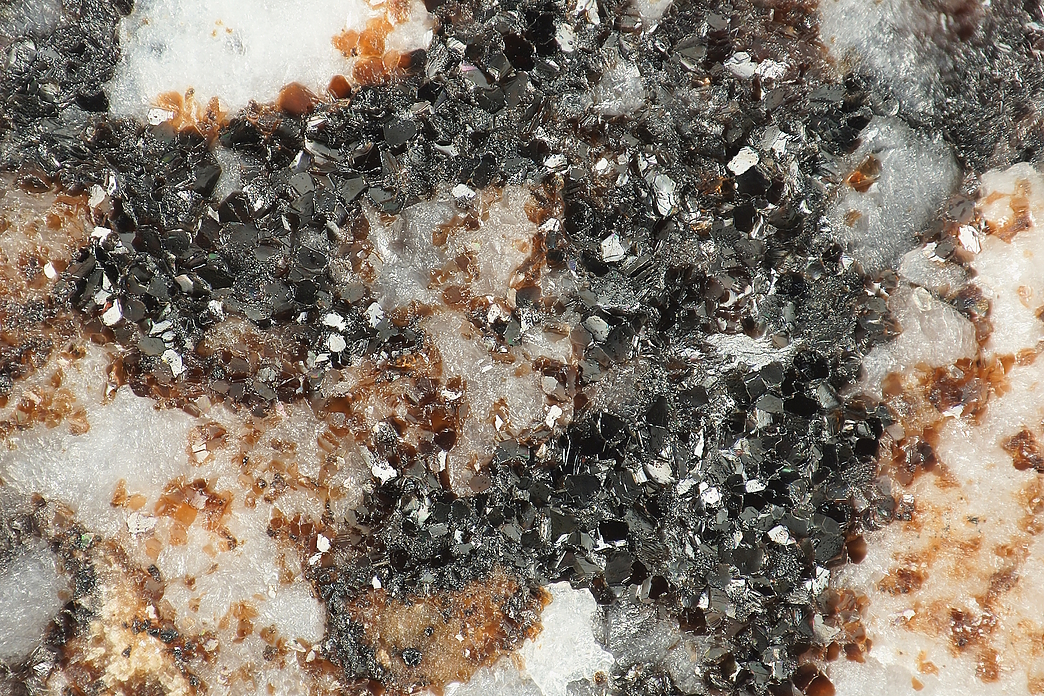
Franklin Mine, Franklin, Sussex County, New Jersey, USA