
Minnesotaite
A valid IMA mineral species - grandfathered
This page is currently not sponsored. Click here to sponsor this page.
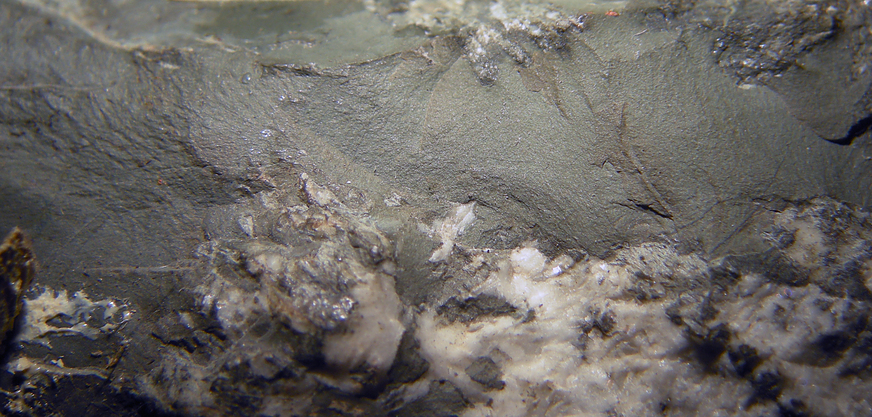
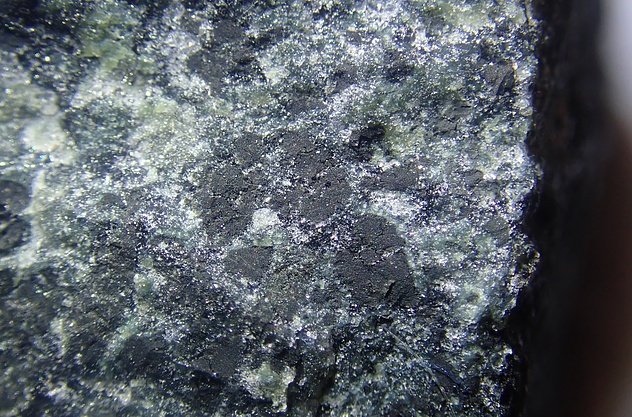

About Minnesotaite
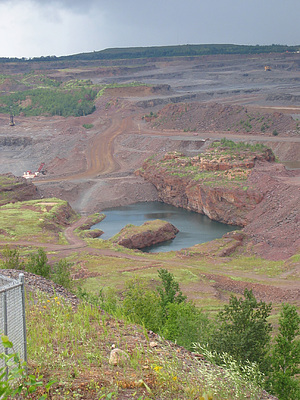
Mahoning-Hull-Rust mine in operation, 2004
Mahoning-Hull-Rust Mine, Hibbing, Saint Louis County, Minnesota, USA
Mahoning-Hull-Rust Mine, Hibbing, Saint Louis County, Minnesota, USA
Formula:
Fe2+3Si4O10(OH)2
Colour:
Greenish-gray to olive green
Lustre:
Resinous, Waxy, Greasy
Hardness:
1½ - 2
Specific Gravity:
3.01
Crystal System:
Triclinic
Member of:
Name:
For its occurrence in the state of Minnesota.
Co-Type Localities:
Isostructural with:
Unique Identifiers
Mindat ID:
2722
Long-form identifier:
mindat:1:1:2722:5
IMA Classification of Minnesotaite
Approved, 'Grandfathered' (first described prior to 1959)
First published:
1944
Classification of Minnesotaite
9.EC.05
9 : SILICATES (Germanates)
E : Phyllosilicates
C : Phyllosilicates with mica sheets, composed of tetrahedral and octahedral nets
9 : SILICATES (Germanates)
E : Phyllosilicates
C : Phyllosilicates with mica sheets, composed of tetrahedral and octahedral nets
71.2.1.5
71 : PHYLLOSILICATES Sheets of Six-Membered Rings
2 : Sheets of 6-membered rings with 2:1 layers
71 : PHYLLOSILICATES Sheets of Six-Membered Rings
2 : Sheets of 6-membered rings with 2:1 layers
14.21.9
14 : Silicates not Containing Aluminum
21 : Silicates of Fe and Mg
14 : Silicates not Containing Aluminum
21 : Silicates of Fe and Mg
Mineral Symbols
As of 2021 there are now IMA–CNMNC approved mineral symbols (abbreviations) for each mineral species, useful for tables and diagrams.
Please only use the official IMA–CNMNC symbol. Older variants are listed for historical use only.
Please only use the official IMA–CNMNC symbol. Older variants are listed for historical use only.
| Symbol | Source | Reference for Standard |
|---|---|---|
| Mns | IMA–CNMNC | Warr, L.N. (2021). IMA–CNMNC approved mineral symbols. Mineralogical Magazine, 85(3), 291-320. doi:10.1180/mgm.2021.43 |
| Mns | Siivolam & Schmid (2007) | Siivolam, J. and Schmid, R. (2007) Recommendations by the IUGS Subcommission on the Systematics of Metamorphic Rocks: List of mineral abbreviations. Web-version 01.02.07. IUGS Commission on the Systematics in Petrology. download |
| Mns | Whitney & Evans (2010) | Whitney, D.L. and Evans, B.W. (2010) Abbreviations for names of rock-forming minerals. American Mineralogist, 95, 185–187 doi:10.2138/am.2010.3371 |
| Mino | The Canadian Mineralogist (2019) | The Canadian Mineralogist (2019) The Canadian Mineralogist list of symbols for rock- and ore-forming minerals (December 30, 2019). download |
| Mns | Warr (2020) | Warr, L.N. (2020) Recommended abbreviations for the names of clay minerals and associated phases. Clay Minerals, 55, 261–264 doi:10.1180/clm.2020.30 |
Pronunciation of Minnesotaite
Pronunciation:
| Play | Recorded by | Country |
|---|---|---|
| Jolyon Ralph | United Kingdom |
Physical Properties of Minnesotaite
Resinous, Waxy, Greasy
Transparency:
Translucent
Comment:
Low luster is common
Colour:
Greenish-gray to olive green
Streak:
White
Hardness:
1½ - 2 on Mohs scale
Tenacity:
Brittle
Cleavage:
Perfect
Micaceous on {001}
Micaceous on {001}
Fracture:
Irregular/Uneven
Comment:
Usually fine-grained
Density:
3.01 g/cm3 (Measured) 2.97 g/cm3 (Calculated)
Optical Data of Minnesotaite
Type:
Biaxial (-)
RI values:
nα = 1.578 - 1.583 nβ = 1.578 - 1.622 nγ = 1.615 - 1.623
2V:
Measured: 4°
Birefringence:
0.037-0.040
Max. Birefringence:
δ = 0.037 - 0.040
Based on recorded range of RI values above.
Based on recorded range of RI values above.
Interference Colours:
The colours simulate birefringence patterns seen in thin section under crossed polars. They do not take into account mineral colouration or opacity.
Michel-Levy Bar The default colours simulate the birefringence range for a 30 µm thin-section thickness. Adjust the slider to simulate a different thickness.
Grain Simulation You can rotate the grain simulation to show how this range might look as you rotated a sample under crossed polars. Each grain retains its interference colour (retardation) while its brightness falls to black at extinction and reaches a maximum between extinction positions.
The colours simulate birefringence patterns seen in thin section under crossed polars. They do not take into account mineral colouration or opacity.
Michel-Levy Bar The default colours simulate the birefringence range for a 30 µm thin-section thickness. Adjust the slider to simulate a different thickness.
Grain Simulation You can rotate the grain simulation to show how this range might look as you rotated a sample under crossed polars. Each grain retains its interference colour (retardation) while its brightness falls to black at extinction and reaches a maximum between extinction positions.
Surface Relief:
Moderate (positive)
Relative to Canada balsam mounting medium (n ≈ 1.537).
Relative to Canada balsam mounting medium (n ≈ 1.537).
This shows the grain boundary and Becke line effect under plane-polarised
light, based on the contrast between this mineral's average refractive
index and the mounting medium. It does not take into account mineral
colouration.
In focus
Interference Figure:
This shows the idealized biaxial acute bisectrix (Bxa) interference figure
- the conoscopic view for a grain cut perpendicular to the acute bisectrix, using
this mineral's 2V. The two small white dots mark the melatopes - the points
where the two optic axes emerge - and are shown only when they fall within the
field of view. The coloured bands are isochromatics, and the dark bands are
isogyres.
Rotate the stage: at 0°/90° the isogyres form a cross through the melatopes; at 45° they pull apart into curved hyperbolas. That splitting on rotation - absent in a uniaxial figure - is the standard diagnostic test for telling biaxial minerals from uniaxial ones. If 2V is large, the melatopes may fall outside the field of view, as they often do at the microscope too.
Rotate the stage: at 0°/90° the isogyres form a cross through the melatopes; at 45° they pull apart into curved hyperbolas. That splitting on rotation - absent in a uniaxial figure - is the standard diagnostic test for telling biaxial minerals from uniaxial ones. If 2V is large, the melatopes may fall outside the field of view, as they often do at the microscope too.
Dispersion:
r < v moderate
Pleochroism:
Visible
Comments:
X= pale green
Z= colorless to pale greenish yellow
Z= colorless to pale greenish yellow
Chemistry of Minnesotaite
Mindat Formula:
Fe2+3Si4O10(OH)2
Element Weights:
Elements listed:
Common Impurities:
Ti,Al,Mn,Ca,Na,K,H2O
Crystallography of Minnesotaite
Crystal System:
Triclinic
Class (H-M):
1 - Pinacoidal
Space Group:
P1
Cell Parameters:
a = 5.623(2) Å, b = 9.419(2) Å, c = 9.624(3) Å
α = 85.21(3)°, β = 95.64(3)°, γ = 90.00°
α = 85.21(3)°, β = 95.64(3)°, γ = 90.00°
Ratio:
a:b:c = 0.597 : 1 : 1.022
Unit Cell V:
505.46 ų (Calculated from Unit Cell)
Z:
2
Morphology:
Usually fine-grained dense masses of microscopic plates or needles
Twinning:
Inferred from single crystal X-ray analysis
X-Ray Powder Diffraction
Powder Diffraction Data:
| d-spacing | Intensity |
|---|---|
| 9.54 Å | (100) |
| 4.78 Å | (20) |
| 3.18 Å | (50) |
| 2.76 Å | (30) |
| 2.66 Å | (40) |
| 2.54 Å | (30) |
| 2.53 Å | (50) |
| 2.21 Å | (20) |
Comments:
2.54 and 2.53 frequently overlap; 41-594
Geological Environment
Paragenetic Mode(s):
| Paragenetic Mode | Earliest Age (Ga) |
|---|---|
| Stage 5: Initiation of plate tectonics | <3.5-2.5 |
| 40 : Regional metamorphism (greenschist, amphibolite, granulite facies) |
Geological Setting:
Low grade metamorphosed banded iron formations; also hydrothermal alteration around sulphide veins.
Type Occurrence of Minnesotaite
Co-Type Localities:
Geological Setting of Type Material:
Banded Iron Formation
Synonyms of Minnesotaite
Other Language Names for Minnesotaite
Relationship of Minnesotaite to other Species
Member of:
Other Members of Pyrophyllite-Talc Group:
| Ferripyrophyllite | Fe3+Si2O5(OH) | Mon. 2/m |
| Pyrophyllite | Al2Si4O10(OH)2 | Tric. 1 |
| Talc | Mg3Si4O10(OH)2 | Tric. 1 : P1 |
| Willemseite | Ni3Si4O10(OH)2 | Mon. |
Common Associates
Related Minerals - Strunz-mindat Grouping
| 9.EC. | Meifuite | KFe6(Si7Al)O19(OH)4Cl2 |
| 9.EC. | Balestraite | KLi2V5+Si4O12 |
| 9.EC.05 | Talc | Mg3Si4O10(OH)2 |
| 9.EC.05 | Willemseite | Ni3Si4O10(OH)2 |
| 9.EC.9.EC. | Voloshinite | Rb(LiAl1.5◻0.5)(Al0.5Si3.5)O10F2 |
| 9.EC.10 | Fluorluanshiweiite | KLiAl1.5(Si3.5Al0.5)O10F2 |
| 9.EC.10 | Garmite | CsLiMg2(Si4O10)F2 |
| 9.EC.10 | Gorbunovite | CsLi2(Ti,Fe)Si4O10(F,OH,O)2 |
| 9.EC.10 | Ferripyrophyllite | Fe3+Si2O5(OH) |
| 9.EC.10 | Manganiceladonite | K(MgMn3+◻)(Si4O10)(OH)2 |
| 9.EC.10 | Luanshiweiite | KLiAl1.5(Si3.5Al0.5)O10(OH)2 |
| 9.EC.10 | Pyrophyllite | Al2Si4O10(OH)2 |
| 9.EC.15 | Paragonite | NaAl2(AlSi3O10)(OH)2 |
| 9.EC.15 | Ferroaluminoceladonite | K(Fe2+Al◻)(Si4O10)(OH)2 |
| 9.EC.15 | Nanpingite | CsAl2(AlSi3O10)(OH,F)2 |
| 9.EC.15 | Ferroceladonite | K(Fe2+Fe3+◻)(Si4O10)(OH)2 |
| 9.EC.15 | Ganterite | Ba0.5(Na,K)0.5Al2(Si2.5Al1.5)O10(OH)2 |
| 9.EC.15 | Kreiterite | CsLi2Fe3+(Si4O10)F2 |
| 9.EC.15 | Roscoelite | KV3+2(AlSi3O10)(OH)2 |
| 9.EC.15 | Aluminoceladonite | K(MgAl◻)(Si4O10)(OH)2 |
| 9.EC.15 | Tobelite | (NH4)Al2(AlSi3O10)(OH)2 |
| 9.EC.15 | Tainiolite | KLiMg2(Si4O10)F2 |
| 9.EC.15 | Celadonite | K(MgFe3+◻)(Si4O10)(OH)2 |
| 9.EC.15 | Chromceladonite | K(MgCr◻)(Si4O10)(OH)2 |
| 9.EC.15 | Montdorite | KFe2+1.5Mn2+0.5Mg0.5Si4O10(F,OH)2 |
| 9.EC.15 | Chromphyllite | KCr2(AlSi3O10)(OH)2 |
| 9.EC.15 | Boromuscovite | KAl2(BSi3O10)(OH)2 |
| 9.EC.15 | 'UM1988-22-SiO:AlCaFFeHKLiMg' | KLiMgAl2Si3O10F2 |
| 9.EC.15 | Chernykhite | (Ba,Na)(V3+,Al,Mg)2((Si,Al)4O10)(OH)2 |
| 9.EC.15 | Muscovite | KAl2(AlSi3O10)(OH)2 |
| 9.EC.20 | Masutomilite | K(LiAlMn2+)[AlSi3O10]F2 |
| 9.EC.20 | Oxyphlogopite | K(Mg,Ti,Fe)3[(Si,Al)4O10](O,F)2 |
| 9.EC.20 | 'Chloroferrokinoshitalite' | (Ba,K)(Fe2+,Mg)3(Al2Si2O10)(Cl,OH,F)2 |
| 9.EC.20 | Siderophyllite | KFe2+2Al(Al2Si2O10)(OH)2 |
| 9.EC.20 | Sokolovaite | CsLi2Al(Si4O10)F2 |
| 9.EC.20 | Hendricksite | KZn3(Si3Al)O10(OH)2 |
| 9.EC.20 | Tetraferriphlogopite | KMg3(Si3Fe3+)O10(OH)2 |
| 9.EC.20 | Fluorannite | KFe2+3(Si3Al)O10F2 |
| 9.EC.20 | Aspidolite | NaMg3(AlSi3O10)(OH)2 |
| 9.EC.20 | Suhailite | (NH4)Fe2+3(AlSi3O10)(OH)2 |
| 9.EC.20 | Ephesite | NaLiAl2(Al2Si2O10)(OH)2 |
| 9.EC.20 | Norrishite | KLiMn3+2(Si4O10)O2 |
| 9.EC.20 | Phlogopite | KMg3(AlSi3O10)(OH)2 |
| 9.EC.20 | Yangzhumingite | KMg2.5(Si4O10)F2 |
| 9.EC.20 | Orlovite | KLi2Ti(Si4O10)OF |
| 9.EC.20 | Tetraferriannite | KFe2+3(Si3Fe3+)O10(OH)2 |
| 9.EC.20 | Shirokshinite | K(NaMg2)(Si4O10)F2 |
| 9.EC.20 | Trilithionite | K(Li1.5Al1.5)(AlSi3O10)(F,OH)2 |
| 9.EC.20 | Polylithionite | KLi2Al(Si4O10)(F,OH)2 |
| 9.EC.20 | Shirozulite | KMn2+3(Si3Al)O10(OH)2 |
| 9.EC.20 | Preiswerkite | NaMg2Al(Al2Si2O10)(OH)2 |
| 9.EC.20 | Fluorophlogopite | KMg3(Si3Al)O10F2 |
| 9.EC.20 | Wonesite | (Na,K,◻)(Mg,Fe,Al)6(Si,Al)8O20(OH,F)4 |
| 9.EC.20 | 'UM2004-49-SiO:AlCsFHKLi' | (Cs,K)(Al,Li)2.6((Si,Al)4O10)(F,OH)2 |
| 9.EC.20 | Fluorotetraferriphlogopite | KMg3(Fe3+Si3O10)F2 |
| 9.EC.20 | Annite | KFe2+3(AlSi3O10)(OH)2 |
| 9.EC.20 | Eastonite | KMg2Al(Al2Si2O10)(OH)2 |
| 9.EC.22 | 'Pimelite' | Ni3Si4O10(OH)2 · 4H2O |
| 9.EC.30 | Margarite | CaAl2(Al2Si2O10)(OH)2 |
| 9.EC.35 | Kinoshitalite | (Ba,K)(Mg,Mn2+,Al)3(Al2Si2O10)(OH)2 |
| 9.EC.35 | Ferrokinoshitalite | (Ba,K)(Fe2+,Mg)3(Al2Si2O10)(OH,F)2 |
| 9.EC.35 | Clintonite | CaAlMg2(SiAl3O10)(OH)2 |
| 9.EC.35 | Oxykinoshitalite | (Ba,K)(Mg,Ti,Fe3+,Fe2+)3((Si,Al)4O10)(O,OH,F)2 |
| 9.EC.35 | Fluorokinoshitalite | BaMg3(Al2Si2O10)F2 |
| 9.EC.35 | Bityite | CaLiAl2(AlBeSi2O10)(OH)2 |
| 9.EC.35 | Anandite | (Ba,K)(Fe2+,Mg)3((Si,Al,Fe)4O10)(S,OH)2 |
| 9.EC.40 | Montmorillonite | (Na,Ca)0.33(Al,Mg)2(Si4O10)(OH)2 · nH2O |
| 9.EC.40 | Beidellite | (Na,Ca0.5)0.3Al2((Si,Al)4O10)(OH)2 · nH2O |
| 9.EC.40 | Volkonskoite | Ca0.3(Cr,Mg,Fe)2((Si,Al)4O10)(OH)2 · 4H2O |
| 9.EC.40 | Nontronite | Na0.3Fe2((Si,Al)4O10)(OH)2 · nH2O |
| 9.EC.40 | Kurumsakite | (Zn,Ni,Cu)8Al8V5+2Si5O35 · 27H2O (?) |
| 9.EC.40 | Yakhontovite | (Ca,Na)0.5(Cu,Fe,Mg)2(Si4O10)(OH)2 · 3H2O |
| 9.EC.45 | Swinefordite | Li(Al,Li,Mg)3((Si,Al)4O10)2(OH,F)4 · nH2O |
| 9.EC.45 | Hectorite | Na0.3(Mg,Li)3(Si4O10)(F,OH)2 |
| 9.EC.45 | Zincsilite | Zn3Si4O10(OH)2 · 4H2O (?) |
| 9.EC.45 | Hanjiangite | Ba2CaV3+Al(H2AlSi3O12)(CO3)2F |
| 9.EC.45 | Spadaite | MgSiO2(OH)2 · H2O (?) |
| 9.EC.45 | Ferrosaponite | Ca0.3(Fe2+,Mg,Fe3+)3((Si,Al)4O10)(OH)2 · 4H2O |
| 9.EC.45 | Stevensite | (Ca,Na)xMg3-x(Si4O10)(OH)2 |
| 9.EC.45 | Saponite | Ca0.25(Mg,Fe)3((Si,Al)4O10)(OH)2 · nH2O |
| 9.EC.45 | Sauconite | Na0.3Zn3((Si,Al)4O10)(OH)2 · 4H2O |
| 9.EC.50 | Vermiculite | Mg0.7(Mg,Fe,Al)6(Si,Al)8O20(OH)4 · 8H2O |
| 9.EC.52 | 'Tarasovite' | near NaKAl11Si13O40(OH)9 · 3H2O |
| 9.EC.55 | Clinochlore | Mg5Al(AlSi3O10)(OH)8 |
| 9.EC.55 | Borocookeite | (LiAl4◻)[BSi3O10](OH)8 |
| 9.EC.55 | Franklinfurnaceite | Ca2Fe3+Mn2+3Mn3+(Zn2Si2O10)(OH)8 |
| 9.EC.55 | Pennantite | Mn2+5Al(AlSi3O10)(OH)8 |
| 9.EC.55 | Vakhrushevaite | Mg5Cr(AlSi3O10)(OH)8 |
| 9.EC.55 | Nimite | Ni5Al(AlSi3O10)(OH)8 |
| 9.EC.55 | Cookeite | (LiAl4◻)[AlSi3O10](OH)8 |
| 9.EC.55 | Gonyerite | Mn2+5Fe3+(Fe3+Si3O10)(OH)8 |
| 9.EC.55 | Chamosite | Fe2+5Al(AlSi3O10)(OH)8 |
| 9.EC.55 | 'Orthochamosite' | (Fe2+,Mg,Fe3+)5Al(AlSi3O10)(OH,O)8 |
| 9.EC.55 | Baileychlore | Zn5Al(AlSi3O10)(OH)8 |
| 9.EC.55 | Sudoite | Mg2Al3(AlSi3O10)(OH)8 |
| 9.EC.55 | Glagolevite | Na(Mg,Al)6(AlSi3O10)(OH,O)8 |
| 9.EC.55 | Donbassite | Al4.33(AlSi3O10)(OH)8 |
| 9.EC.60 | Dozyite | Mg7Al2(Al2Si4O15)(OH)12 |
| 9.EC.60 | Rectorite | (Na,Ca)Al4((Si,Al)8O20)(OH)4 · 2H2O |
| 9.EC.60 | Corrensite | (Mg,Fe)9((Si,Al)8O20)(OH)10 · nH2O |
| 9.EC.60 | Aliettite | Ca0.2Mg6((Si,Al)8O20)(OH)4 · 4H2O |
| 9.EC.60 | Karpinskite | (Ni,Mg)2Si2O5(OH)2 (?) |
| 9.EC.60 | Lunijianlaite | Li0.7Al6.2(AlSi7O20)(OH,O)10 |
| 9.EC.60 | Tosudite | Na0.5(Al,Mg)6((Si,Al)8O18)(OH)12 · 5H2O |
| 9.EC.60 | Hydrobiotite | K(Mg,Fe2+)6((Si,Al)8O20)(OH)4 · nH2O |
| 9.EC.60 | Saliotite | (Li,Na)Al3(AlSi3O10)(OH)5 |
| 9.EC.60 | Kulkeite | Mg8Al(AlSi7O20)(OH)10 |
| 9.EC.60 | Brinrobertsite | Na0.3Al4(Si4O10)2(OH)4 · 3.5 H2O |
| 9.EC.65 | Macaulayite | (Fe,Al)24Si4O43(OH)2 |
| 9.EC.70 | Burckhardtite | Pb2(Fe3+Te6+)[AlSi3O8]O6 |
| 9.EC.75 | Niksergievite | (Ba,Ca)2Al3(AlSi3O10)(CO3)(OH)6 · nH2O |
| 9.EC.75 | Ferrisurite | (Pb,Ca)2.4Fe3+2(Si4O10)(CO3)1.7(OH)3 · nH2O |
| 9.EC.75 | Surite | (Pb,Ca)3(Al,Fe2+,Mg)2((Si,Al)4O10)(CO3)2(OH)2 |
| 9.EC.80 | Kegelite | Pb8Al4(Si8O20)(SO4)2(CO3)4(OH)8 |
Fluorescence of Minnesotaite
Not fluorescent
Other Information
Health Risks:
No information on health risks for this material has been entered into the database. You should always treat mineral specimens with care.
Internet Links for Minnesotaite
mindat.org URL:
https://www.mindat.org/min-2722.html
Please feel free to link to this page.
Please feel free to link to this page.
Search Engines:
External Links:
Mineral Dealers:
References for Minnesotaite
Reference List:
Gruner, John W. (1944) The composition and structure of minnesotaite, a common iron silicate in iron formations. American Mineralogist, 29 (9-10) 363-372
Baker, J. H. (1985) Greenalite, Mg-rich minnesotaite and stilpnomelane from the Ösjöberg and Sirsjöberg iron-ore mines, Hjulsjö, W. Bergslagen, Sweden. Mineralogical Magazine, 49 (353) 611-613 doi:10.1180/minmag.1985.049.353.18
Mackenzie, K.J.D., Berezowski, R.M., Bowden, M.E. (1986) Thermal and Mössbauer studies of iron-containing hydrous silicates. VI. Minnesotaite. Thermochimica Acta, 99. 273-289 doi:10.1016/0040-6031(86)85290-x
Papike, J. J. (1988) Chemistry of the rock‐forming silicates: Multiple‐chain, sheet, and framework structures. Reviews of Geophysics, 26 (3). 407-444 doi:10.1029/rg026i003p00407
Localities for Minnesotaite
Showing 79 localities.
 symbol to view information about a locality.
The
symbol to view information about a locality.
The Locality List
 - This locality has map coordinates listed.
- This locality has estimated coordinates.
ⓘ - Click for references and further information on this occurrence.
? - Indicates mineral may be doubtful at this locality.
- This locality has map coordinates listed.
- This locality has estimated coordinates.
ⓘ - Click for references and further information on this occurrence.
? - Indicates mineral may be doubtful at this locality.
 - Good crystals or important locality for species.
 - World class for species or very significant.
(TL) - Type Locality for a valid mineral species.
(FRL) - First Recorded Locality for everything else (eg varieties).
- World class for species or very significant.
(TL) - Type Locality for a valid mineral species.
(FRL) - First Recorded Locality for everything else (eg varieties).
All localities listed without proper references should be considered as questionable.
Australia | |
| Skirrow (1993) |
| www.earth2006.org.au (n.d.) |
| Rio Tinto Group |
| Grubb (1971) |
| Gole (1980) |
| Angerer et al. (2022) |
| Lascelles (2006) |
| Lascelles (2006) |
Belarus | |
| Levitskiy et al. (2018, July) |
Brazil | |
| Huang et al. (2022) |
| Grainger et al. (2008) | |
Canada | |
| Handbook of Mineralogy. +2 other references |
| Klein et al. (1976) |
| Fyon (1986) |
| Galley et al. (1995) +1 other reference |
| Guggenheim et al. (1986) |
| Lesher (1978) +1 other reference | |
| Guggenheim et al. (1986) | |
| Klein et al. (1976) | |
China | |
| Feng et al. (1986) |
| Hui et al. (2025) |
| Jinchu Zhu and Fusheng Zhang (1987) |
| Hongbing Hao and Wei Zhang (2001) |
| Fan et al. (2025) |
Czech Republic | |
| Fuksová (2010) |
Finland | |
| Paakkola |
Ghana | |
| Addae et al. (2026) |
India | |
| Sakthi Saravanan et al. (2009) |
| Mohapatra et al. (2003) |
Ireland | |
| Schultz (1966) +2 other references |
Italy | |
| Nisio et al. (1987) |
| Stara et al. (1999) |
Romania | |
| Hîrtopanu et al. (2003) +1 other reference | |
| minerals-of-the-carpathians.eu (2008) |
| Hîrtopanu (1997) +1 other reference |
Russia | |
| Kazachenko et al. (2013) |
South Africa | |
| Harmony Gold |
| Cairncross et al. (1995) |
Spain | |
| Gaines et al. (1997) |
Sweden | |
| Baker (1985) |
Tanzania | |
| AngloGold Ashanti Limited |
UK | |
| Handbook of Mineralogy. +2 other references |
Ukraine | |
| Sharygin et al. (2014) |
USA | |
| Rocks & Min.: 63:108. |
| Bozhilov et al. (2001) |
| Heinrich et al. (2004) |
| Heinrich et al. (2004) | |
| Heinrich et al. (2004) | |
| Rocks & Minerals: 61:328. +1 other reference |
| - (2005) |
| Morris (1983) |
| Ransom (1974) |
| Blake (1965) +1 other reference |
| USGS Prof Paper 407 | |
| Blake (1965) +1 other reference |
| Morey et al. (1993) | |
| - (2005) |
| - (2005) | |
| Guggenheim et al. (1983) |
| - (2005) |
| Am Min 29:363-372 |
| Guggenheim et al. (1986) |
| 55TH INSTITUTE ON LAKE SUPERIOR GEOLOGY (2009) | |
| - (2005) | |
| - (2005) | |
| Erik Vercammen collection | |
| ArcelorMittal | |
| 55TH INSTITUTE ON LAKE SUPERIOR GEOLOGY (2009) | |
| ArcelorMittal | |
| - (2005) | |
| - (2005) | |
| - (2005) | |
| - (2005) | |
| - (2005) | |
| - (2005) | |
| NMBMMR Memoir 38 Geology and Technology ... |
| Adamera Minerals |
| Cordua (1998) |
| Cordua (1998) |
Quick NavTopAbout MinnesotaiteUnique IdentifiersIMA Classification Classification Mineral SymbolsPronunciation Physical Properties Optical Data Chemistry Crystallography X-Ray Powder DiffractionGeological EnvironmentType Occurrence SynonymsOther LanguagesRelationshipsCommon AssociatesStrunz-MindatFluorescence Other InformationInternet Links References Localities Locality List

Bluebell Mine, Riondel, Slocan Mining Division, British Columbia, Canada