
Rectorite
A valid IMA mineral species - grandfathered
This page is currently not sponsored. Click here to sponsor this page.


About Rectorite

Elias W. Rector
Formula:
(Na,Ca)Al4((Si,Al)8O20)(OH)4 · 2H2O
Colour:
White to light brown
Lustre:
Waxy, Greasy, Pearly, Earthy
Hardness:
0½ - 1
Specific Gravity:
2.34 (Calculated)
Crystal System:
Monoclinic
Member of:
Name:
Named in 1891 by Richard Newman Brackett and John Francis Williams in honor of Colonel Elias William Rector (11 June 1847(49), Little Rock, Arkansas, USA - 29 January 1917, Hot Spring, Arkansas, USA), a politician (Speaker of the Arkansas House of Representatives) and attorney in Hot Springs, Arkansas, who supported the formation of the Arkansas Geological Survey.
A 1:1 regular interstratification of muscovite/illite (dioctahedral mica) and montmorillonite (dioctahedral smectite). Frequently called "rectorite-K" to distinguish it from regularly interstratified paragonite/montmorillonite = "rectorite-Na".
Unique Identifiers
Mindat ID:
3377
Long-form identifier:
mindat:1:1:3377:6
Similar Names
| Hectorite | A valid IMA mineral species - grandfathered - questionable | Na0.3(Mg,Li)3(Si4O10)(F,OH)2 |
| Hectorite (of Cox) | (Mg,Fe)2Si3O8 · 0.5H2O | |
| Rectorite-K | A variety of Rectorite | (Na,Ca)Al4((Si,Al)8O20)(OH)4 · 2H2O |
IMA Classification of Rectorite
Approved, 'Grandfathered' (first described prior to 1959)
IMA Formula:
(Na,Ca)Al4(Si,Al)8O20(OH)4·2H2O
First published:
1891
Classification of Rectorite
9.EC.60
9 : SILICATES (Germanates)
E : Phyllosilicates
C : Phyllosilicates with mica sheets, composed of tetrahedral and octahedral nets
9 : SILICATES (Germanates)
E : Phyllosilicates
C : Phyllosilicates with mica sheets, composed of tetrahedral and octahedral nets
71.4.2.7
71 : PHYLLOSILICATES Sheets of Six-Membered Rings
4 : Sheets of 6-membered rings interlayered 1:1, 2:1, and octahedra
71 : PHYLLOSILICATES Sheets of Six-Membered Rings
4 : Sheets of 6-membered rings interlayered 1:1, 2:1, and octahedra
16.2.9
16 : Silicates Containing Aluminum and other Metals
2 : Aluminosilicates of Na
16 : Silicates Containing Aluminum and other Metals
2 : Aluminosilicates of Na
Mineral Symbols
As of 2021 there are now IMA–CNMNC approved mineral symbols (abbreviations) for each mineral species, useful for tables and diagrams.
| Symbol | Source | Reference for Standard |
|---|---|---|
| Rec | IMA–CNMNC | Warr, L.N. (2021). IMA–CNMNC approved mineral symbols. Mineralogical Magazine, 85(3), 291-320. doi:10.1180/mgm.2021.43 |
Physical Properties of Rectorite
Waxy, Greasy, Pearly, Earthy
Transparency:
Translucent
Colour:
White to light brown
Hardness:
0½ - 1 on Mohs scale
Tenacity:
Flexible
Cleavage:
Perfect
On {001}
On {001}
Density:
2.34 g/cm3 (Calculated)
Optical Data of Rectorite
Type:
Biaxial (-)
RI values:
nα = 1.519 nβ = 1.55 nγ = 1.559
2V:
Measured: 5° to 20°, Calculated: 54°
Max. Birefringence:
δ = 0.040
Based on recorded range of RI values above.
Based on recorded range of RI values above.
Interference Colours:
The colours simulate birefringence patterns seen in thin section under crossed polars. They do not take into account mineral colouration or opacity.
Michel-Levy Bar The default colours simulate the birefringence range for a 30 µm thin-section thickness. Adjust the slider to simulate a different thickness.
Grain Simulation You can rotate the grain simulation to show how this range might look as you rotated a sample under crossed polars. Each grain retains its interference colour (retardation) while its brightness falls to black at extinction and reaches a maximum between extinction positions.
The colours simulate birefringence patterns seen in thin section under crossed polars. They do not take into account mineral colouration or opacity.
Michel-Levy Bar The default colours simulate the birefringence range for a 30 µm thin-section thickness. Adjust the slider to simulate a different thickness.
Grain Simulation You can rotate the grain simulation to show how this range might look as you rotated a sample under crossed polars. Each grain retains its interference colour (retardation) while its brightness falls to black at extinction and reaches a maximum between extinction positions.
Surface Relief:
Moderate
Dispersion:
r > v
Chemistry of Rectorite
Mindat Formula:
(Na,Ca)Al4((Si,Al)8O20)(OH)4 · 2H2O
Element Weights:
Common Impurities:
Fe,K
Crystallography of Rectorite
Crystal System:
Monoclinic
Cell Parameters:
a = 5.13 Å, b = 8.88 Å, c = 23.85 Å
β = 96.3°
β = 96.3°
Ratio:
a:b:c = 0.578 : 1 : 2.686
Unit Cell V:
1,079.91 ų (Calculated from Unit Cell)
Z:
2
Comment:
Point Group: n.d.; Space Group: n.d.
X-Ray Powder Diffraction
Powder Diffraction Data:
| d-spacing | Intensity |
|---|---|
| 23.8 Å | (100) |
| 11.9 Å | (65) |
| 3.40 Å | (16) |
| 2.971 Å | (16) |
| 1.970 Å | (12) |
| 4.75 Å | (10) |
| 1.827 Å | (4) |
Comments:
air dried sample; after heating to 600ºC, d(001) = 19.3 Å; after ethylene glycol treatment d(001) = 26.8 Å
Geological Environment
Paragenetic Mode(s):
| Paragenetic Mode | Earliest Age (Ga) |
|---|---|
| Stage 3b: Earth’s earliest hydrosphere | >4.45 |
| 16 : Low-? aqueous alteration of Hadean subaerial lithologies (see also #23) | |
| Near-surface Processes | |
| 22 : Hydration and low-? subsurface aqueous alteration (see also #23) | |
| Stage 7: Great Oxidation Event | <2.4 |
| 47a : [Near-surface hydration of prior minerals] |
Type Occurrence of Rectorite
Place of Conservation of Type Material:
National Museum of Natural History, Washington, D.C., USA, 80607.
Other Language Names for Rectorite
Varieties of Rectorite
| Rectorite-K | A 1:1 regular interstratification of muscovite/illite (dioctahedral mica) and montmorillonite (dioctahedral smectite) is frequently called "rectorite-K" to distinguish it from regularly interstratified paragonite/montmorillonite = "rectorite-Na". |
| Rectorite-Na | A regularly interstratified paragonite/montmorillonite. Compare Rectorite-K. |
Relationship of Rectorite to other Species
Member of:
Other Members of Mixed-layer clay minerals:
| Aliettite | Ca0.2Mg6((Si,Al)8O20)(OH)4 · 4H2O | Mon. |
| Corrensite | (Mg,Fe)9((Si,Al)8O20)(OH)10 · nH2O | Orth. |
| 'Glaucony' | The term glaucony was defined first by Odin and Létolle (1980) for green minerals in marine sediments formed by ... | |
| Tosudite | Na0.5(Al,Mg)6((Si,Al)8O18)(OH)12 · 5H2O | Mon. 2 : B2 |
Common Associates
Related Minerals - Strunz-mindat Grouping
| 9.EC. | Meifuite | KFe6(Si7Al)O19(OH)4Cl2 |
| 9.EC. | Balestraite | KLi2V5+Si4O12 |
| 9.EC.05 | Talc | Mg3Si4O10(OH)2 |
| 9.EC.05 | Minnesotaite | Fe2+3Si4O10(OH)2 |
| 9.EC.05 | Willemseite | Ni3Si4O10(OH)2 |
| 9.EC.9.EC. | Voloshinite | Rb(LiAl1.5◻0.5)(Al0.5Si3.5)O10F2 |
| 9.EC.10 | Fluorluanshiweiite | KLiAl1.5(Si3.5Al0.5)O10F2 |
| 9.EC.10 | Garmite | CsLiMg2(Si4O10)F2 |
| 9.EC.10 | Gorbunovite | CsLi2(Ti,Fe)Si4O10(F,OH,O)2 |
| 9.EC.10 | Ferripyrophyllite | Fe3+Si2O5(OH) |
| 9.EC.10 | Manganiceladonite | K(MgMn3+◻)(Si4O10)(OH)2 |
| 9.EC.10 | Luanshiweiite | KLiAl1.5(Si3.5Al0.5)O10(OH)2 |
| 9.EC.10 | Pyrophyllite | Al2Si4O10(OH)2 |
| 9.EC.15 | Paragonite | NaAl2(AlSi3O10)(OH)2 |
| 9.EC.15 | Ferroaluminoceladonite | K(Fe2+Al◻)(Si4O10)(OH)2 |
| 9.EC.15 | Nanpingite | CsAl2(AlSi3O10)(OH,F)2 |
| 9.EC.15 | Ferroceladonite | K(Fe2+Fe3+◻)(Si4O10)(OH)2 |
| 9.EC.15 | Ganterite | Ba0.5(Na,K)0.5Al2(Si2.5Al1.5)O10(OH)2 |
| 9.EC.15 | Kreiterite | CsLi2Fe3+(Si4O10)F2 |
| 9.EC.15 | Roscoelite | KV3+2(AlSi3O10)(OH)2 |
| 9.EC.15 | Aluminoceladonite | K(MgAl◻)(Si4O10)(OH)2 |
| 9.EC.15 | Tobelite | (NH4)Al2(AlSi3O10)(OH)2 |
| 9.EC.15 | Tainiolite | KLiMg2(Si4O10)F2 |
| 9.EC.15 | Celadonite | K(MgFe3+◻)(Si4O10)(OH)2 |
| 9.EC.15 | Chromceladonite | K(MgCr◻)(Si4O10)(OH)2 |
| 9.EC.15 | Montdorite | KFe2+1.5Mn2+0.5Mg0.5Si4O10(F,OH)2 |
| 9.EC.15 | Chromphyllite | KCr2(AlSi3O10)(OH)2 |
| 9.EC.15 | Boromuscovite | KAl2(BSi3O10)(OH)2 |
| 9.EC.15 | 'UM1988-22-SiO:AlCaFFeHKLiMg' | KLiMgAl2Si3O10F2 |
| 9.EC.15 | Chernykhite | (Ba,Na)(V3+,Al,Mg)2((Si,Al)4O10)(OH)2 |
| 9.EC.15 | Muscovite | KAl2(AlSi3O10)(OH)2 |
| 9.EC.20 | Masutomilite | K(LiAlMn2+)[AlSi3O10]F2 |
| 9.EC.20 | Oxyphlogopite | K(Mg,Ti,Fe)3[(Si,Al)4O10](O,F)2 |
| 9.EC.20 | 'Chloroferrokinoshitalite' | (Ba,K)(Fe2+,Mg)3(Al2Si2O10)(Cl,OH,F)2 |
| 9.EC.20 | Siderophyllite | KFe2+2Al(Al2Si2O10)(OH)2 |
| 9.EC.20 | Sokolovaite | CsLi2Al(Si4O10)F2 |
| 9.EC.20 | Hendricksite | KZn3(Si3Al)O10(OH)2 |
| 9.EC.20 | Tetraferriphlogopite | KMg3(Si3Fe3+)O10(OH)2 |
| 9.EC.20 | Fluorannite | KFe2+3(Si3Al)O10F2 |
| 9.EC.20 | Aspidolite | NaMg3(AlSi3O10)(OH)2 |
| 9.EC.20 | Suhailite | (NH4)Fe2+3(AlSi3O10)(OH)2 |
| 9.EC.20 | Ephesite | NaLiAl2(Al2Si2O10)(OH)2 |
| 9.EC.20 | Norrishite | KLiMn3+2(Si4O10)O2 |
| 9.EC.20 | Phlogopite | KMg3(AlSi3O10)(OH)2 |
| 9.EC.20 | Yangzhumingite | KMg2.5(Si4O10)F2 |
| 9.EC.20 | Orlovite | KLi2Ti(Si4O10)OF |
| 9.EC.20 | Tetraferriannite | KFe2+3(Si3Fe3+)O10(OH)2 |
| 9.EC.20 | Shirokshinite | K(NaMg2)(Si4O10)F2 |
| 9.EC.20 | Trilithionite | K(Li1.5Al1.5)(AlSi3O10)(F,OH)2 |
| 9.EC.20 | Polylithionite | KLi2Al(Si4O10)(F,OH)2 |
| 9.EC.20 | Shirozulite | KMn2+3(Si3Al)O10(OH)2 |
| 9.EC.20 | Preiswerkite | NaMg2Al(Al2Si2O10)(OH)2 |
| 9.EC.20 | Fluorophlogopite | KMg3(Si3Al)O10F2 |
| 9.EC.20 | Wonesite | (Na,K,◻)(Mg,Fe,Al)6(Si,Al)8O20(OH,F)4 |
| 9.EC.20 | 'UM2004-49-SiO:AlCsFHKLi' | (Cs,K)(Al,Li)2.6((Si,Al)4O10)(F,OH)2 |
| 9.EC.20 | Fluorotetraferriphlogopite | KMg3(Fe3+Si3O10)F2 |
| 9.EC.20 | Annite | KFe2+3(AlSi3O10)(OH)2 |
| 9.EC.20 | Eastonite | KMg2Al(Al2Si2O10)(OH)2 |
| 9.EC.22 | 'Pimelite' | Ni3Si4O10(OH)2 · 4H2O |
| 9.EC.30 | Margarite | CaAl2(Al2Si2O10)(OH)2 |
| 9.EC.35 | Kinoshitalite | (Ba,K)(Mg,Mn2+,Al)3(Al2Si2O10)(OH)2 |
| 9.EC.35 | Ferrokinoshitalite | (Ba,K)(Fe2+,Mg)3(Al2Si2O10)(OH,F)2 |
| 9.EC.35 | Clintonite | CaAlMg2(SiAl3O10)(OH)2 |
| 9.EC.35 | Oxykinoshitalite | (Ba,K)(Mg,Ti,Fe3+,Fe2+)3((Si,Al)4O10)(O,OH,F)2 |
| 9.EC.35 | Fluorokinoshitalite | BaMg3(Al2Si2O10)F2 |
| 9.EC.35 | Bityite | CaLiAl2(AlBeSi2O10)(OH)2 |
| 9.EC.35 | Anandite | (Ba,K)(Fe2+,Mg)3((Si,Al,Fe)4O10)(S,OH)2 |
| 9.EC.40 | Montmorillonite | (Na,Ca)0.33(Al,Mg)2(Si4O10)(OH)2 · nH2O |
| 9.EC.40 | Beidellite | (Na,Ca0.5)0.3Al2((Si,Al)4O10)(OH)2 · nH2O |
| 9.EC.40 | Volkonskoite | Ca0.3(Cr,Mg,Fe)2((Si,Al)4O10)(OH)2 · 4H2O |
| 9.EC.40 | Nontronite | Na0.3Fe2((Si,Al)4O10)(OH)2 · nH2O |
| 9.EC.40 | Kurumsakite | (Zn,Ni,Cu)8Al8V5+2Si5O35 · 27H2O (?) |
| 9.EC.40 | Yakhontovite | (Ca,Na)0.5(Cu,Fe,Mg)2(Si4O10)(OH)2 · 3H2O |
| 9.EC.45 | Swinefordite | Li(Al,Li,Mg)3((Si,Al)4O10)2(OH,F)4 · nH2O |
| 9.EC.45 | Hectorite | Na0.3(Mg,Li)3(Si4O10)(F,OH)2 |
| 9.EC.45 | Zincsilite | Zn3Si4O10(OH)2 · 4H2O (?) |
| 9.EC.45 | Hanjiangite | Ba2CaV3+Al(H2AlSi3O12)(CO3)2F |
| 9.EC.45 | Spadaite | MgSiO2(OH)2 · H2O (?) |
| 9.EC.45 | Ferrosaponite | Ca0.3(Fe2+,Mg,Fe3+)3((Si,Al)4O10)(OH)2 · 4H2O |
| 9.EC.45 | Stevensite | (Ca,Na)xMg3-x(Si4O10)(OH)2 |
| 9.EC.45 | Saponite | Ca0.25(Mg,Fe)3((Si,Al)4O10)(OH)2 · nH2O |
| 9.EC.45 | Sauconite | Na0.3Zn3((Si,Al)4O10)(OH)2 · 4H2O |
| 9.EC.50 | Vermiculite | Mg0.7(Mg,Fe,Al)6(Si,Al)8O20(OH)4 · 8H2O |
| 9.EC.52 | 'Tarasovite' | near NaKAl11Si13O40(OH)9 · 3H2O |
| 9.EC.55 | Clinochlore | Mg5Al(AlSi3O10)(OH)8 |
| 9.EC.55 | Borocookeite | (LiAl4◻)[BSi3O10](OH)8 |
| 9.EC.55 | Franklinfurnaceite | Ca2Fe3+Mn2+3Mn3+(Zn2Si2O10)(OH)8 |
| 9.EC.55 | Pennantite | Mn2+5Al(AlSi3O10)(OH)8 |
| 9.EC.55 | Vakhrushevaite | Mg5Cr(AlSi3O10)(OH)8 |
| 9.EC.55 | Nimite | Ni5Al(AlSi3O10)(OH)8 |
| 9.EC.55 | Cookeite | (LiAl4◻)[AlSi3O10](OH)8 |
| 9.EC.55 | Gonyerite | Mn2+5Fe3+(Fe3+Si3O10)(OH)8 |
| 9.EC.55 | Chamosite | Fe2+5Al(AlSi3O10)(OH)8 |
| 9.EC.55 | 'Orthochamosite' | (Fe2+,Mg,Fe3+)5Al(AlSi3O10)(OH,O)8 |
| 9.EC.55 | Baileychlore | Zn5Al(AlSi3O10)(OH)8 |
| 9.EC.55 | Sudoite | Mg2Al3(AlSi3O10)(OH)8 |
| 9.EC.55 | Glagolevite | Na(Mg,Al)6(AlSi3O10)(OH,O)8 |
| 9.EC.55 | Donbassite | Al4.33(AlSi3O10)(OH)8 |
| 9.EC.60 | Dozyite | Mg7Al2(Al2Si4O15)(OH)12 |
| 9.EC.60 | Corrensite | (Mg,Fe)9((Si,Al)8O20)(OH)10 · nH2O |
| 9.EC.60 | Aliettite | Ca0.2Mg6((Si,Al)8O20)(OH)4 · 4H2O |
| 9.EC.60 | Karpinskite | (Ni,Mg)2Si2O5(OH)2 (?) |
| 9.EC.60 | Lunijianlaite | Li0.7Al6.2(AlSi7O20)(OH,O)10 |
| 9.EC.60 | Tosudite | Na0.5(Al,Mg)6((Si,Al)8O18)(OH)12 · 5H2O |
| 9.EC.60 | Hydrobiotite | K(Mg,Fe2+)6((Si,Al)8O20)(OH)4 · nH2O |
| 9.EC.60 | Saliotite | (Li,Na)Al3(AlSi3O10)(OH)5 |
| 9.EC.60 | Kulkeite | Mg8Al(AlSi7O20)(OH)10 |
| 9.EC.60 | Brinrobertsite | Na0.3Al4(Si4O10)2(OH)4 · 3.5 H2O |
| 9.EC.65 | Macaulayite | (Fe,Al)24Si4O43(OH)2 |
| 9.EC.70 | Burckhardtite | Pb2(Fe3+Te6+)[AlSi3O8]O6 |
| 9.EC.75 | Niksergievite | (Ba,Ca)2Al3(AlSi3O10)(CO3)(OH)6 · nH2O |
| 9.EC.75 | Ferrisurite | (Pb,Ca)2.4Fe3+2(Si4O10)(CO3)1.7(OH)3 · nH2O |
| 9.EC.75 | Surite | (Pb,Ca)3(Al,Fe2+,Mg)2((Si,Al)4O10)(CO3)2(OH)2 |
| 9.EC.80 | Kegelite | Pb8Al4(Si8O20)(SO4)2(CO3)4(OH)8 |
Other Information
Health Risks:
No information on health risks for this material has been entered into the database. You should always treat mineral specimens with care.
Internet Links for Rectorite
mindat.org URL:
https://www.mindat.org/min-3377.html
Please feel free to link to this page.
Please feel free to link to this page.
Search Engines:
External Links:
Mineral Dealers:
References for Rectorite
Reference List:
Brindley, G. W. (1956) Allevardite, a swelling double-layer mica mineral. American Mineralogist, 41 (1-2) 91-103 (as allevardite)
Kodama, H. (1966) The nature of the component layers of rectorite. American Mineralogist, 51 (7) 1035-1055
IMA (1967) International Mineralogical Association: Commission on New Minerals and Mineral Names. Mineralogical Magazine and Journal of the Mineralogical Society, 36 (277) 131-136 doi:10.1180/minmag.1967.036.277.20
Henderson, G. V.; Bradley, W. F. (1970) Rectorite and the Rectorite-Like Layer Structures. Clays and Clay Minerals, 18 (2). 115-119 doi:10.1346/ccmn.1970.0180207
Jakobsen, Hans J., Nielsen, Niels C., Lindgreen, Holger (1995) Sequences of charged sheets in rectorite. American Mineralogist, 80 (3) 247-252 doi:10.2138/am-1995-3-406
Localities for Rectorite
Showing 55 localities.
 symbol to view information about a locality.
The
symbol to view information about a locality.
The Locality List
 - This locality has map coordinates listed.
- This locality has estimated coordinates.
ⓘ - Click for references and further information on this occurrence.
? - Indicates mineral may be doubtful at this locality.
- This locality has map coordinates listed.
- This locality has estimated coordinates.
ⓘ - Click for references and further information on this occurrence.
? - Indicates mineral may be doubtful at this locality.
 - Good crystals or important locality for species.
 - World class for species or very significant.
(TL) - Type Locality for a valid mineral species.
(FRL) - First Recorded Locality for everything else (eg varieties).
- World class for species or very significant.
(TL) - Type Locality for a valid mineral species.
(FRL) - First Recorded Locality for everything else (eg varieties).
All localities listed without proper references should be considered as questionable.
Australia | |
| Bussat (1980) |
| Bussat (1980) |
| Bussat (1980) |
| Bussat (1980) | |
Austria | |
| Exel (1993) |
Brazil | |
| Cassedanne et al. (1975) |
Canada | |
| Norman Wilson collection |
China | |
| Naixian Zhang et al. (1996) |
| Lin Yang (1991) |
| Rongying Zhang et al. (1987) |
Colombia | |
Cyprus | |
| Adamides (2010) |
Finland | |
| Kinnunen |
France | |
| ClayMin 32:89 (1997) |
Hungary | |
| Koch (1985) |
Japan | |
| INOUE et al. (1991) |
| INOUE et al. (2017) |
| Kawano et al. (1989) +1 other reference |
| Clays and Clay Minerals 45:773 (1997) |
New Zealand | |
| Singh (2015) |
Nigeria | |
| Ademila et al. (2017) |
Russia | |
| Burlakov (1995) |
| tv-cv1m illites from galkinskoe massive sulfide deposit (russia) +2 other references |
| |
Slovakia | |
| Pauliš |
South Africa | |
| Atanasova et al. (2016) |
| Cairncross et al. (1995) | |
Spain | |
| Higueras et al. (1999) |
Switzerland | |
| Hofmann et al. (2014) |
| [var: Rectorite-K] XRD Analyses by N. Meisser +1 other reference |
UK | |
| Livingstone (1988) |
USA | |
| www.caves.org +2 other references |
| Brackett et al. (1891) +2 other references |
| Howard (1987) +1 other reference | |
| Rocks & Minerals (1988) +1 other reference |
| Rocks & Minerals (1988) +1 other reference |
| Miser et al. (in coop. with the U.S.G.S.) +2 other references |
| Rocks & Minerals (1988) |
| Wilson (1986) |
| Rocks & Minerals (1988) |
| Smith (1997) | |
| Rocks & Minerals (1988) | |
| ... |
| Eckel et al. (1997) |
| Eckel et al. (1997) |
| Cossaboom (1981) +1 other reference |
| Gnanou (2018) |
| Gnanou (2018) |
| Paris (2011) |
| Paris (2011) |
| Bullock (1981) |
| Bullock (1981) |
| Bullock (1981) |
| Bullock (1981) +2 other references |
Quick NavTopAbout RectoriteUnique IdentifiersSimilar NamesIMA Classification Classification Mineral SymbolsPhysical Properties Optical Data Chemistry Crystallography X-Ray Powder DiffractionGeological EnvironmentType Occurrence Other LanguagesVarietiesRelationshipsCommon AssociatesStrunz-MindatOther InformationInternet Links References Localities Locality List

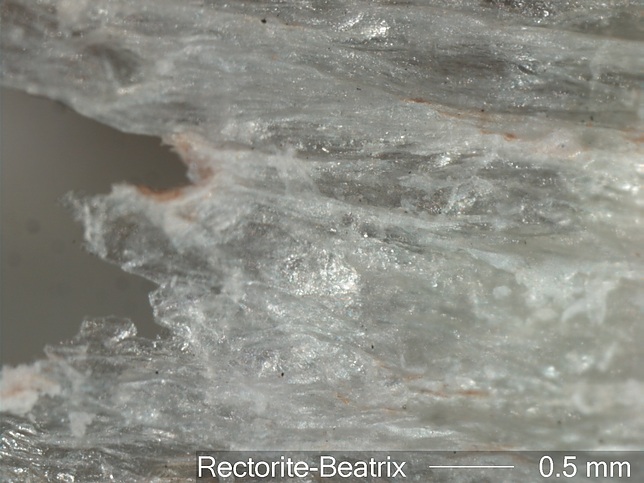
Beatrix Mine, Welkom, Matjhabeng Local Municipality, Lejweleputswa District Municipality, Free State, South Africa