
Wagnerite
A valid IMA mineral species - grandfathered
This page is currently not sponsored. Click here to sponsor this page.


About Wagnerite

Franz M. von Wagner
Formula:
Mg2(PO4)F
Colour:
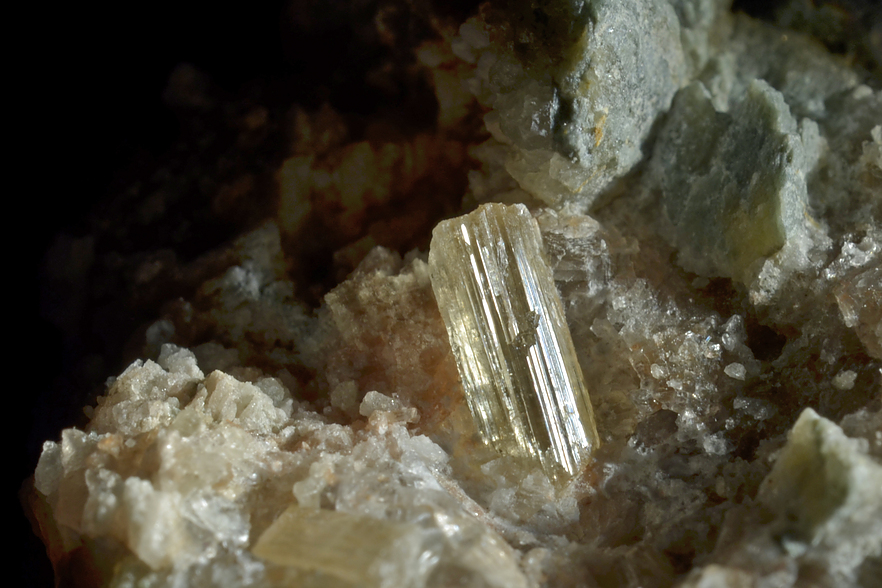
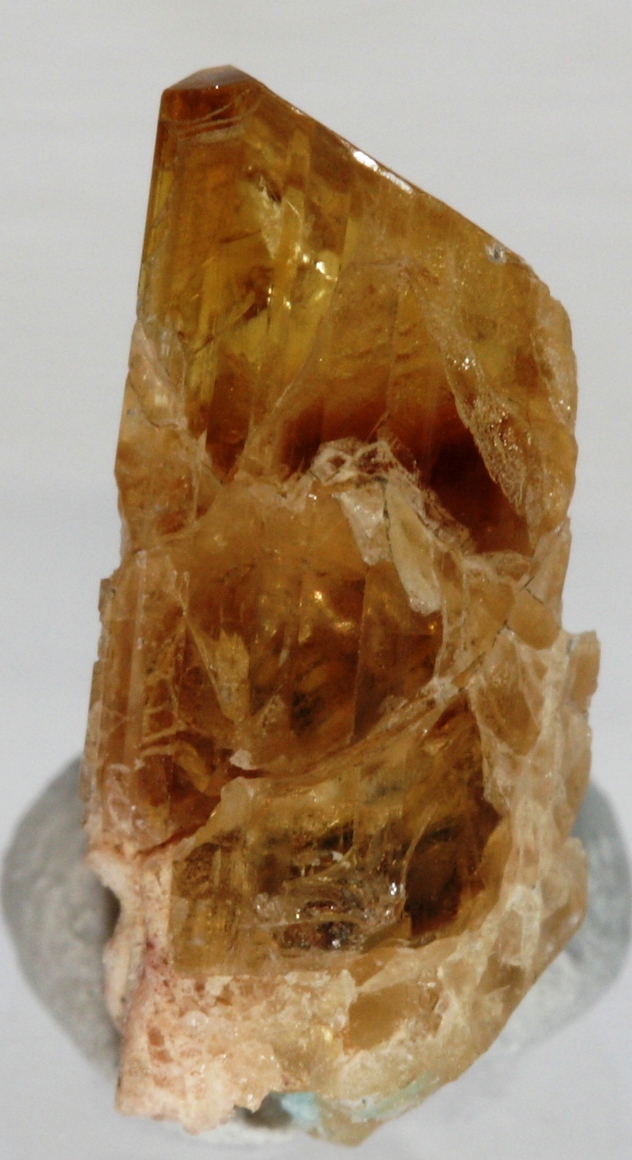
Yellow, brown, red brown, light grey, green, red; colourless in transmitted light.
Lustre:
Sub-Vitreous, Resinous, Greasy
Hardness:
5 - 5½
Specific Gravity:
3.15
Crystal System:
Monoclinic
Member of:
Name:
Named in 1821 by Johann Nepomuk von Fuchs in honour of Franz Michael von Wagner (20 August 1768, Waldershof, Germany - 27 April 1851, Munich, Germany), mining administrator at Fichtelberg in 1791, later at Chiemgau in 1794, at Reichenhall and Traunstein in 1803, Schwarz, Tyrol in 1806, etc. In 1820, Wagner became head of mining, salt mines, and the mint. Wagner was also important in the development of mining in Bavaria.
Isostructural with:
Wagnerite Group.
The Mg analogue of zwieselite (not isotypic).
Several polytypes are known. The most common one is wagnerite-Ma2bc.
"We show that wagnerite and the 5b_0, 7b_0 and 9b_0 phases share the same topological arrangement of cations and oxygen atoms, differ only by the periodic faulting of the A-B succession of the F atoms along b, and are all members of a polytypic series based on the magniotriplite cell (b_0). The relevant polytypes and F ordering schemes are wagnerite-a2bc (AB), wagnerite-a5bc (ABAAB), wagnerite-a7bc (ABAABAB) and wagnerite-a9bc (ABAABABAB)."
The Mg analogue of zwieselite (not isotypic).
Several polytypes are known. The most common one is wagnerite-Ma2bc.
"We show that wagnerite and the 5b_0, 7b_0 and 9b_0 phases share the same topological arrangement of cations and oxygen atoms, differ only by the periodic faulting of the A-B succession of the F atoms along b, and are all members of a polytypic series based on the magniotriplite cell (b_0). The relevant polytypes and F ordering schemes are wagnerite-a2bc (AB), wagnerite-a5bc (ABAAB), wagnerite-a7bc (ABAABAB) and wagnerite-a9bc (ABAABABAB)."
Unique Identifiers
Mindat ID:
4229
Long-form identifier:
mindat:1:1:4229:7
IMA Classification of Wagnerite
Approved, 'Grandfathered' (first described prior to 1959)
IMA status notes:
Redefined by the IMA
IMA Formula:
Mg2PO4F
First published:
1821
Approval history:
Redefined IMA03-C.
Classification of Wagnerite
8.BB.15
8 : PHOSPHATES, ARSENATES, VANADATES
B : Phosphates, etc., with additional anions, without H2O
B : With only medium-sized cations, (OH, etc.):RO4 about 1:1
8 : PHOSPHATES, ARSENATES, VANADATES
B : Phosphates, etc., with additional anions, without H2O
B : With only medium-sized cations, (OH, etc.):RO4 about 1:1
41.6.2.1
41 : ANHYDROUS PHOSPHATES, ETC.CONTAINING HYDROXYL OR HALOGEN
6 : A2(XO4)Zq
41 : ANHYDROUS PHOSPHATES, ETC.CONTAINING HYDROXYL OR HALOGEN
6 : A2(XO4)Zq
22.1.22
22 : Phosphates, Arsenates or Vanadates with other Anions
1 : Phosphates, arsenates or vanadates with fluoride
22 : Phosphates, Arsenates or Vanadates with other Anions
1 : Phosphates, arsenates or vanadates with fluoride
Mineral Symbols
As of 2021 there are now IMA–CNMNC approved mineral symbols (abbreviations) for each mineral species, useful for tables and diagrams.
Please only use the official IMA–CNMNC symbol. Older variants are listed for historical use only.
Please only use the official IMA–CNMNC symbol. Older variants are listed for historical use only.
| Symbol | Source | Reference for Standard |
|---|---|---|
| Wag | IMA–CNMNC | Warr, L.N. (2021). IMA–CNMNC approved mineral symbols. Mineralogical Magazine, 85(3), 291-320. doi:10.1180/mgm.2021.43 |
| Wag | Whitney & Evans (2010) | Whitney, D.L. and Evans, B.W. (2010) Abbreviations for names of rock-forming minerals. American Mineralogist, 95, 185–187 doi:10.2138/am.2010.3371 |
| Wag | The Canadian Mineralogist (2019) | The Canadian Mineralogist (2019) The Canadian Mineralogist list of symbols for rock- and ore-forming minerals (December 30, 2019). download |
Physical Properties of Wagnerite
Sub-Vitreous, Resinous, Greasy
Transparency:
Transparent, Translucent
Colour:
Yellow, brown, red brown, light grey, green, red; colourless in transmitted light.
Streak:
White
Hardness:
5 - 5½ on Mohs scale
Tenacity:
Brittle
Cleavage:
Imperfect/Fair
On {100} and {120}, imperfect; on {001}, in traces.
On {100} and {120}, imperfect; on {001}, in traces.
Fracture:
Conchoidal, Sub-Conchoidal
Density:
3.15 g/cm3 (Measured) 3.15 g/cm3 (Calculated)
Comment:
Slightly lesser values in opaque material (altered [?] or calcian material).
Optical Data of Wagnerite
Type:
Biaxial (+)
RI values:
nα = 1.5678 nβ = 1.5719 nγ = 1.5824
2V:
Measured: 25° to 35°
Birefringence:
0.046
Max. Birefringence:
δ = 0.015
Based on recorded range of RI values above.
Based on recorded range of RI values above.
Interference Colours:
The colours simulate birefringence patterns seen in thin section under crossed polars. They do not take into account mineral colouration or opacity.
Michel-Levy Bar The default colours simulate the birefringence range for a 30 µm thin-section thickness. Adjust the slider to simulate a different thickness.
Grain Simulation You can rotate the grain simulation to show how this range might look as you rotated a sample under crossed polars. Each grain retains its interference colour (retardation) while its brightness falls to black at extinction and reaches a maximum between extinction positions.
The colours simulate birefringence patterns seen in thin section under crossed polars. They do not take into account mineral colouration or opacity.
Michel-Levy Bar The default colours simulate the birefringence range for a 30 µm thin-section thickness. Adjust the slider to simulate a different thickness.
Grain Simulation You can rotate the grain simulation to show how this range might look as you rotated a sample under crossed polars. Each grain retains its interference colour (retardation) while its brightness falls to black at extinction and reaches a maximum between extinction positions.
Surface Relief:
Moderate (positive)
Relative to Canada balsam mounting medium (n ≈ 1.537).
Relative to Canada balsam mounting medium (n ≈ 1.537).
This shows the grain boundary and Becke line effect under plane-polarised
light, based on the contrast between this mineral's average refractive
index and the mounting medium. It does not take into account mineral
colouration.
In focus
Interference Figure:
This shows the idealized biaxial acute bisectrix (Bxa) interference figure
- the conoscopic view for a grain cut perpendicular to the acute bisectrix, using
this mineral's 2V. The two small white dots mark the melatopes - the points
where the two optic axes emerge - and are shown only when they fall within the
field of view. The coloured bands are isochromatics, and the dark bands are
isogyres.
Rotate the stage: at 0°/90° the isogyres form a cross through the melatopes; at 45° they pull apart into curved hyperbolas. That splitting on rotation - absent in a uniaxial figure - is the standard diagnostic test for telling biaxial minerals from uniaxial ones. If 2V is large, the melatopes may fall outside the field of view, as they often do at the microscope too.
Rotate the stage: at 0°/90° the isogyres form a cross through the melatopes; at 45° they pull apart into curved hyperbolas. That splitting on rotation - absent in a uniaxial figure - is the standard diagnostic test for telling biaxial minerals from uniaxial ones. If 2V is large, the melatopes may fall outside the field of view, as they often do at the microscope too.
Dispersion:
r > v weak
Optical Extinction:
Y = b; Z ∧ c = 21°.
Pleochroism:
Non-pleochroic
Chemistry of Wagnerite
Mindat Formula:
Mg2(PO4)F
Element Weights:
Elements listed:
Crystallography of Wagnerite
Polytype:
Formula:
Crystal System:
Class (H-M)
Space Group:
Space Group Setting:
Cell Parameters:
Ratio:
Unit Cell Volume (calc):
Z:
Comment:
| Wagnerite-Ma2bc | Wagnerite-Ma3bc | Wagnerite-Ma5bc | Wagnerite-Ma7bc | Wagnerite-Ma9bc |
|---|---|---|---|---|
| Mg2(PO4)F | Mg2(PO4)F | Mg2(PO4)F | Mg2(PO4)F | Mg2(PO4)F |
| Monoclinic | Monoclinic | |||
| 2/m - Prismatic | m - Domatic | |||
| P21/b | ||||
| P21/c | ||||
| a = 9.644(7) Å, b = 12.679(8) Å, c = 11.957(8) Å β = 108.30(15)° | a = 9.645(2) Å, b = 31.659(6) Å, c = 11.914(2) Å β = 108.26(3)° | |||
| a:b:c = 0.761 : 1 : 0.943 | a:b:c = 0.305 : 1 : 0.376 | |||
| V 1,388.11 ų (Calculated from Unit Cell) | V 3454.76 ų | |||
| 16 | 40 | |||
| from Werfen Austria | Space group Ia (non-standard setting). |
Crystal Structure
Load
Unit Cell | Unit Cell Packed
2x2x2 | 3x3x3 | 4x4x4
Unit Cell | Unit Cell Packed
2x2x2 | 3x3x3 | 4x4x4
Show
Big Balls | Small Balls | Just Balls | Spacefill
Polyhedra Off | Si Polyhedra | All Polyhedra
Remove metal-metal sticks
Big Balls | Small Balls | Just Balls | Spacefill
Polyhedra Off | Si Polyhedra | All Polyhedra
Remove metal-metal sticks
Display Options
Black Background | White Background
Perspective On | Perspective Off
2D | Stereo | Red-Blue | Red-Cyan
Black Background | White Background
Perspective On | Perspective Off
2D | Stereo | Red-Blue | Red-Cyan
View
CIF File Best | x | y | z | a | b | c
CIF File Best | x | y | z | a | b | c
Rotation
Stop | Start
Stop | Start
Labels
Console Off | On | Grey | Yellow
Console Off | On | Grey | Yellow
Data courtesy of the American Mineralogist Crystal Structure Database. Click on an AMCSD ID to view structure
| ID | Species | Reference | Link | Year | Locality | Pressure (GPa) | Temp (K) |
|---|---|---|---|---|---|---|---|
| 0005829 | Wagnerite | Ren L, Grew E S, Xiong M, Ma Z (2003) Wagnerite-Ma5bc, a new polytype of Mg2(PO4)(F,OH), from granulite-facies paragneiss, Larsemann Hills, Prydz Bay, East Antartica The Canadian Mineralogist 41 393-411 |  | 2003 | Larsemann Hills, Prydz Bay, East Antartica | 0 | 293 |
| 0012075 | Wagnerite | Tadini C (1981) Magniotriplite: its crystal structure and relation to the triplite-triploidite group Bulletin de Mineralogie 104 677-680 | 1981 | a pegmatite of the Valmy, Alberes massif, Pyrenees, France | 0 | 293 | |
| 0012052 | Wagnerite | Coda A, Giuseppetti G, Tadini C, Carobbi S G (1967) The crystal structure of wagnerite Atti della Accademia Nazionale dei Lincei 43 212-224 | 1967 | Hollgraben near Werfen, Austria | 0 | 293 | |
| 0012516 | Wagnerite | Amisano Canesi A, Chiari G (1992) Refinement of very-high-pressure wagnerite, Mg2(PO4)F European Crystallographic Meeting 14 189-189 | 1992 | 0 | 293 |
CIF Raw Data - click here to close
X-Ray Powder Diffraction
Powder Diffraction Data:
| d-spacing | Intensity |
|---|---|
| 5.69 Å | (4) |
| 5.55 Å | (2) |
| 5.23 Å | (6) |
| 4.25 Å | (9) |
| 3.840 Å | (5) |
| 3.545 Å | (6) |
| 3.297 Å | (65) |
| 3.256 Å | (9) |
| 3.123 Å | (63) |
| 2.985 Å | (100) |
| 2.854 Å | (59) |
| 2.813 Å | (15) |
| 2.779 Å | (15) |
| 2.758 Å | (25) |
| 2.710 Å | (22) |
| 2.558 Å | (6) |
| 2.484 Å | (13) |
| 2.405 Å | (7) |
| 2.293 Å | (6) |
| 2.244 Å | (10) |
| 2.229 Å | (9) |
| 2.206 Å | (12) |
| 2.126 Å | (8) |
| 2.080 Å | (12) |
| 2.069 Å | (13) |
| 1.988 Å | (11) |
| 1.926 Å | (11) |
| 1.919 Å | (10) |
| 1.900 Å | (13) |
| 1.894 Å | (15) |
| 1.861 Å | (6) |
| 1.822 Å | (2) |
| 1.801 Å | (4) |
| 1.779 Å | (5) |
| 1.754 Å | (8) |
| 1.744 Å | (8) |
| 1.731 Å | (12) |
| 1.673 Å | (10) |
| 1.633 Å | (5) |
| 1.588 Å | (13) |
| 1.584 Å | (16) |
| 1.563 Å | (8) |
| 1.555 Å | (10) |
| 1.545 Å | (8) |
| 1.533 Å | (9) |
Comments:
Leroux, Marc V. and Ercit, T. Scott (1992) Wagnerite, an accessory phase in cordierite-anthophyllite gneiss from Star Lake, Manitoba.
Geological Environment
Paragenetic Mode(s):
| Paragenetic Mode | Earliest Age (Ga) |
|---|---|
| Near-surface Processes | |
| 21 : Chemically precipitated carbonate, phosphate, iron formations | |
| Stage 4b: Highly evolved igneous rocks | >3.0 |
| 34 : Complex granite pegmatites | |
| 35 : Ultra-alkali and agpaitic igneous rocks | |
| Stage 5: Initiation of plate tectonics | <3.5-2.5 |
| 39 : High-? metamorphism (blueschist, eclogite, ultrahigh ? facies) | |
| 40 : Regional metamorphism (greenschist, amphibolite, granulite facies) | |
| Stage 10a: Neoproterozoic oxygenation/terrestrial biosphere | <0.6 |
| 50 : Coal and/or oil shale minerals | <0.36 |
| Stage 10b: Anthropogenic minerals | <10 Ka |
| 54 : Coal and other mine fire minerals (see also #51 and #56) |
Type Occurrence of Wagnerite
Place of Conservation of Type Material:
No designated type specimen.
Associated Minerals at Type Locality:
Synonyms of Wagnerite
Other Language Names for Wagnerite
Varieties of Wagnerite
| Magniotriplite | A discredited iron- and magnesium-rich structural variety (polytype) of wagnerite. Originally described from Karasu granite pegmatite, Turkestan Range, Osh Oblast, Kyrgyzstan and Kyrk-Bulak granite pegmatite, Turkestan Range, Osh Oblast, Kyrgyzstan. |
Relationship of Wagnerite to other Species
Member of:
Other Members of Wagnerite Group:
| Arsenowagnerite | Mg2(AsO4)F | Mon. 2/m : P21/b |
| Hydroxylwagnerite | Mg2(PO4)(OH) | Mon. 2/m : P21/b |
| Joosteite | Mn2+(Mn3+,Fe3+)(PO4)O | Mon. 2/m |
| Sarkinite | Mn2+2(AsO4)(OH) | Mon. 2/m : P21/b |
| Stanĕkite | (Mn2+,Fe2+,Mg)Fe3+(PO4)O | Mon. 2/m : P21/b |
| 'Wagnerite-Arsenowagnerite Series' |
Forms a series with:
Common Associates
Associations Based on Photo Data:
| 11 photos of Wagnerite associated with Lazulite | MgAl2(PO4)2(OH)2 |
| 9 photos of Wagnerite associated with Scorzalite | Fe2+Al2(PO4)2(OH)2 |
| 7 photos of Wagnerite associated with Quartz | SiO2 |
| 3 photos of Wagnerite associated with Isokite | CaMg(PO4)F |
| 3 photos of Wagnerite associated with Kyanite | Al2(SiO4)O |
| 3 photos of Wagnerite associated with Panasqueiraite | CaMg(PO4)(OH) |
| 3 photos of Wagnerite associated with Rutile | TiO2 |
| 2 photos of Wagnerite associated with Berlinite | AlPO4 |
| 2 photos of Wagnerite associated with Fluorapatite | Ca5(PO4)3F |
| 2 photos of Wagnerite associated with 'Breunnerite' | (Mg,Fe)CO3 |
Related Minerals - Strunz-mindat Grouping
| 8.BB. | Moabite | NiFe3+(PO4)O |
| 8.BB. | Tilasite | CaMg(AsO4)F |
| 8.BB. | Paulgrothite | Cu9Fe3+O4(PO4)4Cl3 |
| 8.BB. | Karlditmarite | Cu9O4(PO4)2(SO4)2 |
| 8.BB. | Milkovoite | Cu4O(PO4)(AsO4) |
| 8.BB.X | Arsenowagnerite | Mg2(AsO4)F |
| 8.BB.05 | Tavorite | LiFe3+(PO4)(OH) |
| 8.BB.05 | Amblygonite | LiAl(PO4)F |
| 8.BB.05 | Montebrasite | LiAl(PO4)(OH) |
| 8.BB.10 | Zwieselite | Fe2+2(PO4)F |
| 8.BB.10 | Triplite | Mn2+2(PO4)F |
| 8.BB.15 | 'Unnamed (Sb-analogue of Auriacusite)' | Fe3+Cu2+[(Sb,As)O4]O |
| 8.BB.15 | Joosteite | Mn2+(Mn3+,Fe3+)(PO4)O |
| 8.BB.15 | Hydroxylwagnerite | Mg2(PO4)(OH) |
| 8.BB.15 | Stanĕkite | (Mn2+,Fe2+,Mg)Fe3+(PO4)O |
| 8.BB.15 | Triploidite | Mn2+2(PO4)(OH) |
| 8.BB.15 | Sarkinite | Mn2+2(AsO4)(OH) |
| 8.BB.15 | Wolfeite | Fe2+2(PO4)(OH) |
| 8.BB.20 | Holtedahlite | Mg2(PO4)(OH) |
| 8.BB.20 | Satterlyite | (Fe2+,Mg,Fe)12(PO4)5(PO3OH)(OH,O)6 |
| 8.BB.25 | Althausite | Mg4(PO4)2(OH,O)(F,◻) |
| 8.BB.30 | Zincolivenite | CuZn(AsO4)(OH) |
| 8.BB.30 | Adamite | Zn2(AsO4)(OH) |
| 8.BB.30 | Libethenite | Cu2(PO4)(OH) |
| 8.BB.30 | Zincolibethenite | CuZn(PO4)(OH) |
| 8.BB.30 | Eveite | Mn2+2(AsO4)(OH) |
| 8.BB.30 | Olivenite | Cu2(AsO4)(OH) |
| 8.BB.30 | Auriacusite | Fe3+Cu2+(AsO4)O |
| 8.BB.35 | Paradamite | Zn2(AsO4)(OH) |
| 8.BB.35 | Tarbuttite | Zn2(PO4)(OH) |
| 8.BB.40 | Barbosalite | Fe2+Fe3+2(PO4)2(OH)2 |
| 8.BB.40 | Scorzalite | Fe2+Al2(PO4)2(OH)2 |
| 8.BB.40 | Lazulite | MgAl2(PO4)2(OH)2 |
| 8.BB.40 | Meizhouite | Fe2+V3+2(PO4)2(OH)2 |
| 8.BB.40 | Hentschelite | CuFe3+2(PO4)2(OH)2 |
| 8.BB.40 | Wilhelmkleinite | ZnFe3+2(AsO4)2(OH)2 |
| 8.BB.45 | Dokuchaevite | Cu8O2(VO4)3Cl3 |
| 8.BB.45 | Trolleite | Al4(PO4)3(OH)3 |
| 8.BB.45 | Yaroshevskite | Cu9O2(VO4)4Cl2 |
| 8.BB.50 | Namibite | Cu(BiO)2(VO4)(OH) |
| 8.BB.50 | Aleutite | [Cu5O2](AsO4)(VO4) · (Cu,K,Pb,Rb,Cs,)Cl |
| 8.BB.52a | Ericlaxmanite | Cu4O(AsO4)2 |
| 8.BB.52b | Kozyrevskite | Cu4O(AsO4)2 |
| 8.BB.55 | Phosphoellenbergerite | (Mg,◻)2Mg12(PO4,PO3OH)6(PO3OH,CO3)2(OH)6 |
| 8.BB.55 | Popovite | Cu5O2(AsO4)2 |
| 8.BB.60 | Urusovite | CuAl(AsO4)O |
| 8.BB.65 | Theoparacelsite | Cu3(As2O7)(OH)2 |
| 8.BB.70 | Turanite | Cu5(VO4)2(OH)4 |
| 8.BB.75 | Stoiberite | Cu5(VO4)2O2 |
| 8.BB.80 | Fingerite | Cu11(VO4)6O2 |
| 8.BB.85 | Averievite | Cu6(VO4)2O2Cl2 |
| 8.BB.90 | Richellite | CaFe3+2(PO4)2(OH,F)2 |
| 8.BB.90 | Lipscombite | Fe2+Fe3+2(PO4)2(OH)2 |
| 8.BB.90 | Zinclipscombite | ZnFe3+2(PO4)2(OH)2 |
Fluorescence of Wagnerite
Not fluorescent in UV.
Other Information
Notes:
Soluble in acids.
May alter to apatite.
May alter to apatite.
Health Risks:
No information on health risks for this material has been entered into the database. You should always treat mineral specimens with care.
Internet Links for Wagnerite
mindat.org URL:
https://www.mindat.org/min-4229.html
Please feel free to link to this page.
Please feel free to link to this page.
Search Engines:
External Links:
Mineral Dealers:
References for Wagnerite
Reference List:
Breithaupt, August (1823) Vollständige Charakteristik des Mineral-Systems (1st ed.). Arnoldischen Buchhandlung.p.193 - as Pleuroklas
Kobell, F. (1873) Ueber den Kjerulfin, eine neue Mineralspecies von Bamle in Norwegen. Journal für praktische Chemie: 7: 272.(as Kjerulfin)
Klement, R.; Dihn, P. (1938) Basische Phosphate zweiwertiger Metalle III. Barium–Hydroxylapatit. Zeitschrift für anorganische und allgemeine Chemie, 240 (1). 31-39 doi:10.1002/zaac.19382400105
Richmond, Wallace E. (1940) Crystal chemistry of the phosphates, arsenates and vanadates of the type A2XO4(Z). American Mineralogist, 25 (7). 441-479
Jaffe, Howard W., Hall, Leo M., Evans, Howard T. (1992) Wagnerite with isokite from the Benson Mines, west-central Adirondack Highlands, New York. Mineralogical Magazine, 56 (383) 227-233 doi:10.1180/minmag.1992.056.383.09
Ren, L., Grew, E. S., Xiong, M., Ma, Z. (2003) Wagnerite-Ma5bc, a new polytype of Mg2(PO4)(F,OH), from granulite-facies paragneiss, Larsemann Hills, Prydz Bay, East Antarctica. The Canadian Mineralogist, 41 (2) 393-411 doi:10.2113/gscanmin.41.2.393
Dyar, M. D., Jawin, E. R., Breves, E., Marchand, G., Nelms, M., Lane, M. D., Mertzman, S. A., Bish, D. L., Bishop, J. L. (2014) Mössbauer parameters of iron in phosphate minerals: Implications for interpretation of martian data. American Mineralogist, 99 (5) 914-942 doi:10.2138/am.2014.4701
Chopin, Christian, Armbruster, Thomas, Grew, Edward S., Baronnet, Alain, Leyx, Catherine, Medenbach, Olaf (2014) The triplite–triploidite supergroup: structural modulation in wagnerite, discreditation of magniotriplite, and the new mineral hydroxylwagnerite. European Journal of Mineralogy, 26 (4) 553-565 doi:10.1127/0935-1221/2014/0026-2386
Localities for Wagnerite
Showing 94 localities.
 symbol to view information about a locality.
The
symbol to view information about a locality.
The Locality List
 - This locality has map coordinates listed.
- This locality has estimated coordinates.
ⓘ - Click for references and further information on this occurrence.
? - Indicates mineral may be doubtful at this locality.
- This locality has map coordinates listed.
- This locality has estimated coordinates.
ⓘ - Click for references and further information on this occurrence.
? - Indicates mineral may be doubtful at this locality.
 - Good crystals or important locality for species.
 - World class for species or very significant.
(TL) - Type Locality for a valid mineral species.
(FRL) - First Recorded Locality for everything else (eg varieties).
- World class for species or very significant.
(TL) - Type Locality for a valid mineral species.
(FRL) - First Recorded Locality for everything else (eg varieties).
All localities listed without proper references should be considered as questionable.
Antarctica | |
| gsa.confex.com (n.d.) +1 other reference |
| Grew (1981) +1 other reference | |
| Grew (1981) +1 other reference |
| Baba et al. (2000) +1 other reference |
| [Wagnerite-Ma5bc] Ren et al. (2003) |
| Grew et al. (2007) | |
| Grew et al. (2006) +1 other reference |
Argentina | |
| Colombo et al. (2012) |
Australia | |
| [var: Magniotriplite] Lottermoser et al. (1997) |
| Bottrill +1 other reference |
| Hassan (2017) |
Austria | |
| Putz et al. (2004) |
| Putz et al. (2004) | |
| Neschen (n.d.) +1 other reference |
| Strasser (2000) +1 other reference |
| Strasser (1989) |
| Kirchner (1983) +1 other reference | |
| Strasser (1989) |
| Strasser (1989) | |
| C.Auer (2020) |
| Palache et al. (1951) +1 other reference |
| Neschen (n.d.) |
| Strasser (1989) |
| Kirchner (1983) |
| Strasser (1989) | |
| WALLENTA (1985) |
Canada | |
| Leroux et al. (1992) |
| Horváth et al. (2000) +1 other reference |
China | |
| Rao et al. (2014) +1 other reference |
| Shuyin Niu et al. (2008) |
Czech Republic | |
| Seifert +3 other references |
| Staněk (1991) +4 other references |
| Staněk (1997) | |
Europe | |
| Berbain et al. (2012) | |
Finland | |
| Ilkka Mikkola collection |
France | |
| Berbain et al. (2005) |
| Berbain et al. (2005) | |
| Berbain et al. (2012) | |
Germany | |
| Weiß (1990) |
| Dill et al. (2012) |
| Dill et al. (2011) |
| Weiß et al. (1999) |
| Hentschel (1987) +1 other reference |
| Lapis (5) |
| Blass et al. (2006) |
| Gunnar Färber - Mineralienliste 1-2018 |
| Lapis 30 (7/8) |
India | |
| Dwivedi et al. (2017) |
Italy | |
| Palache et al. (1951) +1 other reference |
| Piccoli et al. (2007) |
| Mandarino (1996) | |
| Piccoli et al. (2007) |
Kyrgyzstan | |
| [var: Magniotriplite] [DAN-SSSR (1951) +2 other references |
| [var: Magniotriplite] Pekov (1998) |
Norway | |
| Kobell (1873) +4 other references |
| Neumann (1985) | |
| Helland (1874) +1 other reference |
| Alf Olav Larsen +2 other references |
| Hansen (197?) +1 other reference | |
| Brøgger et al. (1875) | |
Poland | |
| Ł. Kruszewski EPMA/PXRD data +1 other reference |
| Ł. Kruszewski PXRD data (to be published soon) |
Portugal | |
| Figueiras +4 other references | |
Russia | |
| Izbrodin et al. (2009) |
| Cesnokov et al. (1998) |
| Pekov et al. (2022) |
| [var: Magniotriplite] Trunilina et al. (2024) |
Spain | |
| [var: Magniotriplite] Roda et al. (2001) |
| [var: Magniotriplite] Roda et al. (2004) +1 other reference |
| Calvo Rebollar et al. (2022) |
| [var: Magniotriplite] Bareche (2005) |
| [var: Magniotriplite] & locality references +1 other reference | |
Sweden | |
| The Swedish Museum of Natural History (Naturhistoriska riksmuseet) |
| The Swedish Museum of Natural History (Naturhistoriska riksmuseet) | |
| [var: Magniotriplite] |
| [var: Magniotriplite] Wik et al. (2005) | |
| Grensman (1989) +1 other reference |
USA | |
| Grant et al. (2005) |
| King (n.d.) |
| U.S. Geological Survey Professional ... +1 other reference |
| King et al. (1991) |
| NY State Museum spec. no. 16020 |
| Jaffe et al. (1992) |
| XRD by Dr. Lance Kearns in 2010. See ... |
Quick NavTopAbout WagneriteUnique IdentifiersIMA Classification Classification Mineral SymbolsPhysical Properties Optical Data Chemistry Crystallography Crystal StructureX-Ray Powder DiffractionGeological EnvironmentType Occurrence SynonymsOther LanguagesVarietiesRelationshipsCommon AssociatesStrunz-MindatFluorescence Other InformationInternet Links References Localities Locality List

Caspar quarry, Ettringen, Vordereifel, Mayen-Koblenz, Rhineland-Palatinate, Germany