
Serandite
A valid IMA mineral species - grandfathered
This page is currently not sponsored. Click here to sponsor this page.
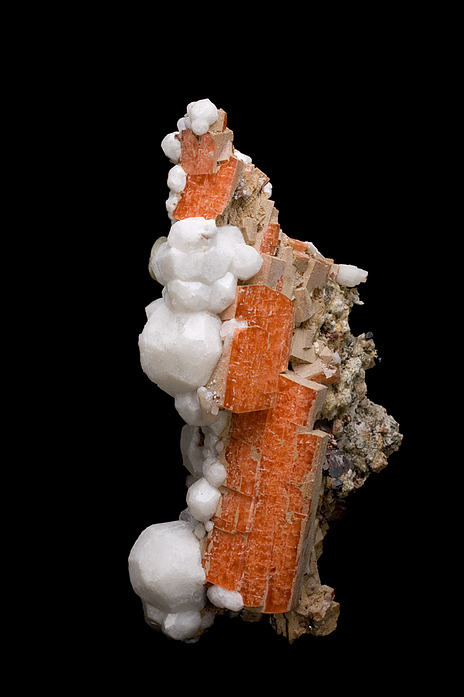
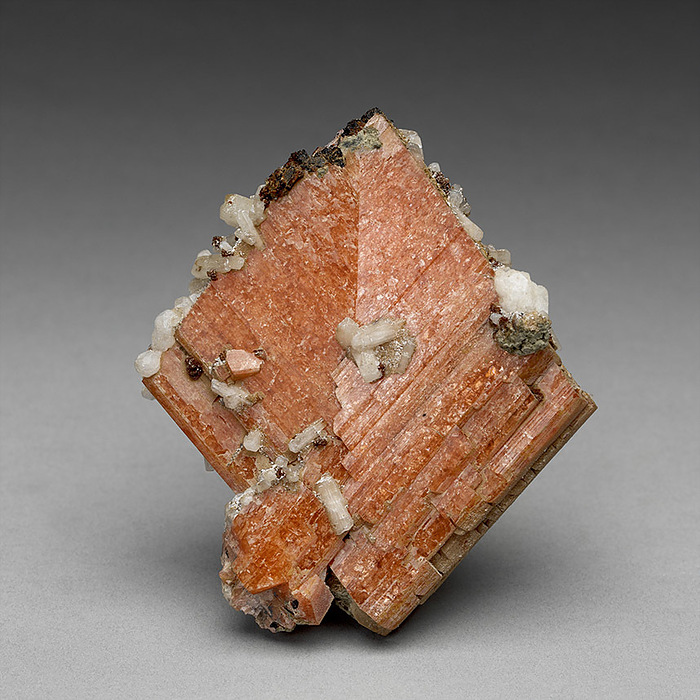

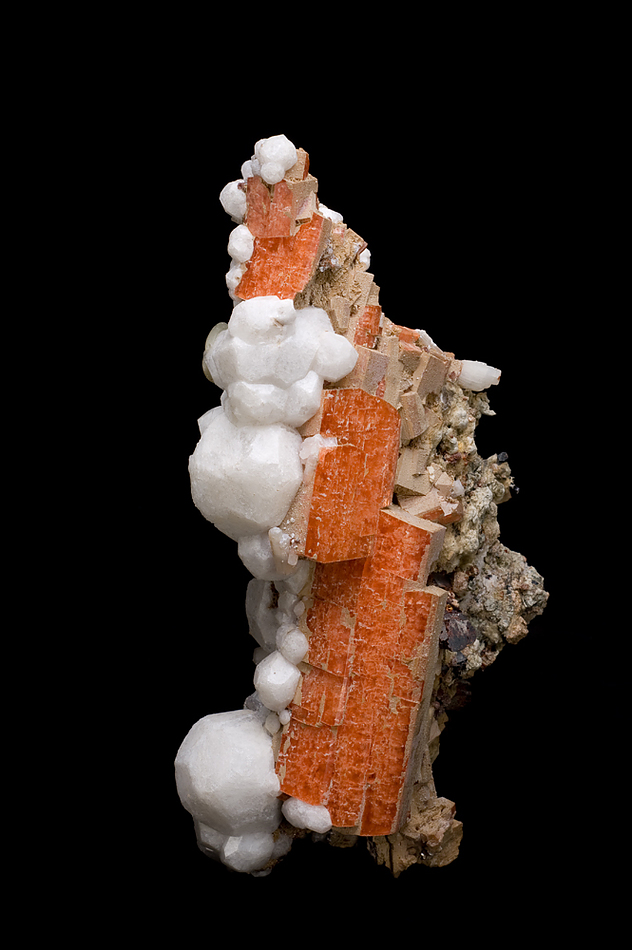
About Serandite
Formula:
NaMn2+2Si3O8(OH)
Colour:
Pale pink, salmon-red, salmon-orange, deep orange, rose-red, brown, colourless
Lustre:
Vitreous, Sub-Vitreous, Greasy
Hardness:
5 - 5½
Specific Gravity:
3.34
Crystal System:
Triclinic
Member of:
Name:
Named in 1931 by Antoine François Alfred Lacroix after J.M. Serand, lighthouse keeper of the Island of Roume, Los Islands, Guinea, who assisted in collecting the mineral and who, coincidentally, had a rosy pink complexion.
The name was modified in 2015 from sérandite to serandite by IMA approval 15-E.
The name was modified in 2015 from sérandite to serandite by IMA approval 15-E.
Pectolite-Serandite Series. The manganese analogue of pectolite and the sodium analogue of tanohataite. Part of serandite-schizolite-pectolite series.
Note: Many of the lighter pink "serandites" are schizolite. They can't be sorted visually. None of the deep orange serandites are schizolite.
 Visit gemdat.org for gemological information about Serandite.
Note: Many of the lighter pink "serandites" are schizolite. They can't be sorted visually. None of the deep orange serandites are schizolite.
Visit gemdat.org for gemological information about Serandite.Unique Identifiers
Mindat ID:
3622
Long-form identifier:
mindat:1:1:3622:7
Similar Names
| Strandite | A valid IMA mineral species - pending publication | Pb3Mn43+Mn34+O15 |
IMA Classification of Serandite
Approved, 'Grandfathered' (first described prior to 1959)
First published:
1931
Classification of Serandite
9.DG.05
9 : SILICATES (Germanates)
D : Inosilicates
G : Inosilicates with 3-periodic single and multiple chains
9 : SILICATES (Germanates)
D : Inosilicates
G : Inosilicates with 3-periodic single and multiple chains
65.2.1.5
65 : INOSILICATES Single-Width,Unbranched Chains,(W=1)
2 : Single-Width Unbranched Chains, W=1 with chains P=3
65 : INOSILICATES Single-Width,Unbranched Chains,(W=1)
2 : Single-Width Unbranched Chains, W=1 with chains P=3
14.18.27
14 : Silicates not Containing Aluminum
18 : Silicates of Mn and Na, K, Mg, Ca or Fe
14 : Silicates not Containing Aluminum
18 : Silicates of Mn and Na, K, Mg, Ca or Fe
Mineral Symbols
As of 2021 there are now IMA–CNMNC approved mineral symbols (abbreviations) for each mineral species, useful for tables and diagrams.
| Symbol | Source | Reference for Standard |
|---|---|---|
| Srd | IMA–CNMNC | Warr, L.N. (2021). IMA–CNMNC approved mineral symbols. Mineralogical Magazine, 85(3), 291-320. doi:10.1180/mgm.2021.43 |
Physical Properties of Serandite
Vitreous, Sub-Vitreous, Greasy
Transparency:
Transparent, Translucent
Comment:
Fibrous aggregates are dull to silky
Colour:
Pale pink, salmon-red, salmon-orange, deep orange, rose-red, brown, colourless
Streak:
White
Hardness:
5 - 5½ on Mohs scale
Tenacity:
Brittle
Cleavage:
Perfect
On {001} and {100}
On {001} and {100}
Fracture:
Irregular/Uneven, Splintery
Density:
3.34 g/cm3 (Measured) 3.42 g/cm3 (Calculated)
Optical Data of Serandite
Type:
Biaxial (+)
RI values:
nα = 1.668 nβ = 1.671 nγ = 1.703
2V:
Measured: 39° , Calculated: 39°
Birefringence:
0.035
Max. Birefringence:
δ = 0.035
Based on recorded range of RI values above.
Based on recorded range of RI values above.
Interference Colours:
The colours simulate birefringence patterns seen in thin section under crossed polars. They do not take into account mineral colouration or opacity.
Michel-Levy Bar The default colours simulate the birefringence range for a 30 µm thin-section thickness. Adjust the slider to simulate a different thickness.
Grain Simulation You can rotate the grain simulation to show how this range might look as you rotated a sample under crossed polars. Each grain retains its interference colour (retardation) while its brightness falls to black at extinction and reaches a maximum between extinction positions.
The colours simulate birefringence patterns seen in thin section under crossed polars. They do not take into account mineral colouration or opacity.
Michel-Levy Bar The default colours simulate the birefringence range for a 30 µm thin-section thickness. Adjust the slider to simulate a different thickness.
Grain Simulation You can rotate the grain simulation to show how this range might look as you rotated a sample under crossed polars. Each grain retains its interference colour (retardation) while its brightness falls to black at extinction and reaches a maximum between extinction positions.
Surface Relief:
Very High (positive)
Relative to Canada balsam mounting medium (n ≈ 1.537).
Relative to Canada balsam mounting medium (n ≈ 1.537).
This shows the grain boundary and Becke line effect under plane-polarised
light, based on the contrast between this mineral's average refractive
index and the mounting medium. It does not take into account mineral
colouration.
In focus
Interference Figure:
This shows the idealized biaxial acute bisectrix (Bxa) interference figure
- the conoscopic view for a grain cut perpendicular to the acute bisectrix, using
this mineral's 2V. The two small white dots mark the melatopes - the points
where the two optic axes emerge - and are shown only when they fall within the
field of view. The coloured bands are isochromatics, and the dark bands are
isogyres.
Rotate the stage: at 0°/90° the isogyres form a cross through the melatopes; at 45° they pull apart into curved hyperbolas. That splitting on rotation - absent in a uniaxial figure - is the standard diagnostic test for telling biaxial minerals from uniaxial ones. If 2V is large, the melatopes may fall outside the field of view, as they often do at the microscope too.
Rotate the stage: at 0°/90° the isogyres form a cross through the melatopes; at 45° they pull apart into curved hyperbolas. That splitting on rotation - absent in a uniaxial figure - is the standard diagnostic test for telling biaxial minerals from uniaxial ones. If 2V is large, the melatopes may fall outside the field of view, as they often do at the microscope too.
Dispersion:
r < v moderate
Chemistry of Serandite
Mindat Formula:
NaMn2+2Si3O8(OH)
Element Weights:
Common Impurities:
Al,Fe,Mg,K,H2O
Chemical Analysis
Oxide wt%:
| 1 | |
|---|---|
| P2O5 | 0.01 % |
| SiO2 | 49.82 % |
| MnO | 38.99 % |
| MgO | 0.01 % |
| CaO | 0.62 % |
| SrO | 0.02 % |
| Na2O | 8.42 % |
| H2O (by stoichiometry) | 2.49 % |
| Total: | 100.38 % |
Empirical formulas:
| Sample ID | Empirical Formula |
|---|---|
| 1 | (Na0.98Ca0.02)(Mn2+0.98Ca0.02)Mn2+1.00[Si2.99O8](OH) |
Sample references:
| ID | Locality | Reference | Notes |
|---|---|---|---|
| 1 | Woods Mine, Inglis Co., New South Wales, Australia | Bands of euhedral serandite crystals with contained rounded relict(?) grains of vittinkiite, accompanying natronambulite(?), in a matrix of abundant quartz, braunite and mangano-mangani-ungarettiite. The distribution of the minor Ca content is estimated based on site filling and has not been verified by structural analysis. H2O is calculated based on stoichiometry. |
Crystallography of Serandite
Crystal System:
Triclinic
Class (H-M):
1 - Pinacoidal
Space Group:
P1
Setting:
P1
Cell Parameters:
a = 7.683(1) Å, b = 6.889(1) Å, c = 6.747(1) Å
α = 90.53(5)°, β = 94.12(2)°, γ = 102.75(2)°
α = 90.53(5)°, β = 94.12(2)°, γ = 102.75(2)°
Ratio:
a:b:c = 1.115 : 1 : 0.979
Unit Cell V:
347.29 ų (Calculated from Unit Cell)
Z:
2
Morphology:
Blocky prismatic to acicular crystals.
Twinning:
Around [010] composition plane {100}, less commonly contact twin on {110}.
Crystal Structure
Load
Unit Cell | Unit Cell Packed
2x2x2 | 3x3x3 | 4x4x4
Unit Cell | Unit Cell Packed
2x2x2 | 3x3x3 | 4x4x4
Show
Big Balls | Small Balls | Just Balls | Spacefill
Polyhedra Off | Si Polyhedra | All Polyhedra
Remove metal-metal sticks
Big Balls | Small Balls | Just Balls | Spacefill
Polyhedra Off | Si Polyhedra | All Polyhedra
Remove metal-metal sticks
Display Options
Black Background | White Background
Perspective On | Perspective Off
2D | Stereo | Red-Blue | Red-Cyan
Black Background | White Background
Perspective On | Perspective Off
2D | Stereo | Red-Blue | Red-Cyan
View
CIF File Best | x | y | z | a | b | c
CIF File Best | x | y | z | a | b | c
Rotation
Stop | Start
Stop | Start
Labels
Console Off | On | Grey | Yellow
Console Off | On | Grey | Yellow
Data courtesy of the American Mineralogist Crystal Structure Database. Click on an AMCSD ID to view structure
| ID | Species | Reference | Link | Year | Locality | Pressure (GPa) | Temp (K) |
|---|---|---|---|---|---|---|---|
| 0020404 | Serandite | Williams E R, Weller M T (2014) A variable-temperature neutron diffraction study of serandite: A Mn-silicate framework with a very strong, two-proton site, hydrogen bond American Mineralogist 99 1755-1760 | 2014 | Mont St. Hilaire, Quebec, Canada | 0 | 298 | |
| 0010758 | Serandite | Takeuchi Y, Kudoh Y, Haga N (1973) The interpretation of partial Patterson functions and its application to structure analyses of serandite Mn2NaHSi3O9 and banalsite BaNa2Al4Si4O16 Zeitschrift fur Kristallographie 138 313-336 |  | 1973 | Tanohata mine, Japan | 0 | 293 |
| 0020403 | Serandite | Williams E R, Weller M T (2014) A variable-temperature neutron diffraction study of serandite: A Mn-silicate framework with a very strong, two-proton site, hydrogen bond American Mineralogist 99 1755-1760 | 2014 | Mont St. Hilaire, Quebec, Canada | 0 | 150 | |
| 0020405 | Serandite | Williams E R, Weller M T (2014) A variable-temperature neutron diffraction study of serandite: A Mn-silicate framework with a very strong, two-proton site, hydrogen bond American Mineralogist 99 1755-1760 | 2014 | Mont St. Hilaire, Quebec, Canada | 0 | 575 | |
| 0020402 | Serandite | Williams E R, Weller M T (2014) A variable-temperature neutron diffraction study of serandite: A Mn-silicate framework with a very strong, two-proton site, hydrogen bond American Mineralogist 99 1755-1760 | 2014 | Mont St. Hilaire, Quebec, Canada | 0 | 4 | |
| 0020406 | Serandite | Williams E R, Weller M T (2014) A variable-temperature neutron diffraction study of serandite: A Mn-silicate framework with a very strong, two-proton site, hydrogen bond American Mineralogist 99 1755-1760 | 2014 | Mont St. Hilaire, Quebec, Canada | 0 | 800 | |
| 0002431 | Serandite | Jacobsen S D, Smyth J R, Swope R J, Sheldon R I (2000) Two proton positions in the very strong hydrogen bond of serandite, NaMn2[Si3O8(OH)] American Mineralogist 85 745-752 | | 2000 | 0 | 293 | |
| 0002430 | Serandite | Jacobsen S D, Smyth J R, Swope R J, Sheldon R I (2000) Two proton positions in the very strong hydrogen bond of serandite, NaMn2[Si3O8(OH)] American Mineralogist 85 745-752 | | 2000 | 0 | 293 | |
| 0000623 | Serandite | Ohashi Y, Finger L W (1978) The role of octahedral cations in pyroxenoid crystal chemistry. I. Bustamite, wollastonite, and the pectolite-schizolite-serandite series sample SRN, from Rouma, Island of Los, Guinea American Mineralogist 63 274-288 | | 1978 | 0 | 293 | |
| 0000499 | Serandite | Takeuchi Y, Kudoh Y, Yamanaka T (1976) Crystal chemistry of the serandite-pectolite series and related minerals American Mineralogist 61 229-237 | | 1976 | 0 | 293 |
CIF Raw Data - click here to close
X-Ray Powder Diffraction
Powder Diffraction Data:
| d-spacing | Intensity |
|---|---|
| 7.51 Å | (25) |
| 3.158 Å | (90) |
| 2.983 Å | (100) |
| 2.838 Å | (65) |
| 2.602 Å | (35) |
| 2.495 Å | (45) |
| 2.192 Å | (60) |
Comments:
ICDD 25-723
Geological Environment
Paragenetic Mode(s):
| Paragenetic Mode | Earliest Age (Ga) |
|---|---|
| High-? alteration and/or metamorphism | |
| 32 : Ba/Mn/Pb/Zn deposits, including metamorphic deposits | |
| Stage 4b: Highly evolved igneous rocks | >3.0 |
| 35 : Ultra-alkali and agpaitic igneous rocks |
Geological Setting:
In sodalite zenoliths and pegmatites, phonolite, contact metamorphic rocks.
Type Occurrence of Serandite
General Appearance of Type Material:
Pink bladed mineral.
Place of Conservation of Type Material:
National Museum of Natural History (Smithsonian Institution), Washington, D.C., USA, number 96515.
Geological Setting of Type Material:
Alkalic pegmatite.
Associated Minerals at Type Locality:
Other Language Names for Serandite
Varieties of Serandite
| Calcium-bearing Sérandite | A variety of Sérandite especially rich in calcium. Most Sérandite contains some calcium. |
Relationship of Serandite to other Species
Member of:
Other Members of Wollastonite Group:
| Barrydawsonite-(Y) | Na1.5Y0.5CaSi3O8(OH) | Mon. 2/m : P21/b |
| Bustamite | CaMn2+(Si2O6) | Tric. 1 : P1 |
| Cascandite | CaScSi3O8(OH) | Tric. 1 |
| Dalnegorskite | Ca5Mn2+(Si3O9)2 | Tric. 1 : P1 |
| Ferrobustamite | CaFe2+(Si2O6) | Tric. 1 |
| Mendigite | Mn2Mn2MnCa(Si3O9)2 | Tric. 1 : P1 |
| Murakamiite | LiCa2Si3O8(OH) | Tric. 1 : P1 |
| Pectolite | NaCa2Si3O8(OH) | Tric. 1 : P1 |
| Schizolite | NaCaMnSi3O8(OH) | Tric. 1 : P1 |
| Tanohataite | LiMn2Si3O8(OH) | Tric. 1 : P1 |
| Vistepite | SnMn4B2Si4O16(OH)2 | Tric. 1 : P1 |
| Wollastonite | Ca3(Si3O9) | Tric. 1 : P1 |
Forms a series with:
Common Associates
Associations Based on Photo Data:
| 343 photos of Serandite associated with Aegirine | NaFe3+Si2O6 |
| 224 photos of Serandite associated with Analcime | Na(AlSi2O6) · H2O |
| 143 photos of Serandite associated with Natrolite | Na2Al2Si3O10 · 2H2O |
| 134 photos of Serandite associated with Polylithionite | KLi2Al(Si4O10)(F,OH)2 |
| 113 photos of Serandite associated with Albite | Na(AlSi3O8) |
| 69 photos of Serandite associated with Manganoneptunite | KNa2Li(Mn2+)2Ti2[Si4O12]2 |
| 64 photos of Serandite associated with Leucophanite | NaCaBeSi2O6F |
| 61 photos of Serandite associated with Ussingite | Na2AlSi3O8OH |
| 55 photos of Serandite associated with Microcline | K(AlSi3O8) |
| 54 photos of Serandite associated with Rhodochrosite | MnCO3 |
Related Minerals - Strunz-mindat Grouping
| 9.DG. | Barrydawsonite-(Y) | Na1.5Y0.5CaSi3O8(OH) |
| 9.DG. | Paratobermorite | Ca5AlSi5O16(OH) · 5H2O |
| 9.DG. | Calcinaksite | KNaCa(Si4O10) · H2O |
| 9.DG. | Alvesite | NaKZrSi6O15 · 2H2O |
| 9.DG.02 | Steedeite | NaMn2[Si3BO9](OH)2 |
| 9.DG.02 | Nolzeite | NaMn2[Si3BO9](OH)2 · 2H2O |
| 9.DG.05 | Murakamiite | LiCa2Si3O8(OH) |
| 9.DG.05 | Bustamite | CaMn2+(Si2O6) |
| 9.DG.05 | Pectolite | NaCa2Si3O8(OH) |
| 9.DG.05 | Tanohataite | LiMn2Si3O8(OH) |
| 9.DG.05 | Dalnegorskite | Ca5Mn2+(Si3O9)2 |
| 9.DG.05 | 'Wollastonite-1A' | CaSiO3 |
| 9.DG.05 | Wollastonite | Ca3(Si3O9) |
| 9.DG.05 | Ferrobustamite | CaFe2+(Si2O6) |
| 9.DG.05 | Schizolite | NaCaMnSi3O8(OH) |
| 9.DG.07 | Cascandite | CaScSi3O8(OH) |
| 9.DG.08 | Plombièrite | Ca5Si6O16(OH)2 · 7H2O |
| 9.DG.10 | Clinotobermorite | Ca5Si6O17 · 5H2O |
| 9.DG.10 | Riversideite | Ca5Si6O16(OH)2 · 2H2O |
| 9.DG.10 | Tobermorite | Ca5Si6O17 · 5H2O |
| 9.DG.12 | Jusite | Na2Ca15Al4Si16O54 · 17H2O |
| 9.DG.12 | Kenotobermorite | Ca4Si6O15(OH)2 · 5H2O |
| 9.DG.15 | Foshagite | Ca4(Si3O9)(OH)2 |
| 9.DG.20 | Jennite | Ca9(Si3O9)2(OH)8 · 8H2O |
| 9.DG.20 | Kamenevite | K2TiSi3O9 · H2O |
| 9.DG.25 | Paraumbite | K3Zr2H(Si3O9)2 · nH2O |
| 9.DG.25 | Umbite | K2(Zr,Ti)Si3O9 · H2O |
| 9.DG.30 | Sørensenite | Na4SnBe2Si6O16(OH)4 |
| 9.DG.32 | Escheite | Ca2NaMnTi5[Si12O34]O2(OH)3 · 12H2O |
| 9.DG.35 | Xonotlite | Ca6(Si6O17)(OH)2 |
| 9.DG.40 | Hillebrandite | Ca2(SiO3)(OH)2 |
| 9.DG.45 | Zorite | Na8(Ti,Nb)5(Si6O17)2(OH,O)5 · 14H2O |
| 9.DG.45 | Chivruaiite | Ca4(Ti,Nb)5(Si6O17)2(OH,O)5 · 13-14H2O |
| 9.DG.50 | Haineaultite | (Na,Ca)5Ca(Ti,Nb)5(Si6O17)2(OH,F)8 · 5H2O |
| 9.DG.55 | Epididymite | Na2Be2Si6O15 · H2O |
| 9.DG.60 | Eudidymite | Na2Be2Si6O15 · H2O |
| 9.DG.65 | Elpidite | Na2ZrSi6O15 · 3H2O |
| 9.DG.65 | Patynite | NaKCa4[Si9O23] |
| 9.DG.67 | Whelanite | Cu2+2Ca6[Si6O17(OH)](CO3)(OH)3 · 2H2O |
| 9.DG.70 | Enricofrancoite | KNaCaSi4O10 |
| 9.DG.70 | Yusupovite | Na2Zr(Si6O15) · 2.5H2O |
| 9.DG.70 | Litidionite | KNaCuSi4O10 |
| 9.DG.70 | Fenaksite | (K,Na)4(Fe,Mn)2(Si4O10)2(OH,F) |
| 9.DG.70 | Manaksite | KNaMnSi4O10 |
| 9.DG.75 | Senkevichite | CsKNaCa2TiO[Si7O18](OH) |
| 9.DG.75 | Tinaksite | K2Na(Ca,Mn2+)2TiO[Si7O18(OH)] |
| 9.DG.75 | Tokkoite | K2Ca4[Si7O18(OH)](OH,F) |
| 9.DG.80 | Fluorcanasite | K3Na3Ca5Si12O30F4 · H2O |
| 9.DG.80 | Canasite | K3Na3Ca5Si12O30(OH)4 |
| 9.DG.85 | Miserite | K1.5-x(Ca,Y,REE)5(Si6O15)(Si2O7)(OH,F)2 · yH2O |
| 9.DG.90 | Frankamenite | K3Na3Ca5(Si12O30)(F,OH)4 · H2O |
| 9.DG.92 | Charoite | (K,Sr)15-16(Ca,Na)32[Si6O11(O,OH)6]2[Si12O18(O,OH)12]2[Si17O25(O,OH)18]2(OH,F)4 · ~3H2O |
| 9.DG.95 | Yuksporite | K4(Ca,Na)14(Sr,Ba)2(◻,Mn,Fe)(Ti,Nb)4(O,OH)4(Si6O17)2(Si2O7)3(H2O,OH)3 |
| 9.DG.97 | Eveslogite | (Na,K,Ca,Sr,Ba)48 [(Ti,Nb,Mn,Fe2+)12Si48O144(OH)12](F,OH,Cl)14 |
Fluorescence of Serandite
Not fluorescent in UV
Other Information
Health Risks:
No information on health risks for this material has been entered into the database. You should always treat mineral specimens with care.
Internet Links for Serandite
mindat.org URL:
https://www.mindat.org/min-3622.html
Please feel free to link to this page.
Please feel free to link to this page.
Search Engines:
External Links:
Mineral Dealers:
References for Serandite
Reference List:
Schaller, Waldemar T. (1955) The pectolite-schizolite-serandite series. American Mineralogist, 40 (11-12) 1022-1031
Manning, P. G. (1968) Absorption spectra of the manganese-bearing chain silicates pyroxmangite, rhodonite, bustamite and serandite. The Canadian Mineralogist, 9 (3) 348-357
Takéuchi, Yoshio, Kudoh, Yasuhiro, Yamanaka, Takamitsu (1976) Crystal chemistry of the serandite-pectolite series and related minerals. American Mineralogist, 61 (3-4) 229-237
Müller, Wolfgang Friedrich (1976) On stacking disorder and polytypism in pectolite and serandite. Zeitschrift für Kristallographie, 144 (1). 401-408 doi:10.1524/zkri.1976.144.1-6.401
Ohashi, Yoshikazu, Finger, Larry W. (1978) The role of octahedral cations in pyroxenoid crystal chemistry. I. Bustamite, wollastonite, and the pectolite-schizolite-serandite series. American Mineralogist, 63 (3-4) 274-288
Liebau, Friedrich (1980) The role of cationic hydrogen in pyroxenoid crystal chemistry. American Mineralogist, 65 (9-10) 981-985
Hammer, Vera M. F., Libowitzky, Eugen, Rossman, George R. (1998) Single-crystal IR spectroscopy of very strong hydrogen bonds in pectolite, NaCa2[Si3O8(OH)], and serandite, NaMn2[Si3O8(OH)]. American Mineralogist, 83 (5) 569-576 doi:10.2138/am-1998-5-617
Jacobsen, Steven D., Smyth, Joseph R., Swope, R. Jeffrey, Sheldon, Robert I. (2000) Two proton positions in the very strong hydrogen bond of serandite, NaMn2[Si3O8(OH)]. American Mineralogist, 85 (5) 745-752 doi:10.2138/am-2000-5-613
Nagashima, Mariko, Imaoka, Teruyoshi, Fukuda, Chihiro, Pettke, Thomas (2018) Relationship between cation substitution and hydrogen-bond system in hydrous pyroxenoids with three-periodic single-chain of SiO4 tetrahedra: pectolite, murakamiite, marshallsussmanite, serandite and tanohataite. European Journal of Mineralogy, 30 (3) 451-463 doi:10.1127/ejm/2018/0030-2744
Ye, Yu, Li, Long, Smyth, Joseph R., Wang, Zhongping, Liu, Dan, Wang, Xiang, Wang, Cao (2019) High-temperature X-ray diffraction, Raman and IR spectroscopy on serandite. Physics and Chemistry of Minerals, 46 (7) 705-715 doi:10.1007/s00269-019-01032-2
Localities for Serandite
Showing 65 localities.
 symbol to view information about a locality.
The
symbol to view information about a locality.
The Locality List
 - This locality has map coordinates listed.
- This locality has estimated coordinates.
ⓘ - Click for references and further information on this occurrence.
? - Indicates mineral may be doubtful at this locality.
- This locality has map coordinates listed.
- This locality has estimated coordinates.
ⓘ - Click for references and further information on this occurrence.
? - Indicates mineral may be doubtful at this locality.
 - Good crystals or important locality for species.
 - World class for species or very significant.
(TL) - Type Locality for a valid mineral species.
(FRL) - First Recorded Locality for everything else (eg varieties).
- World class for species or very significant.
(TL) - Type Locality for a valid mineral species.
(FRL) - First Recorded Locality for everything else (eg varieties).
All localities listed without proper references should be considered as questionable.
Quick NavTopAbout SeranditeUnique IdentifiersSimilar NamesIMA Classification Classification Mineral SymbolsPhysical Properties Optical Data Chemistry Chemical AnalysisCrystallography Crystal StructureX-Ray Powder DiffractionGeological EnvironmentType Occurrence Other LanguagesVarietiesRelationshipsCommon AssociatesStrunz-MindatFluorescence Other InformationInternet Links References Localities Locality List

Poudrette quarry, Mont Saint-Hilaire, La Vallée-du-Richelieu RCM, Montérégie, Québec, Canada