
Paratobermorite
A valid IMA mineral species
This page is currently not sponsored. Click here to sponsor this page.
About Paratobermorite
Formula:
Ca5AlSi5O16(OH) · 5H2O
Colour:
Colourless, pale yellowish, pale beige, or pinkish
Lustre:
Vitreous
Hardness:
3½
Specific Gravity:
2.51
Crystal System:
Monoclinic
Member of:
Name:
For the Greek παρα for "near" and the relationship to tobermorite and kenotobermorite.
The only member of the Tobermorite supergroup to contain essential Al (as of 2024).
Like other members of the tobermorite supergroup, paratobermorite displays OD (order-disorder) character, with two MDO (maximum degree of order) structures: one (MDO1), with non-standard space group F2/d11 and the second (MDO2), just corresponding to the structure-type of paratobermorite, with non-standard space group C1121/m.
Related structure to other “tobermorites 11 Å,”: tobermorite group
Crystal structure details:
* a complex layer comprises sheet of 7-fold Ca-centred polyhedra (with wollastonite-type chains)
* Al and Si occupy T3 and T4 sites, in the 1:1 ratio
* xonotlite-type ribbons are formed due to vertex-sharing between tetrahedra from neighboring complex layers
* the heteropolyhedral Ca-T-O quasi-framework (layers, or so-called complex modules of type A) has wide channels where additional Ca atoms and water molecules reside, differing from type B modules in tobermorite.
This makes paratobermorite a new-type microporous material and a potential cation exchanger.
Like other members of the tobermorite supergroup, paratobermorite displays OD (order-disorder) character, with two MDO (maximum degree of order) structures: one (MDO1), with non-standard space group F2/d11 and the second (MDO2), just corresponding to the structure-type of paratobermorite, with non-standard space group C1121/m.
Related structure to other “tobermorites 11 Å,”: tobermorite group
Crystal structure details:
* a complex layer comprises sheet of 7-fold Ca-centred polyhedra (with wollastonite-type chains)
* Al and Si occupy T3 and T4 sites, in the 1:1 ratio
* xonotlite-type ribbons are formed due to vertex-sharing between tetrahedra from neighboring complex layers
* the heteropolyhedral Ca-T-O quasi-framework (layers, or so-called complex modules of type A) has wide channels where additional Ca atoms and water molecules reside, differing from type B modules in tobermorite.
This makes paratobermorite a new-type microporous material and a potential cation exchanger.
Unique Identifiers
Mindat ID:
55441
Long-form identifier:
mindat:1:1:55441:9
IMA Classification of Paratobermorite
Approved
IMA Formula:
[Ca(H2O)3]Ca4(Al0.5Si0.5)2Si4O16(OH)(H2O)2
Approval year:
2020
First published:
2022
Classification of Paratobermorite
9.DG.
9 : SILICATES (Germanates)
D : Inosilicates
G : Inosilicates with 3-periodic single and multiple chains
9 : SILICATES (Germanates)
D : Inosilicates
G : Inosilicates with 3-periodic single and multiple chains
Mineral Symbols
As of 2021 there are now IMA–CNMNC approved mineral symbols (abbreviations) for each mineral species, useful for tables and diagrams.
| Symbol | Source | Reference for Standard |
|---|---|---|
| Ptbm | IMA–CNMNC | Warr, L.N. (2021). IMA–CNMNC approved mineral symbols. Mineralogical Magazine, 85(3), 291-320. doi:10.1180/mgm.2021.43 |
Physical Properties of Paratobermorite
Vitreous
Transparency:
Transparent
Colour:
Colourless, pale yellowish, pale beige, or pinkish
Streak:
White
Hardness:
3½ on Mohs scale
Comment:
ca.
Tenacity:
Brittle
Cleavage:
Perfect
on (001)
on (001)
Density:
2.51(2) g/cm3 (Measured) 2.533 g/cm3 (Calculated)
Optical Data of Paratobermorite
Type:
Biaxial (+)
RI values:
nα = 1.565(2) nβ = 1.566(2) nγ = 1.578(2)
2V:
Measured: 25° (10), Calculated: 32°
Max. Birefringence:
δ = 0.013
Based on recorded range of RI values above.
Based on recorded range of RI values above.
Interference Colours:
The colours simulate birefringence patterns seen in thin section under crossed polars. They do not take into account mineral colouration or opacity.
Michel-Levy Bar The default colours simulate the birefringence range for a 30 µm thin-section thickness. Adjust the slider to simulate a different thickness.
Grain Simulation You can rotate the grain simulation to show how this range might look as you rotated a sample under crossed polars. Each grain retains its interference colour (retardation) while its brightness falls to black at extinction and reaches a maximum between extinction positions.
The colours simulate birefringence patterns seen in thin section under crossed polars. They do not take into account mineral colouration or opacity.
Michel-Levy Bar The default colours simulate the birefringence range for a 30 µm thin-section thickness. Adjust the slider to simulate a different thickness.
Grain Simulation You can rotate the grain simulation to show how this range might look as you rotated a sample under crossed polars. Each grain retains its interference colour (retardation) while its brightness falls to black at extinction and reaches a maximum between extinction positions.
Surface Relief:
Moderate
Optical Extinction:
Extinction is parallel and elongation is negative.
Comments:
Optical orientation: X = c, Y = b, Z = a.
Chemistry of Paratobermorite
Mindat Formula:
Ca5AlSi5O16(OH) · 5H2O
Element Weights:
Crystallography of Paratobermorite
Crystal System:
Monoclinic
Class (H-M):
2/m - Prismatic
Cell Parameters:
a = 11.2220(4) Å, b = 7.3777(2) Å, c = 22.9425(8) Å
γ = 89.990(3)°
γ = 89.990(3)°
Ratio:
a:b:c = 1.521 : 1 : 3.11
Unit Cell V:
0.00 ų (Calculated from Unit Cell)
Comment:
The space group is C1121/m (non-standard setting).
X-Ray Powder Diffraction
Powder Diffraction Data:
| d-spacing | Intensity |
|---|---|
| 11.52 Å | (100) |
| 5.46 Å | (24) |
| 3.562 Å | (17) |
| 3.088 Å | (51) |
| 2.982 Å | (50) |
| 2.838 Å | (20) |
| 2.013 Å | (14) |
| 1.848 Å | (22) |
Type Occurrence of Paratobermorite
General Appearance of Type Material:
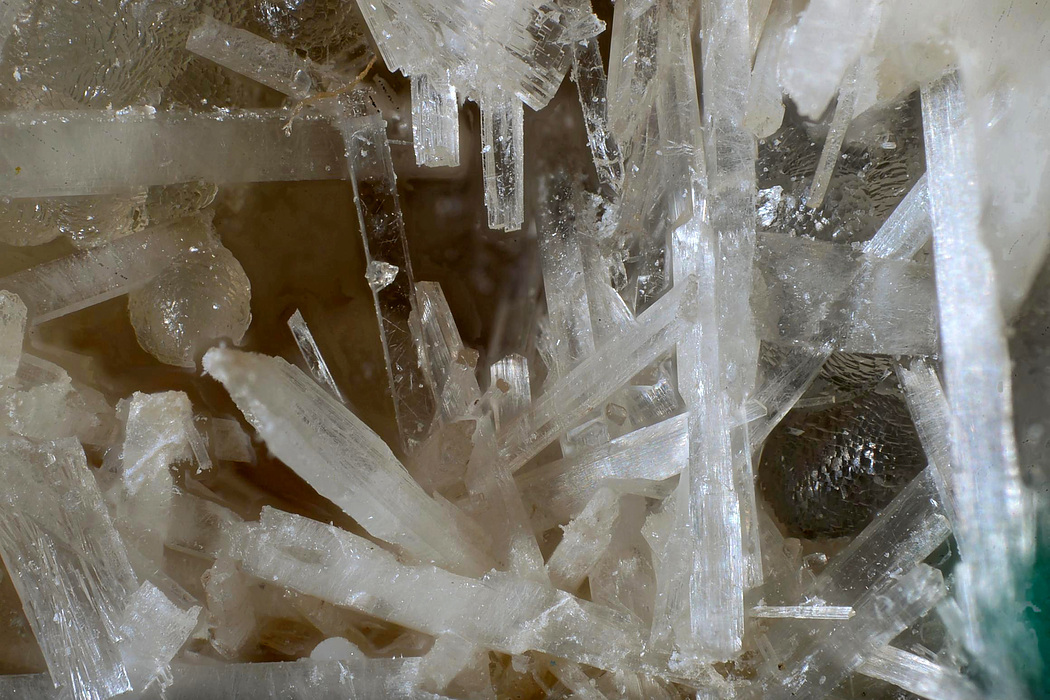
Well-shaped, prismatic to acicular crystals, up to 1 x 1.5 x 8 mm, usually forming spray- bush-like or open-work aggregates, up to 1.5 cm across; the latter comprise interrupted crusts, up to 3 x 5 cm.
Place of Conservation of Type Material:
Collections of the Fersman Mineralogical Museum, Russian Academy of Sciences, Leninskiy Prospekt 18-2, Moscow 119071, Russia, registration number 5643/1.
Geological Setting of Type Material:
Cavities of grossular rodingite within a chrysotile asbestos deposit.
Associated Minerals at Type Locality:
Synonyms of Paratobermorite
Other Language Names for Paratobermorite
Dutch:Paratobermoriet
German:Paratobermorit
Relationship of Paratobermorite to other Species
Member of:
Other Members of Tobermorite Supergroup:
| Clinotobermorite | Ca5Si6O17 · 5H2O | Mon. |
| Plombièrite | Ca5Si6O16(OH)2 · 7H2O | Orth. |
| Riversideite | Ca5Si6O16(OH)2 · 2H2O | Orth. |
| Tobermorite Group | Ca4+x(AlySi6-y)O15+2x-y · 5H2O |
Common Associates
Associations Based on Photo Data:
Related Minerals - Strunz-mindat Grouping
| 9.DG. | Barrydawsonite-(Y) | Na1.5Y0.5CaSi3O8(OH) |
| 9.DG. | Calcinaksite | KNaCa(Si4O10) · H2O |
| 9.DG. | Alvesite | NaKZrSi6O15 · 2H2O |
| 9.DG.02 | Steedeite | NaMn2[Si3BO9](OH)2 |
| 9.DG.02 | Nolzeite | NaMn2[Si3BO9](OH)2 · 2H2O |
| 9.DG.05 | Murakamiite | LiCa2Si3O8(OH) |
| 9.DG.05 | Serandite | NaMn2+2Si3O8(OH) |
| 9.DG.05 | Bustamite | CaMn2+(Si2O6) |
| 9.DG.05 | Pectolite | NaCa2Si3O8(OH) |
| 9.DG.05 | Tanohataite | LiMn2Si3O8(OH) |
| 9.DG.05 | Dalnegorskite | Ca5Mn2+(Si3O9)2 |
| 9.DG.05 | 'Wollastonite-1A' | CaSiO3 |
| 9.DG.05 | Wollastonite | Ca3(Si3O9) |
| 9.DG.05 | Ferrobustamite | CaFe2+(Si2O6) |
| 9.DG.05 | Schizolite | NaCaMnSi3O8(OH) |
| 9.DG.07 | Cascandite | CaScSi3O8(OH) |
| 9.DG.08 | Plombièrite | Ca5Si6O16(OH)2 · 7H2O |
| 9.DG.10 | Clinotobermorite | Ca5Si6O17 · 5H2O |
| 9.DG.10 | Riversideite | Ca5Si6O16(OH)2 · 2H2O |
| 9.DG.10 | Tobermorite | Ca5Si6O17 · 5H2O |
| 9.DG.12 | Jusite | Na2Ca15Al4Si16O54 · 17H2O |
| 9.DG.12 | Kenotobermorite | Ca4Si6O15(OH)2 · 5H2O |
| 9.DG.15 | Foshagite | Ca4(Si3O9)(OH)2 |
| 9.DG.20 | Jennite | Ca9(Si3O9)2(OH)8 · 8H2O |
| 9.DG.20 | Kamenevite | K2TiSi3O9 · H2O |
| 9.DG.25 | Paraumbite | K3Zr2H(Si3O9)2 · nH2O |
| 9.DG.25 | Umbite | K2(Zr,Ti)Si3O9 · H2O |
| 9.DG.30 | Sørensenite | Na4SnBe2Si6O16(OH)4 |
| 9.DG.32 | Escheite | Ca2NaMnTi5[Si12O34]O2(OH)3 · 12H2O |
| 9.DG.35 | Xonotlite | Ca6(Si6O17)(OH)2 |
| 9.DG.40 | Hillebrandite | Ca2(SiO3)(OH)2 |
| 9.DG.45 | Zorite | Na8(Ti,Nb)5(Si6O17)2(OH,O)5 · 14H2O |
| 9.DG.45 | Chivruaiite | Ca4(Ti,Nb)5(Si6O17)2(OH,O)5 · 13-14H2O |
| 9.DG.50 | Haineaultite | (Na,Ca)5Ca(Ti,Nb)5(Si6O17)2(OH,F)8 · 5H2O |
| 9.DG.55 | Epididymite | Na2Be2Si6O15 · H2O |
| 9.DG.60 | Eudidymite | Na2Be2Si6O15 · H2O |
| 9.DG.65 | Elpidite | Na2ZrSi6O15 · 3H2O |
| 9.DG.65 | Patynite | NaKCa4[Si9O23] |
| 9.DG.67 | Whelanite | Cu2+2Ca6[Si6O17(OH)](CO3)(OH)3 · 2H2O |
| 9.DG.70 | Enricofrancoite | KNaCaSi4O10 |
| 9.DG.70 | Yusupovite | Na2Zr(Si6O15) · 2.5H2O |
| 9.DG.70 | Litidionite | KNaCuSi4O10 |
| 9.DG.70 | Fenaksite | (K,Na)4(Fe,Mn)2(Si4O10)2(OH,F) |
| 9.DG.70 | Manaksite | KNaMnSi4O10 |
| 9.DG.75 | Senkevichite | CsKNaCa2TiO[Si7O18](OH) |
| 9.DG.75 | Tinaksite | K2Na(Ca,Mn2+)2TiO[Si7O18(OH)] |
| 9.DG.75 | Tokkoite | K2Ca4[Si7O18(OH)](OH,F) |
| 9.DG.80 | Fluorcanasite | K3Na3Ca5Si12O30F4 · H2O |
| 9.DG.80 | Canasite | K3Na3Ca5Si12O30(OH)4 |
| 9.DG.85 | Miserite | K1.5-x(Ca,Y,REE)5(Si6O15)(Si2O7)(OH,F)2 · yH2O |
| 9.DG.90 | Frankamenite | K3Na3Ca5(Si12O30)(F,OH)4 · H2O |
| 9.DG.92 | Charoite | (K,Sr)15-16(Ca,Na)32[Si6O11(O,OH)6]2[Si12O18(O,OH)12]2[Si17O25(O,OH)18]2(OH,F)4 · ~3H2O |
| 9.DG.95 | Yuksporite | K4(Ca,Na)14(Sr,Ba)2(◻,Mn,Fe)(Ti,Nb)4(O,OH)4(Si6O17)2(Si2O7)3(H2O,OH)3 |
| 9.DG.97 | Eveslogite | (Na,K,Ca,Sr,Ba)48 [(Ti,Nb,Mn,Fe2+)12Si48O144(OH)12](F,OH,Cl)14 |
Fluorescence of Paratobermorite
Not fluorescent.
Other Information
IR Spectrum:
Confirms the occurrence of nonequivalent water molecules and T-O-T angles where T atoms come from neighboring chains.
Health Risks:
No information on health risks for this material has been entered into the database. You should always treat mineral specimens with care.
Internet Links for Paratobermorite
mindat.org URL:
https://www.mindat.org/min-55441.html
Please feel free to link to this page.
Please feel free to link to this page.
Search Engines:
External Links:
Mineral Dealers:
References for Paratobermorite
Reference List:
Miyawaki, Ritsuro, Hatert, Frédéric, Pasero, Marco, Mills, Stuart J. (2021) IMA Commission on New Minerals, Nomenclature and Classification (CNMNC) – Newsletter 61. European Journal of Mineralogy, 33 (3) 299-304 doi:10.5194/ejm-33-299-2021
Pekov, Igor V., Zubkova, Natalia V., Chukanov, Nikita V., Merlino, Stefano, Yapaskurt, Vasiliy O., Belakovskiy, Dmitry I., Loskutov, Alexander B., Novgorodova, Elena A., Vozchikova, Svetlana A., Britvin, Sergey N., Pushcharovsky, Dmitry Yu (2022) Paratobermorite, Ca4(Al0.5Si0.5)2Si4O16(OH)·2H2O·(Ca·3H2O), a new tobermorite-supergroup mineral with a novel topological type of the microporous crystal structure. American Mineralogist, 107 (12) 2272-2281 doi:10.2138/am-2022-8284
Localities for Paratobermorite
Showing 1 localities.
 symbol to view information about a locality.
The
symbol to view information about a locality.
The Locality List
 - This locality has map coordinates listed.
- This locality has estimated coordinates.
ⓘ - Click for references and further information on this occurrence.
? - Indicates mineral may be doubtful at this locality.
- This locality has map coordinates listed.
- This locality has estimated coordinates.
ⓘ - Click for references and further information on this occurrence.
? - Indicates mineral may be doubtful at this locality.
 - Good crystals or important locality for species.
 - World class for species or very significant.
(TL) - Type Locality for a valid mineral species.
(FRL) - First Recorded Locality for everything else (eg varieties).
- World class for species or very significant.
(TL) - Type Locality for a valid mineral species.
(FRL) - First Recorded Locality for everything else (eg varieties).
All localities listed without proper references should be considered as questionable.
Russia (TL) | |
| Miyawaki et al. (2021) +1 other reference |
Quick NavTopAbout ParatobermoriteUnique IdentifiersIMA Classification Classification Mineral SymbolsPhysical Properties Optical Data Chemistry Crystallography X-Ray Powder DiffractionType Occurrence SynonymsOther LanguagesRelationshipsCommon AssociatesStrunz-MindatFluorescence Other InformationInternet Links References Localities Locality List

Southern open pit, Bazhenovskoye deposit, Asbest, Sverdlovsk Oblast, Russia