
Pectolite
A valid IMA mineral species - grandfathered
This page is currently not sponsored. Click here to sponsor this page.

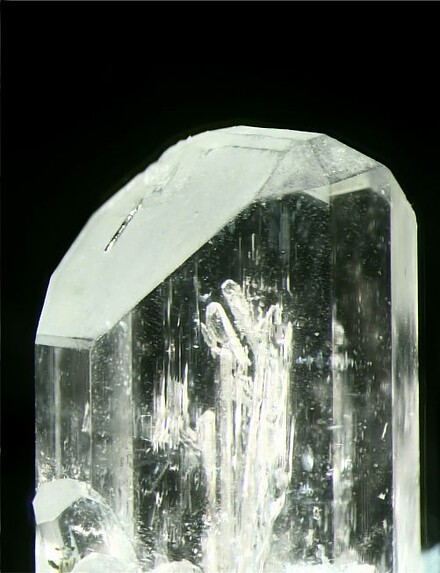
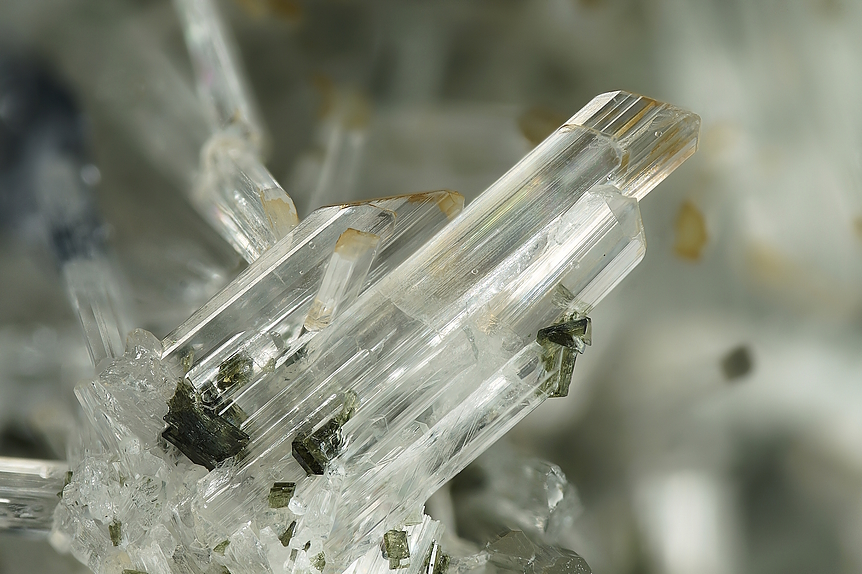
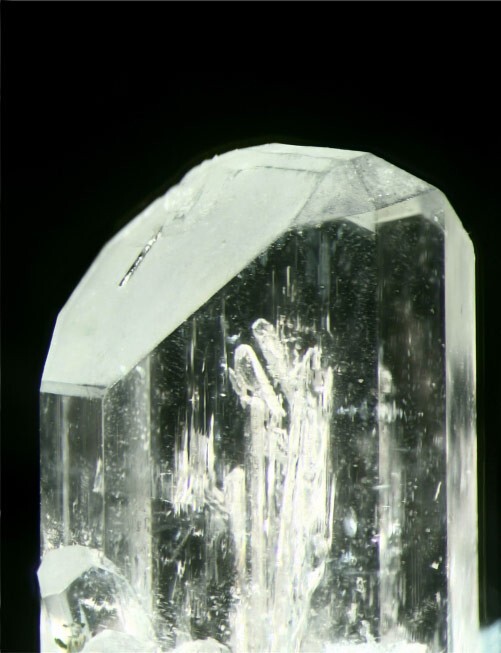
About Pectolite
Formula:
NaCa2Si3O8(OH)
Colour:
Colourless, white, pale pink, greenish, pale blue
Lustre:
Sub-Vitreous, Silky
Hardness:
4½ - 5
Specific Gravity:
2.84 - 2.9
Crystal System:
Triclinic
Member of:
Name:
Named in 1828 by Franz von Kobell from the Greek πηκτός (English: pektos) for "held tightly together", in allusion to its resistance to pulverization.
Wollastonite Group.
Pectolite-Serandite Series. The calcium analogue of Sérandite.
Constitutes serandite-schizolite-pectolite series.
 Visit gemdat.org for gemological information about Pectolite.
Pectolite-Serandite Series. The calcium analogue of Sérandite.
Constitutes serandite-schizolite-pectolite series.
Visit gemdat.org for gemological information about Pectolite.Unique Identifiers
Mindat ID:
3141
Long-form identifier:
mindat:1:1:3141:3
IMA Classification of Pectolite
Approved, 'Grandfathered' (first described prior to 1959)
Classification of Pectolite
9.DG.05
9 : SILICATES (Germanates)
D : Inosilicates
G : Inosilicates with 3-periodic single and multiple chains
9 : SILICATES (Germanates)
D : Inosilicates
G : Inosilicates with 3-periodic single and multiple chains
65.2.1.4a
65 : INOSILICATES Single-Width,Unbranched Chains,(W=1)
2 : Single-Width Unbranched Chains, W=1 with chains P=3
65 : INOSILICATES Single-Width,Unbranched Chains,(W=1)
2 : Single-Width Unbranched Chains, W=1 with chains P=3
14.6.2
14 : Silicates not Containing Aluminum
6 : Silicates of Ca with alkali or Mg or both
14 : Silicates not Containing Aluminum
6 : Silicates of Ca with alkali or Mg or both
Mineral Symbols
As of 2021 there are now IMA–CNMNC approved mineral symbols (abbreviations) for each mineral species, useful for tables and diagrams.
Please only use the official IMA–CNMNC symbol. Older variants are listed for historical use only.
Please only use the official IMA–CNMNC symbol. Older variants are listed for historical use only.
| Symbol | Source | Reference for Standard |
|---|---|---|
| Pct | IMA–CNMNC | Warr, L.N. (2021). IMA–CNMNC approved mineral symbols. Mineralogical Magazine, 85(3), 291-320. doi:10.1180/mgm.2021.43 |
| Pct | Kretz (1983) | Kretz, R. (1983) Symbols of rock-forming minerals. American Mineralogist, 68, 277–279. |
| Pct | Siivolam & Schmid (2007) | Siivolam, J. and Schmid, R. (2007) Recommendations by the IUGS Subcommission on the Systematics of Metamorphic Rocks: List of mineral abbreviations. Web-version 01.02.07. IUGS Commission on the Systematics in Petrology. download |
| Pct | Whitney & Evans (2010) | Whitney, D.L. and Evans, B.W. (2010) Abbreviations for names of rock-forming minerals. American Mineralogist, 95, 185–187 doi:10.2138/am.2010.3371 |
| Pct | The Canadian Mineralogist (2019) | The Canadian Mineralogist (2019) The Canadian Mineralogist list of symbols for rock- and ore-forming minerals (December 30, 2019). download |
Pronunciation of Pectolite
Pronunciation:
| Play | Recorded by | Country |
|---|---|---|
| Jolyon Ralph | United Kingdom |
Physical Properties of Pectolite
Sub-Vitreous, Silky
Transparency:
Transparent, Translucent
Colour:
Colourless, white, pale pink, greenish, pale blue
Streak:
White
Hardness:
4½ - 5 on Mohs scale
Tenacity:
Brittle
Cleavage:
Perfect
on {100} and {001}
on {100} and {001}
Fracture:
Irregular/Uneven
Comment:
Tough when compact.
Density:
2.84 - 2.9 g/cm3 (Measured) 2.87 g/cm3 (Calculated)
Optical Data of Pectolite
Type:
Biaxial (+)
RI values:
nα = 1.594 - 1.61 nβ = 1.603 - 1.614 nγ = 1.631 - 1.642
2V:
Measured: 50° to 63°, Calculated: 42° to 60°
Max. Birefringence:
δ = 0.032 - 0.037
Based on recorded range of RI values above.
Based on recorded range of RI values above.
Interference Colours:
The colours simulate birefringence patterns seen in thin section under crossed polars. They do not take into account mineral colouration or opacity.
Michel-Levy Bar The default colours simulate the birefringence range for a 30 µm thin-section thickness. Adjust the slider to simulate a different thickness.
Grain Simulation You can rotate the grain simulation to show how this range might look as you rotated a sample under crossed polars. Each grain retains its interference colour (retardation) while its brightness falls to black at extinction and reaches a maximum between extinction positions.
The colours simulate birefringence patterns seen in thin section under crossed polars. They do not take into account mineral colouration or opacity.
Michel-Levy Bar The default colours simulate the birefringence range for a 30 µm thin-section thickness. Adjust the slider to simulate a different thickness.
Grain Simulation You can rotate the grain simulation to show how this range might look as you rotated a sample under crossed polars. Each grain retains its interference colour (retardation) while its brightness falls to black at extinction and reaches a maximum between extinction positions.
Surface Relief:
High (positive)
Relative to Canada balsam mounting medium (n ≈ 1.537).
Relative to Canada balsam mounting medium (n ≈ 1.537).
This shows the grain boundary and Becke line effect under plane-polarised
light, based on the contrast between this mineral's average refractive
index and the mounting medium. It does not take into account mineral
colouration.
In focus
Interference Figure:
This shows the idealized biaxial acute bisectrix (Bxa) interference figure
- the conoscopic view for a grain cut perpendicular to the acute bisectrix, using
this mineral's 2V. The two small white dots mark the melatopes - the points
where the two optic axes emerge - and are shown only when they fall within the
field of view. The coloured bands are isochromatics, and the dark bands are
isogyres.
Rotate the stage: at 0°/90° the isogyres form a cross through the melatopes; at 45° they pull apart into curved hyperbolas. That splitting on rotation - absent in a uniaxial figure - is the standard diagnostic test for telling biaxial minerals from uniaxial ones. If 2V is large, the melatopes may fall outside the field of view, as they often do at the microscope too.
Rotate the stage: at 0°/90° the isogyres form a cross through the melatopes; at 45° they pull apart into curved hyperbolas. That splitting on rotation - absent in a uniaxial figure - is the standard diagnostic test for telling biaxial minerals from uniaxial ones. If 2V is large, the melatopes may fall outside the field of view, as they often do at the microscope too.
Dispersion:
r > v weak to very strong
Optical Extinction:
X ∧ c = 10°-19°; Y ∧ a = 10°-16°; Z ∧ b = 2°.
Chemistry of Pectolite
Mindat Formula:
NaCa2Si3O8(OH)
Element Weights:
Common Impurities:
K,Fe,Mg,Al,H2O
Chemical Analysis
Oxide wt%:
| 1 | 2 | 3 | |
|---|---|---|---|
| SiO2 | 54.21 % | 53.87 % | 53.86 % |
| Mn2O3* | 0.06 % | ||
| MnO* | 1.04 % | 1.51 % | |
| CaO | 32.20 % | 31.93 % | 32.81 % |
| SrO | 0.22 % | 0.16 % | 0.01 % |
| Na2O | 9.03 % | 8.76 % | 8.64 % |
| Li2O (est. stoichiometry | 0.22 % | 0.28 % | |
| H2O (by stoichiometry) | 2.70 % | 2.69 % | 2.67 % |
| P2O5 | 0.02 % | 0.03 % | 0.03 % |
| ZrO2 | 0.04 % | 0.01 % | |
| Fe2O3* | 0.01 % | ||
| NiO | 0.01 % | ||
| MgO | 0.02 % | 0.03 % | 0.02 % |
| K2O | 0.01 % | 0.01 % | 0.08 % |
| Cr2O3 | 0.01 % | ||
| FeO* | 0.03 % | 0.31 % | |
| SO3 | 0.10 % | ||
| Al2O3 | 0.01 % | ||
| Ga2O3 | 0.01 % | ||
| V2O3 | 0.02 % | ||
| MnO | 0.80 % | ||
| PbO | 0.01 % | ||
| Total: | 99.79 % | 99.32 % | 99.38 % |
Empirical formulas:
| Sample ID | Empirical Formula |
|---|---|
| 1 | (Na0.94Li~0.05?Sr0.01)(Ca1.91Mn2+0.05Na0.03)[Si3.00O8(OH)] |
| 2 | (Na0.93Li~0.06?Sr0.01)(Ca1.91Mn2+0.07Na0.02)[Si3.00O8(OH)] |
| 3 | (Na0.94Ca0.03K0.01)(Ca1.94Mn2+0.04Fe2+0.01)[Si3.02O8(OH)] |
Sample references:
| ID | Locality | Reference | Notes |
|---|---|---|---|
| 1 | N'Chwaning III Mine, N'Chwaning Mines, Joe Morolong Local Municipality, John Taolo Gaetsewe District Municipality, Northern Cape, South Africa | weakly zoned pectolite, analysis of rim displaying bright yellow cathodoluminescence. H2O calculated from stoichiometry. Estimated minor Li2O added to improve stoichiometry, but should be verified by ICP-MS or SIMS. *Fe3+/∑Fe and Mn3+/∑Mn calculated by charge balance. | |
| 2 | " " | weakly zoned pectolite, analysis of core displaying pale yellow cathodoluminescence. H2O calculated from stoichiometry. Estimated minor Li2O added to improve stoichiometry, but should be verified by ICP-MS or SIMS. *Fe3+/∑Fe and Mn3+/∑Mn calculated by charge balance. | |
| 3 | North Wilson pit, Union Carbide Mine, Wilson Springs, Garland County, Arkansas, USA | observed as rims around some wollastonite grains; note that pectolite was not observed visually in the hand sample. Normalized to ∑(cations) = 6. *Fe3+/∑Fe calculated by charge balance; H2O calculated by stoichiometry. |
Crystallography of Pectolite
Polytype:
Formula:
Crystal System:
Class (H-M)
Space Group:
Space Group Setting:
Cell Parameters:
Ratio:
Unit Cell Volume (calc):
Z:
Comment:
| Pectolite-1A | Pectolite-M2abc |
|---|---|
| NaCa2Si3O8(OH) | NaCa2[HSi3O9] |
| Triclinic | |
| 1 - Pinacoidal | |
| P1 | |
| a = 7.980(1) Å, b = 7.023(1) Å, c = 7.018(1) Å α = 90.54(1)°, β = 95.14(1)°, γ = 102.55(1)° | |
| a:b:c = 1.136 : 1 : 0.999 | |
| V 382.20 ų (Calculated from Unit Cell) | |
Crystal Structure
Load
Unit Cell | Unit Cell Packed
2x2x2 | 3x3x3 | 4x4x4
Unit Cell | Unit Cell Packed
2x2x2 | 3x3x3 | 4x4x4
Show
Big Balls | Small Balls | Just Balls | Spacefill
Polyhedra Off | Si Polyhedra | All Polyhedra
Remove metal-metal sticks
Big Balls | Small Balls | Just Balls | Spacefill
Polyhedra Off | Si Polyhedra | All Polyhedra
Remove metal-metal sticks
Display Options
Black Background | White Background
Perspective On | Perspective Off
2D | Stereo | Red-Blue | Red-Cyan
Black Background | White Background
Perspective On | Perspective Off
2D | Stereo | Red-Blue | Red-Cyan
View
CIF File Best | x | y | z | a | b | c
CIF File Best | x | y | z | a | b | c
Rotation
Stop | Start
Stop | Start
Labels
Console Off | On | Grey | Yellow
Console Off | On | Grey | Yellow
Data courtesy of the American Mineralogist Crystal Structure Database. Click on an AMCSD ID to view structure
| ID | Species | Reference | Link | Year | Locality | Pressure (GPa) | Temp (K) |
|---|---|---|---|---|---|---|---|
| 0010648 | Pectolite | Prewitt C T (1967) Refinement of the structure of pectolite, Ca2NaHSi3O9 Zeitschrift fur Kristallographie 125 298-316 |  | 1967 | Erie railroad cut, Bergen Hill, New Jersey, USA | 0 | 293 |
CIF Raw Data - click here to close
X-Ray Powder Diffraction
Loading XRD data...
Data courtesy of RRUFF project at University of Arizona, used with permission.
Powder Diffraction Data:
| d-spacing | Intensity |
|---|---|
| 2.921 Å | (100) |
| 3.10 Å | (80) |
| 3.90 Å | (60) |
| 3.33 Å | (60b) |
| 3.28 Å | (60b) |
| 2.739 Å | (60) |
| 2.600 Å | (60) |
Comments:
Bergen Hill, New Jersey, USA. Data from Hildebrand (1953).
Geological Environment
Paragenetic Mode(s):
| Paragenetic Mode | Earliest Age (Ga) |
|---|---|
| Stage 3a: Earth’s earliest Hadean crust | >4.50 |
| 7 : Ultramafic igneous rocks | |
| 10 : Basalt-hosted zeolite minerals | |
| Stage 3b: Earth’s earliest hydrosphere | >4.45 |
| 13 : Hadean serpentinization | |
| Near-surface Processes | |
| 23 : Subaerial aqueous alteration by non-redox-sensitive fluids (see also #47) | |
| High-? alteration and/or metamorphism | |
| 31 : Thermally altered carbonate, phosphate, and iron formations | |
| Stage 4b: Highly evolved igneous rocks | >3.0 |
| 35 : Ultra-alkali and agpaitic igneous rocks | |
| Stage 5: Initiation of plate tectonics | <3.5-2.5 |
| 40 : Regional metamorphism (greenschist, amphibolite, granulite facies) |
Geological Setting:
Primary mineral in nepheline syenites. Hydrothermal mineral in cavities in basalts and diabases. In serpentinites and peridotites.
Type Occurrence of Pectolite
Co-Type Localities:
Place of Conservation of Type Material:
No designated type material.
Synonyms of Pectolite
Other Language Names for Pectolite
Dutch:Pectoliet
Russian:Пектолит
Simplified Chinese:针钠钙石
Spanish:Gonsogolita
Pecktolita
Pectolita
Pecktolita
Pectolita
Traditional Chinese:針鈉鈣石
Varieties of Pectolite
| Larimar | A trade name for a bluish massive pectolite found in the Dominican Republic and exploited as a gem material. Originally described from Filipinas Larimar Mine, Los Checheses, Sierra de Baoruco, Barahona Province, Dominican Republic. |
| Manganese-bearing Pectolite | A manganese-bearing variety of pectolite. |
Relationship of Pectolite to other Species
Member of:
Other Members of Wollastonite Group:
| Barrydawsonite-(Y) | Na1.5Y0.5CaSi3O8(OH) | Mon. 2/m : P21/b |
| Bustamite | CaMn2+(Si2O6) | Tric. 1 : P1 |
| Cascandite | CaScSi3O8(OH) | Tric. 1 |
| Dalnegorskite | Ca5Mn2+(Si3O9)2 | Tric. 1 : P1 |
| Ferrobustamite | CaFe2+(Si2O6) | Tric. 1 |
| Mendigite | Mn2Mn2MnCa(Si3O9)2 | Tric. 1 : P1 |
| Murakamiite | LiCa2Si3O8(OH) | Tric. 1 : P1 |
| Schizolite | NaCaMnSi3O8(OH) | Tric. 1 : P1 |
| Serandite | NaMn2+2Si3O8(OH) | Tric. 1 : P1 |
| Tanohataite | LiMn2Si3O8(OH) | Tric. 1 : P1 |
| Vistepite | SnMn4B2Si4O16(OH)2 | Tric. 1 : P1 |
| Wollastonite | Ca3(Si3O9) | Tric. 1 : P1 |
Forms a series with:
Common Associates
Associations Based on Photo Data:
| 146 photos of Pectolite associated with Calcite | CaCO3 |
| 142 photos of Pectolite associated with Prehnite | Ca2Al2Si3O10(OH)2 |
| 88 photos of Pectolite associated with Fluorapophyllite-(K) | KCa4(Si8O20)(F,OH) · 8H2O |
| 64 photos of Pectolite associated with Apophyllite Group | AB4[Si8O20]X · 8H2O |
| 63 photos of Pectolite associated with Natrolite | Na2Al2Si3O10 · 2H2O |
| 62 photos of Pectolite associated with Grossular | Ca3Al2(SiO4)3 |
| 54 photos of Pectolite associated with Datolite | CaB(SiO4)(OH) |
| 49 photos of Pectolite associated with Aegirine | NaFe3+Si2O6 |
| 46 photos of Pectolite associated with Villiaumite | NaF |
| 41 photos of Pectolite associated with Pyrite | FeS2 |
Related Minerals - Strunz-mindat Grouping
| 9.DG. | Barrydawsonite-(Y) | Na1.5Y0.5CaSi3O8(OH) |
| 9.DG. | Paratobermorite | Ca5AlSi5O16(OH) · 5H2O |
| 9.DG. | Calcinaksite | KNaCa(Si4O10) · H2O |
| 9.DG. | Alvesite | NaKZrSi6O15 · 2H2O |
| 9.DG.02 | Steedeite | NaMn2[Si3BO9](OH)2 |
| 9.DG.02 | Nolzeite | NaMn2[Si3BO9](OH)2 · 2H2O |
| 9.DG.05 | Murakamiite | LiCa2Si3O8(OH) |
| 9.DG.05 | Serandite | NaMn2+2Si3O8(OH) |
| 9.DG.05 | Bustamite | CaMn2+(Si2O6) |
| 9.DG.05 | Tanohataite | LiMn2Si3O8(OH) |
| 9.DG.05 | Dalnegorskite | Ca5Mn2+(Si3O9)2 |
| 9.DG.05 | 'Wollastonite-1A' | CaSiO3 |
| 9.DG.05 | Wollastonite | Ca3(Si3O9) |
| 9.DG.05 | Ferrobustamite | CaFe2+(Si2O6) |
| 9.DG.05 | Schizolite | NaCaMnSi3O8(OH) |
| 9.DG.07 | Cascandite | CaScSi3O8(OH) |
| 9.DG.08 | Plombièrite | Ca5Si6O16(OH)2 · 7H2O |
| 9.DG.10 | Clinotobermorite | Ca5Si6O17 · 5H2O |
| 9.DG.10 | Riversideite | Ca5Si6O16(OH)2 · 2H2O |
| 9.DG.10 | Tobermorite | Ca5Si6O17 · 5H2O |
| 9.DG.12 | Jusite | Na2Ca15Al4Si16O54 · 17H2O |
| 9.DG.12 | Kenotobermorite | Ca4Si6O15(OH)2 · 5H2O |
| 9.DG.15 | Foshagite | Ca4(Si3O9)(OH)2 |
| 9.DG.20 | Jennite | Ca9(Si3O9)2(OH)8 · 8H2O |
| 9.DG.20 | Kamenevite | K2TiSi3O9 · H2O |
| 9.DG.25 | Paraumbite | K3Zr2H(Si3O9)2 · nH2O |
| 9.DG.25 | Umbite | K2(Zr,Ti)Si3O9 · H2O |
| 9.DG.30 | Sørensenite | Na4SnBe2Si6O16(OH)4 |
| 9.DG.32 | Escheite | Ca2NaMnTi5[Si12O34]O2(OH)3 · 12H2O |
| 9.DG.35 | Xonotlite | Ca6(Si6O17)(OH)2 |
| 9.DG.40 | Hillebrandite | Ca2(SiO3)(OH)2 |
| 9.DG.45 | Zorite | Na8(Ti,Nb)5(Si6O17)2(OH,O)5 · 14H2O |
| 9.DG.45 | Chivruaiite | Ca4(Ti,Nb)5(Si6O17)2(OH,O)5 · 13-14H2O |
| 9.DG.50 | Haineaultite | (Na,Ca)5Ca(Ti,Nb)5(Si6O17)2(OH,F)8 · 5H2O |
| 9.DG.55 | Epididymite | Na2Be2Si6O15 · H2O |
| 9.DG.60 | Eudidymite | Na2Be2Si6O15 · H2O |
| 9.DG.65 | Elpidite | Na2ZrSi6O15 · 3H2O |
| 9.DG.65 | Patynite | NaKCa4[Si9O23] |
| 9.DG.67 | Whelanite | Cu2+2Ca6[Si6O17(OH)](CO3)(OH)3 · 2H2O |
| 9.DG.70 | Enricofrancoite | KNaCaSi4O10 |
| 9.DG.70 | Yusupovite | Na2Zr(Si6O15) · 2.5H2O |
| 9.DG.70 | Litidionite | KNaCuSi4O10 |
| 9.DG.70 | Fenaksite | (K,Na)4(Fe,Mn)2(Si4O10)2(OH,F) |
| 9.DG.70 | Manaksite | KNaMnSi4O10 |
| 9.DG.75 | Senkevichite | CsKNaCa2TiO[Si7O18](OH) |
| 9.DG.75 | Tinaksite | K2Na(Ca,Mn2+)2TiO[Si7O18(OH)] |
| 9.DG.75 | Tokkoite | K2Ca4[Si7O18(OH)](OH,F) |
| 9.DG.80 | Fluorcanasite | K3Na3Ca5Si12O30F4 · H2O |
| 9.DG.80 | Canasite | K3Na3Ca5Si12O30(OH)4 |
| 9.DG.85 | Miserite | K1.5-x(Ca,Y,REE)5(Si6O15)(Si2O7)(OH,F)2 · yH2O |
| 9.DG.90 | Frankamenite | K3Na3Ca5(Si12O30)(F,OH)4 · H2O |
| 9.DG.92 | Charoite | (K,Sr)15-16(Ca,Na)32[Si6O11(O,OH)6]2[Si12O18(O,OH)12]2[Si17O25(O,OH)18]2(OH,F)4 · ~3H2O |
| 9.DG.95 | Yuksporite | K4(Ca,Na)14(Sr,Ba)2(◻,Mn,Fe)(Ti,Nb)4(O,OH)4(Si6O17)2(Si2O7)3(H2O,OH)3 |
| 9.DG.97 | Eveslogite | (Na,K,Ca,Sr,Ba)48 [(Ti,Nb,Mn,Fe2+)12Si48O144(OH)12](F,OH,Cl)14 |
Other Information
Notes:
May be triboluminescent.
Health Risks:
The white needles of pectolite are sharp and stiff and easily penetrate the skin. Once embedded they are invisible and brittle and difficult to remove, often very painful. Handle with caution at all times. Do not rub your hands after handling. Rinse hands in a strong stream of water before handling anything else, especially food.
Pectolite in petrology
An essential component of rock names highlighted in red, an accessory component in rock names highlighted in green.
Internet Links for Pectolite
mindat.org URL:
https://www.mindat.org/min-3141.html
Please feel free to link to this page.
Please feel free to link to this page.
Search Engines:
External Links:
Mineral Dealers:
References for Pectolite
Reference List:
Peacock, M. A. (1935) On Pectolite. Zeitschrift für Kristallographie , 90 (1-6). 97-111 doi:10.1524/zkri.1935.90.1.97
Hildebrand, Fred A. (1953) Minimizing the effects of preferred orientation in x-ray powder diffraction patterns. American Mineralogist, 38 (11-12) 1051-1056
Schaller, Waldemar T. (1955) The pectolite-schizolite-serandite series. American Mineralogist, 40 (11-12) 1022-1031
Buerger, M. J. (1956) The Determination of the Crystal Structure of Pectolite,Ca2NaHSi3O9. Zeitschrift für Kristallographie, 108 (3-4). 248-262 doi:10.1524/zkri.1956.108.3-4.248
Prewitt, C. T. (1967) Refinement of the structure of pectolite, Ca2NaHSi3O9. Zeitschrift für Kristallographie, 125 (125). 298-316 doi:10.1524/zkri.1967.125.125.298
Müller, Wolfgang Friedrich (1976) On stacking disorder and polytypism in pectolite and serandite. Zeitschrift für Kristallographie, 144 (1). 401-408 doi:10.1524/zkri.1976.144.1-6.401
Takéuchi, Yoshio, Kudoh, Yasuhiro (1977) Hydrogen bonding and cation ordering in Magnet Cove pectolite. Zeitschrift für Kristallographie, 146 (4-6). 281-292 doi:10.1524/zkri.1977.146.4-6.281
Fleischer, Michael, Cabri, Louis J., Chao, George Y., Pabst, Adolf (1978) New Mineral Names. American Mineralogist, 63 (3-4) 424-427
Ohashi, Yoshikazu, Finger, Larry W. (1978) The role of octahedral cations in pyroxenoid crystal chemistry. I. Bustamite, wollastonite, and the pectolite-schizolite-serandite series. American Mineralogist, 63 (3-4) 274-288
Liebau, Friedrich (1980) The role of cationic hydrogen in pyroxenoid crystal chemistry. American Mineralogist, 65 (9-10) 981-985
Scott Smith, Barbara H., Michael Skinner, E., Roger Clement, C. (1983) Further data on the occurrence of pectolite in kimberlite. Mineralogical Magazine, 47 (342) 75-78 doi:10.1180/minmag.1983.047.342.13
Woodruff, Robert E., Fritsch, Emmanuel (1989) Blue Pectolite from the Dominican Republic. Gems & Gemology, 25 (4). 216-225 doi:10.5741/gems.25.4.216
Hammer, Vera M. F., Libowitzky, Eugen, Rossman, George R. (1998) Single-crystal IR spectroscopy of very strong hydrogen bonds in pectolite, NaCa2[Si3O8(OH)], and serandite, NaMn2[Si3O8(OH)]. American Mineralogist, 83 (5) 569-576 doi:10.2138/am-1998-5-617
Frost, Ray L., López, Andrés, Theiss, Frederick L., Romano, Antônio Wilson, Scholz, Ricardo (2015) A vibrational spectroscopic study of the silicate mineral pectolite – NaCa2Si3O8(OH) Spectrochimica Acta Part A: Molecular and Biomolecular Spectroscopy, 134. 58-62 doi:10.1016/j.saa.2014.06.097
Kowalczyk, Joanna, Natkaniec-Nowak, Lucyna, Wachowiak, Jacek (2015) Larimar – a unique pectolite rock from the Dominican Republic. Geology, Geophysics & Environment, 41 (1). 101-102 doi:10.7494/geol.2015.41.1.101
Nagashima, Mariko, Imaoka, Teruyoshi, Fukuda, Chihiro, Pettke, Thomas (2018) Relationship between cation substitution and hydrogen-bond system in hydrous pyroxenoids with three-periodic single-chain of SiO4 tetrahedra: pectolite, murakamiite, marshallsussmanite, serandite and tanohataite. European Journal of Mineralogy, 30 (3) 451-463 doi:10.1127/ejm/2018/0030-2744
Localities for Pectolite
Showing 489 localities.
 symbol to view information about a locality.
The
symbol to view information about a locality.
The Locality List
 - This locality has map coordinates listed.
- This locality has estimated coordinates.
ⓘ - Click for references and further information on this occurrence.
? - Indicates mineral may be doubtful at this locality.
- This locality has map coordinates listed.
- This locality has estimated coordinates.
ⓘ - Click for references and further information on this occurrence.
? - Indicates mineral may be doubtful at this locality.
 - Good crystals or important locality for species.
 - World class for species or very significant.
(TL) - Type Locality for a valid mineral species.
(FRL) - First Recorded Locality for everything else (eg varieties).
- World class for species or very significant.
(TL) - Type Locality for a valid mineral species.
(FRL) - First Recorded Locality for everything else (eg varieties).
All localities listed without proper references should be considered as questionable.
Quick NavTopAbout PectoliteUnique IdentifiersIMA Classification Classification Mineral SymbolsPronunciation Physical Properties Optical Data Chemistry Chemical AnalysisCrystallography Crystal StructureX-Ray Powder DiffractionGeological EnvironmentType Occurrence SynonymsOther LanguagesVarietiesRelationshipsCommon AssociatesStrunz-MindatOther InformationPectolite in petrologyInternet Links References Localities Locality List

Millington Quarry, Bernards Township, Somerset County, New Jersey, USA