
Leucophanite
A valid IMA mineral species - grandfathered
This page is currently not sponsored. Click here to sponsor this page.


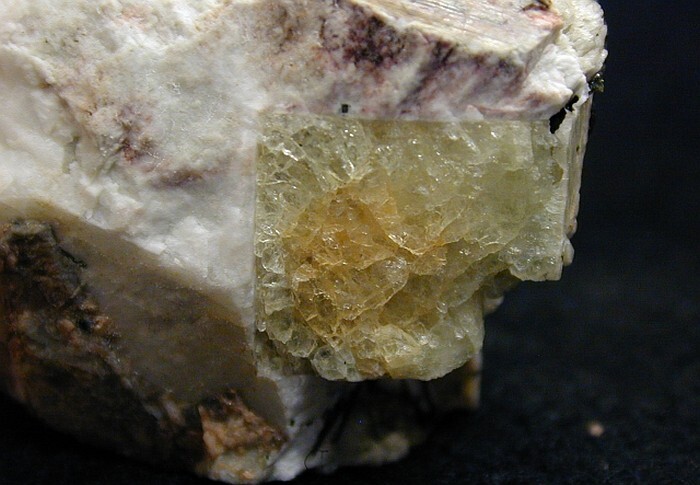


About Leucophanite
Formula:
NaCaBeSi2O6F
Colour:
Pale yellow, greenish white, yellowish green, colourless,
Lustre:
Vitreous, Greasy
Hardness:
4
Specific Gravity:
2.96 - 3.07
Crystal System:
Orthorhombic
Name:
First found, around 1824, by the Norwegian priest and mineral collector Hans Morten Thrane Esmark (1801-1882) and later named as leucophan by him in 1829. From the Greek for white λευκός, and to appear, φαίνομαι, in allusion to its property of throwing back a white shine when observing it from certain angles. The first description was published by Erdmann (1840). The name was later changed, in the 20th century, to leucophanite. The crystal structure was solved by Cannillo et al. (1967).
Type Locality:
Unique Identifiers
Mindat ID:
2383
Long-form identifier:
mindat:1:1:2383:8
IMA Classification of Leucophanite
Approved, 'Grandfathered' (first described prior to 1959)
First published:
1840
Classification of Leucophanite
9.DH.05
9 : SILICATES (Germanates)
D : Inosilicates
H : Inosilicates with 4-periodic single chains, Si4O12
9 : SILICATES (Germanates)
D : Inosilicates
H : Inosilicates with 4-periodic single chains, Si4O12
55.4.2.4
55 : SOROSILICATES Si2O7 Groups,Generally with no Additional Anions
4 : Si2O7 Groups, Generally with No Additional Anions with cations in [8] and lower coordination
55 : SOROSILICATES Si2O7 Groups,Generally with no Additional Anions
4 : Si2O7 Groups, Generally with No Additional Anions with cations in [8] and lower coordination
17.1.8
17 : Silicates Containing other Anions
1 : Silicates with fluoride (not containing Al)
17 : Silicates Containing other Anions
1 : Silicates with fluoride (not containing Al)
Mineral Symbols
As of 2021 there are now IMA–CNMNC approved mineral symbols (abbreviations) for each mineral species, useful for tables and diagrams.
| Symbol | Source | Reference for Standard |
|---|---|---|
| Lph | IMA–CNMNC | Warr, L.N. (2021). IMA–CNMNC approved mineral symbols. Mineralogical Magazine, 85(3), 291-320. doi:10.1180/mgm.2021.43 |
Physical Properties of Leucophanite
Vitreous, Greasy
Transparency:
Transparent, Translucent
Colour:
Pale yellow, greenish white, yellowish green, colourless,
Streak:
White
Hardness:
4 on Mohs scale
Tenacity:
Very brittle
Cleavage:
Perfect
On {001}, distinct on {100},{010} and [201}.
On {001}, distinct on {100},{010} and [201}.
Fracture:
Irregular/Uneven, Conchoidal
Density:
2.96 - 3.07 g/cm3 (Measured) 2.961 g/cm3 (Calculated)
Optical Data of Leucophanite
Type:
Biaxial (-)
RI values:
nα = 1.571 nβ = 1.595 nγ = 1.598
2V:
Measured: 36° to 50°, Calculated: 38°
Max. Birefringence:
δ = 0.027
Based on recorded range of RI values above.
Based on recorded range of RI values above.
Interference Colours:
The colours simulate birefringence patterns seen in thin section under crossed polars. They do not take into account mineral colouration or opacity.
Michel-Levy Bar The default colours simulate the birefringence range for a 30 µm thin-section thickness. Adjust the slider to simulate a different thickness.
Grain Simulation You can rotate the grain simulation to show how this range might look as you rotated a sample under crossed polars. Each grain retains its interference colour (retardation) while its brightness falls to black at extinction and reaches a maximum between extinction positions.
The colours simulate birefringence patterns seen in thin section under crossed polars. They do not take into account mineral colouration or opacity.
Michel-Levy Bar The default colours simulate the birefringence range for a 30 µm thin-section thickness. Adjust the slider to simulate a different thickness.
Grain Simulation You can rotate the grain simulation to show how this range might look as you rotated a sample under crossed polars. Each grain retains its interference colour (retardation) while its brightness falls to black at extinction and reaches a maximum between extinction positions.
Surface Relief:
Moderate (positive)
Relative to Canada balsam mounting medium (n ≈ 1.537).
Relative to Canada balsam mounting medium (n ≈ 1.537).
This shows the grain boundary and Becke line effect under plane-polarised
light, based on the contrast between this mineral's average refractive
index and the mounting medium. It does not take into account mineral
colouration.
In focus
Interference Figure:
This shows the idealized biaxial acute bisectrix (Bxa) interference figure
- the conoscopic view for a grain cut perpendicular to the acute bisectrix, using
this mineral's 2V. The two small white dots mark the melatopes - the points
where the two optic axes emerge - and are shown only when they fall within the
field of view. The coloured bands are isochromatics, and the dark bands are
isogyres.
Rotate the stage: at 0°/90° the isogyres form a cross through the melatopes; at 45° they pull apart into curved hyperbolas. That splitting on rotation - absent in a uniaxial figure - is the standard diagnostic test for telling biaxial minerals from uniaxial ones. If 2V is large, the melatopes may fall outside the field of view, as they often do at the microscope too.
Rotate the stage: at 0°/90° the isogyres form a cross through the melatopes; at 45° they pull apart into curved hyperbolas. That splitting on rotation - absent in a uniaxial figure - is the standard diagnostic test for telling biaxial minerals from uniaxial ones. If 2V is large, the melatopes may fall outside the field of view, as they often do at the microscope too.
Dispersion:
r > v
Optical Extinction:
X = c; Y = a; Z = b.
Chemistry of Leucophanite
Mindat Formula:
NaCaBeSi2O6F
Element Weights:
Common Impurities:
Al,Fe,Mg,K,H2O
Crystallography of Leucophanite
Crystal System:
Orthorhombic
Class (H-M):
222 - Disphenoidal
Space Group:
P212121
Cell Parameters:
a = 7.401(2) Å, b = 7.412 Å, c = 9.990(2) Å
Ratio:
a:b:c = 0.999 : 1 : 1.348
Unit Cell V:
548.01 ų (Calculated from Unit Cell)
Z:
2
Morphology:
Pinacoids {100}, {010} and {001}, prisms {110}, {201}, sphenoids {111} and{111}. Other forms include {101}, {102}, {113}.
Twinning:
Penetration fourlings; polysynthetic parallel to {110}.
Comment:
Pseudotetragonal. Space Group: P 1: a = 7.417(4) b = 7.398(4) c = 9.986(4) ® = 90:00(2) ± ¯ = 90:00(2) ± ° = 90:00(2) ± Z = 2
Crystallographic forms of Leucophanite
Crystal Atlas:
Image Loading
Click on an icon to view

Leucophanite no.25 - {110} - Goldschmidt (1913-1926)
3d models and HTML5 code kindly provided by
www.smorf.nl.
Toggle
Edge Lines | Miller Indices | Axes
Transparency
Opaque | Translucent | Transparent
View
Along a-axis | Along b-axis | Along c-axis | Start rotation | Stop rotation
Edge Lines | Miller Indices | Axes
Transparency
Opaque | Translucent | Transparent
View
Along a-axis | Along b-axis | Along c-axis | Start rotation | Stop rotation
Crystal Structure
Load
Unit Cell | Unit Cell Packed
2x2x2 | 3x3x3 | 4x4x4
Unit Cell | Unit Cell Packed
2x2x2 | 3x3x3 | 4x4x4
Show
Big Balls | Small Balls | Just Balls | Spacefill
Polyhedra Off | Si Polyhedra | All Polyhedra
Remove metal-metal sticks
Big Balls | Small Balls | Just Balls | Spacefill
Polyhedra Off | Si Polyhedra | All Polyhedra
Remove metal-metal sticks
Display Options
Black Background | White Background
Perspective On | Perspective Off
2D | Stereo | Red-Blue | Red-Cyan
Black Background | White Background
Perspective On | Perspective Off
2D | Stereo | Red-Blue | Red-Cyan
View
CIF File Best | x | y | z | a | b | c
CIF File Best | x | y | z | a | b | c
Rotation
Stop | Start
Stop | Start
Labels
Console Off | On | Grey | Yellow
Console Off | On | Grey | Yellow
Data courtesy of the American Mineralogist Crystal Structure Database. Click on an AMCSD ID to view structure
| ID | Species | Reference | Link | Year | Locality | Pressure (GPa) | Temp (K) |
|---|---|---|---|---|---|---|---|
| 0011026 | Leucophanite | Cannillo E, Giuseppetti G, Mazzi F, Tazzoli V (1992) The crystal structure of a rare earth bearing leucophanite: (Ca,RE)CaNa2Be2Si4O12(F,O)2 Zeitschrift fur Kristallographie 202 71-79 |  | 1992 | Mt Saint Hilaire, Quebec, Canada | 0 | 293 |
| 0005227 | Leucophanite | Grice J D, Hawthorne F C (1989) Refinement of the crystal structure of leucophanite The Canadian Mineralogist 27 193-197 | | 1989 | 0 | 293 |
CIF Raw Data - click here to close
X-Ray Powder Diffraction
Loading XRD data...
Data courtesy of RRUFF project at University of Arizona, used with permission.
Powder Diffraction Data:
| d-spacing | Intensity |
|---|---|
| 2.75 Å | (100) |
| 3.60 Å | (50) |
| 2.97 Å | (50) |
| 1.69 Å | (50) |
| 2.31 Å | (40) |
| 2.20 Å | (40) |
| 1.98 Å | (40) |
Comments:
Eikaholmen, Langesundsfjord, Norway. ICDD 18-711.
Geological Environment
Paragenetic Mode(s):
| Paragenetic Mode | Earliest Age (Ga) |
|---|---|
| Stage 4b: Highly evolved igneous rocks | >3.0 |
| 35 : Ultra-alkali and agpaitic igneous rocks |
Type Occurrence of Leucophanite
General Appearance of Type Material:
Masses.
Place of Conservation of Type Material:
Mineralogical-Geological Museum, University of Oslo, Oslo, Norway, number 24918.
Geological Setting of Type Material:
Nepheline syenite pegmatite.
Associated Minerals at Type Locality:
Synonyms of Leucophanite
Other Language Names for Leucophanite
Dutch:Leucophaniet
Norwegian:Leukofan
Russian:Лейкофанит
Simplified Chinese:白铍石
Spanish:Leucophanita
Traditional Chinese:白鈹石
Common Associates
Associations Based on Photo Data:
| 120 photos of Leucophanite associated with Aegirine | NaFe3+Si2O6 |
| 64 photos of Leucophanite associated with Serandite | NaMn2+2Si3O8(OH) |
| 63 photos of Leucophanite associated with Polylithionite | KLi2Al(Si4O10)(F,OH)2 |
| 52 photos of Leucophanite associated with Albite | Na(AlSi3O8) |
| 38 photos of Leucophanite associated with Microcline | K(AlSi3O8) |
| 27 photos of Leucophanite associated with Analcime | Na(AlSi2O6) · H2O |
| 19 photos of Leucophanite associated with Zircon | Zr(SiO4) |
| 17 photos of Leucophanite associated with Astrophyllite | K2NaFe2+7Ti2[Si4O12]2O2(OH)4F |
| 14 photos of Leucophanite associated with Fluorite | CaF2 |
| 13 photos of Leucophanite associated with Catapleiite | Na2Zr(Si3O9) · 2H2O |
Related Minerals - Strunz-mindat Grouping
| 9.DH. | Devilliersite | Ca4Ca2Fe3+10O4[(Fe3+10Si2)O36] |
| 9.DH. | 'Gageite-2M' | (Mn,Mg,Zn)42Si16O54(OH)40 |
| 9.DH. | Bavsiite | Ba2V2O2[Si4O12] |
| 9.DH. | Yuzuxiangite | Sr3Fe3+(Si2O6)2(OH) · 3H2O |
| 9.DH. | Louisfuchsite | Ca2(Mg4Ti2)(Al4Si2)O20 |
| 9.DH.10 | Ohmilite | Sr3(Ti,Fe3+)(Si4O12)(O,OH) · 2-3H2O |
| 9.DH.15 | Haradaite | SrVSi2O7 |
| 9.DH.15 | Suzukiite | BaVSi2O7 |
| 9.DH.20 | Shcherbakovite | (K,Ba)KNa(Ti,Nb)2(Si4O12)O2 |
| 9.DH.20 | Batisite | BaNaNaTi2(Si4O12)O2 |
| 9.DH.20 | Noonkanbahite | BaKNaTi2(Si4O12)O2 |
| 9.DH.25 | Taikanite | Sr3BaMn2+2(Si4O12)O2 |
| 9.DH.30 | Krauskopfite | BaSi2O5 · 3H2O |
| 9.DH.35 | Gageite | Mn21(Si4O12)2O3(OH)20 |
| 9.DH.35 | Balangeroite | (Mg,Fe2+,Fe3+,Mn2+)42Si16O54(OH)40 |
| 9.DH.40 | Kuratite | Ca2(Fe2+5Ti)O2[Si4Al2O18] |
| 9.DH.40 | Aenigmatite | Na4[Fe2+10Ti2]O4[Si12O36] |
| 9.DH.40 | Dorrite | Ca4(Mg3Fe3+9)O4(Si3Al8Fe3+O36) |
| 9.DH.40 | Serendibite | Ca4[Mg6Al6]O4[Si6B3Al3O36] |
| 9.DH.40 | Rhönite | Ca4[Mg8Fe3+2Ti2]O4[Si6Al6O36] |
| 9.DH.40 | Khesinite | Ca4(Mg3Fe3+9)O4(Fe3+9Si3)O36 |
| 9.DH.40 | 'UM1991-29-SiO:FeMgNa' | Na4(Mg5Fe3+7)O4[Si9Fe3+3O36] |
| 9.DH.40 | Høgtuvaite | Ca4[Fe2+6Fe3+6]O4[Si8Be2Al2O36] |
| 9.DH.40 | 'Leucorhönite' | Ca2(Mg,Fe3+,Al)6(Si,Al)6O20 |
| 9.DH.40 | Welshite | Ca4Mg9Sb3O4[Si6Be3AlFe2O36] |
| 9.DH.40 | Wilkinsonite | Na2Fe2+4Fe3+2(Si6O18)O2 |
| 9.DH.40 | Krinovite | Na2Mg4Cr3+2(Si6O18)O2 |
| 9.DH.40 | Makarochkinite | (Ca,Na)4[Fe2+8Fe3+2Ti2]O4[Si8Be2Al2O36] |
| 9.DH.45 | Sapphirine | Mg4(Mg3Al9)O4[Si3Al9O36] |
| 9.DH.50 | Khmaralite | (Mg,Al,Fe)16[(Al,Si,Be)12O36]O4 |
| 9.DH.55 | 'UM1988-26-SiO:AlMg' | Mg4Al2O[Si3Al2O15] |
| 9.DH.55 | Surinamite | (Mg,Fe)3Al4BeSi3O16 |
| 9.DH.60 | Deerite | Fe2+6Fe3+3(Si6O17)O3(OH)5 |
| 9.DH.65 | Taneyamalite | (Na,Ca)Mn2+12(Si,Al)12(O,OH)44 |
| 9.DH.65 | Howieite | Na(Fe2+,Fe3+,Al,Mg)12(Si6O17)2(O,OH)10 |
| 9.DH.70 | Johninnesite | Na2Mn2+9Mg7(OH)8[AsO4]2[Si6O17]2 |
| 9.DH.75 | Agrellite | NaCa2Si4O10F |
Fluorescence of Leucophanite
Triboluminescent with orange red light (http://www.mindat.org/mesg-6-204391.html). Pink, rarely blue in SW and LW UV light. strongly phosphorescent.
Other Information
Electrical:
Pyroelectric.
Thermal Behaviour:
Heated in a closed tube, it whitens and phosphoresces bluish. Before the blowpipe in forceps it phosphoresces and fuses with intumescence at 8 to a clear colorless glass, which becomes white on flaming, imparting an intense yellow color to the flame.
Health Risks:
No information on health risks for this material has been entered into the database. You should always treat mineral specimens with care.
Internet Links for Leucophanite
mindat.org URL:
https://www.mindat.org/min-2383.html
Please feel free to link to this page.
Please feel free to link to this page.
Search Engines:
External Links:
Mineral Dealers:
References for Leucophanite
Reference List:
Tamnau, (1839) Ueber den Leukophan. Annalen der Physik und Chemie, 124. 504 doi:10.1002/andp.18391241111
Rammelsberg, C. (1856) Ueber die Identität des Leucophans und Melinophans. Annalen der Physik und Chemie, 174. 257-261 doi:10.1002/andp.18561740608
Zachariasen, W. H. (1930) On Meliphanite and Leucophanite. Zeitschrift für Kristallographie, 74 (1-6). 226-229 doi:10.1524/zkri.1930.74.1.226
Chao, G. Y. (1967) Leucophanite, elpidite, and narsarsukite from the Desourdy quarry, Mont St. Hilaire, Quebec. The Canadian Mineralogist, 9 (2).
Cannilo, E., Giuseppetti, G., Tazzoli, V. (1967) The crystal structure of leucophanite. Acta Crystallographica, 23 (2) 255-259 doi:10.1107/s0365110x67002567
Cannillo, E., Giuseppetti, G., Tazzoli, U. (1969) On the crystal structure of leucophanite. Acta Crystallographica Section B Structural Crystallography and Crystal Chemistry, 25 (5) 993-994 doi:10.1107/s0567740869003347
Grice, Joel D., Hawthorne, Frank C. (1989) Refinement of the crystal structure of leucophanite. The Canadian Mineralogist, 27 (2) 193-197
Cannillo, Elio; Giuseppetti, Giuseppe; Mazzi, Fiorenzo; Tazzoli, Vittorio (1992) The crystal structure of a rare earth bearing leucophanite: (Ca,RE)CaNa2Be2Si4O12(F,O)2. Zeitschrift für Kristallographie, 202 (1-2). 71-79 doi:10.1524/zkri.1992.202.1-2.71
Jambor, L., Burke, Ernst A. J., Grew, Edward S., Puziewicz, Jacek (1993) New Mineral Names. American Mineralogist, 78 (5-6) 672-678
Bohse, Henning, Petersen, Ole V., Niedermayr, Gerhard (2001) Notes on leucophanite from the Ilímaussaq alkaline complex, South Greenland, in The Ilímaussaq alkaline complex, South Greenland: status of mineralogical research with new results. Geology of Greenland Survey Bulletin, 190 (190) 119-121 doi:10.34194/ggub.v190.5180
Grice, J. D., Hawthorne, F. C. (2002) New data on meliphanite, Ca4(Na,Ca)4Be4AlSi7O24(F,O)4. The Canadian Mineralogist, 40 (3) 971-980 doi:10.2113/gscanmin.40.3.971
Friis, Henrik, Balzic-Zunich, T., Finch, A. (2004) A structural and luminescence study of leucophanite, NaCaBeSi2O6F. GFF, 126 (1) 67-68 doi:10.1080/11035890401261sn8
Friis, H., Balić-Žunić, T., Williams, C. T., R. Garcia-Sanchez, (2007) Incorporation of REE into leucophanite: a compositional and structural
study. Mineralogical Magazine, 71 (6) 625-640 doi:10.1180/minmag.2007.071.6.625
Localities for Leucophanite
Showing 74 localities.
 symbol to view information about a locality.
The
symbol to view information about a locality.
The Locality List
 - This locality has map coordinates listed.
- This locality has estimated coordinates.
ⓘ - Click for references and further information on this occurrence.
? - Indicates mineral may be doubtful at this locality.
- This locality has map coordinates listed.
- This locality has estimated coordinates.
ⓘ - Click for references and further information on this occurrence.
? - Indicates mineral may be doubtful at this locality.
 - Good crystals or important locality for species.
 - World class for species or very significant.
(TL) - Type Locality for a valid mineral species.
(FRL) - First Recorded Locality for everything else (eg varieties).
- World class for species or very significant.
(TL) - Type Locality for a valid mineral species.
(FRL) - First Recorded Locality for everything else (eg varieties).
All localities listed without proper references should be considered as questionable.
Quick NavTopAbout LeucophaniteUnique IdentifiersIMA Classification Classification Mineral SymbolsPhysical Properties Optical Data Chemistry Crystallography Crystallographic forms Crystal StructureX-Ray Powder DiffractionGeological EnvironmentType Occurrence SynonymsOther LanguagesCommon AssociatesStrunz-MindatFluorescence Other InformationInternet Links References Localities Locality List

Eikaholmen, Larvik Commune, Vestfold, Norway