
Gibraltar Goldfield, Coolgardie Shire, Western Australia, Australiai
| Regional Level Types | |
|---|---|
| Gibraltar Goldfield | Ore Field |
| Coolgardie Shire | Shire |
| Western Australia | State |
| Australia | Country |
This page is currently not sponsored. Click here to sponsor this page.


Latitude & Longitude (WGS84):
31° 2' 20'' South , 120° 58' 21'' East
Latitude & Longitude (decimal):
Type:
Köppen climate type:
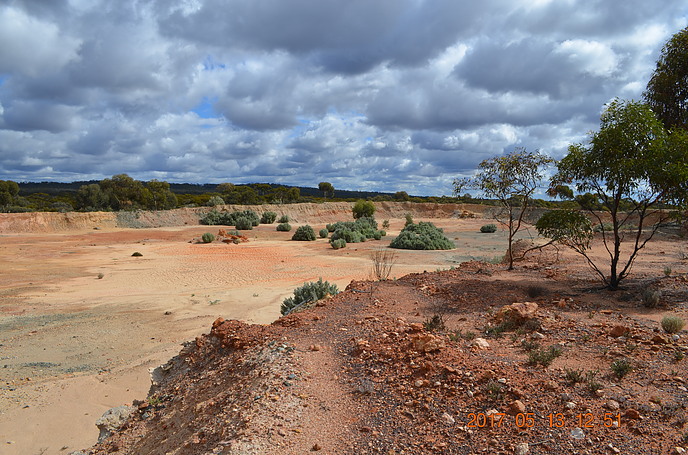
The Gibraltar Goldfield includes mines (mainly gold) south-west of Coolgardie. It includes several modern abandoned pits close to the Queen Victoria Rocks Road, starting at Lord Bob's 15 kilometres from Coolgardie to Gnarlbine about 30 kilometres from the town, in low hills and undulating country.
The gold bearing country then swings north-west to the Gibraltar group of leases proper. These are historic mines from the early 20th Century, the largest being Carlton and Lloyd George. They occupy a north north-west to south south-east shallow drainage channel. Old shafts, trenches and small tailings heaps remain. Access is via sandy tracks north-west from the Gnarlbine mine, but is not recommended as the area is isolated and getting lost is easy.
Directly north-west of here is the named Gibraltar Mine, a modern entity from 1987, and 6 kilometres further north-west the large modern abandoned Bullabulling gold mines near the Great Eastern Highway.
In 1895 there was a rush of prospectors to the area. Several small mines were developed including De Beers and Easter Gift. The lodes were low grade, and interest soon waned. Around 1912, Bill Davies found gold at what would become the Lloyd George Mine, and several leases were subsequently pegged, and shallow mines opened. Clayton and Young (surnames) found gold at what would become the Carlton mine south-east of Lloyd George.
The gold mines are in highly schistose and gneissic rocks bounded by granite. These are either dark greenish granulitic foliated fine grained amphibolite/hornblende, or fine grained paler grey granulitic geneissic feldspar/biotite. This is cut by a large number of pegmatites. Interesting minerals however are not noted apart from a topaz locality.
The deposits in the central Gibraltar leases are wide and shallow. consisting of bands of impregnated schist, with unclear boundaries. Gold is erratic, low grade with occasional rich shoots, coarse, fairly free of sulphides, and exceptionally pure. In places the pegmatites form the hanging walls of shoots. In the lodes, quartz stringers of great length are found, and occasional thick lenses of quartz. The pegmatites and quartz are gold poor or barren, with gold found in the surrounding schist.
Modern mining has excavated several open pits (at the time of writing abandoned) from the 1980's to early 2000's including Lord Bob, Norris, Grosmont and Gnarlbine near the Queen Victoria Rocks Road. In addition, Gibraltar to the north-west, and several shallow open pits at Bullabulling. Old historic gold mines litter the countryside inbetween. Up to 1933, the district had produced about 30,000 tonnes of ore for 15,000 ounces of gold. This included Bullabulling 1915 to 1921 800 tonnes 790 ounces, Lloyd George 1915 to 1919 428 tonnes 370 ounces and then later 27,838 tonnes for 13,895 ounces, De Beers and Reform 1897 to 1914 356 tonnes for 112 ounces, Quartette 27 tonnes for 109 ounces, Sala group Portland and Kim 1908 to 1909 105 tonnes at 10 ounces, Gnarlbine group of St George 1898 61 tonnes 8 ounces and Great Gnarlbine 1899 to 1902 for 148 tonnes 492 ounces, Baroota Wonder leases 1911 135 tonnes 150 ounces, and Gnarlbine mine itself 161 tonnes 780 ounces
Select Mineral List Type
Standard Detailed Gallery Strunz Chemical ElementsCommodity List
This is a list of exploitable or exploited mineral commodities recorded from this region.Mineral List
Mineral list contains entries from the region specified including sub-localities20 valid minerals.
Rock Types Recorded
Note: data is currently VERY limited. Please bear with us while we work towards adding this information!
Rock list contains entries from the region specified including sub-localities
Select Rock List Type
Alphabetical List Tree DiagramDetailed Mineral List:
Gallery:
List of minerals arranged by Strunz 10th Edition classification
| Group 1 - Elements | |||
|---|---|---|---|
| ⓘ | Native Gold | 1.AA.05 | Au |
| Group 2 - Sulphides and Sulfosalts | |||
| ⓘ | Pyrite | 2.EB.05a | FeS2 |
| Group 4 - Oxides and Hydroxides | |||
| ⓘ | Magnetite | 4.BB.05 | Fe2+Fe3+2O4 |
| ⓘ | Spinel | 4.BB.05 | MgAl2O4 |
| ⓘ | Hematite | 4.CB.05 | Fe2O3 |
| ⓘ | Quartz | 4.DA.05 | SiO2 |
| ⓘ | Columbite-(Fe) | 4.DB.35 | Fe2+Nb2O6 |
| ⓘ | Columbite-(Mn) | 4.DB.35 | Mn2+Nb2O6 |
| Group 5 - Nitrates and Carbonates | |||
| ⓘ | Calcite | 5.AB.05 | CaCO3 |
| ⓘ | Dolomite | 5.AB.10 | CaMg(CO3)2 |
| Group 9 - Silicates | |||
| ⓘ | Epidote | 9.BG.05a | (CaCa)(AlAlFe3+)O[Si2O7][SiO4](OH) |
| ⓘ | Diopside | 9.DA.15 | CaMgSi2O6 |
| ⓘ | Muscovite | 9.EC.15 | KAl2(AlSi3O10)(OH)2 |
| ⓘ | Eastonite | 9.EC.20 | KMg2Al(Al2Si2O10)(OH)2 |
| ⓘ | Nontronite | 9.EC.40 | Na0.3Fe2((Si,Al)4O10)(OH)2 · nH2O |
| ⓘ | Vermiculite | 9.EC.50 | Mg0.7(Mg,Fe,Al)6(Si,Al)8O20(OH)4 · 8H2O |
| ⓘ | Kaolinite | 9.ED.05 | Al2(Si2O5)(OH)4 |
| ⓘ | var. Chrome-Kaolinite | 9.ED.05 | (Al,Cr)2(Si2O5)(OH)4 |
| ⓘ | Halloysite | 9.ED.10 | Al2(Si2O5)(OH)4 |
| ⓘ | Microcline | 9.FA.30 | K(AlSi3O8) |
| ⓘ | Albite | 9.FA.35 | Na(AlSi3O8) |
| Unclassified | |||
| ⓘ | 'Biotite' | - | K(Fe2+/Mg)2(Al/Fe3+/Mg/Ti)([Si/Al/Fe]2Si2O10)(OH/F)2 |
| ⓘ | 'Chlorite Group' | - | |
| ⓘ | 'Feldspar Group' | - | |
| ⓘ | 'Limonite' | - | |
| ⓘ | 'Fayalite-Forsterite Series' | - | |
| ⓘ | 'Hornblende Root Name Group' | - | ◻Ca2(Z2+4Z3+)(AlSi7O22)(OH,F,Cl)2 |
| ⓘ | 'Garnet Group' | - | X3Z2(SiO4)3 |
| ⓘ | 'Manganese Oxides' | - | |
List of minerals for each chemical element
| H | Hydrogen | |
|---|---|---|
| H | ⓘ Biotite | K(Fe2+/Mg)2(Al/Fe3+/Mg/Ti)([Si/Al/Fe]2Si2O10)(OH/F)2 |
| H | ⓘ Epidote | (CaCa)(AlAlFe3+)O[Si2O7][SiO4](OH) |
| H | ⓘ Halloysite | Al2(Si2O5)(OH)4 |
| H | ⓘ Kaolinite | Al2(Si2O5)(OH)4 |
| H | ⓘ Muscovite | KAl2(AlSi3O10)(OH)2 |
| H | ⓘ Nontronite | Na0.3Fe2((Si,Al)4O10)(OH)2 · nH2O |
| H | ⓘ Vermiculite | Mg0.7(Mg,Fe,Al)6(Si,Al)8O20(OH)4 · 8H2O |
| H | ⓘ Eastonite | KMg2Al(Al2Si2O10)(OH)2 |
| H | ⓘ Hornblende Root Name Group | ◻Ca2(Z42+Z3+)(AlSi7O22)(OH,F,Cl)2 |
| H | ⓘ Kaolinite var. Chrome-Kaolinite | (Al,Cr)2(Si2O5)(OH)4 |
| C | Carbon | |
| C | ⓘ Calcite | CaCO3 |
| C | ⓘ Dolomite | CaMg(CO3)2 |
| O | Oxygen | |
| O | ⓘ Albite | Na(AlSi3O8) |
| O | ⓘ Biotite | K(Fe2+/Mg)2(Al/Fe3+/Mg/Ti)([Si/Al/Fe]2Si2O10)(OH/F)2 |
| O | ⓘ Calcite | CaCO3 |
| O | ⓘ Diopside | CaMgSi2O6 |
| O | ⓘ Dolomite | CaMg(CO3)2 |
| O | ⓘ Epidote | (CaCa)(AlAlFe3+)O[Si2O7][SiO4](OH) |
| O | ⓘ Columbite-(Fe) | Fe2+Nb2O6 |
| O | ⓘ Halloysite | Al2(Si2O5)(OH)4 |
| O | ⓘ Hematite | Fe2O3 |
| O | ⓘ Kaolinite | Al2(Si2O5)(OH)4 |
| O | ⓘ Columbite-(Mn) | Mn2+Nb2O6 |
| O | ⓘ Magnetite | Fe2+Fe23+O4 |
| O | ⓘ Microcline | K(AlSi3O8) |
| O | ⓘ Muscovite | KAl2(AlSi3O10)(OH)2 |
| O | ⓘ Nontronite | Na0.3Fe2((Si,Al)4O10)(OH)2 · nH2O |
| O | ⓘ Quartz | SiO2 |
| O | ⓘ Spinel | MgAl2O4 |
| O | ⓘ Vermiculite | Mg0.7(Mg,Fe,Al)6(Si,Al)8O20(OH)4 · 8H2O |
| O | ⓘ Eastonite | KMg2Al(Al2Si2O10)(OH)2 |
| O | ⓘ Fayalite-Forsterite Series | |
| O | ⓘ Hornblende Root Name Group | ◻Ca2(Z42+Z3+)(AlSi7O22)(OH,F,Cl)2 |
| O | ⓘ Kaolinite var. Chrome-Kaolinite | (Al,Cr)2(Si2O5)(OH)4 |
| O | ⓘ Garnet Group | X3Z2(SiO4)3 |
| F | Fluorine | |
| F | ⓘ Biotite | K(Fe2+/Mg)2(Al/Fe3+/Mg/Ti)([Si/Al/Fe]2Si2O10)(OH/F)2 |
| F | ⓘ Hornblende Root Name Group | ◻Ca2(Z42+Z3+)(AlSi7O22)(OH,F,Cl)2 |
| Na | Sodium | |
| Na | ⓘ Albite | Na(AlSi3O8) |
| Na | ⓘ Nontronite | Na0.3Fe2((Si,Al)4O10)(OH)2 · nH2O |
| Mg | Magnesium | |
| Mg | ⓘ Biotite | K(Fe2+/Mg)2(Al/Fe3+/Mg/Ti)([Si/Al/Fe]2Si2O10)(OH/F)2 |
| Mg | ⓘ Diopside | CaMgSi2O6 |
| Mg | ⓘ Dolomite | CaMg(CO3)2 |
| Mg | ⓘ Spinel | MgAl2O4 |
| Mg | ⓘ Vermiculite | Mg0.7(Mg,Fe,Al)6(Si,Al)8O20(OH)4 · 8H2O |
| Mg | ⓘ Eastonite | KMg2Al(Al2Si2O10)(OH)2 |
| Mg | ⓘ Fayalite-Forsterite Series | |
| Al | Aluminium | |
| Al | ⓘ Albite | Na(AlSi3O8) |
| Al | ⓘ Biotite | K(Fe2+/Mg)2(Al/Fe3+/Mg/Ti)([Si/Al/Fe]2Si2O10)(OH/F)2 |
| Al | ⓘ Epidote | (CaCa)(AlAlFe3+)O[Si2O7][SiO4](OH) |
| Al | ⓘ Halloysite | Al2(Si2O5)(OH)4 |
| Al | ⓘ Kaolinite | Al2(Si2O5)(OH)4 |
| Al | ⓘ Microcline | K(AlSi3O8) |
| Al | ⓘ Muscovite | KAl2(AlSi3O10)(OH)2 |
| Al | ⓘ Nontronite | Na0.3Fe2((Si,Al)4O10)(OH)2 · nH2O |
| Al | ⓘ Spinel | MgAl2O4 |
| Al | ⓘ Vermiculite | Mg0.7(Mg,Fe,Al)6(Si,Al)8O20(OH)4 · 8H2O |
| Al | ⓘ Eastonite | KMg2Al(Al2Si2O10)(OH)2 |
| Al | ⓘ Hornblende Root Name Group | ◻Ca2(Z42+Z3+)(AlSi7O22)(OH,F,Cl)2 |
| Al | ⓘ Kaolinite var. Chrome-Kaolinite | (Al,Cr)2(Si2O5)(OH)4 |
| Si | Silicon | |
| Si | ⓘ Albite | Na(AlSi3O8) |
| Si | ⓘ Biotite | K(Fe2+/Mg)2(Al/Fe3+/Mg/Ti)([Si/Al/Fe]2Si2O10)(OH/F)2 |
| Si | ⓘ Diopside | CaMgSi2O6 |
| Si | ⓘ Epidote | (CaCa)(AlAlFe3+)O[Si2O7][SiO4](OH) |
| Si | ⓘ Halloysite | Al2(Si2O5)(OH)4 |
| Si | ⓘ Kaolinite | Al2(Si2O5)(OH)4 |
| Si | ⓘ Microcline | K(AlSi3O8) |
| Si | ⓘ Muscovite | KAl2(AlSi3O10)(OH)2 |
| Si | ⓘ Nontronite | Na0.3Fe2((Si,Al)4O10)(OH)2 · nH2O |
| Si | ⓘ Quartz | SiO2 |
| Si | ⓘ Vermiculite | Mg0.7(Mg,Fe,Al)6(Si,Al)8O20(OH)4 · 8H2O |
| Si | ⓘ Eastonite | KMg2Al(Al2Si2O10)(OH)2 |
| Si | ⓘ Fayalite-Forsterite Series | |
| Si | ⓘ Hornblende Root Name Group | ◻Ca2(Z42+Z3+)(AlSi7O22)(OH,F,Cl)2 |
| Si | ⓘ Kaolinite var. Chrome-Kaolinite | (Al,Cr)2(Si2O5)(OH)4 |
| Si | ⓘ Garnet Group | X3Z2(SiO4)3 |
| S | Sulfur | |
| S | ⓘ Pyrite | FeS2 |
| Cl | Chlorine | |
| Cl | ⓘ Hornblende Root Name Group | ◻Ca2(Z42+Z3+)(AlSi7O22)(OH,F,Cl)2 |
| K | Potassium | |
| K | ⓘ Biotite | K(Fe2+/Mg)2(Al/Fe3+/Mg/Ti)([Si/Al/Fe]2Si2O10)(OH/F)2 |
| K | ⓘ Microcline | K(AlSi3O8) |
| K | ⓘ Muscovite | KAl2(AlSi3O10)(OH)2 |
| K | ⓘ Eastonite | KMg2Al(Al2Si2O10)(OH)2 |
| Ca | Calcium | |
| Ca | ⓘ Calcite | CaCO3 |
| Ca | ⓘ Diopside | CaMgSi2O6 |
| Ca | ⓘ Dolomite | CaMg(CO3)2 |
| Ca | ⓘ Epidote | (CaCa)(AlAlFe3+)O[Si2O7][SiO4](OH) |
| Ca | ⓘ Hornblende Root Name Group | ◻Ca2(Z42+Z3+)(AlSi7O22)(OH,F,Cl)2 |
| Ti | Titanium | |
| Ti | ⓘ Biotite | K(Fe2+/Mg)2(Al/Fe3+/Mg/Ti)([Si/Al/Fe]2Si2O10)(OH/F)2 |
| Cr | Chromium | |
| Cr | ⓘ Kaolinite var. Chrome-Kaolinite | (Al,Cr)2(Si2O5)(OH)4 |
| Mn | Manganese | |
| Mn | ⓘ Columbite-(Mn) | Mn2+Nb2O6 |
| Fe | Iron | |
| Fe | ⓘ Biotite | K(Fe2+/Mg)2(Al/Fe3+/Mg/Ti)([Si/Al/Fe]2Si2O10)(OH/F)2 |
| Fe | ⓘ Epidote | (CaCa)(AlAlFe3+)O[Si2O7][SiO4](OH) |
| Fe | ⓘ Columbite-(Fe) | Fe2+Nb2O6 |
| Fe | ⓘ Hematite | Fe2O3 |
| Fe | ⓘ Magnetite | Fe2+Fe23+O4 |
| Fe | ⓘ Nontronite | Na0.3Fe2((Si,Al)4O10)(OH)2 · nH2O |
| Fe | ⓘ Pyrite | FeS2 |
| Fe | ⓘ Vermiculite | Mg0.7(Mg,Fe,Al)6(Si,Al)8O20(OH)4 · 8H2O |
| Fe | ⓘ Fayalite-Forsterite Series | |
| Nb | Niobium | |
| Nb | ⓘ Columbite-(Fe) | Fe2+Nb2O6 |
| Nb | ⓘ Columbite-(Mn) | Mn2+Nb2O6 |
| Au | Gold | |
| Au | ⓘ Native Gold | Au |
Localities in this Region
- Western Australia
- Coolgardie Shire
- Western Australia
- Coolgardie Shire
Other Regions, Features and Areas containing this locality
Australia
- Western Australia
- Kambalda Nickel Metallogenic ProvinceGeologic Province
- West Australian ElementCraton
- Yilgarn CratonCraton
Australian PlateTectonic Plate
- West Australian Craton
- Eastern Yilgarn CratonCraton
This page contains all mineral locality references listed on mindat.org. This does not claim to be a complete list. If you know of more minerals from this site, please register so you can add to our database. This locality information is for reference purposes only. You should never attempt to
visit any sites listed in mindat.org without first ensuring that you have the permission of the land and/or mineral rights holders
for access and that you are aware of all safety precautions necessary.
References

Cheapside Gold Mine, Gibraltar Goldfield, Coolgardie Shire, Western Australia, Australia