
Mordenite
A valid IMA mineral species - grandfathered
This page is currently not sponsored. Click here to sponsor this page.



About Mordenite

Formula:
(Na2,Ca,K2)4(Al8Si40)O96 · 28H2O
Colour:
Colourless, white, yellowish, pinkish
Lustre:
Vitreous, Silky
Hardness:
3 - 4
Specific Gravity:
2.12 - 2.15
Crystal System:
Orthorhombic
Member of:
Name:
For the community of Morden, Nova Scotia, the type locality.
Type Locality:
Zeolite Group.
An unnamed K-dominant "mordenite" seems to exist in nature (e.g., Lo et al., 1991; Lo & Hsieh, 1991; Coombs et al., 1997; Sun et al., 2003). It is well-known as a synthetic compound.
An unnamed K-dominant "mordenite" seems to exist in nature (e.g., Lo et al., 1991; Lo & Hsieh, 1991; Coombs et al., 1997; Sun et al., 2003). It is well-known as a synthetic compound.
Unique Identifiers
Mindat ID:
2779
Long-form identifier:
mindat:1:1:2779:9
Similar Names
| Martinite | A valid IMA mineral species | (Na,◻,Ca)12Ca4(Si,S,B)14B2O38(OH,Cl)2F2 · 4H2O |
| Martinite (of Kloos) | A variety of Whitlockite | Ca9Mg(PO4)6(PO3OH) |
| Morvenite | A variety of Harmotome | (Ba0.5,Ca0.5,K,Na)5[Al5Si11O32] · 12H2O |
IMA Classification of Mordenite
Approved, 'Grandfathered' (first described prior to 1959)
IMA Formula:
(Na2,Ca,K2)4(Al8Si40)O96·28H2O
First published:
1864
Classification of Mordenite
9.GD.35
9 : SILICATES (Germanates)
G : Tektosilicates with zeolitic H2O; zeolite family
D : Chains of 6-membered rings – tabular zeolites
9 : SILICATES (Germanates)
G : Tektosilicates with zeolitic H2O; zeolite family
D : Chains of 6-membered rings – tabular zeolites
77.1.6.1
77 : TECTOSILICATES Zeolites
1 : Zeolite group - True zeolites
77 : TECTOSILICATES Zeolites
1 : Zeolite group - True zeolites
16.10.15
16 : Silicates Containing Aluminum and other Metals
10 : Aluminosilicates of Ca and alkalis
16 : Silicates Containing Aluminum and other Metals
10 : Aluminosilicates of Ca and alkalis
Mineral Symbols
As of 2021 there are now IMA–CNMNC approved mineral symbols (abbreviations) for each mineral species, useful for tables and diagrams.
Please only use the official IMA–CNMNC symbol. Older variants are listed for historical use only.
Please only use the official IMA–CNMNC symbol. Older variants are listed for historical use only.
| Symbol | Source | Reference for Standard |
|---|---|---|
| Mor | IMA–CNMNC | Warr, L.N. (2021). IMA–CNMNC approved mineral symbols. Mineralogical Magazine, 85(3), 291-320. doi:10.1180/mgm.2021.43 |
| Mor | Whitney & Evans (2010) | Whitney, D.L. and Evans, B.W. (2010) Abbreviations for names of rock-forming minerals. American Mineralogist, 95, 185–187 doi:10.2138/am.2010.3371 |
| Mor | The Canadian Mineralogist (2019) | The Canadian Mineralogist (2019) The Canadian Mineralogist list of symbols for rock- and ore-forming minerals (December 30, 2019). download |
| Mor | Warr (2020) | Warr, L.N. (2020) Recommended abbreviations for the names of clay minerals and associated phases. Clay Minerals, 55, 261–264 doi:10.1180/clm.2020.30 |
Physical Properties of Mordenite
Vitreous, Silky
Transparency:
Transparent, Translucent
Comment:
Pearly on {010}
Colour:
Colourless, white, yellowish, pinkish
Streak:
White
Hardness:
3 - 4 on Mohs scale
Tenacity:
Brittle
Cleavage:
Perfect
Perfect on {100}; distinct on {010}.
Perfect on {100}; distinct on {010}.
Fracture:
Irregular/Uneven
Density:
2.12 - 2.15 g/cm3 (Measured) 2.125 g/cm3 (Calculated)
Optical Data of Mordenite
Type:
Biaxial (+/-)
RI values:
nα = 1.472 - 1.483 nβ = 1.475 - 1.485 nγ = 1.477 - 1.487
2V:
Measured: 76° to 104°, Calculated: 78° to 88°
Max. Birefringence:
δ = 0.004 - 0.005
Based on recorded range of RI values above.
Based on recorded range of RI values above.
Interference Colours:
The colours simulate birefringence patterns seen in thin section under crossed polars. They do not take into account mineral colouration or opacity.
Michel-Levy Bar The default colours simulate the birefringence range for a 30 µm thin-section thickness. Adjust the slider to simulate a different thickness.
Grain Simulation You can rotate the grain simulation to show how this range might look as you rotated a sample under crossed polars. Each grain retains its interference colour (retardation) while its brightness falls to black at extinction and reaches a maximum between extinction positions.
The colours simulate birefringence patterns seen in thin section under crossed polars. They do not take into account mineral colouration or opacity.
Michel-Levy Bar The default colours simulate the birefringence range for a 30 µm thin-section thickness. Adjust the slider to simulate a different thickness.
Grain Simulation You can rotate the grain simulation to show how this range might look as you rotated a sample under crossed polars. Each grain retains its interference colour (retardation) while its brightness falls to black at extinction and reaches a maximum between extinction positions.
Surface Relief:
Moderate (negative)
Relative to Canada balsam mounting medium (n ≈ 1.537).
Relative to Canada balsam mounting medium (n ≈ 1.537).
This shows the grain boundary and Becke line effect under plane-polarised
light, based on the contrast between this mineral's average refractive
index and the mounting medium. It does not take into account mineral
colouration.
In focus
Interference Figure:
This shows the idealized biaxial acute bisectrix (Bxa) interference figure
- the conoscopic view for a grain cut perpendicular to the acute bisectrix, using
this mineral's 2V. The two small white dots mark the melatopes - the points
where the two optic axes emerge - and are shown only when they fall within the
field of view. The coloured bands are isochromatics, and the dark bands are
isogyres.
Rotate the stage: at 0°/90° the isogyres form a cross through the melatopes; at 45° they pull apart into curved hyperbolas. That splitting on rotation - absent in a uniaxial figure - is the standard diagnostic test for telling biaxial minerals from uniaxial ones. If 2V is large, the melatopes may fall outside the field of view, as they often do at the microscope too.
Rotate the stage: at 0°/90° the isogyres form a cross through the melatopes; at 45° they pull apart into curved hyperbolas. That splitting on rotation - absent in a uniaxial figure - is the standard diagnostic test for telling biaxial minerals from uniaxial ones. If 2V is large, the melatopes may fall outside the field of view, as they often do at the microscope too.
Dispersion:
none
Optical Extinction:
X = c; Y = a; Z = b.
Chemistry of Mordenite
Mindat Formula:
(Na2,Ca,K2)4(Al8Si40)O96 · 28H2O
Element Weights:
Common Impurities:
Mg
Crystallography of Mordenite
Crystal System:
Orthorhombic
Cell Parameters:
a = 18.16 Å, b = 20.45 Å, c = 7.54 Å
Ratio:
a:b:c = 0.888 : 1 : 0.369
Unit Cell V:
2,800.14 ų (Calculated from Unit Cell)
Z:
4
Morphology:
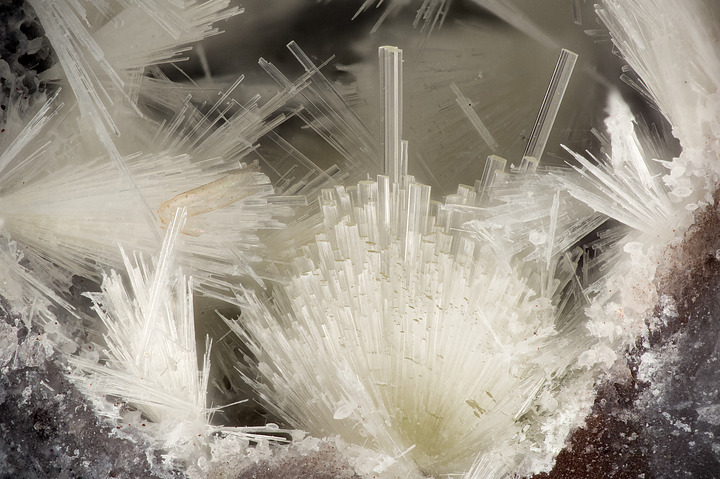
Prismatic crystals, acicular to fine fibrous, radiating groups, cottony aggregates, compact, porcelaneous.
Comment:
Point Group: mm2 or 2/m 2/m 2/m:; Space Group: Cmc21 or Cmcm
Crystal Structure
Load
Unit Cell | Unit Cell Packed
2x2x2 | 3x3x3 | 4x4x4
Unit Cell | Unit Cell Packed
2x2x2 | 3x3x3 | 4x4x4
Show
Big Balls | Small Balls | Just Balls | Spacefill
Polyhedra Off | Si Polyhedra | All Polyhedra
Remove metal-metal sticks
Big Balls | Small Balls | Just Balls | Spacefill
Polyhedra Off | Si Polyhedra | All Polyhedra
Remove metal-metal sticks
Display Options
Black Background | White Background
Perspective On | Perspective Off
2D | Stereo | Red-Blue | Red-Cyan
Black Background | White Background
Perspective On | Perspective Off
2D | Stereo | Red-Blue | Red-Cyan
View
CIF File Best | x | y | z | a | b | c
CIF File Best | x | y | z | a | b | c
Rotation
Stop | Start
Stop | Start
Labels
Console Off | On | Grey | Yellow
Console Off | On | Grey | Yellow
Data courtesy of the American Mineralogist Crystal Structure Database. Click on an AMCSD ID to view structure
| ID | Species | Reference | Link | Year | Locality | Pressure (GPa) | Temp (K) |
|---|---|---|---|---|---|---|---|
| 0006588 | Mordenite | Passaglia E, Artioli G, Gualtieri A, Carnevali R (1995) Diagenetic mordenite from Ponza, Italy European Journal of Mineralogy 7 429-438 | 1995 | Ponza, Italy | 0 | 293 | |
| 0003444 | Mordenite | Simoncic P, Armbruster T (2004) Peculiarity and defect structure of the natural and synthetic zeolite mordenite: A single-crystal X-ray study American Mineralogist 89 421-431 |  | 2004 | 0 | 293 | |
| 0003443 | Mordenite | Simoncic P, Armbruster T (2004) Peculiarity and defect structure of the natural and synthetic zeolite mordenite: A single-crystal X-ray study American Mineralogist 89 421-431 | | 2004 | 0 | 293 | |
| 0006998 | Mordenite | Martucci A, Sacerdoti M, Cruciani G, Dalconi C (2003) In situ time resolved synchrotron powder diffraction study of mordenite European Journal of Mineralogy 15 485-493 | 2003 | 0 | 293 | ||
| 0006997 | Mordenite | Martucci A, Sacerdoti M, Cruciani G, Dalconi C (2003) In situ time resolved synchrotron powder diffraction study of mordenite European Journal of Mineralogy 15 485-493 | 2003 | 0 | 293 | ||
| 0006996 | Mordenite | Martucci A, Sacerdoti M, Cruciani G, Dalconi C (2003) In situ time resolved synchrotron powder diffraction study of mordenite European Journal of Mineralogy 15 485-493 | 2003 | 0 | 293 | ||
| 0006995 | Mordenite | Martucci A, Sacerdoti M, Cruciani G, Dalconi C (2003) In situ time resolved synchrotron powder diffraction study of mordenite European Journal of Mineralogy 15 485-493 | 2003 | 0 | 293 |
CIF Raw Data - click here to close
X-Ray Powder Diffraction
Loading XRD data...
Data courtesy of RRUFF project at University of Arizona, used with permission.
Powder Diffraction Data:
| d-spacing | Intensity |
|---|---|
| 3.483 Å | (100) |
| 3.222 Å | (100) |
| 9.10 Å | (90) |
| 6.61 Å | (90) |
| 3.999 Å | (90) |
| 3.393 Å | (90) |
| 4.525 Å | (80) |
Comments:
Aros, Isle of Mull, Scotland. Data from Harris and Brindley (1954).
Geological Environment
Paragenetic Mode(s):
| Paragenetic Mode | Earliest Age (Ga) |
|---|---|
| Stage 3a: Earth’s earliest Hadean crust | >4.50 |
| 9 : Lava/xenolith minerals (hornfels, sanidinite facies) | |
| 10 : Basalt-hosted zeolite minerals | |
| Stage 3b: Earth’s earliest hydrosphere | >4.45 |
| 14 : Hot springs, geysers, and other subaerial geothermal minerals | |
| 16 : Low-? aqueous alteration of Hadean subaerial lithologies (see also #23) | |
| 17 : Marine authigenic Hadean minerals (see also #24) | |
| Near-surface Processes | |
| 24 : Authigenic minerals in terrestrial sediments (see also #17) | |
| 25 : Evaporites (prebiotic) |
Geological Setting:
Veins and amygdaloids in igneous rocks.
Type Occurrence of Mordenite
General Appearance of Type Material:
Rounded masses to about 5 cm, blotched with green celadonite. White, yellowish or pink, sometimes with a thin yellowish crust. With a very fine fibrous structure.
Place of Conservation of Type Material:
National Museum of Natural History, Washington, D.C., USA, R4062; The Natural History Museum, London, England, 52574.
Geological Setting of Type Material:
Basalt.
Associated Minerals at Type Locality:
Synonyms of Mordenite
Other Language Names for Mordenite
Relationship of Mordenite to other Species
Member of:
Other Members of Zeolite Group:
| Alflarsenite | NaCa2Be3Si4O13(OH) · 2H2O | Mon. 2 : P21 |
| Amicite | K2Na2Al4Si4O16 · 5H2O | Mon. 2 |
| Ammonioleucite | (NH4)(AlSi2O6) | Tet. 4/m : I41/a |
| Analcime | Na(AlSi2O6) · H2O | Tric. 1 : P1 |
| Arzamastsevite | K6Al5Si6O20(OH)4Cl | Tet. 42m : I42m |
| Bellbergite | (K,Ba,Sr)2Sr2Ca2(Ca,Na)4[Al3Si3O12]6 · 30H2O | Hex. |
| Bikitaite | LiAlSi2O6 · H2O | Tric. 1 : P1 |
| Boggsite | Ca8Na3(Si,Al)96O192 · 70H2O | Orth. mmm(2/m2/m2/m) : Imma |
| Brewsterite Subgroup | Zeolite Group. | |
| Chabazite-Levyne Subgroup | M[Al2Si4O12] · 6H2O | |
| Chiavennite | CaMnBe2Si5O13(OH)2 · 2H2O | Mon. 2/m : P21/b |
| Clinoptilolite Subgroup | (Na/Ca/K)3-6[Al6-7Si29-30O72] · 20H2O | |
| Cowlesite | CaAl2Si3O10 · 6H2O | Orth. mmm(2/m2/m2/m) |
| Dachiardite Subgroup | Zeolite Group. | |
| Direnzoite | NaK6MgCa2(Al13Si47O120) · 36H2O | Orth. mmm(2/m2/m2/m) : Pmmn |
| Edingtonite | Ba[Al2Si3O10] · 4H2O | Orth. 222 : P212121 |
| Epistilbite | CaAl2Si6O16 · 5H2O | Mon. |
| Erionite Subgroup | M2[Al4Si14O36] · 15H2O | |
| Fabrièsite | Na3Al3Si3O12 · 2H2O | Orth. mm2 : Pmm2 |
| Faujasite Subgroup | M3.5[Al7Si17O48] · 32H2O | |
| Ferrierite Subgroup | Name used for unanalysed specimens that could be either ferrierite-K, ferrierite-Mg, ... | |
| Ferrochiavennite | Ca1-2Fe[(Si,Al,Be)5Be2O13(OH)2] · 2H2O | Mon. 2/m : P21/b |
| Flörkeite | (K3Ca2Na)[Al8Si8O32] · 12H2O | Tric. 1 : P1 |
| Garronite Subgroup | ||
| Gaultite | Na4Zn2Si7O18 · 5H2O | Orth. mm2 : Fdd2 |
| Gismondine Subgroup | Zeolite Group. | |
| Gmelinite Subgroup | In 1997, gmelinite was split into Gmelinite-Ca, Gmelinite-Na and Gmelinite-K. | |
| Gobbinsite | Na5(Si11Al5)O32 · 11H2O | Orth. mmm(2/m2/m2/m) : Pnma |
| Goosecreekite | Ca[Al2Si6O16] · 5H2O | Mon. 2 : P21 |
| Gottardiite | Na3Mg3Ca5Al19Si117O272 · 93H2O | Orth. mmm(2/m2/m2/m) : Cmca |
| Heulandite Subgroup | (Na/Ca/K)5-6[Al8-9 Si27-28 O72] · nH2O | |
| Hsianghualite | Ca3Li2(Be3Si3O12)F2 | Iso. 23 : I213 |
| Kalborsite | K6Al4BSi6O20(OH)4Cl | Tet. 42m : P421c |
| Kirchhoffite | Cs(BSi2O6) | Tet. 4/mmm(4/m2/m2/m) : I41/acd |
| Laumontite | CaAl2Si4O12 · 4H2O | Mon. 2/m : B2/m |
| Leucite | K(AlSi2O6) | Tet. 4/m : I41/a |
| Limousinite | BaCa[Be4P4O16] · 6H2O | Mon. 2/m : P21/b |
| Lithosite | K6Al4Si8O25 · 2H2O | Mon. |
| Loomisite | Ba[Be2P2O8] · H2O | Mon. m |
| Lovdarite | K2Na6Be4Si14O36 · 9H2O | Orth. mm2 |
| Maricopaite | Pb7Ca2(Si,Al)48O100 · 32H2O | Orth. |
| Martinandresite | Ba2(Al4Si12O32) · 10H2O | Orth. mmm(2/m2/m2/m) : Pmmn |
| Mazzite Subgroup | Zeolite Group. | |
| Meierite | Ba44Si66Al30O192Cl25(OH)33 | Iso. m3m(4/m32/m) : Im3m |
| Merlinoite | K5Ca2(Si23Al9)O64 · 24H2O | Orth. mmm(2/m2/m2/m) : Immm |
| Montesommaite | (K,Na)9Al9Si23O64 · 10H2O | Orth. mm2 : Fdd2 |
| Mountainite | KNa2Ca2[Si8O19(OH)] · 6H2O | Mon. 2/m : P2/b |
| Mutinaite | Na3Ca4Si85Al11O192 · 60H2O | Orth. mmm(2/m2/m2/m) : Pnma |
| Nabesite | Na2BeSi4O10 · 4H2O | Orth. 222 : P212121 |
| Natrolite Subgroup | A subgroup of the Zeolite Group. | |
| Offretite | KCaMg(Si13Al5)O36 · 15H2O | Hex. 6m2 : P6m2 |
| Pahasapaite | Li8(Ca,Li,K)10.5Be24(PO4)24 · 38H2O | Iso. 23 : I23 |
| Parthéite | Ca2(Si4Al4) O15 (OH)2 · 4H2O | Mon. 2/m : B2/b |
| Paulingite Subgroup | Paulingite was originally described in 1960. | |
| Perlialite | K9Na(Ca,Sr)[Al2Si4O12]6 · 15H2O | Hex. 6/mmm(6/m2/m2/m) : P6/mmm |
| Phillipsite Subgroup | (Ca0.5,K,Na,Ba0.5)4-7[Al4-7Si12-9O32] . 12H2O | |
| Pollucite | (Cs,Na)2(Al2Si4O12) · 2H2O | Iso. m3m(4/m32/m) : Ia3d |
| Roggianite | Ca2Be(OH)2Al2Si4O13 · 2.5H2O | Tet. 4/mmm(4/m2/m2/m) : I4/mcm |
| Rongibbsite | Pb2(Si4Al)O11(OH) | Mon. 2/m : B2/m |
| Stilbite Subgroup | M6-7[Al8-9Si27-28O72] · nH2O | |
| Terranovaite | (Na,Ca)8(Si68Al12)O160 · 29H2O | Orth. |
| Thomsonite Subgroup | The large majority of "thomsonite" is thomsonite-Ca. | |
| Thornasite | Na12Th4+3(Si8O19)4 · 18H2O | Trig. 3m : R3m |
| Tschernichite | (Ca,Na2)[Al2Si4O12] · 4-8H2O | Tet. 4/mmm(4/m2/m2/m) : P4/mmm |
| Tschörtnerite | Ca4(Ca,Sr,K,Ba)3Cu3[Al3Si3O12]4(OH)8 · nH2O | Iso. m3m(4/m32/m) : Fm3m |
| 'UM1996-38-SiO:AlCaHNa' | Na-Ca-Al-Si-O-H | |
| 'UM1999-33-SiO:AlHKNa' | K7Na5Al12Si20O64 · 24H2O | |
| 'UM2002-40-SiO:AlCaHKMgNa' | (Mg,Ca,Na,K)7.5(Al12.8Si51.2)O128 · 65H2O | Tet. 422 : P4122 |
| 'Unnamed (Ca analogue of Merlinoite)' | (Ca,K,Na)5(Ca,Ba)2Al9Si23O64 · 23H2O ? | |
| Wairakite | Ca(Al2Si4O12) · 2H2O | Mon. 2/m : B2/m |
| Weinebeneite | CaBe3(PO4)2(OH)2 · 4H2O | Mon. m : Bb |
| Wenkite | (Ba,K)4(Ca,Na)6[(Si,Al)20O39(OH)2](SO4)3 · 0.5H2O | Hex. 6m2 : P62m |
| Wilancookite | (Ba5Li2◻)Ba6Be24P24O96 · 26H2O | Iso. 23 : I23 |
| Willhendersonite | KCa[Al3Si3O12] · 5H2O | Tric. 1 : P1 |
| Yugawaralite | CaAl2Si6O16 · 4H2O | Mon. m : Pb |
Common Associates
Associations Based on Photo Data:
| 189 photos of Mordenite associated with Calcite | CaCO3 |
| 156 photos of Mordenite associated with Heulandite Subgroup | (Na/Ca/K)5-6[Al8-9 Si27-28 O72] · nH2O |
| 146 photos of Mordenite associated with Heulandite-Ca | (Ca,Na)5(Si27Al9)O72 · 26H2O |
| 117 photos of Mordenite associated with Stilbite-Ca | NaCa4(Si27Al9)O72 · 28H2O |
| 116 photos of Mordenite associated with Stilbite Subgroup | M6-7[Al8-9Si27-28O72] · nH2O |
| 108 photos of Mordenite associated with Quartz | SiO2 |
| 71 photos of Mordenite associated with Cavansite | Ca(VO)Si4O10 · 4H2O |
| 68 photos of Mordenite associated with Pentagonite | Ca(VO)Si4O10 · 4H2O |
| 67 photos of Mordenite associated with Clinoptilolite Subgroup | (Na/Ca/K)3-6[Al6-7Si29-30O72] · 20H2O |
| 66 photos of Mordenite associated with 'Chalcedony' | SiO2 |
Related Minerals - Strunz-mindat Grouping
| 9.GD.05 | Gmelinite-Ca | Ca2(Si8Al4)O24 · 11H2O |
| 9.GD.05 | Gmelinite-K | K4(Si8Al4O24) · 11H2O |
| 9.GD.05 | Gmelinite-Na | Na4(Si8Al4)O24 · 11H2O |
| 9.GD.10 | Chabazite-Mg | (Mg0.7K0.5Ca0.5Na0.1)[Al3Si9O24] · 10H2O |
| 9.GD.10 | Willhendersonite | KCa[Al3Si3O12] · 5H2O |
| 9.GD.10 | Chabazite-Ca | (Ca,K2,Na2)2[Al2Si4O12]2 · 12H2O |
| 9.GD.10 | Chabazite-K | (K2,Ca,Na2,Sr,Mg)2[Al2Si4O12]2 · 12H2O |
| 9.GD.10 | Chabazite-Na | (Na2,K2,Ca,Sr,Mg)2[Al2Si4O12]2 · 12H2O |
| 9.GD.10 | Chabazite-Sr | Sr2[Al2Si4O12]2 · 12H2O |
| 9.GD.15 | Lévyne-Ca | (Ca,Na2,K2)[Al2Si4O12] · 6H2O |
| 9.GD.15 | Lévyne-Na | (Na2,Ca,K2)[Al2Si4O12] · 6H2O |
| 9.GD.20 | Erionite-Ca | (Ca,K2,Na2)2[Al4Si14O36] · 15H2O |
| 9.GD.20 | Erionite-K | (K2,Ca,Na2)2[Al4Si14O36] · 15H2O |
| 9.GD.20 | Erionite-Na | (Na2,K2,Ca)2[Al4Si14O36] · 15H2O |
| 9.GD.20 | Bellbergite | (K,Ba,Sr)2Sr2Ca2(Ca,Na)4[Al3Si3O12]6 · 30H2O |
| 9.GD.25 | Offretite | KCaMg(Si13Al5)O36 · 15H2O |
| 9.GD.25 | Wenkite | (Ba,K)4(Ca,Na)6[(Si,Al)20O39(OH)2](SO4)3 · 0.5H2O |
| 9.GD.30 | Faujasite-Ca | (Ca,Na2,Mg)3.5[Al7Si17O48] · 32H2O |
| 9.GD.30 | Faujasite-Mg | (Mg,Na2,Ca)3.5[Al7Si17O48] · 32H2O |
| 9.GD.30 | Faujasite-Na | (Na2,Ca,Mg)3.5[Al7Si17O48] · 32H2O |
| 9.GD.35 | Maricopaite | Pb7Ca2(Si,Al)48O100 · 32H2O |
| 9.GD.40 | Dachiardite-K | K4(Si20Al4O48) · 13H2O |
| 9.GD.40 | Dachiardite-Ca | (Ca,Na2,K2)5Al10Si38O96 · 25H2O |
| 9.GD.40 | Dachiardite-Na | (Na2,Ca,K2)5Al10Si38O96 · 25H2O |
| 9.GD.45 | Epistilbite | CaAl2Si6O16 · 5H2O |
| 9.GD.50 | Ferrierite-K | (K,Na)5(Si31Al5)O72 · 18H2O |
| 9.GD.50 | Ferrierite-Mg | [Mg2(K,Na)2Ca0.5](Si29Al7)O72 · 18H2O |
| 9.GD.50 | Ferrierite-Na | (Na,K)5(Si31Al5)O72 · 18H2O |
| 9.GD.50 | Ferrierite-NH4 | (NH4,Mg0.5)5(Al5Si31O72) · 22H2O |
| 9.GD.55 | Bikitaite | LiAlSi2O6 · H2O |
Other Information
Thermal Behaviour:
Before the blowpipe it fuses in a good heat without any
intumescence to a glassy bead or white enamel.
intumescence to a glassy bead or white enamel.
Notes:
Does not gelatinize, but gives slimy silica in hydrochloric acid.
Health Risks:
No information on health risks for this material has been entered into the database. You should always treat mineral specimens with care.
Internet Links for Mordenite
mindat.org URL:
https://www.mindat.org/min-2779.html
Please feel free to link to this page.
Please feel free to link to this page.
Search Engines:
External Links:
Mineral Dealers:
References for Mordenite
Reference List:
How, Henry (1864) XI.—On mordenite, a new mineral from the trap of Nova Scotia. Journal of the Chemical Society, 17. 100-104 doi:10.1039/js8641700100
Schaller, Waldemar T. (1932) Ptilolite from Utah. American Mineralogist, 17 (4) 125-127 (as ptilolite)
Waymouth, C., Thornely, P. C., Taylor, W. H. (1938) An X-ray examination of mordenite (ptilolite) Mineralogical Magazine and Journal of the Mineralogical Society, 25 (163) 212-216 doi:10.1180/minmag.1938.025.163.04
Barrer, R. M. (1948) 435. Syntheses and reactions of mordenite. Journal of the Chemical Society (Resumed), 1948. 2158-2163 doi:10.1039/jr9480002158
Harris, P. G., Brindley, G. W. (1954) Mordenite as an alteration product of a pitchstone glass. American Mineralogist, 39 (9-10) 819-824
Meier, W. M. (1961) The crystal structure of mordenite (ptilolite). Zeitschrift für Kristallographie, 115 (5). 439-450 doi:10.1524/zkri.1961.115.5-6.439
Barrer, Richard M., Klinowski, Jacek (1974) Ion exchange in mordenite. Journal of the Chemical Society, Faraday Transactions 1: Physical Chemistry in Condensed Phases, 70. 2362pp. doi:10.1039/f19747002362
Passaglia, E. (1975) The crystal chemistry of mordenites. Contributions to Mineralogy and Petrology, 50 (1) 65-77 doi:10.1007/bf00385222
Barrer, Richard M., Klinowski, Jacek (1975) Hydrogen mordenite and hydronium mordenite. Ion exchange and thermal stability. Journal of the Chemical Society, Faraday Transactions 1: Physical Chemistry in Condensed Phases, 71. 690pp. doi:10.1039/f19757100690
Pechar, F., Rykl, D. (1983) Study of the complex vibrational spectra of natural zeolite mordenites. Zeolites, 3 (4) 329-332 doi:10.1016/0144-2449(83)90177-x
Chi, Cheng-Hang, Sand, L.B. (1985) Synthesis of the large-port K-mordenite endmember: Its relation to ion-exchange theory. Zeolites, 5 (5). 309-312 doi:10.1016/0144-2449(85)90163-0
Gottardi, Glauco, Galli, Ermanno (1985) Natural Zeolites - Minerals and Rocks No. 18. Springer Berlin Heidelberg. 411 pp. doi:10.1007/978-3-642-46518-5
Alberti, A.; Davoli, P.; Vezzalini, G. (1986) The crystal structure refinement of a natural mordenite. Zeitschrift für Kristallographie, 175 (1-4). 249-256 doi:10.1524/zkri.1986.175.14.249
Passaglia, Elio, Artioli, Gilberto, Gualtieri, Alessandrο, Carnevali, Roberta (1995) Diagenetic mordenite from Ponza, Italy. European Journal of Mineralogy, 7 (2) 429-438 doi:10.1127/ejm/7/2/0429
Coombs, Douglas S., Alberti, Alberto, Armbruster, Thomas, Artioli, Gilberto, Colella, Carmine, Galli, Ermanno, Grice, Joel D., Liebau, Friedrich, Mandarino, Joseph A., Minato, Hideo, et al. (1997) Recommended nomenclature for zeolite minerals; report of the Subcommittee on Zeolites of the International Mineralogical Association, Commission on New Minerals and Mineral Names. The Canadian Mineralogist, 35 (6). 1571-1606
Cressey, G. (2004) W.A. Deer, R.A. Howie, W.S. Wise and J. Zussman. Rock-Forming Minerals. Volume 4B. Second Edition. Framework Silicates: Silica Minerals, Feldspathoids and the Zeolites.
London (The Geological Society) 2004, xv + 982 pp. £125 (£62.50 to GSL members) ISBN 1-86239-144-0. Hardback. Mineralogical Magazine, 68 (5) 831-832 doi:10.1180/0680831pp.401-407
Simoncic, Petra, Armbruster, Thomas (2004) Peculiarity and defect structure of the natural and synthetic zeolite mordenite: A single-crystal X-ray study. American Mineralogist, 89 (2) 421-431 doi:10.2138/am-2004-2-323
Korkuna, O., Leboda, R., Skubiszewska-Zięba, J., Vrublevs’ka, T., Gun’ko, V.M., Ryczkowski, J. (2006) Structural and physicochemical properties of natural zeolites: clinoptilolite and mordenite. Microporous and Mesoporous Materials, 87 (3). 243-254 doi:10.1016/j.micromeso.2005.08.002
Localities for Mordenite
Showing 537 localities.
 symbol to view information about a locality.
The
symbol to view information about a locality.
The Locality List
 - This locality has map coordinates listed.
- This locality has estimated coordinates.
ⓘ - Click for references and further information on this occurrence.
? - Indicates mineral may be doubtful at this locality.
- This locality has map coordinates listed.
- This locality has estimated coordinates.
ⓘ - Click for references and further information on this occurrence.
? - Indicates mineral may be doubtful at this locality.
 - Good crystals or important locality for species.
 - World class for species or very significant.
(TL) - Type Locality for a valid mineral species.
(FRL) - First Recorded Locality for everything else (eg varieties).
- World class for species or very significant.
(TL) - Type Locality for a valid mineral species.
(FRL) - First Recorded Locality for everything else (eg varieties).
All localities listed without proper references should be considered as questionable.
Quick NavTopAbout MordeniteUnique IdentifiersSimilar NamesIMA Classification Classification Mineral SymbolsPhysical Properties Optical Data Chemistry Crystallography Crystal StructureX-Ray Powder DiffractionGeological EnvironmentType Occurrence SynonymsOther LanguagesRelationshipsCommon AssociatesStrunz-MindatOther InformationInternet Links References Localities Locality List

Selgil, Berufjörður, Djúpavogshreppur, Múlaþing, Eastern Region, Iceland