
Clinoptilolite Subgroup
A group of related mineral species
This page is currently not sponsored. Click here to sponsor this page.
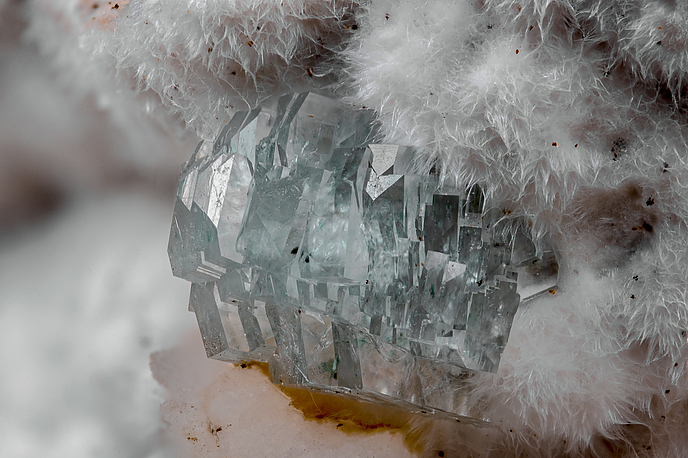
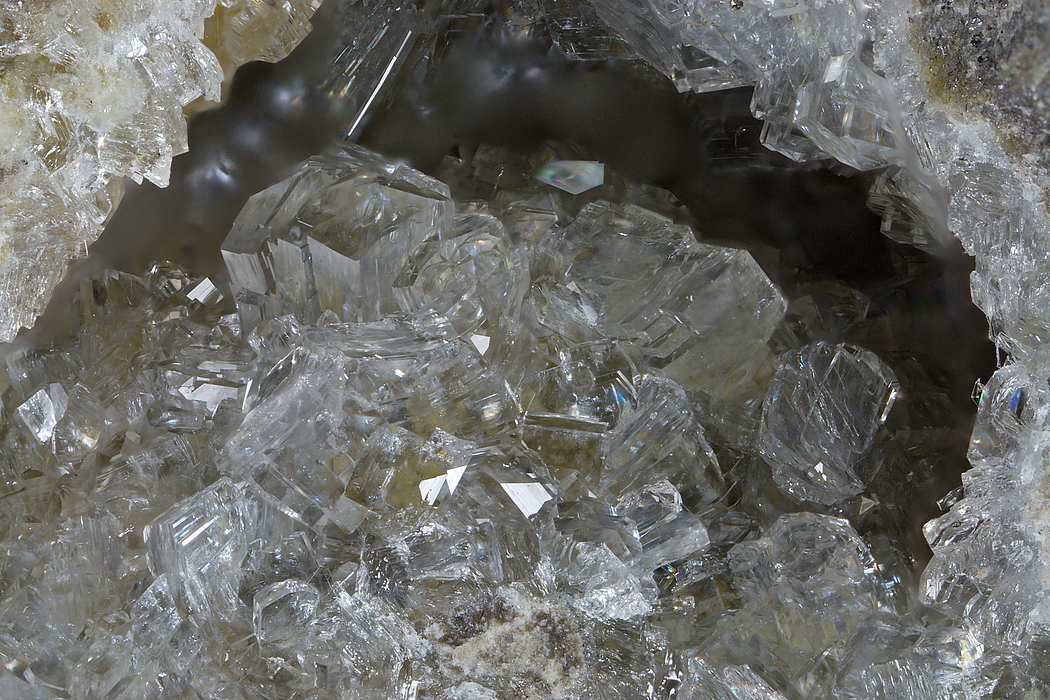


About Clinoptilolite Subgroup
Formula:
(Na/Ca/K)3-6[Al6-7Si29-30O72] · 20H2O
Member of:
Name:
From the Greek klino - "oblique" ptylon - "feather" and lithos - "stone." It was described in 1969 from an occurrence in Owl Canyon, San Bernardino County, California.
Clinoptilolite is the name applied to specimens with unknown dominance of the extra-framework cations. It comprises clinoptilolite-Ca, clinoptilolite-K and clinoptilolite-Na.
Note on the distinguishing differences between clinoptilolite and heulandite (http://rruff.info/uploads/CM35_1571.pdf ):
"Zeolite mineral species shall not be distinguished solely on the basis of the framework Si : Al ratio. An exception is made in the case of heulandite and clinoptilolite; heulandite is defined as the zeolite mineral series having the distinctive framework topology of heulandite and the ratio Si : Al < 4.0. Clinoptilolite is defined as the series with the same framework topology and Si : Al ≥ 4.0.
Application of the rule:
Many zeolites have a widely variable Si : Al ratio, but this, in itself, is not regarded as providing adequate grounds for recognition of separate species. The exception is based on entrenched usage of the names heulandite and clinoptilolite, and their convenience for recognizing an important chemical feature. The cutoff value adopted (following Boles 1972) is arbitrary in a continuous range of compositions. The usual 50% compositional rule cannot be applied, as there are no clearly defined Si,Al end-member compositions for heulandite and clinoptilolite. Thermal stability has been used by some investigators to distinguish clinoptilolite from heulandite. This is a derivative property, however, suggested by Mumpton (1960) as an aid to identification, and it is not appropriate as the basis for definition. Alietti (1972) and Boles (1972) have shown that there is no gap in composition either in framework or extra-framework cation contents between heulandite and clinoptilolite, and that samples transitional in composition show intermediate properties in terms of thermal stability.
Clinoptilolite:
The cation content is highly variable. Ca-, Na-, and K-dominant compositions are known, and Sr, Ba, and Mg are in some cases substantial. TSi (Si/(Si+Al)) is in the range 0.80–0.84. Minerals with the same framework topology but with TSi < 0.80, Si/Al < 4.0 are classified as heulandite, with which clinoptilolite forms a continuous series. Monoclinic, C2/m, or C2, or Cm.
Heulandite:
The cation content is highly variable. Ca-, Na-, K-, and Sr-dominant compositions are known, and Ba and Mg are in some cases substantial. TSi in the range 0.71 to 0.80."
Note on the distinguishing differences between clinoptilolite and heulandite (http://rruff.info/uploads/CM35_1571.pdf ):
"Zeolite mineral species shall not be distinguished solely on the basis of the framework Si : Al ratio. An exception is made in the case of heulandite and clinoptilolite; heulandite is defined as the zeolite mineral series having the distinctive framework topology of heulandite and the ratio Si : Al < 4.0. Clinoptilolite is defined as the series with the same framework topology and Si : Al ≥ 4.0.
Application of the rule:
Many zeolites have a widely variable Si : Al ratio, but this, in itself, is not regarded as providing adequate grounds for recognition of separate species. The exception is based on entrenched usage of the names heulandite and clinoptilolite, and their convenience for recognizing an important chemical feature. The cutoff value adopted (following Boles 1972) is arbitrary in a continuous range of compositions. The usual 50% compositional rule cannot be applied, as there are no clearly defined Si,Al end-member compositions for heulandite and clinoptilolite. Thermal stability has been used by some investigators to distinguish clinoptilolite from heulandite. This is a derivative property, however, suggested by Mumpton (1960) as an aid to identification, and it is not appropriate as the basis for definition. Alietti (1972) and Boles (1972) have shown that there is no gap in composition either in framework or extra-framework cation contents between heulandite and clinoptilolite, and that samples transitional in composition show intermediate properties in terms of thermal stability.
Clinoptilolite:
The cation content is highly variable. Ca-, Na-, and K-dominant compositions are known, and Sr, Ba, and Mg are in some cases substantial. TSi (Si/(Si+Al)) is in the range 0.80–0.84. Minerals with the same framework topology but with TSi < 0.80, Si/Al < 4.0 are classified as heulandite, with which clinoptilolite forms a continuous series. Monoclinic, C2/m, or C2, or Cm.
Heulandite:
The cation content is highly variable. Ca-, Na-, K-, and Sr-dominant compositions are known, and Ba and Mg are in some cases substantial. TSi in the range 0.71 to 0.80."
Unique Identifiers
Mindat ID:
1082
Long-form identifier:
mindat:1:1:1082:1
Classification of Clinoptilolite Subgroup
16.10.18
16 : Silicates Containing Aluminum and other Metals
10 : Aluminosilicates of Ca and alkalis
16 : Silicates Containing Aluminum and other Metals
10 : Aluminosilicates of Ca and alkalis
Chemistry of Clinoptilolite Subgroup
Mindat Formula:
(Na/Ca/K)3-6[Al6-7Si29-30O72] · 20H2O
Crystal Structure
Load
Unit Cell | Unit Cell Packed
2x2x2 | 3x3x3 | 4x4x4
Unit Cell | Unit Cell Packed
2x2x2 | 3x3x3 | 4x4x4
Show
Big Balls | Small Balls | Just Balls | Spacefill
Polyhedra Off | Si Polyhedra | All Polyhedra
Remove metal-metal sticks
Big Balls | Small Balls | Just Balls | Spacefill
Polyhedra Off | Si Polyhedra | All Polyhedra
Remove metal-metal sticks
Display Options
Black Background | White Background
Perspective On | Perspective Off
2D | Stereo | Red-Blue | Red-Cyan
Black Background | White Background
Perspective On | Perspective Off
2D | Stereo | Red-Blue | Red-Cyan
View
CIF File Best | x | y | z | a | b | c
CIF File Best | x | y | z | a | b | c
Rotation
Stop | Start
Stop | Start
Labels
Console Off | On | Grey | Yellow
Console Off | On | Grey | Yellow
Data courtesy of the American Mineralogist Crystal Structure Database. Click on an AMCSD ID to view structure
| ID | Species | Reference | Link | Year | Locality | Pressure (GPa) | Temp (K) |
|---|---|---|---|---|---|---|---|
| 0006813 | Clinoptilolite-Ca | Cappelletti P, Langella A, Cruciani G (1999) Crystal-chemistry and synchrotron Rietveld refinement of two different clinoptilolites from volcanoclastites of North-Western Sardinia European Journal of Mineralogy 11 1051-1060 | 1999 | volcanoclastites of North-Western Sardinia | 0 | 293 | |
| 0006812 | Clinoptilolite-Ca | Cappelletti P, Langella A, Cruciani G (1999) Crystal-chemistry and synchrotron Rietveld refinement of two different clinoptilolites from volcanoclastites of North-Western Sardinia European Journal of Mineralogy 11 1051-1060 | 1999 | volcanoclastites of North-Western Sardinia | 0 | 293 | |
| 0010793 | Clinoptilolite-Ca | Koyama K, Takeuchi Y (1977) Clinoptilolite: The distribution of potassium atoms and its role in thermal stability Zeitschrift fur Kristallographie 145 216-239 |  | 1977 | Agoura, California, USA | 0 | 293 |
| 0010792 | Clinoptilolite-Ca | Koyama K, Takeuchi Y (1977) Clinoptilolite: The distribution of potassium atoms and its role in thermal stability Zeitschrift fur Kristallographie 145 216-239 | | 1977 | Kuruma Pass, Fukushima Prefecture, Japan | 0 | 293 |
| 0015652 | Clinoptilolite-Na | Alberti A (1975) The crystal structure of two clinoptilolites Tschermaks Mineralogische und Petrographische Mitteilungen 22 25-37 | 1975 | Alpe di Siusi, Italy | 0 | 293 | |
| 0015651 | Clinoptilolite-Ca | Alberti A (1975) The crystal structure of two clinoptilolites Tschermaks Mineralogische und Petrographische Mitteilungen 22 25-37 | 1975 | Agoura, California, USA | 0 | 293 | |
| 0001550 | Clinoptilolite-K | Armbruster T (1993) Dehydration mechanism of clinoptilolite and heulandite: Single-crystal X-ray study of Na-poor, Ca-, K-, Mg-rich clinoptilolite at 100 K Sample Dehyd 3 Data obtained from the ICSD American Mineralogist 78 260-264 | | 1993 | 0 | 293 | |
| 0001549 | Clinoptilolite-K | Armbruster T (1993) Dehydration mechanism of clinoptilolite and heulandite: Single-crystal X-ray study of Na-poor, Ca-, K-, Mg-rich clinoptilolite at 100 K Sample Dehyd 2 Data obtained from the ICSD American Mineralogist 78 260-264 | | 1993 | 0 | 293 | |
| 0001548 | Clinoptilolite-Ca | Armbruster T (1993) Dehydration mechanism of clinoptilolite and heulandite: Single-crystal X-ray study of Na-poor, Ca-, K-, Mg-rich clinoptilolite at 100 K Sample Dehyd 1 Data obtained from the ICSD American Mineralogist 78 260-264 | | 1993 | 0 | 293 | |
| 0001547 | Clinoptilolite-Ca | Armbruster T (1993) Dehydration mechanism of clinoptilolite and heulandite: Single-crystal X-ray study of Na-poor, Ca-, K-, Mg-rich clinoptilolite at 100 K Sample Natural Data obtained from the ICSD American Mineralogist 78 260-264 | | 1993 | 0 | 293 | |
| 0001433 | Clinoptilolite-Na | Armbruster T, Gunter M E (1991) Stepwise dehydration of heulandite-clinoptilolite from Succor Creek, Oregon, U.S.A.: A single-crystal X-ray study at 100K sample name: dehyd4 American Mineralogist 76 1872-1883 | | 1991 | 0 | 293 | |
| 0001432 | Clinoptilolite-Na | Armbruster T, Gunter M E (1991) Stepwise dehydration of heulandite-clinoptilolite from Succor Creek, Oregon, U.S.A.: A single-crystal X-ray study at 100K sample name: dehyd3 American Mineralogist 76 1872-1883 | | 1991 | 0 | 293 | |
| 0001431 | Clinoptilolite-Na | Armbruster T, Gunter M E (1991) Stepwise dehydration of heulandite-clinoptilolite from Succor Creek, Oregon, U.S.A.: A single-crystal X-ray study at 100K sample name: dehyd2 American Mineralogist 76 1872-1883 | | 1991 | 0 | 293 | |
| 0001430 | Clinoptilolite-Na | Armbruster T, Gunter M E (1991) Stepwise dehydration of heulandite-clinoptilolite from Succor Creek, Oregon, U.S.A.: A single-crystal X-ray study at 100K sample name: dehyd1 American Mineralogist 76 1872-1883 | | 1991 | 0 | 293 | |
| 0001429 | Clinoptilolite-Na | Armbruster T, Gunter M E (1991) Stepwise dehydration of heulandite-clinoptilolite from Succor Creek, Oregon, U.S.A.: A single-crystal X-ray study at 100 K sample name: natural American Mineralogist 76 1872-1883 | | 1991 | 0 | 293 | |
| 0001304 | Clinoptilolite-Ca | Smyth J R, Spaid A T, Bish D L (1990) Crystal structures of a natural and a Cs-exchanged clinoptilolite natural sample American Mineralogist 75 522-528 | | 1990 | 0 | 293 |
CIF Raw Data - click here to close
Synonyms of Clinoptilolite Subgroup
Other Language Names for Clinoptilolite Subgroup
Relationship of Clinoptilolite Subgroup to other Species
Member of:
Other Members of Zeolite Group:
| Alflarsenite | NaCa2Be3Si4O13(OH) · 2H2O | Mon. 2 : P21 |
| Amicite | K2Na2Al4Si4O16 · 5H2O | Mon. 2 |
| Ammonioleucite | (NH4)(AlSi2O6) | Tet. 4/m : I41/a |
| Analcime | Na(AlSi2O6) · H2O | Tric. 1 : P1 |
| Arzamastsevite | K6Al5Si6O20(OH)4Cl | Tet. 42m : I42m |
| Bellbergite | (K,Ba,Sr)2Sr2Ca2(Ca,Na)4[Al3Si3O12]6 · 30H2O | Hex. |
| Bikitaite | LiAlSi2O6 · H2O | Tric. 1 : P1 |
| Boggsite | Ca8Na3(Si,Al)96O192 · 70H2O | Orth. mmm(2/m2/m2/m) : Imma |
| Brewsterite Subgroup | Zeolite Group. | |
| Chabazite-Levyne Subgroup | M[Al2Si4O12] · 6H2O | |
| Chiavennite | CaMnBe2Si5O13(OH)2 · 2H2O | Mon. 2/m : P21/b |
| Cowlesite | CaAl2Si3O10 · 6H2O | Orth. mmm(2/m2/m2/m) |
| Dachiardite Subgroup | Zeolite Group. | |
| Direnzoite | NaK6MgCa2(Al13Si47O120) · 36H2O | Orth. mmm(2/m2/m2/m) : Pmmn |
| Edingtonite | Ba[Al2Si3O10] · 4H2O | Orth. 222 : P212121 |
| Epistilbite | CaAl2Si6O16 · 5H2O | Mon. |
| Erionite Subgroup | M2[Al4Si14O36] · 15H2O | |
| Fabrièsite | Na3Al3Si3O12 · 2H2O | Orth. mm2 : Pmm2 |
| Faujasite Subgroup | M3.5[Al7Si17O48] · 32H2O | |
| Ferrierite Subgroup | Name used for unanalysed specimens that could be either ferrierite-K, ferrierite-Mg, ... | |
| Ferrochiavennite | Ca1-2Fe[(Si,Al,Be)5Be2O13(OH)2] · 2H2O | Mon. 2/m : P21/b |
| Flörkeite | (K3Ca2Na)[Al8Si8O32] · 12H2O | Tric. 1 : P1 |
| Garronite Subgroup | ||
| Gaultite | Na4Zn2Si7O18 · 5H2O | Orth. mm2 : Fdd2 |
| Gismondine Subgroup | Zeolite Group. | |
| Gmelinite Subgroup | In 1997, gmelinite was split into Gmelinite-Ca, Gmelinite-Na and Gmelinite-K. | |
| Gobbinsite | Na5(Si11Al5)O32 · 11H2O | Orth. mmm(2/m2/m2/m) : Pnma |
| Goosecreekite | Ca[Al2Si6O16] · 5H2O | Mon. 2 : P21 |
| Gottardiite | Na3Mg3Ca5Al19Si117O272 · 93H2O | Orth. mmm(2/m2/m2/m) : Cmca |
| Heulandite Subgroup | (Na/Ca/K)5-6[Al8-9 Si27-28 O72] · nH2O | |
| Hsianghualite | Ca3Li2(Be3Si3O12)F2 | Iso. 23 : I213 |
| Kalborsite | K6Al4BSi6O20(OH)4Cl | Tet. 42m : P421c |
| Kirchhoffite | Cs(BSi2O6) | Tet. 4/mmm(4/m2/m2/m) : I41/acd |
| Laumontite | CaAl2Si4O12 · 4H2O | Mon. 2/m : B2/m |
| Leucite | K(AlSi2O6) | Tet. 4/m : I41/a |
| Limousinite | BaCa[Be4P4O16] · 6H2O | Mon. 2/m : P21/b |
| Lithosite | K6Al4Si8O25 · 2H2O | Mon. |
| Loomisite | Ba[Be2P2O8] · H2O | Mon. m |
| Lovdarite | K2Na6Be4Si14O36 · 9H2O | Orth. mm2 |
| Maricopaite | Pb7Ca2(Si,Al)48O100 · 32H2O | Orth. |
| Martinandresite | Ba2(Al4Si12O32) · 10H2O | Orth. mmm(2/m2/m2/m) : Pmmn |
| Mazzite Subgroup | Zeolite Group. | |
| Meierite | Ba44Si66Al30O192Cl25(OH)33 | Iso. m3m(4/m32/m) : Im3m |
| Merlinoite | K5Ca2(Si23Al9)O64 · 24H2O | Orth. mmm(2/m2/m2/m) : Immm |
| Montesommaite | (K,Na)9Al9Si23O64 · 10H2O | Orth. mm2 : Fdd2 |
| Mordenite | (Na2,Ca,K2)4(Al8Si40)O96 · 28H2O | Orth. |
| Mountainite | KNa2Ca2[Si8O19(OH)] · 6H2O | Mon. 2/m : P2/b |
| Mutinaite | Na3Ca4Si85Al11O192 · 60H2O | Orth. mmm(2/m2/m2/m) : Pnma |
| Nabesite | Na2BeSi4O10 · 4H2O | Orth. 222 : P212121 |
| Natrolite Subgroup | A subgroup of the Zeolite Group. | |
| Offretite | KCaMg(Si13Al5)O36 · 15H2O | Hex. 6m2 : P6m2 |
| Pahasapaite | Li8(Ca,Li,K)10.5Be24(PO4)24 · 38H2O | Iso. 23 : I23 |
| Parthéite | Ca2(Si4Al4) O15 (OH)2 · 4H2O | Mon. 2/m : B2/b |
| Paulingite Subgroup | Paulingite was originally described in 1960. | |
| Perlialite | K9Na(Ca,Sr)[Al2Si4O12]6 · 15H2O | Hex. 6/mmm(6/m2/m2/m) : P6/mmm |
| Phillipsite Subgroup | (Ca0.5,K,Na,Ba0.5)4-7[Al4-7Si12-9O32] . 12H2O | |
| Pollucite | (Cs,Na)2(Al2Si4O12) · 2H2O | Iso. m3m(4/m32/m) : Ia3d |
| Roggianite | Ca2Be(OH)2Al2Si4O13 · 2.5H2O | Tet. 4/mmm(4/m2/m2/m) : I4/mcm |
| Rongibbsite | Pb2(Si4Al)O11(OH) | Mon. 2/m : B2/m |
| Stilbite Subgroup | M6-7[Al8-9Si27-28O72] · nH2O | |
| Terranovaite | (Na,Ca)8(Si68Al12)O160 · 29H2O | Orth. |
| Thomsonite Subgroup | The large majority of "thomsonite" is thomsonite-Ca. | |
| Thornasite | Na12Th4+3(Si8O19)4 · 18H2O | Trig. 3m : R3m |
| Tschernichite | (Ca,Na2)[Al2Si4O12] · 4-8H2O | Tet. 4/mmm(4/m2/m2/m) : P4/mmm |
| Tschörtnerite | Ca4(Ca,Sr,K,Ba)3Cu3[Al3Si3O12]4(OH)8 · nH2O | Iso. m3m(4/m32/m) : Fm3m |
| 'UM1996-38-SiO:AlCaHNa' | Na-Ca-Al-Si-O-H | |
| 'UM1999-33-SiO:AlHKNa' | K7Na5Al12Si20O64 · 24H2O | |
| 'UM2002-40-SiO:AlCaHKMgNa' | (Mg,Ca,Na,K)7.5(Al12.8Si51.2)O128 · 65H2O | Tet. 422 : P4122 |
| 'Unnamed (Ca analogue of Merlinoite)' | (Ca,K,Na)5(Ca,Ba)2Al9Si23O64 · 23H2O ? | |
| Wairakite | Ca(Al2Si4O12) · 2H2O | Mon. 2/m : B2/m |
| Weinebeneite | CaBe3(PO4)2(OH)2 · 4H2O | Mon. m : Bb |
| Wenkite | (Ba,K)4(Ca,Na)6[(Si,Al)20O39(OH)2](SO4)3 · 0.5H2O | Hex. 6m2 : P62m |
| Wilancookite | (Ba5Li2◻)Ba6Be24P24O96 · 26H2O | Iso. 23 : I23 |
| Willhendersonite | KCa[Al3Si3O12] · 5H2O | Tric. 1 : P1 |
| Yugawaralite | CaAl2Si6O16 · 4H2O | Mon. m : Pb |
Clinoptilolite Subgroup Members:
| Clinoptilolite-Ca | Ca3(Si30Al6)O72 · 20H2O | Mon. 2/m |
| Clinoptilolite-K | K6(Si30Al6)O72 · 20H2O | Mon. 2/m |
| Clinoptilolite-Na | Na6(Si30Al6)O72 · 20H2O | Mon. 2/m : B2/m |
Click on any node to view relationships. Formula-derived relationship network for the group members above. Use Find related species to add formula-neighbour species outside the current group view. Solid links show inferred chemical differences; dashed violet links show same-formula crystallographic differences. Hydration states are not treated as relationship changes. These relationships do not imply any real-world substitution reactions between these species.
Radioactivity
Other Information
Health Risks:
No information on health risks for this material has been entered into the database. You should always treat mineral specimens with care.
Internet Links for Clinoptilolite Subgroup
mindat.org URL:
https://www.mindat.org/min-1082.html
Please feel free to link to this page.
Please feel free to link to this page.
Search Engines:
Mineral Dealers:
References for Clinoptilolite Subgroup
Reference List:
Schaller, Waldemar T. (1932) The mordenite-ptilolite group; clinoptilolite, a new species. American Mineralogist, 17 (4) 128-134
Hey, Max H., Bannister, F. A. (1934) Studies on the zeolites. Part VII. ‘Clinoptilolite’, a silica-rich variety of heulandite. Mineralogical Magazine and Journal of the Mineralogical Society, 23 (145) 556-559 doi:10.1180/minmag.1934.023.145.03
Mason, Brian, Sand, L. B. (1960) Clinoptilolite from Patagonia; The relationship between clinoptilolite and heulandite. American Mineralogist, 45 (3-4) 341-350
Alietti, Andrea (1972) Polymorphism and crystal-chemistry of heulandites and clinoptilolites. American Mineralogist, 57 (9-10) 1448-1462
Alberti, A. (1972) On the crystal structure of the zeolite heulandite. TMPM Tschermaks Mineralogische und Petrographische Mitteilungen, 18 (2). 129-146 doi:10.1007/bf01081798
Alberti, A. (1975) The crystal structure of two clinoptilolites. TMPM Tschermaks Mineralogische und Petrographische Mitteilungen, 22 (1). 25-37 doi:10.1007/bf01081301
Koyama, Kazutoshi, Takéuchi, Y. (1977) Clinoptilolite: the distribution of potassium atoms and its role in thermal stability. Zeitschrift für Kristallographie, 145 (3-4). 216-239 doi:10.1524/zkri.1977.145.3-4.216
Ogihara, Shigenori, Iijima, Azuma (1990) Exceptionally K-rich clinoptilolite — heulandite group zeolites from three offshore boreholes off northern Japan. European Journal of Mineralogy, 2 (6) 819-826 doi:10.1127/ejm/2/6/0819
Armbruster, Thomas (1993) Dehydration mechanism of clinoptilolite and heulandite: Single-crystal X-ray study of Na-poor, Ca-, K-, Mg-rich clinoptilolite at 100 K. American Mineralogist, 78 (3-4) 260-264
Coombs, Douglas S., Alberti, Alberto, Armbruster, Thomas, Artioli, Gilberto, Colella, Carmine, Galli, Ermanno, Grice, Joel D., Liebau, Friedrich, Mandarino, Joseph A., Minato, Hideo, et al. (1997) Recommended nomenclature for zeolite minerals; report of the Subcommittee on Zeolites of the International Mineralogical Association, Commission on New Minerals and Mineral Names. The Canadian Mineralogist, 35 (6). 1571-1606
Esenli, Fahri, Kumbasar, Isik (1998) X-Ray Diffraction Intensity Ratios I(111)/I(3¯11) of Natural Heulandites and Clinoptilolites. Clays and Clay Minerals, 46 (6) 679-686 doi:10.1346/ccmn.1998.0460608
Johnson, Matthew, O'Connor, David, Barnes, Paul, Catlow, C. Richard A., Owens, Scott L., Sankar, Gopinathan, Bell, Robert, Teat, Simon J., Stephenson, Richard (2003) Cation Exchange, Dehydration, and Calcination in Clinoptilolite: In Situ X-ray Diffraction and Computer Modeling. The Journal of Physical Chemistry B, 107 (4). 942-951 doi:10.1021/jp021672+
Korkuna, O., Leboda, R., Skubiszewska-Zięba, J., Vrublevs’ka, T., Gun’ko, V.M., Ryczkowski, J. (2006) Structural and physicochemical properties of natural zeolites: clinoptilolite and mordenite. Microporous and Mesoporous Materials, 87 (3). 243-254 doi:10.1016/j.micromeso.2005.08.002
Localities for Clinoptilolite Subgroup
Showing 475 localities.
 symbol to view information about a locality.
The
symbol to view information about a locality.
The Locality List
 - This locality has map coordinates listed.
- This locality has estimated coordinates.
ⓘ - Click for references and further information on this occurrence.
? - Indicates mineral may be doubtful at this locality.
- This locality has map coordinates listed.
- This locality has estimated coordinates.
ⓘ - Click for references and further information on this occurrence.
? - Indicates mineral may be doubtful at this locality.
 - Good crystals or important locality for species.
 - World class for species or very significant.
(TL) - Type Locality for a valid mineral species.
(FRL) - First Recorded Locality for everything else (eg varieties).
- World class for species or very significant.
(TL) - Type Locality for a valid mineral species.
(FRL) - First Recorded Locality for everything else (eg varieties).
All localities listed without proper references should be considered as questionable.

Cape Lookout Quarry, Netarts, Tillamook County, Oregon, USA