
Hydroxylclinohumite
A valid IMA mineral species
This page is currently not sponsored. Click here to sponsor this page.

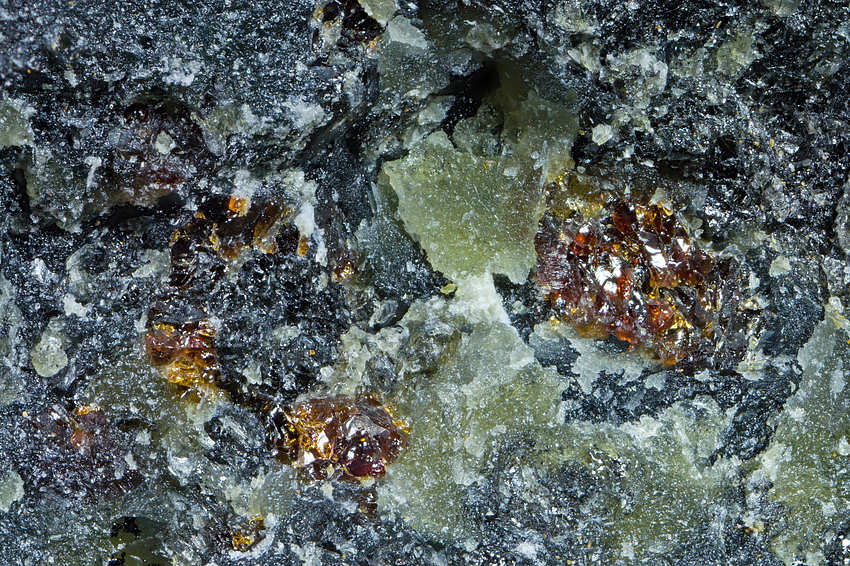


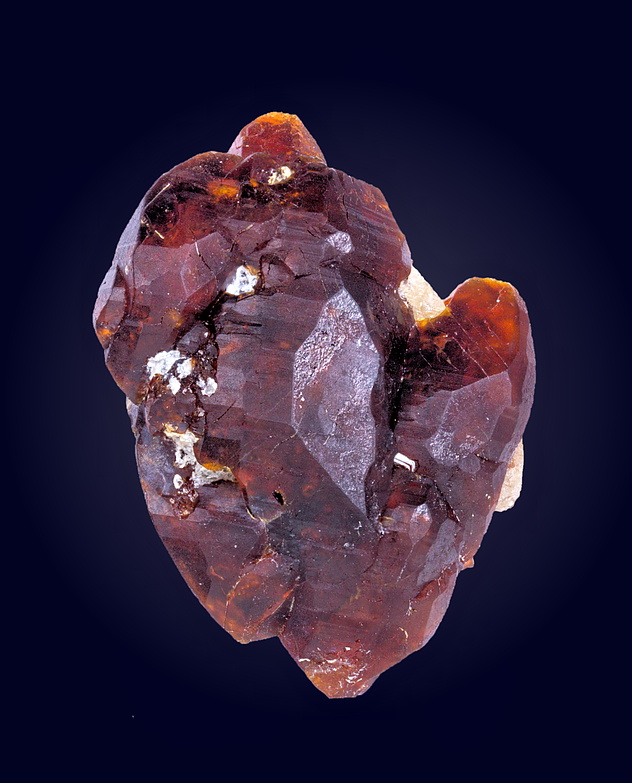
About Hydroxylclinohumite
Formula:
Mg9(SiO4)4(OH)2
a n=4 member of the humite polysomatic series
Colour:
Pale yellow to orange-yellow, almost colourless.
Lustre:
Vitreous, Dull
Hardness:
6½
Specific Gravity:
3.13
Crystal System:
Monoclinic
Member of:
Name:
In allusion to its chemical composition and crystal structure as the HYDROXYL-dominant, monoCLINic member of the group and its relationship to humite which was named after Sir Abraham Hume (1749-1838), English connoisseur and collector of gems, minerals and artwork.
Isostructural with:
Hydroxylclinohumite is a monoclinic member of the humite group. It forms a continuous series towards clinohumite. The name "clinohumite" has commonly been used as a default when the F/OH ratio has not been determined. Since hydroxylclinohumite was approved as a separate mineral (1998), it has become apparent that hydroxylclinohumite is much more common than indicated in the literature and locality entries in Mindat. It should also be noted that some of the published analyses (Luc Yen, Vietnam and Kukh-i-Lal,Tajikistan) are very close to the borderline between the two minerals, and both of these minerals are probably present at many localities.
Hydroxylclinohumite often contain some Ti and the varietal name titanoclinohumite (older literature uses the name "titanolivine" for this variety) is commonly used. Zambonini (1919) came to the conclusion that "titanolivine" from Ala Valley (Piedmont, Italy) is a titanian clinohumite very rich in OH and pratically F-free; therefore, he proposed, unsuccessfully, to substitute the name "titanolivine" with "titanhydroclinohumite" or "hydroclinohumite titanifère" (the species hydroxylclinohumite has been instituted in 1998 only). Humite group minerals found in metamorphosed serpentinites are often hydroxylclinohumite.
It is difficult to distinguish minerals in the humite group, as they largely occur in the same environments and localities. Their physical and optical appearances are also similar, as is the occurrence as rounded crystals or anhedral grains. A quantitative chemical analysis (electron microprobe) combined with structural analyses (XRD) seem to be required to identify individual humite-group species with absolute certainty. It is therefore quite possible that some of the locality entries and photos may be incorrectly identified as hydroxylclinohumite.
Hydroxylclinohumite often contain some Ti and the varietal name titanoclinohumite (older literature uses the name "titanolivine" for this variety) is commonly used. Zambonini (1919) came to the conclusion that "titanolivine" from Ala Valley (Piedmont, Italy) is a titanian clinohumite very rich in OH and pratically F-free; therefore, he proposed, unsuccessfully, to substitute the name "titanolivine" with "titanhydroclinohumite" or "hydroclinohumite titanifère" (the species hydroxylclinohumite has been instituted in 1998 only). Humite group minerals found in metamorphosed serpentinites are often hydroxylclinohumite.
It is difficult to distinguish minerals in the humite group, as they largely occur in the same environments and localities. Their physical and optical appearances are also similar, as is the occurrence as rounded crystals or anhedral grains. A quantitative chemical analysis (electron microprobe) combined with structural analyses (XRD) seem to be required to identify individual humite-group species with absolute certainty. It is therefore quite possible that some of the locality entries and photos may be incorrectly identified as hydroxylclinohumite.
Unique Identifiers
Mindat ID:
7729
Long-form identifier:
mindat:1:1:7729:9
IMA Classification of Hydroxylclinohumite
Approved
Approval year:
1998
First published:
1999
Classification of Hydroxylclinohumite
9.AF.55
9 : SILICATES (Germanates)
A : Nesosilicates
F : Nesosilicates with additional anions; cations in [4], [5] and/or only [6] coordination
9 : SILICATES (Germanates)
A : Nesosilicates
F : Nesosilicates with additional anions; cations in [4], [5] and/or only [6] coordination
Mineral Symbols
As of 2021 there are now IMA–CNMNC approved mineral symbols (abbreviations) for each mineral species, useful for tables and diagrams.
| Symbol | Source | Reference for Standard |
|---|---|---|
| Hchu | IMA–CNMNC | Warr, L.N. (2021). IMA–CNMNC approved mineral symbols. Mineralogical Magazine, 85(3), 291-320. doi:10.1180/mgm.2021.43 |
Physical Properties of Hydroxylclinohumite
Vitreous, Dull
Transparency:
Transparent, Translucent
Colour:
Pale yellow to orange-yellow, almost colourless.
Streak:
White
Hardness:
6½ on Mohs scale
Hardness:
VHN60=732 - 747 kg/mm2 - Vickers
Cleavage:
None Observed
None
None
Fracture:
Irregular/Uneven, Conchoidal
Density:
3.13 g/cm3 (Measured) 3.14 g/cm3 (Calculated)
Optical Data of Hydroxylclinohumite
Type:
Biaxial (+)
RI values:
nα = 1.631 nβ = 1.641 nγ = 1.664
2V:
Measured: 70° , Calculated: 68°
Max. Birefringence:
δ = 0.033
Based on recorded range of RI values above.
Based on recorded range of RI values above.
Interference Colours:
The colours simulate birefringence patterns seen in thin section under crossed polars. They do not take into account mineral colouration or opacity.
Michel-Levy Bar The default colours simulate the birefringence range for a 30 µm thin-section thickness. Adjust the slider to simulate a different thickness.
Grain Simulation You can rotate the grain simulation to show how this range might look as you rotated a sample under crossed polars. Each grain retains its interference colour (retardation) while its brightness falls to black at extinction and reaches a maximum between extinction positions.
The colours simulate birefringence patterns seen in thin section under crossed polars. They do not take into account mineral colouration or opacity.
Michel-Levy Bar The default colours simulate the birefringence range for a 30 µm thin-section thickness. Adjust the slider to simulate a different thickness.
Grain Simulation You can rotate the grain simulation to show how this range might look as you rotated a sample under crossed polars. Each grain retains its interference colour (retardation) while its brightness falls to black at extinction and reaches a maximum between extinction positions.
Surface Relief:
High (positive)
Relative to Canada balsam mounting medium (n ≈ 1.537).
Relative to Canada balsam mounting medium (n ≈ 1.537).
This shows the grain boundary and Becke line effect under plane-polarised
light, based on the contrast between this mineral's average refractive
index and the mounting medium. It does not take into account mineral
colouration.
In focus
Interference Figure:
This shows the idealized biaxial acute bisectrix (Bxa) interference figure
- the conoscopic view for a grain cut perpendicular to the acute bisectrix, using
this mineral's 2V. The two small white dots mark the melatopes - the points
where the two optic axes emerge - and are shown only when they fall within the
field of view. The coloured bands are isochromatics, and the dark bands are
isogyres.
Rotate the stage: at 0°/90° the isogyres form a cross through the melatopes; at 45° they pull apart into curved hyperbolas. That splitting on rotation - absent in a uniaxial figure - is the standard diagnostic test for telling biaxial minerals from uniaxial ones. If 2V is large, the melatopes may fall outside the field of view, as they often do at the microscope too.
Rotate the stage: at 0°/90° the isogyres form a cross through the melatopes; at 45° they pull apart into curved hyperbolas. That splitting on rotation - absent in a uniaxial figure - is the standard diagnostic test for telling biaxial minerals from uniaxial ones. If 2V is large, the melatopes may fall outside the field of view, as they often do at the microscope too.
Dispersion:
weak
Pleochroism:
Visible
Comments:
X = yellow, Z = colorless.
Chemistry of Hydroxylclinohumite
Mindat Formula:
Mg9(SiO4)4(OH)2
a n=4 member of the humite polysomatic series
a n=4 member of the humite polysomatic series
Element Weights:
Elements listed:
Chemical Analysis
Oxide wt%:
| 1 | 2 | |
|---|---|---|
| SiO2 | 36.59 % | |
| TiO2 | 5.27 % | 4.88 % |
| Al2O3 | 0.15 % | 0.01 % |
| Cr2O3 | ||
| FeO | 4.48 % | 4.57 % |
| MnO | 0.05 % | 0.07 % |
| MgO | 49.68 % | 48.83 % |
| H2O | 2.69 % | 2.84 % |
| CaO | 0.05 % | |
| Total: | 98.91 % | 61.25 % |
Empirical formulas:
| Sample ID | Empirical Formula |
|---|---|
| 3 | Mg8.58Fe0.24 Mn0.03 B0.14 Zn0.02Ti0.04(Si0.99O4)4O0.16F0.04(OH)1.80. |
| 4 | (Mg0.69Ti0.29Fe0.02)?1.00Mg7.91(SiO4)4.08[(OH)1.10F0.53O0.37]?2.00; ideal formula: (Mg0.7Ti0.3)?1Mg8.0(SiO4)4[(OH)1.2F0.5O0.3]2) |
Sample references:
| ID | Locality | Reference | Notes |
|---|---|---|---|
| 1 | Salem ultrabasic rocks, Tamil Nadu, India | Wet chemical analyses of a sample from a smaller ultramafic body. F content below detection limit. | |
| 2 | " " | Wet Chemical analysis from a "bigger" ultramafic body. F content below detection limit. | |
| 3 | Kukh-i-Lal, Ishkoshim, Gorno-Badakhshan, Tajikistan | ||
| 4 | Luc Yen Mine, Lục Yên District, Yên Bái Province, Vietnam |
Crystallography of Hydroxylclinohumite
Crystal System:
Monoclinic
Class (H-M):
2/m - Prismatic
Space Group:
P21/b
Setting:
P21/c
Cell Parameters:
a = 13.6894(3) Å, b = 4.748(1) Å, c = 10.273(2) Å
β = 100.63°
β = 100.63°
Ratio:
a:b:c = 2.883 : 1 : 2.164
Unit Cell V:
656.06 ų
Z:
2
Twinning:
[Not reported, but clinohumite showns twinning on {100}.]
Crystal Structure
Load
Unit Cell | Unit Cell Packed
2x2x2 | 3x3x3 | 4x4x4
Unit Cell | Unit Cell Packed
2x2x2 | 3x3x3 | 4x4x4
Show
Big Balls | Small Balls | Just Balls | Spacefill
Polyhedra Off | Si Polyhedra | All Polyhedra
Remove metal-metal sticks
Big Balls | Small Balls | Just Balls | Spacefill
Polyhedra Off | Si Polyhedra | All Polyhedra
Remove metal-metal sticks
Display Options
Black Background | White Background
Perspective On | Perspective Off
2D | Stereo | Red-Blue | Red-Cyan
Black Background | White Background
Perspective On | Perspective Off
2D | Stereo | Red-Blue | Red-Cyan
View
CIF File Best | x | y | z | a | b | c
CIF File Best | x | y | z | a | b | c
Rotation
Stop | Start
Stop | Start
Labels
Console Off | On | Grey | Yellow
Console Off | On | Grey | Yellow
Data courtesy of the American Mineralogist Crystal Structure Database. Click on an AMCSD ID to view structure
| ID | Species | Reference | Link | Year | Locality | Pressure (GPa) | Temp (K) |
|---|---|---|---|---|---|---|---|
| 0002660 | Hydroxylclinohumite | Friedrich A, Lager G A, Kunz M, Chakoumakos B C, Smyth J R, Schultz A J (2001) Temperature-dependent single-crystal neutron diffraction study of natural chondrodite and clinohumite American Mineralogist 86 981-989 |  | 2001 | 0 | 295 | |
| 0002626 | Hydroxylclinohumite | Berry A J, James M (2001) Refinement of hydrogen positions in synthetic hydroxyl-clinohumite by powder neutron diffraction American Mineralogist 86 181-184 | | 2001 | 0 | 293 | |
| 0000668 | Hydroxylclinohumite | Fujino K, Takeuchi Y (1978) Crystal chemistry of titanian chondrodite and titanian clinohumite of high-pressure origin American Mineralogist 63 535-543 | | 1978 | 0 | 293 | |
| 0005091 | Hydroxylclinohumite | Kocman V, Rucklidge J C (1973) The crystal structure of a titaniferous clinohumite The Canadian Mineralogist 12 39-45 | | 1973 | 0 | 293 | |
| 0000302 | Hydroxylclinohumite | Robinson K, Gibbs G V, Ribbe P H (1973) The crystal structures of the humite minerals. IV. Clinohumite and titanoclinohumite American Mineralogist 58 43-49 | | 1973 | 0 | 293 | |
| 0000301 | Hydroxylclinohumite | Robinson K, Gibbs G V, Ribbe P H (1973) The crystal structures of the humite minerals. IV. Clinohumite and titanclinohumite American Mineralogist 58 43-49 | | 1973 | 0 | 293 | |
| 0002661 | Hydroxylclinohumite | Friedrich A, Lager G A, Kunz M, Chakoumakos B C, Smyth J R, Schultz A J (2001) Temperature-dependent single-crystal neutron diffraction study of natural chondrodite and clinohumite American Mineralogist 86 981-989 | | 2001 | 0 | 100 | |
| 0002662 | Hydroxylclinohumite | Friedrich A, Lager G A, Kunz M, Chakoumakos B C, Smyth J R, Schultz A J (2001) Temperature-dependent single-crystal neutron diffraction study of natural chondrodite and clinohumite American Mineralogist 86 981-989 | | 2001 | 0 | 20 |
CIF Raw Data - click here to close
X-Ray Powder Diffraction
Loading XRD data...
Data courtesy of RRUFF project at University of Arizona, used with permission.
Powder Diffraction Data:
| d-spacing | Intensity |
|---|---|
| 13.9 Å | (10) |
| 6.73 Å | (6) |
| 5.05 Å | (70) |
| 4.49 Å | (5) |
| 4.46 Å | (52) |
| 4.29 Å | (11) |
| 4.18 Å | (11) |
| 3.88 Å | (31) |
| 3.78 Å | (8) |
| 3.72 Å | (95) |
| 3.67 Å | (8) |
| 3.50 Å | (28) |
| 3.46 Å | (33) |
| 3.35 Å | (64) |
| 3.23 Å | (30) |
| 3.03 Å | (18) |
| 2.922 Å | (11) |
| 2.772 Å | (91) |
| 2.754 Å | (60) |
| 2.748 Å | (50) |
| 2.690 Å | (17) |
| 2.612 Å | (39) |
| 2.551 Å | (80) |
| 2.516 Å | (93) |
| 2.414 Å | (38) |
| 2.398 Å | (25) |
| 2.365 Å | (50) |
| 2.311 Å | (15) |
| 2.295 Å | (8) |
| 2.269 Å | (100) |
| 2.259 Å | (95) |
| 2.224 Å | (5) |
| 2.215 Å | (8) |
| 2.200 Å | (15) |
| 2.155 Å | (12) |
| 2.092 Å | (9) |
| 1.884 Å | (9) |
| 1.878 Å | (6) |
| 1.779 Å | (10) |
| 1.747 Å | (79) |
| 1.687 Å | (20) |
| 1.632 Å | (22) |
| 1.620 Å | (20) |
| 1.548 Å | (8) |
| 1.512 Å | (7) |
| 1.495 Å | (37) |
| 1.485 Å | (51) |
| 1.402 Å | (20) |
| 1.398 Å | (12) |
| 1.351 Å | (15) |
| 1.348 Å | (18) |
Comments:
УДК549.621+522.161(470.5)ЗВМО.М5.1999г.Proc.RМS.N5.1999@В.М.ГЕКИМЯНЦ.*Е.В.СОКОЛОВА,*Э.М.СПИРИДОНОВ.*ДЖ.ФЕРРАРИС.**Н.В.ЧУКАНОВ.***М.ПРЕНЧИПЕ.**В.Н.АВДОНИН,****Ю.А.ПОЛЕНОВ****ГИДРОКСИЛКЛИНОГУМИТM~(Si04MOH,F)z-НОВЫЙМИНЕРАЛИЗГРУППЫГУМИТА\v.М.GEK1MYANTS.Е.У.SOKOLOVA.Е.М.SPlR1DONOV,О.FERRARlS.N.У.CHUКANOV,М.PRENC1PE.У.N.А VDON1N.Уи.А.POLENOV.HYDROXYLCLINOHUMlТE Mg9(Si04)4(OH,F)2 - А NEW MINERAL ОF ТНЕ HUMIТE GROUP
Geological Environment
Paragenetic Mode(s):
| Paragenetic Mode | Earliest Age (Ga) |
|---|---|
| High-? alteration and/or metamorphism | |
| 31 : Thermally altered carbonate, phosphate, and iron formations | |
| Stage 4b: Highly evolved igneous rocks | >3.0 |
| 35 : Ultra-alkali and agpaitic igneous rocks | |
| Stage 5: Initiation of plate tectonics | <3.5-2.5 |
| 40 : Regional metamorphism (greenschist, amphibolite, granulite facies) |
Type Occurrence of Hydroxylclinohumite
General Appearance of Type Material:
Oval, elongate grains to 3 mm in diameter, and as aggregates to 2 cm associated with spinel as inclusions in calcite. Without crystal faces.
Place of Conservation of Type Material:
1) Mining Geological Museum at Ekaterinburg, Russia.
2) Mineralogy Museum of Saint Petersburg University, Russia.
2) Mineralogy Museum of Saint Petersburg University, Russia.
Geological Setting of Type Material:
In Mg-skarn (calciphyric) rims around dolomitic marble xenoliths in gabbroic rocks.
Associated Minerals at Type Locality:
Synonyms of Hydroxylclinohumite
Other Language Names for Hydroxylclinohumite
Dutch:Hydroxylclinohumiet
Russian:Гидроксилклиногумит
Simplified Chinese:水斜硅镁石
Spanish:Hydroxylclinohumita
Varieties of Hydroxylclinohumite
| Titanclinohumite | A Ti-bearing variety of both Clinohumite and Hydroxylclinohumite. The varietal name titanoclinohumite (older literature uses the name "titanolivine" for this variety) is commonly used to indicate Ti-bearing hydroxylclinohumite found in metamorphosed serp... |
Relationship of Hydroxylclinohumite to other Species
Member of:
Other Members of Humite Subgroup:
| Chondrodite | Mg5(SiO4)2F2 | Mon. 2/m : P21/b |
| Clinohumite | Mg9(SiO4)4F2 | Mon. 2/m : P21/b |
| Humite | Mg7(SiO4)3F2 | Orth. mmm(2/m2/m2/m) : Pnma |
| Hydroxylchondrodite | Mg5(SiO4)2(OH)2 | Mon. 2/m : P21/b |
| Norbergite | Mg3(SiO4)F2 | Orth. mmm(2/m2/m2/m) |
| 'Unnamed (OH-analogue of humite)' | Mg7(SiO4)3(OH)2 | Orth. |
Common Associates
Associations Based on Photo Data:
| 29 photos of Hydroxylclinohumite associated with Clinochlore | Mg5Al(AlSi3O10)(OH)8 |
| 4 photos of Hydroxylclinohumite associated with Calcite | CaCO3 |
| 3 photos of Hydroxylclinohumite associated with Spessartine | Mn2+3Al2(SiO4)3 |
| 3 photos of Hydroxylclinohumite associated with Muscovite | KAl2(AlSi3O10)(OH)2 |
| 3 photos of Hydroxylclinohumite associated with Spinel | MgAl2O4 |
| 2 photos of Hydroxylclinohumite associated with Geikielite | MgTiO3 |
| 1 photo of Hydroxylclinohumite associated with Albite | Na(AlSi3O8) |
| 1 photo of Hydroxylclinohumite associated with Magnetite | Fe2+Fe3+2O4 |
Related Minerals - Strunz-mindat Grouping
| 9.AF. | Chegemite | Ca7(SiO4)3(OH)2 |
| 9.AF. | Jingwenite-(Y) | YAlV4+(SiO4)O2(OH)2 |
| 9.AF. | Barwoodite | Mn2+6Nb5+(SiO4)2O3(OH)3 |
| 9.AF.05 | Sillimanite | Al2(SiO4)O |
| 9.AF.05 | 'Xenolite' | Al10Si8O31 |
| 9.AF.10 | Kanonaite | Mn3+Al(SiO4)O |
| 9.AF.10 | Andalusite | Al2(SiO4)O |
| 9.AF.15 | Kyanite | Al2(SiO4)O |
| 9.AF.20 | Krieselite | Al2(GeO4)F2 |
| 9.AF.20 | Mullite | Al4+2xSi2-2xO10-x |
| 9.AF.23 | Boromullite | Al9BSi2O19 |
| 9.AF.25 | Yoderite | Mg(Al,Fe3+)3(SiO4)2O(OH) |
| 9.AF.30 | Zincostaurolite | Zn2Al9Si4O23(OH) |
| 9.AF.30 | Staurolite | Fe2+2Al9Si4O23(OH) |
| 9.AF.30 | Magnesiostaurolite | Mg(Mg,Li)3(Al,Mg)18Si8O44(OH)4 |
| 9.AF.35 | Topaz | Al2(SiO4)(F,OH)2 |
| 9.AF.40 | Norbergite | Mg3(SiO4)F2 |
| 9.AF.45 | Chondrodite | Mg5(SiO4)2F2 |
| 9.AF.45 | Kumtyubeite | Ca5(SiO4)2F2 |
| 9.AF.45 | Reinhardbraunsite | Ca5(SiO4)2(OH,F)2 |
| 9.AF.45 | Hydroxylchondrodite | Mg5(SiO4)2(OH)2 |
| 9.AF.45 | Alleghanyite | Mn2+5(SiO4)2(OH)2 |
| 9.AF.50 | 'Unnamed (Ca-analogue of Humite)' | Ca7(SiO4)4F2 |
| 9.AF.50 | Humite | Mg7(SiO4)3F2 |
| 9.AF.50 | Manganhumite | Mn2+7(SiO4)3(OH)2 |
| 9.AF.50 | 'Unnamed (OH-analogue of humite)' | Mg7(SiO4)3(OH)2 |
| 9.AF.50 | Fluorchegemite | Ca7(SiO4)3F2 |
| 9.AF.55 | Clinohumite | Mg9(SiO4)4F2 |
| 9.AF.55 | Sonolite | Mn2+9(SiO4)4(OH)2 |
| 9.AF.60 | Leucophoenicite | Mn2+7(SiO4)3(OH)2 |
| 9.AF.65 | Ribbeite | Mn2+5(SiO4)2(OH)2 |
| 9.AF.70 | Jerrygibbsite | Mn2+9(SiO4)4(OH)2 |
| 9.AF.75 | Franciscanite | Mn2+6(V5+,◻)2(SiO4)2(O,OH)6 |
| 9.AF.75 | Scorticoite | Mn6(Sb,◻)Σ2(SiO4)2O3(OH)3 |
| 9.AF.75 | Welinite | Mn2+6(W6+,Mg)2(SiO4)2(O,OH)6 |
| 9.AF.75 | Örebroite | Mn2+3(Sb5+,Fe3+)(SiO4)(O,OH)3 |
| 9.AF.80 | Ellenbergerite | Mg6(Mg,Ti,Zr,◻)2(Al,Mg)6Si8O28(OH)10 |
| 9.AF.85 | Magnesiochloritoid | MgAl2O(SiO4)(OH)2 |
| 9.AF.85 | Ottrélite | Mn2+Al2O(SiO4)(OH)2 |
| 9.AF.85 | Chloritoid | Fe2+Al2O(SiO4)(OH)2 |
| 9.AF.90 | Olmiite | CaMn2+[SiO3(OH)](OH) |
| 9.AF.90 | Poldervaartite | CaCa[SiO3(OH)](OH) |
| 9.AF.95 | Pilawite-(Y) | Ca2Y2Al4(SiO4)4O2(OH)2 |
Other Information
IR Spectrum:
Strong absorption bands at 987, 960, 724, 610, and 530 cm–1, plus 3560, 3580, and 3385 cm–1.
Health Risks:
No information on health risks for this material has been entered into the database. You should always treat mineral specimens with care.
Internet Links for Hydroxylclinohumite
mindat.org URL:
https://www.mindat.org/min-7729.html
Please feel free to link to this page.
Please feel free to link to this page.
Search Engines:
External Links:
Mineral Dealers:
References for Hydroxylclinohumite
Reference List:
Zambonini, Ferruccio (1919) Sur la véritable nature du titanolivine de la vallée d'Ala (Piémont) Bulletin de Minéralogie, 42 (5) 250-279 doi:10.3406/bulmi.1919.3732
Robinson, Keith, Gibbs, G. V., Ribbe, and Paul H. (1973) The crystal structures of the humite minerals. IV. Clinohumite and titanoclinohumite. American Mineralogist, 58 (1-2) 43-49
Ferraris, Giovanni, Prencipe, M., Sokolova, E., Gekimyants, V.M., Spiridonov, E.M. (2000) Hydroxylclinohumite, a new member of the humite group: Twinning, crystal structure and crystal chemistry of the clinohumite subgroup. Zeitschrift für Kristallographie - Crystalline Materials, 215 (3). 169-173 doi:10.1524/zkri.2000.215.3.169
Jambor, John L., Puziewicz, Jacek, Roberts, Andrew C. (2000) New Mineral Names. American Mineralogist, 85 (11-12) 1843-1847
Ottolini, Luisa, Cámara, Fernando, Bigi, Simona (2000) An investigation of matrix effects in the analysis of fluorine in humite-group minerals by EMPA, SIMS, and SREF. American Mineralogist, 85 (1) 89-102 doi:10.2138/am-2000-0110
Berry, Andrew J., James, Michael (2001) Refinement of hydrogen positions in synthetic hydroxyl-clinohumite by powder neutron diffraction. American Mineralogist, 86 (1) 181-184 doi:10.2138/am-2001-0120
Friedrich, Alexandra, Lager, George A., Kunz, Martin, Chakoumakos, Bryan C., Smyth, Joseph R., Schultz, Arthur J. (2001) Temperature-dependent single-crystal neutron diffraction study of natural chondrodite and clinohumites. American Mineralogist, 86 (9) 981-989 doi:10.2138/am-2001-8-904
Liu, Zhenxian, Lager, George A., Hemley, Russell J., Ross, Nancy L. (2003) Synchrotron infrared spectroscopy of OH-chondrodite and OH-clinohumite at high pressure. American Mineralogist, 88 (10) 1412-1415 doi:10.2138/am-2003-1003
Hurai, V.; Wierzbicka-Wieczorek, M.; Pentrák, M.; Huraiová, M.; Thomas, R.; Swierczewska, A.; Luptáková, J. (2014) X-Ray Diffraction and Vibrational Spectroscopic Characteristics of Hydroxylclinohumite from Ruby-Bearing Marbles (Luc Yen District, Vietnam). International Journal of Mineralogy, 2014. 6485301 doi:10.1155/2014/648530
Localities for Hydroxylclinohumite
Showing 113 localities.
 symbol to view information about a locality.
The
symbol to view information about a locality.
The Locality List
 - This locality has map coordinates listed.
- This locality has estimated coordinates.
ⓘ - Click for references and further information on this occurrence.
? - Indicates mineral may be doubtful at this locality.
- This locality has map coordinates listed.
- This locality has estimated coordinates.
ⓘ - Click for references and further information on this occurrence.
? - Indicates mineral may be doubtful at this locality.
 - Good crystals or important locality for species.
 - World class for species or very significant.
(TL) - Type Locality for a valid mineral species.
(FRL) - First Recorded Locality for everything else (eg varieties).
- World class for species or very significant.
(TL) - Type Locality for a valid mineral species.
(FRL) - First Recorded Locality for everything else (eg varieties).
All localities listed without proper references should be considered as questionable.
Quick NavTopAbout HydroxylclinohumiteUnique IdentifiersIMA Classification Classification Mineral SymbolsPhysical Properties Optical Data Chemistry Chemical AnalysisCrystallography Crystal StructureX-Ray Powder DiffractionGeological EnvironmentType Occurrence SynonymsOther LanguagesVarietiesRelationshipsCommon AssociatesStrunz-MindatOther InformationInternet Links References Localities Locality List

Jikhan, Kuran Wa Munjan District, Badakhshan, Afghanistan