
Ribbeite
A valid IMA mineral species
This page is currently not sponsored. Click here to sponsor this page.


About Ribbeite

Paul Ribbe
Formula:
Mn2+5(SiO4)2(OH)2
Mn may be replaced by minor Mg.
Colour:
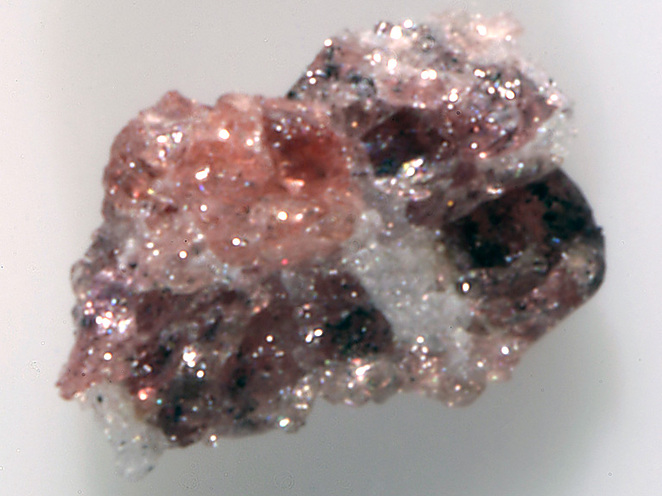
Pink
Lustre:
Vitreous, Sub-Vitreous
Hardness:
5
Specific Gravity:
3.90
Crystal System:
Orthorhombic
Member of:
Name:
Named in 1987 by Donald R. Peacor, Pete J. Dunn, S. C. Su, and J. Innes in honor of Paul Hubert Ribbe [2 April 1935 Bristol, Connecticut, USA - 24 June 2017 Virginia, USA], professor of mineralogy at Virginia Polytechnic Institute and State University, Blacksburg, Virginia, USA and investigator of crystal structures, particularly those of the feldspar group. The publication of the new species commented: "We have named this new species ribbeite in honor of Dr. Paul H. Ribbe in recognition of his many contributions to mineralogy, both to the science through his research, and to the society of mineralogists, in part through his editorship of the Reviews in Mineralogy series of the Mineralogical Society of America. It is particularly appropriate that ribbeite is closely related to the humite group, to which he has made major contributions."
Dimorph of:
Isostructural with:
This page provides mineralogical data about Ribbeite.
Unique Identifiers
Mindat ID:
3411
Long-form identifier:
mindat:1:1:3411:7
IMA Classification of Ribbeite
Approved
Approval year:
1985
First published:
1987
Classification of Ribbeite
9.AF.65
9 : SILICATES (Germanates)
A : Nesosilicates
F : Nesosilicates with additional anions; cations in [4], [5] and/or only [6] coordination
9 : SILICATES (Germanates)
A : Nesosilicates
F : Nesosilicates with additional anions; cations in [4], [5] and/or only [6] coordination
52.3.2b.4
52 : NESOSILICATES Insular SiO4 Groups and O,OH,F,H2O
3 : Insular SiO4 Groups and O, OH, F, and H2O with cations in [6] coordination only
52 : NESOSILICATES Insular SiO4 Groups and O,OH,F,H2O
3 : Insular SiO4 Groups and O, OH, F, and H2O with cations in [6] coordination only
14.17.5
14 : Silicates not Containing Aluminum
17 : Silicates of Mn
14 : Silicates not Containing Aluminum
17 : Silicates of Mn
Mineral Symbols
As of 2021 there are now IMA–CNMNC approved mineral symbols (abbreviations) for each mineral species, useful for tables and diagrams.
| Symbol | Source | Reference for Standard |
|---|---|---|
| Rib | IMA–CNMNC | Warr, L.N. (2021). IMA–CNMNC approved mineral symbols. Mineralogical Magazine, 85(3), 291-320. doi:10.1180/mgm.2021.43 |
Physical Properties of Ribbeite
Vitreous, Sub-Vitreous
Transparency:
Transparent
Colour:
Pink
Streak:
White
Hardness:
5 on Mohs scale
Tenacity:
Brittle
Cleavage:
None Observed
Fracture:
Irregular/Uneven
Density:
3.90 g/cm3 (Measured) 3.84 g/cm3 (Calculated)
Optical Data of Ribbeite
Type:
Biaxial (+)
RI values:
nα = 1.780 nβ = 1.792 nγ = 1.808
2V:
Measured: 83° , Calculated: 84°
Birefringence:
0.028
Max. Birefringence:
δ = 0.028
Based on recorded range of RI values above.
Based on recorded range of RI values above.
Interference Colours:
The colours simulate birefringence patterns seen in thin section under crossed polars. They do not take into account mineral colouration or opacity.
Michel-Levy Bar The default colours simulate the birefringence range for a 30 µm thin-section thickness. Adjust the slider to simulate a different thickness.
Grain Simulation You can rotate the grain simulation to show how this range might look as you rotated a sample under crossed polars. Each grain retains its interference colour (retardation) while its brightness falls to black at extinction and reaches a maximum between extinction positions.
The colours simulate birefringence patterns seen in thin section under crossed polars. They do not take into account mineral colouration or opacity.
Michel-Levy Bar The default colours simulate the birefringence range for a 30 µm thin-section thickness. Adjust the slider to simulate a different thickness.
Grain Simulation You can rotate the grain simulation to show how this range might look as you rotated a sample under crossed polars. Each grain retains its interference colour (retardation) while its brightness falls to black at extinction and reaches a maximum between extinction positions.
Surface Relief:
Moderate
Dispersion:
r > v distinct
Pleochroism:
Visible
Comments:
X, Y colorless; Z light pink
Comments:
Z > X - Y; X = b, Y = a, Z = c
Chemistry of Ribbeite
Mindat Formula:
Mn2+5(SiO4)2(OH)2
Mn may be replaced by minor Mg.
Mn may be replaced by minor Mg.
Element Weights:
Elements listed:
Common Impurities:
Fe,Ca,H2O
Crystallography of Ribbeite
Crystal System:
Orthorhombic
Class (H-M):
mmm(2/m2/m2/m) - Dipyramidal
Cell Parameters:
a = 4.799 Å, b = 10.742 Å, c = 15.70 Å
Ratio:
a:b:c = 0.447 : 1 : 1.462
Unit Cell V:
809.35 ų (Calculated from Unit Cell)
Z:
4
Morphology:
Anhedral
Comment:
Space group either Pbnm or Pbn21
Crystal Structure
Load
Unit Cell | Unit Cell Packed
2x2x2 | 3x3x3 | 4x4x4
Unit Cell | Unit Cell Packed
2x2x2 | 3x3x3 | 4x4x4
Show
Big Balls | Small Balls | Just Balls | Spacefill
Polyhedra Off | Si Polyhedra | All Polyhedra
Remove metal-metal sticks
Big Balls | Small Balls | Just Balls | Spacefill
Polyhedra Off | Si Polyhedra | All Polyhedra
Remove metal-metal sticks
Display Options
Black Background | White Background
Perspective On | Perspective Off
2D | Stereo | Red-Blue | Red-Cyan
Black Background | White Background
Perspective On | Perspective Off
2D | Stereo | Red-Blue | Red-Cyan
View
CIF File Best | x | y | z | a | b | c
CIF File Best | x | y | z | a | b | c
Rotation
Stop | Start
Stop | Start
Labels
Console Off | On | Grey | Yellow
Console Off | On | Grey | Yellow
Data courtesy of the American Mineralogist Crystal Structure Database. Click on an AMCSD ID to view structure
| ID | Species | Reference | Link | Year | Locality | Pressure (GPa) | Temp (K) |
|---|---|---|---|---|---|---|---|
| 0001545 | Ribbeite | Freed R L, Rouse R C, Peacor D R (1993) Ribbeite, a second example of edge-sharing silicate tetrahedra in the leucophoenicite group American Mineralogist 78 190-194 |  | 1993 | 0 | 293 |
CIF Raw Data - click here to close
X-Ray Powder Diffraction
Powder Diffraction Data:
| d-spacing | Intensity |
|---|---|
| 5.08 Å | (5) |
| 4.41 Å | (30) |
| 4.23 Å | (2) |
| 3.93 Å | (1) |
| 3.83 Å | (30) |
| 3.53 Å | (5) |
| 3.49 Å | (5) |
| 3.362 Å | (10) |
| 3.256 Å | (5) |
| 2.925 Å | (70) |
| 2.873 Å | (80) |
| 2.821 Å | (70) |
| 2.695 Å | (60) |
| 2.552 Å | (80) |
| 2.515 Å | (40) |
| 2.398 Å | (2) |
| 2.356 Å | (40) |
| 2.315 Å | (5) |
| 2.246 Å | (10) |
| 2.216 Å | (2) |
| 2.117 Å | (5) |
| 1.996 Å | (1) |
| 1.834 Å | (1) |
| 1.796 Å | (100) |
Comments:
Peacor, Donald R., Dunn, Pete J., Su, Shu-Chun, and Innes, John (1987) Ribbeite, a Polymorph of Alleghanyite and Member of the Leucophoenicite Group from the Kombat Mine, Namibia, The American Mineralogist, v. 72, p. 213-216.
Geological Environment
Paragenetic Mode(s):
| Paragenetic Mode | Earliest Age (Ga) |
|---|---|
| High-? alteration and/or metamorphism | |
| 32 : Ba/Mn/Pb/Zn deposits, including metamorphic deposits |
Type Occurrence of Ribbeite
General Appearance of Type Material:
Fine-grained, anhedral granular aggregates of crystals approximately 0.5 mm in diameter with a typical granulitic texture.
Place of Conservation of Type Material:
National Museum of Natural History, Washington, D.C., USA, 163208.
Geological Setting of Type Material:
Ribbeite occurs as pinkish lenses up to 5 cm thick and 20 cm long within a 20-m-wide zone of tectonically intercalated manganese and iron ores. Locally within the stope environs, the complexly deformed manganese andiron ores assume the attitude of a vertically plunging cylindroidal fold in which ribbeite has a preferential association with carbonate-silicate facies within the manganese ores. The lenses are derived by tectonic transposition and boudinaging of the original sedimentary protore layering. The area containing ribbeite measured only ca. 40 cm across as exposed on the stope back. Ribbeite can be regarded as a scarce mineral. The transposed layering is transgressed by an abundance of veinlets of a proposed new manganese hydroxy-carbonate that clearly postdate the major tectonism but are themselves slightly deformed. Of interest also is the occurrence of manganosite as a constituent (to 5olo by volume) of some hausmannite-pyrochroite-barite-calcite layers within the Mn ores but not immediately associated with the ribbeite-alleghanyite layers. The manganosite is altering to pyrochroite and hausmannite and occurs as ragged emerald-green relicts up to 2 cm in diameter. The textural evidence strongly suggests that manganosite was a syngenetic precursor of the hausmannite ores.
Associated Minerals at Type Locality:
Synonyms of Ribbeite
Other Language Names for Ribbeite
Relationship of Ribbeite to other Species
Member of:
Other Members of Leucophoenicite Subgroup:
| Jerrygibbsite | Mn2+9(SiO4)4(OH)2 | Orth. mmm(2/m2/m2/m) : Pbcn |
| Leucophoenicite | Mn2+7(SiO4)3(OH)2 | Mon. 2/m : P21/b |
Common Associates
Associations Based on Photo Data:
| 1 photo of Ribbeite associated with Hausmannite | Mn2+Mn3+2O4 |
Related Minerals - Strunz-mindat Grouping
| 9.AF. | Chegemite | Ca7(SiO4)3(OH)2 |
| 9.AF. | Jingwenite-(Y) | YAlV4+(SiO4)O2(OH)2 |
| 9.AF. | Barwoodite | Mn2+6Nb5+(SiO4)2O3(OH)3 |
| 9.AF.05 | Sillimanite | Al2(SiO4)O |
| 9.AF.05 | 'Xenolite' | Al10Si8O31 |
| 9.AF.10 | Kanonaite | Mn3+Al(SiO4)O |
| 9.AF.10 | Andalusite | Al2(SiO4)O |
| 9.AF.15 | Kyanite | Al2(SiO4)O |
| 9.AF.20 | Krieselite | Al2(GeO4)F2 |
| 9.AF.20 | Mullite | Al4+2xSi2-2xO10-x |
| 9.AF.23 | Boromullite | Al9BSi2O19 |
| 9.AF.25 | Yoderite | Mg(Al,Fe3+)3(SiO4)2O(OH) |
| 9.AF.30 | Zincostaurolite | Zn2Al9Si4O23(OH) |
| 9.AF.30 | Staurolite | Fe2+2Al9Si4O23(OH) |
| 9.AF.30 | Magnesiostaurolite | Mg(Mg,Li)3(Al,Mg)18Si8O44(OH)4 |
| 9.AF.35 | Topaz | Al2(SiO4)(F,OH)2 |
| 9.AF.40 | Norbergite | Mg3(SiO4)F2 |
| 9.AF.45 | Chondrodite | Mg5(SiO4)2F2 |
| 9.AF.45 | Kumtyubeite | Ca5(SiO4)2F2 |
| 9.AF.45 | Reinhardbraunsite | Ca5(SiO4)2(OH,F)2 |
| 9.AF.45 | Hydroxylchondrodite | Mg5(SiO4)2(OH)2 |
| 9.AF.45 | Alleghanyite | Mn2+5(SiO4)2(OH)2 |
| 9.AF.50 | 'Unnamed (Ca-analogue of Humite)' | Ca7(SiO4)4F2 |
| 9.AF.50 | Humite | Mg7(SiO4)3F2 |
| 9.AF.50 | Manganhumite | Mn2+7(SiO4)3(OH)2 |
| 9.AF.50 | 'Unnamed (OH-analogue of humite)' | Mg7(SiO4)3(OH)2 |
| 9.AF.50 | Fluorchegemite | Ca7(SiO4)3F2 |
| 9.AF.55 | Hydroxylclinohumite | Mg9(SiO4)4(OH)2 |
| 9.AF.55 | Clinohumite | Mg9(SiO4)4F2 |
| 9.AF.55 | Sonolite | Mn2+9(SiO4)4(OH)2 |
| 9.AF.60 | Leucophoenicite | Mn2+7(SiO4)3(OH)2 |
| 9.AF.70 | Jerrygibbsite | Mn2+9(SiO4)4(OH)2 |
| 9.AF.75 | Franciscanite | Mn2+6(V5+,◻)2(SiO4)2(O,OH)6 |
| 9.AF.75 | Scorticoite | Mn6(Sb,◻)Σ2(SiO4)2O3(OH)3 |
| 9.AF.75 | Welinite | Mn2+6(W6+,Mg)2(SiO4)2(O,OH)6 |
| 9.AF.75 | Örebroite | Mn2+3(Sb5+,Fe3+)(SiO4)(O,OH)3 |
| 9.AF.80 | Ellenbergerite | Mg6(Mg,Ti,Zr,◻)2(Al,Mg)6Si8O28(OH)10 |
| 9.AF.85 | Magnesiochloritoid | MgAl2O(SiO4)(OH)2 |
| 9.AF.85 | Ottrélite | Mn2+Al2O(SiO4)(OH)2 |
| 9.AF.85 | Chloritoid | Fe2+Al2O(SiO4)(OH)2 |
| 9.AF.90 | Olmiite | CaMn2+[SiO3(OH)](OH) |
| 9.AF.90 | Poldervaartite | CaCa[SiO3(OH)](OH) |
| 9.AF.95 | Pilawite-(Y) | Ca2Y2Al4(SiO4)4O2(OH)2 |
Fluorescence of Ribbeite
Not fluorescent in UV
Other Information
Health Risks:
No information on health risks for this material has been entered into the database. You should always treat mineral specimens with care.
Internet Links for Ribbeite
mindat.org URL:
https://www.mindat.org/min-3411.html
Please feel free to link to this page.
Please feel free to link to this page.
Search Engines:
External Links:
Mineral Dealers:
References for Ribbeite
Reference List:
Peacor, Donald R., Dunn, Pete J., Su, Shu-Chun, Innes, John (1987) Ribbeite, a polymorph of alleghanyite and member of the leucophoenicite group from the Kombat mine, Namibia. American Mineralogist, 72 (1-2) 213-216
Localities for Ribbeite
Showing 16 localities.
 symbol to view information about a locality.
The
symbol to view information about a locality.
The Locality List
 - This locality has map coordinates listed.
- This locality has estimated coordinates.
ⓘ - Click for references and further information on this occurrence.
? - Indicates mineral may be doubtful at this locality.
- This locality has map coordinates listed.
- This locality has estimated coordinates.
ⓘ - Click for references and further information on this occurrence.
? - Indicates mineral may be doubtful at this locality.
 - Good crystals or important locality for species.
 - World class for species or very significant.
(TL) - Type Locality for a valid mineral species.
(FRL) - First Recorded Locality for everything else (eg varieties).
- World class for species or very significant.
(TL) - Type Locality for a valid mineral species.
(FRL) - First Recorded Locality for everything else (eg varieties).
All localities listed without proper references should be considered as questionable.
Japan | |
| Minakawa et al (1991) |
| Masutomi Museum specimen (Kyoto) |
| Akira Kato (2011) |
| Masutomi Museum specimen (Kyoto) |
| Yamada (2004) | |
| Yamada (2004) | |
| Akira Kato (undated manuscript) +1 other reference |
Namibia (TL) | |
| Peacor et al. (1987) +2 other references |
Romania | |
| Hîrtopanu et al. (2003) +1 other reference | |
| minerals-of-the-carpathians.eu (2008) +2 other references |
| Hîrtopanu (1997) +1 other reference |
Russia | |
| Brusnitsyn et al. (2002) +1 other reference |
| Brusnitsyn +1 other reference |
Spain | |
| Dill et al. (2023) |
Switzerland | |
| The Canadian Mineralogist Vol. 44 (2006) |
USA | |
| Heixhong Yang |
Quick NavTopAbout RibbeiteUnique IdentifiersIMA Classification Classification Mineral SymbolsPhysical Properties Optical Data Chemistry Crystallography Crystal StructureX-Ray Powder DiffractionGeological EnvironmentType Occurrence SynonymsOther LanguagesRelationshipsCommon AssociatesStrunz-MindatFluorescence Other InformationInternet Links References Localities Locality List

Yuzhno-Faizulinskoe Mn deposit, Sibay, Bashkortostan, Russia