
Chloritoid
A valid IMA mineral species - grandfathered
This page is currently not sponsored. Click here to sponsor this page.

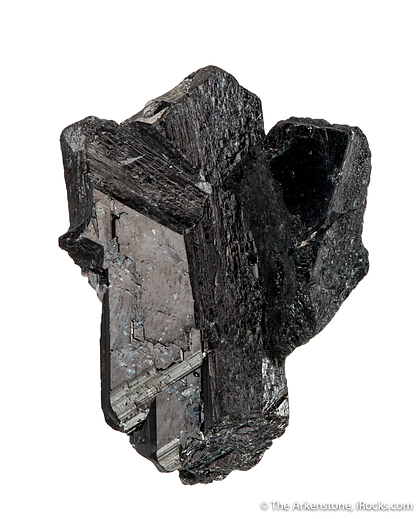
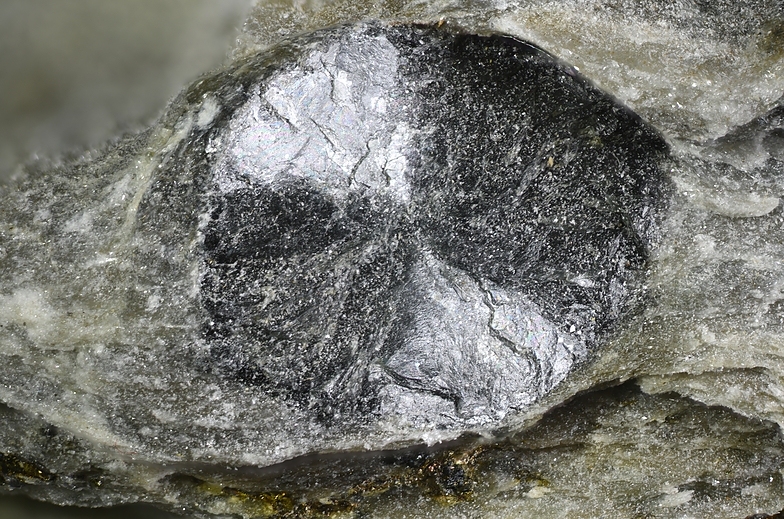

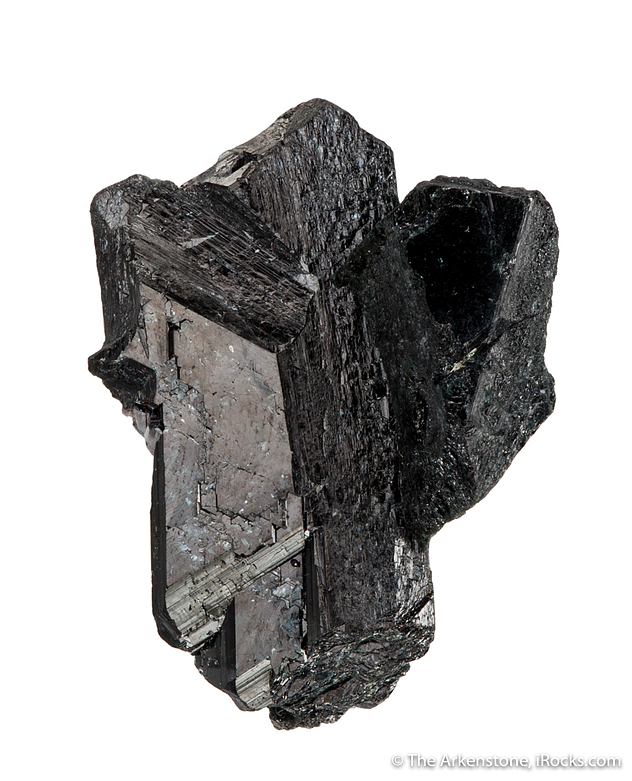
About Chloritoid
Formula:
Fe2+Al2O(SiO4)(OH)2
Colour:
Dark green to green-gray or nearly black
Lustre:
Vitreous, Pearly
Hardness:
6½
Specific Gravity:
3.4 - 3.8
Crystal System:
Monoclinic
Member of:
Name:
Originally name chlorispath, it was renamed in 1835 by August Breithaupt to chloritoid. The name is for the visual similarity to chlorite-group minerals.
Carboirite-Chloritoid Series. The Fe2+ analogue of ottrélite and magnesiochloritoid.
Monoclinic, triclinic and (described in 2026 for the first time by Zolotarev et al.) trigonal polytypes are known.
Monoclinic, triclinic and (described in 2026 for the first time by Zolotarev et al.) trigonal polytypes are known.
Unique Identifiers
Mindat ID:
1017
Long-form identifier:
mindat:1:1:1017:3
Similar Names
| Chloritite | A synonym of 'Chloritolite' |
IMA Classification of Chloritoid
Approved, 'Grandfathered' (first described prior to 1959)
IMA Formula:
Fe2+Al2OSiO4(OH)2
First published:
1832
Classification of Chloritoid
9.AF.85
9 : SILICATES (Germanates)
A : Nesosilicates
F : Nesosilicates with additional anions; cations in [4], [5] and/or only [6] coordination
9 : SILICATES (Germanates)
A : Nesosilicates
F : Nesosilicates with additional anions; cations in [4], [5] and/or only [6] coordination
52.3.3.1
52 : NESOSILICATES Insular SiO4 Groups and O,OH,F,H2O
3 : Insular SiO4 Groups and O, OH, F, and H2O with cations in [6] coordination only
52 : NESOSILICATES Insular SiO4 Groups and O,OH,F,H2O
3 : Insular SiO4 Groups and O, OH, F, and H2O with cations in [6] coordination only
16.19.6
16 : Silicates Containing Aluminum and other Metals
19 : Aluminosilicates of Fe and Mg
16 : Silicates Containing Aluminum and other Metals
19 : Aluminosilicates of Fe and Mg
Mineral Symbols
As of 2021 there are now IMA–CNMNC approved mineral symbols (abbreviations) for each mineral species, useful for tables and diagrams.
Please only use the official IMA–CNMNC symbol. Older variants are listed for historical use only.
Please only use the official IMA–CNMNC symbol. Older variants are listed for historical use only.
| Symbol | Source | Reference for Standard |
|---|---|---|
| Cld | IMA–CNMNC | Warr, L.N. (2021). IMA–CNMNC approved mineral symbols. Mineralogical Magazine, 85(3), 291-320. doi:10.1180/mgm.2021.43 |
| Cld | Kretz (1983) | Kretz, R. (1983) Symbols of rock-forming minerals. American Mineralogist, 68, 277–279. |
| Cld | Siivolam & Schmid (2007) | Siivolam, J. and Schmid, R. (2007) Recommendations by the IUGS Subcommission on the Systematics of Metamorphic Rocks: List of mineral abbreviations. Web-version 01.02.07. IUGS Commission on the Systematics in Petrology. download |
| Cld | Whitney & Evans (2010) | Whitney, D.L. and Evans, B.W. (2010) Abbreviations for names of rock-forming minerals. American Mineralogist, 95, 185–187 doi:10.2138/am.2010.3371 |
| Cld | The Canadian Mineralogist (2019) | The Canadian Mineralogist (2019) The Canadian Mineralogist list of symbols for rock- and ore-forming minerals (December 30, 2019). download |
Pronunciation of Chloritoid
Pronunciation:
| Play | Recorded by | Country |
|---|---|---|
| Jolyon Ralph | United Kingdom |
Physical Properties of Chloritoid
Vitreous, Pearly
Transparency:
Translucent
Colour:
Dark green to green-gray or nearly black
Streak:
White, grayish, or very slightly greenish
Hardness:
6½ on Mohs scale
Cleavage:
Perfect
{001} perfect, {110} good.
{001} perfect, {110} good.
Parting:
On {010}
Density:
3.4 - 3.8 g/cm3 (Measured) 3.56 g/cm3 (Calculated)
Optical Data of Chloritoid
Type:
Biaxial (+)
RI values:
nα = 1.713 - 1.73 nβ = 1.719 - 1.734 nγ = 1.723 - 1.74
2V:
Measured: 36° to 89°, Calculated: 78° to 80°
Birefringence:
0.01, may be anomalous blue
Max. Birefringence:
δ = 0.010
Based on recorded range of RI values above.
Based on recorded range of RI values above.
Interference Colours:
The colours simulate birefringence patterns seen in thin section under crossed polars. They do not take into account mineral colouration or opacity.
Michel-Levy Bar The default colours simulate the birefringence range for a 30 µm thin-section thickness. Adjust the slider to simulate a different thickness.
Grain Simulation You can rotate the grain simulation to show how this range might look as you rotated a sample under crossed polars. Each grain retains its interference colour (retardation) while its brightness falls to black at extinction and reaches a maximum between extinction positions.
The colours simulate birefringence patterns seen in thin section under crossed polars. They do not take into account mineral colouration or opacity.
Michel-Levy Bar The default colours simulate the birefringence range for a 30 µm thin-section thickness. Adjust the slider to simulate a different thickness.
Grain Simulation You can rotate the grain simulation to show how this range might look as you rotated a sample under crossed polars. Each grain retains its interference colour (retardation) while its brightness falls to black at extinction and reaches a maximum between extinction positions.
Surface Relief:
Very High (positive)
Relative to Canada balsam mounting medium (n ≈ 1.537).
Relative to Canada balsam mounting medium (n ≈ 1.537).
This shows the grain boundary and Becke line effect under plane-polarised
light, based on the contrast between this mineral's average refractive
index and the mounting medium. It does not take into account mineral
colouration.
In focus
Interference Figure:
This shows the idealized biaxial acute bisectrix (Bxa) interference figure
- the conoscopic view for a grain cut perpendicular to the acute bisectrix, using
this mineral's 2V. The two small white dots mark the melatopes - the points
where the two optic axes emerge - and are shown only when they fall within the
field of view. The coloured bands are isochromatics, and the dark bands are
isogyres.
Rotate the stage: at 0°/90° the isogyres form a cross through the melatopes; at 45° they pull apart into curved hyperbolas. That splitting on rotation - absent in a uniaxial figure - is the standard diagnostic test for telling biaxial minerals from uniaxial ones. If 2V is large, the melatopes may fall outside the field of view, as they often do at the microscope too.
Rotate the stage: at 0°/90° the isogyres form a cross through the melatopes; at 45° they pull apart into curved hyperbolas. That splitting on rotation - absent in a uniaxial figure - is the standard diagnostic test for telling biaxial minerals from uniaxial ones. If 2V is large, the melatopes may fall outside the field of view, as they often do at the microscope too.
Dispersion:
r > v
Pleochroism:
Strong
Comments:
X = olive-green to yellow; Y = grayish blue to blue; Z = colorless to pale greenish yellow.
Orientation:
X or Y = b (monoclinic)
Z^c = 2-30 deg, Y ~= b (triclinic)
Orientation:
X or Y = b (monoclinic)
Z^c = 2-30 deg, Y ~= b (triclinic)
Chemistry of Chloritoid
Mindat Formula:
Fe2+Al2O(SiO4)(OH)2
Element Weights:
Crystallography of Chloritoid
Crystal System:
Monoclinic
Class (H-M):
2/m - Prismatic
Space Group:
B2/b
Setting:
C2/c
Cell Parameters:
a = 9.50 Å, b = 5.50 Å, c = 18.22 Å
β = 101.9°
β = 101.9°
Ratio:
a:b:c = 1.727 : 1 : 3.313
Unit Cell V:
931.54 ų (Calculated from Unit Cell)
Z:
4
Morphology:
Thin to thick foliated plates or prisms, or as massive aggregates. Seldom as pseudohexagonal tabular crystals.
Also triclinic.
Also triclinic.
Twinning:
Twin axes [100], [110], and [130] observed.
Common on {001}, polysynthetic.
Common on {001}, polysynthetic.
Comment:
For monoclinic polytype (space group C2/c). Triclinic polytype (C-1) has a = 9.46(1), b = 5.50(1), c = 9.15(1) A, α = 97.05(2), β = 101.56(2), γ = 90.10(2)°.
Crystal Structure
Load
Unit Cell | Unit Cell Packed
2x2x2 | 3x3x3 | 4x4x4
Unit Cell | Unit Cell Packed
2x2x2 | 3x3x3 | 4x4x4
Show
Big Balls | Small Balls | Just Balls | Spacefill
Polyhedra Off | Si Polyhedra | All Polyhedra
Remove metal-metal sticks
Big Balls | Small Balls | Just Balls | Spacefill
Polyhedra Off | Si Polyhedra | All Polyhedra
Remove metal-metal sticks
Display Options
Black Background | White Background
Perspective On | Perspective Off
2D | Stereo | Red-Blue | Red-Cyan
Black Background | White Background
Perspective On | Perspective Off
2D | Stereo | Red-Blue | Red-Cyan
View
CIF File Best | x | y | z | a | b | c
CIF File Best | x | y | z | a | b | c
Rotation
Stop | Start
Stop | Start
Labels
Console Off | On | Grey | Yellow
Console Off | On | Grey | Yellow
Data courtesy of the American Mineralogist Crystal Structure Database. Click on an AMCSD ID to view structure
| ID | Species | Reference | Link | Year | Locality | Pressure (GPa) | Temp (K) |
|---|---|---|---|---|---|---|---|
| 0008491 | Chloritoid | Koch-Muller M, Kahlenberg V, Schmidt C, Wirth R (2000) Location of OH groups and oxidation processes in triclinic chloritoid Physics and Chemistry of Minerals 27 703-712 | 2000 | 0 | 293 | ||
| 0006829 | Chloritoid | Koch-Muller M, Abs-Wurmbach I, Langer K, Shaw C, Wirth R, Gottschalk M (2000) Synthetic and natural Fe-Mg chloritoid: structural, spectroscopic and thermodynamic studies European Journal of Mineralogy 12 293-314 | 2000 | 0 | 293 | ||
| 0006828 | Chloritoid | Koch-Muller M, Abs-Wurmbach I, Langer K, Shaw C, Wirth R, Gottschalk M (2000) Synthetic and natural Fe-Mg chloritoid: structural, spectroscopic and thermodynamic studies European Journal of Mineralogy 12 293-314 | 2000 | 0 | 293 | ||
| 0000786 | Chloritoid | Hanscom R (1980) The structure of triclinic chloritoid and chloritoid polymorphism American Mineralogist 65 534-539 |  | 1980 | 0 | 293 |
CIF Raw Data - click here to close
X-Ray Powder Diffraction
Powder Diffraction Data:
| d-spacing | Intensity |
|---|---|
| 4.46 Å | (100) |
| 2.964 Å | (18) |
| 2.459 Å | (6) |
| 2.356 Å | (7) |
| 2.306 Å | (14) |
| 1.574 Å | (11) |
| 1.482 Å | (6) |
Geological Environment
Paragenetic Mode(s):
| Paragenetic Mode | Earliest Age (Ga) |
|---|---|
| Near-surface Processes | |
| 23 : Subaerial aqueous alteration by non-redox-sensitive fluids (see also #47) | |
| Stage 5: Initiation of plate tectonics | <3.5-2.5 |
| 39 : High-? metamorphism (blueschist, eclogite, ultrahigh ? facies) | |
| 40 : Regional metamorphism (greenschist, amphibolite, granulite facies) |
Type Occurrence of Chloritoid
General Appearance of Type Material:
Greenish-black crystals similar in appearance to chlorite.
Place of Conservation of Type Material:
n.d.
Associated Minerals at Type Locality:
Synonyms of Chloritoid
Other Language Names for Chloritoid
Varieties of Chloritoid
| Masonite | An impure chloritoid. Originally described from Prospect Hill, Natick, West Warwick, Kent Co., Rhode Island, USA. |
Relationship of Chloritoid to other Species
Member of:
Other Members of Chloritoid Group:
| Carboirite | Fe2+Al2O(GeO4)(OH)2 | Tric. 1 |
| Magnesiochloritoid | MgAl2O(SiO4)(OH)2 | Mon. 2/m : B2/b |
| Ottrélite | Mn2+Al2O(SiO4)(OH)2 | Mon. |
Forms a series with:
Common Associates
Associations Based on Photo Data:
| 23 photos of Chloritoid associated with Muscovite | KAl2(AlSi3O10)(OH)2 |
| 22 photos of Chloritoid associated with Staurolite | Fe2+2Al9Si4O23(OH) |
| 12 photos of Chloritoid associated with Magnetite | Fe2+Fe3+2O4 |
| 10 photos of Chloritoid associated with Quartz | SiO2 |
| 8 photos of Chloritoid associated with 'Schist' | |
| 6 photos of Chloritoid associated with Yttrocrasite-(Y) | (Y,Th,Ca,U)(Ti,Fe)2(O,OH)6 |
| 6 photos of Chloritoid associated with Pyrophyllite | Al2Si4O10(OH)2 |
| 4 photos of Chloritoid associated with Dravite | NaMg3Al6(Si6O18)(BO3)3(OH)3(OH) |
| 3 photos of Chloritoid associated with Chlorite Group | |
| 2 photos of Chloritoid associated with Piemontite | (CaCa)(AlAlMn3+)O[Si2O7][SiO4](OH) |
Related Minerals - Strunz-mindat Grouping
| 9.AF. | Chegemite | Ca7(SiO4)3(OH)2 |
| 9.AF. | Jingwenite-(Y) | YAlV4+(SiO4)O2(OH)2 |
| 9.AF. | Barwoodite | Mn2+6Nb5+(SiO4)2O3(OH)3 |
| 9.AF.05 | Sillimanite | Al2(SiO4)O |
| 9.AF.05 | 'Xenolite' | Al10Si8O31 |
| 9.AF.10 | Kanonaite | Mn3+Al(SiO4)O |
| 9.AF.10 | Andalusite | Al2(SiO4)O |
| 9.AF.15 | Kyanite | Al2(SiO4)O |
| 9.AF.20 | Krieselite | Al2(GeO4)F2 |
| 9.AF.20 | Mullite | Al4+2xSi2-2xO10-x |
| 9.AF.23 | Boromullite | Al9BSi2O19 |
| 9.AF.25 | Yoderite | Mg(Al,Fe3+)3(SiO4)2O(OH) |
| 9.AF.30 | Zincostaurolite | Zn2Al9Si4O23(OH) |
| 9.AF.30 | Staurolite | Fe2+2Al9Si4O23(OH) |
| 9.AF.30 | Magnesiostaurolite | Mg(Mg,Li)3(Al,Mg)18Si8O44(OH)4 |
| 9.AF.35 | Topaz | Al2(SiO4)(F,OH)2 |
| 9.AF.40 | Norbergite | Mg3(SiO4)F2 |
| 9.AF.45 | Chondrodite | Mg5(SiO4)2F2 |
| 9.AF.45 | Kumtyubeite | Ca5(SiO4)2F2 |
| 9.AF.45 | Reinhardbraunsite | Ca5(SiO4)2(OH,F)2 |
| 9.AF.45 | Hydroxylchondrodite | Mg5(SiO4)2(OH)2 |
| 9.AF.45 | Alleghanyite | Mn2+5(SiO4)2(OH)2 |
| 9.AF.50 | 'Unnamed (Ca-analogue of Humite)' | Ca7(SiO4)4F2 |
| 9.AF.50 | Humite | Mg7(SiO4)3F2 |
| 9.AF.50 | Manganhumite | Mn2+7(SiO4)3(OH)2 |
| 9.AF.50 | 'Unnamed (OH-analogue of humite)' | Mg7(SiO4)3(OH)2 |
| 9.AF.50 | Fluorchegemite | Ca7(SiO4)3F2 |
| 9.AF.55 | Hydroxylclinohumite | Mg9(SiO4)4(OH)2 |
| 9.AF.55 | Clinohumite | Mg9(SiO4)4F2 |
| 9.AF.55 | Sonolite | Mn2+9(SiO4)4(OH)2 |
| 9.AF.60 | Leucophoenicite | Mn2+7(SiO4)3(OH)2 |
| 9.AF.65 | Ribbeite | Mn2+5(SiO4)2(OH)2 |
| 9.AF.70 | Jerrygibbsite | Mn2+9(SiO4)4(OH)2 |
| 9.AF.75 | Franciscanite | Mn2+6(V5+,◻)2(SiO4)2(O,OH)6 |
| 9.AF.75 | Scorticoite | Mn6(Sb,◻)Σ2(SiO4)2O3(OH)3 |
| 9.AF.75 | Welinite | Mn2+6(W6+,Mg)2(SiO4)2(O,OH)6 |
| 9.AF.75 | Örebroite | Mn2+3(Sb5+,Fe3+)(SiO4)(O,OH)3 |
| 9.AF.80 | Ellenbergerite | Mg6(Mg,Ti,Zr,◻)2(Al,Mg)6Si8O28(OH)10 |
| 9.AF.85 | Magnesiochloritoid | MgAl2O(SiO4)(OH)2 |
| 9.AF.85 | Ottrélite | Mn2+Al2O(SiO4)(OH)2 |
| 9.AF.90 | Olmiite | CaMn2+[SiO3(OH)](OH) |
| 9.AF.90 | Poldervaartite | CaCa[SiO3(OH)](OH) |
| 9.AF.95 | Pilawite-(Y) | Ca2Y2Al4(SiO4)4O2(OH)2 |
Other Information
Health Risks:
No information on health risks for this material has been entered into the database. You should always treat mineral specimens with care.
Chloritoid in petrology
An essential component of rock names highlighted in red, an accessory component in rock names highlighted in green.
Internet Links for Chloritoid
mindat.org URL:
https://www.mindat.org/min-1017.html
Please feel free to link to this page.
Please feel free to link to this page.
Search Engines:
External Links:
Mineral Dealers:
References for Chloritoid
Reference List:
Fiedler, Karl Gustav (1832) Lagerstätten des Diaspor, Chloritspath, Pyrophyllit und Monazit, aufgefunden im Ural. Annalen der Physik und Chemie, 101. 322-333 doi:10.1002/andp.18321010613
Tilley, C. E. (1925) Petrographical Notes on some Chloritoid Rocks. Geological Magazine, 62 (7) 309-319 doi:10.1017/s0016756800105618
Stuckey, J. L. (1926) Chloritoid from the Deep River region, North Carolina. American Mineralogist, 11 (7) 186-188
Barth, Tom F. W., Balk, Robert (1934) Chloritoid from Dutchess County, New York. American Mineralogist, 19 (8) 345-350
Gustafson, J. K. (1946) Two occurrences of chloritoid as a hydrothermal mineral in igneous rocks. American Mineralogist, 31 (5-6) 313-316
Milne, I. H. (1949) Chloritoid from Megantic County, Quebec. American Mineralogist, 34 (5-6) 422-434
Hietanen, Anna (1951) Chloritoid from Rawlinsville, Lancaster County, Pennsylvania. American Mineralogist, 36 (11-12) 859-868
Halferdahl, L. B. (1961) Chloritoid: its composition, X-ray and optical properties, stability and occurrences. Journal of Petrology, 2 (1) 49-135 doi:10.1093/petrology/2.1.49
Hoschek, Gert, Winkler, Helmut G. F. (1965) Bildung von Staurolith und Chloritoid bei der experimentellen Metamorphose. Die Naturwissenschaften, 52 (21). 589 doi:10.1007/bf00631356
Hoschek, G. (1967) Untersuchungen zum Stabilitätsbereich von Chloritoid und Staurolith. Contributions to Mineralogy and Petrology, 14 (2). p.123-162. doi:10.1007/bf00377530
Ganguly, J. (1969) Chloritoid stability and related paragenesis: Theory, experiments, and applications. American Journal of Science, 267 (8). 910-944 doi:10.2475/ajs.267.8.910
Hoschek, G. (1969) The stability of staurolite and chloritoid and their significance in metamorphism of pelitic rocks. Contributions to Mineralogy and Petrology, 22 (3) 208-232 doi:10.1007/bf00387954
Fox, J. S. (1971) Coexisting chloritoid and staurolite and the staurolite–chlorite isograd from the Agnew Lake area, Ontario, Canada. Geological Magazine, 108 (3) 205-219 doi:10.1017/s0016756800051554
Schrijver, K., Maclean, W. H. (1972) Coexisting chloritoid and staurolite. Geological Magazine, 109 (4) 369-370 doi:10.1017/s001675680003778x
Kramm, Ulrich (1973) Chloritoid stability in manganese rich low-grade metamorphic rocks, Venn-Stavelot Massif, Ardennes. Contributions to Mineralogy and Petrology, 41 (2) 179-196 doi:10.1007/bf00375042
Hanscom, R. H. (1975) Refinement of the crystal structure of monoclinic chloritoid. Acta Crystallographica Section B Structural Crystallography and Crystal Chemistry, 31 (3) 780-784 doi:10.1107/s0567740875003792
Bailey, S. W. (1977) Report of the I.M.A.-I. U.Cr. Joint Committee on Nomenclature. American Mineralogist, 62 (5-6) 411-415
Hanscom, Roger (1980) The structure of triclinic chloritoid and chloritoid polymorphism. American Mineralogist, 65 (5-6) 534-539
Grambling, Jeffrey A. (1983) Reversals in Fe-Mg partitioning between chloritoid and staurolite. American Mineralogist, 68 (3-4) 373-388
Theye, Thomas, Seidel, Eberhard, Vidal, Olivier (1992) Carpholite, sudoite, and chloritoid in low-grade high-pressure metapelites from Crete and the Peloponnese, Greece. European Journal of Mineralogy, 4 (3) 487-507 doi:10.1127/ejm/4/3/0487
Vidal, Olivier, Theye, Thomas, Chopin, Christian (1994) Experimental study of chloritoid stability at high pressure and various fO2 conditions. Contributions to Mineralogy and Petrology, 118 (3) 256-270 doi:10.1007/bf00306647
Franceschelli, M., Memmi, I. (1999) Zoning of chloritoid from kyanite-facies metapsammites, Alpi Apuane, Italy. Mineralogical Magazine, 63 (1). 105-110 doi:10.1180/002646199548222
Koch-Müller, Monika, Abs-Wurmbach, Irmgard, Langer, Klaus, Shaw, Cuff, Wirth, Richard, Gottschalk, Matthias (2000) Synthetic and natural Fe-Mg chloritoid: structural, spectroscopic and thermodynamic studies. European Journal of Mineralogy, 12 (2) 293-314 doi:10.1127/ejm/12/2/0293
Papeschi, Samuele; Rossetti, Federico; Walters, Jesse B. (2023) Growth of kyanite and Fe‐Mg chloritoid in Fe2O3‐rich high‐pressure–low‐temperature metapelites and metapsammites: A case study from the Massa Unit (Alpi Apuane, Italy). Journal of Metamorphic Geology, 41 (8). 1049-1079 doi:10.1111/jmg.12736
Zolotarev, Andrey A.; Zhitova, Elena S.; Selivanova, Ekaterina A.; Krivovichev, Sergey V.; Zhegunov, Pavel S.; Savchenko, Yevgeny E.; Nikolaev, Alexander P. (2026) A new trigonal (3T) polytype of chloritoid, Fe2+Al2(SiO4)O(OH)2, from the Kosoy Brod deposit, Middle Urals, Russia: Chemical composition, crystal structure, and complexity analysis. American Mineralogist, 111 (1). p.150-157. doi:10.2138/am-2025-9751
Localities for Chloritoid
Showing 491 localities.
 symbol to view information about a locality.
The
symbol to view information about a locality.
The Locality List
 - This locality has map coordinates listed.
- This locality has estimated coordinates.
ⓘ - Click for references and further information on this occurrence.
? - Indicates mineral may be doubtful at this locality.
- This locality has map coordinates listed.
- This locality has estimated coordinates.
ⓘ - Click for references and further information on this occurrence.
? - Indicates mineral may be doubtful at this locality.
 - Good crystals or important locality for species.
 - World class for species or very significant.
(TL) - Type Locality for a valid mineral species.
(FRL) - First Recorded Locality for everything else (eg varieties).
- World class for species or very significant.
(TL) - Type Locality for a valid mineral species.
(FRL) - First Recorded Locality for everything else (eg varieties).
All localities listed without proper references should be considered as questionable.
Quick NavTopAbout ChloritoidUnique IdentifiersSimilar NamesIMA Classification Classification Mineral SymbolsPronunciation Physical Properties Optical Data Chemistry Crystallography Crystal StructureX-Ray Powder DiffractionGeological EnvironmentType Occurrence SynonymsOther LanguagesVarietiesRelationshipsCommon AssociatesStrunz-MindatOther InformationChloritoid in petrologyInternet Links References Localities Locality List

Saint-Jacques-de-Leeds, Les Appalaches RCM, Chaudière-Appalaches, Québec, Canada