
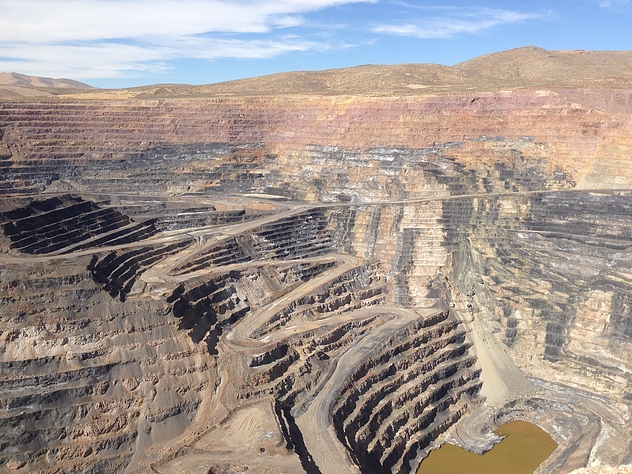
Twin Creeks Mine, Potosi Mining District, Osgood Mountains, Humboldt County, Nevada, USAi
| Regional Level Types | |
|---|---|
| Twin Creeks Mine | Mine |
| Potosi Mining District | Mining District |
| Osgood Mountains | Mountain Range |
| Humboldt County | County |
| Nevada | State |
| USA | Country |
This page is currently not sponsored. Contact us for sponsorship opportunities.


Latitude & Longitude (WGS84):
41° 13' 13'' North , 117° 9' 56'' West
Latitude & Longitude (decimal):
Type:
Köppen climate type:
Nearest Settlements:
| Place | Population | Distance |
|---|---|---|
| Golconda | 214 (2011) | 40.2km |
| Paradise Valley | 109 (2011) | 43.2km |
Owned/operated by:
Other/historical names associated with this locality:
Chimney Creek Mine, Rabbit Creek Mine, Mega pit (the merged pit), DZ Zone, Main, Chert Zone, HGO Zone, Jackrabbit Zone, LGO Zone, Sage, Section 8, Snowshoe Zone, South Layback, Section 30, South Oxide, Upper Sill Zone, West Pit, SWS Zone
Structure: The Conelea overturned anticline dominates the structural picture of the early Rabbit Creek Mine area. The fold axis strikes N20-30W, dips 20-30 degrees southwest, and plunges 5 degrees northwest. The Conelea Anticline is offset by three NE-striking faults; the northernmost of the three (DZ fault) has about 2000 ft. of dextral offset. The DZ fault is interpreted as a Riedel "R" shear associated with an inferred major N-S basement suture with right lateral offset, the "Rabbit Suture". Low angle unconformity developed in the Gough's Canyon Formation. The Chimney Creek deposit occurs along a northeasterly range front lineament that is probably an extension of the Getchell Fault. Host rocks strike NE, dip 21-32 NW. Leviathan allochthon. Antler orogenic belt. major, deep seated, N-S structural zone (suture) 40 km (25 miles) long, known as the Getchell high-angle fault system bounds the eastern flank of the Osgood Mountains. N-S trending belt of gold mineralization that is at least 5.6 km (3.5 miles) long and 300 m (1000 ft) to 450m (1500ft) wide. Roberts Mountain Thrust (below) and the Golconda Thrust (above), intruded by the mid-Cretaceous Osgood Mt. granodiorite and related trachyandesite dikes.
Alteration: Decalcification, silicification, dolomitization, argillization, and minor sericitization of sediments. Albitization and propylitization of basalt. Decalcification increased porosity, allowing introduction of mineralizing fluids. Silica was introduced in several stages in the HGO orebody. Dolomitization accompanied one of the silicification stages. Argillization is important in the LGO orebody. Hydrothermal alteration formed sericite, kaolinite, dickite, alunite, natroalunite. A zone of phyllic alteration, 50 m wide around feeder zone, contains ore-grade mineralization. Carbonate dissolution zones; two generations of silicification (jasperoid); propylitic alteration of basalts.
Tectonics: back-arc thrust belt
Commodity: Ore Materials: gold Gangue Materials: albite, chlorite, kaolinite, sericite, calcite, amphibole, quartz, pyrite, augite, epidote, limonite, leucoxene, K-feldspar, tourmaline, fluorite, barite, organic carbon, goethite
Deposit: The original gently dipping mineralized zone containing significant gold values was found in an area about 1600 by 800 feet covered by 60m to 165 m of alluvium. It consisted of a gold-bearing tabular jasperoid body 30-50 m thick extending at least 600 m outward from the center of Chimney Creek. Seven other nearby gold mineralized zones were soon recognized. These zones were first developed as the separate Rabbit Creek and Chimney Creek open pit mines, later merged into a single ?Mega-pit?. In the Section 30 South Mega pit area, mill-grade oxide mineralization was found in both limbs of a large fold, with mineralization extending more than 1,500 feet south of the limit of the Mega pit as currently planned. All three target areas were drilled extensively in 1996 and1997, and Santa Fe Pacific Gold intersected "high-grade" in some of their drilling below the Twin Creeks pit. The Galena vein underground target is relatively high-grade (0.25-0.40 opt) mineralization within a northeast-southwest trending fault zone in the greenstones immediately beneath the Vista deposit north of the Mega pit. The target extended along strike for over 1,000 feet and about 500 feet down the structure, averaging about 10-15 feet wide, open along strike and at depth. The Zone 40 target is a fold-controlled zone of high-grade (about 0.5 opt) refractory mineralization at the bottom of the Mega pit. The Sage ore body is a northern extension of the existing Twin Creeks Mega pit, and occurs in the overturned fold axis of a NW-trending anticline at depths of 600 to 1200 feet. The carbonaceous and sulfide ore will be processed through the Sage autoclave. Most gold values are found in calcareous shales in the Ordovician sequence and in limestones in the Etchart Formation, although not all layers contain the same amount of gold. Strongest gold mineralization is not adjacent to faults but the form and distribution of mineralization suggests that gold-bearing solutions gained access to favorable layers along faults. In the Ordovician sequence, gold values are highest in shales that have undergone maximum dissolution of carbonate minerals. Petrographic study shows that some gold is associated with adularia, but deposit-scale comparisons do not show a consistent relation between K/Al ratios and gold values. The distribution of antimony is similar to that of gold, whereas mercury is more concentrated than gold, and arsenic is more widely dispersed than gold. The relation between gold, iron, and sulfide sulfur values shows that mineralization is concentrated in rocks that have gained sulfur, but not iron, to form gold-bearing arsenian pyrite. Thus, these rocks have undergone sulfidation rather than pyritization. The iron that underwent sulfidation came largely from preore, diagenetic(?) ferroan dolomite and was released into solution by decarbonation, a common form of alteration associated with Carlin-type deposits. It appears tha wall-rock iron content and decarbonation processes which liberate this iron are the most important factors controlling formation of this Carlin-type gold deposit.
Deposit type: Sediment-hosted Au
Development: The Chimney Creek deposit was discovered in 1985 by Gold Fields Mining Corp., after which Santa Fe Pacific geologists reviewed the railroad grant sections in the adjacent Rabbit Creek area. They identified and drilled a strong N-S photolineament between the Chimney Creek to Rabbit Creek deposits and the third round of drilling in January 1987 dicovered the Rabbit Creek orebody. Prestripping commenced March 1989, mill and heap leach construction began in August 1989, and initial production began August 1990 utilizing oxide ores with an output of 200,000 ounces of gold per year. In 1993, Santa Fe Pacific Gold Company's Chimney Creek Mine and Rabbit Creek Mine merged into one "mega pit" which since that time has been called the Twin Creeks Mine. In 1997, Newmont Gold Company acquired the property as part of its takeover of Santa Fe Pacific. Since the merger of the two mines, Twin Creeks' production has averaged about a half million ounces of gold per year. Production decreased temporarily due to an incident in late 1994 in which about 3 million tons of overburden slid into the Twin Creeks pit covering ore that was scheduled to be mined in 1995. In mid-1996, gold reserves at Twin Creeks stood at 10.5 million ounces. Santa Fe Pacific increased its exploration budget to drill test extensions south of the main pit, as well as sulfide mineralization around the Vista Pit and two underground targets. In early 1997, the mine began a sulfide expansion project which included construction of two 4,000 tpd autoclave circuits, which was expected to increase Twin Creeks' annual production by about 100,000 ounces of gold. SFPG also invested $30 million in its shovel and haulage fleet, including the addition of a new electric shovel with a 56-cubic yard bucket, the largest of its kind in the industry. In 1996, deep exploration targets (to 3,000-feet) were drilled below the Vista and Mega pits. Santa Fe?s efforts to expand gold resources at the Twin Creeks mine during 1996 focused on three areas: the Galena vein, Zone 40, and Section 30 South Mega pit. Newmont acquired Santa Fe Pacific Gold Corporation in 1997, adding Twin Creeks, Lone Tree and several satellite deposits near Winnemucca to its portfolio. The Sage layback was broadly drilled by Santa Fe Pacific Gold in the mid-1990s. Infill drilling and a new model by Newmont in late 2002 were successful in adding high-grade ounces and reducing layback costs by $50 per ounce. Sage was added to Twin Creeks? reserves in 2003. The Sage ore body is a northern extension of the existing Twin Creeks Mega pit, and occurs in the overturned fold axis of a NW-trending anticline at depths of 600 to 1200 feet. The carbonaceous and sulfide ore will be processed through the Sage autoclave
Geology: The original Rabbit Creek Gold Deposit was concealed under a thick series of coalescing alluvial fans forming a pediment of the Osgood Mountains. The ore body occurs in Paleozoic sedimentary rocks which are completely covered by quaternary sand, gravel and clay. The Paleozoic rocks deposited in a eugeosynclinal environment were extensively deformed during three pre-Tertiary tectonic events. Thrusting during the Antler and Sonoma orogenies brought Western facies deep water units over or interleaved them with Eastern facies, shallow water units in a complex assemblage. Thrusts are generally N-NE striking. Paleozoic units are tilted and folded, often isoclinally, and steeply dipping. During the basin and range extension mafic and felsic dikes were intruded. High angle faults played a primary role in localizing the flow of hydrothermal systems responsible for the deposition of gold. Host rocks are black, carbonaceous, calcareous shales, siltstones, cherts, interbedded basaltic hydroclastic tuffs, and coeval basalts and volcaniclastics. Concordant sills and lava flow of high-titanium basalts of tholeiitic-to-alkalic composition. The Chimney Creek Deposit is stratigraphically and tectonally complex. The deposit is sandwiched between the mid-Paleozoic Roberts Mountain Thrust and the Permo-Triassic Golconda Thrust. Alteration and mineralization re channeled into the thick bedded lower member of the Etchart Limestone along high angle fault feeder zones in the Gough's Canyon Formation and spread out laterally along bedding to form a conformable sediment-hosted gold-silver deposit above a disconformable structurally controlled volcanic-hosted feeder zone. Mineralization occurs exclusively in the Gough's Canyon Formation and the lower members of the Etchart Limestone. The highest Au-Ag grades are coincident with the most severe carbonate dissolution zones in the etchart formation. Gold grade drops off slightly with increasing distance from the projected feeder pipes. Au-bearing bedded jasperoids form tabular bodies from 30-50m thick extending at least 600 m outward from the center of the chimney creek. Alteration is pervasive and extensive inside and below the orebody. Etchart Formation, 850 m thick, consists of siliciclastic carbonate shallow water sequence ( rich in silicate mineral detritus), pebbly litharenite, siltstone, sandy dolomite and dolomite. Metamorphosed d altered basalts, ranging from greenschists retaining igneous textures to intensely hydrothermally altered rocks. Dacite dikes are related to the Osgood Mountains granodiorite and cut altered rocks and are themselves altered.
Ore(s): The "Rabbit Suture" is considered a first order control. The DZ fault was probably a feeder fault. Favorable calcareous lithologies within NW- trending overturned anticline are stratigraphic controls. Bedding in the lower member of the Etchart Limestone. Complex tectonics, stratigraphy and alteration.
Alteration: Decalcification, silicification, dolomitization, argillization, and minor sericitization of sediments. Albitization and propylitization of basalt. Decalcification increased porosity, allowing introduction of mineralizing fluids. Silica was introduced in several stages in the HGO orebody. Dolomitization accompanied one of the silicification stages. Argillization is important in the LGO orebody. Hydrothermal alteration formed sericite, kaolinite, dickite, alunite, natroalunite. A zone of phyllic alteration, 50 m wide around feeder zone, contains ore-grade mineralization. Carbonate dissolution zones; two generations of silicification (jasperoid); propylitic alteration of basalts.
Tectonics: back-arc thrust belt
Commodity: Ore Materials: gold Gangue Materials: albite, chlorite, kaolinite, sericite, calcite, amphibole, quartz, pyrite, augite, epidote, limonite, leucoxene, K-feldspar, tourmaline, fluorite, barite, organic carbon, goethite
Deposit: The original gently dipping mineralized zone containing significant gold values was found in an area about 1600 by 800 feet covered by 60m to 165 m of alluvium. It consisted of a gold-bearing tabular jasperoid body 30-50 m thick extending at least 600 m outward from the center of Chimney Creek. Seven other nearby gold mineralized zones were soon recognized. These zones were first developed as the separate Rabbit Creek and Chimney Creek open pit mines, later merged into a single ?Mega-pit?. In the Section 30 South Mega pit area, mill-grade oxide mineralization was found in both limbs of a large fold, with mineralization extending more than 1,500 feet south of the limit of the Mega pit as currently planned. All three target areas were drilled extensively in 1996 and1997, and Santa Fe Pacific Gold intersected "high-grade" in some of their drilling below the Twin Creeks pit. The Galena vein underground target is relatively high-grade (0.25-0.40 opt) mineralization within a northeast-southwest trending fault zone in the greenstones immediately beneath the Vista deposit north of the Mega pit. The target extended along strike for over 1,000 feet and about 500 feet down the structure, averaging about 10-15 feet wide, open along strike and at depth. The Zone 40 target is a fold-controlled zone of high-grade (about 0.5 opt) refractory mineralization at the bottom of the Mega pit. The Sage ore body is a northern extension of the existing Twin Creeks Mega pit, and occurs in the overturned fold axis of a NW-trending anticline at depths of 600 to 1200 feet. The carbonaceous and sulfide ore will be processed through the Sage autoclave. Most gold values are found in calcareous shales in the Ordovician sequence and in limestones in the Etchart Formation, although not all layers contain the same amount of gold. Strongest gold mineralization is not adjacent to faults but the form and distribution of mineralization suggests that gold-bearing solutions gained access to favorable layers along faults. In the Ordovician sequence, gold values are highest in shales that have undergone maximum dissolution of carbonate minerals. Petrographic study shows that some gold is associated with adularia, but deposit-scale comparisons do not show a consistent relation between K/Al ratios and gold values. The distribution of antimony is similar to that of gold, whereas mercury is more concentrated than gold, and arsenic is more widely dispersed than gold. The relation between gold, iron, and sulfide sulfur values shows that mineralization is concentrated in rocks that have gained sulfur, but not iron, to form gold-bearing arsenian pyrite. Thus, these rocks have undergone sulfidation rather than pyritization. The iron that underwent sulfidation came largely from preore, diagenetic(?) ferroan dolomite and was released into solution by decarbonation, a common form of alteration associated with Carlin-type deposits. It appears tha wall-rock iron content and decarbonation processes which liberate this iron are the most important factors controlling formation of this Carlin-type gold deposit.
Deposit type: Sediment-hosted Au
Development: The Chimney Creek deposit was discovered in 1985 by Gold Fields Mining Corp., after which Santa Fe Pacific geologists reviewed the railroad grant sections in the adjacent Rabbit Creek area. They identified and drilled a strong N-S photolineament between the Chimney Creek to Rabbit Creek deposits and the third round of drilling in January 1987 dicovered the Rabbit Creek orebody. Prestripping commenced March 1989, mill and heap leach construction began in August 1989, and initial production began August 1990 utilizing oxide ores with an output of 200,000 ounces of gold per year. In 1993, Santa Fe Pacific Gold Company's Chimney Creek Mine and Rabbit Creek Mine merged into one "mega pit" which since that time has been called the Twin Creeks Mine. In 1997, Newmont Gold Company acquired the property as part of its takeover of Santa Fe Pacific. Since the merger of the two mines, Twin Creeks' production has averaged about a half million ounces of gold per year. Production decreased temporarily due to an incident in late 1994 in which about 3 million tons of overburden slid into the Twin Creeks pit covering ore that was scheduled to be mined in 1995. In mid-1996, gold reserves at Twin Creeks stood at 10.5 million ounces. Santa Fe Pacific increased its exploration budget to drill test extensions south of the main pit, as well as sulfide mineralization around the Vista Pit and two underground targets. In early 1997, the mine began a sulfide expansion project which included construction of two 4,000 tpd autoclave circuits, which was expected to increase Twin Creeks' annual production by about 100,000 ounces of gold. SFPG also invested $30 million in its shovel and haulage fleet, including the addition of a new electric shovel with a 56-cubic yard bucket, the largest of its kind in the industry. In 1996, deep exploration targets (to 3,000-feet) were drilled below the Vista and Mega pits. Santa Fe?s efforts to expand gold resources at the Twin Creeks mine during 1996 focused on three areas: the Galena vein, Zone 40, and Section 30 South Mega pit. Newmont acquired Santa Fe Pacific Gold Corporation in 1997, adding Twin Creeks, Lone Tree and several satellite deposits near Winnemucca to its portfolio. The Sage layback was broadly drilled by Santa Fe Pacific Gold in the mid-1990s. Infill drilling and a new model by Newmont in late 2002 were successful in adding high-grade ounces and reducing layback costs by $50 per ounce. Sage was added to Twin Creeks? reserves in 2003. The Sage ore body is a northern extension of the existing Twin Creeks Mega pit, and occurs in the overturned fold axis of a NW-trending anticline at depths of 600 to 1200 feet. The carbonaceous and sulfide ore will be processed through the Sage autoclave
Geology: The original Rabbit Creek Gold Deposit was concealed under a thick series of coalescing alluvial fans forming a pediment of the Osgood Mountains. The ore body occurs in Paleozoic sedimentary rocks which are completely covered by quaternary sand, gravel and clay. The Paleozoic rocks deposited in a eugeosynclinal environment were extensively deformed during three pre-Tertiary tectonic events. Thrusting during the Antler and Sonoma orogenies brought Western facies deep water units over or interleaved them with Eastern facies, shallow water units in a complex assemblage. Thrusts are generally N-NE striking. Paleozoic units are tilted and folded, often isoclinally, and steeply dipping. During the basin and range extension mafic and felsic dikes were intruded. High angle faults played a primary role in localizing the flow of hydrothermal systems responsible for the deposition of gold. Host rocks are black, carbonaceous, calcareous shales, siltstones, cherts, interbedded basaltic hydroclastic tuffs, and coeval basalts and volcaniclastics. Concordant sills and lava flow of high-titanium basalts of tholeiitic-to-alkalic composition. The Chimney Creek Deposit is stratigraphically and tectonally complex. The deposit is sandwiched between the mid-Paleozoic Roberts Mountain Thrust and the Permo-Triassic Golconda Thrust. Alteration and mineralization re channeled into the thick bedded lower member of the Etchart Limestone along high angle fault feeder zones in the Gough's Canyon Formation and spread out laterally along bedding to form a conformable sediment-hosted gold-silver deposit above a disconformable structurally controlled volcanic-hosted feeder zone. Mineralization occurs exclusively in the Gough's Canyon Formation and the lower members of the Etchart Limestone. The highest Au-Ag grades are coincident with the most severe carbonate dissolution zones in the etchart formation. Gold grade drops off slightly with increasing distance from the projected feeder pipes. Au-bearing bedded jasperoids form tabular bodies from 30-50m thick extending at least 600 m outward from the center of the chimney creek. Alteration is pervasive and extensive inside and below the orebody. Etchart Formation, 850 m thick, consists of siliciclastic carbonate shallow water sequence ( rich in silicate mineral detritus), pebbly litharenite, siltstone, sandy dolomite and dolomite. Metamorphosed d altered basalts, ranging from greenschists retaining igneous textures to intensely hydrothermally altered rocks. Dacite dikes are related to the Osgood Mountains granodiorite and cut altered rocks and are themselves altered.
Ore(s): The "Rabbit Suture" is considered a first order control. The DZ fault was probably a feeder fault. Favorable calcareous lithologies within NW- trending overturned anticline are stratigraphic controls. Bedding in the lower member of the Etchart Limestone. Complex tectonics, stratigraphy and alteration.
Select Mineral List Type
Standard Detailed Gallery Strunz Chemical ElementsCommodity List
This is a list of exploitable or exploited mineral commodities recorded from this region.Mineral List
Mineral list contains entries from the region specified including sub-localities39 valid minerals.
Rock Types Recorded
Rock list contains entries from the region specified including sub-localities
Select Rock List Type
Alphabetical List Tree DiagramDetailed Mineral List:

List of minerals arranged by Strunz 10th Edition classification
| Group 1 - Elements | |||
|---|---|---|---|
| ⓘ | Native Gold | 1.AA.05 | Au |
| ⓘ | Native Tellurium | 1.CC.10 | Te |
| Group 2 - Sulphides and Sulfosalts | |||
| ⓘ | Coloradoite | 2.CB.05a | HgTe |
| ⓘ | Pyrrhotite | 2.CC.10 | Fe1-xS |
| ⓘ | Galena | 2.CD.10 | PbS |
| ⓘ | Metastibnite | 2.DB.05 | Sb2S3 |
| ⓘ | Stibnite | 2.DB.05 | Sb2S3 |
| ⓘ | Calaverite | 2.EA.10 | AuTe2 |
| ⓘ | Pyrite | 2.EB.05a | FeS2 |
| ⓘ | Marcasite | 2.EB.10a | FeS2 |
| ⓘ | Arsenopyrite | 2.EB.20 | FeAsS |
| ⓘ | Realgar | 2.FA.15a | As4S4 |
| ⓘ | Orpiment | 2.FA.30 | As2S3 |
| ⓘ | 'Tetrahedrite Subgroup' | 2.GB.05 | Cu6(Cu4C2+2)Sb4S12S |
| ⓘ | Galkhaite | 2.GB.20 | (Hg5Cu)CsAs4S12 |
| Group 3 - Halides | |||
| ⓘ | Fluorite | 3.AB.25 | CaF2 |
| Group 4 - Oxides and Hydroxides | |||
| ⓘ | Goethite | 4.00. | Fe3+O(OH) |
| ⓘ | Quartz | 4.DA.05 | SiO2 |
| Group 5 - Nitrates and Carbonates | |||
| ⓘ | Calcite | 5.AB.05 | CaCO3 |
| ⓘ | Rhodochrosite | 5.AB.05 | MnCO3 |
| ⓘ | Dolomite | 5.AB.10 | CaMg(CO3)2 |
| ⓘ | Cerussite | 5.AB.15 | PbCO3 |
| Group 7 - Sulphates, Chromates, Molybdates and Tungstates | |||
| ⓘ | Baryte | 7.AD.35 | BaSO4 |
| Group 8 - Phosphates, Arsenates and Vanadates | |||
| ⓘ | Whitlockite | 8.AC.45 | Ca9Mg(PO4)6(PO3OH) |
| ⓘ | Conichalcite | 8.BH.35 | CaCu(AsO4)(OH) |
| ⓘ | Beudantite | 8.BL.05 | PbFe3+3(AsO4)(SO4)(OH)6 |
| ⓘ | Hinsdalite | 8.BL.05 | PbAl3(PO4)(SO4)(OH)6 |
| ⓘ | Fluorapatite var. Carbonate-rich Fluorapatite | 8.BN.05 | Ca5(PO4,CO3)3(F,O) |
| ⓘ | 8.BN.05 | Ca5(PO4)3F | |
| ⓘ | Variscite | 8.CD.10 | AlPO4 · 2H2O |
| ⓘ | Gaitite | 8.CG.05 | Ca2Zn(AsO4)2 · 2H2O |
| ⓘ | Kingsmountite | 8.DH.25 | Ca3Mn2+FeAl4(PO4)6(OH)4 · 12H2O |
| ⓘ | Montgomeryite | 8.DH.25 | Ca4MgAl4(PO4)6(OH)4 · 12H2O |
| ⓘ | Mitridatite | 8.DH.30 | Ca2Fe3+3(PO4)3O2 · 3H2O |
| Group 9 - Silicates | |||
| ⓘ | Forsterite | 9.AC.05 | Mg2(SiO4) |
| ⓘ | Epidote | 9.BG.05a | (CaCa)(AlAlFe3+)O[Si2O7][SiO4](OH) |
| ⓘ | Augite | 9.DA.15 | (CaxMgyFez)(Mgy1Fez1)Si2O6 |
| ⓘ | Muscovite var. Illite | 9.EC.15 | K0.65Al2.0[Al0.65Si3.35O10](OH)2 |
| ⓘ | 9.EC.15 | KAl2(AlSi3O10)(OH)2 | |
| ⓘ | var. Sericite | 9.EC.15 | KAl2(AlSi3O10)(OH)2 |
| ⓘ | Phlogopite | 9.EC.20 | KMg3(AlSi3O10)(OH)2 |
| ⓘ | Kaolinite | 9.ED.05 | Al2(Si2O5)(OH)4 |
| ⓘ | Albite | 9.FA.35 | Na(AlSi3O8) |
| Unclassified | |||
| ⓘ | 'K Feldspar var. Adularia' | - | KAlSi3O8 |
| ⓘ | 'Amphibole Supergroup' | - | AB2C5(T8O22)W2 |
| ⓘ | 'Chlorite Group' | - | |
| ⓘ | 'Feldspar Group' | - | |
| ⓘ | 'Limonite' | - | |
| ⓘ | 'Tourmaline' | - | AD3G6(T6O18)(BO3)3X3Z |
| ⓘ | 'Leucoxene' | - | |
| ⓘ | 'K Feldspar' | - | |
List of minerals for each chemical element
| H | Hydrogen | |
|---|---|---|
| H | ⓘ Beudantite | PbFe33+(AsO4)(SO4)(OH)6 |
| H | ⓘ Conichalcite | CaCu(AsO4)(OH) |
| H | ⓘ Epidote | (CaCa)(AlAlFe3+)O[Si2O7][SiO4](OH) |
| H | ⓘ Gaitite | Ca2Zn(AsO4)2 · 2H2O |
| H | ⓘ Goethite | Fe3+O(OH) |
| H | ⓘ Hinsdalite | PbAl3(PO4)(SO4)(OH)6 |
| H | ⓘ Muscovite var. Illite | K0.65Al2.0[Al0.65Si3.35O10](OH)2 |
| H | ⓘ Kaolinite | Al2(Si2O5)(OH)4 |
| H | ⓘ Kingsmountite | Ca3Mn2+FeAl4(PO4)6(OH)4 · 12H2O |
| H | ⓘ Mitridatite | Ca2Fe33+(PO4)3O2 · 3H2O |
| H | ⓘ Montgomeryite | Ca4MgAl4(PO4)6(OH)4 · 12H2O |
| H | ⓘ Muscovite | KAl2(AlSi3O10)(OH)2 |
| H | ⓘ Phlogopite | KMg3(AlSi3O10)(OH)2 |
| H | ⓘ Variscite | AlPO4 · 2H2O |
| H | ⓘ Whitlockite | Ca9Mg(PO4)6(PO3OH) |
| H | ⓘ Muscovite var. Sericite | KAl2(AlSi3O10)(OH)2 |
| B | Boron | |
| B | ⓘ Tourmaline | AD3G6(T6O18)(BO3)3X3Z |
| C | Carbon | |
| C | ⓘ Calcite | CaCO3 |
| C | ⓘ Fluorapatite var. Carbonate-rich Fluorapatite | Ca5(PO4,CO3)3(F,O) |
| C | ⓘ Cerussite | PbCO3 |
| C | ⓘ Dolomite | CaMg(CO3)2 |
| C | ⓘ Rhodochrosite | MnCO3 |
| O | Oxygen | |
| O | ⓘ K Feldspar var. Adularia | KAlSi3O8 |
| O | ⓘ Albite | Na(AlSi3O8) |
| O | ⓘ Amphibole Supergroup | AB2C5(T8O22)W2 |
| O | ⓘ Augite | (CaxMgyFez)(Mgy1Fez1)Si2O6 |
| O | ⓘ Baryte | BaSO4 |
| O | ⓘ Beudantite | PbFe33+(AsO4)(SO4)(OH)6 |
| O | ⓘ Calcite | CaCO3 |
| O | ⓘ Fluorapatite var. Carbonate-rich Fluorapatite | Ca5(PO4,CO3)3(F,O) |
| O | ⓘ Cerussite | PbCO3 |
| O | ⓘ Conichalcite | CaCu(AsO4)(OH) |
| O | ⓘ Dolomite | CaMg(CO3)2 |
| O | ⓘ Epidote | (CaCa)(AlAlFe3+)O[Si2O7][SiO4](OH) |
| O | ⓘ Fluorapatite | Ca5(PO4)3F |
| O | ⓘ Forsterite | Mg2(SiO4) |
| O | ⓘ Gaitite | Ca2Zn(AsO4)2 · 2H2O |
| O | ⓘ Goethite | Fe3+O(OH) |
| O | ⓘ Hinsdalite | PbAl3(PO4)(SO4)(OH)6 |
| O | ⓘ Muscovite var. Illite | K0.65Al2.0[Al0.65Si3.35O10](OH)2 |
| O | ⓘ Kaolinite | Al2(Si2O5)(OH)4 |
| O | ⓘ Kingsmountite | Ca3Mn2+FeAl4(PO4)6(OH)4 · 12H2O |
| O | ⓘ Mitridatite | Ca2Fe33+(PO4)3O2 · 3H2O |
| O | ⓘ Montgomeryite | Ca4MgAl4(PO4)6(OH)4 · 12H2O |
| O | ⓘ Muscovite | KAl2(AlSi3O10)(OH)2 |
| O | ⓘ Phlogopite | KMg3(AlSi3O10)(OH)2 |
| O | ⓘ Quartz | SiO2 |
| O | ⓘ Rhodochrosite | MnCO3 |
| O | ⓘ Tourmaline | AD3G6(T6O18)(BO3)3X3Z |
| O | ⓘ Variscite | AlPO4 · 2H2O |
| O | ⓘ Whitlockite | Ca9Mg(PO4)6(PO3OH) |
| O | ⓘ Muscovite var. Sericite | KAl2(AlSi3O10)(OH)2 |
| F | Fluorine | |
| F | ⓘ Fluorapatite var. Carbonate-rich Fluorapatite | Ca5(PO4,CO3)3(F,O) |
| F | ⓘ Fluorapatite | Ca5(PO4)3F |
| F | ⓘ Fluorite | CaF2 |
| Na | Sodium | |
| Na | ⓘ Albite | Na(AlSi3O8) |
| Mg | Magnesium | |
| Mg | ⓘ Augite | (CaxMgyFez)(Mgy1Fez1)Si2O6 |
| Mg | ⓘ Dolomite | CaMg(CO3)2 |
| Mg | ⓘ Forsterite | Mg2(SiO4) |
| Mg | ⓘ Montgomeryite | Ca4MgAl4(PO4)6(OH)4 · 12H2O |
| Mg | ⓘ Phlogopite | KMg3(AlSi3O10)(OH)2 |
| Mg | ⓘ Whitlockite | Ca9Mg(PO4)6(PO3OH) |
| Al | Aluminium | |
| Al | ⓘ K Feldspar var. Adularia | KAlSi3O8 |
| Al | ⓘ Albite | Na(AlSi3O8) |
| Al | ⓘ Epidote | (CaCa)(AlAlFe3+)O[Si2O7][SiO4](OH) |
| Al | ⓘ Hinsdalite | PbAl3(PO4)(SO4)(OH)6 |
| Al | ⓘ Muscovite var. Illite | K0.65Al2.0[Al0.65Si3.35O10](OH)2 |
| Al | ⓘ Kaolinite | Al2(Si2O5)(OH)4 |
| Al | ⓘ Kingsmountite | Ca3Mn2+FeAl4(PO4)6(OH)4 · 12H2O |
| Al | ⓘ Montgomeryite | Ca4MgAl4(PO4)6(OH)4 · 12H2O |
| Al | ⓘ Muscovite | KAl2(AlSi3O10)(OH)2 |
| Al | ⓘ Phlogopite | KMg3(AlSi3O10)(OH)2 |
| Al | ⓘ Variscite | AlPO4 · 2H2O |
| Al | ⓘ Muscovite var. Sericite | KAl2(AlSi3O10)(OH)2 |
| Si | Silicon | |
| Si | ⓘ K Feldspar var. Adularia | KAlSi3O8 |
| Si | ⓘ Albite | Na(AlSi3O8) |
| Si | ⓘ Augite | (CaxMgyFez)(Mgy1Fez1)Si2O6 |
| Si | ⓘ Epidote | (CaCa)(AlAlFe3+)O[Si2O7][SiO4](OH) |
| Si | ⓘ Forsterite | Mg2(SiO4) |
| Si | ⓘ Muscovite var. Illite | K0.65Al2.0[Al0.65Si3.35O10](OH)2 |
| Si | ⓘ Kaolinite | Al2(Si2O5)(OH)4 |
| Si | ⓘ Muscovite | KAl2(AlSi3O10)(OH)2 |
| Si | ⓘ Phlogopite | KMg3(AlSi3O10)(OH)2 |
| Si | ⓘ Quartz | SiO2 |
| Si | ⓘ Muscovite var. Sericite | KAl2(AlSi3O10)(OH)2 |
| P | Phosphorus | |
| P | ⓘ Fluorapatite var. Carbonate-rich Fluorapatite | Ca5(PO4,CO3)3(F,O) |
| P | ⓘ Fluorapatite | Ca5(PO4)3F |
| P | ⓘ Hinsdalite | PbAl3(PO4)(SO4)(OH)6 |
| P | ⓘ Kingsmountite | Ca3Mn2+FeAl4(PO4)6(OH)4 · 12H2O |
| P | ⓘ Mitridatite | Ca2Fe33+(PO4)3O2 · 3H2O |
| P | ⓘ Montgomeryite | Ca4MgAl4(PO4)6(OH)4 · 12H2O |
| P | ⓘ Variscite | AlPO4 · 2H2O |
| P | ⓘ Whitlockite | Ca9Mg(PO4)6(PO3OH) |
| S | Sulfur | |
| S | ⓘ Arsenopyrite | FeAsS |
| S | ⓘ Baryte | BaSO4 |
| S | ⓘ Beudantite | PbFe33+(AsO4)(SO4)(OH)6 |
| S | ⓘ Galena | PbS |
| S | ⓘ Galkhaite | (Hg5Cu)CsAs4S12 |
| S | ⓘ Hinsdalite | PbAl3(PO4)(SO4)(OH)6 |
| S | ⓘ Marcasite | FeS2 |
| S | ⓘ Metastibnite | Sb2S3 |
| S | ⓘ Orpiment | As2S3 |
| S | ⓘ Pyrite | FeS2 |
| S | ⓘ Pyrrhotite | Fe1-xS |
| S | ⓘ Realgar | As4S4 |
| S | ⓘ Stibnite | Sb2S3 |
| S | ⓘ Tetrahedrite Subgroup | Cu6(Cu4C22+)Sb4S12S |
| K | Potassium | |
| K | ⓘ K Feldspar var. Adularia | KAlSi3O8 |
| K | ⓘ Muscovite var. Illite | K0.65Al2.0[Al0.65Si3.35O10](OH)2 |
| K | ⓘ Muscovite | KAl2(AlSi3O10)(OH)2 |
| K | ⓘ Phlogopite | KMg3(AlSi3O10)(OH)2 |
| K | ⓘ Muscovite var. Sericite | KAl2(AlSi3O10)(OH)2 |
| Ca | Calcium | |
| Ca | ⓘ Augite | (CaxMgyFez)(Mgy1Fez1)Si2O6 |
| Ca | ⓘ Calcite | CaCO3 |
| Ca | ⓘ Fluorapatite var. Carbonate-rich Fluorapatite | Ca5(PO4,CO3)3(F,O) |
| Ca | ⓘ Conichalcite | CaCu(AsO4)(OH) |
| Ca | ⓘ Dolomite | CaMg(CO3)2 |
| Ca | ⓘ Epidote | (CaCa)(AlAlFe3+)O[Si2O7][SiO4](OH) |
| Ca | ⓘ Fluorapatite | Ca5(PO4)3F |
| Ca | ⓘ Fluorite | CaF2 |
| Ca | ⓘ Gaitite | Ca2Zn(AsO4)2 · 2H2O |
| Ca | ⓘ Kingsmountite | Ca3Mn2+FeAl4(PO4)6(OH)4 · 12H2O |
| Ca | ⓘ Mitridatite | Ca2Fe33+(PO4)3O2 · 3H2O |
| Ca | ⓘ Montgomeryite | Ca4MgAl4(PO4)6(OH)4 · 12H2O |
| Ca | ⓘ Whitlockite | Ca9Mg(PO4)6(PO3OH) |
| Mn | Manganese | |
| Mn | ⓘ Kingsmountite | Ca3Mn2+FeAl4(PO4)6(OH)4 · 12H2O |
| Mn | ⓘ Rhodochrosite | MnCO3 |
| Fe | Iron | |
| Fe | ⓘ Arsenopyrite | FeAsS |
| Fe | ⓘ Augite | (CaxMgyFez)(Mgy1Fez1)Si2O6 |
| Fe | ⓘ Beudantite | PbFe33+(AsO4)(SO4)(OH)6 |
| Fe | ⓘ Epidote | (CaCa)(AlAlFe3+)O[Si2O7][SiO4](OH) |
| Fe | ⓘ Goethite | Fe3+O(OH) |
| Fe | ⓘ Kingsmountite | Ca3Mn2+FeAl4(PO4)6(OH)4 · 12H2O |
| Fe | ⓘ Marcasite | FeS2 |
| Fe | ⓘ Mitridatite | Ca2Fe33+(PO4)3O2 · 3H2O |
| Fe | ⓘ Pyrite | FeS2 |
| Fe | ⓘ Pyrrhotite | Fe1-xS |
| Cu | Copper | |
| Cu | ⓘ Conichalcite | CaCu(AsO4)(OH) |
| Cu | ⓘ Galkhaite | (Hg5Cu)CsAs4S12 |
| Cu | ⓘ Tetrahedrite Subgroup | Cu6(Cu4C22+)Sb4S12S |
| Zn | Zinc | |
| Zn | ⓘ Gaitite | Ca2Zn(AsO4)2 · 2H2O |
| As | Arsenic | |
| As | ⓘ Arsenopyrite | FeAsS |
| As | ⓘ Beudantite | PbFe33+(AsO4)(SO4)(OH)6 |
| As | ⓘ Conichalcite | CaCu(AsO4)(OH) |
| As | ⓘ Gaitite | Ca2Zn(AsO4)2 · 2H2O |
| As | ⓘ Galkhaite | (Hg5Cu)CsAs4S12 |
| As | ⓘ Orpiment | As2S3 |
| As | ⓘ Realgar | As4S4 |
| Sb | Antimony | |
| Sb | ⓘ Metastibnite | Sb2S3 |
| Sb | ⓘ Stibnite | Sb2S3 |
| Sb | ⓘ Tetrahedrite Subgroup | Cu6(Cu4C22+)Sb4S12S |
| Te | Tellurium | |
| Te | ⓘ Calaverite | AuTe2 |
| Te | ⓘ Coloradoite | HgTe |
| Te | ⓘ Native Tellurium | Te |
| Cs | Caesium | |
| Cs | ⓘ Galkhaite | (Hg5Cu)CsAs4S12 |
| Ba | Barium | |
| Ba | ⓘ Baryte | BaSO4 |
| Au | Gold | |
| Au | ⓘ Calaverite | AuTe2 |
| Au | ⓘ Native Gold | Au |
| Hg | Mercury | |
| Hg | ⓘ Coloradoite | HgTe |
| Hg | ⓘ Galkhaite | (Hg5Cu)CsAs4S12 |
| Pb | Lead | |
| Pb | ⓘ Beudantite | PbFe33+(AsO4)(SO4)(OH)6 |
| Pb | ⓘ Cerussite | PbCO3 |
| Pb | ⓘ Galena | PbS |
| Pb | ⓘ Hinsdalite | PbAl3(PO4)(SO4)(OH)6 |
Other Databases
| Link to USGS MRDS: | 10310333 |
|---|
Localities in this Region
Other Regions, Features and Areas containing this locality
North AmericaContinent
North America PlateTectonic Plate
- Basin and Range BasinsBasin
- Mojave DomainDomain
- Northern Basin and RangeWide Rift
This page contains all mineral locality references listed on mindat.org. This does not claim to be a complete list. If you know of more minerals from this site, please register so you can add to our database. This locality information is for reference purposes only. You should never attempt to
visit any sites listed in mindat.org without first ensuring that you have the permission of the land and/or mineral rights holders
for access and that you are aware of all safety precautions necessary.
References
Groff, John A.; Heizler, Matthew T.; McIntosh, William C.; Norman, David I. (1997) 40Ar/39Ar dating and mineral paragenesis for Carlin-type gold deposits along the Getchell Trend, Nevada; evidence for Cretaceous and Tertiary gold mineralization. Economic Geology, 92 (5). 601-622 doi:10.2113/gsecongeo.92.5.601
Quick NavTopCommoditiesMineral ListRock TypesOther DatabasesLocalities in RegionOther RegionsReferences

Twin Creeks Mine, Potosi Mining District, Osgood Mountains, Humboldt County, Nevada, USA