
Wupatkiite
A valid IMA mineral species
This page is currently not sponsored. Click here to sponsor this page.
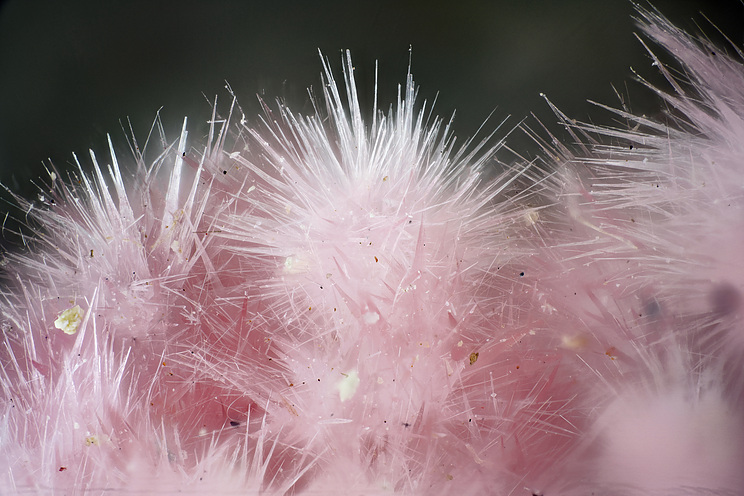


About Wupatkiite

Formula:
Co2+Al2(SO4)4 · 22H2O
Colour:
Light pink, pink-red
Lustre:
Silky
Hardness:
1½ - 2
Specific Gravity:
1.92
Crystal System:
Monoclinic
Member of:
Name:
For the prehistoric Wupatki pueblo dwelling near the locality.
This page provides mineralogical data about Wupatkiite.
Unique Identifiers
Mindat ID:
7372
Long-form identifier:
mindat:1:1:7372:7
IMA Classification of Wupatkiite
Approved
IMA Formula:
Co2+Al2(S6+O4)4·22H2O
Approval year:
1994
First published:
1995
Classification of Wupatkiite
7.CB.85
7 : SULFATES (selenates, tellurates, chromates, molybdates, wolframates)
C : Sulfates (selenates, etc.) without additional anions, with H2O
B : With only medium-sized cations
7 : SULFATES (selenates, tellurates, chromates, molybdates, wolframates)
C : Sulfates (selenates, etc.) without additional anions, with H2O
B : With only medium-sized cations
29.7.3.7
29 : HYDRATED ACID AND NORMAL SULFATES
7 : AB2(XO4)4·H2O
29 : HYDRATED ACID AND NORMAL SULFATES
7 : AB2(XO4)4·H2O
Mineral Symbols
As of 2021 there are now IMA–CNMNC approved mineral symbols (abbreviations) for each mineral species, useful for tables and diagrams.
| Symbol | Source | Reference for Standard |
|---|---|---|
| Wup | IMA–CNMNC | Warr, L.N. (2021). IMA–CNMNC approved mineral symbols. Mineralogical Magazine, 85(3), 291-320. doi:10.1180/mgm.2021.43 |
Physical Properties of Wupatkiite
Silky
Transparency:
Translucent
Colour:
Light pink, pink-red
Streak:
White
Hardness:
1½ - 2 on Mohs scale
Cleavage:
Imperfect/Fair
One at 70° to fiber length.
One at 70° to fiber length.
Density:
1.92 g/cm3 (Measured) 1.87 g/cm3 (Calculated)
Optical Data of Wupatkiite
Type:
Biaxial
RI values:
nα = 1.477 nγ = 1.484
Max. Birefringence:
δ = 0.007
Based on recorded range of RI values above.
Based on recorded range of RI values above.
Interference Colours:
The colours simulate birefringence patterns seen in thin section under crossed polars. They do not take into account mineral colouration or opacity.
Michel-Levy Bar The default colours simulate the birefringence range for a 30 µm thin-section thickness. Adjust the slider to simulate a different thickness.
Grain Simulation You can rotate the grain simulation to show how this range might look as you rotated a sample under crossed polars. Each grain retains its interference colour (retardation) while its brightness falls to black at extinction and reaches a maximum between extinction positions.
The colours simulate birefringence patterns seen in thin section under crossed polars. They do not take into account mineral colouration or opacity.
Michel-Levy Bar The default colours simulate the birefringence range for a 30 µm thin-section thickness. Adjust the slider to simulate a different thickness.
Grain Simulation You can rotate the grain simulation to show how this range might look as you rotated a sample under crossed polars. Each grain retains its interference colour (retardation) while its brightness falls to black at extinction and reaches a maximum between extinction positions.
Surface Relief:
Moderate (negative)
Relative to Canada balsam mounting medium (n ≈ 1.537).
Relative to Canada balsam mounting medium (n ≈ 1.537).
This shows the grain boundary and Becke line effect under plane-polarised
light, based on the contrast between this mineral's average refractive
index and the mounting medium. It does not take into account mineral
colouration.
In focus
Dispersion:
none
Optical Extinction:
Maximum extinction angle ∧ Z is 12°.
Pleochroism:
Weak
Comments:
very pale pink parallel to fiber bundles
Chemistry of Wupatkiite
Mindat Formula:
Co2+Al2(SO4)4 · 22H2O
Element Weights:
(Co2+,Mg,Ni2+)Al2(SO4)4 · 22H2O
Crystallography of Wupatkiite
Crystal System:
Monoclinic
Class (H-M):
2/m - Prismatic
Space Group:
P21/b
Setting:
P21/c
Cell Parameters:
a = 6.819(4) Å, b = 24.234(10) Å, c = 21.204(10) Å
β = 100.33(5)°
β = 100.33(5)°
Ratio:
a:b:c = 0.281 : 1 : 0.875
Unit Cell V:
3,447.20 ų (Calculated from Unit Cell)
Z:
4
X-Ray Powder Diffraction
Powder Diffraction Data:
| d-spacing | Intensity |
|---|---|
| 4.790 Å | (100) |
| 3.494 Å | (92) |
| 3.768 Å | (33) |
| 4.295 Å | (27) |
| 3.945 Å | (26) |
| 6.03 Å | (22) |
| 4.106 Å | (22) |
Geological Environment
Paragenetic Mode(s):
| Paragenetic Mode | Earliest Age (Ga) |
|---|---|
| Stage 7: Great Oxidation Event | <2.4 |
| 47a : [Near-surface hydration of prior minerals] | |
| 47b : [Sulfates and sulfites] | |
| Stage 10a: Neoproterozoic oxygenation/terrestrial biosphere | <0.6 |
| 50 : Coal and/or oil shale minerals | <0.36 |
Type Occurrence of Wupatkiite
General Appearance of Type Material:
Cross-fiber veinlets with fibers up to 8 mm long.
Place of Conservation of Type Material:
National School of Mines, Paris, France.
Geological Setting of Type Material:
Post-mine mineral occurring as encrustations on the walls of a shallow open cut.
Associated Minerals at Type Locality:
Synonyms of Wupatkiite
Other Language Names for Wupatkiite
Relationship of Wupatkiite to other Species
Member of:
Other Members of Halotrichite Group:
| Apjohnite | Mn2+Al2(SO4)4 · 22H2O | Mon. 2/m : P21/b |
| Bílinite | Fe2+Fe3+2(SO4)4 · 22H2O | Mon. 2/m : P21/b |
| Dietrichite | ZnAl2(SO4)4 · 22H2O | Mon. 2/m : P21/b |
| Halotrichite | Fe2+Al2(SO4)4 · 22H2O | Mon. 2 : P2 |
| Pickeringite | MgAl2(SO4)4 · 22H2O | Mon. 2/m : P21/b |
| Redingtonite | Fe2+Cr3+2(SO4)4 · 22H2O | Mon. 2 |
Common Associates
Associations Based on Photo Data:
| 2 photos of Wupatkiite associated with Ilsemannite | Mo3O8 · nH2O |
| 1 photo of Wupatkiite associated with Quartz | SiO2 |
| 1 photo of Wupatkiite associated with Halotrichite | Fe2+Al2(SO4)4 · 22H2O |
| 1 photo of Wupatkiite associated with Alunogen | Al2(SO4)3 · 17H2O |
Related Minerals - Strunz-mindat Grouping
| 7.CB. | Sarvodaite | Al2(SO4)3 · 5H2O |
| 7.CB.02 | Voudourisite | CdSO4 · H2O |
| 7.CB.05 | Szmikite | MnSO4 · H2O |
| 7.CB.05 | Szomolnokite | FeSO4 · H2O |
| 7.CB.05 | Cobaltkieserite | CoSO4 · H2O |
| 7.CB.05 | Dwornikite | Ni(SO4) · H2O |
| 7.CB.05 | Kieserite | MgSO4 · H2O |
| 7.CB.05 | Poitevinite | (Cu,Fe)SO4 · H2O |
| 7.CB.05 | Gunningite | ZnSO4 · H2O |
| 7.CB.07 | Sanderite | MgSO4 · 2H2O |
| 7.CB.10 | Bonattite | CuSO4 · 3H2O |
| 7.CB.12 | Belogubite | CuZn(SO4)2 · 10H2O |
| 7.CB.15 | Drobecite | CdSO4 · 4H2O |
| 7.CB.15 | Aplowite | CoSO4 · 4H2O |
| 7.CB.15 | Cranswickite | MgSO4 · 4H2O |
| 7.CB.15 | Rozenite | FeSO4 · 4H2O |
| 7.CB.15 | Starkeyite | MgSO4 · 4H2O |
| 7.CB.15 | Ilesite | Mn2+(SO4) · 4H2O |
| 7.CB.15 | Boyleite | ZnSO4 · 4H2O |
| 7.CB.20 | Siderotil | FeSO4 · 5H2O |
| 7.CB.20 | Jôkokuite | MnSO4 · 5H2O |
| 7.CB.20 | Pentahydrite | MgSO4 · 5H2O |
| 7.CB.20 | Chalcanthite | CuSO4 · 5H2O |
| 7.CB.25 | Chvaleticeite | Mn2+(H2O)6(SO4) |
| 7.CB.25 | Nickelhexahydrite | Ni2+(H2O)6(SO4) |
| 7.CB.25 | Hexahydrite | Mg(H2O)6(SO4) |
| 7.CB.25 | Bianchite | Zn(H2O)6(SO4) |
| 7.CB.25 | Moorhouseite | Co2+(H2O)6(SO4) |
| 7.CB.25 | Ferrohexahydrite | Fe2+(H2O)6(SO4) |
| 7.CB.30 | Retgersite | NiSO4 · 6H2O |
| 7.CB.35 | Zincmelanterite | Zn(H2O)6(SO4) · H2O |
| 7.CB.35 | Melanterite | Fe2+(H2O)6(SO4) · H2O |
| 7.CB.35 | Alpersite | (Mg,Cu2+)(H2O)6(SO4) · H2O |
| 7.CB.35 | Bieberite | Co2+(H2O)6(SO4) · H2O |
| 7.CB.35 | Boothite | Cu2+(H2O)6(SO4) · H2O |
| 7.CB.35 | Mallardite | Mn2+(H2O)6(SO4) · H2O |
| 7.CB.40 | Epsomite | MgSO4 · 7H2O |
| 7.CB.40 | Goslarite | ZnSO4 · 7H2O |
| 7.CB.40 | Morenosite | NiSO4 · 7H2O |
| 7.CB.45 | Meta-alunogen | Al2(SO4)3 · 12H2O |
| 7.CB.45 | Alunogen | Al2(SO4)3 · 17H2O |
| 7.CB.50 | Aluminocoquimbite | Al2Fe2(SO4)6(H2O)12 · 6H2O |
| 7.CB.50 | Lazaridisite | Cd3(SO4)3 · 8H2O |
| 7.CB.52 | Pararaisaite | CuMg[Te6+O4(OH)2] · 6H2O |
| 7.CB.55 | Paracoquimbite | Fe4(SO4)6(H2O)12 · 6H2O |
| 7.CB.55 | Rhomboclase | (H5O2)Fe3+(SO4)2 · 2H2O |
| 7.CB.55 | Raisaite | CuMg[Te6+O4(OH)2] · 6H2O |
| 7.CB.55 | Coquimbite | AlFe3(SO4)6(H2O)12 · 6H2O |
| 7.CB.57 | 'Caichengyunite' | Fe2+3Al2(SO4)6 · 30H2O |
| 7.CB.60 | Kornelite | Fe2(SO4)3 · 7H2O |
| 7.CB.65 | Quenstedtite | Fe2(SO4)3 · 11H2O |
| 7.CB.70 | Lausenite | Fe2(SO4)3 · 5H2O |
| 7.CB.75 | Römerite | Fe2+Fe3+2(SO4)4 · 14H2O |
| 7.CB.75 | Lishizhenite | ZnFe2(SO4)4 · 14H2O |
| 7.CB.80 | Ransomite | CuFe2(SO4)4 · 6H2O |
| 7.CB.85 | Dietrichite | ZnAl2(SO4)4 · 22H2O |
| 7.CB.85 | Halotrichite | Fe2+Al2(SO4)4 · 22H2O |
| 7.CB.85 | Apjohnite | Mn2+Al2(SO4)4 · 22H2O |
| 7.CB.85 | Redingtonite | Fe2+Cr3+2(SO4)4 · 22H2O |
| 7.CB.85 | Pickeringite | MgAl2(SO4)4 · 22H2O |
| 7.CB.85 | Bílinite | Fe2+Fe3+2(SO4)4 · 22H2O |
| 7.CB.90 | Meridianiite | MgSO4 · 11H2O |
Other Information
Thermal Behaviour:
Melts readily, producing a bright pink syrupy liquid. After all water has been driven off, a dense blue slag is produced.
Notes:
Soluble in water.
Health Risks:
No information on health risks for this material has been entered into the database. You should always treat mineral specimens with care.
Internet Links for Wupatkiite
mindat.org URL:
https://www.mindat.org/min-7372.html
Please feel free to link to this page.
Please feel free to link to this page.
Search Engines:
External Links:
Mineral Dealers:
References for Wupatkiite
Reference List:
Williams, Sidney A., Cesbron, Fabien P. (1995) Wupatkiite from the Cameron Uranium District, Arizona, a new member of the halotrichite group. Mineralogical Magazine, 59 (396) 553-556 doi:10.1180/minmag.1995.059.396.16
Frost, Ray L., Theo Kloprogge, J., Williams, Peter A., Leverett, Peter (2000) Raman microscopy of some natural pseudo-alums: halotrichite, apjohnite and wupatkiite, at 298 and 77 K. Journal of Raman Spectroscopy, 31 (12). 1083-1087 doi:10.1002/1097-4555(200012)31:12<1083::aid-jrs647>3.0.co;2-#
Localities for Wupatkiite
Showing 9 localities.
 symbol to view information about a locality.
The
symbol to view information about a locality.
The Locality List
 - This locality has map coordinates listed.
- This locality has estimated coordinates.
ⓘ - Click for references and further information on this occurrence.
? - Indicates mineral may be doubtful at this locality.
- This locality has map coordinates listed.
- This locality has estimated coordinates.
ⓘ - Click for references and further information on this occurrence.
? - Indicates mineral may be doubtful at this locality.
 - Good crystals or important locality for species.
 - World class for species or very significant.
(TL) - Type Locality for a valid mineral species.
(FRL) - First Recorded Locality for everything else (eg varieties).
- World class for species or very significant.
(TL) - Type Locality for a valid mineral species.
(FRL) - First Recorded Locality for everything else (eg varieties).
All localities listed without proper references should be considered as questionable.
Australia | |
| Vic Cloete collection +4 other references |
Costa Rica | |
| Ulloa et al. (2018) |
Cyprus | |
| Ng +1 other reference |
Russia | |
| Shcherbakova (2004) |
Slovakia | |
| |
Spain | |
| Valente et al. (2013) |
USA (TL) | |
| Williams et al. (1995) |
| Grant et al. (2005) | |
| Richard Dale Collection |
Quick NavTopAbout WupatkiiteUnique IdentifiersIMA Classification Classification Mineral SymbolsPhysical Properties Optical Data Chemistry Crystallography X-Ray Powder DiffractionGeological EnvironmentType Occurrence SynonymsOther LanguagesRelationshipsCommon AssociatesStrunz-MindatOther InformationInternet Links References Localities Locality List

Lorena Gold Mine, Cloncurry, Cloncurry Shire, Queensland, Australia