
Tritomite-(Y)
A valid IMA mineral species
This page is currently not sponsored. Click here to sponsor this page.


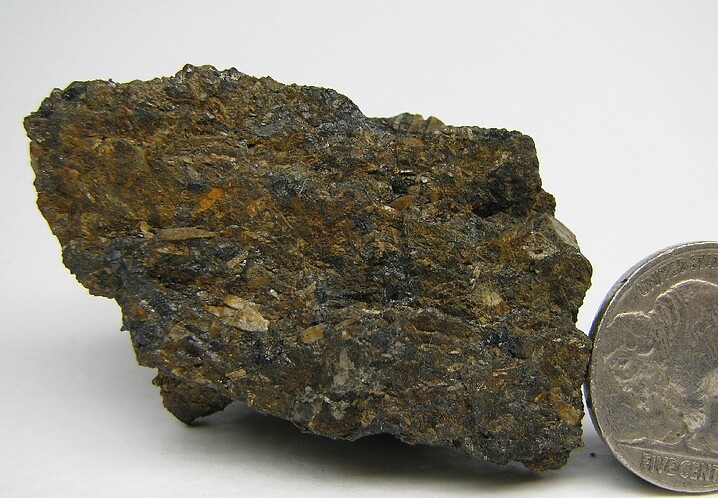
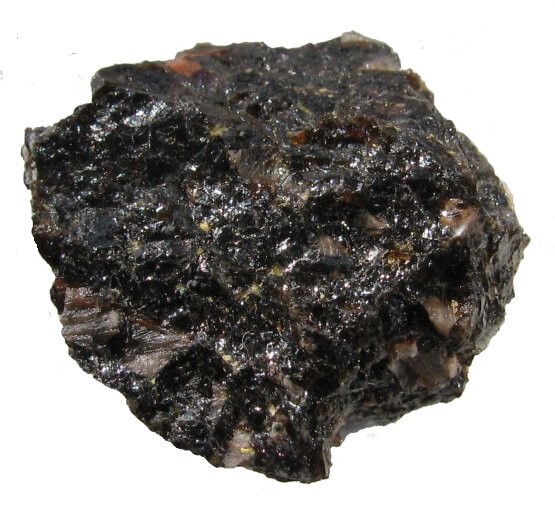
About Tritomite-(Y)
Formula:
Y5(SiO4,BO4)3(O,OH,F)
Also given as (Y,Ca,La,Fe)5(Si,B,Al)3(O,OH,F)13.
Colour:
Dark green-black, red-brown, nearly black
Lustre:
Vitreous, Resinous
Hardness:
3½ - 6½
Specific Gravity:
3.05 - 3.40
Member of:
Name:
For its relation to tritomite-(Ce) and yttrium in the composition. The name tritomite is derived from the Greek τρί (tri), threefold and τομος (tomos), a cut, in allusion to the triangular and pseudo-tetrahedral crystal outline.
The mineral was described as a new species by Frondel (1961) and named spencite after Hugh S. Spence, a Canadian mineralogist who first found the mineral in 1934. The name was changed to tritomite-(Y) and spencite became a synonym, owing to the implementation of the new nomenclature for rare-earth minerals (Levinson 1966, Nickel & Mandarino 1987). Spencite was the Y-analogue of the tritomite-(Ce), and the tritomite name had priority (Horváth 2003).
The mineral was described as a new species by Frondel (1961) and named spencite after Hugh S. Spence, a Canadian mineralogist who first found the mineral in 1934. The name was changed to tritomite-(Y) and spencite became a synonym, owing to the implementation of the new nomenclature for rare-earth minerals (Levinson 1966, Nickel & Mandarino 1987). Spencite was the Y-analogue of the tritomite-(Ce), and the tritomite name had priority (Horváth 2003).
A mineral in the Britholite Group of the Apatite Supergroup (Pasero et al. 2010). A borosilicate whith REEs strongly prevalent over Ca in the M sites for stoichometric reason (Pasero et al. 2010). The Y-analogue of tritomite-(Ce).
Unique Identifiers
Mindat ID:
4027
Long-form identifier:
mindat:1:1:4027:9
Similar Names
| Tridymite | A valid IMA mineral species - grandfathered | SiO2 |
| Tritomite | ||
| Tritomite-(Ce) | A valid IMA mineral species | Ce5(SiO4,BO4)3(OH,O) |
| β-Tridymite | SiO2 |
IMA Classification of Tritomite-(Y)
Classification of Tritomite-(Y)
9.AH.25
9 : SILICATES (Germanates)
A : Nesosilicates
H : Nesosilicates with CO3, SO4, PO4, etc.
9 : SILICATES (Germanates)
A : Nesosilicates
H : Nesosilicates with CO3, SO4, PO4, etc.
54.2.5.2
54 : NESOSILICATES Borosilicates and Some Beryllosilicates
2 : Borosilicates and Some Beryllosilicates with B in [4] coordination
54 : NESOSILICATES Borosilicates and Some Beryllosilicates
2 : Borosilicates and Some Beryllosilicates with B in [4] coordination
17.5.23
17 : Silicates Containing other Anions
5 : Borosilicates
17 : Silicates Containing other Anions
5 : Borosilicates
Mineral Symbols
As of 2021 there are now IMA–CNMNC approved mineral symbols (abbreviations) for each mineral species, useful for tables and diagrams.
| Symbol | Source | Reference for Standard |
|---|---|---|
| Tto-Y | IMA–CNMNC | Warr, L.N. (2021). IMA–CNMNC approved mineral symbols. Mineralogical Magazine, 85(3), 291-320. doi:10.1180/mgm.2021.43 |
Physical Properties of Tritomite-(Y)
Vitreous, Resinous
Colour:
Dark green-black, red-brown, nearly black
Streak:
Greenish gray
Hardness:
3½ - 6½ on Mohs scale
Hardness:
VHN100=515 - 609 - Vickers
Fracture:
Conchoidal
Density:
3.05 - 3.40 g/cm3 (Measured)
Optical Data of Tritomite-(Y)
Type:
Isotropic
RI values:
n = 1.627 - 1.685
Birefringence:
Isotropic minerals have no birefringence
Surface Relief:
Moderate
Chemistry of Tritomite-(Y)
Mindat Formula:
Y5(SiO4,BO4)3(O,OH,F)
Also given as (Y,Ca,La,Fe)5(Si,B,Al)3(O,OH,F)13.
Also given as (Y,Ca,La,Fe)5(Si,B,Al)3(O,OH,F)13.
Element Weights:
Crystallography of Tritomite-(Y)
Cell Parameters:
a = 9.32 Å, c = 6.84 Å
Ratio:
a:c = 1 : 0.734
Morphology:
Anhedral grains and irregular masses.
Comment:
Metamict; hexagonal after heating at 1000 ±C
X-Ray Powder Diffraction
Powder Diffraction Data:
| d-spacing | Intensity |
|---|---|
| 2.78 Å | (100) |
| 4.02 Å | (50) |
| 3.13 Å | (50) |
| 3.83 Å | (40) |
| 3.05 Å | (40) |
| 2.76 Å | (40) |
| 1.930 Å | (40) |
Comments:
Cranberry Lake, New Jersey, USA. The data are from Jaffe and Molinski (1962). Pattern collected after heating material at 1000°C.
Geological Environment
Paragenetic Mode(s):
| Paragenetic Mode | Earliest Age (Ga) |
|---|---|
| Stage 4b: Highly evolved igneous rocks | >3.0 |
| 35 : Ultra-alkali and agpaitic igneous rocks |
Type Occurrence of Tritomite-(Y)
General Appearance of Type Material:
As anhedral grains and irregular masses up to 2.5 cm in size.
Place of Conservation of Type Material:
Harvard University, Cambridge, Massachusetts, USA, number 108000.
The Natural History Museum, London, England, number 1963,226.
Canadian Geological Survey, Ottawa, Ontario, Canada, number 14270.
The Natural History Museum, London, England, number 1963,226.
Canadian Geological Survey, Ottawa, Ontario, Canada, number 14270.
Geological Setting of Type Material:
In a granite pegmatite.
Associated Minerals at Type Locality:
Synonyms of Tritomite-(Y)
Other Language Names for Tritomite-(Y)
Varieties of Tritomite-(Y)
| Alumospencite | Aluminian Spencite |
Relationship of Tritomite-(Y) to other Species
Member of:
Other Members of Britholite Group:
| Britholite-(Ce) | (Ce,Ca)5(SiO4)3OH | Hex. 6/m : P63/m |
| 'Britholite-(La)' | Ca2(La,Ce,Ca)3(SiO4,PO4)3(OH,F) | |
| Britholite-(Y) | (Y,Ca)5(SiO4)3OH | Hex. 6/m : P63/m |
| 'Calciobritholite' | (Ca,Y)5(SiO4,PO4)3(OH) | |
| Fluorbritholite-(Ce) | (Ce,Ca)5(SiO4)3F | Hex. 6/m : P63/m |
| Fluorbritholite-(La) | Ca2La3(SiO4)3F | Hex. 6/m : P63/m |
| Fluorbritholite-(Nd) | Ca2Nd3(SiO4)3F | Hex. 6/m : P63/m |
| Fluorbritholite-(Y) | (Y,Ca)5(SiO4)3F | Hex. 6/m : P63/m |
| Fluorcalciobritholite | (Ca,REE)5(SiO4,PO4)3F | Hex. 6/m : P63/m |
| Tritomite-(Ce) | Ce5(SiO4,BO4)3(OH,O) |
Common Associates
Associations Based on Photo Data:
| 4 photos of Tritomite-(Y) associated with Allanite Group | (A12+REE3+)(M13+M23+M32+)O[Si2O7][SiO4](OH) |
| 2 photos of Tritomite-(Y) associated with Zircon | Zr(SiO4) |
| 1 photo of Tritomite-(Y) associated with Quartz | SiO2 |
| 1 photo of Tritomite-(Y) associated with Magnetite | Fe2+Fe3+2O4 |
| 1 photo of Tritomite-(Y) associated with 'Cyrtolite' | Zr[(SiO4),(OH)4] |
| 1 photo of Tritomite-(Y) associated with Pyrite | FeS2 |
| 1 photo of Tritomite-(Y) associated with 'Scapolite' |
Related Minerals - Strunz-mindat Grouping
| 9.AH. | Fluorbritholite-(Nd) | Ca2Nd3(SiO4)3F |
| 9.AH.05 | Iimoriite-(Y) | Y2[SiO4][CO3] |
| 9.AH.10 | Tundrite-(Ce) | Na2Ce2Ti(SiO4)(CO3)2O2 |
| 9.AH.10 | Tundrite-(Nd) | Na2(Nd,Ce)2Ti(SiO4)(CO3)2O2 |
| 9.AH.15 | Galuskinite | Ca7(SiO4)3(CO3) |
| 9.AH.15 | Spurrite | Ca5(SiO4)2(CO3) |
| 9.AH.20 | Ternesite | Ca5(SiO4)2(SO4) |
| 9.AH.20 | Silicocarnotite | Ca5[(SiO4)(PO4)](PO4) |
| 9.AH.25 | Britholite-(Ce) | (Ce,Ca)5(SiO4)3OH |
| 9.AH.25 | Britholite-(Y) | (Y,Ca)5(SiO4)3OH |
| 9.AH.25 | Mattheddleite | Pb5(SiO4)1.5(SO4)1.5(Cl,OH) |
| 9.AH.25 | Fluorbritholite-(Ce) | (Ce,Ca)5(SiO4)3F |
| 9.AH.25 | Fluorellestadite | Ca5(SiO4)1.5(SO4)1.5F |
| 9.AH.25 | Fluorbritholite-(La) | Ca2La3(SiO4)3F |
| 9.AH.25 | Fluorbritholite-(Y) | (Y,Ca)5(SiO4)3F |
| 9.AH.25 | Hydroxylellestadite | Ca5(SiO4)1.5(SO4)1.5(OH) |
| 9.AH.25 | 'Calciobritholite' | (Ca,Y)5(SiO4,PO4)3(OH) |
| 9.AH.25 | 'Britholite-(La)' | Ca2(La,Ce,Ca)3(SiO4,PO4)3(OH,F) |
| 9.AH.25 | Tritomite-(Ce) | Ce5(SiO4,BO4)3(OH,O) |
| 9.AH.25 | Fluorcalciobritholite | (Ca,REE)5(SiO4,PO4)3F |
| 9.AH.25 | Chlorellestadite | Ca5(SiO4)1.5(SO4)1.5Cl |
| 9.AH.35 | Dargaite | BaCa12(SiO4)4(SO4)2O3 |
| 9.AH.35 | Nabimusaite | KCa12(SiO4)4(SO4)2O2F |
| 9.AH.40 | Stracherite | BaCa6(SiO4)2[(PO4)(CO3)]F |
| 9.AH.40 | Zadovite | BaCa6[(SiO4)(PO4)](PO4)2F |
| 9.AH.40 | Gazeevite | BaCa6(SiO4)2(SO4)2O |
| 9.AH.45 | Flamite | Ca8-x(Na,K)x(SiO4)4-x(PO4)x |
| 9.AH.50 | Byzantievite | Ba5(Ca,REE,Y)22(Ti,Nb)18(SiO4)4[(PO4),(SiO4)]4(BO3)9O22[(OH),F]43(H2O)1.5 |
| 9.AH.55 | Greenwoodite | (Ba,V3+O)2V3+9(Fe3+,Fe2+)2Si2O22 |
| 9.AH.60 | Kihlmanite-(Ce) | Ce2TiO2(SiO4)(HCO3)2(H2O) |
| 9.AH.65 | Tsangpoite | Ca5(PO4)2(SiO4) |
| 9.AH.70 | 'Enalite' | (Th,REE,Al) [(PO4),(SiO4),(OH)] |
Other Information
Notes:
Decompose by hydrochloric acid with separation of gelatinous silica.
Health Risks:
No information on health risks for this material has been entered into the database. You should always treat mineral specimens with care.
Internet Links for Tritomite-(Y)
mindat.org URL:
https://www.mindat.org/min-4027.html
Please feel free to link to this page.
Please feel free to link to this page.
Search Engines:
External Links:
Mineral Dealers:
References for Tritomite-(Y)
Reference List:
Frondel, Clifford (1961) Two yttrium minerals; spencite and rowlandite. The Canadian Mineralogist, 6 (5). 576-581
Jaffe, Howard W., Molinski, Victor J. (1962) Spencite, the yttrium analogue of tritomite from Sussex County, New Jersey. American Mineralogist, 47 (1-2) 9-25
Localities for Tritomite-(Y)
Showing 7 localities.
 symbol to view information about a locality.
The
symbol to view information about a locality.
The Locality List
 - This locality has map coordinates listed.
- This locality has estimated coordinates.
ⓘ - Click for references and further information on this occurrence.
? - Indicates mineral may be doubtful at this locality.
- This locality has map coordinates listed.
- This locality has estimated coordinates.
ⓘ - Click for references and further information on this occurrence.
? - Indicates mineral may be doubtful at this locality.
 - Good crystals or important locality for species.
 - World class for species or very significant.
(TL) - Type Locality for a valid mineral species.
(FRL) - First Recorded Locality for everything else (eg varieties).
- World class for species or very significant.
(TL) - Type Locality for a valid mineral species.
(FRL) - First Recorded Locality for everything else (eg varieties).
All localities listed without proper references should be considered as questionable.
Brazil | |
| Grainger et al. (2008) |
Canada | |
| Grice (1989) |
| D. D. Hogarth et al. (1973) |
| Frondel (1961) +2 other references |
| Rocks & Min.:59:206 & 210. +2 other references |
Slovakia | |
| Huraiová M. et al. (Lučenecká kotlina) |
USA | |
| Jaffe et al. (1962) +1 other reference |
Quick NavTopAbout Tritomite-(Y)Unique IdentifiersSimilar NamesIMA Classification Classification Mineral SymbolsPhysical Properties Optical Data Chemistry Crystallography X-Ray Powder DiffractionGeological EnvironmentType Occurrence SynonymsOther LanguagesVarietiesRelationshipsCommon AssociatesStrunz-MindatOther InformationInternet Links References Localities Locality List

Madawaska Mine, Faraday Township, Hastings County, Ontario, Canada