
Spurrite
A valid IMA mineral species - grandfathered
This page is currently not sponsored. Click here to sponsor this page.
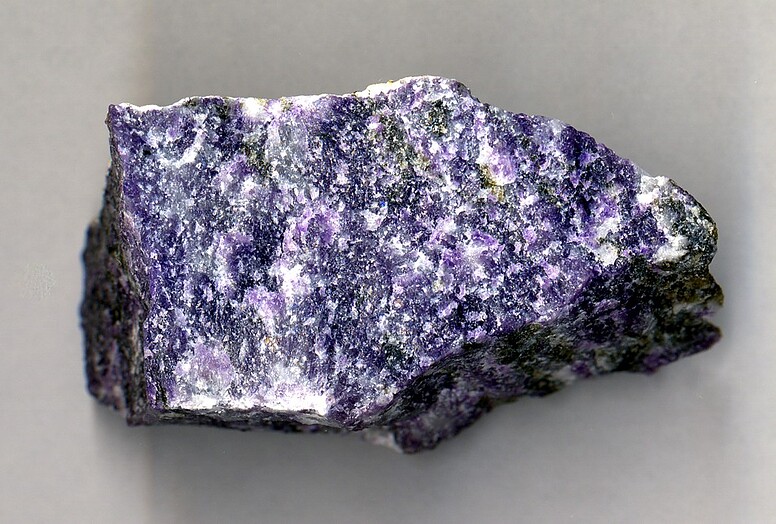
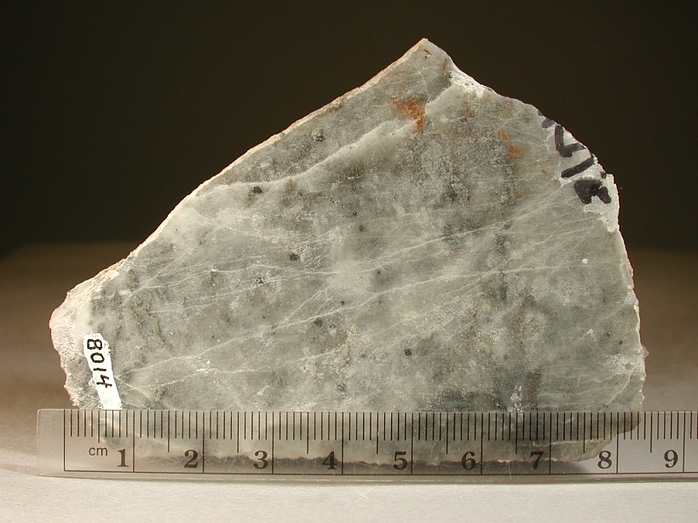


About Spurrite

Josiah Edward Spurr
Formula:
Ca5(SiO4)2(CO3)
Colour:
Colourless, grey-white, lilac-grey
Lustre:
Vitreous, Resinous
Hardness:
5
Specific Gravity:
3.014
Crystal System:
Monoclinic
Name:
Named by Fred Eugene Wright in 1908 after Josiah Edward Spurr (1 October 1870, Gloucester, Massachusetts, USA - 12 January 1950, Orlando, Florida, USA), economic geologist who collected the first specimens. He led expeditions to mapping the interior of Alaska at the beginning of the gold rush. Later he became a renowned consulting economic geologist. In his later years he studied the craters of the moon. The volcano Mount Spurr, in Alaska, and Spurr Crater in the northwestern part of Palus Putredinis near Archimedes Crater, on the Moon, are also named for him.
The Negra mine (B,Na)-enriched spurrite is isotypic with synthetic NaCa5(SiO4)2(BO3) compound.
Unique Identifiers
Mindat ID:
3734
Long-form identifier:
mindat:1:1:3734:7
Similar Names
IMA Classification of Spurrite
Approved, 'Grandfathered' (first described prior to 1959)
First published:
1908
Classification of Spurrite
9.AH.15
9 : SILICATES (Germanates)
A : Nesosilicates
H : Nesosilicates with CO3, SO4, PO4, etc.
9 : SILICATES (Germanates)
A : Nesosilicates
H : Nesosilicates with CO3, SO4, PO4, etc.
53.1.1.1
53 : NESOSILICATES Insular SiO4 Groups and Other Anions or Complex Cations
1 : Insular SiO4 Groups and Other Anions of Complex Cations with (CO3)
53 : NESOSILICATES Insular SiO4 Groups and Other Anions or Complex Cations
1 : Insular SiO4 Groups and Other Anions of Complex Cations with (CO3)
17.4.2
17 : Silicates Containing other Anions
4 : Silicates with carbonates
17 : Silicates Containing other Anions
4 : Silicates with carbonates
Mineral Symbols
As of 2021 there are now IMA–CNMNC approved mineral symbols (abbreviations) for each mineral species, useful for tables and diagrams.
Please only use the official IMA–CNMNC symbol. Older variants are listed for historical use only.
Please only use the official IMA–CNMNC symbol. Older variants are listed for historical use only.
| Symbol | Source | Reference for Standard |
|---|---|---|
| Spu | IMA–CNMNC | Warr, L.N. (2021). IMA–CNMNC approved mineral symbols. Mineralogical Magazine, 85(3), 291-320. doi:10.1180/mgm.2021.43 |
| Spu | Whitney & Evans (2010) | Whitney, D.L. and Evans, B.W. (2010) Abbreviations for names of rock-forming minerals. American Mineralogist, 95, 185–187 doi:10.2138/am.2010.3371 |
| Spu | The Canadian Mineralogist (2019) | The Canadian Mineralogist (2019) The Canadian Mineralogist list of symbols for rock- and ore-forming minerals (December 30, 2019). download |
Physical Properties of Spurrite
Vitreous, Resinous
Transparency:
Transparent
Colour:
Colourless, grey-white, lilac-grey
Streak:
White
Hardness:
5 on Mohs scale
Tenacity:
Brittle
Cleavage:
Distinct/Good
Perfect on {001}, poor on {100}, (001) ^ (100) = 79 degrees
Perfect on {001}, poor on {100}, (001) ^ (100) = 79 degrees
Density:
3.014 g/cm3 (Measured) 3.025 g/cm3 (Calculated)
Comment:
Measured with a pycnometer, both in xylene and in water
Optical Data of Spurrite
Type:
Biaxial (-)
RI values:
nα = 1.637 - 1.641 nβ = 1.672 - 1.676 nγ = 1.676 - 1.681
2V:
Measured: 35° to 41°
Max. Birefringence:
δ = 0.039 - 0.040
Based on recorded range of RI values above.
Based on recorded range of RI values above.
Interference Colours:
The colours simulate birefringence patterns seen in thin section under crossed polars. They do not take into account mineral colouration or opacity.
Michel-Levy Bar The default colours simulate the birefringence range for a 30 µm thin-section thickness. Adjust the slider to simulate a different thickness.
Grain Simulation You can rotate the grain simulation to show how this range might look as you rotated a sample under crossed polars. Each grain retains its interference colour (retardation) while its brightness falls to black at extinction and reaches a maximum between extinction positions.
The colours simulate birefringence patterns seen in thin section under crossed polars. They do not take into account mineral colouration or opacity.
Michel-Levy Bar The default colours simulate the birefringence range for a 30 µm thin-section thickness. Adjust the slider to simulate a different thickness.
Grain Simulation You can rotate the grain simulation to show how this range might look as you rotated a sample under crossed polars. Each grain retains its interference colour (retardation) while its brightness falls to black at extinction and reaches a maximum between extinction positions.
Surface Relief:
Very High (positive)
Relative to Canada balsam mounting medium (n ≈ 1.537).
Relative to Canada balsam mounting medium (n ≈ 1.537).
This shows the grain boundary and Becke line effect under plane-polarised
light, based on the contrast between this mineral's average refractive
index and the mounting medium. It does not take into account mineral
colouration.
In focus
Interference Figure:
This shows the idealized biaxial acute bisectrix (Bxa) interference figure
- the conoscopic view for a grain cut perpendicular to the acute bisectrix, using
this mineral's 2V. The two small white dots mark the melatopes - the points
where the two optic axes emerge - and are shown only when they fall within the
field of view. The coloured bands are isochromatics, and the dark bands are
isogyres.
Rotate the stage: at 0°/90° the isogyres form a cross through the melatopes; at 45° they pull apart into curved hyperbolas. That splitting on rotation - absent in a uniaxial figure - is the standard diagnostic test for telling biaxial minerals from uniaxial ones. If 2V is large, the melatopes may fall outside the field of view, as they often do at the microscope too.
Rotate the stage: at 0°/90° the isogyres form a cross through the melatopes; at 45° they pull apart into curved hyperbolas. That splitting on rotation - absent in a uniaxial figure - is the standard diagnostic test for telling biaxial minerals from uniaxial ones. If 2V is large, the melatopes may fall outside the field of view, as they often do at the microscope too.
Dispersion:
relatively weak
Chemistry of Spurrite
Mindat Formula:
Ca5(SiO4)2(CO3)
Element Weights:
Elements listed:
Common Impurities:
Ti,Al,Fe,Mn,Mg,Na,K
Chemical Analysis
Empirical formulas:
| Sample ID | Empirical Formula |
|---|---|
| 1 | H0.18Ca5.01Na0.05[(SiO4)1.91(SO4)0.08)][(CO3)0.71(BO3)0.28]O11 |
Sample references:
| ID | Locality | Reference | Notes |
|---|---|---|---|
| 1 | Negra Mine, Maconi, Cadereyta de Montes Municipality, Queretaro, Mexico | via EPMA, wet chemistry & gas chromatography of annealing products |
Crystallography of Spurrite
Crystal System:
Monoclinic
Class (H-M):
2/m - Prismatic
Space Group:
P21/b
Setting:
P21/a
Cell Parameters:
a = 10.49 Å, b = 6.705 Å, c = 14.16 Å
β = 101.32°
β = 101.32°
Ratio:
a:b:c = 1.565 : 1 : 2.112
Unit Cell V:
976.57 ų (Calculated from Unit Cell)
Z:
4
Twinning:
Polysynthetic twins on {001} and {101}. Also composition planes {001} or {205}.
Crystal Structure
Load
Unit Cell | Unit Cell Packed
2x2x2 | 3x3x3 | 4x4x4
Unit Cell | Unit Cell Packed
2x2x2 | 3x3x3 | 4x4x4
Show
Big Balls | Small Balls | Just Balls | Spacefill
Polyhedra Off | Si Polyhedra | All Polyhedra
Remove metal-metal sticks
Big Balls | Small Balls | Just Balls | Spacefill
Polyhedra Off | Si Polyhedra | All Polyhedra
Remove metal-metal sticks
Display Options
Black Background | White Background
Perspective On | Perspective Off
2D | Stereo | Red-Blue | Red-Cyan
Black Background | White Background
Perspective On | Perspective Off
2D | Stereo | Red-Blue | Red-Cyan
View
CIF File Best | x | y | z | a | b | c
CIF File Best | x | y | z | a | b | c
Rotation
Stop | Start
Stop | Start
Labels
Console Off | On | Grey | Yellow
Console Off | On | Grey | Yellow
Data courtesy of the American Mineralogist Crystal Structure Database. Click on an AMCSD ID to view structure
| ID | Species | Reference | Link | Year | Locality | Pressure (GPa) | Temp (K) |
|---|---|---|---|---|---|---|---|
| 0006059 | Spurrite | Grice J D (2005) The structure of spurrite, tilleyite and scawtite, and relationships to other silicate-carbonate minerals The Canadian Mineralogist 43 1489-1500 |  | 2005 | Cornet Hill, Apuseni Mountains, Romania | 0 | 293 |
| 0009239 | Spurrite | Smith J V, Karle I L, Hauptman H, Karle J (1960) The crystal structure of spurrite, Ca5(SiO4)2CO3. II. Description of structure Acta Crystallographica 13 454-458 |  | 1960 | contact zone at Scawt Hill, North Ireland | 0 | 293 |
CIF Raw Data - click here to close
X-Ray Powder Diffraction
Loading XRD data...
Data courtesy of RRUFF project at University of Arizona, used with permission.
Powder Diffraction Data:
| d-spacing | Intensity |
|---|---|
| 2.701 Å | (100) |
| 2.635 Å | (70) |
| 3.019 Å | (65) |
| 2.663 Å | (50) |
| 2.170 Å | (40) |
| 3.81 Å | (30) |
| 2.609 Å | (30) |
Geological Environment
Paragenetic Mode(s):
| Paragenetic Mode | Earliest Age (Ga) |
|---|---|
| High-? alteration and/or metamorphism | |
| 31 : Thermally altered carbonate, phosphate, and iron formations | |
| Stage 5: Initiation of plate tectonics | <3.5-2.5 |
| 40 : Regional metamorphism (greenschist, amphibolite, granulite facies) | |
| Stage 10a: Neoproterozoic oxygenation/terrestrial biosphere | <0.6 |
| 51 : Pyrometamorphic minerals (see also #54 and #56) | <0.36 |
Type Occurrence of Spurrite
Co-Type Localities:
General Appearance of Type Material:
Granular masses which resemble crystallized marble.
Place of Conservation of Type Material:
National Museum of Natural History, Washington, D.C., USA, 86532.
The Natural History Museum, London, England, 1923,1032.
The Natural History Museum, London, England, 1923,1032.
Geological Setting of Type Material:
High-temperature thermal metamorphism along the contact between carbonate rock and mafic magma.
Associated Minerals at Type Locality:
Synonyms of Spurrite
Other Language Names for Spurrite
Common Associates
Associations Based on Photo Data:
| 7 photos of Spurrite associated with Gehlenite | Ca2Al[AlSiO7] |
| 7 photos of Spurrite associated with Hillebrandite | Ca2(SiO3)(OH)2 |
| 6 photos of Spurrite associated with Ariegilatite | BaCa12(SiO4)4(PO4)2F2O |
| 6 photos of Spurrite associated with Dellaite | Ca6Si3O11(OH)2 |
| 5 photos of Spurrite associated with Vesuvianite | Ca19Fe3+Al4(Al6Mg2)(◻4)◻[Si2O7]4[(SiO4)10]O(OH)9 |
| 5 photos of Spurrite associated with Rustumite | Ca10(Si2O7)2(SiO4)(OH)2Cl2 |
| 5 photos of Spurrite associated with Stracherite | BaCa6(SiO4)2[(PO4)(CO3)]F |
| 4 photos of Spurrite associated with Periclase | MgO |
| 4 photos of Spurrite associated with Portlandite | Ca(OH)2 |
| 3 photos of Spurrite associated with Fluorite | CaF2 |
Related Minerals - Strunz-mindat Grouping
| 9.AH. | Fluorbritholite-(Nd) | Ca2Nd3(SiO4)3F |
| 9.AH.05 | Iimoriite-(Y) | Y2[SiO4][CO3] |
| 9.AH.10 | Tundrite-(Ce) | Na2Ce2Ti(SiO4)(CO3)2O2 |
| 9.AH.10 | Tundrite-(Nd) | Na2(Nd,Ce)2Ti(SiO4)(CO3)2O2 |
| 9.AH.15 | Galuskinite | Ca7(SiO4)3(CO3) |
| 9.AH.20 | Ternesite | Ca5(SiO4)2(SO4) |
| 9.AH.20 | Silicocarnotite | Ca5[(SiO4)(PO4)](PO4) |
| 9.AH.25 | Britholite-(Ce) | (Ce,Ca)5(SiO4)3OH |
| 9.AH.25 | Britholite-(Y) | (Y,Ca)5(SiO4)3OH |
| 9.AH.25 | Mattheddleite | Pb5(SiO4)1.5(SO4)1.5(Cl,OH) |
| 9.AH.25 | Fluorbritholite-(Ce) | (Ce,Ca)5(SiO4)3F |
| 9.AH.25 | Fluorellestadite | Ca5(SiO4)1.5(SO4)1.5F |
| 9.AH.25 | Fluorbritholite-(La) | Ca2La3(SiO4)3F |
| 9.AH.25 | Fluorbritholite-(Y) | (Y,Ca)5(SiO4)3F |
| 9.AH.25 | Hydroxylellestadite | Ca5(SiO4)1.5(SO4)1.5(OH) |
| 9.AH.25 | 'Calciobritholite' | (Ca,Y)5(SiO4,PO4)3(OH) |
| 9.AH.25 | 'Britholite-(La)' | Ca2(La,Ce,Ca)3(SiO4,PO4)3(OH,F) |
| 9.AH.25 | Tritomite-(Ce) | Ce5(SiO4,BO4)3(OH,O) |
| 9.AH.25 | Tritomite-(Y) | Y5(SiO4,BO4)3(O,OH,F) |
| 9.AH.25 | Fluorcalciobritholite | (Ca,REE)5(SiO4,PO4)3F |
| 9.AH.25 | Chlorellestadite | Ca5(SiO4)1.5(SO4)1.5Cl |
| 9.AH.35 | Dargaite | BaCa12(SiO4)4(SO4)2O3 |
| 9.AH.35 | Nabimusaite | KCa12(SiO4)4(SO4)2O2F |
| 9.AH.40 | Stracherite | BaCa6(SiO4)2[(PO4)(CO3)]F |
| 9.AH.40 | Zadovite | BaCa6[(SiO4)(PO4)](PO4)2F |
| 9.AH.40 | Gazeevite | BaCa6(SiO4)2(SO4)2O |
| 9.AH.45 | Flamite | Ca8-x(Na,K)x(SiO4)4-x(PO4)x |
| 9.AH.50 | Byzantievite | Ba5(Ca,REE,Y)22(Ti,Nb)18(SiO4)4[(PO4),(SiO4)]4(BO3)9O22[(OH),F]43(H2O)1.5 |
| 9.AH.55 | Greenwoodite | (Ba,V3+O)2V3+9(Fe3+,Fe2+)2Si2O22 |
| 9.AH.60 | Kihlmanite-(Ce) | Ce2TiO2(SiO4)(HCO3)2(H2O) |
| 9.AH.65 | Tsangpoite | Ca5(PO4)2(SiO4) |
| 9.AH.70 | 'Enalite' | (Th,REE,Al) [(PO4),(SiO4),(OH)] |
Other Information
Notes:
With a blowpipe srurrite shows a strong calcium flame reaction, loses its glassy luster, becomes white and porcelain-like but does not fuse even in thin splinters.
Effervesces readily with weak hydrochloric acid, dissolves completely and gelatinizes thoroughly.
Green cathodoluminescence.
Effervesces readily with weak hydrochloric acid, dissolves completely and gelatinizes thoroughly.
Green cathodoluminescence.
Health Risks:
No information on health risks for this material has been entered into the database. You should always treat mineral specimens with care.
Spurrite in petrology
An essential component of rock names highlighted in red, an accessory component in rock names highlighted in green.
Internet Links for Spurrite
mindat.org URL:
https://www.mindat.org/min-3734.html
Please feel free to link to this page.
Please feel free to link to this page.
Search Engines:
External Links:
Mineral Dealers:
References for Spurrite
Reference List:
Smith, J. V., Karle, I. L., Hauptman, H., Karle, J. (1960) The crystal structure of spurrite, Ca5(SiO4)2CO3. II. Description of structures. Acta Crystallographica, 13 (6) 454-458 doi:10.1107/s0365110x60001096
Hauptman, H., Karle, I. L., Karle, J. (1960) Crystal structure of spurrite, Ca5(SiO4)2CO3. I. Determination by the probability method. Acta Crystallographica, 13 (6) 451-453 doi:10.1107/s0365110x60001084
Localities for Spurrite
Showing 77 localities.
 symbol to view information about a locality.
The
symbol to view information about a locality.
The Locality List
 - This locality has map coordinates listed.
- This locality has estimated coordinates.
ⓘ - Click for references and further information on this occurrence.
? - Indicates mineral may be doubtful at this locality.
- This locality has map coordinates listed.
- This locality has estimated coordinates.
ⓘ - Click for references and further information on this occurrence.
? - Indicates mineral may be doubtful at this locality.
 - Good crystals or important locality for species.
 - World class for species or very significant.
(TL) - Type Locality for a valid mineral species.
(FRL) - First Recorded Locality for everything else (eg varieties).
- World class for species or very significant.
(TL) - Type Locality for a valid mineral species.
(FRL) - First Recorded Locality for everything else (eg varieties).
All localities listed without proper references should be considered as questionable.
Angola | |
| Campeny et al. (2015) +1 other reference |
Canada | |
| Rosa et al. (2010) |
Georgia | |
| Galuskina et al. (2015) +2 other references |
Germany | |
| Hentschel (1978) +1 other reference |
| Blaß et al. (2015) |
| [Lapis (5) |
| Sharygin (2012) | |
Indonesia | |
| Knuever et al. (2023) | |
Ireland | |
| Nawaz (1974) +1 other reference |
| Nockolds et al. (1947) |
Israel | |
| Juroszek et al. (2019) |
| Shulamit Gross (1977) +1 other reference |
| Krüger et al. (2018) +3 other references | |
| Burg et al. (1999) | |
| Galuskin et al. (2023) | |
| Britvin et al. (2025) |
| Gross (1977) |
Japan | |
| Matsuyama (2001) |
| Kusachi et al (1971) |
| Yamada (2004) | |
| Yamada (2004) | |
| Bunno et al. (1982) |
| Bernard et al. (2004) |
| Henmi et al. (1973) +6 other references |
Jordan | |
| Pitty et al. (2010) |
| Fleurance et al. (2013) |
| Vapnik et al. (2019) |
| Khoury et al. (2015) +2 other references | |
| Sokol +10 other references | |
| Galuskina et al. (2019) | |
| Khoury et al. (1982) +2 other references |
Mexico | |
| Mineralogical Magazine 1964 33 : 841-852 |
| Mineralogical Magazine 1964 33 : 841-852 | |
| Panczner (1987) |
| Wright F E (1908) +1 other reference |
| Panczner (1987) | |
| Panczner (1987) |
| Gaytán Rueda (1975) +3 other references |
Middle East | |
| Gross (1977) | |
New Zealand | |
| Mason (1957) |
| Baker et al. (1980) | |
Palestine | |
| Sokol et al. (2011) +1 other reference |
| Shulamit Gross (1977) |
Poland | |
| Kruszewski (2006) |
Romania | |
| Constantinescu et al. (1988b) +3 other references |
| Canadian Mineralogist: 39: 1435-1453. +3 other references |
| Marincea et al. (2001) +2 other references | |
| Pascal et al. (2001) | |
Russia | |
| Cesnokov et al. (1998) |
| Brazhnikova et al. (2023) |
| Pekov (1998) | |
| Pavel M. Kartashov (n.d.) +1 other reference |
| Galuskin et al. (2015) |
| Galuskin et al. (2011) |
| Sokol et al. (2019) +3 other references |
| Mineralogical Society of America - ... +1 other reference |
Slovakia | |
| Martin Števko-unpublished |
| Martin Števko-unpublished |
Turkey | |
| Am Min 73:11-12 p 1497 +4 other references |
Uganda | |
| Barker et al. (1989) |
UK | |
| Henmi et al. (1973) +2 other references |
| Tilley (1942) +2 other references | |
| Tilley (1947) |
| Beard et al. (2007) |
| Excalibur Mineral Corp. - Mineral News +1 other reference |
| Agrell (1965) +2 other references | |
Ukraine | |
| Шарыгин (2015) |
USA | |
| Galbraith (1959) |
| Colville et al. (1977) +3 other references |
| Am Min (1962) +1 other reference |
| Woodford et al. (1941) +3 other references |
| Woodford et al. (1941) | |
| Woodford et al. (1941) | |
| Schooner (circa 1985) |
| NMGS 21st Field Conference |
| Smith (1991) |
| Bridge (1966) |
Quick NavTopAbout SpurriteUnique IdentifiersSimilar NamesIMA Classification Classification Mineral SymbolsPhysical Properties Optical Data Chemistry Chemical AnalysisCrystallography Crystal StructureX-Ray Powder DiffractionGeological EnvironmentType Occurrence SynonymsOther LanguagesCommon AssociatesStrunz-MindatOther InformationSpurrite in petrologyInternet Links References Localities Locality List

Fuka mine, Fuka, Bitchū, Takahashi City, Okayama Prefecture, Japan