
Hemerdon Tungsten Mine (Drakelands Mine), Sparkwell, South Hams, Devon, England, UKi
| Regional Level Types | |
|---|---|
| Hemerdon Tungsten Mine (Drakelands Mine) | Mine (Possible Future Operation) |
| Sparkwell | Civil Parish |
| South Hams | Local Government Area |
| Devon | County |
| England | Constituent Country |
| UK | Country |
This page is currently not sponsored. Contact us for sponsorship opportunities.


Latitude & Longitude (WGS84):
50° 24' 26'' North , 4° 0' 35'' West
Latitude & Longitude (decimal):
UK National Grid Reference:
SX572584
Type:
Mine (Possible Future Operation) - last checked 2020
Köppen climate type:
Nearest Clubs:
Local clubs are the best way to get access to collecting localities
Local clubs are the best way to get access to collecting localities
| Club | Location | Distance |
|---|---|---|
| British Micromount Society, Devon and Cornwall Branch Meetings | Liskeard, Cornwall | 33km |
Owned/operated by:
Other/historical names associated with this locality:
Hemerdon Bal Mine; Hemerdon Ball Mine, Hemerdon Ball quarry
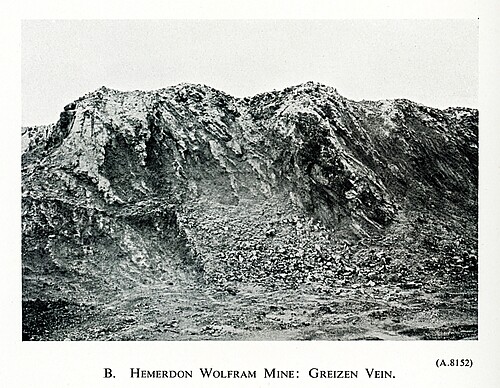
An open-cast tungsten mine near Plymouth in Devon — this locality is famed for its high-quality scorodite (among the best in Europe) with ferberite and cassiterite. The deposit was sampled in 1982 by AMAX, but problems were encountered due to the difficulty of separating the clays from the ore.
In 1999 the deposit was worked for specimens, as well as in 2006.
On 4th December 2007, it was announced that an Australian company, Wolf Minerals LLC, had acquired the rights to mine this deposit. Current plans are to reopen the site as a full-scale open cast metal mine for tungsten and tin, producing up to 3,000 tonnes of tungsten metal per year.
The mine restarted production in August 2015 with the first tungsten concentrate in 45 years leaving the deposit.
The mine ceased operating on October 10th, 2018 after Wolf Minerals (UK) Ltd went into voluntary administration. It is currently (October 2018) seeking further investment to restart operations.
The original name for the workings was "Hemerdon Bal", this was corrupted over time (possibly due to a misspelling on Ordnance Survey maps that remains to this day) to "Hemerdon Ball". *
* It is worth noting that the name Hemerdon Ball, which is the name of the hill, is shown on OS mapping surveys and published between 1854 and 1863. Whilst some shafts of what is the Woolcombe Mine are identified on this old mapping lying to the west of the current Hemerdon site, this considerably pre-dates the identification and initial defining and working of the tin-tungsten deposit in around 1916. The presence of tungsten mineralisation had been observed in a small quarry on Hemerdon Ball in the latter half of the 19th century. Indeed, it would seem more likely that "Hemerdon Bal" is a corruption of the older place name rather than the original name of the workings.
Select Mineral List Type
Standard Detailed Gallery Strunz Chemical ElementsCommodity List
This is a list of exploitable or exploited mineral commodities recorded from this region.Mineral List
Mineral list contains entries from the region specified including sub-localities17 valid minerals.
Rock Types Recorded
Rock list contains entries from the region specified including sub-localities
Select Rock List Type
Alphabetical List Tree DiagramDetailed Mineral List:
| ⓘ Arsenopyrite Formula: FeAsS Description: Silvery masses to several cms commonly partly to completely altered to scorodite. |
| ⓘ Cassiterite Formula: SnO2 |
| ⓘ 'Chlorite Group' References: |
| ⓘ 'Clay minerals' References: Locality descriptionIdentification: Visual Identification |
| ⓘ Ferberite Formula: FeWO4 Description: Extreamly rare as free grown crystals to 1.5cm, common as micro-crystals. Also common as bladed crystals to over 10cm embeded in quartz. |
| ⓘ Goethite Formula: Fe3+O(OH) Description: Common as an alteration of hematite, and ferberite. |
| ⓘ Hematite Formula: Fe2O3 Description: Mostly seen as black lenticular micro-crystals to 1mm as single crystals, and forming inter-grown aggregates to several cms. Commonly with an iridescent tarnish. References: |
| ⓘ Hydrokenoelsmoreite Formula: ◻2W2O6(H2O) Description: Occasionally found associated with ferberite or near to this mineral. Hydrokenoelsmoreite is very esaly over looked at this location due to its mica like habit, or looks like kaolinite. Thin platy micro-crystals have been found covering several cms. The colour varies from white to light yellow and pale brown, probably due to Fe contamination. |
| ⓘ Hydrokenoelsmoreite var. Alumotungstite Formula: ◻2W2O6(H2O) |
| ⓘ Hydrokenoelsmoreite var. Ferritungstite Formula: ◻2(W,Fe3+)2(O,OH)6(H2O) References: |
| ⓘ Kaolinite Formula: Al2(Si2O5)(OH)4 Description: A very common white clay in the deposit making it difacult to procces the ore. References: |
| ⓘ Lepidocrocite Formula: Fe3+O(OH) Description: small group of black mm-sized crystals, the thinnest crystals seen to be yellow under the microscope |
| ⓘ 'Limonite' References: |
| ⓘ Malachite Formula: Cu2(CO3)(OH)2 References: |
| ⓘ Molybdenite Formula: MoS2 Description: Bright silvery metallic micro-flakes associated with wolframite, quartz, arsenopyite, muscovite, tourmaline and scorodite. References: |
| ⓘ Muscovite Formula: KAl2(AlSi3O10)(OH)2 Description: A major mineral in the greisen tungsten/tin deposit along with quartz and tourmaline. Cavitys are commonly lined with typical hexagonal books of muscovte crystals to 5mm across the 'C' face. The colour is mostly white-silvery to stained shades of brown by Fe oxides. References: |
| ⓘ Native Sulphur Formula: S8 Description: Rounded very pale yellow micro-crystals to 0.5mm associated with granular white to pale green scorodite, with cassiterite on quartz, and minor ferberite. References: |
| ⓘ Pharmacosiderite Formula: KFe3+4(AsO4)3(OH)4 · 6-7H2O Description: Not uncommon as cubic crystals to 1mm, rare as crystals over 1.5mm. The colour varies from almost colourless to light green, yellow-brown, and yellow. |
| ⓘ 'Plumbogummite Group' Description: The partly defined mineral forms tiny micro-crystals to 0.25mm with a pseudocubic habit, and a white to flesh pink colouration. Associated with cassiterite and tourmaline on quartz. References: |
| ⓘ Pyrite Formula: FeS2 References: |
| ⓘ Quartz Formula: SiO2 Description: Occasionally forms prismatic crystals to 10cm. |
| ⓘ Russellite Formula: Bi2WO6 Description: Rarely found as pale to light yellow botryoidal crusts to 1cm, or as scattered balls to 0.75mm dia. |
| ✪ Scorodite Formula: Fe3+AsO4 · 2H2O Description: Some of the best examples of scorodite have come from this mine over the years, and it looks set to produce further specimens when mining starts in 2012/13. Exceptional scorodite crystals have been found to about 1cm, more usual as blue to greenish druse of crystals lining cavities to many cms in the quartz veinstone. References: |
| ⓘ 'Tourmaline' Formula: AD3G6(T6O18)(BO3)3X3Z Description: Forms as a major mineral in veins to 10 of mts long. Free grown crystals are seldom more than 1cm long. The colour is mostly black in the hand specimen, whiel under the micrscope the colour is seen to be much more varied from almost colourless to blue and brown and black. |
Gallery:

List of minerals arranged by Strunz 10th Edition classification
| Group 1 - Elements | |||
|---|---|---|---|
| ⓘ | Native Sulphur | 1.CC.05 | S8 |
| Group 2 - Sulphides and Sulfosalts | |||
| ⓘ | Molybdenite | 2.EA.30 | MoS2 |
| ⓘ | Pyrite | 2.EB.05a | FeS2 |
| ⓘ | Arsenopyrite | 2.EB.20 | FeAsS |
| Group 4 - Oxides and Hydroxides | |||
| ⓘ | Goethite | 4.00. | Fe3+O(OH) |
| ⓘ | Hematite | 4.CB.05 | Fe2O3 |
| ⓘ | Quartz | 4.DA.05 | SiO2 |
| ⓘ | Cassiterite | 4.DB.05 | SnO2 |
| ⓘ | Ferberite | 4.DB.30 | FeWO4 |
| ⓘ | Russellite | 4.DE.15 | Bi2WO6 |
| ⓘ | Hydrokenoelsmoreite var. Ferritungstite | 4.DH.15 | ◻2(W,Fe3+)2(O,OH)6(H2O) |
| ⓘ | 4.DH.15 | ◻2W2O6(H2O) | |
| ⓘ | var. Alumotungstite | 4.DH.15 va | ◻2W2O6(H2O) |
| ⓘ | Lepidocrocite | 4.FE.15 | Fe3+O(OH) |
| Group 5 - Nitrates and Carbonates | |||
| ⓘ | Malachite | 5.BA.10 | Cu2(CO3)(OH)2 |
| Group 8 - Phosphates, Arsenates and Vanadates | |||
| ⓘ | Scorodite | 8.CD.10 | Fe3+AsO4 · 2H2O |
| ⓘ | Pharmacosiderite | 8.DK.10 | KFe3+4(AsO4)3(OH)4 · 6-7H2O |
| Group 9 - Silicates | |||
| ⓘ | Muscovite | 9.EC.15 | KAl2(AlSi3O10)(OH)2 |
| ⓘ | Kaolinite | 9.ED.05 | Al2(Si2O5)(OH)4 |
| Unclassified | |||
| ⓘ | 'Chlorite Group' | - | |
| ⓘ | 'Clay minerals' | - | |
| ⓘ | 'Limonite' | - | |
| ⓘ | 'Tourmaline' | - | AD3G6(T6O18)(BO3)3X3Z |
| ⓘ | 'Plumbogummite Group' | - | |
List of minerals for each chemical element
| H | Hydrogen | |
|---|---|---|
| H | ⓘ Hydrokenoelsmoreite var. Alumotungstite | ◻2W2O6(H2O) |
| H | ⓘ Hydrokenoelsmoreite var. Ferritungstite | ◻2(W,Fe3+)2(O,OH)6(H2O) |
| H | ⓘ Goethite | Fe3+O(OH) |
| H | ⓘ Kaolinite | Al2(Si2O5)(OH)4 |
| H | ⓘ Lepidocrocite | Fe3+O(OH) |
| H | ⓘ Malachite | Cu2(CO3)(OH)2 |
| H | ⓘ Muscovite | KAl2(AlSi3O10)(OH)2 |
| H | ⓘ Pharmacosiderite | KFe43+(AsO4)3(OH)4 · 6-7H2O |
| H | ⓘ Scorodite | Fe3+AsO4 · 2H2O |
| H | ⓘ Hydrokenoelsmoreite | ◻2W2O6(H2O) |
| B | Boron | |
| B | ⓘ Tourmaline | AD3G6(T6O18)(BO3)3X3Z |
| C | Carbon | |
| C | ⓘ Malachite | Cu2(CO3)(OH)2 |
| O | Oxygen | |
| O | ⓘ Hydrokenoelsmoreite var. Alumotungstite | ◻2W2O6(H2O) |
| O | ⓘ Cassiterite | SnO2 |
| O | ⓘ Ferberite | FeWO4 |
| O | ⓘ Hydrokenoelsmoreite var. Ferritungstite | ◻2(W,Fe3+)2(O,OH)6(H2O) |
| O | ⓘ Goethite | Fe3+O(OH) |
| O | ⓘ Hematite | Fe2O3 |
| O | ⓘ Kaolinite | Al2(Si2O5)(OH)4 |
| O | ⓘ Lepidocrocite | Fe3+O(OH) |
| O | ⓘ Malachite | Cu2(CO3)(OH)2 |
| O | ⓘ Muscovite | KAl2(AlSi3O10)(OH)2 |
| O | ⓘ Pharmacosiderite | KFe43+(AsO4)3(OH)4 · 6-7H2O |
| O | ⓘ Quartz | SiO2 |
| O | ⓘ Russellite | Bi2WO6 |
| O | ⓘ Scorodite | Fe3+AsO4 · 2H2O |
| O | ⓘ Tourmaline | AD3G6(T6O18)(BO3)3X3Z |
| O | ⓘ Hydrokenoelsmoreite | ◻2W2O6(H2O) |
| Al | Aluminium | |
| Al | ⓘ Kaolinite | Al2(Si2O5)(OH)4 |
| Al | ⓘ Muscovite | KAl2(AlSi3O10)(OH)2 |
| Si | Silicon | |
| Si | ⓘ Kaolinite | Al2(Si2O5)(OH)4 |
| Si | ⓘ Muscovite | KAl2(AlSi3O10)(OH)2 |
| Si | ⓘ Quartz | SiO2 |
| S | Sulfur | |
| S | ⓘ Arsenopyrite | FeAsS |
| S | ⓘ Molybdenite | MoS2 |
| S | ⓘ Pyrite | FeS2 |
| S | ⓘ Native Sulphur | S8 |
| K | Potassium | |
| K | ⓘ Muscovite | KAl2(AlSi3O10)(OH)2 |
| K | ⓘ Pharmacosiderite | KFe43+(AsO4)3(OH)4 · 6-7H2O |
| Fe | Iron | |
| Fe | ⓘ Arsenopyrite | FeAsS |
| Fe | ⓘ Ferberite | FeWO4 |
| Fe | ⓘ Hydrokenoelsmoreite var. Ferritungstite | ◻2(W,Fe3+)2(O,OH)6(H2O) |
| Fe | ⓘ Goethite | Fe3+O(OH) |
| Fe | ⓘ Hematite | Fe2O3 |
| Fe | ⓘ Lepidocrocite | Fe3+O(OH) |
| Fe | ⓘ Pharmacosiderite | KFe43+(AsO4)3(OH)4 · 6-7H2O |
| Fe | ⓘ Pyrite | FeS2 |
| Fe | ⓘ Scorodite | Fe3+AsO4 · 2H2O |
| Cu | Copper | |
| Cu | ⓘ Malachite | Cu2(CO3)(OH)2 |
| As | Arsenic | |
| As | ⓘ Arsenopyrite | FeAsS |
| As | ⓘ Pharmacosiderite | KFe43+(AsO4)3(OH)4 · 6-7H2O |
| As | ⓘ Scorodite | Fe3+AsO4 · 2H2O |
| Mo | Molybdenum | |
| Mo | ⓘ Molybdenite | MoS2 |
| Sn | Tin | |
| Sn | ⓘ Cassiterite | SnO2 |
| W | Tungsten | |
| W | ⓘ Hydrokenoelsmoreite var. Alumotungstite | ◻2W2O6(H2O) |
| W | ⓘ Ferberite | FeWO4 |
| W | ⓘ Hydrokenoelsmoreite var. Ferritungstite | ◻2(W,Fe3+)2(O,OH)6(H2O) |
| W | ⓘ Russellite | Bi2WO6 |
| W | ⓘ Hydrokenoelsmoreite | ◻2W2O6(H2O) |
| Bi | Bismuth | |
| Bi | ⓘ Russellite | Bi2WO6 |
Localities in this Region
- England
- Devon
- South Hams
- Sparkwell
- Hemerdon Tungsten Mine (Drakelands Mine)
- Sparkwell
- South Hams
- Devon
Other Regions, Features and Areas containing this locality
British and Irish IslesGroup of Islands
Eurasian PlateTectonic Plate
- Rheno-Hercynian BeltOrogenic Belt
EuropeContinent
UK
- England
- Cornubian mining districtMining District
This page contains all mineral locality references listed on mindat.org. This does not claim to be a complete list. If you know of more minerals from this site, please register so you can add to our database. This locality information is for reference purposes only. You should never attempt to
visit any sites listed in mindat.org without first ensuring that you have the permission of the land and/or mineral rights holders
for access and that you are aware of all safety precautions necessary.
References
Mills, Stuart J., Christy, Andrew G., Rumsey, Mike S., Spratt, John (2016) The crystal chemistry of elsmoreite from the Hemerdon (Drakelands) mine, UK: hydrokenoelsmoreite-3C and hydrokenoelsmoreite-6R. Mineralogical Magazine, 80 (7) 1195-1203 doi:10.1180/minmag.2016.080.058
www.plymouthherald.co.uk (2018) https://www.plymouthherald.co.uk/news/business/how-hemerdon-tungsten-mine-could-2098530
[1]Bobos, Iuliu; Kloprogge, J. Theo; Brandão, Paula; Rocha, João; Vilarinho, Rui; Moreira, Joaquim Agostinho (2026) Al-Bearing Scorodite (Scorodite—Mansfieldite Series) from Hemerdon Ball Mine, Plympton, Tavistock District, Devon, United Kingdom: Single-Crystal X-Ray Diffraction, Chemistry and Vibrational Spectroscopy. Crystals, 16 (6). doi:10.3390/cryst16060381

Hemerdon Tungsten Mine, Sparkwell, South Hams, Devon, England, UK