
Scorodite
A valid IMA mineral species - grandfathered
This page is currently not sponsored. Click here to sponsor this page.
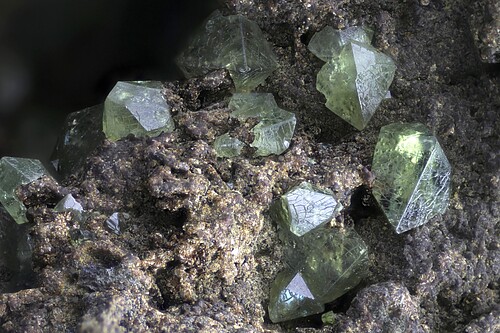
About Scorodite
Formula:
Fe3+AsO4 · 2H2O
Colour:
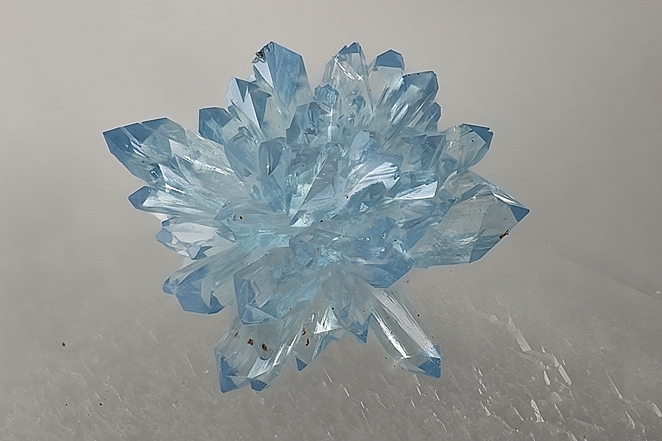
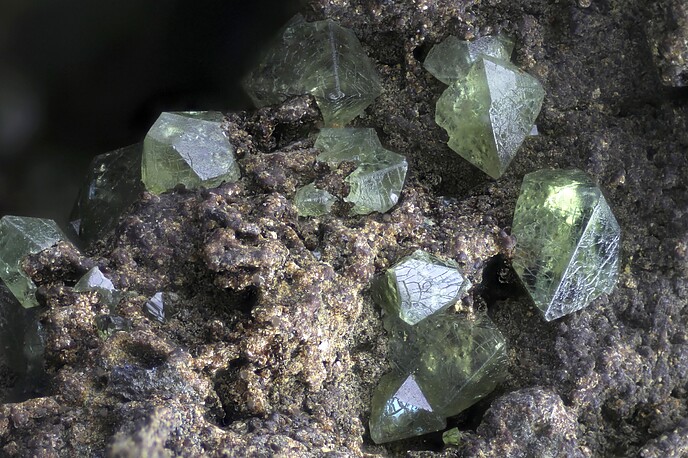
Green, blue-green, grey, grayish-green, blue, yellow-brown, nearly colourless, violet; colourless to faintly greenish or greenish brown in transmitted light.
Lustre:
Sub-Adamantine, Vitreous, Resinous
Hardness:
3½ - 4
Specific Gravity:
3.27
Crystal System:
Orthorhombic
Member of:
Name:
Named in 1818 by Johann Friedrich August Breithaupt from the Greek σκορόδιου = "Scorodion" - garlic-like, due to the smell when heated.
Type Locality:
Dimorph of:
Variscite Group; Mansfieldite-Scorodite Series.
The orthorhombic dimorph of parascorodite. The ferric iron analogue of mansfieldite and yanomamite. The arsenate analouge of strengite.
A relatively common secondary mineral resulting from the oxidation of arsenopyrite or other arsenic-bearing species.
Compare 'UM1979-03-AsO:Fe' and 'UM1979-04-AsO:Fe'.
The orthorhombic dimorph of parascorodite. The ferric iron analogue of mansfieldite and yanomamite. The arsenate analouge of strengite.
A relatively common secondary mineral resulting from the oxidation of arsenopyrite or other arsenic-bearing species.
Compare 'UM1979-03-AsO:Fe' and 'UM1979-04-AsO:Fe'.
Unique Identifiers
Mindat ID:
3595
Long-form identifier:
mindat:1:1:3595:4
IMA Classification of Scorodite
Approved, 'Grandfathered' (first described prior to 1959)
IMA Formula:
Fe3+As5+O4·2H2O
Classification of Scorodite
8.CD.10
8 : PHOSPHATES, ARSENATES, VANADATES
C : Phosphates without additional anions, with H2O
D : With only medium-sized cations, RO4:H2O = 1:2
8 : PHOSPHATES, ARSENATES, VANADATES
C : Phosphates without additional anions, with H2O
D : With only medium-sized cations, RO4:H2O = 1:2
40.4.1.3
40 : HYDRATED NORMAL PHOSPHATES,ARSENATES AND VANADATES
4 : (AB)5(XO4)2·xH2O
40 : HYDRATED NORMAL PHOSPHATES,ARSENATES AND VANADATES
4 : (AB)5(XO4)2·xH2O
20.9.2
20 : Arsenates (also arsenates with phosphate, but without other anions)
9 : Arsenates of Fe
20 : Arsenates (also arsenates with phosphate, but without other anions)
9 : Arsenates of Fe
Mineral Symbols
As of 2021 there are now IMA–CNMNC approved mineral symbols (abbreviations) for each mineral species, useful for tables and diagrams.
Please only use the official IMA–CNMNC symbol. Older variants are listed for historical use only.
Please only use the official IMA–CNMNC symbol. Older variants are listed for historical use only.
| Symbol | Source | Reference for Standard |
|---|---|---|
| Scd | IMA–CNMNC | Warr, L.N. (2021). IMA–CNMNC approved mineral symbols. Mineralogical Magazine, 85(3), 291-320. doi:10.1180/mgm.2021.43 |
| Scd | The Canadian Mineralogist (2019) | The Canadian Mineralogist (2019) The Canadian Mineralogist list of symbols for rock- and ore-forming minerals (December 30, 2019). download |
Physical Properties of Scorodite
Sub-Adamantine, Vitreous, Resinous
Transparency:
Translucent
Colour:
Green, blue-green, grey, grayish-green, blue, yellow-brown, nearly colourless, violet; colourless to faintly greenish or greenish brown in transmitted light.
Comment:
Earthy material: light green to light grayish or brownish green.
Streak:
Greenish-White
Hardness:
3½ - 4 on Mohs scale
Cleavage:
Imperfect/Fair
Imperfect on {201}, traces on {001}{100}
Imperfect on {201}, traces on {001}{100}
Fracture:
Sub-Conchoidal
Density:
3.27 g/cm3 (Measured) 3.276 g/cm3 (Calculated)
Optical Data of Scorodite
Type:
Biaxial (+)
RI values:
nα = 1.741 - 1.784 nβ = 1.744 - 1.805 nγ = 1.768 - 1.82
2V:
Measured: 40° to 75°, Calculated: 46° to 80°
Max. Birefringence:
δ = 0.027 - 0.036
Based on recorded range of RI values above.
Based on recorded range of RI values above.
Interference Colours:
The colours simulate birefringence patterns seen in thin section under crossed polars. They do not take into account mineral colouration or opacity.
Michel-Levy Bar The default colours simulate the birefringence range for a 30 µm thin-section thickness. Adjust the slider to simulate a different thickness.
Grain Simulation You can rotate the grain simulation to show how this range might look as you rotated a sample under crossed polars. Each grain retains its interference colour (retardation) while its brightness falls to black at extinction and reaches a maximum between extinction positions.
The colours simulate birefringence patterns seen in thin section under crossed polars. They do not take into account mineral colouration or opacity.
Michel-Levy Bar The default colours simulate the birefringence range for a 30 µm thin-section thickness. Adjust the slider to simulate a different thickness.
Grain Simulation You can rotate the grain simulation to show how this range might look as you rotated a sample under crossed polars. Each grain retains its interference colour (retardation) while its brightness falls to black at extinction and reaches a maximum between extinction positions.
Surface Relief:
Very High (positive)
Relative to Canada balsam mounting medium (n ≈ 1.537).
Relative to Canada balsam mounting medium (n ≈ 1.537).
This shows the grain boundary and Becke line effect under plane-polarised
light, based on the contrast between this mineral's average refractive
index and the mounting medium. It does not take into account mineral
colouration.
In focus
Interference Figure:
This shows the idealized biaxial acute bisectrix (Bxa) interference figure
- the conoscopic view for a grain cut perpendicular to the acute bisectrix, using
this mineral's 2V. The two small white dots mark the melatopes - the points
where the two optic axes emerge - and are shown only when they fall within the
field of view. The coloured bands are isochromatics, and the dark bands are
isogyres.
Rotate the stage: at 0°/90° the isogyres form a cross through the melatopes; at 45° they pull apart into curved hyperbolas. That splitting on rotation - absent in a uniaxial figure - is the standard diagnostic test for telling biaxial minerals from uniaxial ones. If 2V is large, the melatopes may fall outside the field of view, as they often do at the microscope too.
Rotate the stage: at 0°/90° the isogyres form a cross through the melatopes; at 45° they pull apart into curved hyperbolas. That splitting on rotation - absent in a uniaxial figure - is the standard diagnostic test for telling biaxial minerals from uniaxial ones. If 2V is large, the melatopes may fall outside the field of view, as they often do at the microscope too.
Dispersion:
relatively strong r > v
Pleochroism:
Weak
Comments:
blue-violet to blue-green
Chemistry of Scorodite
Mindat Formula:
Fe3+AsO4 · 2H2O
Element Weights:
Elements listed:
Common Impurities:
Al
Crystallography of Scorodite
Crystal System:
Orthorhombic
Class (H-M):
mmm(2/m2/m2/m) - Dipyramidal
Cell Parameters:
a = 8.937 Å, b = 10.278 Å, c = 9.996 Å
Ratio:
a:b:c = 0.87 : 1 : 0.973
Unit Cell V:
918.2 ų
Z:
8
Morphology:
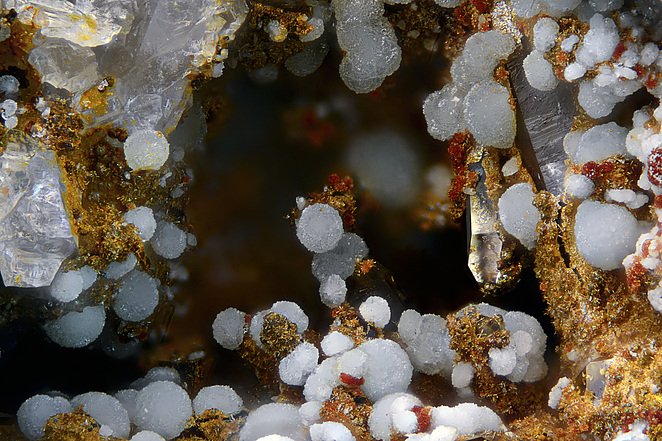
Crystals commonly pyramidal {111} (sometimes pseudo-octahedral), tabular {001}, or prismatic [010]. Commonly aggregated into crusts or irregular groups. Also occurs massive, crystalline or porous and sinter-like, earthy.
Comment:
space group is Pcab
Crystallographic forms of Scorodite
Crystal Atlas:
Image Loading
Click on an icon to view

Scorodite no.3 - {111} - Goldschmidt (1913-1926)
Scorodite no.8 - {111} - Goldschmidt (1913-1926)
3d models and HTML5 code kindly provided by
www.smorf.nl.
Toggle
Edge Lines | Miller Indices | Axes
Transparency
Opaque | Translucent | Transparent
View
Along a-axis | Along b-axis | Along c-axis | Start rotation | Stop rotation
Edge Lines | Miller Indices | Axes
Transparency
Opaque | Translucent | Transparent
View
Along a-axis | Along b-axis | Along c-axis | Start rotation | Stop rotation
Crystal Structure
Load
Unit Cell | Unit Cell Packed
2x2x2 | 3x3x3 | 4x4x4
Unit Cell | Unit Cell Packed
2x2x2 | 3x3x3 | 4x4x4
Show
Big Balls | Small Balls | Just Balls | Spacefill
Polyhedra Off | Si Polyhedra | All Polyhedra
Remove metal-metal sticks
Big Balls | Small Balls | Just Balls | Spacefill
Polyhedra Off | Si Polyhedra | All Polyhedra
Remove metal-metal sticks
Display Options
Black Background | White Background
Perspective On | Perspective Off
2D | Stereo | Red-Blue | Red-Cyan
Black Background | White Background
Perspective On | Perspective Off
2D | Stereo | Red-Blue | Red-Cyan
View
CIF File Best | x | y | z | a | b | c
CIF File Best | x | y | z | a | b | c
Rotation
Stop | Start
Stop | Start
Labels
Console Off | On | Grey | Yellow
Console Off | On | Grey | Yellow
Data courtesy of the American Mineralogist Crystal Structure Database. Click on an AMCSD ID to view structure
| ID | Species | Reference | Link | Year | Locality | Pressure (GPa) | Temp (K) |
|---|---|---|---|---|---|---|---|
| 0010474 | Scorodite | Xu Y, Zhou G P, Zheng X F (2007) Redetermination of iron(III) arsenate dihydrate Acta Crystallographica E63 i67-i69 |  | 2007 | synthetic | 0 | 293 |
| 0018660 | Scorodite | Hawthorne F C (1976) The hydrogen positions in scorodite Acta Crystallographica B32 2891-2892 | | 1976 | not given | 0 | 293 |
| 0009529 | Scorodite | Kitahama K, Kiriyama R, Yoshihisa B (1975) Refinement of the crystal structure of scorodite Acta Crystallographica B31 322-324 | | 1975 | 0 | 293 |
CIF Raw Data - click here to close
X-Ray Powder Diffraction
Loading XRD data...
Data courtesy of RRUFF project at University of Arizona, used with permission.
Powder Diffraction Data:
| d-spacing | Intensity |
|---|---|
| 5.65 Å | (80) |
| 5.05 Å | (40) |
| 4.50 Å | (100) |
| 3.20 Å | (80) |
| 3.07 Å | (60) |
| 3.01 Å | (60) |
| 2.601 Å | (60) |
Geological Environment
Paragenetic Mode(s):
| Paragenetic Mode | Earliest Age (Ga) |
|---|---|
| Stage 7: Great Oxidation Event | <2.4 |
| 47a : [Near-surface hydration of prior minerals] | |
| 47d : [Arsenates, antimonates, selenates, bismuthinates] | |
| Stage 10b: Anthropogenic minerals | <10 Ka |
| 55 : Anthropogenic mine minerals |
Geological Setting:
In the secondary oxidation zone of iron bearing arsenides, in gossans; also observed in a primary hydrothermal deposit (Saubach).
Type Occurrence of Scorodite
Synonyms of Scorodite
Other Language Names for Scorodite
Varieties of Scorodite
| Aluminian Scorodite | An Al-bearing scorodite. |
| Phosphoscorodite | An intermediate (but As-dominant) member of the Scorodite-Strengite Series. |
Relationship of Scorodite to other Species
Member of:
Other Members of Variscite Group:
| Mansfieldite | AlAsO4 · 2H2O | Orth. mmm(2/m2/m2/m) : Pbca |
| Strengite | FePO4 · 2H2O | Orth. mmm(2/m2/m2/m) : Pbca |
| Variscite | AlPO4 · 2H2O | Orth. mmm(2/m2/m2/m) : Pbca |
| Yanomamite | InAsO4 · 2H2O | Orth. mmm(2/m2/m2/m) : Pbca |
Forms a series with:
Common Associates
Associations Based on Photo Data:
| 239 photos of Scorodite associated with Pharmacosiderite | KFe3+4(AsO4)3(OH)4 · 6-7H2O |
| 232 photos of Scorodite associated with Quartz | SiO2 |
| 131 photos of Scorodite associated with Carminite | PbFe3+2(AsO4)2(OH)2 |
| 129 photos of Scorodite associated with Pyrite | FeS2 |
| 94 photos of Scorodite associated with Bariopharmacosiderite | Ba0.5Fe3+4(AsO4)3(OH)4 · 5H2O |
| 66 photos of Scorodite associated with Arsenopyrite | FeAsS |
| 53 photos of Scorodite associated with Goethite | Fe3+O(OH) |
| 50 photos of Scorodite associated with Arthurite | CuFe3+2(AsO4)2(OH)2 · 4H2O |
| 46 photos of Scorodite associated with Jarosite | KFe3+3(SO4)2(OH)6 |
| 44 photos of Scorodite associated with Löllingite | FeAs2 |
Related Minerals - Strunz-mindat Grouping
| 8.CD. | Castellaroite | Mn2+3(AsO4)2 · 4H2O |
| 8.CD. | Sergeysmirnovite | MgZn2(PO4)2 · 4H2O |
| 8.CD.05 | Phosphosiderite | FePO4 · 2H2O |
| 8.CD.05 | Metavariscite | AlPO4 · 2H2O |
| 8.CD.05 | Bonacinaite | Sc(AsO4) · 2H2O |
| 8.CD.05 | Kolbeckite | ScPO4 · 2H2O |
| 8.CD.10 | Yanomamite | InAsO4 · 2H2O |
| 8.CD.10 | Mansfieldite | AlAsO4 · 2H2O |
| 8.CD.10 | Variscite | AlPO4 · 2H2O |
| 8.CD.10 | Strengite | FePO4 · 2H2O |
| 8.CD.15 | Parascorodite | FeAsO4 · 2H2O |
| 8.CD.20 | Ludlamite | Fe2+3(PO4)2 · 4H2O |
| 8.CD.25 | Sterlinghillite | Mn2+3(AsO4)2 · 3H2O |
| 8.CD.30 | Rollandite | Cu3(AsO4)2 · 4H2O |
| 8.CD.35 | Liversidgeite | Zn6(PO4)4 · 7H2O |
| 8.CD.40 | Thorasphite | Th2H(PO4,AsO4)3 · 6H2O |
Other Information
Notes:
Soluble in acids; decomposed in strong alkalies.
Alters to limonite.
Alters to limonite.
Health Risks:
No information on health risks for this material has been entered into the database. You should always treat mineral specimens with care.
Internet Links for Scorodite
mindat.org URL:
https://www.mindat.org/min-3595.html
Please feel free to link to this page.
Please feel free to link to this page.
Search Engines:
External Links:
Mineral Dealers:
References for Scorodite
Reference List:
Haüy, René Just (1809) Tableau comparatif des résultats de la Cristallographie et de l'analyse Chimique, relativement a la Classification des Minéraux.. Chez Courcier, Paris.p.91 - as Cuivre arseniaté ferrifére
Beudant, François-Sulpice (1832) Traité élémentaire de minéralogie. Deuxiéme Edition [Elementary Treatise on Mineralogy. Second Edition] (2nd ed.) Vol. 2 - Tome II [Volume II]. Chez Verdière. p.605
Bourgeois, Léon, Verneuil, (1880) Reproduction de la scorodite. Bulletin de Minéralogie, 3 (2) 32-34 doi:10.3406/bulmi.1880.1549
Goldschmidt, Victor (1891) Index der Krystallformen der Mineralien Vol. 3. Springer Berlin Heidelberg. doi:10.1007/978-3-662-25554-4 p.135
Larsen, Esper S. (1921) The microscopic determination of the nonopaque minerals. Bulletin 679. US Geological Survey doi:10.3133/b679 p.132
Ito, T., Shiga, T. (1932) Scorodite from Kiura mine, Japan. Mineralogical Magazine and Journal of the Mineralogical Society, 23 (137) 130-136 doi:10.1180/minmag.1932.023.137.03
Foshag, W. F. (1937) Carminite and associated minerals from Mapimi, Mexico. American Mineralogist, 22 (5) 479-484 p.482
Strunz, H. (1938) Isotypie zwischen Skorodit und Norbergit Fe[AsO4/(Η2Ο)2] und Mg3[SiO4/(OH,F)2]. Zeitschrift für Kristallographie, Mineralogie und Petrographie, 99 (1-6). 513-514 doi:10.1524/zkri.1938.99.1.513
McConnell, Duncan (1940) Clinobarrandite and the isodimorphous series, variscite-metavariscite. American Mineralogist, 25 (11) 719-725
Allen, Victor T., Fahey, Joseph J. (1948) Mansfieldite, a new arsenate, the aluminum analogue of scorodite, and the mansfieldite-scorodite series. American Mineralogist, 33 (3-4) 122-134
Dasgupta, D. R., Datta, A. K., Sen Gupta, N. R. (1966) Occurrence of scorodite in a pegmatite in Bhilwara District, Rajasthan, India. Mineralogical Magazine and Journal of the Mineralogical Society, 35 (273) 776-777 doi:10.1180/minmag.1966.035.273.14
Takashima, Yoshimasa; Maeda, Yonezo (1969) The Mössbauer effect in mixed crystals of Fe(P,As)O4 · 2H2O and (Fe,Al)PO4 · 2H2O. Journal of Inorganic and Nuclear Chemistry, 31 (5). 1337-1343 doi:10.1016/0022-1902(69)80245-9
Kitahama, K., Kiriyama, R., Baba, Y. (1975) Refinement of the crystal structure of scorodite. Acta Crystallographica Section B Structural Crystallography and Crystal Chemistry, 31 (1) 322-324 doi:10.1107/s056774087500266x
Hawthorne, F. C. (1976) The hydrogen positions in scorodite. Acta Crystallographica Section B Structural Crystallography and Crystal Chemistry, 32 (10) 2891-2892 doi:10.1107/s0567740876009138
Dove, Patricia Martin, Rimstidt, J. Donald (1985) The solubility and stability of scorodite, FeAsO4·2H2O. American Mineralogist, 70 (7-8) 838-844
Dutrizac, J.E., Jambor, J.L. (1988) The synthesis of crystalline scorodite, FeAsO4 · 2H2O. Hydrometallurgy, 19 (3). 377-384 doi:10.1016/0304-386x(88)90042-4
Krause, E., Ettel, V. A. (1988) Solubility and stability of scorodite FeAsO4·2H2O: New data and further discussion. American Mineralogist, 73 (7-8) 850-854
Krause, E., Ettel, V.A. (1989) Solubilities and stabilities of ferric arsenate compounds. Hydrometallurgy, 22 (3). 311-337 doi:10.1016/0304-386x(89)90028-5
Demopoulos, G.P., Droppert, D.J., Van Weert, G. (1995) Precipitation of crystalline scorodite (FeAsO4 · 2H2O) from chloride solutions. Hydrometallurgy, 38 (3). 245-261 doi:10.1016/0304-386x(94)00062-8
Vink, B.W. (1996) Stability relations of antimony and arsenic compounds in the light of revised and extended Eh-pH diagrams. Chemical Geology, 130 (1) 21-30 doi:10.1016/0009-2541(95)00183-2
Xu, Yan, Zhou, Guang-Peng, Zheng, Xue-Fang (2007) Redetermination of iron(III) arsenate dihydrate. Acta Crystallographica Section E Structure Reports Online, 63 (3). i67-i69 doi:10.1107/s1600536807005302(= scorodite)
Paktunc, Dogan, Dutrizac, John, Gertsman, Valery (2008) Synthesis and phase transformations involving scorodite, ferric arsenate and arsenical ferrihydrite: Implications for arsenic mobility. Geochimica et Cosmochimica Acta, 72 (11) 2649-2672 doi:10.1016/j.gca.2008.03.012
Gomez, M. A., Assaaoudi, H., Becze, L., Cutler, J. N., Demopoulos, G. P. (2009) Vibrational spectroscopy study of hydrothermally produced scorodite (FeAsO4·2H2O), ferric arsenate sub‐hydrate (FAsH; FeAsO4·0.75H2O) and basic ferric arsenate sulfate (BFAS; Fe[(AsO4)1−x(SO4)x(OH)x]·wH2O). Journal of Raman Spectroscopy, 41 (2). 212-221 doi:10.1002/jrs.2419
Gomez, Mario A., Le Berre, Jean-Francois, Assaaoudi, Hassane, Demopoulos, George P. (2011) Raman spectroscopic study of the hydrogen and arsenate bonding environment in isostructural synthetic arsenates of the variscite group-M3+AsO4·2H2O (M3+ = Fe, Al, In and Ga): implications for arsenic release in water. Journal of Raman Spectroscopy, 42 (1). 62-71 doi:10.1002/jrs.2639
Kossoff, David, Welch, Mark D., Hudson-Edwards, Karen A. (2015) Scorodite precipitation in the presence of antimony. Chemical Geology, 406. 1-9 doi:10.1016/j.chemgeo.2015.04.013
Kloprogge, J. Theo, Wood, Barry J. (2017) X-ray Photoelectron Spectroscopic and Raman microscopic investigation of the variscite group minerals: Variscite, strengite, scorodite and mansfieldite. Spectrochimica Acta Part A: Molecular and Biomolecular Spectroscopy, 185. 163-172 doi:10.1016/j.saa.2017.05.042
Ma, Xu; Qi, Fengdai; Gomez, Mario Alberto; Su, Rui; Yan, Zelong; Yao, Shuhua; Wang, Shaofeng; Jia, Yongfeng (2022) Spectroscopic study on the local structure of sulfate (SO42-) incorporated in scorodite (FeAsO4·2H2O) lattice: Implication for understanding the Fe(III)-As(V)-SO42- bearing minerals formation. American Mineralogist, 107 (10). 1840-1849 doi:10.2138/am-2022-8184
Localities for Scorodite
Showing 1,510 localities.
 symbol to view information about a locality.
The
symbol to view information about a locality.
The Locality List
 - This locality has map coordinates listed.
- This locality has estimated coordinates.
ⓘ - Click for references and further information on this occurrence.
? - Indicates mineral may be doubtful at this locality.
- This locality has map coordinates listed.
- This locality has estimated coordinates.
ⓘ - Click for references and further information on this occurrence.
? - Indicates mineral may be doubtful at this locality.
 - Good crystals or important locality for species.
 - World class for species or very significant.
(TL) - Type Locality for a valid mineral species.
(FRL) - First Recorded Locality for everything else (eg varieties).
- World class for species or very significant.
(TL) - Type Locality for a valid mineral species.
(FRL) - First Recorded Locality for everything else (eg varieties).
All localities listed without proper references should be considered as questionable.
Quick NavTopAbout ScoroditeUnique IdentifiersIMA Classification Classification Mineral SymbolsPhysical Properties Optical Data Chemistry Crystallography Crystallographic forms Crystal StructureX-Ray Powder DiffractionGeological EnvironmentType Occurrence SynonymsOther LanguagesVarietiesRelationshipsCommon AssociatesStrunz-MindatOther InformationInternet Links References Localities Locality List

Clara Mine, Oberwolfach, Ortenaukreis, Freiburg Region, Baden-Württemberg, Germany