
Ludlamite
A valid IMA mineral species - grandfathered
This page is currently not sponsored. Click here to sponsor this page.


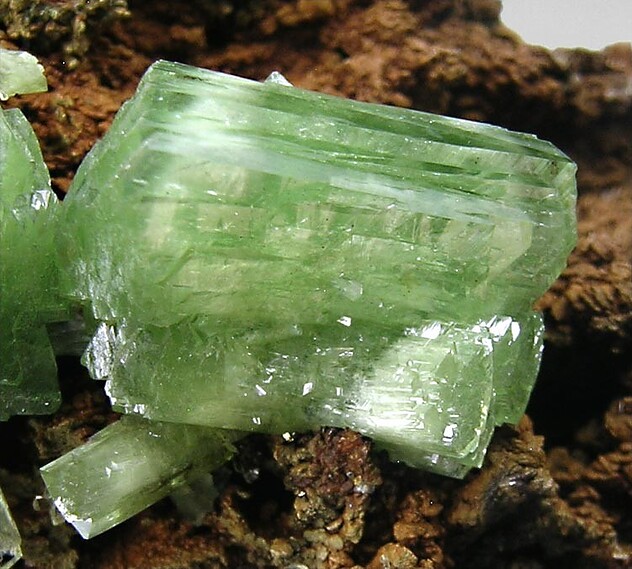

About Ludlamite
Formula:
Fe2+3(PO4)2 · 4H2O
Colour:
Apple-green to bright green; nearly colourless in transmitted light; rarely blue
Lustre:
Sub-Vitreous, Resinous, Greasy
Hardness:
3½
Specific Gravity:
3.12 - 3.19
Crystal System:
Monoclinic
Member of:
Name:
Named in 1877 by English chemist Frederick Field (1826-1885) in honor of English chemist and mineral collector Henry Ludlam (14 October 1824, England, United Kingdom - 23 June 1880, London, England, United Kingdom).
Type Locality:
A secondary phosphate mineral in complex granitic pegmatites; also found in polymetallic veins.
 Visit gemdat.org for gemological information about Ludlamite.
Visit gemdat.org for gemological information about Ludlamite.Unique Identifiers
Mindat ID:
2452
Long-form identifier:
mindat:1:1:2452:1
IMA Classification of Ludlamite
Approved, 'Grandfathered' (first described prior to 1959)
IMA Formula:
Fe2+3(PO4)2(H2O)4
First published:
1877
Classification of Ludlamite
8.CD.20
8 : PHOSPHATES, ARSENATES, VANADATES
C : Phosphates without additional anions, with H2O
D : With only medium-sized cations, RO4:H2O = 1:2
8 : PHOSPHATES, ARSENATES, VANADATES
C : Phosphates without additional anions, with H2O
D : With only medium-sized cations, RO4:H2O = 1:2
40.3.5.1
40 : HYDRATED NORMAL PHOSPHATES,ARSENATES AND VANADATES
3 : A3(XO4)2·xH2O
40 : HYDRATED NORMAL PHOSPHATES,ARSENATES AND VANADATES
3 : A3(XO4)2·xH2O
19.12.35
19 : Phosphates
12 : Phosphates of Mn
19 : Phosphates
12 : Phosphates of Mn
Mineral Symbols
As of 2021 there are now IMA–CNMNC approved mineral symbols (abbreviations) for each mineral species, useful for tables and diagrams.
Please only use the official IMA–CNMNC symbol. Older variants are listed for historical use only.
Please only use the official IMA–CNMNC symbol. Older variants are listed for historical use only.
| Symbol | Source | Reference for Standard |
|---|---|---|
| Lud | IMA–CNMNC | Warr, L.N. (2021). IMA–CNMNC approved mineral symbols. Mineralogical Magazine, 85(3), 291-320. doi:10.1180/mgm.2021.43 |
| Lud | The Canadian Mineralogist (2019) | The Canadian Mineralogist (2019) The Canadian Mineralogist list of symbols for rock- and ore-forming minerals (December 30, 2019). download |
Pronunciation of Ludlamite
Pronunciation:
| Play | Recorded by | Country |
|---|---|---|
| Jolyon Ralph | United Kingdom |
Physical Properties of Ludlamite
Sub-Vitreous, Resinous, Greasy
Transparency:
Transparent, Translucent
Comment:
Pearly on cleavage {001}
Colour:
Apple-green to bright green; nearly colourless in transmitted light; rarely blue
Streak:
Pale greenish white
Hardness:
3½ on Mohs scale
Tenacity:
Brittle
Cleavage:
Perfect
Perfect on {001}, indistinct on {100}
Perfect on {001}, indistinct on {100}
Density:
3.12 - 3.19 g/cm3 (Measured) 3.176 g/cm3 (Calculated)
Optical Data of Ludlamite
Type:
Biaxial (+)
RI values:
nα = 1.650 - 1.653 nβ = 1.669 - 1.675 nγ = 1.688 - 1.697
2V:
Measured: 82° , Calculated: 86° to 88°
Birefringence:
0.041
Max. Birefringence:
δ = 0.038 - 0.044
Based on recorded range of RI values above.
Based on recorded range of RI values above.
Interference Colours:
The colours simulate birefringence patterns seen in thin section under crossed polars. They do not take into account mineral colouration or opacity.
Michel-Levy Bar The default colours simulate the birefringence range for a 30 µm thin-section thickness. Adjust the slider to simulate a different thickness.
Grain Simulation You can rotate the grain simulation to show how this range might look as you rotated a sample under crossed polars. Each grain retains its interference colour (retardation) while its brightness falls to black at extinction and reaches a maximum between extinction positions.
The colours simulate birefringence patterns seen in thin section under crossed polars. They do not take into account mineral colouration or opacity.
Michel-Levy Bar The default colours simulate the birefringence range for a 30 µm thin-section thickness. Adjust the slider to simulate a different thickness.
Grain Simulation You can rotate the grain simulation to show how this range might look as you rotated a sample under crossed polars. Each grain retains its interference colour (retardation) while its brightness falls to black at extinction and reaches a maximum between extinction positions.
Surface Relief:
Very High (positive)
Relative to Canada balsam mounting medium (n ≈ 1.537).
Relative to Canada balsam mounting medium (n ≈ 1.537).
This shows the grain boundary and Becke line effect under plane-polarised
light, based on the contrast between this mineral's average refractive
index and the mounting medium. It does not take into account mineral
colouration.
In focus
Interference Figure:
This shows the idealized biaxial acute bisectrix (Bxa) interference figure
- the conoscopic view for a grain cut perpendicular to the acute bisectrix, using
this mineral's 2V. The two small white dots mark the melatopes - the points
where the two optic axes emerge - and are shown only when they fall within the
field of view. The coloured bands are isochromatics, and the dark bands are
isogyres.
Rotate the stage: at 0°/90° the isogyres form a cross through the melatopes; at 45° they pull apart into curved hyperbolas. That splitting on rotation - absent in a uniaxial figure - is the standard diagnostic test for telling biaxial minerals from uniaxial ones. If 2V is large, the melatopes may fall outside the field of view, as they often do at the microscope too.
Rotate the stage: at 0°/90° the isogyres form a cross through the melatopes; at 45° they pull apart into curved hyperbolas. That splitting on rotation - absent in a uniaxial figure - is the standard diagnostic test for telling biaxial minerals from uniaxial ones. If 2V is large, the melatopes may fall outside the field of view, as they often do at the microscope too.
Dispersion:
r > v perceptible
Optical Extinction:
Y = b; Z ∧ c = -67°.
Pleochroism:
Non-pleochroic
Chemistry of Ludlamite
Mindat Formula:
Fe2+3(PO4)2 · 4H2O
Element Weights:
Elements listed:
Crystallography of Ludlamite
Crystal System:
Monoclinic
Class (H-M):
2/m - Prismatic
Space Group:
P21/b
Setting:
P21/a
Cell Parameters:
a = 10.541(5) Å, b = 4.646(4) Å, c = 9.324(5) Å
β = 100.43°
β = 100.43°
Ratio:
a:b:c = 2.269 : 1 : 2.007
Unit Cell V:
449.08 ų (Calculated from Unit Cell)
Z:
2
Morphology:
Crystals tabular {001}, exhibiting forms {100}, {110}, {001}, and {_111}, and others. Form parallel groups at times. Also occurs granular, massive.
Comment:
For a Mg-rich ludlamite, Kolitsch et al. (2011) give: a = 10.526(2), b = 4.550(1), c = 8.994(2) Å, β = 104.01(3)°, V = 417.94(15) Å3.
Crystal Structure
Load
Unit Cell | Unit Cell Packed
2x2x2 | 3x3x3 | 4x4x4
Unit Cell | Unit Cell Packed
2x2x2 | 3x3x3 | 4x4x4
Show
Big Balls | Small Balls | Just Balls | Spacefill
Polyhedra Off | Si Polyhedra | All Polyhedra
Remove metal-metal sticks
Big Balls | Small Balls | Just Balls | Spacefill
Polyhedra Off | Si Polyhedra | All Polyhedra
Remove metal-metal sticks
Display Options
Black Background | White Background
Perspective On | Perspective Off
2D | Stereo | Red-Blue | Red-Cyan
Black Background | White Background
Perspective On | Perspective Off
2D | Stereo | Red-Blue | Red-Cyan
View
CIF File Best | x | y | z | a | b | c
CIF File Best | x | y | z | a | b | c
Rotation
Stop | Start
Stop | Start
Labels
Console Off | On | Grey | Yellow
Console Off | On | Grey | Yellow
Data courtesy of the American Mineralogist Crystal Structure Database. Click on an AMCSD ID to view structure
| ID | Species | Reference | Link | Year | Locality | Pressure (GPa) | Temp (K) |
|---|---|---|---|---|---|---|---|
| 0009144 | Ludlamite | Ito T, Mori H (1951) The crystal structure of ludlamite Acta Crystallographica 4 412-416 |  | 1951 | Ashio, Japan | 0 | 293 |
| 0012982 | Ludlamite | Abrahams S C (1966) Ferromagnetic and crystal structure of ludlamite, Fe3(PO4)2*4(H2O), at 4.2 K Journal of Chemical Physics 44 2230-2237 | 1966 | 0 | 293 | ||
| 0012981 | Ludlamite | Abrahams S C, Bernstein J L (1966) Crystal structure of paramagnetic ludlamite, Fe3(PO4)2*4(H2O), at 298 K Journal of Chemical Physics 44 2223-2229 | 1966 | 0 | 293 |
CIF Raw Data - click here to close
X-Ray Powder Diffraction
Loading XRD data...
Data courtesy of RRUFF project at University of Arizona, used with permission.
Powder Diffraction Data:
| d-spacing | Intensity |
|---|---|
| 4.91 Å | (75) |
| 3.96 Å | (100) |
| 3.74 Å | (50) |
| 2.990 Å | (60) |
| 2.765 Å | (100) |
| 2.543 Å | (100) |
| 2.387 Å | (40) |
Comments:
ICDD 17-468; See also 35-634
Geological Environment
Paragenetic Mode(s):
| Paragenetic Mode | Earliest Age (Ga) |
|---|---|
| Near-surface Processes | |
| 23 : Subaerial aqueous alteration by non-redox-sensitive fluids (see also #47) | |
| Stage 4b: Highly evolved igneous rocks | >3.0 |
| 34 : Complex granite pegmatites |
Geological Setting:
Complex granitic pegmatites as a alteration product under reducing conditions.
Type Occurrence of Ludlamite
General Appearance of Type Material:
Green crystals with a rhombic outline.
Place of Conservation of Type Material:
The Natural History Museum, London, England: #44187.
Geological Setting of Type Material:
Copper-tin veins associated with granite intrusives.
Associated Minerals at Type Locality:
Synonyms of Ludlamite
Other Language Names for Ludlamite
Relationship of Ludlamite to other Species
Member of:
Other Members of Ludlamite Group:
| Metaswitzerite | Mn2+3(PO4)2 · 4H2O | Mon. 2/m : P2/b |
| Sterlinghillite | Mn2+3(AsO4)2 · 3H2O | Mon. |
| Switzerite | Mn2+3(PO4)2 · 7H2O | Mon. 2/m : P21/b |
Common Associates
Associations Based on Photo Data:
| 211 photos of Ludlamite associated with Siderite | FeCO3 |
| 145 photos of Ludlamite associated with Pyrite | FeS2 |
| 139 photos of Ludlamite associated with Vivianite | Fe2+Fe2+2(PO4)2 · 8H2O |
| 40 photos of Ludlamite associated with Quartz | SiO2 |
| 18 photos of Ludlamite associated with Phosphoferrite | (Fe2+,Mn2+)3(PO4)2 · 3H2O |
| 13 photos of Ludlamite associated with Kryzhanovskite | (Fe3+,Mn2+)3(PO4)2(OH,H2O)3 |
| 10 photos of Ludlamite associated with Messelite | Ca2Fe2+(PO4)2 · 2H2O |
| 9 photos of Ludlamite associated with Triphylite | LiFe2+PO4 |
| 7 photos of Ludlamite associated with Sphalerite | ZnS |
| 5 photos of Ludlamite associated with Fluorapatite | Ca5(PO4)3F |
Related Minerals - Strunz-mindat Grouping
| 8.CD. | Castellaroite | Mn2+3(AsO4)2 · 4H2O |
| 8.CD. | Sergeysmirnovite | MgZn2(PO4)2 · 4H2O |
| 8.CD.05 | Phosphosiderite | FePO4 · 2H2O |
| 8.CD.05 | Metavariscite | AlPO4 · 2H2O |
| 8.CD.05 | Bonacinaite | Sc(AsO4) · 2H2O |
| 8.CD.05 | Kolbeckite | ScPO4 · 2H2O |
| 8.CD.10 | Yanomamite | InAsO4 · 2H2O |
| 8.CD.10 | Mansfieldite | AlAsO4 · 2H2O |
| 8.CD.10 | Scorodite | Fe3+AsO4 · 2H2O |
| 8.CD.10 | Variscite | AlPO4 · 2H2O |
| 8.CD.10 | Strengite | FePO4 · 2H2O |
| 8.CD.15 | Parascorodite | FeAsO4 · 2H2O |
| 8.CD.25 | Sterlinghillite | Mn2+3(AsO4)2 · 3H2O |
| 8.CD.30 | Rollandite | Cu3(AsO4)2 · 4H2O |
| 8.CD.35 | Liversidgeite | Zn6(PO4)4 · 7H2O |
| 8.CD.40 | Thorasphite | Th2H(PO4,AsO4)3 · 6H2O |
Fluorescence of Ludlamite
Not fluorescent in UV
Other Information
Magnetism:
Diamagnetic
Notes:
Soluble in acids.
In closed tube, decrepitates violently, releasing water and turning blue.
In closed tube, decrepitates violently, releasing water and turning blue.
Health Risks:
No information on health risks for this material has been entered into the database. You should always treat mineral specimens with care.
Internet Links for Ludlamite
mindat.org URL:
https://www.mindat.org/min-2452.html
Please feel free to link to this page.
Please feel free to link to this page.
Search Engines:
External Links:
Mineral Dealers:
References for Ludlamite
Reference List:
Field, Frederick (1877) On ludlamite, a new Cornish mineral. The London, Edinburgh, and Dublin Philosophical Magazine and Journal of Science, S. 5 Vol. 3 (15). 52-57 doi:10.1080/14786447708639190
Maskelyne, N.S. (1877) Note on the optical characters of Ludlamite. The London, Edinburgh, and Dublin Philosophical Magazine and Journal of Science, S. 5 Vol. 3 (16). 135-137 doi:10.1080/14786447708639204
Maskelyne, N. Story (1877) Additional note on ludlamite. The London, Edinburgh, and Dublin Philosophical Magazine and Journal of Science, S. 5 Vol. 3 (21). 525 doi:10.1080/14786447708639279
Field, Frederick (1885) On Ludlamite, A New Cornish Mineral. Mineralogical Magazine, 6 (1). 23-31 doi:10.1180/minmag.1885.006.1.05
Berman, Harry (1925) The identity of "lehnerite" and ludlamite. American Mineralogist, 10 (11). 428-429
Larsen, E.S.; Berman, H. (1934) The microscopic determination of the nonopaque minerals. Bulletin of the US Geological Survey Vol. 848. US Geological Survey p.1-266. doi:10.3133/b848 p.124
Wolfe, C. W. (1949) Ludlamite from the Palermo mine, North Groton, New Hampshire. American Mineralogist, 34 (1-2) 94-97
Glass, Jewell J., Vhay, John S. (1949) A new locality for ludlamite. American Mineralogist, 34 (3-4) 335-336
Ito, T., Mori, H. (1951) The crystal structure of ludlamite. Acta Crystallographica, 4 (5) 412-416 doi:10.1107/s0365110x51001367
Abrahams, S. C., Bernstein, J. L. (1966) Crystal Structure of Paramagnetic Ludlamite, Fe3(PO4)2·4H2O, at 298°K. The Journal of Chemical Physics, 44 (6) 2223-2229 doi:10.1063/1.1727026
Abrahams, S. C. (1966) Ferromagnetic and Crystal Structure of Ludlamite, Fe3(PO4)2·4H2O, at 4.2°K. The Journal of Chemical Physics, 44 (6) 2230-2237 doi:10.1063/1.1727027
Mattievich, E., Danon, J. (1977) Hydrothermal synthesis and Mössbauer studies of ferrous phosphates of the homologous series Fe32+(PO4)2(H2O)n. Journal of Inorganic and Nuclear Chemistry, 39 (4) 569-580 doi:10.1016/0022-1902(77)80567-8
Rodgers, K.A.; Henderson, G.S. (1986) The thermochemistry of some iron phosphate minerals: vivianite, metavivianite, baraćite [sic], ludlamite and vivianite/metavivianite admixtures. Thermochimica Acta, 104. 1-12 doi:10.1016/0040-6031(86)85179-6
Forsyth, J B, Wilkinson, C, Paster, S (1990) Magnetism in ludlamite, Fe3(PO4)2.4H2O. Journal of Physics: Condensed Matter, 2 (42). 8381-8390 doi:10.1088/0953-8984/2/42/015
Frost, Ray L., Xi, Yunfei, Scholz, Ricardo, Belotti, Fernanda M. (2013) Vibrational spectroscopic characterization of the phosphate mineral ludlamite (Fe,Mn,Mg)3(PO4)2⋅4H2O – A mineral found in lithium bearing pegmatites. Spectrochimica Acta Part A: Molecular and Biomolecular Spectroscopy, 103. 143-150 doi:10.1016/j.saa.2012.11.023
Localities for Ludlamite
Showing 77 localities.
 symbol to view information about a locality.
The
symbol to view information about a locality.
The Locality List
 - This locality has map coordinates listed.
- This locality has estimated coordinates.
ⓘ - Click for references and further information on this occurrence.
? - Indicates mineral may be doubtful at this locality.
- This locality has map coordinates listed.
- This locality has estimated coordinates.
ⓘ - Click for references and further information on this occurrence.
? - Indicates mineral may be doubtful at this locality.
 - Good crystals or important locality for species.
 - World class for species or very significant.
(TL) - Type Locality for a valid mineral species.
(FRL) - First Recorded Locality for everything else (eg varieties).
- World class for species or very significant.
(TL) - Type Locality for a valid mineral species.
(FRL) - First Recorded Locality for everything else (eg varieties).
All localities listed without proper references should be considered as questionable.
Austria | |
| Kolitsch et al. (2011) +2 other references |
| Niedermayr et al. (1988) +1 other reference |
Bolivia | |
| Wilson (2001) +1 other reference |
| Royal Ontario Museum specimen (Pala, obtained 1972) | |
| Royal Ontario Museum specimen (Pala) +1 other reference |
| First found here in December 2003. ... |
Bosnia and Herzegovina | |
| Radosavljević et al. (2016) |
| Mineco Limited | |
Brazil | |
| Sergio Varvello collection |
| Cassedanne et al. (1982) |
| Baijot et al. (2014) | |
| Cassedane et al. (1978) +1 other reference |
| Baijot et al. (2012) |
| Sergio Varvello collection |
Canada | |
| Robinson et al. (1992) |
| Robinson et al. (1992) | |
| 150-152. +2 other references | |
| Robinson et al. (1992) |
China | |
| Rao et al. (2014) +1 other reference |
Czech Republic | |
| Povondra et al. (eds.) +1 other reference |
| Breiter K. |
| Masau +2 other references |
Finland | |
| Kallio et al. (West) |
France | |
| FONTAN F (1976) |
| Forner et al. (1997) +1 other reference |
Germany | |
| Weiß (1990) |
| Palache et al. (1951) +2 other references |
| web.archive.org (2001) | |
| Wittern (2001) +1 other reference | |
| Thomas et al. (2000) |
Greece | |
| Rieck et al. (2020) |
| Rieck et al. (2020) |
Japan | |
| Sadanaga et al. (1974) |
Kosovo | |
| Féraud J. (1979) |
Mexico | |
| |
| Panczner (1983) +1 other reference |
Morocco | |
| Favreau (2012) |
Poland | |
| Włodek et al. (2015) |
| Pieczka et al. (2015) +1 other reference |
Portugal | |
| Alves et al. (2012) |
| Schnorrer-Köhler et al. (1991) |
| Neiva et al. (2001) |
South Africa | |
| Cairncross et al. (1995) |
Spain | |
| Christian Rewitzer collection +1 other reference |
| Calvo (1996) |
Switzerland | |
| Vignola et al. (2008) |
UK (TL) | |
| Phil. Mag. (1877) +2 other references |
Ukraine | |
| Lyzhachenko et al. (2019) |
USA | |
| Anonymous (1951) +1 other reference |
| Schooner (1961) |
| Palache et al. (1951) +1 other reference |
| Ream (1995) +2 other references |
| Mineralogy of Maine |
| Falster et al. (2019) |
| King et al. (1994) +1 other reference |
| King et al. (6) +1 other reference | |
| |
| Tim Blake |
| W. B. Thompson et al. (2005) |
| P. Cristofono et al. (2011) |
| Smith (2005) |
| Rocks & Minerals: 80: 252. +1 other reference |
| USGS Prof Paper 353 +4 other references | |
| Geological Society of America Abstracts ... +2 other references | |
| Thompson et al. (2022) |
| Rocks & Minerals 80:4 pp234-241 +1 other reference |
| Freeport-McMoRan |
| Northrop et al. (1996) | |
| Campbell et al. (1985) |
| Rocks & Minerals: 60: 117. +1 other reference |
| Smith et al. (2000) |
| Campbell et al. (1985) |
| Smith et al. (2000) | |
| Anthony et al. (2016) |
| Smith et al. (2000) | |
| Rocks & Minerals: 57: 160 +1 other reference | |
Quick NavTopAbout LudlamiteUnique IdentifiersIMA Classification Classification Mineral SymbolsPronunciation Physical Properties Optical Data Chemistry Crystallography Crystal StructureX-Ray Powder DiffractionGeological EnvironmentType Occurrence SynonymsOther LanguagesRelationshipsCommon AssociatesStrunz-MindatFluorescence Other InformationInternet Links References Localities Locality List

San Antonio Mine, East Camp, Santa Eulalia Mining District, Aquiles Serdán Municipality, Chihuahua, Mexico