
Gadolinite-(Ce)
A valid IMA mineral species
This page is currently not sponsored. Click here to sponsor this page.

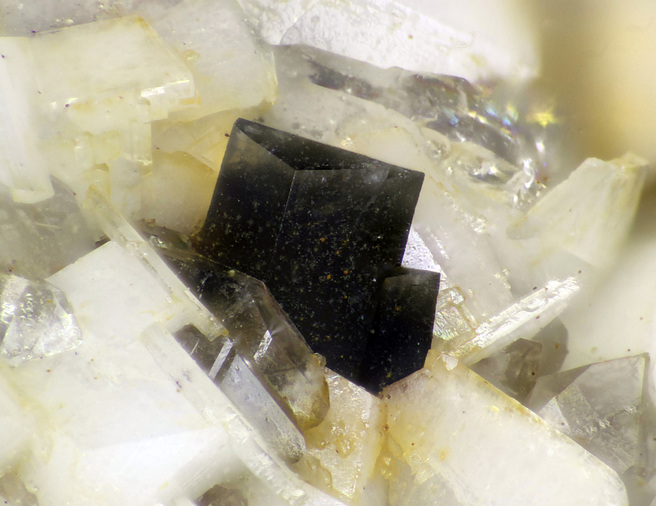

About Gadolinite-(Ce)

Johan Gadolin
Formula:
(Ce,La,Nd,Y)2Fe2+Be2Si2O10
Often slightly radioactive due to minor U and/or Th contents; therefore often metamict.
Colour:
Black
Lustre:
Vitreous
Hardness:
6½ - 7
Specific Gravity:
4.20
Crystal System:
Monoclinic
Member of:
Name:
Named for its relationship to gadolinite-(Y), but with cerium as the dominant rare earth element. Gadolinite honors Johan Gadolin (5 June 1760, Turku, Finland - 15 August 1852, Mynämäki, Finland), chemist, physicist, and mineralogist.
Type Locality:
The cerium analogue of Gadolinite-(Y) and Gadolinite-(Nd).
At the type locality, gadolinite-(Ce) often occurs with an orange or yellow alteration rim (up to 0.5 mm).
The Italian occurrences of gadolinite-(Ce) are not probed by analyses and most correctly they should be classified as "gadolinite" (s.l.).
At the type locality, gadolinite-(Ce) often occurs with an orange or yellow alteration rim (up to 0.5 mm).
The Italian occurrences of gadolinite-(Ce) are not probed by analyses and most correctly they should be classified as "gadolinite" (s.l.).
Unique Identifiers
Mindat ID:
1627
Long-form identifier:
mindat:1:1:1627:4
Similar Names
| Catalinite | A variety of 'Jasper' | SiO2 |
| Catlinite | A variety of 'Argillite' | |
| Gadolinite | A group of related mineral species | |
| Gadolinite-(Nd) | A valid IMA mineral species | Nd2Fe2+Be2O2(SiO4)2 |
| Gadolinite-(Y) | A valid IMA mineral species - grandfathered | Y2Fe2+Be2Si2O10 |
IMA Classification of Gadolinite-(Ce)
Approved
IMA Formula:
Fe2+Be2Ce3+2(SiO4)2O2
Approval year:
1987
First published:
1978
Classification of Gadolinite-(Ce)
9.AJ.20
9 : SILICATES (Germanates)
A : Nesosilicates
J : Nesosilicates with BO3 triangles and/or B[4], Be[4] tetrahedra, cornersharing with SiO4
9 : SILICATES (Germanates)
A : Nesosilicates
J : Nesosilicates with BO3 triangles and/or B[4], Be[4] tetrahedra, cornersharing with SiO4
54.2.1b.2
54 : NESOSILICATES Borosilicates and Some Beryllosilicates
2 : Borosilicates and Some Beryllosilicates with B in [4] coordination
54 : NESOSILICATES Borosilicates and Some Beryllosilicates
2 : Borosilicates and Some Beryllosilicates with B in [4] coordination
14.3.24
14 : Silicates not Containing Aluminum
3 : Silicates of Be
14 : Silicates not Containing Aluminum
3 : Silicates of Be
Mineral Symbols
As of 2021 there are now IMA–CNMNC approved mineral symbols (abbreviations) for each mineral species, useful for tables and diagrams.
Please only use the official IMA–CNMNC symbol. Older variants are listed for historical use only.
Please only use the official IMA–CNMNC symbol. Older variants are listed for historical use only.
| Symbol | Source | Reference for Standard |
|---|---|---|
| Gad-Ce | IMA–CNMNC | Warr, L.N. (2021). IMA–CNMNC approved mineral symbols. Mineralogical Magazine, 85(3), 291-320. doi:10.1180/mgm.2021.43 |
| Gad | Siivolam & Schmid (2007) | Siivolam, J. and Schmid, R. (2007) Recommendations by the IUGS Subcommission on the Systematics of Metamorphic Rocks: List of mineral abbreviations. Web-version 01.02.07. IUGS Commission on the Systematics in Petrology. download |
Physical Properties of Gadolinite-(Ce)
Vitreous
Colour:
Black
Comment:
Olive green in thin sections
Hardness:
6½ - 7 on Mohs scale
Fracture:
Conchoidal
Density:
4.20 g/cm3 (Measured)
Optical Data of Gadolinite-(Ce)
Type:
Biaxial (-)
RI values:
nα = 1.78 nβ = 1.8 nγ = 1.81
2V:
Measured: 70° (5)
Birefringence:
mid-2nd order birefringence
Max. Birefringence:
δ = 0.030
Based on recorded range of RI values above.
Based on recorded range of RI values above.
Interference Colours:
The colours simulate birefringence patterns seen in thin section under crossed polars. They do not take into account mineral colouration or opacity.
Michel-Levy Bar The default colours simulate the birefringence range for a 30 µm thin-section thickness. Adjust the slider to simulate a different thickness.
Grain Simulation You can rotate the grain simulation to show how this range might look as you rotated a sample under crossed polars. Each grain retains its interference colour (retardation) while its brightness falls to black at extinction and reaches a maximum between extinction positions.
The colours simulate birefringence patterns seen in thin section under crossed polars. They do not take into account mineral colouration or opacity.
Michel-Levy Bar The default colours simulate the birefringence range for a 30 µm thin-section thickness. Adjust the slider to simulate a different thickness.
Grain Simulation You can rotate the grain simulation to show how this range might look as you rotated a sample under crossed polars. Each grain retains its interference colour (retardation) while its brightness falls to black at extinction and reaches a maximum between extinction positions.
Surface Relief:
Very High (positive)
Relative to Canada balsam mounting medium (n ≈ 1.537).
Relative to Canada balsam mounting medium (n ≈ 1.537).
This shows the grain boundary and Becke line effect under plane-polarised
light, based on the contrast between this mineral's average refractive
index and the mounting medium. It does not take into account mineral
colouration.
In focus
Interference Figure:
This shows the idealized biaxial acute bisectrix (Bxa) interference figure
- the conoscopic view for a grain cut perpendicular to the acute bisectrix, using
this mineral's 2V. The two small white dots mark the melatopes - the points
where the two optic axes emerge - and are shown only when they fall within the
field of view. The coloured bands are isochromatics, and the dark bands are
isogyres.
Rotate the stage: at 0°/90° the isogyres form a cross through the melatopes; at 45° they pull apart into curved hyperbolas. That splitting on rotation - absent in a uniaxial figure - is the standard diagnostic test for telling biaxial minerals from uniaxial ones. If 2V is large, the melatopes may fall outside the field of view, as they often do at the microscope too.
Rotate the stage: at 0°/90° the isogyres form a cross through the melatopes; at 45° they pull apart into curved hyperbolas. That splitting on rotation - absent in a uniaxial figure - is the standard diagnostic test for telling biaxial minerals from uniaxial ones. If 2V is large, the melatopes may fall outside the field of view, as they often do at the microscope too.
Pleochroism:
Non-pleochroic
Comments:
pale yellow-green in thin section
Comments:
The mineral is reported in numerous sources as "isotropic" with n = 1.78, but as the mineral is monoclinic, this observation was clearly done on metamict material. This assertion appears to derive from an observation on material only from Skien, Norway (Segalstad & Larsen, 1978). In contrast to the Norwegian sample, gadolinite-(Ce) from the Malmkärra mine, Norberg, Sweden is U-free and Th-free and is non-metamict. This material shows normal anisotropic optical properties consistent with a monoclinic symmetry (non-zero birefringence; biaxial nature).
Note that in the absence of measured R.I. data for anisotropic gadolinite-(Ce), the listed R.I. values above are those of the analogous species gadolinite-(Nd) (but no estimate of errors is attempted). However, these values nonetheless successfully reproduce the observed birefringence and 2V° of the Malmkärra mine gadolinite-(Ce). Not unexpectedly, the overall optical properties of non-metamict gadolinite-(Ce) appear to be largely comparable to those of gadolinite-(Nd).
Note that in the absence of measured R.I. data for anisotropic gadolinite-(Ce), the listed R.I. values above are those of the analogous species gadolinite-(Nd) (but no estimate of errors is attempted). However, these values nonetheless successfully reproduce the observed birefringence and 2V° of the Malmkärra mine gadolinite-(Ce). Not unexpectedly, the overall optical properties of non-metamict gadolinite-(Ce) appear to be largely comparable to those of gadolinite-(Nd).
Chemistry of Gadolinite-(Ce)
Mindat Formula:
(Ce,La,Nd,Y)2Fe2+Be2Si2O10
Often slightly radioactive due to minor U and/or Th contents; therefore often metamict.
Often slightly radioactive due to minor U and/or Th contents; therefore often metamict.
Element Weights:
Crystallography of Gadolinite-(Ce)
Crystal System:
Monoclinic
Class (H-M):
2/m - Prismatic
Cell Parameters:
a = 9.8973 Å, b = 7.6282 Å, c = 4.7505 Å
β = 90.416°
β = 90.416°
Ratio:
a:b:c = 1.297 : 1 : 0.623
Unit Cell V:
358.65 ų (Calculated from Unit Cell)
Comment:
Space group P2/c was determined for material heated at 700oC
X-Ray Powder Diffraction
Powder Diffraction Data:
| d-spacing | Intensity |
|---|---|
| 6.06 Å | (42) |
| 3.74 Å | (37) |
| 3.44 Å | (34) |
| 3.13 Å | (86) |
| 2.85 Å | (100) |
| 2.56 Å | (46) |
| 2.21 Å | (33) |
| 1.976 Å | (30) |
Reference:
Comments:
Spacings for the material hydrothermally recrystallized at 700oC: 2.88 (100), 4.81 (90), 2.60 (80), 2.59 (80), 3.18 (70), 3.00 (70), and 3.59 (60)
Geological Environment
Paragenetic Mode(s):
| Paragenetic Mode | Earliest Age (Ga) |
|---|---|
| High-? alteration and/or metamorphism | |
| 31 : Thermally altered carbonate, phosphate, and iron formations | |
| Stage 4b: Highly evolved igneous rocks | >3.0 |
| 34 : Complex granite pegmatites | |
| 35 : Ultra-alkali and agpaitic igneous rocks |
Type Occurrence of Gadolinite-(Ce)
General Appearance of Type Material:
Black irregular masses up to 20 mm in matrix.
Place of Conservation of Type Material:
Mineralogical-Geological Museum, University of Oslo, Oslo, Norway, number 21325.
Chemical Analysis of Type Material:
| SiO2 | 22.99 % |
|---|---|
| BeO | 8.83 % |
| Al2O3 | 0.02 % |
| B2O3 | 0.55 % |
| TiO2 | 0.25 % |
| FeO | 10.65 % |
| MnO | 1.89 % |
| MgO | 0.33 % |
| CaO | 2.15 % |
| Na2O | 0.11 % |
| K2O | 0.52 % |
| Y2O3 | 14.82 % |
| La2O3 | 9.07 % |
| Ce2O3 | 15.55 % |
| Total: | 87.73 % |
Geological Setting of Type Material:
Syenite pegmatite.
Associated Minerals at Type Locality:
Other Language Names for Gadolinite-(Ce)
Dutch:Gadoliniet-(Ce)
German:Gadolinit-(Ce)
Russian:Гадолинит-(Ce)
Simplified Chinese:硅铍铈矿
Traditional Chinese:矽鈹鈰礦
Relationship of Gadolinite-(Ce) to other Species
Member of:
Other Members of Gadolinite:
| Gadolinite-(Nd) | Nd2Fe2+Be2O2(SiO4)2 | Mon. 2/m : P21/b |
| Gadolinite-(Y) | Y2Fe2+Be2Si2O10 | Mon. 2/m : P21/b |
Common Associates
Associations Based on Photo Data:
| 5 photos of Gadolinite-(Ce) associated with Albite | Na(AlSi3O8) |
| 4 photos of Gadolinite-(Ce) associated with Phenakite | Be2SiO4 |
| 4 photos of Gadolinite-(Ce) associated with Microcline | K(AlSi3O8) |
| 4 photos of Gadolinite-(Ce) associated with Quartz | SiO2 |
| 2 photos of Gadolinite-(Ce) associated with Thorite | Th(SiO4) |
| 2 photos of Gadolinite-(Ce) associated with Xenotime-(Y) | Y(PO4) |
| 2 photos of Gadolinite-(Ce) associated with 'Adularia' | KAlSi3O8 |
| 2 photos of Gadolinite-(Ce) associated with Monazite-(Ce) | Ce(PO4) |
| 2 photos of Gadolinite-(Ce) associated with Fluorite | CaF2 |
| 2 photos of Gadolinite-(Ce) associated with Annite | KFe2+3(AlSi3O10)(OH)2 |
Related Minerals - Strunz-mindat Grouping
| 9.AJ. | Hingganite-(Nd) | Nd2◻Be2Si2O8(OH)2 |
| 9.AJ. | Arrheniusite-(Ce) | CaMg[(Ce7Y3)Ca5](SiO4)4(Si2B3AsO18)(BO3)F11 |
| 9.AJ.05 | Ominelite | (Fe2+,Mg)(Al,Fe3+)3(SiO4)(BO3)O2 |
| 9.AJ.05 | Grandidierite | (Mg,Fe2+)(Al,Fe3+)3(SiO4)(BO3)O2 |
| 9.AJ.10 | Dumortierite | Al(Al2O)(Al2O)2(SiO4)3(BO3) |
| 9.AJ.10 | Nioboholtite | (Nb0.6◻0.4)Al6BSi3O18 |
| 9.AJ.10 | Titanoholtite | (Ti0.75◻0.25)Al6BSi3O18 |
| 9.AJ.10 | Holtite | (Ta0.6◻0.4)Al6BSi3O18(O,OH)2.25 |
| 9.AJ.10 | Magnesiodumortierite | Mg(Al2OH)(Al2O)2(SiO4)3(BO3) |
| 9.AJ.15 | Garrelsite | Ba3NaSi2B7O16(OH)4 |
| 9.AJ.20 | 'Muromontite' | near Be2FeY2Si3O12 |
| 9.AJ.20 | Gadolinite-(Nd) | Nd2Fe2+Be2O2(SiO4)2 |
| 9.AJ.20 | Datolite | CaB(SiO4)(OH) |
| 9.AJ.20 | Melanocerite-(Ce) | (Ce,Ca)5(SiO4,BO4)3(OH,O) |
| 9.AJ.20 | Gadolinite-(Y) | Y2Fe2+Be2Si2O10 |
| 9.AJ.20 | 'Unnamed (OH-analogue of Gadolinite-(Y))' | (Y,Ca)2(Fe,◻)Be2Si2O8(OH,O)2 |
| 9.AJ.20 | Hingganite-(Ce) | (Ce,REE)2(◻,Fe2+)Be2[SiO4]2(OH)2 |
| 9.AJ.20 | Hingganite-(Y) | (Y,REE,Ca)2(◻,Fe2+)Be2[SiO4]2(OH)2 |
| 9.AJ.20 | Hingganite-(Yb) | (Yb,Y,REE)2◻Be2[SiO4]2(OH)2 |
| 9.AJ.20 | Homilite | Ca2(Fe2+,Mg)B2Si2O10 |
| 9.AJ.20 | 'Minasgeraisite-(Y)' | (Ca2Y2)◻2(Be2B2)[SiO4]4(OH)4 |
| 9.AJ.20 | Calcybeborosilite-(Y) | (Y,Ca)2(◻,Fe2+)(B,Be)2[SiO4]2(OH,O)2 |
| 9.AJ.25 | Stillwellite-(La) | LaBSiO5 |
| 9.AJ.25 | Stillwellite-(Ce) | (Ce,La,Ca)BSiO5 |
| 9.AJ.30 | Cappelenite-(Y) | Ba(Y,Ce)6Si3B6O24F2 |
| 9.AJ.35 | Laptevite-(Ce) | Ca6(Fe2+,Mn2+)Y3REE7(SiO4)3(PO4)(B3Si3O18)(BO3)F11 |
| 9.AJ.35 | Proshchenkoite-(Y) | Ca(Y,REE,Ca,Na,Mn)15Fe2+(P,Si)Si6B3O34F14 |
| 9.AJ.35 | Okanoganite-(Y) | (Na,Ca)3(Y,Ce)12Si6B2O27F14 |
| 9.AJ.35 | Hundholmenite-(Y) | (Y,REE,Ca,Na)15(Al,Fe3+)(CaxAs3+1-x)(Si,As5+)Si6B3(O,F)48 |
| 9.AJ.35 | Vicanite-(Ce) | (Ca,Ce,La,Th)15As5+(As3+0.5,Na0.5)Fe3+Si6B4O40F7 |
| 9.AJ.40 | Jadarite | LiNaSiB3O7(OH) |
Other Information
Thermal Behaviour:
DTA shows a broad and indistinct exotherm at about 250-350 °C and a large exotherm at 790 °C grading into a smaller exotherm at 8l0 °C.
Health Risks:
No information on health risks for this material has been entered into the database. You should always treat mineral specimens with care.
Internet Links for Gadolinite-(Ce)
mindat.org URL:
https://www.mindat.org/min-1627.html
Please feel free to link to this page.
Please feel free to link to this page.
Search Engines:
External Links:
Mineral Dealers:
References for Gadolinite-(Ce)
Reference List:
Segalstad, Tom Victor, Larsen, Alf Olav (1978) Gadolinite-(Ce) from Skien, southwestern Oslo region, Norway. American Mineralogist, 63 (1-2) 188-195
Localities for Gadolinite-(Ce)
Showing 49 localities.
 symbol to view information about a locality.
The
symbol to view information about a locality.
The Locality List
 - This locality has map coordinates listed.
- This locality has estimated coordinates.
ⓘ - Click for references and further information on this occurrence.
? - Indicates mineral may be doubtful at this locality.
- This locality has map coordinates listed.
- This locality has estimated coordinates.
ⓘ - Click for references and further information on this occurrence.
? - Indicates mineral may be doubtful at this locality.
 - Good crystals or important locality for species.
 - World class for species or very significant.
(TL) - Type Locality for a valid mineral species.
(FRL) - First Recorded Locality for everything else (eg varieties).
- World class for species or very significant.
(TL) - Type Locality for a valid mineral species.
(FRL) - First Recorded Locality for everything else (eg varieties).
All localities listed without proper references should be considered as questionable.
Austria | |
| Wittern (1994) |
| Exel (1993) |
Czech Republic | |
| Jaranowski et al. (2025) |
Germany | |
| |
Italy | |
| Thorne (n.d.) |
| |
| Carlini | |
| Grill (1935) |
| Pezzotta et al. (1999) |
| Folie et al. (2010) |
Mozambique | |
| Behier (1957) +1 other reference |
Norway | |
| Larsen et al. (2010) |
| Segalstad et al. (1978) |
| - (n.d.) | |
| Larsen et al. (1981, June) +1 other reference |
| Raade et al. (1983) | |
| Grice et al. (2013) | |
| Larsen et al. (1992) |
| Andresen (2011) |
| Larsen et al. (2010) | |
| Engvoldsen et al. (1991) |
| Hansen (1981) +1 other reference |
| Berge (n.d.) | |
| Engvoldsen et al. (1991) |
| Engvoldsen et al. (1991) |
| Engvoldsen et al. (1991) | |
| Collection of Peter Andresen. | |
| Berge (1993) +1 other reference | |
| Engvoldsen et al. (1991) | |
| Peter Andresen collection +2 other references | |
| Larsen et al. (1981, June) +1 other reference | |
Pakistan | |
| RUFF |
Poland | |
| Evans et al. (2018) +1 other reference |
Russia | |
| Kasatkin et al. (2020) |
| ... |
| European Journal of Mineralogy 19 (2007) |
Sweden | |
| Nysten et al. (2006) |
| Nysten et al. (2006) +1 other reference | |
| Andersson et al. (2024) | |
| Nysten et al. (2006) |
| Öhman et al. (2005) +1 other reference |
| Andersson et al. (2024) | |
USA | |
| Hanley et al. (1950) +1 other reference |
| Eckel et al. (1997) |
| Eckel et al. (1997) | |
| Ream (2004) | |
| Smith (2005) +1 other reference |
| Metamict crystal identified by XRD after annealing at 700° for 48 hours by John Attard et al. (Ce) |
Quick NavTopAbout Gadolinite-(Ce)Unique IdentifiersSimilar NamesIMA Classification Classification Mineral SymbolsPhysical Properties Optical Data Chemistry Crystallography X-Ray Powder DiffractionGeological EnvironmentType Occurrence Other LanguagesRelationshipsCommon AssociatesStrunz-MindatOther InformationInternet Links References Localities Locality List

Buer, Bjørkedalen, Porsgrunn, Telemark, Norway