
Elbaite
A valid IMA mineral species - grandfathered
This page kindly sponsored by June Epp



About Elbaite
Formula:
Na(Li1.5Al1.5)Al6(Si6O18)(BO3)3(OH)3(OH)
Colour:
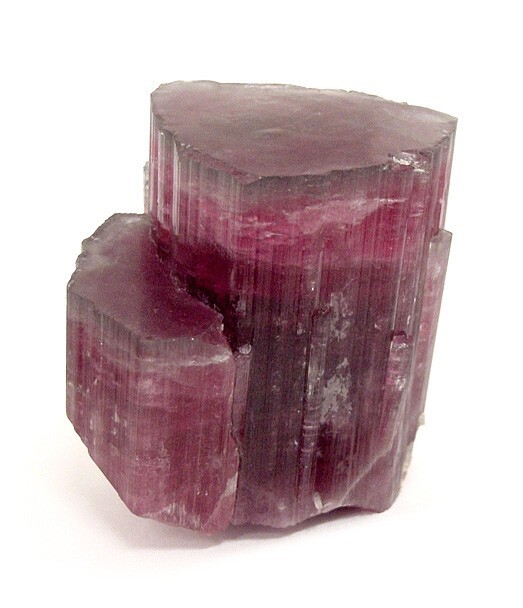
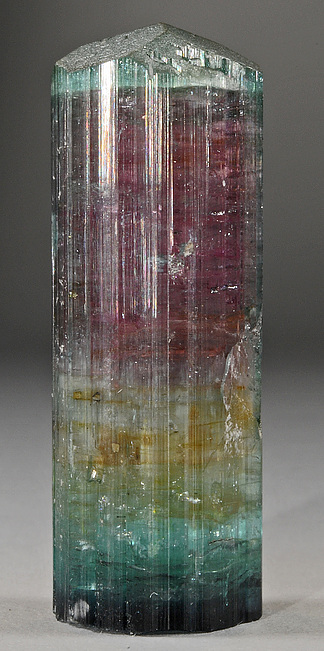
Green, blue-green, blue, red to pink, orange, yellow, colourless
Lustre:
Vitreous, Resinous
Hardness:
7½
Specific Gravity:
2.9 - 3.1
Crystal System:
Trigonal
Member of:
Name:
Named after the type locality, the island of Elba, Italy
Tourmaline Group.
Elbaite-Liddicoatite Series, Dravite-Elbaite Series, and the Elbaite-Schorl Series.
The OH-analogue of fluor-elbaite.
“Paraíba tourmaline” elbaites may bear significant amounts of Pb (Pb2+, Pb4+) and Bi (Bi3+). Substitutions may be at:
- the X site, via BiLi(NaAl)−1, PbLi(NaCu)−1 and possibly PbCu(NaAl)−1 substitution paths, and
- at the Y site, where Pb4+ can be according to the PbLi(AlCu)−1 and PbVO(AlVOH)−1 paths.
 Visit gemdat.org for gemological information about Elbaite.
Elbaite-Liddicoatite Series, Dravite-Elbaite Series, and the Elbaite-Schorl Series.
The OH-analogue of fluor-elbaite.
“Paraíba tourmaline” elbaites may bear significant amounts of Pb (Pb2+, Pb4+) and Bi (Bi3+). Substitutions may be at:
- the X site, via BiLi(NaAl)−1, PbLi(NaCu)−1 and possibly PbCu(NaAl)−1 substitution paths, and
- at the Y site, where Pb4+ can be according to the PbLi(AlCu)−1 and PbVO(AlVOH)−1 paths.
Visit gemdat.org for gemological information about Elbaite.Unique Identifiers
Mindat ID:
1364
Long-form identifier:
mindat:1:1:1364:8
Similar Names
IMA Classification of Elbaite
Approved, 'Grandfathered' (first described prior to 1959)
IMA Formula:
Na(Al1.5Li1.5)Al6(Si6O18)(BO3)3(OH)3OH
Approval history:
Proposal 24-A is accepted, and a neotype sample is defined for the mineral elbaite, first described in 1913. The type locality is the Rosina pegmatite, located about 100 m south of the village of San Piero in Campo, Elba island, Italy.
A full description of the neotype was published by Bosi et al. (2025).
A full description of the neotype was published by Bosi et al. (2025).
Classification of Elbaite
9.CK.05
9 : SILICATES (Germanates)
C : Cyclosilicates
K : [Si6O18]12- 6-membered single rings, with insular complex anions
9 : SILICATES (Germanates)
C : Cyclosilicates
K : [Si6O18]12- 6-membered single rings, with insular complex anions
Dana 7th ed.:
61.3.1.10
61.3.1.8
61 : CYCLOSILICATES Six-Membered Rings
3 : Six-Membered Rings with borate groups
61 : CYCLOSILICATES Six-Membered Rings
3 : Six-Membered Rings with borate groups
17.5.5
17 : Silicates Containing other Anions
5 : Borosilicates
17 : Silicates Containing other Anions
5 : Borosilicates
Mineral Symbols
As of 2021 there are now IMA–CNMNC approved mineral symbols (abbreviations) for each mineral species, useful for tables and diagrams.
Please only use the official IMA–CNMNC symbol. Older variants are listed for historical use only.
Please only use the official IMA–CNMNC symbol. Older variants are listed for historical use only.
| Symbol | Source | Reference for Standard |
|---|---|---|
| Elb | IMA–CNMNC | Warr, L.N. (2021). IMA–CNMNC approved mineral symbols. Mineralogical Magazine, 85(3), 291-320. doi:10.1180/mgm.2021.43 |
| Elb | Kretz (1983) | Kretz, R. (1983) Symbols of rock-forming minerals. American Mineralogist, 68, 277–279. |
| Elb | Siivolam & Schmid (2007) | Siivolam, J. and Schmid, R. (2007) Recommendations by the IUGS Subcommission on the Systematics of Metamorphic Rocks: List of mineral abbreviations. Web-version 01.02.07. IUGS Commission on the Systematics in Petrology. download |
| Elb | Whitney & Evans (2010) | Whitney, D.L. and Evans, B.W. (2010) Abbreviations for names of rock-forming minerals. American Mineralogist, 95, 185–187 doi:10.2138/am.2010.3371 |
| Elb | The Canadian Mineralogist (2019) | The Canadian Mineralogist (2019) The Canadian Mineralogist list of symbols for rock- and ore-forming minerals (December 30, 2019). download |
Physical Properties of Elbaite
Vitreous, Resinous
Transparency:
Transparent, Translucent
Colour:
Green, blue-green, blue, red to pink, orange, yellow, colourless
Comment:
The isomorphous substitution of ions forms the different colors of tourmalines. The cations in the structure (such as Fe, Mn, Cr, etc.) exist in a wide range of isomorphous substitutions, which gives tourmaline a very rich color. There are no or very few transition metal ions in colorless tourmaline.
The red hue of tourmaline is attributed to the d-d transition of octahedral Mn3+, Mn2+, or Mn2+-Mn3+ intervalence charge transfer (IVCT) in its crystal structure. The deep blue color is due to Fe2+, Fe3+, and Mn3+. The “neon” blue color of Paraíba tourmaline is attributed to Cu2+ and Mn3+. The yellow color could be associated with both the Fe2+-Ti4+ and Fe2+-Fe3+ intervalence charge transfers. Regarding the color genesis of green tourmalines, many previous experimental studies have shown that it is due to the isomorphous substitution of transition metal ions, such as Cr, V, and Fe, at the Y or Z position in its structure. It has also been shown that the green color of tourmaline is due to defects in the crystal structure of tourmaline.
The chromogenic components iron and manganese were found in the green elbaites; however, the bivariate correlation analysis indicated that the Mn content had no impact on the color, whereas the Fe content significantly affected both the lightness and the hue of green elbaites. The primary factors influencing the color of tourmaline were the absorption band at 720 nm caused by the Fe2+ d-d transitions and the 300 to 400 nm wide absorption edge extending to the visible range due to the O2−-Fe3+ charge transfer. Infrared spectroscopy indicated that the color of tourmalines was also influenced by their structure. As the degree of Y and Z octahedral distortion in the tourmaline lattice increased, the lightness of the tourmaline decreased and its color deepened.
Based on the Raman frequencies of [OH], short-range crystal occupancy assignments of metal cations were inferred for different samples. The UV-visible spectral analysis demonstrated that the symmetric broad absorption band
centered at 725 nm in the blue samples results from intermetallic charge transfer between Fe2+ and Fe3+, with Fe content directly affecting the depth of the blue hue.
Elbaite enriched in Mn (17,346–20,669 μg/g) and Fe (8396–10,750 μg/g). Heat treatment enhanced transparency and induced strong pleochroism (yellowish green parallel c-axis, brown perpendicular c-axis). UV-Vis spectroscopy identified the brown color origin in the parallel c-axis direction: absorption bands at 730 nm (Fe2+ d–d transition, 5T2g → 5Eg), 540 nm (Fe2+→Fe3+ intervalence charge transfer, IVCT), and 415 nm (Fe2+→Ti4+ IVCT + possible Mn2+ contribution). Post-treatment, the 540 nm band vanished, creating a green transmission window and causing the color shift parallel the c-axis. The spectra perpendicular to the c-axis remained largely unchanged. The disappearance of the 540 nm band, attributed to the reduction of Fe3+ to Fe2+ eliminating the Fe2+–Fe3+ pair interaction required for IVCT, is the primary color change mechanism. The parallel c-axis section of the samples shows brown and yellow-green dichroism after heat treatment. A decrease in the IR intensity at 4170 cm−1 indicates a reduced Fe3+ concentration. The weakening or disappearance of the 4721 cm−1 absorption band of the infrared spectrum and the near-infrared 976 nm absorption band of the ultraviolet–visible spectrum provides diagnostic indicators for identifying heat treatment in similar brown elbaite–fluorelbaite.
The red hue of tourmaline is attributed to the d-d transition of octahedral Mn3+, Mn2+, or Mn2+-Mn3+ intervalence charge transfer (IVCT) in its crystal structure. The deep blue color is due to Fe2+, Fe3+, and Mn3+. The “neon” blue color of Paraíba tourmaline is attributed to Cu2+ and Mn3+. The yellow color could be associated with both the Fe2+-Ti4+ and Fe2+-Fe3+ intervalence charge transfers. Regarding the color genesis of green tourmalines, many previous experimental studies have shown that it is due to the isomorphous substitution of transition metal ions, such as Cr, V, and Fe, at the Y or Z position in its structure. It has also been shown that the green color of tourmaline is due to defects in the crystal structure of tourmaline.
The chromogenic components iron and manganese were found in the green elbaites; however, the bivariate correlation analysis indicated that the Mn content had no impact on the color, whereas the Fe content significantly affected both the lightness and the hue of green elbaites. The primary factors influencing the color of tourmaline were the absorption band at 720 nm caused by the Fe2+ d-d transitions and the 300 to 400 nm wide absorption edge extending to the visible range due to the O2−-Fe3+ charge transfer. Infrared spectroscopy indicated that the color of tourmalines was also influenced by their structure. As the degree of Y and Z octahedral distortion in the tourmaline lattice increased, the lightness of the tourmaline decreased and its color deepened.
Based on the Raman frequencies of [OH], short-range crystal occupancy assignments of metal cations were inferred for different samples. The UV-visible spectral analysis demonstrated that the symmetric broad absorption band
centered at 725 nm in the blue samples results from intermetallic charge transfer between Fe2+ and Fe3+, with Fe content directly affecting the depth of the blue hue.
Elbaite enriched in Mn (17,346–20,669 μg/g) and Fe (8396–10,750 μg/g). Heat treatment enhanced transparency and induced strong pleochroism (yellowish green parallel c-axis, brown perpendicular c-axis). UV-Vis spectroscopy identified the brown color origin in the parallel c-axis direction: absorption bands at 730 nm (Fe2+ d–d transition, 5T2g → 5Eg), 540 nm (Fe2+→Fe3+ intervalence charge transfer, IVCT), and 415 nm (Fe2+→Ti4+ IVCT + possible Mn2+ contribution). Post-treatment, the 540 nm band vanished, creating a green transmission window and causing the color shift parallel the c-axis. The spectra perpendicular to the c-axis remained largely unchanged. The disappearance of the 540 nm band, attributed to the reduction of Fe3+ to Fe2+ eliminating the Fe2+–Fe3+ pair interaction required for IVCT, is the primary color change mechanism. The parallel c-axis section of the samples shows brown and yellow-green dichroism after heat treatment. A decrease in the IR intensity at 4170 cm−1 indicates a reduced Fe3+ concentration. The weakening or disappearance of the 4721 cm−1 absorption band of the infrared spectrum and the near-infrared 976 nm absorption band of the ultraviolet–visible spectrum provides diagnostic indicators for identifying heat treatment in similar brown elbaite–fluorelbaite.
Streak:
White
Hardness:
7½ on Mohs scale
Tenacity:
Brittle
Cleavage:
Poor/Indistinct
on {1120} and {1011}
on {1120} and {1011}
Fracture:
Irregular/Uneven, Conchoidal
Density:
2.9 - 3.1 g/cm3 (Measured) 3.069 g/cm3 (Calculated)
Optical Data of Elbaite
Type:
Uniaxial (-)
RI values:
nω = 1.633 - 1.651 nε = 1.615 - 1.63
Max. Birefringence:
δ = 0.018 - 0.021
Based on recorded range of RI values above.
Based on recorded range of RI values above.
Interference Colours:
The colours simulate birefringence patterns seen in thin section under crossed polars. They do not take into account mineral colouration or opacity.
Michel-Levy Bar The default colours simulate the birefringence range for a 30 µm thin-section thickness. Adjust the slider to simulate a different thickness.
Grain Simulation You can rotate the grain simulation to show how this range might look as you rotated a sample under crossed polars. Each grain retains its interference colour (retardation) while its brightness falls to black at extinction and reaches a maximum between extinction positions.
The colours simulate birefringence patterns seen in thin section under crossed polars. They do not take into account mineral colouration or opacity.
Michel-Levy Bar The default colours simulate the birefringence range for a 30 µm thin-section thickness. Adjust the slider to simulate a different thickness.
Grain Simulation You can rotate the grain simulation to show how this range might look as you rotated a sample under crossed polars. Each grain retains its interference colour (retardation) while its brightness falls to black at extinction and reaches a maximum between extinction positions.
Surface Relief:
High (positive)
Relative to Canada balsam mounting medium (n ≈ 1.537).
Relative to Canada balsam mounting medium (n ≈ 1.537).
This shows the grain boundary and Becke line effect under plane-polarised
light, based on the contrast between this mineral's average refractive
index and the mounting medium. It does not take into account mineral
colouration.
In focus
Interference Figure:
This shows the idealized uniaxial interference figure - the conoscopic
(convergent-light, Bertrand-lens-in) view, for a grain cut with the optic axis
centred and vertical. The coloured rings are isochromatics, computed with the
same physics as the Michel-Lévy bar above; the dark cross is the isogyre.
For a genuinely uniaxial mineral viewed this way, that cross stays perfectly stationary if you rotate the stage - unlike a biaxial mineral, where it splits apart on rotation. That invariance is itself the standard diagnostic test for telling uniaxial and biaxial minerals apart at the microscope.
For a genuinely uniaxial mineral viewed this way, that cross stays perfectly stationary if you rotate the stage - unlike a biaxial mineral, where it splits apart on rotation. That invariance is itself the standard diagnostic test for telling uniaxial and biaxial minerals apart at the microscope.
Pleochroism:
Visible
Comments:
O- Pink, pale green, pale to deep blue
E- Colourless, yellow, olive-green, purplish
E- Colourless, yellow, olive-green, purplish
Chemistry of Elbaite
Mindat Formula:
Na(Li1.5Al1.5)Al6(Si6O18)(BO3)3(OH)3(OH)
Element Weights:
Common Impurities:
Fe,Mn,Cu,Ti,Ca,F
Crystallography of Elbaite
Crystal System:
Trigonal
Class (H-M):
3m - Ditrigonal Pyramidal
Space Group:
R3m
Cell Parameters:
a = 15.86(6) Å, c = 7.11(2) Å
Ratio:
a:c = 1 : 0.448
Unit Cell V:
1,548.84 ų (Calculated from Unit Cell)
Z:
3
Morphology:
Prismatic to acicular
Twinning:
Rare on {1011}{4041}
Crystal Structure
Load
Unit Cell | Unit Cell Packed
2x2x2 | 3x3x3 | 4x4x4
Unit Cell | Unit Cell Packed
2x2x2 | 3x3x3 | 4x4x4
Show
Big Balls | Small Balls | Just Balls | Spacefill
Polyhedra Off | Si Polyhedra | All Polyhedra
Remove metal-metal sticks
Big Balls | Small Balls | Just Balls | Spacefill
Polyhedra Off | Si Polyhedra | All Polyhedra
Remove metal-metal sticks
Display Options
Black Background | White Background
Perspective On | Perspective Off
2D | Stereo | Red-Blue | Red-Cyan
Black Background | White Background
Perspective On | Perspective Off
2D | Stereo | Red-Blue | Red-Cyan
View
CIF File Best | x | y | z | a | b | c
CIF File Best | x | y | z | a | b | c
Rotation
Stop | Start
Stop | Start
Labels
Console Off | On | Grey | Yellow
Console Off | On | Grey | Yellow
Data courtesy of the American Mineralogist Crystal Structure Database. Click on an AMCSD ID to view structure
| ID | Species | Reference | Link | Year | Locality | Pressure (GPa) | Temp (K) |
|---|---|---|---|---|---|---|---|
| 0019364 | Elbaite | Diego Gatta G, Danisi R M, Adamo I, Meven M, Diella V (2012) A single-crystal neutron and X-ray diffraction study of elbaite Physics and Chemistry of Minerals 39 577-588 | 2012 | pegmatite dikes near Sao Jose da Safira, Minas Gerais, Brazil | 0 | 293 | |
| 0019363 | Elbaite | Diego Gatta G, Danisi R M, Adamo I, Meven M, Diella V (2012) A single-crystal neutron and X-ray diffraction study of elbaite Physics and Chemistry of Minerals 39 577-588 | 2012 | pegmatite dikes near Sao Jose da Safira, Minas Gerais, Brazil | 0 | 293 | |
| 0003950 | Elbaite | Bosi F, Andreozzi G B, Federico M, Graziani G, Lucchesi S (2005) Crystal chemistry of the elbaite-schorl series American Mineralogist 90 1784-1792 |  | 2005 | Cruziero pegmatite, Minas Gerais, Brazil | 0 | 293 |
| 0003949 | Elbaite | Bosi F, Andreozzi G B, Federico M, Graziani G, Lucchesi S (2005) Crystal chemistry of the elbaite-schorl series American Mineralogist 90 1784-1792 | | 2005 | Cruziero pegmatite, Minas Gerais, Brazil | 0 | 293 |
| 0014789 | Elbaite | Nuber B, Schmetzer K (1984) Structural refinement of tsilaisite (manganese tourmaline) Neues Jahrbuch fur Mineralogie, Monatshefte 1984 301-304 | 1984 | Zambia | 0 | 293 |
CIF Raw Data - click here to close
X-Ray Powder Diffraction
Loading XRD data...
Data courtesy of RRUFF project at University of Arizona, used with permission.
Powder Diffraction Data:
| d-spacing | Intensity |
|---|---|
| 2.560 Å | (100) |
| 2.931 Å | (90) |
| 3.96 Å | (80) |
| 3.45 Å | (70) |
| 4.20 Å | (60) |
| 2.029 Å | (50) |
| 4.96 Å | (35) |
Comments:
Mt. Apatite, Maine, USA. ICDD 26-964.
Geological Environment
Paragenetic Mode(s):
| Paragenetic Mode | Earliest Age (Ga) |
|---|---|
| Stage 4a: Earth’s earliest continental crust | >4.4-3.0 |
| 19 : Granitic intrusive rocks | |
| Near-surface Processes | |
| 23 : Subaerial aqueous alteration by non-redox-sensitive fluids (see also #47) | |
| 26 : Hadean detrital minerals | |
| Stage 4b: Highly evolved igneous rocks | >3.0 |
| 34 : Complex granite pegmatites | |
| Stage 5: Initiation of plate tectonics | <3.5-2.5 |
| 40 : Regional metamorphism (greenschist, amphibolite, granulite facies) |
Geological Setting:
Lithium-rich granitic pegmatites, metamorphic rocks and high temperature hydrothermal veins.
Type Occurrence of Elbaite
Place of Conservation of Type Material:
Neotype material is deposited in the collections of the Museo Universitario di Scienze della Terra (MUST), Dipartimento di Scienze della Terra, Sapienza Università di Roma, Italy, catalogue number 33383/406.
Synonyms of Elbaite
Other Language Names for Elbaite
Varieties of Elbaite
| Brazilian Emerald | A deeply-coloured green variety of tourmaline. |
| Brazilian Sapphire | A blue coloured variety of tourmaline (indicolite) from Brazil. A commercial name. |
| Chromium-bearing Elbaite | A greenish, Cr(III)-bearing variety of elbaite. |
| Copper-bearing Elbaite | A bluish to green-blue Cu-bearing variety of elbaite. Best-price variants have a neon-blue (electric blue) colour. This material, when used as a gemstone, has been assigned a new formal commercial trade name by the Laboratory Manual Harmonization Committ... |
| Daourite | A pink variety of elbaite. |
| Paraíba Tourmaline | An electrifying blue-to-green coloured, gemmy, variety of copper-bearing elbaite or copper-bearing liddicoatite. In mineralogical terms, Paraiba Tourmaline should refer only to tourmaline from the original source, Paraíba, Brazil. However, the name has... |
| Siberite | A red to pink opaque variety of Elbaite. Originally described from Soktuj Gora (Mount Soktuj), Adun-Cholon Range, Nertschinsk (Nerchinsk) Mines, Buriatia (Buryatia) Republic, Transbaikalia (Zabaykalye), Eastern-Siberian Region, Russia. |
Relationship of Elbaite to other Species
Member of:
Other Members of Tourmaline:
| Adachiite | CaFe3Al6(Si5AlO18)(BO3)3(OH)3(OH) | Trig. 3m : R3m |
| Alumino-oxy-rossmanite | ◻Al3Al6(Si5AlO18)(BO3)3(OH)3O | Trig. 3m : R3m |
| Bosiite | NaFe3+3(Al4Mg2)(Si6O18)(BO3)3(OH)3O | Trig. 3m : R3m |
| Celleriite | ◻(Mn2+2Al)Al6(Si6O18)(BO3)3(OH)3(OH) | Trig. 3m : R3m |
| Chromium-dravite | NaMg3Cr3+6(Si6O18)(BO3)3(OH)3(OH) | Trig. 3m : R3m |
| Chromo-alumino-povondraite | NaCr3(Al4Mg2)(Si6O18)(BO3)3(OH)3O | Trig. 3m : R3m |
| Darrellhenryite | Na(Al2Li)Al6(Si6O18)(BO3)3(OH)3O | Trig. 3m : R3m |
| Dravite | NaMg3Al6(Si6O18)(BO3)3(OH)3(OH) | Trig. 3m : R3m |
| Dutrowite | Na(Fe2+2.5Ti0.5)Al6(Si6O18)(BO3)3(OH)3O | Trig. 3m : R3m |
| Ertlite | NaAl3Al6(Si4B2O18)(BO3)3(OH)3O | Trig. 3m : R3m |
| Ferro-bosiite | NaFe3+3(Al4Fe2+2)(Si6O18)(BO3)3(OH)3O | Trig. 3m : R3m |
| Feruvite | CaFe2+3(Al5Mg)(Si6O18)(BO3)3(OH)3(OH) | Trig. 3m : R3m |
| Fluor-buergerite | NaFe3+3Al6(Si6O18)(BO3)3O3F | Trig. 3m : R3m |
| Fluor-dravite | NaMg3Al6(Si6O18)(BO3)3(OH)3F | Trig. 3m : R3m |
| Fluor-elbaite | Na(Li1.5Al1.5)Al6(Si6O18)(BO3)3(OH)3F | Trig. 3m : R3m |
| Fluor-liddicoatite | Ca(Li2Al)Al6(Si6O18)(BO3)3(OH)3F | Trig. 3m : R3m |
| Fluor-rossmanite | ◻(Al2Li)Al6(Si6O18)(BO3)3(OH)3F | Trig. 3m(32/m) : R3m |
| Fluor-schorl | NaFe2+3Al6(Si6O18)(BO3)3(OH)3F | Trig. 3m : R3m |
| Fluor-tsilaisite | NaMn2+3Al6(Si6O18)(BO3)3(OH)3F | Trig. 3m : R3m |
| Fluor-uvite | CaMg3(Al5Mg)(Si6O18)(BO3)3(OH)3F | Trig. 3m : R3m |
| Foitite | ◻(Fe2+2Al)Al6(Si6O18)(BO3)3(OH)3(OH) | Trig. 3m : R3m |
| Liddicoatite | Ca(Li2Al)Al6(Si6O18)(BO3)3(OH)3(OH) | Trig. 3m : R3m |
| Lucchesiite | CaFe2+3 Al6(Si6O18)(BO3)3(OH)3O | Trig. 3m : R3m |
| Magnesio-dutrowite | Na(Mg2.5Ti0.5)Al6(Si6O18)(BO3)3(OH)3O | Trig. 3m : R3m |
| Magnesio-foitite | ◻(Mg2Al)Al6(Si6O18)(BO3)3(OH)3(OH) | Trig. 3m : R3m |
| Magnesio-lucchesiite | CaMg3Al6(Si6O18)(BO3)3(OH)3O | Trig. 3m : R3m |
| Maruyamaite | K(Al2Mg)(Al5Mg)(Si6O18)(BO3)3(OH)3O | Trig. 3m : R3m |
| Olenite | NaAl3Al6(Si6O18)(BO3)3O3(OH) | Trig. 3m : R3m |
| Oxy-chromium-dravite | NaCr3(Cr4Mg2)(Si6O18)(BO3)3(OH)3O | Trig. 3m : R3m |
| Oxy-dravite | Na(Al2Mg)(Al5Mg)(Si6O18)(BO3)3(OH)3O | Trig. 3m : R3m |
| Oxy-foitite | ◻(Fe2+Al2)Al6(Si6O18)(BO3)3(OH)3O | Trig. 3m(32/m) : R3m |
| Oxy-schorl | Na(Fe2+2Al)Al6(Si6O18)(BO3)3(OH)3O | Trig. 3m : R3m |
| Oxy-vanadium-dravite | NaV3(V4Mg2)(Si6O18)(BO3)3(OH)3O | Trig. 3m : R3m |
| Povondraite | NaFe3+3(Mg2Fe3+4)(Si6O18)(BO3)3(OH)3O | Trig. 3m : R3m |
| Princivalleite | Na(Mn2Al)Al6(Si6O18)(BO3)3(OH)3O | Trig. 3m : R3m |
| Rossmanite | ◻(LiAl2)Al6(Si6O18)(BO3)3(OH)3(OH) | Trig. 3m : R3m |
| Schorl | NaFe2+3Al6(Si6O18)(BO3)3(OH)3(OH) | Trig. 3m : R3m |
| Tsilaisite | NaMn2+3Al6(Si6O18)(BO3)3(OH)3(OH) | Trig. 3m : R3m |
| 'UM2000-64-SiO:BFeHKMg' | (K,Na)Fe3+3(Mg2Fe3+4)Si6O18(BO3)3(OH)3O | |
| 'UM2008-52-SiO:AlBCaFFeHLiMgNa' | (Ca,Na,◻)(Al,Li,Fe,Mg)3Al6[Si6O18](BO3)3(OH,O)3(F,O) | |
| 'Unnamed (F analogue of feruvite)' | CaFe2+3(Al5Mg)(Si6O18)(BO3)3(OH)3F | |
| 'Unnamed (Mn2+-F-analogue of foitite)' | ◻(Mn2+2Al)Al6(Si6O18)(BO3)3(OH)3F ? | |
| 'Unnamed (Pb-analogue of Fluor-liddicoatite)' | Pb(Li2Al)Al6(Si6O18)(BO3)3(OH)3F | |
| Uvite | CaMg3(Al5Mg)(Si6O18)(BO3)3(OH)3(OH) | Trig. 3m : R3m |
| Vanadio-oxy-chromium-dravite | NaV3(Cr4Mg2)(Si6O18)(BO3)3(OH)3O | Trig. 3m : R3m |
| Vanadio-oxy-dravite | NaV3(Al4Mg2)(Si6O18)(BO3)3(OH)3O | Trig. 3m : R3m |
Forms a series with:
Common Associates
Associations Based on Photo Data:
| 2,146 photos of Elbaite associated with Quartz | SiO2 |
| 1,752 photos of Elbaite associated with Lepidolite | |
| 1,176 photos of Elbaite associated with 'Cleavelandite' | Na(AlSi3O8) |
| 1,136 photos of Elbaite associated with Albite | Na(AlSi3O8) |
| 311 photos of Elbaite associated with Muscovite | KAl2(AlSi3O10)(OH)2 |
| 288 photos of Elbaite associated with 'Smoky Quartz' | SiO2 |
| 239 photos of Elbaite associated with Microcline | K(AlSi3O8) |
| 189 photos of Elbaite associated with Cookeite | (LiAl4◻)[AlSi3O10](OH)8 |
| 182 photos of Elbaite associated with Schorl | NaFe2+3Al6(Si6O18)(BO3)3(OH)3(OH) |
| 130 photos of Elbaite associated with Fluorapatite | Ca5(PO4)3F |
Related Minerals - Strunz-mindat Grouping
| 9.CK. | Adachiite | CaFe3Al6(Si5AlO18)(BO3)3(OH)3(OH) |
| 9.CK. | Magnesio-dutrowite | Na(Mg2.5Ti0.5)Al6(Si6O18)(BO3)3(OH)3O |
| 9.CK. | Darrellhenryite | Na(Al2Li)Al6(Si6O18)(BO3)3(OH)3O |
| 9.CK. | Fluor-schorl | NaFe2+3Al6(Si6O18)(BO3)3(OH)3F |
| 9.CK. | Princivalleite | Na(Mn2Al)Al6(Si6O18)(BO3)3(OH)3O |
| 9.CK. | Alumino-oxy-rossmanite | ◻Al3Al6(Si5AlO18)(BO3)3(OH)3O |
| 9.CK. | Dutrowite | Na(Fe2+2.5Ti0.5)Al6(Si6O18)(BO3)3(OH)3O |
| 9.CK. | Ferro-bosiite | NaFe3+3(Al4Fe2+2)(Si6O18)(BO3)3(OH)3O |
| 9.CK. | Bosiite | NaFe3+3(Al4Mg2)(Si6O18)(BO3)3(OH)3O |
| 9.CK. | Celleriite | ◻(Mn2+2Al)Al6(Si6O18)(BO3)3(OH)3(OH) |
| 9.CK.05 | Feruvite | CaFe2+3(Al5Mg)(Si6O18)(BO3)3(OH)3(OH) |
| 9.CK.05 | Chromium-dravite | NaMg3Cr3+6(Si6O18)(BO3)3(OH)3(OH) |
| 9.CK.05 | Fluor-rossmanite | ◻(Al2Li)Al6(Si6O18)(BO3)3(OH)3F |
| 9.CK.05 | Oxy-schorl | Na(Fe2+2Al)Al6(Si6O18)(BO3)3(OH)3O |
| 9.CK.05 | Fluor-elbaite | Na(Li1.5Al1.5)Al6(Si6O18)(BO3)3(OH)3F |
| 9.CK.05 | Dravite | NaMg3Al6(Si6O18)(BO3)3(OH)3(OH) |
| 9.CK.05 | Fluor-uvite | CaMg3(Al5Mg)(Si6O18)(BO3)3(OH)3F |
| 9.CK.05 | Foitite | ◻(Fe2+2Al)Al6(Si6O18)(BO3)3(OH)3(OH) |
| 9.CK.05 | Vanadio-oxy-dravite | NaV3(Al4Mg2)(Si6O18)(BO3)3(OH)3O |
| 9.CK.05 | Fluor-buergerite | NaFe3+3Al6(Si6O18)(BO3)3O3F |
| 9.CK.05 | 'Unnamed (F analogue of feruvite)' | CaFe2+3(Al5Mg)(Si6O18)(BO3)3(OH)3F |
| 9.CK.05 | Ertlite | NaAl3Al6(Si4B2O18)(BO3)3(OH)3O |
| 9.CK.05 | Tsilaisite | NaMn2+3Al6(Si6O18)(BO3)3(OH)3(OH) |
| 9.CK.05 | Fluor-liddicoatite | Ca(Li2Al)Al6(Si6O18)(BO3)3(OH)3F |
| 9.CK.05 | Uvite | CaMg3(Al5Mg)(Si6O18)(BO3)3(OH)3(OH) |
| 9.CK.05 | Fluor-tsilaisite | NaMn2+3Al6(Si6O18)(BO3)3(OH)3F |
| 9.CK.05 | Oxy-foitite | ◻(Fe2+Al2)Al6(Si6O18)(BO3)3(OH)3O |
| 9.CK.05 | Liddicoatite | Ca(Li2Al)Al6(Si6O18)(BO3)3(OH)3(OH) |
| 9.CK.05 | Vanadio-oxy-chromium-dravite | NaV3(Cr4Mg2)(Si6O18)(BO3)3(OH)3O |
| 9.CK.05 | Rossmanite | ◻(LiAl2)Al6(Si6O18)(BO3)3(OH)3(OH) |
| 9.CK.05 | Oxy-vanadium-dravite | NaV3(V4Mg2)(Si6O18)(BO3)3(OH)3O |
| 9.CK.05 | Olenite | NaAl3Al6(Si6O18)(BO3)3O3(OH) |
| 9.CK.05 | 'UM2000-64-SiO:BFeHKMg' | (K,Na)Fe3+3(Mg2Fe3+4)Si6O18(BO3)3(OH)3O |
| 9.CK.05 | Magnesio-lucchesiite | CaMg3Al6(Si6O18)(BO3)3(OH)3O |
| 9.CK.05 | Povondraite | NaFe3+3(Mg2Fe3+4)(Si6O18)(BO3)3(OH)3O |
| 9.CK.05 | Lucchesiite | CaFe2+3 Al6(Si6O18)(BO3)3(OH)3O |
| 9.CK.05 | Chromo-alumino-povondraite | NaCr3(Al4Mg2)(Si6O18)(BO3)3(OH)3O |
| 9.CK.05 | Fluor-dravite | NaMg3Al6(Si6O18)(BO3)3(OH)3F |
| 9.CK.05 | Oxy-dravite | Na(Al2Mg)(Al5Mg)(Si6O18)(BO3)3(OH)3O |
| 9.CK.05 | Oxy-chromium-dravite | NaCr3(Cr4Mg2)(Si6O18)(BO3)3(OH)3O |
| 9.CK.05 | 'Luinaite-(OH)' | NaFe2+3Al6(Si6O18)(BO3)3(OH)3(OH) |
| 9.CK.05 | Schorl | NaFe2+3Al6(Si6O18)(BO3)3(OH)3(OH) |
| 9.CK.05 | Magnesio-foitite | ◻(Mg2Al)Al6(Si6O18)(BO3)3(OH)3(OH) |
| 9.CK.05 | Maruyamaite | K(Al2Mg)(Al5Mg)(Si6O18)(BO3)3(OH)3O |
| 9.CK.10 | Abenakiite-(Ce) | Na26Ce6(Si6O18)(PO4)6(CO3)6(SO2)O |
| 9.CK.15 | Scawtite | Ca7(Si3O9)2CO3 · 2H2O |
| 9.CK.20 | Thorosteenstrupine | (Ca,Th,Mn)3Si4O11F · 6H2O |
| 9.CK.20 | Steenstrupine-(Ce) | Na14Mn2+2Fe3+2Ce6Zr(Si6O18)2(PO4)6(PO3OH)(OH)2 · 2H2O |
Fluorescence of Elbaite
blue shortwave-excited luminescence excited by SW UV caused by titanate groups (TiO6)
Other Information
Electrical:
Pyroelectric, piezoelectric
Health Risks:
No information on health risks for this material has been entered into the database. You should always treat mineral specimens with care.
Industrial Uses:
Gemstone
Internet Links for Elbaite
mindat.org URL:
https://www.mindat.org/min-1364.html
Please feel free to link to this page.
Please feel free to link to this page.
Search Engines:
External Links:
Mineral Dealers:
References for Elbaite
Reference List:
Bradley, J. E. S., Bradley, Olive (1953) Observations on the colouring of pink and green zoned tourmaline. Mineralogical Magazine and Journal of the Mineralogical Society, 30 (220) 26-38 doi:10.1180/minmag.1953.030.220.03
Manning, P. G. (1969) An optical absorption study of the origin of colour and pleochroism in pink and brown tourmalines. The Canadian Mineralogist, 9 (5) 678-690
Donnay, Gabrielle, Barton, R. (1972) Refinement of the crystal structure of elbaite and the mechanism of tourmaline solid solution. TMPM Tschermaks Mineralogische und Petrographische Mitteilungen, 18 (4). 273-286 doi:10.1007/bf01082837
Agrosi, G. (2006) Mn-tourmaline crystals from island of Elba (Italy): Growth history and growth marks. American Mineralogist, 91 (5) 944-952 doi:10.2138/am.2006.1978
Fantini, C., Tavares, M. C., Krambrock, K., Moreira, R. L., Righi, A. (2014) Raman and infrared study of hydroxyl sites in natural uvite, fluor-uvite, magnesio-foitite, dravite and elbaite tourmalines. Physics and Chemistry of Minerals, 41 (4) 247-254 doi:10.1007/s00269-013-0642-0
Ertl, Andreas, Bačík, Peter (2020) Considerations About Bi and Pb in the Crystal Structure of Cu-Bearing Tourmaline. Minerals, 10 (8) 706 doi:10.3390/min10080706
Bosi, Ferdinando, Celata, Beatrice, Skogby, Henrik, Hålenius, Ulf, Tempesta, Gioacchino, Ciriotti, Marco E., Bittarello, Erica, Marengo, Alessandra (2021) Mn-bearing purplish-red tourmaline from the Anjanabonoina pegmatite, Madagascar. Mineralogical Magazine, 85 (2) 242-253 doi:10.1180/mgm.2021.20
Ballirano, P.; Celata, B.; Skogby, HK.; Andreozzi, G.B.; Bosi, F. (2022) HT breakdown of Mn-bearing elbaite from the Anjanabonoina pegmatite, Madagascar. Journal of Geosciences, 67 (2). p.151-161. doi:10.3190/jgeosci.347
Vigier, Maxence, Fritsch, Emmanuel, Cavignac, Théo, Latouche, Camille, Jobic, Stéphane (2023) Shortwave UV Blue Luminescence of Some Minerals and Gems Due to Titanate Groups. Minerals, 13 (1) 104 doi:10.3390/min13010104
[1]Guo, Ying, Tang, Jun, Yang, Yushu, Cui, Lianyi, Guo, Ying, Tang, Jun, Yang, Yushu (2023) Spectroscopy Characteristics and Color-Influencing Factors of Green Iron-Bearing Elbaite. Crystals, 13 (10) 1461 doi:10.3390/cryst13101461
Bosi, F.; Hatert, F.; Pasero, M.; Mills, S. J. (2024) IMA Commission on New Minerals, Nomenclature and Classification (CNMNC) – Newsletter 80. European Journal of Mineralogy, 36 (4). 599-604 doi:10.5194/ejm-36-599-2024
[2]Chen, Yifang, Xu, Duo, Zhou, Zhengyu, Schwarz, Dietmar, Zheng, Junhao, Zhang, Lingmin (2024) Chemical Composition and Spectral Variation in Gem-Quality Blue Iron-Bearing Tourmaline from Brazil. Crystals, 14 (10). 877 doi:10.3390/cryst14100877
Bosi, Ferdinando; Pezzotta, Federico; Skobgy, Henrik; Luppi, Riccardo; Ballirano, Paolo; Hålenius, Ulf; Tempesta, Gioacchino; Agrosì, Giovanna; Sejkora, Jiří (2025) Elbaite, the neotype material from the Rosina pegmatite, San Piero in Campo, Elba island, Italy. European Journal of Mineralogy, 37 (4). 505-516 doi:10.5194/ejm-37-505-2025
Localities for Elbaite
Showing 723 localities.
 symbol to view information about a locality.
The
symbol to view information about a locality.
The Locality List
 - This locality has map coordinates listed.
- This locality has estimated coordinates.
ⓘ - Click for references and further information on this occurrence.
? - Indicates mineral may be doubtful at this locality.
- This locality has map coordinates listed.
- This locality has estimated coordinates.
ⓘ - Click for references and further information on this occurrence.
? - Indicates mineral may be doubtful at this locality.
 - Good crystals or important locality for species.
 - World class for species or very significant.
(TL) - Type Locality for a valid mineral species.
(FRL) - First Recorded Locality for everything else (eg varieties).
- World class for species or very significant.
(TL) - Type Locality for a valid mineral species.
(FRL) - First Recorded Locality for everything else (eg varieties).
All localities listed without proper references should be considered as questionable.
Quick NavTopAbout ElbaiteUnique IdentifiersSimilar NamesIMA Classification Classification Mineral SymbolsPhysical Properties Optical Data Chemistry Crystallography Crystal StructureX-Ray Powder DiffractionGeological EnvironmentType Occurrence SynonymsOther LanguagesVarietiesRelationshipsCommon AssociatesStrunz-MindatFluorescence Other InformationInternet Links References Localities Locality List

Tourmaline Queen Mine, Tourmaline Queen Mountain, Pala, Pala Mining District, San Diego County, California, USA