
Ajoite

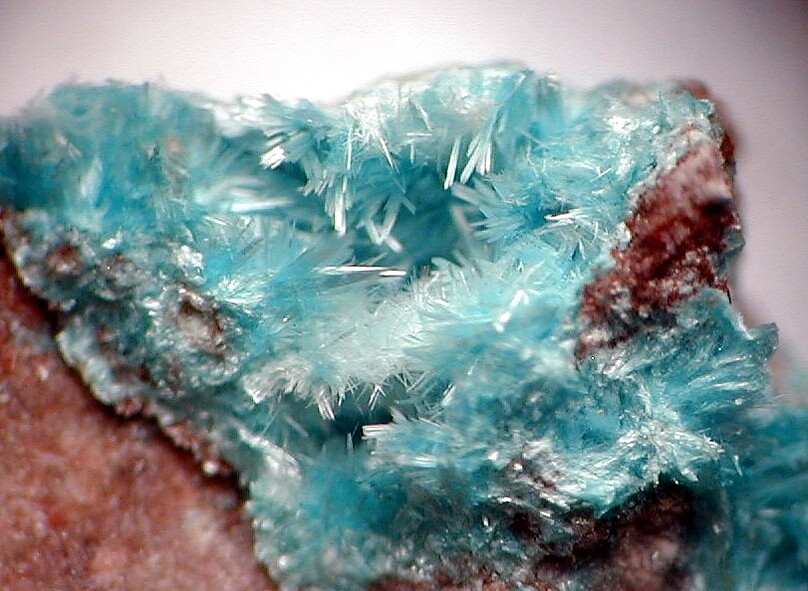


About Ajoite

New Cornelia Mine, Ajo, Little Ajo Mountains, Ajo Mining District, Pima County, Arizona, USA
http://www.mindat.org/mesg-66-124530.html
Unique Identifiers
Similar Names
IMA Classification of Ajoite
Classification of Ajoite
9 : SILICATES (Germanates)
E : Phyllosilicates
A : Single nets of tetrahedra with 4-, 5-, (6-), and 8-membered rings
78 : Unclassified Silicates
5 :
16 : Silicates Containing Aluminum and other Metals
5 : Aluminosilicates of Cs, NH4 and Cu
Mineral Symbols
| Symbol | Source | Reference for Standard |
|---|---|---|
| Aj | IMA–CNMNC | Warr, L.N. (2021). IMA–CNMNC approved mineral symbols. Mineralogical Magazine, 85(3), 291-320. doi:10.1180/mgm.2021.43 |
Physical Properties of Ajoite
on {010}
Optical Data of Ajoite
Based on recorded range of RI values above.
The colours simulate birefringence patterns seen in thin section under crossed polars. They do not take into account mineral colouration or opacity.
Michel-Levy Bar The default colours simulate the birefringence range for a 30 µm thin-section thickness. Adjust the slider to simulate a different thickness.
Grain Simulation You can rotate the grain simulation to show how this range might look as you rotated a sample under crossed polars. Each grain retains its interference colour (retardation) while its brightness falls to black at extinction and reaches a maximum between extinction positions.
Relative to Canada balsam mounting medium (n ≈ 1.537).
Rotate the stage: at 0°/90° the isogyres form a cross through the melatopes; at 45° they pull apart into curved hyperbolas. That splitting on rotation - absent in a uniaxial figure - is the standard diagnostic test for telling biaxial minerals from uniaxial ones. If 2V is large, the melatopes may fall outside the field of view, as they often do at the microscope too.
Y=Z= brilliant bluish green
Chemistry of Ajoite
Crystallography of Ajoite
α = 110.83(1)°, β = 107.21(1)°, γ = 105.68(1)°
From New Cornelia mine {010} is the most prominent form and {100} and {110} are much less prominent but always present. The termination on c may be either {001} or {203} or both.
Crystal Structure
Unit Cell | Unit Cell Packed
2x2x2 | 3x3x3 | 4x4x4
Big Balls | Small Balls | Just Balls | Spacefill
Polyhedra Off | Si Polyhedra | All Polyhedra
Remove metal-metal sticks
Black Background | White Background
Perspective On | Perspective Off
2D | Stereo | Red-Blue | Red-Cyan
CIF File Best | x | y | z | a | b | c
Stop | Start
Console Off | On | Grey | Yellow
| ID | Species | Reference | Link | Year | Locality | Pressure (GPa) | Temp (K) |
|---|---|---|---|---|---|---|---|
| 0015331 | Ajoite | Pluth J J, Smith J V (2002) Arizona porphyry copper/hydrothermal deposits II: Crystal structure of ajoite, (K+Na)3Cu20Al3Si29O76(OH)16*~8H2O Proceedings of the National Academy of Sciences 99 11002-11005 | 2002 | 0 | 293 |
X-Ray Powder Diffraction
| d-spacing | Intensity |
|---|---|
| 12.25 Å | (100) |
| 4.08 Å | (10) |
| 3.381 Å | (8) |
| 3.061 Å | (10) |
| 2.832 Å | (8) |
| 2.455 Å | (12) |
| 2.258 Å | (8) |
Geological Environment
| Paragenetic Mode | Earliest Age (Ga) |
|---|---|
| Stage 7: Great Oxidation Event | <2.4 |
| 47a : [Near-surface hydration of prior minerals] |
Type Occurrence of Ajoite
Other Language Names for Ajoite
Common Associates
| 269 photos of Ajoite associated with Quartz | SiO2 |
| 49 photos of Ajoite associated with Shattuckite | Cu5(Si2O6)2(OH)2 |
| 37 photos of Ajoite associated with Hematite | Fe2O3 |
| 37 photos of Ajoite associated with Papagoite | CaCu[H3AlSi2O9] |
| 32 photos of Ajoite associated with Native Copper | Cu |
| 7 photos of Ajoite associated with Pyrite | FeS2 |
| 7 photos of Ajoite associated with Kaolinite | Al2(Si2O5)(OH)4 |
| 7 photos of Ajoite associated with Cuprorivaite | CaCuSi4O10 |
| 6 photos of Ajoite associated with Olivenite | Cu2(AsO4)(OH) |
| 6 photos of Ajoite associated with Epidote | (CaCa)(AlAlFe3+)O[Si2O7][SiO4](OH) |
Related Minerals - Strunz-mindat Grouping
| 9.EA. | Hydroxymcglassonite-(K) | KSr4Si8O20(OH) · 8H2O |
| 9.EA. | Miyawakiite-(Y) | ◻Y4Fe2(Si8O20)(CO3)4(H2O)3 |
| 9.EA. | Bussyite-(Y) | (Y,REE,Ca)3(Na,Ca)6MnSi9Be5(O,OH,F)34 |
| 9.EA. | Fluorapophyllite-(NH4) | NH4Ca4(Si8O20)F · 8H2O |
| 9.EA.05 | Gillespite | BaFe2+Si4O10 |
| 9.EA.05 | Cuprorivaite | CaCuSi4O10 |
| 9.EA.05 | Wesselsite | SrCuSi4O10 |
| 9.EA.05 | Effenbergerite | BaCuSi4O10 |
| 9.EA.07 | Fluorapophyllite-(Cs) | CsCa4(Si8O20)F · 8H2O |
| 9.EA.10 | Ekanite | Ca2ThSi8O20 |
| 9.EA.15 | Fluorapophyllite-(Na) | NaCa4(Si8O20)F · 8H2O |
| 9.EA.15 | Fluorapophyllite-(K) | KCa4(Si8O20)(F,OH) · 8H2O |
| 9.EA.15 | Hydroxyapophyllite-(K) | KCa4(Si8O20)(OH,F) · 8H2O |
| 9.EA.20 | Magadiite | Na2Si14O29 · 11H2O |
| 9.EA.25 | Dalyite | K2ZrSi6O15 |
| 9.EA.25 | Davanite | K2TiSi6O15 |
| 9.EA.30 | Sazhinite-(La) | Na3La[Si6O15] · 2H2O |
| 9.EA.30 | Sazhinite-(Ce) | Na3CeSi6O15 · 2H2O |
| 9.EA.35 | Armstrongite | CaZr[Si6O15] · 3H2O |
| 9.EA.40 | Okenite | Ca10Si18O46 · 18H2O |
| 9.EA.45 | Perettiite-(Y) | Y2Mn4FeSi2B8O24 |
| 9.EA.45 | Nekoite | Ca3Si6O15 · 7H2O |
| 9.EA.45 | Badakhshanite-(Y) | Y2Mn4Al(Si2B7BeO24) |
| 9.EA.47 | Shlykovite | KCa[Si4O9(OH)] · 3H2O |
| 9.EA.50 | Diegogattaite | Na2CaCu2Si8O20 · H2O |
| 9.EA.50 | Cavansite | Ca(VO)Si4O10 · 4H2O |
| 9.EA.52 | Yangite | PbMnSi3O8 · H2O |
| 9.EA.55 | Pentagonite | Ca(VO)Si4O10 · 4H2O |
| 9.EA.60 | Penkvilksite | Na4Ti2Si8O22 · 4H2O |
| 9.EA.60 | Tumchaite | Na2Zr(Si4O11) · 2H2O |
| 9.EA.65 | Nabesite | Na2BeSi4O10 · 4H2O |
| 9.EA.75 | Zeravshanite | Na2Cs4Zr3[Si18O45]*2H2O |
| 9.EA.80 | Bussyite-(Ce) | (Ce,REE)3(Na,H2O)6MnSi9Be5(O,OH)30F4 |
| 9.EA.85 | Plumbophyllite | Pb2Si4O10 · H2O |
Radioactivity
| Element | % Content | Activity (Bq/kg) | Radiation Type |
|---|---|---|---|
| Uranium (U) | 0.0000% | 0 | α, β, γ |
| Thorium (Th) | 0.0000% | 0 | α, β, γ |
| Potassium (K) | 2.9989% | 930 | β, γ |
For comparison:
- Banana: ~15 Bq per fruit
- Granite: 1,000–3,000 Bq/kg
- EU exemption limit: 10,000 Bq/kg
Note: Risk is shown relative to daily recommended maximum exposure to non-background radiation of 1000 µSv/year. Note that natural background radiation averages around 2400 µSv/year so in reality these risks are probably extremely overstated! With infrequent handling and safe storage natural radioactive minerals do not usually pose much risk.
Note: The mass selector refers to the mass of radioactive mineral present, not the full specimen, also be aware that the matrix may also be radioactive, possibly more radioactive than this mineral!
Activity: –
| Distance | Dose rate | Risk |
|---|---|---|
| 1 cm | ||
| 10 cm | ||
| 1 m |
The external dose rate (D) from a radioactive mineral is estimated by summing the gamma radiation contributions from its Uranium, Thorium, and Potassium content, disregarding daughter-product which may have a significant effect in some cases (eg 'pitchblende'). This involves multiplying the activity (A, in Bq) of each element by its specific gamma ray constant (Γ), which accounts for its unique gamma emissions. The total unshielded dose at 1 cm is then scaled by the square of the distance (r, in cm) and multiplied by a shielding factor (μshield). This calculation provides a 'worst-case' or 'maximum risk' estimate because it assumes the sample is a point source and entirely neglects any self-shielding where radiation is absorbed within the mineral itself, meaning actual doses will typically be lower. The resulting dose rate (D) is expressed in microsieverts per hour (μSv/h).
D = ((AU × ΓU) + (ATh × ΓTh) + (AK × ΓK)) / r2 × μshield
Other Information
Internet Links for Ajoite
Please feel free to link to this page.
References for Ajoite
Localities for Ajoite
Showing 20 localities.
 symbol to view information about a locality.
The
symbol to view information about a locality.
The Locality List
 - This locality has map coordinates listed.
- This locality has estimated coordinates.
ⓘ - Click for references and further information on this occurrence.
? - Indicates mineral may be doubtful at this locality.
- This locality has map coordinates listed.
- This locality has estimated coordinates.
ⓘ - Click for references and further information on this occurrence.
? - Indicates mineral may be doubtful at this locality.
 - Good crystals or important locality for species.
 - World class for species or very significant.
(TL) - Type Locality for a valid mineral species.
(FRL) - First Recorded Locality for everything else (eg varieties).
- World class for species or very significant.
(TL) - Type Locality for a valid mineral species.
(FRL) - First Recorded Locality for everything else (eg varieties).
All localities listed without proper references should be considered as questionable.
Austria | |
| G.Blaß |
| Niedermayr (1996) |
Germany | |
| Schnorrer-Köhler (1990) |
Japan | |
| Numao et al (2005) |
Mexico | |
| Megaw (2023) |
Namibia | |
| Niedermayr (2001) |
Romania | |
| minerals-of-the-carpathians.eu (2008) |
| Hîrtopanu (1997) +1 other reference |
South Africa | |
| Cairncross (1991) +2 other references |
| Moore et al. (2016) | |
| Cairncross et al. (1995) | |
Spain | |
| Joan Abella i Creus (Joanabellacreus@gmail.com) |
UK | |
| www.mindat.org (n.d.) |
USA | |
| Williams (1968) +1 other reference |
| Williams (1968) +2 other references |
| Sun (1961) +1 other reference |
| Schaller et al. (1958) +7 other references |
| Lalith Aditya Senthil Kumar Collection |
| Thorne (n.d.) |
| Mr. Joe Ruiz. |

Messina Mine, Musina, Musina Local Municipality, Vhembe District Municipality, Limpopo, South Africa