
Tugtupite
A valid IMA mineral species
This page is currently not sponsored. Click here to sponsor this page.


About Tugtupite
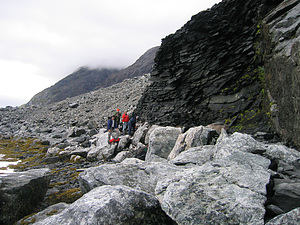
The Type Locale for Tugtupite
Tugtup Agtakôrfia, Tunulliarfik Fjord, Ilímaussaq complex, Kujalleq, Greenland
Tugtup Agtakôrfia, Tunulliarfik Fjord, Ilímaussaq complex, Kujalleq, Greenland
Formula:
(BeAlSi)Na4(SiO4)3Cl
Colour:
Commonly red, also white to pink, bluish white, greenish white
Lustre:
Sub-Vitreous, Waxy, Greasy, Dull
Hardness:
4
Specific Gravity:
2.33
Crystal System:
Tetragonal
Member of:
Name:
Named after its discovery locality, Tugtup Agtâkorfia, Narsaq municipality, Greenland.
See also: Sodalite Group.
Piezoelectric.
 Visit gemdat.org for gemological information about Tugtupite.
Piezoelectric.
Visit gemdat.org for gemological information about Tugtupite.Unique Identifiers
Mindat ID:
4044
Long-form identifier:
mindat:1:1:4044:6
Similar Names
IMA Classification of Tugtupite
Approved
IMA Formula:
Na4BeAlSi4O12Cl
First published:
1962
Classification of Tugtupite
9.FB.10
9 : SILICATES (Germanates)
F : Tektosilicates without zeolitic H2O
B : Tektosilicates with additional anions
9 : SILICATES (Germanates)
F : Tektosilicates without zeolitic H2O
B : Tektosilicates with additional anions
76.2.3.7
76 : TECTOSILICATES Al-Si Framework
2 : Al-Si Framework Feldspathoids and related species
76 : TECTOSILICATES Al-Si Framework
2 : Al-Si Framework Feldspathoids and related species
17.3.5
17 : Silicates Containing other Anions
3 : Silicates with chloride (including aluminosilicates)
17 : Silicates Containing other Anions
3 : Silicates with chloride (including aluminosilicates)
Mineral Symbols
As of 2021 there are now IMA–CNMNC approved mineral symbols (abbreviations) for each mineral species, useful for tables and diagrams.
| Symbol | Source | Reference for Standard |
|---|---|---|
| Ttp | IMA–CNMNC | Warr, L.N. (2021). IMA–CNMNC approved mineral symbols. Mineralogical Magazine, 85(3), 291-320. doi:10.1180/mgm.2021.43 |
Physical Properties of Tugtupite
Sub-Vitreous, Waxy, Greasy, Dull
Transparency:
Translucent
Colour:
Commonly red, also white to pink, bluish white, greenish white
Comment:
colorless in transmitted light
Streak:
White
Hardness:
4 on Mohs scale
Tenacity:
Brittle
Cleavage:
Distinct/Good
On {101}; on {110} fair.
On {101}; on {110} fair.
Fracture:
Step-Like
Comment:
Usually shows cleavage because of the great number of planes associated with the cleavage forms.
Density:
2.33 g/cm3 (Measured) 2.34 g/cm3 (Calculated)
Optical Data of Tugtupite
Type:
Uniaxial (+)
RI values:
nω = 1.496 nε = 1.502
Birefringence:
0.006
Max. Birefringence:
δ = 0.006
Based on recorded range of RI values above.
Based on recorded range of RI values above.
Interference Colours:
The colours simulate birefringence patterns seen in thin section under crossed polars. They do not take into account mineral colouration or opacity.
Michel-Levy Bar The default colours simulate the birefringence range for a 30 µm thin-section thickness. Adjust the slider to simulate a different thickness.
Grain Simulation You can rotate the grain simulation to show how this range might look as you rotated a sample under crossed polars. Each grain retains its interference colour (retardation) while its brightness falls to black at extinction and reaches a maximum between extinction positions.
The colours simulate birefringence patterns seen in thin section under crossed polars. They do not take into account mineral colouration or opacity.
Michel-Levy Bar The default colours simulate the birefringence range for a 30 µm thin-section thickness. Adjust the slider to simulate a different thickness.
Grain Simulation You can rotate the grain simulation to show how this range might look as you rotated a sample under crossed polars. Each grain retains its interference colour (retardation) while its brightness falls to black at extinction and reaches a maximum between extinction positions.
Surface Relief:
Moderate (negative)
Relative to Canada balsam mounting medium (n ≈ 1.537).
Relative to Canada balsam mounting medium (n ≈ 1.537).
This shows the grain boundary and Becke line effect under plane-polarised
light, based on the contrast between this mineral's average refractive
index and the mounting medium. It does not take into account mineral
colouration.
In focus
Interference Figure:
This shows the idealized uniaxial interference figure - the conoscopic
(convergent-light, Bertrand-lens-in) view, for a grain cut with the optic axis
centred and vertical. The coloured rings are isochromatics, computed with the
same physics as the Michel-Lévy bar above; the dark cross is the isogyre.
For a genuinely uniaxial mineral viewed this way, that cross stays perfectly stationary if you rotate the stage - unlike a biaxial mineral, where it splits apart on rotation. That invariance is itself the standard diagnostic test for telling uniaxial and biaxial minerals apart at the microscope.
For a genuinely uniaxial mineral viewed this way, that cross stays perfectly stationary if you rotate the stage - unlike a biaxial mineral, where it splits apart on rotation. That invariance is itself the standard diagnostic test for telling uniaxial and biaxial minerals apart at the microscope.
Dispersion:
Anomalously biaxial
Pleochroism:
Weak
Comments:
Weak lilac to weak red-orange.
Chemistry of Tugtupite
Mindat Formula:
(BeAlSi)Na4(SiO4)3Cl
Element Weights:
Common Impurities:
Fe,Ga,Mg,Ca,K,H2O,S
Crystallography of Tugtupite
Crystal System:
Tetragonal
Class (H-M):
4 - Disphenoidal
Space Group:
I4
Cell Parameters:
a = 8.640(1) Å, c = 8.873(1) Å
Ratio:
a:c = 1 : 1.027
Unit Cell V:
662.4 ų
Z:
2
Morphology:
Short tetragonal prisms with pyramids, sphenoids, and bisphenoids. Fine-grained aggregates; massive.
Twinning:
On (101), penetration twinning resulting in pseudocubic triplets; pseudotrigonal contact twins with composition planes (101) and (011).
Comment:
Pseudo-cubic. Cell parameters from Hassan and Grundy (1991).
Crystal Structure
Load
Unit Cell | Unit Cell Packed
2x2x2 | 3x3x3 | 4x4x4
Unit Cell | Unit Cell Packed
2x2x2 | 3x3x3 | 4x4x4
Show
Big Balls | Small Balls | Just Balls | Spacefill
Polyhedra Off | Si Polyhedra | All Polyhedra
Remove metal-metal sticks
Big Balls | Small Balls | Just Balls | Spacefill
Polyhedra Off | Si Polyhedra | All Polyhedra
Remove metal-metal sticks
Display Options
Black Background | White Background
Perspective On | Perspective Off
2D | Stereo | Red-Blue | Red-Cyan
Black Background | White Background
Perspective On | Perspective Off
2D | Stereo | Red-Blue | Red-Cyan
View
CIF File Best | x | y | z | a | b | c
CIF File Best | x | y | z | a | b | c
Rotation
Stop | Start
Stop | Start
Labels
Console Off | On | Grey | Yellow
Console Off | On | Grey | Yellow
Data courtesy of the American Mineralogist Crystal Structure Database. Click on an AMCSD ID to view structure
| ID | Species | Reference | Link | Year | Locality | Pressure (GPa) | Temp (K) |
|---|---|---|---|---|---|---|---|
| 0003450 | Tugtupite | Antao S M, Hassan I, Parise J B (2004) Tugtupite: High-temperature structures obtained from in situ synchrotron diffraction and Rietveld refinements American Mineralogist 89 492-497 |  | 2004 | 0 | 293 | |
| 0005268 | Tugtupite | Hassan I, Grundy H D (1991) The crystal structure and thermal expansion of tugtupite, Na8[Al2Be2Si8O24]Cl2 The Canadian Mineralogist 29 385-390 | | 1991 | 0 | 293 | |
| 0003451 | Tugtupite | Antao S M, Hassan I, Parise J B (2004) Tugtupite: High-temperature structures obtained from in situ synchrotron diffraction and Rietveld refinements American Mineralogist 89 492-497 | | 2004 | 0 | 306 | |
| 0003452 | Tugtupite | Antao S M, Hassan I, Parise J B (2004) Tugtupite: High-temperature structures obtained from in situ synchrotron diffraction and Rietveld refinements American Mineralogist 89 492-497 | | 2004 | 0 | 338 | |
| 0003453 | Tugtupite | Antao S M, Hassan I, Parise J B (2004) Tugtupite: High-temperature structures obtained from in situ synchrotron diffraction and Rietveld refinements American Mineralogist 89 492-497 | | 2004 | 0 | 386 | |
| 0003454 | Tugtupite | Antao S M, Hassan I, Parise J B (2004) Tugtupite: High-temperature structures obtained from in situ synchrotron diffraction and Rietveld refinements American Mineralogist 89 492-497 | | 2004 | 0 | 483 | |
| 0003455 | Tugtupite | Antao S M, Hassan I, Parise J B (2004) Tugtupite: High-temperature structures obtained from in situ synchrotron diffraction and Rietveld refinements American Mineralogist 89 492-497 | | 2004 | 0 | 579 | |
| 0003456 | Tugtupite | Antao S M, Hassan I, Parise J B (2004) Tugtupite: High-temperature structures obtained from in situ synchrotron diffraction and Rietveld refinements American Mineralogist 89 492-497 | | 2004 | 0 | 692 | |
| 0003457 | Tugtupite | Antao S M, Hassan I, Parise J B (2004) Tugtupite: High-temperature structures obtained from in situ synchrotron diffraction and Rietveld refinements American Mineralogist 89 492-497 | | 2004 | 0 | 789 | |
| 0003458 | Tugtupite | Antao S M, Hassan I, Parise J B (2004) Tugtupite: High-temperature structures obtained from in situ synchrotron diffraction and Rietveld refinements American Mineralogist 89 492-497 | | 2004 | 0 | 869 | |
| 0003459 | Tugtupite | Antao S M, Hassan I, Parise J B (2004) Tugtupite: High-temperature structures obtained from in situ synchrotron diffraction and Rietveld refinements American Mineralogist 89 492-497 | | 2004 | 0 | 917 | |
| 0003460 | Tugtupite | Antao S M, Hassan I, Parise J B (2004) Tugtupite: High-temperature structures obtained from in situ synchrotron diffraction and Rietveld refinements American Mineralogist 89 492-497 | | 2004 | 0 | 982 | |
| 0003461 | Tugtupite | Antao S M, Hassan I, Parise J B (2004) Tugtupite: High-temperature structures obtained from in situ synchrotron diffraction and Rietveld refinements American Mineralogist 89 492-497 | | 2004 | 0 | 1046 | |
| 0003462 | Tugtupite | Antao S M, Hassan I, Parise J B (2004) Tugtupite: High-temperature structures obtained from in situ synchrotron diffraction and Rietveld refinements American Mineralogist 89 492-497 | | 2004 | 0 | 1094 | |
| 0003463 | Tugtupite | Antao S M, Hassan I, Parise J B (2004) Tugtupite: High-temperature structures obtained from in situ synchrotron diffraction and Rietveld refinements American Mineralogist 89 492-497 | | 2004 | 0 | 1142 | |
| 0003464 | Tugtupite | Antao S M, Hassan I, Parise J B (2004) Tugtupite: High-temperature structures obtained from in situ synchrotron diffraction and Rietveld refinements American Mineralogist 89 492-497 | | 2004 | 0 | 1175 | |
| 0003465 | Tugtupite | Antao S M, Hassan I, Parise J B (2004) Tugtupite: High-temperature structures obtained from in situ synchrotron diffraction and Rietveld refinements American Mineralogist 89 492-497 | | 2004 | 0 | 1207 | |
| 0003466 | Tugtupite | Antao S M, Hassan I, Parise J B (2004) Tugtupite: High-temperature structures obtained from in situ synchrotron diffraction and Rietveld refinements American Mineralogist 89 492-497 | | 2004 | 0 | 1255 |
CIF Raw Data - click here to close
X-Ray Powder Diffraction
Loading XRD data...
Data courtesy of RRUFF project at University of Arizona, used with permission.
Powder Diffraction Data:
| d-spacing | Intensity |
|---|---|
| 6.19 Å | (40) |
| 6.11 Å | (10) |
| 4.43 Å | (10) |
| 3.59 Å | (40) |
| 3.54 Å | (100) |
| 2.52 Å | (20) |
| 2.06 Å | (10) |
| 2.04 Å | (10) |
Comments:
Canadian Mineralogist 29:385
Geological Environment
Paragenetic Mode(s):
| Paragenetic Mode | Earliest Age (Ga) |
|---|---|
| Near-surface Processes | |
| 22 : Hydration and low-? subsurface aqueous alteration (see also #23) | |
| Stage 4b: Highly evolved igneous rocks | >3.0 |
| 35 : Ultra-alkali and agpaitic igneous rocks | |
| Stage 7: Great Oxidation Event | <2.4 |
| 47g : [Halogen-bearing surface weathering minerals] |
Type Occurrence of Tugtupite
Place of Conservation of Type Material:
University of Copenhagen, Copenhagen, Denmark, 1970.276.
The Natural History Museum, London, England, 1967,394.
The Natural History Museum, London, England, 1967,394.
Geological Setting of Type Material:
As replacements of chkalovite in hydrothermal veins cutting sodalite syenite and syenite.
Associated Minerals at Type Locality:
Other Language Names for Tugtupite
Relationship of Tugtupite to other Species
Member of:
Other Members of Helvine Group:
| Danalite | Be3Fe2+4(SiO4)3S | Iso. 43m : P43n |
| Genthelvite | Be3Zn4(SiO4)3S | Iso. 43m : P43n |
| Helvine | Be3Mn2+4(SiO4)3S | Iso. 43m : P43n |
Common Associates
Associations Based on Photo Data:
| 121 photos of Tugtupite associated with Chkalovite | Na2BeSi2O6 |
| 81 photos of Tugtupite associated with Analcime | Na(AlSi2O6) · H2O |
| 55 photos of Tugtupite associated with Sodalite | Na4(Si3Al3)O12Cl |
| 39 photos of Tugtupite associated with Polylithionite | KLi2Al(Si4O10)(F,OH)2 |
| 29 photos of Tugtupite associated with Arfvedsonite | NaNa2(Fe2+4Fe3+)Si8O22(OH)2 |
| 24 photos of Tugtupite associated with Albite | Na(AlSi3O8) |
| 20 photos of Tugtupite associated with Ussingite | Na2AlSi3O8OH |
| 14 photos of Tugtupite associated with Sphalerite | ZnS |
| 11 photos of Tugtupite associated with Aegirine | NaFe3+Si2O6 |
| 9 photos of Tugtupite associated with Natrolite | Na2Al2Si3O10 · 2H2O |
Related Minerals - Strunz-mindat Grouping
| 9.FB. | Perchukite-(Y) | PbYAsSi2O8 |
| 9.FB. | Åsgruvanite-(Ce) | Ce16Ca5Al(SiO4)6(AsO3)8(CO3)2Cl4F3(OH)2 |
| 9.FB. | Steudelite | Na3(K17Ca7)Ca4(Al24Si24O96)(SO3)6F6 · 4H2O |
| 9.FB. | Wenlanzhangite-(Y) | Y2V3+2V4+2(SiO4)2O4(OH)4 |
| 9.FB. | Slyudyankaite | Na28Ca4(Si24Al24O96)(SO4)6(S6)1/3(CO2) · 2H2O |
| 9.FB. | Bolotinaite | (Na7◻)(Al6Si6O24)F · 4H2O |
| 9.FB. | Sapozhnikovite | Na8(Al6Si6O24)(HS)2 |
| 9.FB. | Betzite | Na6Ca2(Al6Si6O24)Cl4 |
| 9.FB.05 | Quadridavyne | (Na,K)6Ca2(Al6Si6O24)Cl4 |
| 9.FB.05 | Sulfhydrylbystrite | Na5K2Ca[Al6Si6O24](S5)2(SH) |
| 9.FB.05 | Marinellite | (Na,K)42Ca6(Al6Si6O24)6(SO4)8Cl2 · 3H2O |
| 9.FB.05 | Afghanite | (Na,K)22Ca10(Si24Al24O96)(SO4)6Cl6 |
| 9.FB.05 | Bystrite | (Na,K)7Ca(Al6Si6O24)(S5)Cl |
| 9.FB.05 | Franzinite | (Na,K)6Ca2(Al6Si6O24)(SO4)2 · 0.5H2O |
| 9.FB.05 | Kyanoxalite | Na7(Al6-xSi6+xO24)(C2O4)0.5+x · 5H2O (0 < x < 0.5) |
| 9.FB.05 | Vishnevite | (Na,K)8(Al6Si6O24)(SO4,CO3) · 2H2O |
| 9.FB.05 | Farneseite | (Na,Ca,K)56(Al6Si6O24)7(SO4)12 · 6H2O |
| 9.FB.05 | Alloriite | (Na,Ca,K)26Ca4(Al6Si6O24)4(SO4)6Cl6 |
| 9.FB.05 | Liottite | (Na,K)16Ca8(Al6Si6O24)3(SO4)5Cl4 |
| 9.FB.05 | Depmeierite | Na8(Al6Si6O24)(PO4,CO3)1-x · 3H2O (x<0.5) |
| 9.FB.05 | Biachellaite | (Na,Ca,K)8(Al6Si6O24)(SO4)2(OH)0.5 · H2O |
| 9.FB.05 | Cancrinite | (Na,Ca,◻)8(Al6Si6O24)(CO3,SO4)2 · 2H2O |
| 9.FB.05 | Cancrisilite | Na7(Al5Si7O24)(CO3) · 3H2O |
| 9.FB.05 | Fantappièite | [Na82.5Ca33K16.5](Si99Al99O396)(SO4)33 · 4H2O |
| 9.FB.05 | Carbobystrite | Na8(Al6Si6O24)(CO3) · 3.5H2O |
| 9.FB.05 | Microsommite | Na4K2Ca2(Al6Si6O24)(SO4)Cl2 |
| 9.FB.05 | Pitiglianoite | Na6K2(Al6Si6O24)(SO4) · 2H2O |
| 9.FB.05 | Tounkite | (Na,Ca,K)8(Si6Al6)O24(SO4)2Cl · 0.5H2O |
| 9.FB.05 | Balliranoite | (Na,K)6Ca2(Si6Al6O24)Cl2(CO3) |
| 9.FB.05 | Giuseppettite | (Na,K,Ca)7-8(Al6Si6O24)(SO4,Cl)1-2 |
| 9.FB.05 | Sacrofanite | (Na61K19Ca32)(Si84Al84O336)(SO4)26Cl2F6 · 2H2O |
| 9.FB.05 | Kircherite | Na5Ca2K(Al6Si6O24)(SO4)2 · 0.33H2O |
| 9.FB.05 | Hydroxycancrinite | Na8(Al6Si6O24)(OH)2 · 2H2O |
| 9.FB.05 | Davyne | (Na,K)6Ca2(Al6Si6O24)(Cl2,SO4)2 |
| 9.FB.10 | Haüyne | Na3Ca(Si3Al3)O12(SO4) |
| 9.FB.10 | Lazurite | Na7Ca(Al6Si6O24)(SO4)(S3) · H2O |
| 9.FB.10 | Danalite | Be3Fe2+4(SiO4)3S |
| 9.FB.10 | Helvine | Be3Mn2+4(SiO4)3S |
| 9.FB.10 | Kamaishilite | Ca2(Al2SiO6)(OH)2 |
| 9.FB.10 | Sodalite | Na4(Si3Al3)O12Cl |
| 9.FB.10 | Nosean | Na8(Al6Si6O24)(SO4) · H2O |
| 9.FB.10 | Genthelvite | Be3Zn4(SiO4)3S |
| 9.FB.10 | Bicchulite | Ca2(Al2SiO6)(OH)2 |
| 9.FB.10 | Tsaregorodtsevite | (N(CH3)4)(AlSi5O12) |
| 9.FB.10 | Vladimirivanovite | Na6Ca2(Al6Si6O24)(SO4,S3,S2,Cl)2 · H2O |
| 9.FB.15 | Marialite | Na4Al3Si9O24Cl |
| 9.FB.15 | Meionite | Ca4Al6Si6O24CO3 |
| 9.FB.15 | Silvialite | (Ca,Na)4(Al6Si6O24)(SO4,CO3) |
Fluorescence of Tugtupite
Bright magenta-red to pink (SW UV). A stone was initially pink, and turned red immediately upon exposure to long-wave UV radiation. After the UV lamp was turned off, the stone returned to pink after several minutes. This chromatic change was repeatable.
Specifically, it becomes dark red when exposed to UV radiation (or is irradiated by X-rays), and the colour fades to a paler red, pink or white when kept in the dark or exposed to bright light for a few minutes. This colour behaviour is probably due to an electron trapped in a Cl vacancy and associated sulphur polyanions.
Specifically, it becomes dark red when exposed to UV radiation (or is irradiated by X-rays), and the colour fades to a paler red, pink or white when kept in the dark or exposed to bright light for a few minutes. This colour behaviour is probably due to an electron trapped in a Cl vacancy and associated sulphur polyanions.
Other Information
Health Risks:
No information on health risks for this material has been entered into the database. You should always treat mineral specimens with care.
Internet Links for Tugtupite
mindat.org URL:
https://www.mindat.org/min-4044.html
Please feel free to link to this page.
Please feel free to link to this page.
Search Engines:
External Links:
Mineral Dealers:
References for Tugtupite
Reference List:
Danø, M. (1966) The crystal structure of tugtupite – a new mineral, Na8Al2Be2Si8O24(Cl,S)2. Acta Crystallographica, 20 (6) 812-816 doi:10.1107/s0365110x66001907
Dragsted, Ove (1970) Tugtupite. The Journal of Gemmology, 12 (1) 10-11 doi:10.15506/jog.1970.12.1.10
Povarennykh, A.S, Platonov, A.N, Tarashchan, A.N, Belichenko, V.P (1971) The colour and luminescence of tugtupite (beryllosodalite) from Ilímaussaq. Bulletin Grønlands Geologiske Undersøgelse, 95. 2-12 doi:10.34194/bullggu.v95.6636
Henderson, C. M. B., Taylor, D. (1977) The thermal expansion of tugtupite. Mineralogical Magazine, 41 (317) 130-131 doi:10.1180/minmag.1977.041.317.21
Petersen, Ole V. (1978) The twin formation of tugtupite, a contribution. Mineralogical Magazine, 42 (322) 251-254 doi:10.1180/minmag.1978.042.322.13
Jensen, Aage, Petersen, Ole V. (1982) Tugtupite: A Gemstone from Greenland. Gems & Gemology, 18 (2) 90-94 doi:10.5741/gems.18.2.90
Werner, S., Plech, A. (1995) Compressibility of tugtupite at high pressure. Zeitschrift für Kristallographie - Crystalline Materials, 210 (6) 418 doi:10.1524/zkri.1995.210.6.418
Antao, S. M., Hassan, I. (2002) Thermal Analyses of Sodalite, Tugtupite, Danalite and Helvite. The Canadian Mineralogist, 40 (1) 163-172 doi:10.2113/gscanmin.40.1.163
Zhou, Bing, Sherriff, Barbara L. (2004) Quantum calculations of the electronic structure and NMR quadrupolar interaction parameters for tugtupite. American Mineralogist, 89 (2) 377-381 doi:10.2138/am-2004-2-318
Antao, Sytle M., Hassan, Ishmael, Parise, John B. (2004) Tugtupite: High-temperature structures obtained from in situ synchrotron diffraction and Rietveld refinements. American Mineralogist, 89 (4) 492-497 doi:10.2138/am-2004-0403
Gaft, M., Panczer, G., Nagli, L., Yeates, H. (2009) Laser-induced time-resolved luminescence of tugtupite, sodalite and hackmanite. Physics and Chemistry of Minerals, 36 (3) 127-141 doi:10.1007/s00269-008-0263-1
Eggenkamp, Hans G. M., Marks, Michael A. W., Louvat, Pascale, Markl, Gregor (2021) Bromine Isotope Variations in Magmatic and Hydrothermal Sodalite and Tugtupite and the Estimation of Br Isotope Fractionation between Melt and Sodalite. Minerals, 11 (4) 370 doi:10.3390/min11040370
Localities for Tugtupite
Showing 19 localities.
 symbol to view information about a locality.
The
symbol to view information about a locality.
The Locality List
 - This locality has map coordinates listed.
- This locality has estimated coordinates.
ⓘ - Click for references and further information on this occurrence.
? - Indicates mineral may be doubtful at this locality.
- This locality has map coordinates listed.
- This locality has estimated coordinates.
ⓘ - Click for references and further information on this occurrence.
? - Indicates mineral may be doubtful at this locality.
 - Good crystals or important locality for species.
 - World class for species or very significant.
(TL) - Type Locality for a valid mineral species.
(FRL) - First Recorded Locality for everything else (eg varieties).
- World class for species or very significant.
(TL) - Type Locality for a valid mineral species.
(FRL) - First Recorded Locality for everything else (eg varieties).
All localities listed without proper references should be considered as questionable.
Canada | |
| Olivier Langelier Collection |
| Horváth et al. (1990) |
Greenland | |
| Petersen (1995) +1 other reference |
| Cran Cowan Specimen | |
| Otter (2023) | |
| Soerensen (1962) | |
| Sørensen (1960) +2 other references | |
| Sørensen et al. (2001) |
| Petersen et al. (2002) | |
| Cole (2003) | |
| Sørensen (1960) +1 other reference |
Russia | |
| [World of Stones 95:5-6 +2 other references |
| Men'shikov (2006) | |
| Mikhailova et al. (2022) | |
| Ju et al. (1997) |
| [World of Stones 95:5-6 | |
| Yakovenchuk et al. (2011) | |
| Ermolaeva et al. (2007) |
Quick NavTopAbout TugtupiteUnique IdentifiersSimilar NamesIMA Classification Classification Mineral SymbolsPhysical Properties Optical Data Chemistry Crystallography Crystal StructureX-Ray Powder DiffractionGeological EnvironmentType Occurrence Other LanguagesRelationshipsCommon AssociatesStrunz-MindatFluorescence Other InformationInternet Links References Localities Locality List

Poudrette quarry, Mont Saint-Hilaire, La Vallée-du-Richelieu RCM, Montérégie, Québec, Canada