
Haüyne
A valid IMA mineral species - grandfathered
This page is currently not sponsored. Click here to sponsor this page.


About Haüyne

René Just Haüy
Formula:
Na3Ca(Si3Al3)O12(SO4)
Sulfide and polysulfide anions also occur in some material.
Colour:
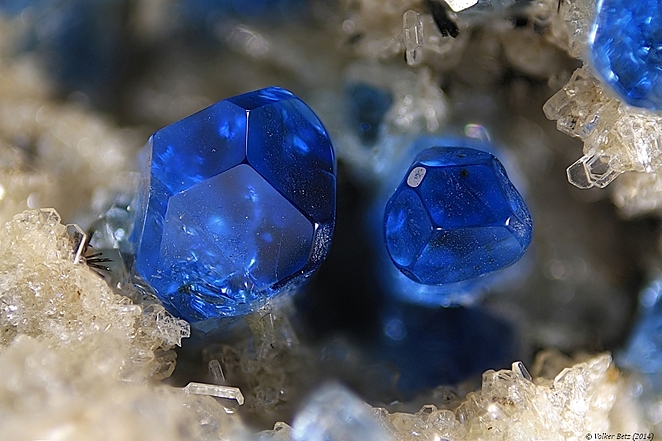
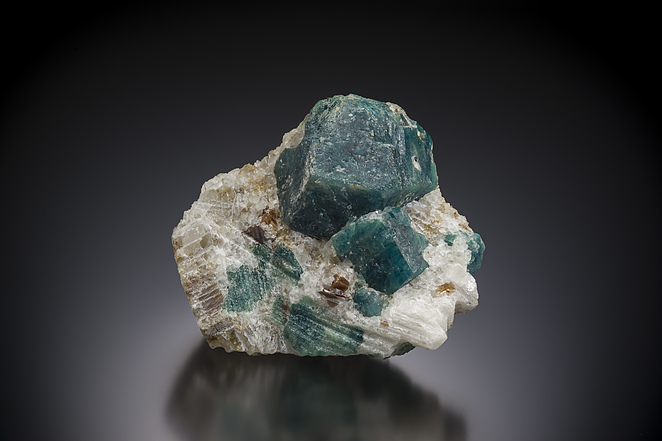
Blue, white, grey, yellow, green, pink
Lustre:
Vitreous, Greasy
Hardness:
5½ - 6
Specific Gravity:
2.44 - 2.5
Crystal System:
Isometric
Member of:
Name:
The first mention of haüyne is found in 1612 in the writings of Marquard Freher (1565-1614). He describes “sapphires” in the sand on the banks of the Laachgraben (the artificially created overflow channel of Lake Laach).
Around 1800, Barthélemy Faujas de Saint-Fond visited the trass pits near Plaidt and found small, beautifully blue-colored crystals enclosed in pumice, which he initially mistook for sapphires (Faujas, 1802). He later showed them to his colleague Haüy, who had previously received similar material from Cordier, which he had collected in the vicinity of the Laach Abbey. Due to their lower hardness, Haüy and Faujas de Saint-Fond were able to rule out the presence of the previously suspected sapphires and, bizarrely, named the mineral “blue pleonast” (Faujas, 1802).
Tentatively named latialite in 1803 by Carlo Giuseppe Gismondi for the locality at Campagna (Latium) without formal publication.
Named in 1807 by Tønnes Christian Bruun de Neergaard in honour of Abbé René Just Haüy (28 February 1743, Saint-Just-en-Chaussée, Picardy, France - 1 June 1822, Paris, France), "the Father of Crystallography". Haüy was a Roman Catholic Priest and curator of the Muséum National d'Histoire Naturelle in Paris. Haüy devised and sold wooden crystal models, which were highly prized internationally, both among his contemporaries and today.
Named berzeline in 1831 by Louis Albert Necker de Saussure in honour of Jöns Jakob Berzelius.
The mineral was temporarily named hauynite by James Dwight Dana in 1868.
The following links confirm the research to establish the holotype specimen and the type locality: https://gminromano.it/wp-content/uploads/2021/03/CP2009-art2.pdf and https://gminromano.it/wp-content/uploads/2021/03/CP2009-art2-eng.pdf
Around 1800, Barthélemy Faujas de Saint-Fond visited the trass pits near Plaidt and found small, beautifully blue-colored crystals enclosed in pumice, which he initially mistook for sapphires (Faujas, 1802). He later showed them to his colleague Haüy, who had previously received similar material from Cordier, which he had collected in the vicinity of the Laach Abbey. Due to their lower hardness, Haüy and Faujas de Saint-Fond were able to rule out the presence of the previously suspected sapphires and, bizarrely, named the mineral “blue pleonast” (Faujas, 1802).
Tentatively named latialite in 1803 by Carlo Giuseppe Gismondi for the locality at Campagna (Latium) without formal publication.
Named in 1807 by Tønnes Christian Bruun de Neergaard in honour of Abbé René Just Haüy (28 February 1743, Saint-Just-en-Chaussée, Picardy, France - 1 June 1822, Paris, France), "the Father of Crystallography". Haüy was a Roman Catholic Priest and curator of the Muséum National d'Histoire Naturelle in Paris. Haüy devised and sold wooden crystal models, which were highly prized internationally, both among his contemporaries and today.
Named berzeline in 1831 by Louis Albert Necker de Saussure in honour of Jöns Jakob Berzelius.
The mineral was temporarily named hauynite by James Dwight Dana in 1868.
The following links confirm the research to establish the holotype specimen and the type locality: https://gminromano.it/wp-content/uploads/2021/03/CP2009-art2.pdf and https://gminromano.it/wp-content/uploads/2021/03/CP2009-art2-eng.pdf
Sodalite Group.
Also classed in the Feldspathoid Supergroup.
Ideally, the two sodalite cages in haüyne's unit cell contain Na3CaSO4.
Pale-coloured varieties are easily confused with nosean and darker, opaque blue ones, usually sulphide-bearing, are called lazurite, currently defined as the sulphide-dominant end member.
Crystallizes in dodecahedra and octahedra with dodecahedral cleavage; an accessory mineral in alkaline igneous rocks, esp. extrusives, commonly associated with nepheline or leucite.
The following links confirm the research to establish the holotype specimen and the type locality: https://gminromano.it/wp-content/uploads/2021/03/CP2009-art2.pdf and https://gminromano.it/wp-content/uploads/2021/03/CP2009-art2-eng.pdf
 Visit gemdat.org for gemological information about Haüyne.
Also classed in the Feldspathoid Supergroup.
Ideally, the two sodalite cages in haüyne's unit cell contain Na3CaSO4.
Pale-coloured varieties are easily confused with nosean and darker, opaque blue ones, usually sulphide-bearing, are called lazurite, currently defined as the sulphide-dominant end member.
Crystallizes in dodecahedra and octahedra with dodecahedral cleavage; an accessory mineral in alkaline igneous rocks, esp. extrusives, commonly associated with nepheline or leucite.
The following links confirm the research to establish the holotype specimen and the type locality: https://gminromano.it/wp-content/uploads/2021/03/CP2009-art2.pdf and https://gminromano.it/wp-content/uploads/2021/03/CP2009-art2-eng.pdf
Visit gemdat.org for gemological information about Haüyne.Name Encoding
ASCII-7:
Hauyne
Unique Identifiers
Mindat ID:
1833
Long-form identifier:
mindat:1:1:1833:9
Similar Names
IMA Classification of Haüyne
Approved, 'Grandfathered' (first described prior to 1959)
IMA Formula:
Na3Ca(Si3Al3)O12(S6+O4)
Classification of Haüyne
9.FB.10
9 : SILICATES (Germanates)
F : Tektosilicates without zeolitic H2O
B : Tektosilicates with additional anions
9 : SILICATES (Germanates)
F : Tektosilicates without zeolitic H2O
B : Tektosilicates with additional anions
Dana 7th ed.:
76.2.3.3
76.2.3.3
76 : TECTOSILICATES Al-Si Framework
2 : Al-Si Framework Feldspathoids and related species
76 : TECTOSILICATES Al-Si Framework
2 : Al-Si Framework Feldspathoids and related species
17.10.4
17 : Silicates Containing other Anions
10 : Silicates with sulphate, molybdate or tungstate
17 : Silicates Containing other Anions
10 : Silicates with sulphate, molybdate or tungstate
Mineral Symbols
As of 2021 there are now IMA–CNMNC approved mineral symbols (abbreviations) for each mineral species, useful for tables and diagrams.
Please only use the official IMA–CNMNC symbol. Older variants are listed for historical use only.
Please only use the official IMA–CNMNC symbol. Older variants are listed for historical use only.
| Symbol | Source | Reference for Standard |
|---|---|---|
| Hyn | IMA–CNMNC | Warr, L.N. (2021). IMA–CNMNC approved mineral symbols. Mineralogical Magazine, 85(3), 291-320. doi:10.1180/mgm.2021.43 |
| Hyn | Siivolam & Schmid (2007) | Siivolam, J. and Schmid, R. (2007) Recommendations by the IUGS Subcommission on the Systematics of Metamorphic Rocks: List of mineral abbreviations. Web-version 01.02.07. IUGS Commission on the Systematics in Petrology. download |
| Hyn | Whitney & Evans (2010) | Whitney, D.L. and Evans, B.W. (2010) Abbreviations for names of rock-forming minerals. American Mineralogist, 95, 185–187 doi:10.2138/am.2010.3371 |
Pronunciation of Haüyne
Pronunciation:
| Play | Recorded by | Country |
|---|---|---|
| Rob Woodside | Canada |
Physical Properties of Haüyne
Vitreous, Greasy
Transparency:
Transparent, Translucent, Opaque
Colour:
Blue, white, grey, yellow, green, pink
Comment:
The various colours arise from minor cage contents
Streak:
Very pale blue to white. Lazurite variety is bright blue
Hardness:
5½ - 6 on Mohs scale
Hardness Data:
Measured
Tenacity:
Brittle
Cleavage:
Distinct/Good
Distinct on {110}
Distinct on {110}
Fracture:
Irregular/Uneven
Density:
2.44 - 2.5 g/cm3 (Measured)
Optical Data of Haüyne
Type:
Isotropic
RI values:
n = 1.494 - 1.509
Surface Relief:
Moderate (negative)
Relative to Canada balsam mounting medium (n ≈ 1.537).
Relative to Canada balsam mounting medium (n ≈ 1.537).
This shows the grain boundary and Becke line effect under plane-polarised
light, based on the contrast between this mineral's average refractive
index and the mounting medium. It does not take into account mineral
colouration.
In focus
Pleochroism:
Non-pleochroic
Chemistry of Haüyne
Mindat Formula:
Na3Ca(Si3Al3)O12(SO4)
Sulfide and polysulfide anions also occur in some material.
Sulfide and polysulfide anions also occur in some material.
Element Weights:
Common Impurities:
K
Crystallography of Haüyne
Crystal System:
Isometric
Class (H-M):
43m - Hextetrahedral
Space Group:
P43n
Cell Parameters:
a = 9.11(2) Å
Unit Cell V:
756.06 ų (Calculated from Unit Cell)
Morphology:
Dodecahedral or octahedral
Twinning:
On {111}
Comment:
Range: 9.08-9.13
Geological Environment
Paragenetic Mode(s):
| Paragenetic Mode | Earliest Age (Ga) |
|---|---|
| Stage 3a: Earth’s earliest Hadean crust | >4.50 |
| 9 : Lava/xenolith minerals (hornfels, sanidinite facies) | |
| Stage 4b: Highly evolved igneous rocks | >3.0 |
| 35 : Ultra-alkali and agpaitic igneous rocks | |
| Stage 7: Great Oxidation Event | <2.4 |
| 45a : [Sulfates, arsenates, selenates, antimonates] |
Geological Setting:
In phonolites and other silica deficient alkaline igneous rocks. Also in some skarns ( possibly metaevaporites).
Type Occurrence of Haüyne
Co-Type Localities:
Geological Setting of Type Material:
Alkaline volcanics
Synonyms of Haüyne
Other Language Names for Haüyne
Varieties of Haüyne
| Berzeline (of Necker) | A white variety of Haüyne. |
Relationship of Haüyne to other Species
Member of:
Other Members of Sodalite Group:
| Bolotinaite | (Na7◻)(Al6Si6O24)F · 4H2O | Iso. 43m : I43m |
| Lazurite | Na7Ca(Al6Si6O24)(SO4)(S3) · H2O | Iso. 43m : P43n |
| Nosean | Na8(Al6Si6O24)(SO4) · H2O | Iso. 43m : P43n |
| Sapozhnikovite | Na8(Al6Si6O24)(HS)2 | Iso. 43m : P43n |
| Slyudyankaite | Na28Ca4(Si24Al24O96)(SO4)6(S6)1/3(CO2) · 2H2O | Tric. 1 : P1 |
| Sodalite | Na4(Si3Al3)O12Cl | Iso. 43m : P43n |
| Tsaregorodtsevite | (N(CH3)4)(AlSi5O12) | Orth. 222 : I222 |
| Vladimirivanovite | Na6Ca2(Al6Si6O24)(SO4,S3,S2,Cl)2 · H2O | Orth. mmm(2/m2/m2/m) |
Common Associates
Associations Based on Photo Data:
| 80 photos of Haüyne associated with Calcite | CaCO3 |
| 59 photos of Haüyne associated with Gonnardite | (Na,Ca)2(Si,Al)5O10 · 3H2O |
| 54 photos of Haüyne associated with Phlogopite | KMg3(AlSi3O10)(OH)2 |
| 52 photos of Haüyne associated with Sanidine | K(AlSi3O8) |
| 51 photos of Haüyne associated with Pyrite | FeS2 |
| 50 photos of Haüyne associated with Titanite | CaTiO(SiO4) |
| 44 photos of Haüyne associated with Augite | (CaxMgyFez)(Mgy1Fez1)Si2O6 |
| 22 photos of Haüyne associated with Magnetite | Fe2+Fe3+2O4 |
| 13 photos of Haüyne associated with Plagioclase | (Na,Ca)[(Si,Al)AlSi2]O8 |
| 11 photos of Haüyne associated with Fluorapatite | Ca5(PO4)3F |
Related Minerals - Strunz-mindat Grouping
| 9.FB. | Perchukite-(Y) | PbYAsSi2O8 |
| 9.FB. | Åsgruvanite-(Ce) | Ce16Ca5Al(SiO4)6(AsO3)8(CO3)2Cl4F3(OH)2 |
| 9.FB. | Steudelite | Na3(K17Ca7)Ca4(Al24Si24O96)(SO3)6F6 · 4H2O |
| 9.FB. | Wenlanzhangite-(Y) | Y2V3+2V4+2(SiO4)2O4(OH)4 |
| 9.FB. | Slyudyankaite | Na28Ca4(Si24Al24O96)(SO4)6(S6)1/3(CO2) · 2H2O |
| 9.FB. | Bolotinaite | (Na7◻)(Al6Si6O24)F · 4H2O |
| 9.FB. | Sapozhnikovite | Na8(Al6Si6O24)(HS)2 |
| 9.FB. | Betzite | Na6Ca2(Al6Si6O24)Cl4 |
| 9.FB.05 | Quadridavyne | (Na,K)6Ca2(Al6Si6O24)Cl4 |
| 9.FB.05 | Sulfhydrylbystrite | Na5K2Ca[Al6Si6O24](S5)2(SH) |
| 9.FB.05 | Marinellite | (Na,K)42Ca6(Al6Si6O24)6(SO4)8Cl2 · 3H2O |
| 9.FB.05 | Afghanite | (Na,K)22Ca10(Si24Al24O96)(SO4)6Cl6 |
| 9.FB.05 | Bystrite | (Na,K)7Ca(Al6Si6O24)(S5)Cl |
| 9.FB.05 | Franzinite | (Na,K)6Ca2(Al6Si6O24)(SO4)2 · 0.5H2O |
| 9.FB.05 | Kyanoxalite | Na7(Al6-xSi6+xO24)(C2O4)0.5+x · 5H2O (0 < x < 0.5) |
| 9.FB.05 | Vishnevite | (Na,K)8(Al6Si6O24)(SO4,CO3) · 2H2O |
| 9.FB.05 | Farneseite | (Na,Ca,K)56(Al6Si6O24)7(SO4)12 · 6H2O |
| 9.FB.05 | Alloriite | (Na,Ca,K)26Ca4(Al6Si6O24)4(SO4)6Cl6 |
| 9.FB.05 | Liottite | (Na,K)16Ca8(Al6Si6O24)3(SO4)5Cl4 |
| 9.FB.05 | Depmeierite | Na8(Al6Si6O24)(PO4,CO3)1-x · 3H2O (x<0.5) |
| 9.FB.05 | Biachellaite | (Na,Ca,K)8(Al6Si6O24)(SO4)2(OH)0.5 · H2O |
| 9.FB.05 | Cancrinite | (Na,Ca,◻)8(Al6Si6O24)(CO3,SO4)2 · 2H2O |
| 9.FB.05 | Cancrisilite | Na7(Al5Si7O24)(CO3) · 3H2O |
| 9.FB.05 | Fantappièite | [Na82.5Ca33K16.5](Si99Al99O396)(SO4)33 · 4H2O |
| 9.FB.05 | Carbobystrite | Na8(Al6Si6O24)(CO3) · 3.5H2O |
| 9.FB.05 | Microsommite | Na4K2Ca2(Al6Si6O24)(SO4)Cl2 |
| 9.FB.05 | Pitiglianoite | Na6K2(Al6Si6O24)(SO4) · 2H2O |
| 9.FB.05 | Tounkite | (Na,Ca,K)8(Si6Al6)O24(SO4)2Cl · 0.5H2O |
| 9.FB.05 | Balliranoite | (Na,K)6Ca2(Si6Al6O24)Cl2(CO3) |
| 9.FB.05 | Giuseppettite | (Na,K,Ca)7-8(Al6Si6O24)(SO4,Cl)1-2 |
| 9.FB.05 | Sacrofanite | (Na61K19Ca32)(Si84Al84O336)(SO4)26Cl2F6 · 2H2O |
| 9.FB.05 | Kircherite | Na5Ca2K(Al6Si6O24)(SO4)2 · 0.33H2O |
| 9.FB.05 | Hydroxycancrinite | Na8(Al6Si6O24)(OH)2 · 2H2O |
| 9.FB.05 | Davyne | (Na,K)6Ca2(Al6Si6O24)(Cl2,SO4)2 |
| 9.FB.10 | Lazurite | Na7Ca(Al6Si6O24)(SO4)(S3) · H2O |
| 9.FB.10 | Danalite | Be3Fe2+4(SiO4)3S |
| 9.FB.10 | Helvine | Be3Mn2+4(SiO4)3S |
| 9.FB.10 | Kamaishilite | Ca2(Al2SiO6)(OH)2 |
| 9.FB.10 | Sodalite | Na4(Si3Al3)O12Cl |
| 9.FB.10 | Nosean | Na8(Al6Si6O24)(SO4) · H2O |
| 9.FB.10 | Genthelvite | Be3Zn4(SiO4)3S |
| 9.FB.10 | Bicchulite | Ca2(Al2SiO6)(OH)2 |
| 9.FB.10 | Tsaregorodtsevite | (N(CH3)4)(AlSi5O12) |
| 9.FB.10 | Vladimirivanovite | Na6Ca2(Al6Si6O24)(SO4,S3,S2,Cl)2 · H2O |
| 9.FB.10 | Tugtupite | (BeAlSi)Na4(SiO4)3Cl |
| 9.FB.15 | Marialite | Na4Al3Si9O24Cl |
| 9.FB.15 | Meionite | Ca4Al6Si6O24CO3 |
| 9.FB.15 | Silvialite | (Ca,Na)4(Al6Si6O24)(SO4,CO3) |
Fluorescence of Haüyne
Reddish orange to purplish pink in LW
Other Information
Health Risks:
No information on health risks for this material has been entered into the database. You should always treat mineral specimens with care.
Haüyne in petrology
An essential component of rock names highlighted in red, an accessory component in rock names highlighted in green.
Internet Links for Haüyne
mindat.org URL:
https://www.mindat.org/min-1833.html
Please feel free to link to this page.
Please feel free to link to this page.
Search Engines:
External Links:
Mineral Dealers:
References for Haüyne
Reference List:
Tsuchiya, Norihiko; Takéuchi, Yoshio (1985) Fine texture of hauyne having a modulated structure. Zeitschrift für Kristallographie, 173 (3-4). 273-281 doi:10.1524/zkri.1985.173.3-4.273
Kiefert, Lore, Hänni, H. A. (2000) Gem-Quality Haüyne from the Eifel District, Germany. Gems & Gemology, 36 (3) 246-253 doi:10.5741/gems.36.3.246
Bellatreccia, F., Della Ventura, G., Piccinini, M., Cavallo, A., Brilli, M. (2009) H2O and CO2 in minerals of the haüyne-sodalite group: an FTIR spectroscopy study. Mineralogical Magazine, 73 (3) 399-413 doi:10.1180/minmag.2009.073.3.399
Caggiani, Maria Cristina, Mangone, Annarosa, Acquafredda, Pasquale (2022) Blue coloured haüyne from Mt. Vulture (Italy) volcanic rocks: SEM‐EDS and Raman investigation of natural and heated crystals. Journal of Raman Spectroscopy, 53 (5) 956-968 doi:10.1002/jrs.6310
Localities for Haüyne
Showing 283 localities.
 symbol to view information about a locality.
The
symbol to view information about a locality.
The Locality List
 - This locality has map coordinates listed.
- This locality has estimated coordinates.
ⓘ - Click for references and further information on this occurrence.
? - Indicates mineral may be doubtful at this locality.
- This locality has map coordinates listed.
- This locality has estimated coordinates.
ⓘ - Click for references and further information on this occurrence.
? - Indicates mineral may be doubtful at this locality.
 - Good crystals or important locality for species.
 - World class for species or very significant.
(TL) - Type Locality for a valid mineral species.
(FRL) - First Recorded Locality for everything else (eg varieties).
- World class for species or very significant.
(TL) - Type Locality for a valid mineral species.
(FRL) - First Recorded Locality for everything else (eg varieties).
All localities listed without proper references should be considered as questionable.
Quick NavTopAbout HaüyneName EncodingUnique IdentifiersSimilar NamesIMA Classification Classification Mineral SymbolsPronunciation Physical Properties Optical Data Chemistry Crystallography Geological EnvironmentType Occurrence SynonymsOther LanguagesVarietiesRelationshipsCommon AssociatesStrunz-MindatFluorescence Other InformationHaüyne in petrologyInternet Links References Localities Locality List

In den Dellen quarries, Mendig, Mendig, Mayen-Koblenz, Rhineland-Palatinate, Germany