
Sieleckiite
A valid IMA mineral species
This page is currently not sponsored. Click here to sponsor this page.



About Sieleckiite

Rob Sielecki
Formula:
Cu3Al4(PO4)2(OH)12 · 2H2O
Colour:
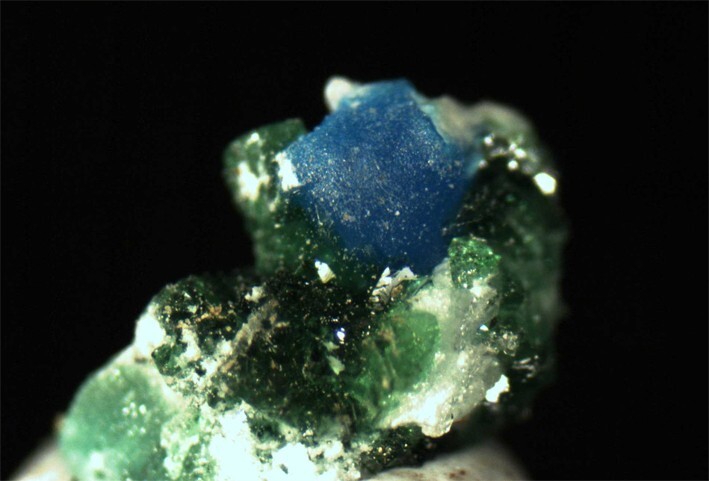
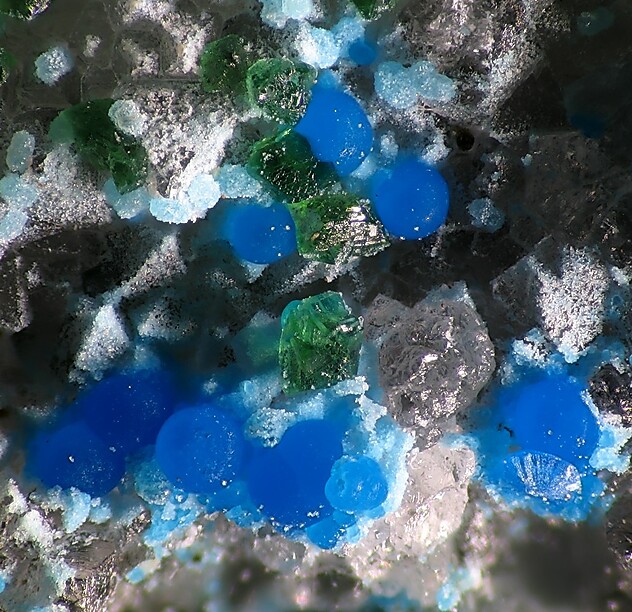
Deep sky blue to royal blue (Royal Horticultural Society, London, 109A)
Lustre:
Pearly
Hardness:
3
Specific Gravity:
3.02
Crystal System:
Monoclinic
Name:
For Australian geologist Robert Sielecki (1958 - ), who found the mineral.
This page provides mineralogical data about Sieleckiite.
Unique Identifiers
Mindat ID:
3656
Long-form identifier:
mindat:1:1:3656:2
IMA Classification of Sieleckiite
Approved
IMA Formula:
Cu2+3Al4(PO4)2(OH)12·2H2O
Approval year:
1987
First published:
1988
Classification of Sieleckiite
8.DF.25
8 : PHOSPHATES, ARSENATES, VANADATES
D : Phosphates, etc. with additional anions, with H2O
F : With only medium-sized cations, (OH,etc.):RO4 > 3:1
8 : PHOSPHATES, ARSENATES, VANADATES
D : Phosphates, etc. with additional anions, with H2O
F : With only medium-sized cations, (OH,etc.):RO4 > 3:1
42.13.12.1
42 : HYDRATED PHOSPHATES, ETC.CONTAINING HYDROXYL OR HALOGEN
13 : Miscellaneous
42 : HYDRATED PHOSPHATES, ETC.CONTAINING HYDROXYL OR HALOGEN
13 : Miscellaneous
19.2.9
19 : Phosphates
2 : Phosphates of Cu
19 : Phosphates
2 : Phosphates of Cu
Mineral Symbols
As of 2021 there are now IMA–CNMNC approved mineral symbols (abbreviations) for each mineral species, useful for tables and diagrams.
| Symbol | Source | Reference for Standard |
|---|---|---|
| Sie | IMA–CNMNC | Warr, L.N. (2021). IMA–CNMNC approved mineral symbols. Mineralogical Magazine, 85(3), 291-320. doi:10.1180/mgm.2021.43 |
Physical Properties of Sieleckiite
Pearly
Transparency:
Translucent
Colour:
Deep sky blue to royal blue (Royal Horticultural Society, London, 109A)
Streak:
Light blue
Hardness:
3 on Mohs scale
Cleavage:
None Observed
Fracture:
Sub-Conchoidal
Density:
3.02(2) g/cm3 (Measured) 2.94 g/cm3 (Calculated)
Comment:
Measured by floatation in CH2l2/ CHCl3 solution.
Optical Data of Sieleckiite
Type:
Biaxial
RI values:
nα = 1.63 nγ = 1.66
Max. Birefringence:
δ = 0.030
Based on recorded range of RI values above.
Based on recorded range of RI values above.
Interference Colours:
The colours simulate birefringence patterns seen in thin section under crossed polars. They do not take into account mineral colouration or opacity.
Michel-Levy Bar The default colours simulate the birefringence range for a 30 µm thin-section thickness. Adjust the slider to simulate a different thickness.
Grain Simulation You can rotate the grain simulation to show how this range might look as you rotated a sample under crossed polars. Each grain retains its interference colour (retardation) while its brightness falls to black at extinction and reaches a maximum between extinction positions.
The colours simulate birefringence patterns seen in thin section under crossed polars. They do not take into account mineral colouration or opacity.
Michel-Levy Bar The default colours simulate the birefringence range for a 30 µm thin-section thickness. Adjust the slider to simulate a different thickness.
Grain Simulation You can rotate the grain simulation to show how this range might look as you rotated a sample under crossed polars. Each grain retains its interference colour (retardation) while its brightness falls to black at extinction and reaches a maximum between extinction positions.
Surface Relief:
High (positive)
Relative to Canada balsam mounting medium (n ≈ 1.537).
Relative to Canada balsam mounting medium (n ≈ 1.537).
This shows the grain boundary and Becke line effect under plane-polarised
light, based on the contrast between this mineral's average refractive
index and the mounting medium. It does not take into account mineral
colouration.
In focus
Dispersion:
relatively strong
Pleochroism:
Weak
Comments:
Colourless to very pale blue.
Chemistry of Sieleckiite
Mindat Formula:
Cu3Al4(PO4)2(OH)12 · 2H2O
Element Weights:
Crystallography of Sieleckiite
Crystal System:
Monoclinic
Class (H-M):
2/m - Prismatic
Space Group:
B2/m
Setting:
C2/m
Cell Parameters:
a = 11.711(2) Å, b = 6.9233(14) Å, c = 9.828(2) Å
β = 92.88(3)°
β = 92.88(3)°
Ratio:
a:b:c = 1.692 : 1 : 1.42
Unit Cell V:
795.8 ų
Z:
2
Twinning:
None observed
Comment:
Originally assumed to be triclinic. Shown to be monoclinic by Elliott (2017).
X-Ray Powder Diffraction
Powder Diffraction Data:
| d-spacing | Intensity |
|---|---|
| 9.120 Å | (50) |
| 5.036 Å | (100) |
| 3.852 Å | (100) |
| 3.276 Å | (30) |
| 2.827 Å | (50) |
| 2.570 Å | (20) |
| 2.460 Å | (50) |
Geological Environment
Paragenetic Mode(s):
| Paragenetic Mode | Earliest Age (Ga) |
|---|---|
| Stage 7: Great Oxidation Event | <2.4 |
| 47a : [Near-surface hydration of prior minerals] | |
| 47c : [Carbonates, phosphates, borates, nitrates] |
Type Occurrence of Sieleckiite
General Appearance of Type Material:
Blue spheres up to 0.5 mm in diameter, made up of fibrous radiating crystals 20-100 µm long and 1-2 µm wide.
Place of Conservation of Type Material:
Museum Victoria, Melbourne, Australia, M38238, M38538. South Australian Museum, Adelaide, Australia, G14180.
Geological Setting of Type Material:
Oxidized zone of a copper deposit.
Associated Minerals at Type Locality:
Synonyms of Sieleckiite
Other Language Names for Sieleckiite
Common Associates
Associations Based on Photo Data:
Related Minerals - Strunz-mindat Grouping
| 8.DF. | Wiperamingaite | NaCaFe3+Al(PO4)F5(OH) · H2O |
| 8.DF. | Kernowite | Cu2Fe(AsO4)(OH)4 · 4H2O |
| 8.DF.05 | Hotsonite | Al11(SO4)3(PO4)2(OH)21 · 16H2O |
| 8.DF.10 | Liskeardite | [(Al,Fe)32(AsO4)18(OH)42(H2O)22] · 52H2O |
| 8.DF.10 | Rosièresite | (Pb, Cu, Al, P, O, H) |
| 8.DF.10 | Evansite | Al3(PO4)(OH)6 · 6H2O |
| 8.DF.10 | Bolivarite | Al2(PO4)(OH)3 · 4-5H2O |
| 8.DF.15 | Rusakovite | (Fe3+,Al)5(VO4,PO4)2(OH)9 · 3H2O |
| 8.DF.20 | Liroconite | Cu2Al(AsO4)(OH)4 · 4H2O |
| 8.DF.30 | Chalcophyllite | Cu18Al2(AsO4)4(SO4)3(OH)24 · 36H2O |
| 8.DF.35 | Parnauite | Cu9(AsO4)2(SO4)(OH)10 · 7H2O |
| 8.DF.40 | Gladiusite | Fe2(Fe,Mg)4(PO4)(OH)11(H2O) |
| 8.DF.50 | Forêtite | Cu2Al2(AsO4)(OH,O,H2O)6 |
Fluorescence of Sieleckiite
Not fluorescent
Other Information
Notes:
Slowly soluble in cold dilute hydrochloric acid.
Health Risks:
No information on health risks for this material has been entered into the database. You should always treat mineral specimens with care.
Internet Links for Sieleckiite
mindat.org URL:
https://www.mindat.org/min-3656.html
Please feel free to link to this page.
Please feel free to link to this page.
Search Engines:
External Links:
Mineral Dealers:
References for Sieleckiite
Reference List:
Localities for Sieleckiite
Showing 3 localities.
 symbol to view information about a locality.
The
symbol to view information about a locality.
The Locality List
 - This locality has map coordinates listed.
- This locality has estimated coordinates.
ⓘ - Click for references and further information on this occurrence.
? - Indicates mineral may be doubtful at this locality.
- This locality has map coordinates listed.
- This locality has estimated coordinates.
ⓘ - Click for references and further information on this occurrence.
? - Indicates mineral may be doubtful at this locality.
 - Good crystals or important locality for species.
 - World class for species or very significant.
(TL) - Type Locality for a valid mineral species.
(FRL) - First Recorded Locality for everything else (eg varieties).
- World class for species or very significant.
(TL) - Type Locality for a valid mineral species.
(FRL) - First Recorded Locality for everything else (eg varieties).
All localities listed without proper references should be considered as questionable.
Australia | |
| Chapman et al. (2005) |
| Birch et al. (1988) +2 other references |
UK | |
| Rumsey et al. (2010) |
Quick NavTopAbout SieleckiiteUnique IdentifiersIMA Classification Classification Mineral SymbolsPhysical Properties Optical Data Chemistry Crystallography X-Ray Powder DiffractionGeological EnvironmentType Occurrence SynonymsOther LanguagesCommon AssociatesStrunz-MindatFluorescence Other InformationInternet Links References Localities Locality List

Mount Oxide Copper mine, Mount Gordon, Gunpowder District, City of Mount Isa, Queensland, Australia