
Liroconite
A valid IMA mineral species - grandfathered
This page is currently not sponsored. Click here to sponsor this page.
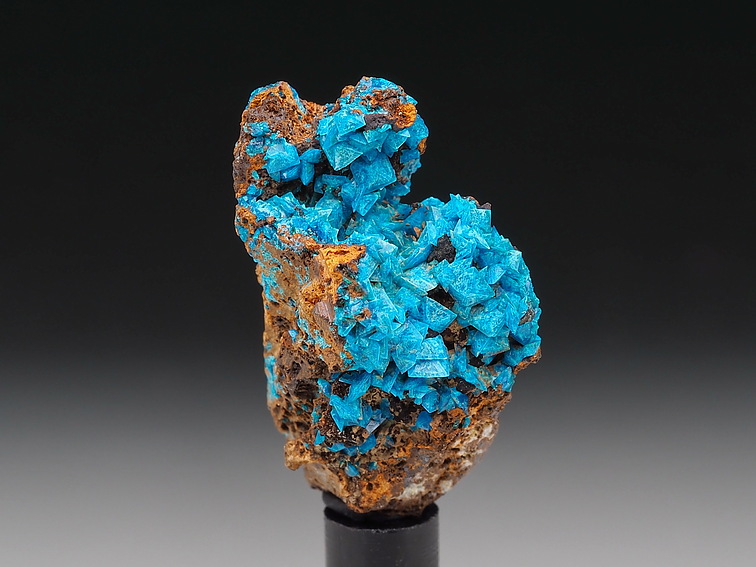

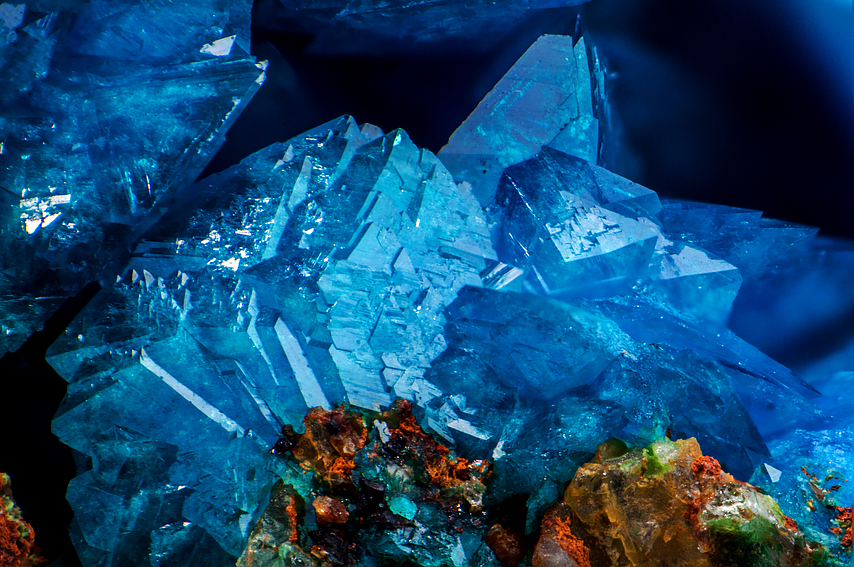

About Liroconite
Formula:
Cu2Al(AsO4)(OH)4 · 4H2O
Colour:
Sky-blue to green; light blue to light bluish green in transmitted light.
Lustre:
Vitreous, Resinous
Hardness:
2 - 2½
Specific Gravity:
2.94 - 3.01
Crystal System:
Monoclinic
Name:
Named in 1825 by Wilhelm Karl von Haidinger from the Greek λειρός = pale, and κουία = powder, in allusion to the color of its streak.
Type Locality:
Unique Identifiers
Mindat ID:
2413
Long-form identifier:
mindat:1:1:2413:2
IMA Classification of Liroconite
Approved, 'Grandfathered' (first described prior to 1959)
IMA Formula:
Cu2+2AlAs5+O4(OH)4·4H2O
First published:
1801
Classification of Liroconite
8.DF.20
8 : PHOSPHATES, ARSENATES, VANADATES
D : Phosphates, etc. with additional anions, with H2O
F : With only medium-sized cations, (OH,etc.):RO4 > 3:1
8 : PHOSPHATES, ARSENATES, VANADATES
D : Phosphates, etc. with additional anions, with H2O
F : With only medium-sized cations, (OH,etc.):RO4 > 3:1
42.2.1.1
42 : HYDRATED PHOSPHATES, ETC.CONTAINING HYDROXYL OR HALOGEN
2 : (AB)3(XO4)Zq·xH2O
42 : HYDRATED PHOSPHATES, ETC.CONTAINING HYDROXYL OR HALOGEN
2 : (AB)3(XO4)Zq·xH2O
20.1.13
20 : Arsenates (also arsenates with phosphate, but without other anions)
1 : Arsenates of Cu
20 : Arsenates (also arsenates with phosphate, but without other anions)
1 : Arsenates of Cu
Mineral Symbols
As of 2021 there are now IMA–CNMNC approved mineral symbols (abbreviations) for each mineral species, useful for tables and diagrams.
| Symbol | Source | Reference for Standard |
|---|---|---|
| Lro | IMA–CNMNC | Warr, L.N. (2021). IMA–CNMNC approved mineral symbols. Mineralogical Magazine, 85(3), 291-320. doi:10.1180/mgm.2021.43 |
Pronunciation of Liroconite
Pronunciation:
| Play | Recorded by | Country |
|---|---|---|
| Jolyon Ralph | United Kingdom |
Physical Properties of Liroconite
Vitreous, Resinous
Transparency:
Transparent, Translucent
Colour:
Sky-blue to green; light blue to light bluish green in transmitted light.
Streak:
Pale blue to pale green
Hardness:
2 - 2½ on Mohs scale
Cleavage:
Poor/Indistinct
On {110} and {011}, indistinct.
On {110} and {011}, indistinct.
Fracture:
Irregular/Uneven, Conchoidal
Density:
2.94 - 3.01 g/cm3 (Measured) 3.03 g/cm3 (Calculated)
Comment:
Density varies with the P:As ratio. Calculated value based on P:As = 1:4.
Optical Data of Liroconite
Type:
Biaxial (-)
RI values:
nα = 1.612(3) nβ = 1.652(3) nγ = 1.675(3)
2V:
Measured: 67° , Calculated: 72°
Max. Birefringence:
δ = 0.063
Based on recorded range of RI values above.
Based on recorded range of RI values above.
Interference Colours:
The colours simulate birefringence patterns seen in thin section under crossed polars. They do not take into account mineral colouration or opacity.
Michel-Levy Bar The default colours simulate the birefringence range for a 30 µm thin-section thickness. Adjust the slider to simulate a different thickness.
Grain Simulation You can rotate the grain simulation to show how this range might look as you rotated a sample under crossed polars. Each grain retains its interference colour (retardation) while its brightness falls to black at extinction and reaches a maximum between extinction positions.
The colours simulate birefringence patterns seen in thin section under crossed polars. They do not take into account mineral colouration or opacity.
Michel-Levy Bar The default colours simulate the birefringence range for a 30 µm thin-section thickness. Adjust the slider to simulate a different thickness.
Grain Simulation You can rotate the grain simulation to show how this range might look as you rotated a sample under crossed polars. Each grain retains its interference colour (retardation) while its brightness falls to black at extinction and reaches a maximum between extinction positions.
Surface Relief:
Moderate
Dispersion:
none
Pleochroism:
Non-pleochroic
Chemistry of Liroconite
Mindat Formula:
Cu2Al(AsO4)(OH)4 · 4H2O
Element Weights:
Crystallography of Liroconite
Crystal System:
Monoclinic
Class (H-M):
2/m - Prismatic
Cell Parameters:
a = 12.664(2) Å, b = 7.553(2) Å, c = 9.914(3) Å
β = 91.32°
β = 91.32°
Ratio:
a:b:c = 1.677 : 1 : 1.313
Unit Cell V:
948.03 ų (Calculated from Unit Cell)
Z:
4
Morphology:
Crystals thin or lenticular [001] with a flat octahedral aspect. The faces of m and e are striated parallel to their intersection edges.
Comment:
Space Group: I2/a
Crystallographic forms of Liroconite
Crystal Atlas:
Image Loading
Click on an icon to view

Liroconite no.4 - {110} - Goldschmidt (1913-1926)
Liroconite no.7 - {100} - Goldschmidt (1913-1926)
3d models and HTML5 code kindly provided by
www.smorf.nl.
Toggle
Edge Lines | Miller Indices | Axes
Transparency
Opaque | Translucent | Transparent
View
Along a-axis | Along b-axis | Along c-axis | Start rotation | Stop rotation
Edge Lines | Miller Indices | Axes
Transparency
Opaque | Translucent | Transparent
View
Along a-axis | Along b-axis | Along c-axis | Start rotation | Stop rotation
Crystal Structure
Load
Unit Cell | Unit Cell Packed
2x2x2 | 3x3x3 | 4x4x4
Unit Cell | Unit Cell Packed
2x2x2 | 3x3x3 | 4x4x4
Show
Big Balls | Small Balls | Just Balls | Spacefill
Polyhedra Off | Si Polyhedra | All Polyhedra
Remove metal-metal sticks
Big Balls | Small Balls | Just Balls | Spacefill
Polyhedra Off | Si Polyhedra | All Polyhedra
Remove metal-metal sticks
Display Options
Black Background | White Background
Perspective On | Perspective Off
2D | Stereo | Red-Blue | Red-Cyan
Black Background | White Background
Perspective On | Perspective Off
2D | Stereo | Red-Blue | Red-Cyan
View
CIF File Best | x | y | z | a | b | c
CIF File Best | x | y | z | a | b | c
Rotation
Stop | Start
Stop | Start
Labels
Console Off | On | Grey | Yellow
Console Off | On | Grey | Yellow
Data courtesy of the American Mineralogist Crystal Structure Database. Click on an AMCSD ID to view structure
| ID | Species | Reference | Link | Year | Locality | Pressure (GPa) | Temp (K) |
|---|---|---|---|---|---|---|---|
| 0010249 | Liroconite | Burns P C, Eby R K, Hawthorne F C (1991) Refinement of the structure of liroconite, a heteropolyhedral framework oxysalt mineral Acta Crystallographica C47 916-919 |  | 1991 | Roughton Gill, England | 0 | 293 |
CIF Raw Data - click here to close
X-Ray Powder Diffraction
Loading XRD data...
Data courtesy of RRUFF project at University of Arizona, used with permission.
Powder Diffraction Data:
| d-spacing | Intensity |
|---|---|
| 6.46 Å | (10) |
| 5.95 Å | (9) |
| 3.92 Å | (5) |
| 3.01 Å | (10) |
| 2.79 Å | (5) |
| 2.69 Å | (6) |
| 2.21 Å | (5) |
Geological Environment
Paragenetic Mode(s):
| Paragenetic Mode | Earliest Age (Ga) |
|---|---|
| Stage 7: Great Oxidation Event | <2.4 |
| 47a : [Near-surface hydration of prior minerals] | |
| 47d : [Arsenates, antimonates, selenates, bismuthinates] |
Geological Setting:
Oxidized zones of copper deposits.
Type Occurrence of Liroconite
General Appearance of Type Material:
Blue bipyramids
Synonyms of Liroconite
Other Language Names for Liroconite
Dutch:Liroconiet
German:Lirokonit
Chalcophacit
Couphochlorit
Lentulit
Linsenerz
Linsenkupfer
Liroconit
Lirokomalachit
Lirokon-malachit
Chalcophacit
Couphochlorit
Lentulit
Linsenerz
Linsenkupfer
Liroconit
Lirokomalachit
Lirokon-malachit
Russian:Лироконит
Simplified Chinese:水砷铝铜矿
Relationship of Liroconite to other Species
Forms a series with:
Common Associates
Associations Based on Photo Data:
| 18 photos of Liroconite associated with Clinoclase | Cu3(AsO4)(OH)3 |
| 14 photos of Liroconite associated with Kernowite | Cu2Fe(AsO4)(OH)4 · 4H2O |
| 14 photos of Liroconite associated with Quartz | SiO2 |
| 9 photos of Liroconite associated with Olivenite | Cu2(AsO4)(OH) |
| 7 photos of Liroconite associated with Cassiterite | SnO2 |
| 7 photos of Liroconite associated with Azurite | Cu3(CO3)2(OH)2 |
| 6 photos of Liroconite associated with Strashimirite | Cu8(AsO4)4(OH)4 · 5H2O |
| 5 photos of Liroconite associated with 'Wood Copper' | Cu2(AsO4)(OH) |
| 5 photos of Liroconite associated with Goethite | Fe3+O(OH) |
| 3 photos of Liroconite associated with Chalcopyrite | CuFeS2 |
Related Minerals - Strunz-mindat Grouping
| 8.DF. | Wiperamingaite | NaCaFe3+Al(PO4)F5(OH) · H2O |
| 8.DF. | Kernowite | Cu2Fe(AsO4)(OH)4 · 4H2O |
| 8.DF.05 | Hotsonite | Al11(SO4)3(PO4)2(OH)21 · 16H2O |
| 8.DF.10 | Liskeardite | [(Al,Fe)32(AsO4)18(OH)42(H2O)22] · 52H2O |
| 8.DF.10 | Rosièresite | (Pb, Cu, Al, P, O, H) |
| 8.DF.10 | Evansite | Al3(PO4)(OH)6 · 6H2O |
| 8.DF.10 | Bolivarite | Al2(PO4)(OH)3 · 4-5H2O |
| 8.DF.15 | Rusakovite | (Fe3+,Al)5(VO4,PO4)2(OH)9 · 3H2O |
| 8.DF.25 | Sieleckiite | Cu3Al4(PO4)2(OH)12 · 2H2O |
| 8.DF.30 | Chalcophyllite | Cu18Al2(AsO4)4(SO4)3(OH)24 · 36H2O |
| 8.DF.35 | Parnauite | Cu9(AsO4)2(SO4)(OH)10 · 7H2O |
| 8.DF.40 | Gladiusite | Fe2(Fe,Mg)4(PO4)(OH)11(H2O) |
| 8.DF.50 | Forêtite | Cu2Al2(AsO4)(OH,O,H2O)6 |
Other Information
Notes:
Soluble in acids.
Health Risks:
No information on health risks for this material has been entered into the database. You should always treat mineral specimens with care.
Internet Links for Liroconite
mindat.org URL:
https://www.mindat.org/min-2413.html
Please feel free to link to this page.
Please feel free to link to this page.
Search Engines:
External Links:
Mineral Dealers:
References for Liroconite
Reference List:
Hausmann, Johann Friedrich Ludwig (1813) Handbuch der Mineralogie (1st ed.). Vandenhoeck und Ruprecht. p.1051 - as Linsenkupfer
Beudant, François-Sulpice (1832) Traité élémentaire de minéralogie. Deuxiéme Edition [Elementary Treatise on Mineralogy. Second Edition] (2nd ed.) Vol. 2 - Tome II [Volume II]. Chez Verdière. p.600
Church, A. H. (1895) A Chemical Study of Some Native Arsenates and Phosphates. Mineralogical Magazine and Journal of the Mineralogical Society, 11 (49) 1-12 doi:10.1180/minmag.1895.011.49.01
Larsen, Esper S. (1921) The microscopic determination of the nonopaque minerals. Bulletin 679. US Geological Survey doi:10.3133/b679 p.101
Berry, L. G. (1951) Observations on conichalcite, cornwallite, euchroite, liroconite and olivenite. American Mineralogist, 36 (5-6) 484-503
Burns, P. C., Eby, R. K., Hawthorne, F. C. (1991) Refinement of the structure of liroconite, a heteropolyhedral framework oxysalt mineral. Acta Crystallographica Section C Crystal Structure Communications, 47 (5) 916-919 doi:10.1107/s0108270190010939
Cook, Robert (2001) Connoisseur's Choice: Liroconite : Gwennap, Cornwall, England. Rocks & Minerals, 76 (6) 404-405 doi:10.1080/00357520109603248
Makreski, Petre, Jovanovski, Stefan, Pejov, Ljupčo, Petruševski, Gjorgji, Ugarković, Sonja, Jovanovski, Gligor (2015) Theoretical and experimental study of the vibrational spectra of liroconite, Cu2Al(AsO4)(OH)4∙4H2O and bayldonite, Cu3Pb[O(AsO3OH)2(OH)2]. Vibrational Spectroscopy, 79. 36-43 doi:10.1016/j.vibspec.2015.04.006
Plumhoff, Alexandra M., Plášil, Jakub, Dachs, Edgar, Benisek, Artur, Sejkora, Jiří, Števko, Martin, Rumsey, Mike S., Majzlan, Juraj (2020) Thermodynamic properties, crystal structure and phase relations of pushcharovskite [Cu(AsO3OH)(H2O).0.5H2O], geminite [Cu(AsO3OH)(H2O)] and liroconite [Cu2Al(AsO4)(OH)4.4H2O]. European Journal of Mineralogy, 32 (3). 285-304 doi:10.5194/ejm-32-285-2020
Kremer, Reinhard K., Bette, Sebastian, Brücher, Eva, Nuss, Jürgen, Schulz, Armin, Whangbo, Myung-Hwan, Koo, Hyun-Joo (2022) Multiple strongly coupled antiferromagnetic spin S = 1/2 dimers in liroconite Cu2Al(As,P)O4(OH)4·4H2O. Zeitschrift für Kristallographie - Crystalline Materials, 237 (10) 403-415 doi:10.1515/zkri-2022-0040
Localities for Liroconite
Showing 35 localities.
 symbol to view information about a locality.
The
symbol to view information about a locality.
The Locality List
 - This locality has map coordinates listed.
- This locality has estimated coordinates.
ⓘ - Click for references and further information on this occurrence.
? - Indicates mineral may be doubtful at this locality.
- This locality has map coordinates listed.
- This locality has estimated coordinates.
ⓘ - Click for references and further information on this occurrence.
? - Indicates mineral may be doubtful at this locality.
 - Good crystals or important locality for species.
 - World class for species or very significant.
(TL) - Type Locality for a valid mineral species.
(FRL) - First Recorded Locality for everything else (eg varieties).
- World class for species or very significant.
(TL) - Type Locality for a valid mineral species.
(FRL) - First Recorded Locality for everything else (eg varieties).
All localities listed without proper references should be considered as questionable.
Australia | |
| Noble (1983) +1 other reference |
China | |
| the exact locality is currently unknown +2 other references |
| UofA |
France | |
| Favreau et al. (2024) |
| Valerie GALEA-CLOLUS collection +2 other references | |
Germany | |
| Habel et al. (2009) |
| Wittern (2001) |
| Wittern (2001) |
| Palache et al. (1951) |
Ireland | |
| Flannery (n.d.) |
Russia | |
| Cook (2001) |
| Cook (2001) |
Slovakia | |
| Pauliš |
| Kodě +2 other references |
| Koděra et al. (1986) |
Spain | |
| Mineralogía de la concesión San Rafael |
| issuu.com (n.d.) +1 other reference |
UK | |
| |
| Mason (1976) | |
| Smyth et al. (1864) +1 other reference |
| [Ian Bruce +1 other reference |
| Phillips (1823) +4 other references |
| David Ifold collection | |
| Royal Cornwall Polytechnic Society (1870) |
| Rocks & Minerals: 60 (1) +7 other references |
| Dana 6: 853 +2 other references | |
| Hall (1868) +1 other reference |
| Hall (1868) +1 other reference |
| Golley et al. (1995) |
| Kingsbury (MS1) +1 other reference |
| Stanley et al. (1991) | |
USA | |
| Grant et al. (2005) |
| Palache et al. (1951) +2 other references |
| Murdoch (1966) |
| Dunn (1995) |
Quick NavTopAbout LiroconiteUnique IdentifiersIMA Classification Classification Mineral SymbolsPronunciation Physical Properties Optical Data Chemistry Crystallography Crystallographic forms Crystal StructureX-Ray Powder DiffractionGeological EnvironmentType Occurrence SynonymsOther LanguagesRelationshipsCommon AssociatesStrunz-MindatOther InformationInternet Links References Localities Locality List

Chenzhou, Hunan, China