
Turquoise
A valid IMA mineral species - grandfathered
This page is currently not sponsored. Click here to sponsor this page.

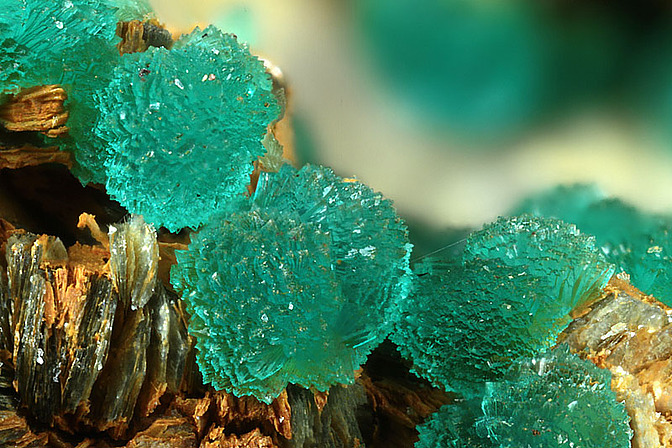


About Turquoise
Formula:
CuAl6(PO4)4(OH)8 · 4H2O
Colour:
Bright blue, sky-blue, pale green, blue-green, turquoise-blue, apple-green, green-gray
Lustre:
Sub-Vitreous, Resinous, Waxy, Dull, Earthy
Hardness:
5 - 6
Specific Gravity:
2.6 - 2.8
Crystal System:
Triclinic
Member of:
Name:
Named from French "turques" or "turquois" meaning "Turkish"; the original material found on the south slopes of the Al-Mirsah-Kuh Mountains (Iran) found its way to Europe via Turkey. The name was known at least as early as the 17th century C.E. Turquoise and members of its group were redefined by Foord and Taggert in 1998, with turquoise reserved for an end-member composition. Foord and Taggert (1998) also noted that most of the gem material labelled "turquoise" is inhomogeneous, and that planerite is the most common constituent in commercial "turquoise".
Isostructural with:
Turquoise Group. Chalcosiderite-Turquoise Series. Planerite-Turquoise Series. The copper analogue of Faustite.
A secondary mineral occurring in the potassic alteration zone of hydrothermal porphyry copper deposits. Also formed by the action of meteoric waters, usually in arid regions, on aluminous igneous or sedimentary rocks (as vein filling in volcanic rocks and phosphatic sediments).
 Visit gemdat.org for gemological information about Turquoise.
A secondary mineral occurring in the potassic alteration zone of hydrothermal porphyry copper deposits. Also formed by the action of meteoric waters, usually in arid regions, on aluminous igneous or sedimentary rocks (as vein filling in volcanic rocks and phosphatic sediments).
Visit gemdat.org for gemological information about Turquoise.Unique Identifiers
Mindat ID:
4060
Long-form identifier:
mindat:1:1:4060:6
IMA Classification of Turquoise
Approved, 'Grandfathered' (first described prior to 1959)
IMA Formula:
Cu2+Al6(PO4)4(OH)8·4H2O
Classification of Turquoise
8.DD.15
8 : PHOSPHATES, ARSENATES, VANADATES
D : Phosphates, etc. with additional anions, with H2O
D : With only medium-sized cations, (OH, etc.):RO4= 2:1
8 : PHOSPHATES, ARSENATES, VANADATES
D : Phosphates, etc. with additional anions, with H2O
D : With only medium-sized cations, (OH, etc.):RO4= 2:1
Dana 7th ed.:
42.9.3.1
42.9.3.1
42 : HYDRATED PHOSPHATES, ETC.CONTAINING HYDROXYL OR HALOGEN
9 : (AB)7(XO4)4Zq·xH2O
42 : HYDRATED PHOSPHATES, ETC.CONTAINING HYDROXYL OR HALOGEN
9 : (AB)7(XO4)4Zq·xH2O
19.2.8
19 : Phosphates
2 : Phosphates of Cu
19 : Phosphates
2 : Phosphates of Cu
Mineral Symbols
As of 2021 there are now IMA–CNMNC approved mineral symbols (abbreviations) for each mineral species, useful for tables and diagrams.
| Symbol | Source | Reference for Standard |
|---|---|---|
| Tqu | IMA–CNMNC | Warr, L.N. (2021). IMA–CNMNC approved mineral symbols. Mineralogical Magazine, 85(3), 291-320. doi:10.1180/mgm.2021.43 |
Pronunciation of Turquoise
Pronunciation:
| Play | Recorded by | Country |
|---|---|---|
| Jolyon Ralph | United Kingdom |
Physical Properties of Turquoise
Sub-Vitreous, Resinous, Waxy, Dull, Earthy
Transparency:
Transparent, Translucent, Opaque
Comment:
Dull to waxy in massive varieties, subvitreous in crystals.
Colour:
Bright blue, sky-blue, pale green, blue-green, turquoise-blue, apple-green, green-gray
Comment:
Ferric iron substitution may cause the color to be green.
Streak:
Pale greenish blue to white
Hardness:
5 - 6 on Mohs scale
Tenacity:
Brittle
Cleavage:
Perfect
on {001}, good on {010}
on {001}, good on {010}
Fracture:
Irregular/Uneven, Sub-Conchoidal
Density:
2.6 - 2.8 g/cm3 (Measured) 2.91 g/cm3 (Calculated)
Optical Data of Turquoise
Type:
Biaxial (+)
RI values:
nα = 1.610 nβ = 1.615 nγ = 1.650
2V:
Measured: 40° , Calculated: 44°
Birefringence:
0.040
Max. Birefringence:
δ = 0.040
Based on recorded range of RI values above.
Based on recorded range of RI values above.
Interference Colours:
The colours simulate birefringence patterns seen in thin section under crossed polars. They do not take into account mineral colouration or opacity.
Michel-Levy Bar The default colours simulate the birefringence range for a 30 µm thin-section thickness. Adjust the slider to simulate a different thickness.
Grain Simulation You can rotate the grain simulation to show how this range might look as you rotated a sample under crossed polars. Each grain retains its interference colour (retardation) while its brightness falls to black at extinction and reaches a maximum between extinction positions.
The colours simulate birefringence patterns seen in thin section under crossed polars. They do not take into account mineral colouration or opacity.
Michel-Levy Bar The default colours simulate the birefringence range for a 30 µm thin-section thickness. Adjust the slider to simulate a different thickness.
Grain Simulation You can rotate the grain simulation to show how this range might look as you rotated a sample under crossed polars. Each grain retains its interference colour (retardation) while its brightness falls to black at extinction and reaches a maximum between extinction positions.
Surface Relief:
High (positive)
Relative to Canada balsam mounting medium (n ≈ 1.537).
Relative to Canada balsam mounting medium (n ≈ 1.537).
This shows the grain boundary and Becke line effect under plane-polarised
light, based on the contrast between this mineral's average refractive
index and the mounting medium. It does not take into account mineral
colouration.
In focus
Interference Figure:
This shows the idealized biaxial acute bisectrix (Bxa) interference figure
- the conoscopic view for a grain cut perpendicular to the acute bisectrix, using
this mineral's 2V. The two small white dots mark the melatopes - the points
where the two optic axes emerge - and are shown only when they fall within the
field of view. The coloured bands are isochromatics, and the dark bands are
isogyres.
Rotate the stage: at 0°/90° the isogyres form a cross through the melatopes; at 45° they pull apart into curved hyperbolas. That splitting on rotation - absent in a uniaxial figure - is the standard diagnostic test for telling biaxial minerals from uniaxial ones. If 2V is large, the melatopes may fall outside the field of view, as they often do at the microscope too.
Rotate the stage: at 0°/90° the isogyres form a cross through the melatopes; at 45° they pull apart into curved hyperbolas. That splitting on rotation - absent in a uniaxial figure - is the standard diagnostic test for telling biaxial minerals from uniaxial ones. If 2V is large, the melatopes may fall outside the field of view, as they often do at the microscope too.
Dispersion:
r < v strong
Pleochroism:
Weak
Comments:
X= colorless
Z= pale blue or pale green
Z= pale blue or pale green
Chemistry of Turquoise
Mindat Formula:
CuAl6(PO4)4(OH)8 · 4H2O
Element Weights:
Common Impurities:
Fe,Ca
Chemical Analysis
Oxide wt%:
| 1 | |
|---|---|
| P2O5 | 23.41 % |
| Al2O3 | 28.31 % |
| Fe2O3 (total) | 9.60 % |
| CuO | 6.37 % |
| Total: | 67.69 % |
Sample references:
| ID | Locality | Reference | Notes |
|---|---|---|---|
| 1 | Mount Vohidraty, Antaly, Ampanihy District, Atsimo-Andrefana, Madagascar | Analyzed by P. Ruf. Analyse only partial |
Crystallography of Turquoise
Crystal System:
Triclinic
Class (H-M):
1 - Pinacoidal
Space Group:
P1
Cell Parameters:
a = 7.409(1) Å, b = 7.635(1) Å, c = 9.914(2) Å
α = 111.356°, β = 114.973°, γ = 69.532°
α = 111.356°, β = 114.973°, γ = 69.532°
Ratio:
a:b:c = 0.97 : 1 : 1.298
Unit Cell V:
449.39 ų
Z:
1
Morphology:
Crystals rare. Steep pinacoidal crystals exhibiting {010}, {110} and {001}. Fine granular, globular crusts, veinlets, massive.
Crystallographic forms of Turquoise
Crystal Atlas:
Image Loading
Click on an icon to view

Turquoise no.1 - {010} - Goldschmidt (1913-1926)
3d models and HTML5 code kindly provided by
www.smorf.nl.
Toggle
Edge Lines | Miller Indices | Axes
Transparency
Opaque | Translucent | Transparent
View
Along a-axis | Along b-axis | Along c-axis | Start rotation | Stop rotation
Edge Lines | Miller Indices | Axes
Transparency
Opaque | Translucent | Transparent
View
Along a-axis | Along b-axis | Along c-axis | Start rotation | Stop rotation
Crystal Structure
Load
Unit Cell | Unit Cell Packed
2x2x2 | 3x3x3 | 4x4x4
Unit Cell | Unit Cell Packed
2x2x2 | 3x3x3 | 4x4x4
Show
Big Balls | Small Balls | Just Balls | Spacefill
Polyhedra Off | Si Polyhedra | All Polyhedra
Remove metal-metal sticks
Big Balls | Small Balls | Just Balls | Spacefill
Polyhedra Off | Si Polyhedra | All Polyhedra
Remove metal-metal sticks
Display Options
Black Background | White Background
Perspective On | Perspective Off
2D | Stereo | Red-Blue | Red-Cyan
Black Background | White Background
Perspective On | Perspective Off
2D | Stereo | Red-Blue | Red-Cyan
View
CIF File Best | x | y | z | a | b | c
CIF File Best | x | y | z | a | b | c
Rotation
Stop | Start
Stop | Start
Labels
Console Off | On | Grey | Yellow
Console Off | On | Grey | Yellow
Data courtesy of the American Mineralogist Crystal Structure Database. Click on an AMCSD ID to view structure
| ID | Species | Reference | Link | Year | Locality | Pressure (GPa) | Temp (K) |
|---|---|---|---|---|---|---|---|
| 0014545 | Turquoise | Kolitsch U, Giester G (2000) The crystal structure of faustite and its copper analogue turquoise Mineralogical Magazine 64 905-913 |  | 2000 | Iron Monarch iron ore deposit, South Australia | 0 | 293 |
| 0010612 | Turquoise | Cid-Dresdner H (1965) Determination and refinement of the crystal structure of turquois, CuAl6(PO4)4(OH)8*4H2O Zeitschrift fur Kristallographie 121 87-113 | | 1965 | Virginia, USA | 0 | 293 |
CIF Raw Data - click here to close
X-Ray Powder Diffraction
Loading XRD data...
Data courtesy of RRUFF project at University of Arizona, used with permission.
Powder Diffraction Data:
| d-spacing | Intensity |
|---|---|
| 9.09 Å | (50) |
| 6.17 Å | (70) |
| 4.80 Å | (60) |
| 3.68 Å | (100) |
| 3.44 Å | (70) |
| 3.28 Å | (70) |
| 2.91 Å | (80) |
| 2.02 Å | (60) |
Comments:
ICDD 6-214; A very weak d(010) peak near d = 9.0 is indicative of A-site vacant material, such as planerite.
Geological Environment
Paragenetic Mode(s):
| Paragenetic Mode | Earliest Age (Ga) |
|---|---|
| Stage 7: Great Oxidation Event | <2.4 |
| 47a : [Near-surface hydration of prior minerals] | |
| 47c : [Carbonates, phosphates, borates, nitrates] |
Geological Setting:
Secondary mineral in potassic alteration zone of porphyry copper deposits. Vein fillings in volcanic rocks and phosphate-rich sediments.
Synonyms of Turquoise
Other Language Names for Turquoise
Arabic:فيروز
Basque:Turkesa
Catalan:Turquesa
Czech:Tyrkys
Dutch:Turkoois
Esperanto:Turkiso
Estonian:Türkiis
Finnish:Turkoosi
Galician:Turquesa
Georgian:ფირუზი
Hebrew:טורקיז
Hindi:फीरोजा़
Hungarian:Türkiz
Lithuanian:Turkis
Navajo:Dootłʼizhii
Polish:Turkus
Portuguese:Turquesa
Quechua:Anqas umiña
Russian:Бирюза
Simplified Chinese:绿松石
Slovak:Tyrkys
Swedish:Turkos
Turkish:Turkuaz
Ukrainian:Бірюза
Vietnamese:Ngọc lam
Varieties of Turquoise
| Agaphite | A vitreous variety of Iranian turquoise. |
| Ferriturquoise | A variety of crystallized turquoise containing 5% Fe2O3 ; ascribed to "Lynch, Virginia" by Spencer in 1943, which was an apparently incorrect reference to Lynch Station, which is an unincorporated community in Campbell County. |
| Rashleighite | Turquoise Group. An Fe(III)-bearing (ferrian) turquoise variety, intermediate on the Chalcosiderite-Turquoise Series. Originally reported from the Bunny Mine (Bonny Mine; St Austell Hills Mine; Shelton Mine), Bugle, Hensbarrow Downs, Luxulyan Area (Lux... |
Relationship of Turquoise to other Species
Member of:
Other Members of Turquoise Group:
| Aheylite | (Fe2+,Zn)Al6(PO4)4(OH)8 · 4H2O | Tric. 1 : P1 |
| Chalcosiderite | CuFe3+6(PO4)4(OH)8 · 4H2O | Tric. 1 : P1 |
| Faustite | ZnAl6(PO4)4(OH)8 · 4H2O | Tric. 1 : P1 |
| Planerite | Al6(PO4)2(PO3OH)2(OH)8 · 4H2O | Tric. 1 : P1 |
| 'UM1981-32-PO:FeH' | Fe2+Fe3+6(PO4)4-x[PO3(OH)]x(OH)8 · 4H2O |
Forms a series with:
Common Associates
Associations Based on Photo Data:
| 167 photos of Turquoise associated with Quartz | SiO2 |
| 149 photos of Turquoise associated with Senegalite | Al2(PO4)(OH)(OH)2 · H2O |
| 117 photos of Turquoise associated with Wavellite | Al3(PO4)2(OH)3 · 5H2O |
| 46 photos of Turquoise associated with Libethenite | Cu2(PO4)(OH) |
| 43 photos of Turquoise associated with Variscite | AlPO4 · 2H2O |
| 32 photos of Turquoise associated with Fluorapatite | Ca5(PO4)3F |
| 32 photos of Turquoise associated with Crandallite | CaAl3(PO4)(PO3OH)(OH)6 |
| 27 photos of Turquoise associated with Strengite | FePO4 · 2H2O |
| 21 photos of Turquoise associated with Pyrite | FeS2 |
| 17 photos of Turquoise associated with Goethite | Fe3+O(OH) |
Related Minerals - Strunz-mindat Grouping
| 8.DD. | Penberthycroftite | [Al6(AsO4)3(OH)9(H2O)5] · 8H2O |
| 8.DD. | Bettertonite | [Al6(AsO4)3(OH)9(H2O)5] · 11H2O |
| 8.DD. | Vargite | MnCu2Mn2(AsO4)2(OH)4(H2O)4 |
| 8.DD. | Galeaclolusite | Al6(AsO4)3(OH)9(H2O)4 · 8H2O |
| 8.DD.05 | Luetheite | Cu2Al2(AsO4)2(OH)4 |
| 8.DD.05 | Chenevixite | Cu2Fe3+2(AsO4)2(OH)4 |
| 8.DD.10 | Akrochordite | MnMn2Mn2(AsO4)2(OH)4(H2O)4 |
| 8.DD.10 | Guanacoite | MgCu2Mg2(AsO4)2(OH)4(H2O)4 |
| 8.DD.15 | 'UM1981-32-PO:FeH' | Fe2+Fe3+6(PO4)4-x[PO3(OH)]x(OH)8 · 4H2O |
| 8.DD.15 | Afmite | Al3(OH)4(H2O)3(PO4)(PO3OH) · H2O |
| 8.DD.15 | Aheylite | (Fe2+,Zn)Al6(PO4)4(OH)8 · 4H2O |
| 8.DD.15 | 'Coeruleolactite' | |
| 8.DD.15 | Faustite | ZnAl6(PO4)4(OH)8 · 4H2O |
| 8.DD.15 | Planerite | Al6(PO4)2(PO3OH)2(OH)8 · 4H2O |
| 8.DD.15 | Chalcosiderite | CuFe3+6(PO4)4(OH)8 · 4H2O |
| 8.DD.20 | Eosphorite | Mn2+Al(PO4)(OH)2 · H2O |
| 8.DD.20 | Ernstite | (Mn2+,Fe3+)Al(PO4)(OH,O)2 · H2O |
| 8.DD.20 | Lefontite | Fe2Al2Be(PO4)2(OH)6 |
| 8.DD.20 | Childrenite | Fe2+Al(PO4)(OH)2 · H2O |
| 8.DD.25 | Kobokoboite | Al6(PO4)4(OH)6 · 11H2O |
| 8.DD.30 | Smamite | Ca2Sb(OH)4[H(AsO4)2] · 6H2O |
| 8.DD.35 | 'Gutsevichite' | Al3(PO4)2(OH)3 · 8H2O |
| 8.DD.40 | 'Laubmannite (of Moore)' | (Fe3+,Fe2+,M)8+x(OH,H2O)9(H2O)2(PO4)5, M = Fe3+, Cu2+ or other metal cation, x ~ 0.1. |
Fluorescence of Turquoise
Not fluorescent in UV
Other Information
Notes:
Soluble with difficulty in HCl.
Often found as pseudomorphs after orthoclase; also after apatite, bone, and teeth.
Often found as pseudomorphs after orthoclase; also after apatite, bone, and teeth.
Health Risks:
No information on health risks for this material has been entered into the database. You should always treat mineral specimens with care.
Industrial Uses:
Jewelry stone.
Internet Links for Turquoise
mindat.org URL:
https://www.mindat.org/min-4060.html
Please feel free to link to this page.
Please feel free to link to this page.
Search Engines:
External Links:
Mineral Dealers:
References for Turquoise
Reference List:
Hausmann, Johann Friedrich Ludwig (1813) Handbuch der Mineralogie (1st ed.). Vandenhoeck und Ruprecht. p.444 - as Hydrargillite
Carnot, Adolphe (1894) Sur la composition chimique des wavellites et des turquoises. Comptes rendus de l’Académie des sciences de Paris, 118 (14-26) 995-998
Penfleld, S. L. (1900) Ueber die chemische Zusammensetzung des Türkis. Zeitschrift für Kristallographie, 33 (1-6). 542-547 doi:10.1524/zkri.1900.33.1.542
Paige, Sidney (1912) The origin of turquoise in the Burro Mountains, New Mexico. Economic Geology, 7 (4) 382-392 doi:10.2113/gsecongeo.7.4.382
Schaller, W. T. (1912) Krystallisierter Türkis von Virginia. Zeitschrift für Kristallographie, 50 (1-6). 120-125 doi:10.1524/zkri.1912.50.1.120
Pearl, Richard Maxwell (1941) Turquois deposits of Colorado. Economic Geology, 36 (3) 335-344 doi:10.2113/gsecongeo.36.3.335
Erd, Richard C., Foster, Margaret D., Proctor, and Paul D. (1953) Faustite, a new mineral, the zinc analogue of turquois. American Mineralogist, 38 (11-12) 964-972
Cid-Dresdner, Hilda (1965) Determination and refinement of the crystal structure of turquois, CuAl6(PO4)4(OH)8·4H2O. Zeitschrift für Kristallographie - Crystalline Materials, 121 (2) 87-113 doi:10.1524/zkri.1965.121.2-4.87
IMA (1967) International Mineralogical Association: Commission on New Minerals and Mineral Names. Mineralogical Magazine and Journal of the Mineralogical Society, 36 (277) 131-136 doi:10.1180/minmag.1967.036.277.20
Khorassani, Ahmad, Abedini, Mansour (1976) A new study of turquoise from Iran. Mineralogical Magazine, 40 (314) 640-642 doi:10.1180/minmag.1976.040.314.12
Foord, Eugene E., Taggart, Joseph E. (1998) A reexamination of the turquoise group: the mineral aheylite, planerite (redefined), turquoise and coeruleolactite. Mineralogical Magazine, 62 (1) 93-111 doi:10.1180/002646198547495
Kolitsch, U., Giester, G. (2000) The crystal structure of faustite and its copper analogue turquoise. Mineralogical Magazine, 64 (5) 905-913 doi:10.1180/002646100549733
Moe, Kyaw Soe, Moses, Thomas M., Johnson, Paul (2007) Polymer-Impregnated Turquoise. Gems & Gemology, 43 (2) 149-151 doi:10.5741/gems.43.2.149
Abdu, Y. A., Hull, S. K., Fayek, M., Hawthorne, F. C. (2011) The turquoise-chalcosiderite Cu(Al,Fe3+)6(PO4)4(OH)8·4H2O solid-solution series: A Mössbauer spectroscopy, XRD, EMPA, and FTIR study. American Mineralogist, 96 (10) 1433-1442 doi:10.2138/am.2011.3658
Čejka, Jiří, Sejkora, Jiří, Macek, Ivo, Malíková, Radana, Wang, Lina, Scholz, Ricardo, Xi, Yunfei, Frost, Ray L. (2015) Raman and infrared spectroscopic study of turquoise minerals. Spectrochimica Acta Part A: Molecular and Biomolecular Spectroscopy, 149. 173-182 doi:10.1016/j.saa.2015.04.029
Qiu, Jun-Ting, Qi, Hui, Duan, Ji-Lin (2016) Reflectance Spectroscopy Characteristics of Turquoise. Minerals, 7 (1). 3pp. doi:10.3390/min7010003
Rossi, Manuela, Rizzi, Rosanna, Vergara, Alessandro, Capitelli, Francesco, Altomare, Angela, Bellatreccia, Fabio, Saviano, Michele, Ghiara, Rosaria M. (2017) Compositional variation of turquoise-group minerals from the historical collection of the Real Museo Mineralogico of the University of Naples. Mineralogical Magazine, 81 (6) 1405-1429 doi:10.1180/minmag.2017.081.055
Eastman, Kyle A., Gammons, Christopher H., Goemann, Karsten, Griffith, Amanda (2022) Supergene Turquoise and Associated Phosphate Minerals of the Porphyry-Lode System at Butte, Montana, USA. The Canadian Mineralogist, 60 (6) 1013-1026 doi:10.3749/canmin.2100068
Tong, Shuoyun, Chen, Guodong, Hu, Weikang, Pan, Shiyang, Zhu, Dan, Liu, Shuang, Lu, Li, Zhou, Shunchao, Zhou, Wanfeng (2023) Determination of Geographic Origin of Turquoise by Combining Laser Ablation Inductively Coupled Plasma Mass Spectrometry Analysis and Chemometrics. Minerals, 13 (10) doi:10.3390/min13101338
Localities for Turquoise
Showing 649 localities.
 symbol to view information about a locality.
The
symbol to view information about a locality.
The Locality List
 - This locality has map coordinates listed.
- This locality has estimated coordinates.
ⓘ - Click for references and further information on this occurrence.
? - Indicates mineral may be doubtful at this locality.
- This locality has map coordinates listed.
- This locality has estimated coordinates.
ⓘ - Click for references and further information on this occurrence.
? - Indicates mineral may be doubtful at this locality.
 - Good crystals or important locality for species.
 - World class for species or very significant.
(TL) - Type Locality for a valid mineral species.
(FRL) - First Recorded Locality for everything else (eg varieties).
- World class for species or very significant.
(TL) - Type Locality for a valid mineral species.
(FRL) - First Recorded Locality for everything else (eg varieties).
All localities listed without proper references should be considered as questionable.
Quick NavTopAbout TurquoiseUnique IdentifiersIMA Classification Classification Mineral SymbolsPronunciation Physical Properties Optical Data Chemistry Chemical AnalysisCrystallography Crystallographic forms Crystal StructureX-Ray Powder DiffractionGeological EnvironmentSynonymsOther LanguagesVarietiesRelationshipsCommon AssociatesStrunz-MindatFluorescence Other InformationInternet Links References Localities Locality List

Serra Azul, Brumadinho, Minas Gerais, Brazil