
Childrenite
A valid IMA mineral species - grandfathered
This page is currently not sponsored. Click here to sponsor this page.


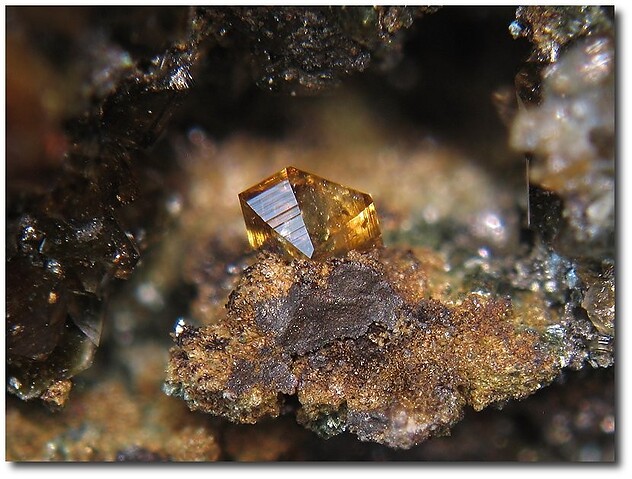
About Childrenite

John George Children
Formula:
Fe2+Al(PO4)(OH)2 · H2O
Colour:
Yellowish brown, brown, clove-brown
Lustre:
Vitreous, Sub-Vitreous, Resinous, Greasy
Hardness:
5
Specific Gravity:
3.11 - 3.19
Crystal System:
Orthorhombic
Name:
Named in 1823 by Henry J. Brooke in honor of John George Children [May 18, 1777 – January 1, 1852 Halstead, Kent, England, UK), English chemist, mineralogist, and zoologist; Keeper of minerals at the British Museum of Natural History.
Type Locality:
Childrenite-Eosphorite Series.
The Fe2+ analogue of eosphorite.
See also the related lefontite.
 Visit gemdat.org for gemological information about Childrenite.
The Fe2+ analogue of eosphorite.
See also the related lefontite.
Visit gemdat.org for gemological information about Childrenite.Unique Identifiers
Mindat ID:
1003
Long-form identifier:
mindat:1:1:1003:6
IMA Classification of Childrenite
Approved, 'Grandfathered' (first described prior to 1959)
IMA Formula:
Fe2+AlPO4(OH)2·H2O
First published:
1823
Classification of Childrenite
8.DD.20
8 : PHOSPHATES, ARSENATES, VANADATES
D : Phosphates, etc. with additional anions, with H2O
D : With only medium-sized cations, (OH, etc.):RO4= 2:1
8 : PHOSPHATES, ARSENATES, VANADATES
D : Phosphates, etc. with additional anions, with H2O
D : With only medium-sized cations, (OH, etc.):RO4= 2:1
42.7.1.1
42 : HYDRATED PHOSPHATES, ETC.CONTAINING HYDROXYL OR HALOGEN
7 : (AB)2(XO4)Zq·xH2O
42 : HYDRATED PHOSPHATES, ETC.CONTAINING HYDROXYL OR HALOGEN
7 : (AB)2(XO4)Zq·xH2O
19.12.57
19 : Phosphates
12 : Phosphates of Mn
19 : Phosphates
12 : Phosphates of Mn
Mineral Symbols
As of 2021 there are now IMA–CNMNC approved mineral symbols (abbreviations) for each mineral species, useful for tables and diagrams.
| Symbol | Source | Reference for Standard |
|---|---|---|
| Chd | IMA–CNMNC | Warr, L.N. (2021). IMA–CNMNC approved mineral symbols. Mineralogical Magazine, 85(3), 291-320. doi:10.1180/mgm.2021.43 |
Physical Properties of Childrenite
Vitreous, Sub-Vitreous, Resinous, Greasy
Transparency:
Transparent, Translucent
Colour:
Yellowish brown, brown, clove-brown
Comment:
Colourless in transmitted light.
Streak:
White
Hardness:
5 on Mohs scale
Tenacity:
Brittle
Cleavage:
Poor/Indistinct
Poor on {100}
Poor on {100}
Fracture:
Irregular/Uneven, Sub-Conchoidal
Density:
3.11 - 3.19 g/cm3 (Measured) 3.13(1) g/cm3 (Calculated)
Optical Data of Childrenite
Type:
Biaxial (-)
RI values:
nα = 1.644 - 1.649 nβ = 1.662 - 1.683 nγ = 1.671 - 1.691
2V:
Measured: 40° to 45°, Calculated: 50°
Birefringence:
0.035
Max. Birefringence:
δ = 0.027 - 0.042
Based on recorded range of RI values above.
Based on recorded range of RI values above.
Interference Colours:
The colours simulate birefringence patterns seen in thin section under crossed polars. They do not take into account mineral colouration or opacity.
Michel-Levy Bar The default colours simulate the birefringence range for a 30 µm thin-section thickness. Adjust the slider to simulate a different thickness.
Grain Simulation You can rotate the grain simulation to show how this range might look as you rotated a sample under crossed polars. Each grain retains its interference colour (retardation) while its brightness falls to black at extinction and reaches a maximum between extinction positions.
The colours simulate birefringence patterns seen in thin section under crossed polars. They do not take into account mineral colouration or opacity.
Michel-Levy Bar The default colours simulate the birefringence range for a 30 µm thin-section thickness. Adjust the slider to simulate a different thickness.
Grain Simulation You can rotate the grain simulation to show how this range might look as you rotated a sample under crossed polars. Each grain retains its interference colour (retardation) while its brightness falls to black at extinction and reaches a maximum between extinction positions.
Surface Relief:
Very High (positive)
Relative to Canada balsam mounting medium (n ≈ 1.537).
Relative to Canada balsam mounting medium (n ≈ 1.537).
This shows the grain boundary and Becke line effect under plane-polarised
light, based on the contrast between this mineral's average refractive
index and the mounting medium. It does not take into account mineral
colouration.
In focus
Interference Figure:
This shows the idealized biaxial acute bisectrix (Bxa) interference figure
- the conoscopic view for a grain cut perpendicular to the acute bisectrix, using
this mineral's 2V. The two small white dots mark the melatopes - the points
where the two optic axes emerge - and are shown only when they fall within the
field of view. The coloured bands are isochromatics, and the dark bands are
isogyres.
Rotate the stage: at 0°/90° the isogyres form a cross through the melatopes; at 45° they pull apart into curved hyperbolas. That splitting on rotation - absent in a uniaxial figure - is the standard diagnostic test for telling biaxial minerals from uniaxial ones. If 2V is large, the melatopes may fall outside the field of view, as they often do at the microscope too.
Rotate the stage: at 0°/90° the isogyres form a cross through the melatopes; at 45° they pull apart into curved hyperbolas. That splitting on rotation - absent in a uniaxial figure - is the standard diagnostic test for telling biaxial minerals from uniaxial ones. If 2V is large, the melatopes may fall outside the field of view, as they often do at the microscope too.
Dispersion:
r > v strong
Optical Extinction:
X = a; Y = b; Z = c. In optically twined matrial Y ∧ c = 4°-8°.
Pleochroism:
Visible
Comments:
X= yellow
Y= pink
Z= pale pink to colourless
Y= pink
Z= pale pink to colourless
Chemistry of Childrenite
Mindat Formula:
Fe2+Al(PO4)(OH)2 · H2O
Element Weights:
Common Impurities:
Ca,Mn
Chemical Analysis
Oxide wt%:
| 1 | |
|---|---|
| P2O5 | 30,97 % |
| Al2O3 | 21,77 % |
| FeO | 16,59 % |
| MnO | 13,55 % |
| MgO | 0,07 % |
| CaO | 0,09 % |
| Total: | 80 % |
Sample references:
| ID | Locality | Reference | Notes |
|---|---|---|---|
| 1 | Buranga pegmatite, Muhororo, Ngororero District, Western Province, Rwanda |
Crystallography of Childrenite
Crystal System:
Orthorhombic
Class (H-M):
mm2 - Pyramidal
Space Group:
Ccc2
Cell Parameters:
a = 10.41 Å, b = 13.42 Å, c = 6.92 Å
α = 90°, β = 90°, γ = 90°
α = 90°, β = 90°, γ = 90°
Ratio:
a:b:c = 0.776 : 1 : 0.516
Unit Cell V:
966.74 ų (Calculated from Unit Cell)
Morphology:
Equant to pyramidal crystals, short prismatic [001], tabular, platy, radiating groups, fibrous crusts, massive.
Twinning:
Common. May show on {100} and {001}. Twins evident when of varying proportions but symmetrical twins consist of four to eight individuals in sectors with four individuals comprising a "termination". Visible twinning is uncommon.
Comment:
Bba2; possibly monoclinic pseudo-orthorhombic.
Crystallographic forms of Childrenite
Crystal Atlas:
Image Loading
Click on an icon to view

Childrenite no.1 - {110} - Goldschmidt (1913-1926)
Childrenite no.9 - {110} - Goldschmidt (1913-1926)
3d models and HTML5 code kindly provided by
www.smorf.nl.
Toggle
Edge Lines | Miller Indices | Axes
Transparency
Opaque | Translucent | Transparent
View
Along a-axis | Along b-axis | Along c-axis | Start rotation | Stop rotation
Edge Lines | Miller Indices | Axes
Transparency
Opaque | Translucent | Transparent
View
Along a-axis | Along b-axis | Along c-axis | Start rotation | Stop rotation
Crystal Structure
Load
Unit Cell | Unit Cell Packed
2x2x2 | 3x3x3 | 4x4x4
Unit Cell | Unit Cell Packed
2x2x2 | 3x3x3 | 4x4x4
Show
Big Balls | Small Balls | Just Balls | Spacefill
Polyhedra Off | Si Polyhedra | All Polyhedra
Remove metal-metal sticks
Big Balls | Small Balls | Just Balls | Spacefill
Polyhedra Off | Si Polyhedra | All Polyhedra
Remove metal-metal sticks
Display Options
Black Background | White Background
Perspective On | Perspective Off
2D | Stereo | Red-Blue | Red-Cyan
Black Background | White Background
Perspective On | Perspective Off
2D | Stereo | Red-Blue | Red-Cyan
View
CIF File Best | x | y | z | a | b | c
CIF File Best | x | y | z | a | b | c
Rotation
Stop | Start
Stop | Start
Labels
Console Off | On | Grey | Yellow
Console Off | On | Grey | Yellow
Data courtesy of the American Mineralogist Crystal Structure Database. Click on an AMCSD ID to view structure
| ID | Species | Reference | Link | Year | Locality | Pressure (GPa) | Temp (K) |
|---|---|---|---|---|---|---|---|
| 0014786 | Childrenite | Giuseppetti G, Tadini C (1984) The crystal structure of childrenite from Tavistock (SW England), Ch89Eo11 term of childrenite-eosphorite series Neues Jahrbuch fur Mineralogie, Monatshefte 1984 263-271 | 1984 | Tavistock, SW England | 0 | 293 | |
| 0014785 | Childrenite | Giuseppetti G, Tadini C (1984) The crystal structure of childrenite from Tavistock (SW England), Ch89Eo11 term of childrenite-eosphorite series Neues Jahrbuch fur Mineralogie, Monatshefte 1984 263-271 | 1984 | Tavistock, SW England | 0 | 293 |
CIF Raw Data - click here to close
X-Ray Powder Diffraction
Powder Diffraction Data:
| d-spacing | Intensity |
|---|---|
| 6.71 Å | (64) |
| 5.197 Å | (36) |
| 4.362 Å | (22) |
| 3.528 Å | (28) |
| 2.816 Å | (100) |
| 2.419 Å | (50) |
| 1.521 Å | (40) |
Geological Environment
Paragenetic Mode(s):
| Paragenetic Mode | Earliest Age (Ga) |
|---|---|
| Near-surface Processes | |
| 22 : Hydration and low-? subsurface aqueous alteration (see also #23) | |
| Stage 4b: Highly evolved igneous rocks | >3.0 |
| 34 : Complex granite pegmatites |
Geological Setting:
Complex granitic pegmatites, a low temperature hydrothermal alteration product of primary phosphates.
Type Occurrence of Childrenite
General Appearance of Type Material:
Small yellow crystals on quartz.
Place of Conservation of Type Material:
No defined type material.
Geological Setting of Type Material:
Low temperature hydrothermal veins.
Associated Minerals at Type Locality:
Other Language Names for Childrenite
Dutch:Childreniet
German:Childrenit
Russian:Чилдренит
Simplified Chinese:磷铝铁石
Spanish:Childrenita
Traditional Chinese:磷鋁鐵石
Relationship of Childrenite to other Species
Forms a series with:
Common Associates
Associations Based on Photo Data:
| 348 photos of Childrenite associated with Vauxite | Fe2+Al2(PO4)2(OH)2 · 6H2O |
| 329 photos of Childrenite associated with Paravauxite | Fe2+Al2(PO4)2(OH)2 · 8H2O |
| 118 photos of Childrenite associated with Quartz | SiO2 |
| 48 photos of Childrenite associated with Roscherite | Ca2Mn2+5Be4(PO4)6(OH)4 · 6H2O |
| 41 photos of Childrenite associated with Wardite | NaAl3(PO4)2(OH)4 · 2H2O |
| 30 photos of Childrenite associated with Siderite | FeCO3 |
| 21 photos of Childrenite associated with Ruifrancoite | Ca2(◻,Mn)2(Fe3+,Mn,Mg)4Be4(PO4)6(OH)4(OH,H2O)2 · 4H2O |
| 20 photos of Childrenite associated with Vivianite | Fe2+Fe2+2(PO4)2 · 8H2O |
| 15 photos of Childrenite associated with Gormanite | (Fe2+,Mg)3(Al,Fe3+)4(PO4)4(OH)6 · 2H2O |
| 14 photos of Childrenite associated with Fluorapatite | Ca5(PO4)3F |
Related Minerals - Strunz-mindat Grouping
| 8.DD. | Penberthycroftite | [Al6(AsO4)3(OH)9(H2O)5] · 8H2O |
| 8.DD. | Bettertonite | [Al6(AsO4)3(OH)9(H2O)5] · 11H2O |
| 8.DD. | Vargite | MnCu2Mn2(AsO4)2(OH)4(H2O)4 |
| 8.DD. | Galeaclolusite | Al6(AsO4)3(OH)9(H2O)4 · 8H2O |
| 8.DD.05 | Luetheite | Cu2Al2(AsO4)2(OH)4 |
| 8.DD.05 | Chenevixite | Cu2Fe3+2(AsO4)2(OH)4 |
| 8.DD.10 | Akrochordite | MnMn2Mn2(AsO4)2(OH)4(H2O)4 |
| 8.DD.10 | Guanacoite | MgCu2Mg2(AsO4)2(OH)4(H2O)4 |
| 8.DD.15 | 'UM1981-32-PO:FeH' | Fe2+Fe3+6(PO4)4-x[PO3(OH)]x(OH)8 · 4H2O |
| 8.DD.15 | Afmite | Al3(OH)4(H2O)3(PO4)(PO3OH) · H2O |
| 8.DD.15 | Aheylite | (Fe2+,Zn)Al6(PO4)4(OH)8 · 4H2O |
| 8.DD.15 | 'Coeruleolactite' | |
| 8.DD.15 | Faustite | ZnAl6(PO4)4(OH)8 · 4H2O |
| 8.DD.15 | Planerite | Al6(PO4)2(PO3OH)2(OH)8 · 4H2O |
| 8.DD.15 | Chalcosiderite | CuFe3+6(PO4)4(OH)8 · 4H2O |
| 8.DD.15 | Turquoise | CuAl6(PO4)4(OH)8 · 4H2O |
| 8.DD.20 | Eosphorite | Mn2+Al(PO4)(OH)2 · H2O |
| 8.DD.20 | Ernstite | (Mn2+,Fe3+)Al(PO4)(OH,O)2 · H2O |
| 8.DD.20 | Lefontite | Fe2Al2Be(PO4)2(OH)6 |
| 8.DD.25 | Kobokoboite | Al6(PO4)4(OH)6 · 11H2O |
| 8.DD.30 | Smamite | Ca2Sb(OH)4[H(AsO4)2] · 6H2O |
| 8.DD.35 | 'Gutsevichite' | Al3(PO4)2(OH)3 · 8H2O |
| 8.DD.40 | 'Laubmannite (of Moore)' | (Fe3+,Fe2+,M)8+x(OH,H2O)9(H2O)2(PO4)5, M = Fe3+, Cu2+ or other metal cation, x ~ 0.1. |
Fluorescence of Childrenite
Not Fluorescent
Other Information
Notes:
Soluble in acids.
Health Risks:
No information on health risks for this material has been entered into the database. You should always treat mineral specimens with care.
Internet Links for Childrenite
mindat.org URL:
https://www.mindat.org/min-1003.html
Please feel free to link to this page.
Please feel free to link to this page.
Search Engines:
External Links:
Mineral Dealers:
References for Childrenite
Reference List:
Church, A. H. (1873) New analyses of certain mineral arseniates and phosphates. Journal of the Chemical Society, 26. 101-111 doi:10.1039/js8732600101
Larsen, Esper S. (1921) The microscopic determination of the nonopaque minerals. Bulletin 679. US Geological Survey doi:10.3133/b679 p.57
Landes, Kenneth K. (1925) The paragenesis of the granite pegmatites of central Maine. American Mineralogist, 10 (11) 355-411 p.384
Mason, Brian (1942) Some iron-manganese phosphate minerals from the pegmatite at Hühnerkobel in Bavaria. Geologiska Föreningen i Stockholm Förhandlingar, 64 (3) 335-340 doi:10.1080/11035894209446083
Barnes, William (1949) The unit cell and space group of childrenite. American Mineralogist, 34 (1-2) 12-18
Barnes, W. H., Shore, Violet C. (1951) The childrenite-eosphorite problem. American Mineralogist, 36 (5-6) 509-510
Kingsbury, Arthur W. G., Hartley, J. (1957) Childrenite from the Lake District, Cumberland. Mineralogical Magazine and Journal of the Mineralogical Society, 31 (237). 498 doi:10.1180/minmag.1957.031.237.10
Winchell, Horace (1958) Optics of the eosphorite-childrenite series. American Mineralogist, 43 (7-8) 765-768
Fransolet, A.-M. (1980) The eosphorite-childrenite series associated with the Li-Mn-Fe phosphate minerals from the Buranga pegmatite, Rwanda. Mineralogical Magazine, 43 (332) 1015-1023 doi:10.1180/minmag.1980.043.332.09
Braithwaite, R. S. W., Cooper, B. V. (1982) Childrenite in South-West England. Mineralogical Magazine, 46 (338) 119-126 doi:10.1180/minmag.1982.046.338.18
Hansen, Staffan, Landa‐Cánovas, Angel (1994) Childrenite and millisite from Västanå Iron Mine, Skåne, Sweden. GFF, 116 (2) 92 doi:10.1080/11035899409546164
Bermanec, V., Šćavničar, S., ZebeC, V. (1995) Childrenite and crandallite from the Stari Trg mine (Trepča), Kosovo: new data. Mineralogy and Petrology, 52 (3) 197-208 doi:10.1007/bf01163245
da Costa, Geraldo Magela, Scholz, Ricardo, Karfunkel, Joachim, Bermanec, Vladimir, de Sá Carneiro Chaves, Mário Luiz (2005) 57Fe-Mössbauer spectroscopy on natural eosphorite-childrenite-ernstite samples. Physics and Chemistry of Minerals, 31 (10). 714-720 doi:10.1007/s00269-004-0434-7
Frost, Ray L., Xi, Yunfei, Scholz, Ricardo, López, Andrés, Lima, Rosa Malena Fernandes, Ferreira, Claudiane Moraes (2013) Vibrational spectroscopic characterization of the phosphate mineral series eosphorite–childrenite–(Mn,Fe)Al(PO4)(OH)2·(H2O) Vibrational Spectroscopy, 67. 14-21 doi:10.1016/j.vibspec.2013.03.005
Localities for Childrenite
Showing 126 localities.
 symbol to view information about a locality.
The
symbol to view information about a locality.
The Locality List
 - This locality has map coordinates listed.
- This locality has estimated coordinates.
ⓘ - Click for references and further information on this occurrence.
? - Indicates mineral may be doubtful at this locality.
- This locality has map coordinates listed.
- This locality has estimated coordinates.
ⓘ - Click for references and further information on this occurrence.
? - Indicates mineral may be doubtful at this locality.
 - Good crystals or important locality for species.
 - World class for species or very significant.
(TL) - Type Locality for a valid mineral species.
(FRL) - First Recorded Locality for everything else (eg varieties).
- World class for species or very significant.
(TL) - Type Locality for a valid mineral species.
(FRL) - First Recorded Locality for everything else (eg varieties).
All localities listed without proper references should be considered as questionable.
Quick NavTopAbout ChildreniteUnique IdentifiersIMA Classification Classification Mineral SymbolsPhysical Properties Optical Data Chemistry Chemical AnalysisCrystallography Crystallographic forms Crystal StructureX-Ray Powder DiffractionGeological EnvironmentType Occurrence Other LanguagesRelationshipsCommon AssociatesStrunz-MindatFluorescence Other InformationInternet Links References Localities Locality List

George and Charlotte Mine, Devon and Cornwall United Mines, Gulworthy, West Devon, Devon, England, UK