
Hidalgoite
A valid IMA mineral species - grandfathered
This page is currently not sponsored. Click here to sponsor this page.


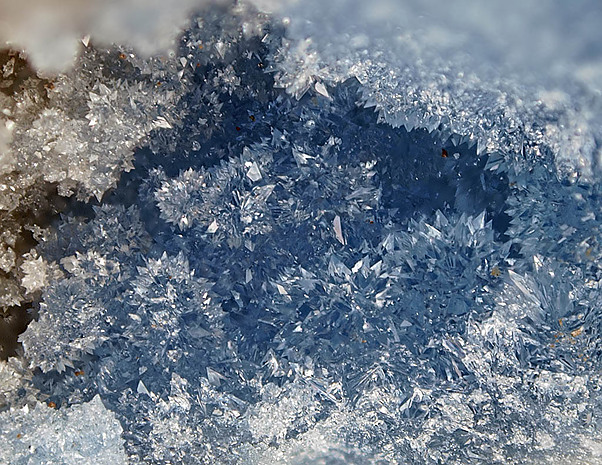

About Hidalgoite

Coat of Arms of Hidalgo, Mexico
Formula:
PbAl3(AsO4)(SO4)(OH)6
Colour:
White, pale green, pistachio-green, emerald-green
Lustre:
Dull
Hardness:
4½
Specific Gravity:
3.71 - 3.96
Crystal System:
Trigonal
Member of:
Name:
Named for the state of Hidalgo, Mexico, that includes the type locality.
The arsenate analogue of hinsdalite and the Al analogue of beudantite.
Forms solid solutions with the arsenate member philipsbornite.
Forms solid solutions with the arsenate member philipsbornite.
Unique Identifiers
Mindat ID:
1899
Long-form identifier:
mindat:1:1:1899:5
IMA Classification of Hidalgoite
Approved, 'Grandfathered' (first described prior to 1959)
IMA Formula:
Pb2+Al3(S6+O4)(As5+O4)(OH)6
First published:
1953
Classification of Hidalgoite
8.BL.05
8 : PHOSPHATES, ARSENATES, VANADATES
B : Phosphates, etc., with additional anions, without H2O
L : With medium-sized and large cations, (OH, etc.):RO4 = 3:1
8 : PHOSPHATES, ARSENATES, VANADATES
B : Phosphates, etc., with additional anions, without H2O
L : With medium-sized and large cations, (OH, etc.):RO4 = 3:1
43.4.1.3
43 : COMPOUND PHOSPHATES, ETC.
4 : Anhydrous Compound Phosphates, etc·, Containing Hydroxyl or Halogen
43 : COMPOUND PHOSPHATES, ETC.
4 : Anhydrous Compound Phosphates, etc·, Containing Hydroxyl or Halogen
22.3.18
22 : Phosphates, Arsenates or Vanadates with other Anions
3 : Phosphates, arsenates or vanadates with sulphates
22 : Phosphates, Arsenates or Vanadates with other Anions
3 : Phosphates, arsenates or vanadates with sulphates
Mineral Symbols
As of 2021 there are now IMA–CNMNC approved mineral symbols (abbreviations) for each mineral species, useful for tables and diagrams.
| Symbol | Source | Reference for Standard |
|---|---|---|
| Hid | IMA–CNMNC | Warr, L.N. (2021). IMA–CNMNC approved mineral symbols. Mineralogical Magazine, 85(3), 291-320. doi:10.1180/mgm.2021.43 |
Physical Properties of Hidalgoite
Dull
Transparency:
Translucent
Comment:
porcelain like luster
Colour:
White, pale green, pistachio-green, emerald-green
Streak:
White
Hardness:
4½ on Mohs scale
Tenacity:
Brittle
Fracture:
Irregular/Uneven, Conchoidal
Density:
3.71 - 3.96 g/cm3 (Measured) 4.21(6) g/cm3 (Calculated)
Optical Data of Hidalgoite
Type:
Uniaxial (+)
RI values:
nω = 1.713 - 1.730 nε = 1.715 - 1.735
Max. Birefringence:
δ = 0.002 - 0.005
Based on recorded range of RI values above.
Based on recorded range of RI values above.
Interference Colours:
The colours simulate birefringence patterns seen in thin section under crossed polars. They do not take into account mineral colouration or opacity.
Michel-Levy Bar The default colours simulate the birefringence range for a 30 µm thin-section thickness. Adjust the slider to simulate a different thickness.
Grain Simulation You can rotate the grain simulation to show how this range might look as you rotated a sample under crossed polars. Each grain retains its interference colour (retardation) while its brightness falls to black at extinction and reaches a maximum between extinction positions.
The colours simulate birefringence patterns seen in thin section under crossed polars. They do not take into account mineral colouration or opacity.
Michel-Levy Bar The default colours simulate the birefringence range for a 30 µm thin-section thickness. Adjust the slider to simulate a different thickness.
Grain Simulation You can rotate the grain simulation to show how this range might look as you rotated a sample under crossed polars. Each grain retains its interference colour (retardation) while its brightness falls to black at extinction and reaches a maximum between extinction positions.
Surface Relief:
Very High (positive)
Relative to Canada balsam mounting medium (n ≈ 1.537).
Relative to Canada balsam mounting medium (n ≈ 1.537).
This shows the grain boundary and Becke line effect under plane-polarised
light, based on the contrast between this mineral's average refractive
index and the mounting medium. It does not take into account mineral
colouration.
In focus
Interference Figure:
This shows the idealized uniaxial interference figure - the conoscopic
(convergent-light, Bertrand-lens-in) view, for a grain cut with the optic axis
centred and vertical. The coloured rings are isochromatics, computed with the
same physics as the Michel-Lévy bar above; the dark cross is the isogyre.
For a genuinely uniaxial mineral viewed this way, that cross stays perfectly stationary if you rotate the stage - unlike a biaxial mineral, where it splits apart on rotation. That invariance is itself the standard diagnostic test for telling uniaxial and biaxial minerals apart at the microscope.
For a genuinely uniaxial mineral viewed this way, that cross stays perfectly stationary if you rotate the stage - unlike a biaxial mineral, where it splits apart on rotation. That invariance is itself the standard diagnostic test for telling uniaxial and biaxial minerals apart at the microscope.
Dispersion:
Strong
Chemistry of Hidalgoite
Mindat Formula:
PbAl3(AsO4)(SO4)(OH)6
Element Weights:
Crystallography of Hidalgoite
Crystal System:
Trigonal
Class (H-M):
3m - Ditrigonal Pyramidal
Space Group:
R3m
Cell Parameters:
a = 7.04(2) Å, c = 16.99(2) Å
Ratio:
a:c = 1 : 2.413
Unit Cell V:
729.24 ų (Calculated from Unit Cell)
Z:
3
X-Ray Powder Diffraction
Powder Diffraction Data:
| d-spacing | Intensity |
|---|---|
| 2.981 Å | (100) |
| 5.73 Å | (90) |
| 3.51 Å | (90) |
| 1.911 Å | (80) |
| 2.257 Å | (70) |
| 1.761 Å | (60) |
| 1.496 Å | (60) |
Geological Environment
Paragenetic Mode(s):
| Paragenetic Mode | Earliest Age (Ga) |
|---|---|
| Stage 7: Great Oxidation Event | <2.4 |
| 47a : [Near-surface hydration of prior minerals] | |
| 47b : [Sulfates and sulfites] | |
| 47d : [Arsenates, antimonates, selenates, bismuthinates] |
Type Occurrence of Hidalgoite
General Appearance of Type Material:
White porous or cavernous to dense porcelain-like masses.
Place of Conservation of Type Material:
National School of Mines, Paris, France.
Harvard University, Cambridge, Massachusetts, USA, 106373–106375.
National Museum of Natural History, Washington, D.C., USA, 112726, 112727.
Harvard University, Cambridge, Massachusetts, USA, 106373–106375.
National Museum of Natural History, Washington, D.C., USA, 112726, 112727.
Geological Setting of Type Material:
Oxidized ore vein.
Associated Minerals at Type Locality:
Other Language Names for Hidalgoite
Relationship of Hidalgoite to other Species
Member of:
Other Members of Beudantite Group:
| Beudantite | PbFe3+3(AsO4)(SO4)(OH)6 | Trig. 3m(32/m) : R3m |
| Cloudite | BaFe3+3(PO4)(SO4)(OH)6 | Trig. 3m(32/m) : R3m |
| Corkite | PbFe3+3(PO4)(SO4)(OH)6 | Trig. 3m(32/m) : R3m |
| Gallobeudantite | PbGa3(AsO4)(SO4)(OH)6 | Trig. 3m : R3m |
| Hinsdalite | PbAl3(PO4)(SO4)(OH)6 | Trig. 3m(32/m) : R3m |
| Kemmlitzite | SrAl3(AsO4)(SO4)(OH)6 | Trig. 3m(32/m) : R3m |
| Oberwolfachite | SrFe3+3(AsO4)(SO4)(OH)6 | Trig. 3m(32/m) : R3m |
| Slottaite | SrFe3+3(PO4)(SO4)(OH)6 | Trig. 3m(32/m) : R3m |
| Svanbergite | SrAl3(PO4)(SO4)(OH)6 | Trig. 3m(32/m) : R3m |
| 'UM2011-07-POSO:AlBaH' | BaAl3(PO4)(SO4)(OH)6 | |
| 'Unnamed (Fe-analogue of Weilerite and Ba-analogue of Oberwolfachite)' | BaFe3(AsO4)(SO4)(OH)6 | |
| Weilerite | BaAl3(AsO4)(SO4)(OH)6 | Hex. |
| Woodhouseite | CaAl3(PO4)(SO4)(OH)6 | Trig. 3m(32/m) : R3m |
Common Associates
Associations Based on Photo Data:
| 28 photos of Hidalgoite associated with Mimetite | Pb5(AsO4)3Cl |
| 10 photos of Hidalgoite associated with Carminite | PbFe3+2(AsO4)2(OH)2 |
| 9 photos of Hidalgoite associated with Bayldonite | PbCu3(AsO4)2(OH)2 |
| 7 photos of Hidalgoite associated with Scorodite | Fe3+AsO4 · 2H2O |
| 6 photos of Hidalgoite associated with Beudantite | PbFe3+3(AsO4)(SO4)(OH)6 |
| 6 photos of Hidalgoite associated with Quartz | SiO2 |
| 5 photos of Hidalgoite associated with Duftite | PbCu(AsO4)(OH) |
| 5 photos of Hidalgoite associated with Anglesite | PbSO4 |
| 5 photos of Hidalgoite associated with Bariopharmacosiderite | Ba0.5Fe3+4(AsO4)3(OH)4 · 5H2O |
| 4 photos of Hidalgoite associated with Bindheimite | Pb2Sb2O6O |
Related Minerals - Strunz-mindat Grouping
| 8.BL. | Kiryuite | NaMnAl(PO4)F3 |
| 8.BL. | Metaheimite | PbCu2(AsO4)(OH)3 |
| 8.BL. | Graulichite-(La) | LaFe3+3(AsO4)2(OH)6 |
| 8.BL. | Cloudite | BaFe3+3(PO4)(SO4)(OH)6 |
| 8.BL. | Oberwolfachite | SrFe3+3(AsO4)(SO4)(OH)6 |
| 8.BL. | Arsenobenauite | SrFe3+3(AsO4)(AsO3OH)(OH)6 |
| 8.BL.05 | Gallobeudantite | PbGa3(AsO4)(SO4)(OH)6 |
| 8.BL.05 | Slottaite | SrFe3+3(PO4)(SO4)(OH)6 |
| 8.BL.05 | Corkite | PbFe3+3(PO4)(SO4)(OH)6 |
| 8.BL.05 | Hinsdalite | PbAl3(PO4)(SO4)(OH)6 |
| 8.BL.05 | 'UM2011-07-POSO:AlBaH' | BaAl3(PO4)(SO4)(OH)6 |
| 8.BL.05 | Kemmlitzite | SrAl3(AsO4)(SO4)(OH)6 |
| 8.BL.05 | Beudantite | PbFe3+3(AsO4)(SO4)(OH)6 |
| 8.BL.05 | Weilerite | BaAl3(AsO4)(SO4)(OH)6 |
| 8.BL.05 | Woodhouseite | CaAl3(PO4)(SO4)(OH)6 |
| 8.BL.05 | Svanbergite | SrAl3(PO4)(SO4)(OH)6 |
| 8.BL.10 | Segnitite | PbFe3+3AsO4(AsO3OH)(OH)6 |
| 8.BL.10 | Arsenogoyazite | SrAl3(AsO4)(AsO3OH)(OH)6 |
| 8.BL.10 | Arsenogorceixite | BaAl3(AsO4)(AsO3OH)(OH)6 |
| 8.BL.10 | Dussertite | BaFe3+3(AsO4)(AsO3OH)(OH)6 |
| 8.BL.10 | Galloplumbogummite | Pb(Ga,Al,Ge)3(PO4)2(OH)6 |
| 8.BL.10 | Stibiosegnitite | Pb(Fe3+2.5Sb5+0.5)(AsO4)2(OH)6 |
| 8.BL.10 va | 'Viséite' | |
| 8.BL.10 | Arsenocrandallite | CaAl3(AsO4)(AsO3OH)(OH)6 |
| 8.BL.10 | Benauite | SrFe3+3(PO4)(PO3OH)(OH)6 |
| 8.BL.10 | Philipsbornite | PbAl3(AsO4)(AsO3OH)(OH)6 |
| 8.BL.10 | Crandallite | CaAl3(PO4)(PO3OH)(OH)6 |
| 8.BL.10 | Springcreekite | BaV3+3(PO4)2(OH,H2O)6 |
| 8.BL.10 | Eylettersite | Th0.75Al3(PO4)2(OH)6 |
| 8.BL.10 | Kintoreite | PbFe3(PO4)(PO3OH)(OH)6 |
| 8.BL.10 | Plumbogummite | PbAl3(PO4)(PO3OH)(OH)6 |
| 8.BL.10 | Gorceixite | BaAl3(PO4)(PO3OH)(OH)6 |
| 8.BL.10 | Goyazite | SrAl3(PO4)(PO3OH)(OH)6 |
| 8.BL.13 | Florencite-(Ce) | CeAl3(PO4)2(OH)6 |
| 8.BL.13 | Florencite-(La) | LaAl3(PO4)2(OH)6 |
| 8.BL.13 | Florencite-(Nd) | NdAl3(PO4)2(OH)6 |
| 8.BL.13 | Zaïrite | BiFe3+3(PO4)2(OH)6 |
| 8.BL.13 | Arsenoflorencite-(La) | LaAl3(AsO4)2(OH)6 |
| 8.BL.13 | 'Arsenoflorencite-(Nd)' | NdAl3(AsO4)2(OH)6 |
| 8.BL.13 | 'Unnamed (As-analogue of Zaïrite)' | (Bi,Pb)Fe3+3(AsO4)2(OH)6 |
| 8.BL.13 | Arsenoflorencite-(Ce) | CeAl3(AsO4)2(OH)6 |
| 8.BL.13 | Graulichite-(Ce) | CeFe3+3(AsO4)2(OH)6 |
| 8.BL.13 | 'Arsenowaylandite' | BiAl3(AsO4)2(OH)6 |
| 8.BL.13 | Waylandite | BiAl3(PO4)2(OH)6 |
| 8.BL.13 | Florencite-(Sm) | SmAl3(PO4)2(OH)6 |
| 8.BL.15 | Viitaniemiite | Na(Ca,Mn2+)Al(PO4)(F,OH)3 |
| 8.BL.25 | Pattersonite | PbFe3+3(PO4)2(OH)5 · H2O |
Other Information
Notes:
Hidalgoite is insoluble in HCl, HNO3, and H2SO4.
Health Risks:
No information on health risks for this material has been entered into the database. You should always treat mineral specimens with care.
Internet Links for Hidalgoite
mindat.org URL:
https://www.mindat.org/min-1899.html
Please feel free to link to this page.
Please feel free to link to this page.
Search Engines:
External Links:
Mineral Dealers:
References for Hidalgoite
Reference List:
Smith, Robert L., Simons, Frank S., Vlisidis, Angelina C. (1953) Hidalgoite, a new mineral. American Mineralogist, 38 (11-12) 1218-1224
Jambor, John L. (1999) Nomenclature of the alunite supergroup. The Canadian Mineralogist, 37 (6). 1323-1341
Bayliss, P., Kolitsch, U., Nickel, E. H., Pring, A. (2010) Alunite supergroup: recommended nomenclature. Mineralogical Magazine, 74 (5) 919-927 doi:10.1180/minmag.2010.074.5.919
Localities for Hidalgoite
Showing 98 localities.
 symbol to view information about a locality.
The
symbol to view information about a locality.
The Locality List
 - This locality has map coordinates listed.
- This locality has estimated coordinates.
ⓘ - Click for references and further information on this occurrence.
? - Indicates mineral may be doubtful at this locality.
- This locality has map coordinates listed.
- This locality has estimated coordinates.
ⓘ - Click for references and further information on this occurrence.
? - Indicates mineral may be doubtful at this locality.
 - Good crystals or important locality for species.
 - World class for species or very significant.
(TL) - Type Locality for a valid mineral species.
(FRL) - First Recorded Locality for everything else (eg varieties).
- World class for species or very significant.
(TL) - Type Locality for a valid mineral species.
(FRL) - First Recorded Locality for everything else (eg varieties).
All localities listed without proper references should be considered as questionable.
Australia | |
| Chapman et al. (2005) +1 other reference |
| Birch et al. (1997) |
| |
| Parbhakar-Fox (2016) |
| Parbhakar-Fox (2016) | |
| Francis (2010) |
| Lancaster +1 other reference |
| |
| Nickel et al. (1993) |
| Nickel et al. (1993) | |
| Nickel et al. (1993) | |
Austria | |
| Auer (2021) |
| Kolitsch (2015) |
Canada | |
| Caplette et al. (2015) |
Chile | |
| Arfè et al. (2016) |
| Samples analysed by Dr. Jochen Schlüter (Hamburg University) |
| SEM-EDS by Joy Desor and Gerhard Möhn |
| SEM-EDS by Joy Desor |
| Maurizio Dini collection |
China | |
| Kaiyin Bai and Zhaoxin Han (2007) |
Czech Republic | |
| Hloušek et al. (2002) |
France | |
| Chollet pascal collection - XRD analysed by Michel Blondieau at "Laboratoire de minéralogie (Belgium) |
| Gourault et al. (2021) |
| Thierry Brunsperger collection |
| Berbain et al. (2019) |
| Melle et al. (2023) |
| Georges FAVREAU collection & EDX ... +2 other references |
| Favreau et al. (2024) | |
Germany | |
| Heinz Förch collection (analysed by Prof. K. Walenta) +1 other reference |
| Gröbner (2003) |
| Schnorrer-Köhler (1989) |
| Schnorrer-Köhler (1990) |
| Schnorrer-Köhler (1983) +2 other references |
| Schnorrer-Köhler (1988) |
| Schnorrer-Köhler (1988) | |
| Wittern (2001) |
| Der Aufschluss Vol.55 |
| SEM-EDS by Joy Desor |
| Wittern (2001) |
Greece | |
| Möckel (2000) |
| |
| Rieck (1999) +1 other reference | |
| Fritz Schreiber collection (SEM-EDS-analysed by Branko Rieck) |
| Kolitsch et al. (2014) |
| Drahota et al. (2024) |
Ireland | |
| de Haller +2 other references |
Italy | |
| Vergani et al. (2020) |
| Vergani et al. (2020) |
| Brizzi et al. (1994) |
| Ciriotti et al. (2010) |
| Ciriotti et al. (2010) | |
| Stara P. (1991) |
| Bortolozzi et al. (2013) |
| Batacchi et al. (2013) |
| Dini et al. (2013) |
Japan | |
| Sadanaga et al. (1974) |
| - (n.d.) |
Mexico (TL) | |
| Smith et al. (1953) +2 other references |
Namibia | |
| Gebhard (1999) |
Portugal | |
| Rui Nunes - November 2007 |
| Gomes et al. (2016) |
| Pedro Alves collection. Characterized ... |
Russia | |
| Bortnikova et al. (2017) |
South Africa | |
| Atanasova et al. (2016) |
Spain | |
| Rewitzer et al. (2023) |
| Valladares et al. (2021) |
| Georges FAVREAU collection & EDX ... | |
| A. Arribas et al. (2005) |
| Calvo (2015) |
| Calvo Rebollar et al. (2022) |
| Gröbner et al. (1999) |
| Joan Abella i Creus (Joanabellacreus@gmail.com) |
| Sainz de Baranda Graf (2013) |
Switzerland | |
| |
Thailand | |
| Patrice Queneau Collection First ... |
| Števko et al. (2021) |
UK | |
| Davis et al. (1964) +3 other references |
| |
| Betterton (2000) | |
| Förtsch (1967) +2 other references |
| Stanley et al. (1991) | |
USA | |
| - (2008) |
| Anthony et al. (1995) |
| Wise (1993) |
| Silver Coin Mine. Compact Disc. Paul ... |
| Castor et al. (2004) +1 other reference |
| NMGS 37th Field Conference |
| Maxwell et al. (1986) |
| Northrop et al. (1996) | |
| Northrop et al. (1996) | |
| Northrop et al. (1996) | |
| Northrop et al. (1996) | |
| Thorne (n.d.) |
| Clarkson et al. (1971) +1 other reference | |
| Paul M. Adams Collection | |
| Paul M. Adams Collection | |
| LaBerge et al. (1999) |
Zimbabwe | |
| Frei (2005) |
Quick NavTopAbout HidalgoiteUnique IdentifiersIMA Classification Classification Mineral SymbolsPhysical Properties Optical Data Chemistry Crystallography X-Ray Powder DiffractionGeological EnvironmentType Occurrence Other LanguagesRelationshipsCommon AssociatesStrunz-MindatOther InformationInternet Links References Localities Locality List

Tsumeb Mine, Tsumeb, Oshikoto Region, Namibia