
Big Onion copper-molybdenum deposit, Smithers, Omineca Mining Division, British Columbia, Canadai
| Regional Level Types | |
|---|---|
| Big Onion copper-molybdenum deposit | Deposit |
| Smithers | Town |
| Omineca Mining Division | Mining Division |
| British Columbia | Province |
| Canada | Country |
This page is currently not sponsored. Click here to sponsor this page.

Latitude & Longitude (WGS84):
54° 48' 34'' North , 126° 53' 45'' West
Latitude & Longitude (decimal):
Type:
Köppen climate type:
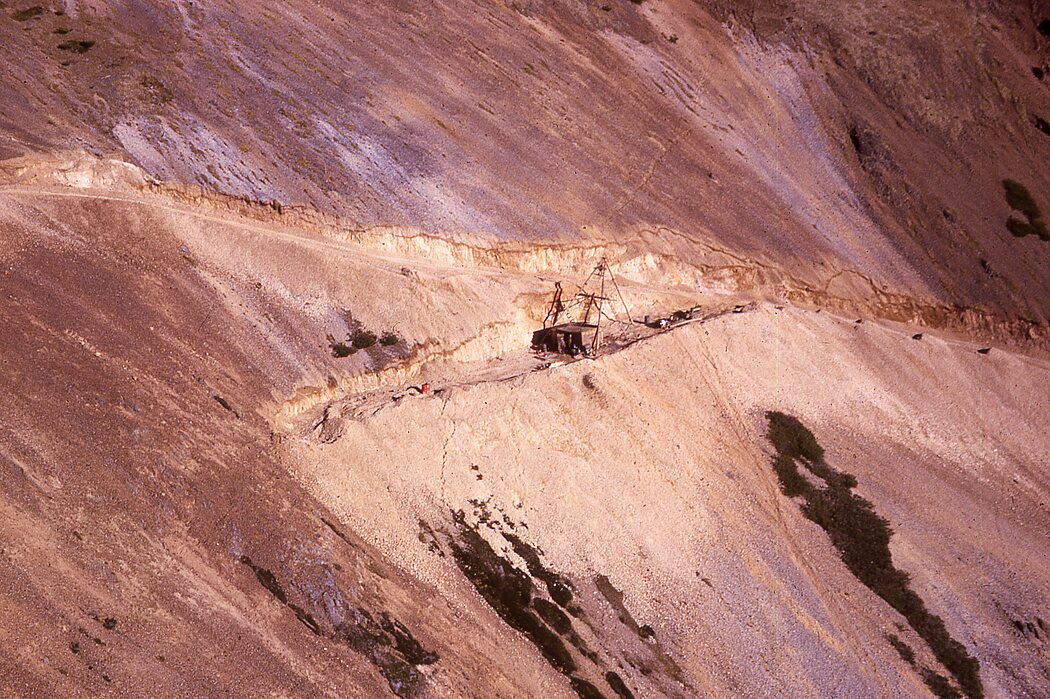
The Big Onion copper-molybdenum deposit is located on the south side of Astlais Mountain, about 19 kilometres east of Smithers, British Columbia, in the Omineca Mining Division.
There is an extended description of the property on the British Columbia “Minfile” site, current to 2015, to which interested readers are referred. A somewhat briefer description by Carter (1981) (after Sutherland Brown, 1967) is quoted below:
“Big Onion property is underlain by Hazelton andesitic volcanic rocks that are intruded by an elongate complex pluton . . . . The pluton is formed of two phases: an early quartz feldspar porphyry which forms a sheath around a later quartz diorite porphyry. The quartz feldspar porphyry is a white aphanitic rock with a few scattered quartz phenocrysts 1 to 4 millimetres in size. Pyrite may form up to 3 per cent of the rock and exposures are commonly iron stained. The quartz diorite porphyry is a medium-grained grey rock with sericitized plagioclase and chloritized hornblende and biotite phenocrysts 3 to 7 millimetres in size.
Copper and molybdenum mineralization is widely distributed near the contacts of the two intrusive phases and in the peripheral volcanic rocks. Chalcopyrite, molybdenite, and minor bornite occur in a stockwork of quartz-filled fractures and as disseminations. The best copper mineralization occurs within the quartz diorite porphyry and molybdenite is mainly restricted to the quartz feldspar porphyry. Pyrite is best developed in volcanic rocks near the intrusive contact.
Postmineralization dykes include a northerly striking quartz monzonite dyke and several varieties of late hornblende andesite dykes.”
Giles Peatfield comments:
The property has a long exploration history, dating back to the discovery and first exploration work in the 1920’s (Hanson, 1925; Lay, 1928). The property then lay dormant until the early 1960’s. Subsequent exploration up to the 1990’s was described by Wojdak and Stock (1995) and in detail on the British Columbia “Minfile” page for Big Onion (093L 124) for the entire history of the property up to 2012.
There have been a number of radiometric ages published for the intrusive rocks at the Big Onion property. Carter (1981, Table 7) reported a date of 48.7 ± 1.9 my [million years - Ma] for a sample (NC-67-7) taken from “. . . the postmineral quartz monzonite dyke.” Note that on Carter’s map of the property (1981, p. 125) the date is quoted as 48.6 my. Wojdak and Stock (1995) noted that “Using revised K-Ar decay constants Carter’s data [sic - date?] is recalculated at 49.5 ± 1.9 Ma.” Further, Wojdak and Stock (1995) wrote that “A sample of strongly sericitized QFP [quartz feldspar porphyry] collected by C. Godwin and analyzed by J. Harakal in 1980 and 1982 at The University of British Columbia produced whole rock K-Ar ages of 117 ± 4 and 112 ± 4 Ma (Mortenson, pers. comm., 1994).”
With regard to resources and reserves, Wojdak and Stock (1995) reported that “Stock (1977) calculated a mineral inventory to a depth of 150 m: [Stock’s total tonnage (probable and possible) was given as 94,380 thousand tonnes grading 0.42% Cu and 0.020% MoS2]. In 1982, Canadian Superior [Exploration Ltd.] commissioned a study to estimate the mineable reserves and pit design. At a cutoff grade of 0.25% Cu equivalent, the Big Onion deposit was estimated to contain 69 million tonnes grading 0.397% Cu equivalent at a stripping ratio of 2.18 (Sampson, 1991). From its drill data, Varitech [Resources Ltd.] estimated the supergene portion of the reserve to be 32 million tonnes grading 0.34% Cu, 0.064 g/t Au and 1.0 g/t Ag (McCrossan, 1991).” Note that none of these “estimates” were likely to meet current NI [Canadian Regulatory National Instrument] 43-101 standards. The use of the term “reserves” is limited to cases where there is a qualified report demonstrating potential economic viability. Finally, Hanson (2009) reported that “The most recent resource estimate (Giroux 2009) [presumably he meant in Hanson and Giroux, 2009] reported an indicated resource of 87,100,000 tonnes grading 0.303% copper and 0.0084% molybdenum using a cut-off of 0.20% copper and a specific gravity of 2.73 g/cm3.” This report does not appear to have been filed, and Mr. Giroux is reluctant to release it without permission (email communication 29 October 2023). Based on my consulting association with Mr. Giroux I would be prepared to accept the resource number as compliant, but as given it lacks much of the detail that would be desirable. As a final point, McCrossan (1991) reported some elevated gold and silver values in material from the supergene zone, but details are lacking and I would regard these number as questionable.
Giles Peatfield comments on the minerals reported:
The original posting on Mindat included a list of ten valid minerals, taken from Singer, et al. (2008), who apparently derived their information from Carter (1981) and from Wojdak and Stock (1995). The above list contains a large number of other minerals, referred to in the latter two and various other publications. Comments on all minerals are given below:
Amphibole group: Sutherland Brown (1967) described both relatively fresh and altered hornblende in different rock types. Wojdak and Stock (1995) described hornblende in a “hornblende porphyry dike”.
Azurite: This was reported by L’Orsa (1967), who noted that “Copper sulphides exposed to weathering form malachite and, less commonly, azurite throughout the property.”
Bornite: This was reported by Sutherland Brown (1967) as a minor constituent of the mineralized material. Other workers agreed.
Calcite: Although presumably common, calcite was only specifically mentioned by L’Orsa (1967) and by Wojdak and Stock (1995).
Chalcocite: This mineral was reported as a supergene alteration of copper sulfides, by L’Orsa (1967), by Wojdak and Stock (1995), and by Hanson (2009).
Chalcopyrite: This is the principal copper mineral at Big Onion, first reported by Hanson (1925) and by all subsequent workers except Lay (1928). It is generally finally disseminated in various intrusive rocks, or in fine quartz-filled fractures.
Chlorite group: “chlorite” was reported by Sutherland Brown (1967) and by Wojdak and Stock (1995), as an alteration mineral.
Clinozoisite: Sutherland Brown (1967) reported clinozoisite as an alteration product in feldspars.
Copper: Native copper was reported by Wojdak and Stock (1995) as a rare constituent of the supergene altered zone.
Covellite: Wojdak and Stock (1995) reported covellite from the supergene zone.
Epidote: Sutherland Brown (1967) described “minor” occurrences of epidote. L’Orsa (1967) described epidote as common in altered volcanic rocks, and less so in some of the altered intrusive rocks.
Feldspar group: Several species of feldspar, dominantly plagioclase and orthoclase, have been reported by several workers. Sutherland Brown (1967) is the most useful reference in this regard.
Hematite: Hanson (1925) reported specularite in small gash veinlets with quartz, pyrite and chalcopyrite. Hematite was reported by L’Orsa (1967) reported that “In places along the quartz porphyry-andesite contact minor chalcopyrite is found in small lenses of massive magnetite and hematite.”
Jarosite? Sutherland Brown (1967) mentioned that “Commonly natural exposures are coated with jarosite or limonite.” One suspects that limonite is more likely, but cannot rule out jarosite.
Kaolinite: Sutherland Brown (1967) reported kaolinite as a constituent of altered feldspar.
Limonite: Lay (1928) reported that, on what was then known as the Cimbria property, “At about 2,000 feet north-east of the tunnels, at an elevation of 4,330 feet, the granitic rock is overlain by a bed of limonite about 5 feet in thickness, evidently of recent origin by reason of the limonitized twigs and leaves present.” In 1966, I (Giles Peatfield) collected small limonite “stalactites” from the back of one of the tunnels, and donated them to the mineral collection at the University of British Columbia; this material is still in the collection of the Pacific Museum of Earth, specimen number S-74-1368.
Mackinawite: Hanson (2009) reported that “2007 microscopy work to support metallurgical tests revealed Mackinawite within a chalcopyrite inclusion in pyrite, . . . .”
Magnetite: This is probably common on the property, but has been specifically mentioned only by Sutherland Brown (1967) and by L’Orsa (1967).
Malachite: Lay (1928) mentioned “copper stain”, by which he probably meant malachite. L’Orsa reported both malachite and less common azurite.
Mica group: There are multiple references to biotite, muscovite and sericite. For more details see Sutherland Brown (1967) and Wojdak and Stock (1995).
Molybdenite: This was reported by several workers. L’Orsa (1967) described several modes of occurrence, of which the most important was molybdenite preferentially concentrated in quartz veins and/or silicified zones in quartz diorite [porphyry] and in quartz [feldspar] porphyry contact zones against quartz diorite porphyry.
Pyrite: This is ubiquitous, reported by all workers.
Quartz: This is also ubiquitous, reported by most workers.
Sphalerite: L’Orsa (1967) noted that “Minor sphalerite has been reported at the contact between quartz [feldspar] porphyry and andesite.”, although he did not say who the discoverer was.
Titanite: Sutherland Brown (1967) reported that “Mafic phenocrysts [in the quartz diorite porphyry] are now entirely chlorite, sphene [titanite], and opaque minerals derived mostly from original hornblende and with minor biotite.”
Giles Peatfield comments on the rock types reported:
The following are some comments on the various rock types listed above.
Andesite: Sutherland Brown (1967) described green and maroon andesites into which the various intrusive bodies were emplaced. Carter (1981) listed these rocks as part of the Jurassic Hazelton Group.
Hornblende andesite: Sutherland Brown (1967) described “. . . several varieties of small late hornblende andesite dykes.” Wojdak and Stock (1995) described “A smaller hornblende porphyry dike . . . .”
Quartz diorite porphyry: This is one of the principal intrusive rocks at Big Onion. Wojdak and Stock (1995) described these rocks as “Northeasterly trending dikes [that] intrude the core of the QFP [quartz feldspar porphyry].”
Quartz monzonite porphyry: Wojdak and Stock (1995) described “A north-striking quartz monzonite porphyry [dyke that] cuts off the southern end of the mineralized zone.”
Quartz feldspar porphyry: Wojdak and Stock (1995) wrote that “The oldest intrusive rock at the Big Onion deposit is a northeasterly trending dike of quartz feldspar porphyry (QFP) lying within the valley of Astlais Creek …. The unit is rhyolitic in composition . . . .” This is one of the principal hosts of copper mineralization, the other being the quartz diorite porphyry.
Tuff: Sutherland Brown (1967) described the maroon andesites (see above) as “. . . all fine grained tuffs in which the original glassy and lithic fragments are highly stained by very finely disseminated iron oxides.”
Giles Peatfield
BASc. (Geological Engineering) University of British Columbia 1966.
PhD Queen's University at Kingston 1978.
Worked for Texas Gulf Sulphur / Texasgulf Inc. / Kidd Creek Mines - 1966 to 1985.
Vancouver based consultant 1982 to retirement in 2016
Select Mineral List Type
Standard Detailed Gallery Strunz Chemical ElementsMineral List
21 valid minerals.
Rock Types Recorded
Note: data is currently VERY limited. Please bear with us while we work towards adding this information!
Select Rock List Type
Alphabetical List Tree DiagramDetailed Mineral List:
| ⓘ 'Amphibole Supergroup' Formula: AB2C5((Si,Al,Ti)8O22)(OH,F,Cl,O)2 References: |
| ⓘ Azurite Formula: Cu3(CO3)2(OH)2 References: |
| ⓘ 'Biotite' Formula: K(Fe2+/Mg)2(Al/Fe3+/Mg/Ti)([Si/Al/Fe]2Si2O10)(OH/F)2 |
| ⓘ Bornite Formula: Cu5FeS4 |
| ⓘ Calcite Formula: CaCO3 |
| ⓘ Chalcocite Formula: Cu2S |
| ⓘ Chalcopyrite Formula: CuFeS2 |
| ⓘ 'Chlorite Group' |
| ⓘ Clinozoisite Formula: (CaCa)(AlAlAl)O[Si2O7][SiO4](OH) References: |
| ⓘ Covellite Formula: CuS |
| ⓘ Epidote Formula: (CaCa)(AlAlFe3+)O[Si2O7][SiO4](OH) |
| ⓘ 'Feldspar Group' References: |
| ⓘ Hematite Formula: Fe2O3 References: |
| ⓘ Jarosite ? Formula: KFe3+3(SO4)2(OH)6 References: |
| ⓘ Kaolinite Formula: Al2(Si2O5)(OH)4 References: |
| ⓘ 'Limonite' References: |
| ⓘ Mackinawite Formula: FeS References: |
| ⓘ Magnetite Formula: Fe2+Fe3+2O4 References: |
| ⓘ Malachite Formula: Cu2(CO3)(OH)2 References: |
| ⓘ 'Mica Group' References: |
| ⓘ Molybdenite Formula: MoS2 |
| ⓘ Muscovite Formula: KAl2(AlSi3O10)(OH)2 |
| ⓘ Muscovite var. Sericite Formula: KAl2(AlSi3O10)(OH)2 |
| ⓘ Native Copper Formula: Cu |
| ⓘ Pyrite Formula: FeS2 |
| ⓘ Quartz Formula: SiO2 References: |
| ⓘ Sphalerite Formula: ZnS References: |
| ⓘ Titanite Formula: CaTi(SiO4)O References: |
Gallery:
List of minerals arranged by Strunz 10th Edition classification
| Group 1 - Elements | |||
|---|---|---|---|
| ⓘ | Native Copper | 1.AA.05 | Cu |
| Group 2 - Sulphides and Sulfosalts | |||
| ⓘ | Chalcocite | 2.BA.05 | Cu2S |
| ⓘ | Bornite | 2.BA.15 | Cu5FeS4 |
| ⓘ | Covellite | 2.CA.05a | CuS |
| ⓘ | Sphalerite | 2.CB.05a | ZnS |
| ⓘ | Chalcopyrite | 2.CB.10a | CuFeS2 |
| ⓘ | Mackinawite | 2.CC.25 | FeS |
| ⓘ | Molybdenite | 2.EA.30 | MoS2 |
| ⓘ | Pyrite | 2.EB.05a | FeS2 |
| Group 4 - Oxides and Hydroxides | |||
| ⓘ | Magnetite | 4.BB.05 | Fe2+Fe3+2O4 |
| ⓘ | Hematite | 4.CB.05 | Fe2O3 |
| ⓘ | Quartz | 4.DA.05 | SiO2 |
| Group 5 - Nitrates and Carbonates | |||
| ⓘ | Calcite | 5.AB.05 | CaCO3 |
| ⓘ | Azurite | 5.BA.05 | Cu3(CO3)2(OH)2 |
| ⓘ | Malachite | 5.BA.10 | Cu2(CO3)(OH)2 |
| Group 7 - Sulphates, Chromates, Molybdates and Tungstates | |||
| ⓘ | Jarosite ? | 7.BC.10 | KFe3+3(SO4)2(OH)6 |
| Group 9 - Silicates | |||
| ⓘ | Titanite | 9.AG.15 | CaTi(SiO4)O |
| ⓘ | Clinozoisite | 9.BG.05a | (CaCa)(AlAlAl)O[Si2O7][SiO4](OH) |
| ⓘ | Epidote | 9.BG.05a | (CaCa)(AlAlFe3+)O[Si2O7][SiO4](OH) |
| ⓘ | Muscovite | 9.EC.15 | KAl2(AlSi3O10)(OH)2 |
| ⓘ | var. Sericite | 9.EC.15 | KAl2(AlSi3O10)(OH)2 |
| ⓘ | Kaolinite | 9.ED.05 | Al2(Si2O5)(OH)4 |
| Unclassified | |||
| ⓘ | 'Amphibole Supergroup' | - | AB2C5((Si,Al,Ti)8O22)(OH,F,Cl,O)2 |
| ⓘ | 'Biotite' | - | K(Fe2+/Mg)2(Al/Fe3+/Mg/Ti)([Si/Al/Fe]2Si2O10)(OH/F)2 |
| ⓘ | 'Chlorite Group' | - | |
| ⓘ | 'Feldspar Group' | - | |
| ⓘ | 'Limonite' | - | |
| ⓘ | 'Mica Group' | - | |
List of minerals for each chemical element
| H | Hydrogen | |
|---|---|---|
| H | ⓘ Amphibole Supergroup | AB2C5((Si,Al,Ti)8O22)(OH,F,Cl,O)2 |
| H | ⓘ Azurite | Cu3(CO3)2(OH)2 |
| H | ⓘ Biotite | K(Fe2+/Mg)2(Al/Fe3+/Mg/Ti)([Si/Al/Fe]2Si2O10)(OH/F)2 |
| H | ⓘ Clinozoisite | (CaCa)(AlAlAl)O[Si2O7][SiO4](OH) |
| H | ⓘ Epidote | (CaCa)(AlAlFe3+)O[Si2O7][SiO4](OH) |
| H | ⓘ Jarosite | KFe33+(SO4)2(OH)6 |
| H | ⓘ Kaolinite | Al2(Si2O5)(OH)4 |
| H | ⓘ Malachite | Cu2(CO3)(OH)2 |
| H | ⓘ Muscovite | KAl2(AlSi3O10)(OH)2 |
| H | ⓘ Muscovite var. Sericite | KAl2(AlSi3O10)(OH)2 |
| C | Carbon | |
| C | ⓘ Azurite | Cu3(CO3)2(OH)2 |
| C | ⓘ Calcite | CaCO3 |
| C | ⓘ Malachite | Cu2(CO3)(OH)2 |
| O | Oxygen | |
| O | ⓘ Amphibole Supergroup | AB2C5((Si,Al,Ti)8O22)(OH,F,Cl,O)2 |
| O | ⓘ Azurite | Cu3(CO3)2(OH)2 |
| O | ⓘ Biotite | K(Fe2+/Mg)2(Al/Fe3+/Mg/Ti)([Si/Al/Fe]2Si2O10)(OH/F)2 |
| O | ⓘ Calcite | CaCO3 |
| O | ⓘ Clinozoisite | (CaCa)(AlAlAl)O[Si2O7][SiO4](OH) |
| O | ⓘ Epidote | (CaCa)(AlAlFe3+)O[Si2O7][SiO4](OH) |
| O | ⓘ Hematite | Fe2O3 |
| O | ⓘ Jarosite | KFe33+(SO4)2(OH)6 |
| O | ⓘ Kaolinite | Al2(Si2O5)(OH)4 |
| O | ⓘ Magnetite | Fe2+Fe23+O4 |
| O | ⓘ Malachite | Cu2(CO3)(OH)2 |
| O | ⓘ Muscovite | KAl2(AlSi3O10)(OH)2 |
| O | ⓘ Quartz | SiO2 |
| O | ⓘ Titanite | CaTi(SiO4)O |
| O | ⓘ Muscovite var. Sericite | KAl2(AlSi3O10)(OH)2 |
| F | Fluorine | |
| F | ⓘ Amphibole Supergroup | AB2C5((Si,Al,Ti)8O22)(OH,F,Cl,O)2 |
| F | ⓘ Biotite | K(Fe2+/Mg)2(Al/Fe3+/Mg/Ti)([Si/Al/Fe]2Si2O10)(OH/F)2 |
| Mg | Magnesium | |
| Mg | ⓘ Biotite | K(Fe2+/Mg)2(Al/Fe3+/Mg/Ti)([Si/Al/Fe]2Si2O10)(OH/F)2 |
| Al | Aluminium | |
| Al | ⓘ Amphibole Supergroup | AB2C5((Si,Al,Ti)8O22)(OH,F,Cl,O)2 |
| Al | ⓘ Biotite | K(Fe2+/Mg)2(Al/Fe3+/Mg/Ti)([Si/Al/Fe]2Si2O10)(OH/F)2 |
| Al | ⓘ Clinozoisite | (CaCa)(AlAlAl)O[Si2O7][SiO4](OH) |
| Al | ⓘ Epidote | (CaCa)(AlAlFe3+)O[Si2O7][SiO4](OH) |
| Al | ⓘ Kaolinite | Al2(Si2O5)(OH)4 |
| Al | ⓘ Muscovite | KAl2(AlSi3O10)(OH)2 |
| Al | ⓘ Muscovite var. Sericite | KAl2(AlSi3O10)(OH)2 |
| Si | Silicon | |
| Si | ⓘ Amphibole Supergroup | AB2C5((Si,Al,Ti)8O22)(OH,F,Cl,O)2 |
| Si | ⓘ Biotite | K(Fe2+/Mg)2(Al/Fe3+/Mg/Ti)([Si/Al/Fe]2Si2O10)(OH/F)2 |
| Si | ⓘ Clinozoisite | (CaCa)(AlAlAl)O[Si2O7][SiO4](OH) |
| Si | ⓘ Epidote | (CaCa)(AlAlFe3+)O[Si2O7][SiO4](OH) |
| Si | ⓘ Kaolinite | Al2(Si2O5)(OH)4 |
| Si | ⓘ Muscovite | KAl2(AlSi3O10)(OH)2 |
| Si | ⓘ Quartz | SiO2 |
| Si | ⓘ Titanite | CaTi(SiO4)O |
| Si | ⓘ Muscovite var. Sericite | KAl2(AlSi3O10)(OH)2 |
| S | Sulfur | |
| S | ⓘ Bornite | Cu5FeS4 |
| S | ⓘ Chalcopyrite | CuFeS2 |
| S | ⓘ Chalcocite | Cu2S |
| S | ⓘ Covellite | CuS |
| S | ⓘ Jarosite | KFe33+(SO4)2(OH)6 |
| S | ⓘ Mackinawite | FeS |
| S | ⓘ Molybdenite | MoS2 |
| S | ⓘ Pyrite | FeS2 |
| S | ⓘ Sphalerite | ZnS |
| Cl | Chlorine | |
| Cl | ⓘ Amphibole Supergroup | AB2C5((Si,Al,Ti)8O22)(OH,F,Cl,O)2 |
| K | Potassium | |
| K | ⓘ Biotite | K(Fe2+/Mg)2(Al/Fe3+/Mg/Ti)([Si/Al/Fe]2Si2O10)(OH/F)2 |
| K | ⓘ Jarosite | KFe33+(SO4)2(OH)6 |
| K | ⓘ Muscovite | KAl2(AlSi3O10)(OH)2 |
| K | ⓘ Muscovite var. Sericite | KAl2(AlSi3O10)(OH)2 |
| Ca | Calcium | |
| Ca | ⓘ Calcite | CaCO3 |
| Ca | ⓘ Clinozoisite | (CaCa)(AlAlAl)O[Si2O7][SiO4](OH) |
| Ca | ⓘ Epidote | (CaCa)(AlAlFe3+)O[Si2O7][SiO4](OH) |
| Ca | ⓘ Titanite | CaTi(SiO4)O |
| Ti | Titanium | |
| Ti | ⓘ Amphibole Supergroup | AB2C5((Si,Al,Ti)8O22)(OH,F,Cl,O)2 |
| Ti | ⓘ Biotite | K(Fe2+/Mg)2(Al/Fe3+/Mg/Ti)([Si/Al/Fe]2Si2O10)(OH/F)2 |
| Ti | ⓘ Titanite | CaTi(SiO4)O |
| Fe | Iron | |
| Fe | ⓘ Biotite | K(Fe2+/Mg)2(Al/Fe3+/Mg/Ti)([Si/Al/Fe]2Si2O10)(OH/F)2 |
| Fe | ⓘ Bornite | Cu5FeS4 |
| Fe | ⓘ Chalcopyrite | CuFeS2 |
| Fe | ⓘ Epidote | (CaCa)(AlAlFe3+)O[Si2O7][SiO4](OH) |
| Fe | ⓘ Hematite | Fe2O3 |
| Fe | ⓘ Jarosite | KFe33+(SO4)2(OH)6 |
| Fe | ⓘ Mackinawite | FeS |
| Fe | ⓘ Magnetite | Fe2+Fe23+O4 |
| Fe | ⓘ Pyrite | FeS2 |
| Cu | Copper | |
| Cu | ⓘ Azurite | Cu3(CO3)2(OH)2 |
| Cu | ⓘ Bornite | Cu5FeS4 |
| Cu | ⓘ Chalcopyrite | CuFeS2 |
| Cu | ⓘ Chalcocite | Cu2S |
| Cu | ⓘ Covellite | CuS |
| Cu | ⓘ Native Copper | Cu |
| Cu | ⓘ Malachite | Cu2(CO3)(OH)2 |
| Zn | Zinc | |
| Zn | ⓘ Sphalerite | ZnS |
| Mo | Molybdenum | |
| Mo | ⓘ Molybdenite | MoS2 |
Other Databases
| Link to British Columbia Minfile: | 093L 124 |
|---|
Other Regions, Features and Areas containing this locality
Canada
- Interior MountainsMountain Range
North AmericaContinent
North America PlateTectonic Plate
- StikiniaVolcanic Arc
This page contains all mineral locality references listed on mindat.org. This does not claim to be a complete list. If you know of more minerals from this site, please register so you can add to our database. This locality information is for reference purposes only. You should never attempt to
visit any sites listed in mindat.org without first ensuring that you have the permission of the land and/or mineral rights holders
for access and that you are aware of all safety precautions necessary.

Big Onion copper-molybdenum deposit, Smithers, Omineca Mining Division, British Columbia, Canada