
Andesite
A rock classification type
This page is currently not sponsored. Click here to sponsor this page.


About Andesite
Name:
It was named by Buch in 1826 from the Andes Mountains, South America.
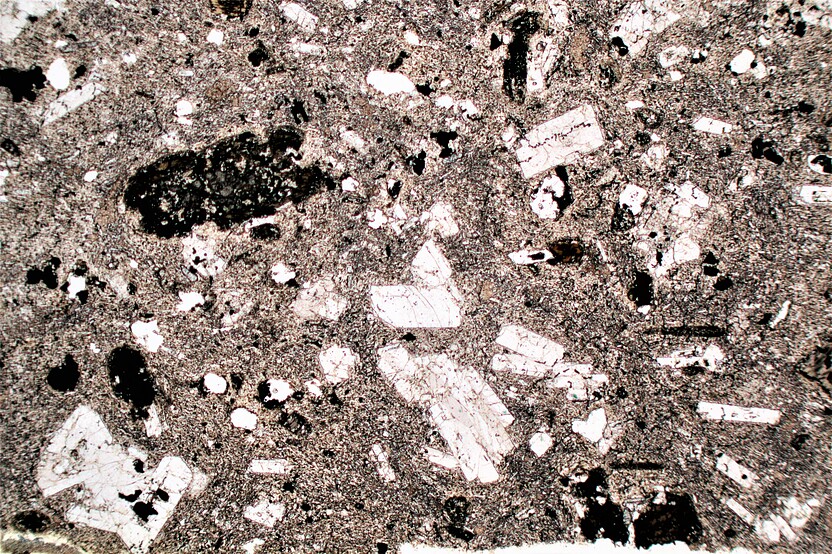
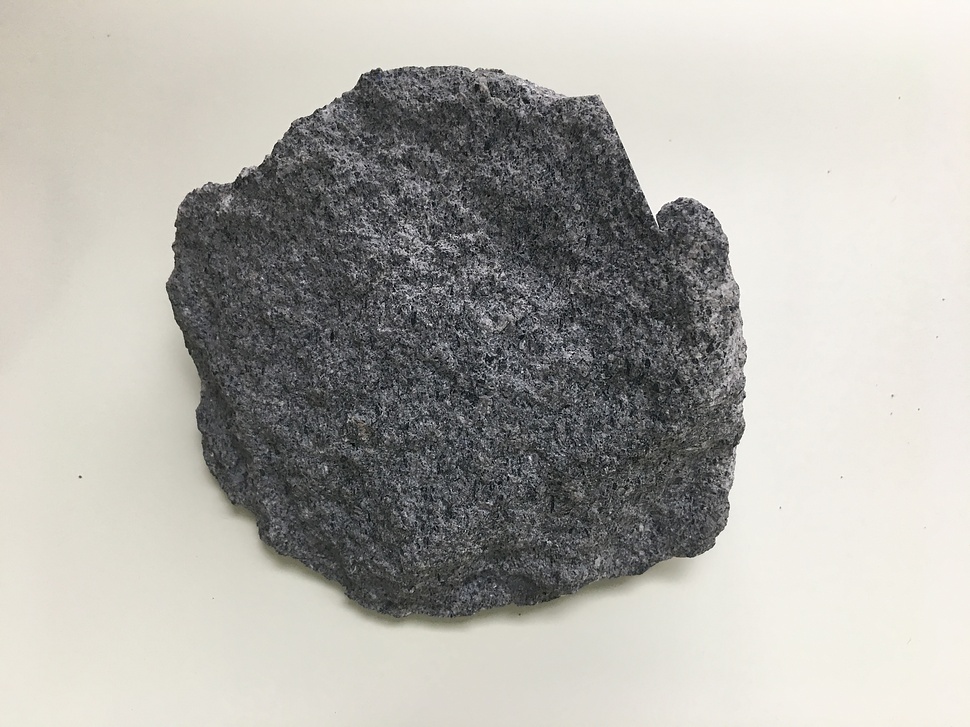
A dark-colored, fine-grained, mostly extrusive rock that is approximately the fine-grained equivalent of diorite. When porphyritic, andesites contain phenocrysts composed primarily of zoned sodic plagioclase (esp. andesine) and one or more mafic minerals (e.g., biotite, hornblende, pyroxene, usually <20%), with a groundmass composed generally of the same minerals as the phenocrysts, although the plagioclase may be more sodic, and quartz is generally present in small amounts.
Andesite grades into latite with increasing alkali feldspar content, or into dacite with more alkali feldspar and quartz. Basalt is similar but with more mafic minerals (especially olivine) and minimal or no quartz or alkali feldspar; basaltic andesite is intermediate.
Andesitic rocks (andesitoids), including andesite and basaltic andesite, plot on the QAPF diagram with 0-20% quartz, <10% feldspathoids and with >65% of feldspars being plagioclase; this puts them in fields 9, 9*, 9’, 10, 10* and 10’ (basaltic and andesitic rocks). They differ from basalts in being more silica rich (>52%), with less mafic minerals. Andesite itself is defined as being in field 9. Because it is difficult to determine the mineralogy when fine grained, andesite is also defined by chemistry on the TAS diagram: 57-63% SiO2, (Na2O+K2O)<~6%. Depending on which definition is used, andesite may plot variably on these diagrams.
Andesite grades into latite with increasing alkali feldspar content, or into dacite with more alkali feldspar and quartz. Basalt is similar but with more mafic minerals (especially olivine) and minimal or no quartz or alkali feldspar; basaltic andesite is intermediate.
Andesitic rocks (andesitoids), including andesite and basaltic andesite, plot on the QAPF diagram with 0-20% quartz, <10% feldspathoids and with >65% of feldspars being plagioclase; this puts them in fields 9, 9*, 9’, 10, 10* and 10’ (basaltic and andesitic rocks). They differ from basalts in being more silica rich (>52%), with less mafic minerals. Andesite itself is defined as being in field 9. Because it is difficult to determine the mineralogy when fine grained, andesite is also defined by chemistry on the TAS diagram: 57-63% SiO2, (Na2O+K2O)<~6%. Depending on which definition is used, andesite may plot variably on these diagrams.
Unique Identifiers
Mindat ID:
48484
Long-form identifier:
mindat:1:1:48484:6
Similar Names
Classification of Andesite
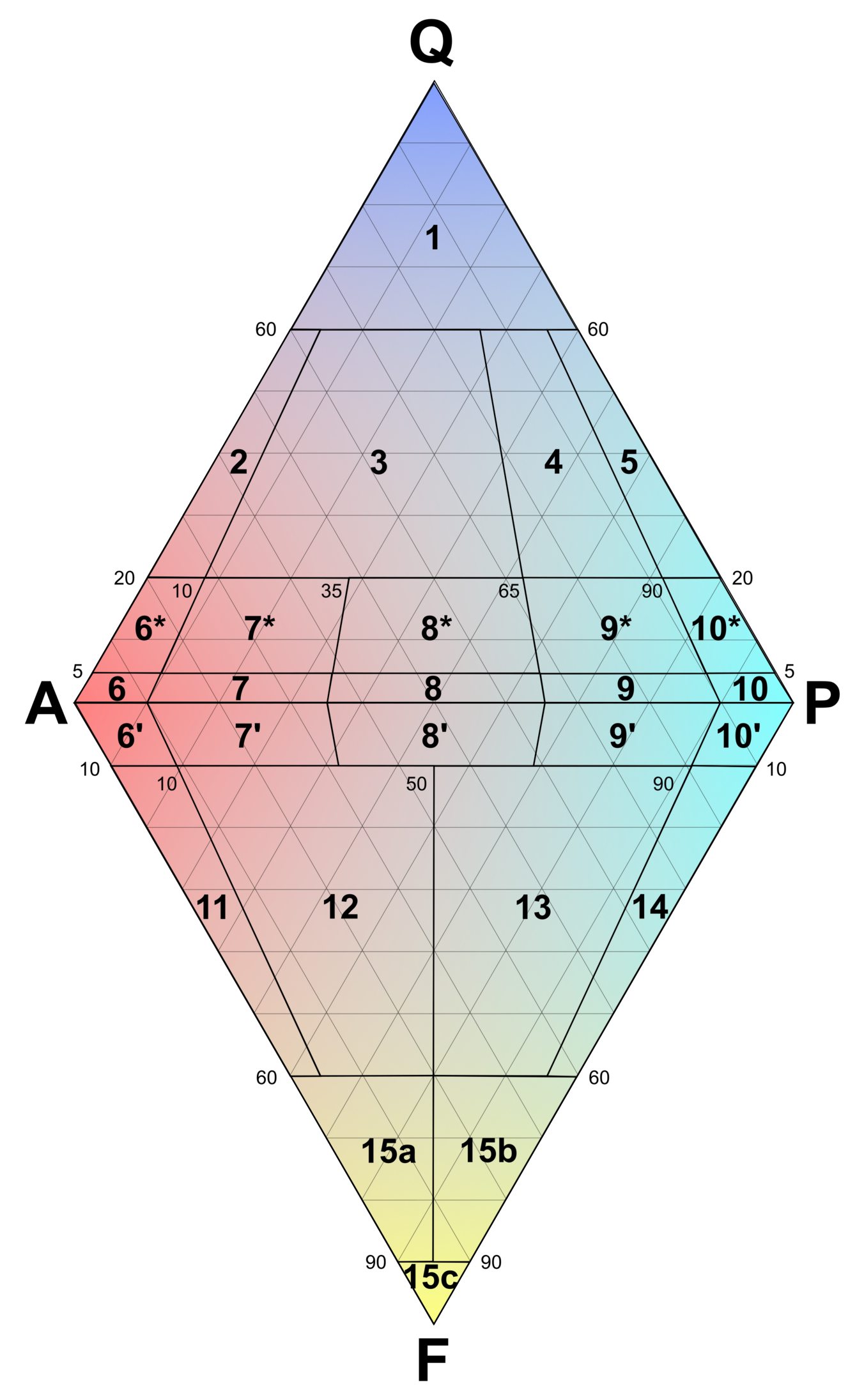
Andesite appears mostly in field 9 in the QAPF diagram

Andesite is found in field O2 in the TAS diagram.
Sub-divisions of Andesite
Mineralogy of Andesite
Essential minerals - these are minerals that are required within the classification of this rock:
| Feldspar > Plagioclase | (Na,Ca)[(Si,Al)AlSi2]O8 |
Non-essential minerals - these minerals are common, sometimes major components, but are not always present:
| Amphibole > Hornblende | AnCa2(Z2+5-mZ3+m)(Si8-(n+m)Al(n+m))(OH,F,Cl)2 |
| Mica > Biotite | K(Fe2+/Mg)2(Al/Fe3+/Mg/Ti)([Si/Al/Fe]2Si2O10)(OH/F)2 |
| Pyroxene | A petrological term for Pyroxene Group. |
Common Associates
Associations Based on Photo Data:
| 16 photos of Andesite associated with Plagioclase | (Na,Ca)[(Si,Al)AlSi2]O8 |
| 10 photos of Andesite associated with Hornblende Root Name Group | ◻Ca2(C2+4C3+)(AlSi7O22)W2 |
| 6 photos of Andesite associated with Biotite | K(Fe2+/Mg)2(Al/Fe3+/Mg/Ti)([Si/Al/Fe]2Si2O10)(OH/F)2 |
| 4 photos of Andesite associated with Trioctahedral mica | |
| 4 photos of Andesite associated with Native Gold | Au |
| 4 photos of Andesite associated with Alunite | KAl3(SO4)2(OH)6 |
| 3 photos of Andesite associated with Almandine | Fe2+3Al2(SiO4)3 |
| 3 photos of Andesite associated with Magnetite | Fe2+Fe3+2O4 |
| 3 photos of Andesite associated with 'Agate' | SiO2 |
| 2 photos of Andesite associated with 'Fayalite-Forsterite Series' |
Internet Links for Andesite
mindat.org URL:
https://www.mindat.org/min-48484.html
Please feel free to link to this page.
Please feel free to link to this page.
References for Andesite
Reference List:

Wolkenburg, Königswinter, Rhein-Sieg-Kreis, Cologne, North Rhine-Westphalia, Germany