
Hafnon
A valid IMA mineral species
This page is currently not sponsored. Click here to sponsor this page.


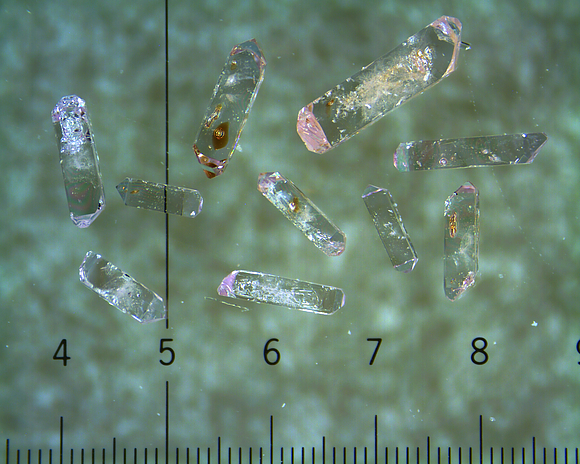


About Hafnon
Formula:
Hf(SiO4)
Colour:
Red-orange, brown-yellow, colourless (rare)
Hardness:
7½
Specific Gravity:
6.97 (Calculated)
Crystal System:
Tetragonal
Member of:
Name:
In allusion to its composition, being a silicate of HAFNium, and ending in "ON" in allusion to, and to be consistent with, its relationship to Zircon.
The hafnium analogue of Thorite and Zircon. Its physical properties are similar to those of zircon, so without an analysis it is not possible to positively identify a specimen as hafnon.
An isomorphous series exists between ZrSiO4-HfSiO4, the Hafnon-Zircon Series.
If a (Hf,Zr)SiO4 sample is Hf-dominant (i.e. Hf>Zr) then it is named hafnon, otherwise it is zircon. For Zr-rich hafnon and Hf-rich zircon the modifiers "Hf/Zr-bearing" or "Hf/Zr-rich" can be used.
Currently the only hafnium-dominant mineral known, although native hafnium (not approved) was announced quite recently.
Type locality: See discussion on messageboard at https://www.mindat.org/mesg-558525.html.
An isomorphous series exists between ZrSiO4-HfSiO4, the Hafnon-Zircon Series.
If a (Hf,Zr)SiO4 sample is Hf-dominant (i.e. Hf>Zr) then it is named hafnon, otherwise it is zircon. For Zr-rich hafnon and Hf-rich zircon the modifiers "Hf/Zr-bearing" or "Hf/Zr-rich" can be used.
Currently the only hafnium-dominant mineral known, although native hafnium (not approved) was announced quite recently.
Type locality: See discussion on messageboard at https://www.mindat.org/mesg-558525.html.
Unique Identifiers
Mindat ID:
1792
Long-form identifier:
mindat:1:1:1792:9
IMA Classification of Hafnon
Approved
IMA Formula:
Hf4+SiO4
Approval year:
1974
Classification of Hafnon
9.AD.30
9 : SILICATES (Germanates)
A : Nesosilicates
D : Nesosilicates without additional anions; cations in [6] and/or greater coordination
9 : SILICATES (Germanates)
A : Nesosilicates
D : Nesosilicates without additional anions; cations in [6] and/or greater coordination
51.5.2.2
51 : NESOSILICATES Insular SiO4 Groups Only
5 : Insular SiO4 Groups Only with cations in >[6] coordination
51 : NESOSILICATES Insular SiO4 Groups Only
5 : Insular SiO4 Groups Only with cations in >[6] coordination
14.10.2
14 : Silicates not Containing Aluminum
10 : Silicates of Zr or Hf
14 : Silicates not Containing Aluminum
10 : Silicates of Zr or Hf
Mineral Symbols
As of 2021 there are now IMA–CNMNC approved mineral symbols (abbreviations) for each mineral species, useful for tables and diagrams.
| Symbol | Source | Reference for Standard |
|---|---|---|
| Haf | IMA–CNMNC | Warr, L.N. (2021). IMA–CNMNC approved mineral symbols. Mineralogical Magazine, 85(3), 291-320. doi:10.1180/mgm.2021.43 |
Pronunciation of Hafnon
Pronunciation:
| Play | Recorded by | Country |
|---|---|---|
| Jolyon Ralph | United Kingdom |
Physical Properties of Hafnon
Transparency:
Transparent, Translucent
Colour:
Red-orange, brown-yellow, colourless (rare)
Hardness:
7½ on Mohs scale
Density:
6.97 g/cm3 (Calculated)
Comment:
data for the synthetic material
Optical Data of Hafnon
Type:
Uniaxial (+)
RI values:
nω = 1.93 - 1.97 nε = 1.98 - 2.03
Max. Birefringence:
δ = 0.050 - 0.060
Based on recorded range of RI values above.
Based on recorded range of RI values above.
Interference Colours:
The colours simulate birefringence patterns seen in thin section under crossed polars. They do not take into account mineral colouration or opacity.
Michel-Levy Bar The default colours simulate the birefringence range for a 30 µm thin-section thickness. Adjust the slider to simulate a different thickness.
Grain Simulation You can rotate the grain simulation to show how this range might look as you rotated a sample under crossed polars. Each grain retains its interference colour (retardation) while its brightness falls to black at extinction and reaches a maximum between extinction positions.
The colours simulate birefringence patterns seen in thin section under crossed polars. They do not take into account mineral colouration or opacity.
Michel-Levy Bar The default colours simulate the birefringence range for a 30 µm thin-section thickness. Adjust the slider to simulate a different thickness.
Grain Simulation You can rotate the grain simulation to show how this range might look as you rotated a sample under crossed polars. Each grain retains its interference colour (retardation) while its brightness falls to black at extinction and reaches a maximum between extinction positions.
Surface Relief:
Very High (positive)
Relative to Canada balsam mounting medium (n ≈ 1.537).
Relative to Canada balsam mounting medium (n ≈ 1.537).
This shows the grain boundary and Becke line effect under plane-polarised
light, based on the contrast between this mineral's average refractive
index and the mounting medium. It does not take into account mineral
colouration.
In focus
Interference Figure:
This shows the idealized uniaxial interference figure - the conoscopic
(convergent-light, Bertrand-lens-in) view, for a grain cut with the optic axis
centred and vertical. The coloured rings are isochromatics, computed with the
same physics as the Michel-Lévy bar above; the dark cross is the isogyre.
For a genuinely uniaxial mineral viewed this way, that cross stays perfectly stationary if you rotate the stage - unlike a biaxial mineral, where it splits apart on rotation. That invariance is itself the standard diagnostic test for telling uniaxial and biaxial minerals apart at the microscope.
For a genuinely uniaxial mineral viewed this way, that cross stays perfectly stationary if you rotate the stage - unlike a biaxial mineral, where it splits apart on rotation. That invariance is itself the standard diagnostic test for telling uniaxial and biaxial minerals apart at the microscope.
Chemistry of Hafnon
Mindat Formula:
Hf(SiO4)
Element Weights:
Elements listed:
Common Impurities:
Zr
Chemical Analysis
Oxide wt%:
| 1 | |
|---|---|
| SiO2 | 28.32 % |
| ZrO2 | 3.28 % |
| HfO2 | 69.78 % |
| Total: | 101.38 % |
Empirical formulas:
| Sample ID | Empirical Formula |
|---|---|
| 1 | (Hf0.80Zr0.06)Σ0.86Si1.14O4 |
Sample references:
| ID | Locality | Reference | Notes |
|---|---|---|---|
| 1 | Muiâne pegmatite, Muiane-Naipa group, Gilé District, Zambezia Province, Mozambique | Electron microprobe |
Crystallography of Hafnon
Crystal System:
Tetragonal
Class (H-M):
4/mmm(4/m2/m2/m) - Ditetragonal Dipyramidal
Space Group:
I41/amd
Cell Parameters:
a = 6.5725(7) Å, c = 5.9632(4) Å
Ratio:
a:c = 1 : 0.907
Unit Cell V:
257.60 ų (Calculated from Unit Cell)
Z:
4
Morphology:
Crystals euhedral to irregular. Often zoned with zircon.
Crystal Structure
Load
Unit Cell | Unit Cell Packed
2x2x2 | 3x3x3 | 4x4x4
Unit Cell | Unit Cell Packed
2x2x2 | 3x3x3 | 4x4x4
Show
Big Balls | Small Balls | Just Balls | Spacefill
Polyhedra Off | Si Polyhedra | All Polyhedra
Remove metal-metal sticks
Big Balls | Small Balls | Just Balls | Spacefill
Polyhedra Off | Si Polyhedra | All Polyhedra
Remove metal-metal sticks
Display Options
Black Background | White Background
Perspective On | Perspective Off
2D | Stereo | Red-Blue | Red-Cyan
Black Background | White Background
Perspective On | Perspective Off
2D | Stereo | Red-Blue | Red-Cyan
View
CIF File Best | x | y | z | a | b | c
CIF File Best | x | y | z | a | b | c
Rotation
Stop | Start
Stop | Start
Labels
Console Off | On | Grey | Yellow
Console Off | On | Grey | Yellow
Data courtesy of the American Mineralogist Crystal Structure Database. Click on an AMCSD ID to view structure
| ID | Species | Reference | Link | Year | Locality | Pressure (GPa) | Temp (K) |
|---|---|---|---|---|---|---|---|
| 0000871 | Hafnon | Speer J A, Cooper B J (1982) Crystal structure of synthetic hafnon, HfSiO4, comparison with zircon and the actinide orthosilicates American Mineralogist 67 804-808 |  | 1982 | 0 | 293 |
CIF Raw Data - click here to close
X-Ray Powder Diffraction
Powder Diffraction Data:
| d-spacing | Intensity |
|---|---|
| 3.29 Å | (100) |
| 2.512 Å | (70) |
| 4.43 Å | (60) |
| 1.705 Å | (55) |
| 2.638 Å | (25) |
| 2.057 Å | (20) |
| 2.324 Å | (18) |
Geological Environment
Paragenetic Mode(s):
| Paragenetic Mode | Earliest Age (Ga) |
|---|---|
| Stage 4b: Highly evolved igneous rocks | >3.0 |
| 34 : Complex granite pegmatites |
Geological Setting:
weathered pegmatite (Mt. Holland)
Type Occurrence of Hafnon
General Appearance of Type Material:
Zones in transparent, orange red colored, grain-zized fragments of euhedral zircon crystals with a high density.
Geological Setting of Type Material:
Heavy mineral concentrates from a tantalum-bearing granitic pegmatite.
Associated Minerals at Type Locality:
Synonyms of Hafnon
Other Language Names for Hafnon
Relationship of Hafnon to other Species
Member of:
Other Members of Zircon Group:
| Coffinite | U(SiO4) · nH2O | Tet. 4/mmm(4/m2/m2/m) : I41/amd |
| Reidite | Zr(SiO4) | Tet. 4/m : I41/a |
| Stetindite-(Ce) | Ce4+SiO4 | Tet. 4/mmm(4/m2/m2/m) : I41/amd |
| Thorite | Th(SiO4) | Tet. 4/mmm(4/m2/m2/m) : I41/amd |
| Zircon | Zr(SiO4) | Tet. 4/mmm(4/m2/m2/m) : I41/amd |
Forms a series with:
Common Associates
Associations Based on Photo Data:
| 2 photos of Hafnon associated with Albite | Na(AlSi3O8) |
| 2 photos of Hafnon associated with Zircon | Zr(SiO4) |
| 1 photo of Hafnon associated with Wodginite | Mn2+Sn4+Ta2O8 |
| 1 photo of Hafnon associated with 'Hafnian Zircon' | (Zr,Hf)SiO4 |
| 1 photo of Hafnon associated with Stibiotantalite | Sb3+TaO4 |
Related Minerals - Strunz-mindat Grouping
| 9.AD. | Adrianite | Ca12(Al4Mg3Si7)O32Cl6 |
| 9.AD.05 | Larnite | Ca2SiO4 |
| 9.AD.10 | Calcio-olivine | Ca2SiO4 |
| 9.AD.15 | Merwinite | Ca3Mg(SiO4)2 |
| 9.AD.20 | Bredigite | Ca7Mg(SiO4)4 |
| 9.AD.25 | Midbarite | Ca3Mg2(V5+2Si)O12 |
| 9.AD.25 | Menzerite-(Y) | (Y2Ca)Mg2(SiO4)3 |
| 9.AD.25 | Uvarovite | Ca3Cr3+2(SiO4)3 |
| 9.AD.25 | Eltyubyuite | Ca12Fe3+10Si4O32Cl6 |
| 9.AD.25 | Eringaite | Ca3Sc2(SiO4)3 |
| 9.AD.25 | Henritermierite | Ca3Mn3+2(SiO4)2[◻(OH)4] |
| 9.AD.25 va | 'Hydrougrandite' | (Ca,Mg,Fe2+)3(Fe3+,Al)2[(OH)4(SiO4)2] |
| 9.AD.25 | Calderite | Mn2+3Fe3+2(SiO4)3 |
| 9.AD.25 | Nikmelnikovite | Ca12(Fe2+Fe3+3Al3◻)[SiO4]6[◻(OH)4]5◻4 |
| 9.AD.25 | Hutcheonite | Ca3Ti2(SiO4)(AlO4)2 |
| 9.AD.25 | Wadalite | (Ca,Mg)6(Al,Fe3+)4((Si,Al)O4)3O4Cl3 |
| 9.AD.25 | Rubinite | Ca3Ti3+2(SiO4)3 |
| 9.AD.25 | Kerimasite | Ca3Zr2(SiO4)(Fe3+O4)2 |
| 9.AD.25 | Holtstamite | Ca3Al2(SiO4)2[◻(OH)4] |
| 9.AD.25 | Spessartine | Mn2+3Al2(SiO4)3 |
| 9.AD.25 | Toturite | Ca3Sn2(SiO4)(Fe3+O4)2 |
| 9.AD.25 | Kimzeyite | Ca3Zr2(SiO4)(AlO4)2 |
| 9.AD.25 | 'Khoharite' | Mg3Fe3+2(SiO4)3 |
| 9.AD.25 | Irinarassite | Ca3Sn2(SiO4)(AlO4)2 |
| 9.AD.25 | Knorringite | Mg3Cr3+2(SiO4)3 |
| 9.AD.25 | Goldmanite | Ca3V3+2(SiO4)3 |
| 9.AD.25 | 'Blythite' | Mn2+3Mn3+2[SiO4]3 |
| 9.AD.25 | 'Skiagite' | Fe2+3Fe3+2[SiO4]3 |
| 9.AD.25 | 'UM1984-37-SiO:CrMn' | Mn2+3Cr3+2(SiO4)3 |
| 9.AD.25 | Almandine | Fe2+3Al2(SiO4)3 |
| 9.AD.25 va | 'Yamatoite' | (Mn2+,Ca)3(V3+,Al)2(SiO4)3 |
| 9.AD.25 | Momoiite | Mn2+3V3+2(SiO4)3 |
| 9.AD.25 | Grossular | Ca3Al2(SiO4)3 |
| 9.AD.25 | Andradite | Ca3Fe3+2(SiO4)3 |
| 9.AD.25 | Morimotoite | Ca3(TiFe2+)(SiO4)3 |
| 9.AD.25 | Majorite | Mg3(MgSi)(SiO4)3 |
| 9.AD.25 | Pyrope | Mg3Al2(SiO4)3 |
| 9.AD.25 | Schorlomite | Ca3Ti2(SiO4)(Fe3+O4)2 |
| 9.AD.30 | Zircon | Zr(SiO4) |
| 9.AD.30 | Coffinite | U(SiO4) · nH2O |
| 9.AD.30 | Thorite | Th(SiO4) |
| 9.AD.30 va | 'Auerlite' | near Th(Si,P)O4 |
| 9.AD.30 | Stetindite-(Ce) | Ce4+SiO4 |
| 9.AD.35 | 'Tombarthite-(Y)' | Y4(Si,H4)4O12-x(OH)4+2x |
| 9.AD.35 | Huttonite | ThSiO4 |
| 9.AD.40 | Eulytine | Bi4(SiO4)3 |
| 9.AD.45 | Reidite | Zr(SiO4) |
| 9.AD.55 | Jeffbenite | Mg3Al2Si3O12 |
Other Information
Health Risks:
No information on health risks for this material has been entered into the database. You should always treat mineral specimens with care.
Internet Links for Hafnon
mindat.org URL:
https://www.mindat.org/min-1792.html
Please feel free to link to this page.
Please feel free to link to this page.
Search Engines:
External Links:
Mineral Dealers:
References for Hafnon
Reference List:
Ramakrishnan, S.S., Gokhale, K.V.G.K., Subbarao, E.C. (1969) Solid solubility in the system zircon - hafnon. Materials Research Bulletin, 4 (5). 323-327 doi:10.1016/0025-5408(69)90036-1
Ramakrishnan, S.S., Subbarao, E.C., Gokhale, K.V.G.K. (1970) Effect of solid solution of thermal stability of zircon. Materials Research Bulletin, 5 (11). 965-972 doi:10.1016/0025-5408(70)90147-9
Neves, J. M. Correia, Nunes, J. E. Lopes, Sahama, Th. G. (1974) High hafnium members of the zircon-hafnon series from the granite pegmatites of Zambézia, Mozambique. Contributions to Mineralogy and Petrology, 48 (1) 73-80 doi:10.1007/bf00399111
Nicola, J H, Rutt, H N (1974) A comparative study of zircon (ZrSiO4) and hafnon (HfSiO4) Raman spectra. Journal of Physics C: Solid State Physics, 7 (7). 1381-1386 doi:10.1088/0022-3719/7/7/029
Vance, E. R., Mackey, D. J. (1978) Optical spectra of U4+ and U5+ in zircon, hafnon, and thorite. Physical Review B, 18 (1). 185-189 doi:10.1103/physrevb.18.185
Meldrum, A., Zinkle, S. J., Boatner, L. A., Ewing, R. C. (1998) A transient liquid-like phase in the displacement cascades of zircon, hafnon and thorite. Nature, 395 (6697). 56-58 doi:10.1038/25698
Meldrum, A., Zinkle, S. J., Boatner, L. A., Ewing, R. C. (1999) Heavy-ion irradiation effects in the ABO4 orthosilicates: Decomposition, amorphization, and recrystallization. Physical Review B, 59 (6). 3981-3992 doi:10.1103/physrevb.59.3981
Lowery Claiborne, L., Miller, C. F., Walker, B. A., Wooden, J. L., Mazdab, F. K., Bea, F. (2006) Tracking magmatic processes through Zr/Hf ratios in rocks and Hf and Ti zoning in zircons: An example from the Spirit Mountain batholith, Nevada. Mineralogical Magazine, 70 (5) 517-543 doi:10.1180/0026461067050348
Van Lichtervelde, Marieke, Holtz, Francois, Hanchar, John M. (2010) Solubility of manganotantalite, zircon and hafnon in highly fluxed peralkaline to peraluminous pegmatitic melts. Contributions to Mineralogy and Petrology, 160 (1) 17-32 doi:10.1007/s00410-009-0462-x
Yin, R., Wang, R. C., Zhang, A.-C., Hu, H., Zhu, J. C., Rao, C., Zhang, H. (2013) Extreme fractionation from zircon to hafnon in the Koktokay No. 1 granitic pegmatite, Altai, northwestern China. American Mineralogist, 98 (10). 1714-1724 doi:10.2138/am.2013.4494
Anthony, John W., Bideaux, Richard A., Bladh, Kenneth W., Nichols, Monte C. - Eds. (2016) Handbook of Mineralogy. https://www.handbookofmineralogy.org/
Grüneberger, Anja Maria, Schmidt, Christian, Jahn, Sandro, Rhede, Dieter, Loges, Anselm, Wilke, Max (2016) Interpretation of Raman spectra of the zircon–hafnon solid solution. European Journal of Mineralogy, 28 (4) 721-733 doi:10.1127/ejm/2016/0028-2551
Neumann, Andreas, Kahlenberg, Volker, Lerche, Ian, Stöber, Stefan, Pöllmann, Herbert (2024) Synthesis and Characterization of Single Crystal Zircon-Hafnon Zr(1–x)Hf(x)SiO4 Solid Solutions and the Comparison with the Reaction Products of a TEOS-Based Hydrothermal Route. ACS Omega, 9 (14). 15781-15803 doi:10.1021/acsomega.3c06960
Localities for Hafnon
Showing 16 localities.
 symbol to view information about a locality.
The
symbol to view information about a locality.
The Locality List
 - This locality has map coordinates listed.
- This locality has estimated coordinates.
ⓘ - Click for references and further information on this occurrence.
? - Indicates mineral may be doubtful at this locality.
- This locality has map coordinates listed.
- This locality has estimated coordinates.
ⓘ - Click for references and further information on this occurrence.
? - Indicates mineral may be doubtful at this locality.
 - Good crystals or important locality for species.
 - World class for species or very significant.
(TL) - Type Locality for a valid mineral species.
(FRL) - First Recorded Locality for everything else (eg varieties).
- World class for species or very significant.
(TL) - Type Locality for a valid mineral species.
(FRL) - First Recorded Locality for everything else (eg varieties).
All localities listed without proper references should be considered as questionable.
Australia | |
| - (Perth 2007) +2 other references |
Canada | |
| Černý et al. (1977) +1 other reference |
| Verified Scott Ercit |
| Rock & Min. 82 +1 other reference |
China | |
| Yin et al. (2013) +1 other reference |
Morocco | |
| Fontan (1978) |
Mozambique | |
| Wilson et al. (2000) |
| MnhnL collection |
| Neves et al. (1974) |
| Neves et al. (1974) | |
| Neves et al. (1974) +1 other reference |
| Wolfgang Henckel |
Russia | |
| Kudryashov et al. (2020) |
USA | |
| "Mineralogy of the Ray Mica Mine |
Zimbabwe | |
| Černý et al. (2003) |
| J. W. Anthony et al.: Handbook of Mineralogy (1997) |
Quick NavTopAbout HafnonUnique IdentifiersIMA Classification Classification Mineral SymbolsPronunciation Physical Properties Optical Data Chemistry Chemical AnalysisCrystallography Crystal StructureX-Ray Powder DiffractionGeological EnvironmentType Occurrence SynonymsOther LanguagesRelationshipsCommon AssociatesStrunz-MindatOther InformationInternet Links References Localities Locality List
