
Quartz-beta
This page is currently not sponsored. Click here to sponsor this page.
Formula:
SiO2
Specific Gravity:
2.5334 (Calculated)
Crystal System:
Hexagonal
Member of:
Polymorph of:
A high-temperature (> ~573°C) polymorph of silica with a crystal structure very similar to that of quartz ("alpha-quartz"), but with a higher symmetry (beta-quartz: hexagonal, quartz: trigonal; Bragg and Gibbs, 1925; Heaney, 1994). Like quartz, beta-quartz occurs in left- and right-handed crystals.
It is not considered a formal mineral species by the IMA. Their structures have the same topology, so alpha- and beta-quartz are polymorphs, but not different species (Nickel and Grice, 1998). As it is not stable at room temperature and cannot be quenched from high temperatures. All "beta-quartz" or "quartz-beta" or "high quartz" in collections actually represent paramorphs of quartz after beta-quartz, or is simply just bipyramidal quartz crystals . This is why on Mindat there is not a single photo labelled "quartz-beta", they are all labelled quartz.
The phase transition is at about 573°C at ambient pressures. When heated quickly, beta-quartz melts at about 1550°C, otherwise it will turn into beta-cristobalite at around 1050°C. The temperature of the phase transition from quartz to beta-quartz increases with pressure.
"Beta-quartz" is most commonly found in silica-rich volcanic rocks like rhyolite, in which it occurs as stubby, bipyramidal and usually dull and gray crystals/paramorphs embedded in the matrix. This has led people to believe that quartz crystals with a bipyramidal habit from other, non-volcanic localities grew as beta-quartz, and the habit is unfortunately called "beta-type" or similar.
However, "beta-quartz" that grows freely in cavities frequently forms elongated crystals that are very similar to quartz, or even as very thin, needle-like crystals Eg: https://www.mindat.org/photo-214061.html
It is not considered a formal mineral species by the IMA. Their structures have the same topology, so alpha- and beta-quartz are polymorphs, but not different species (Nickel and Grice, 1998). As it is not stable at room temperature and cannot be quenched from high temperatures. All "beta-quartz" or "quartz-beta" or "high quartz" in collections actually represent paramorphs of quartz after beta-quartz, or is simply just bipyramidal quartz crystals . This is why on Mindat there is not a single photo labelled "quartz-beta", they are all labelled quartz.
The phase transition is at about 573°C at ambient pressures. When heated quickly, beta-quartz melts at about 1550°C, otherwise it will turn into beta-cristobalite at around 1050°C. The temperature of the phase transition from quartz to beta-quartz increases with pressure.
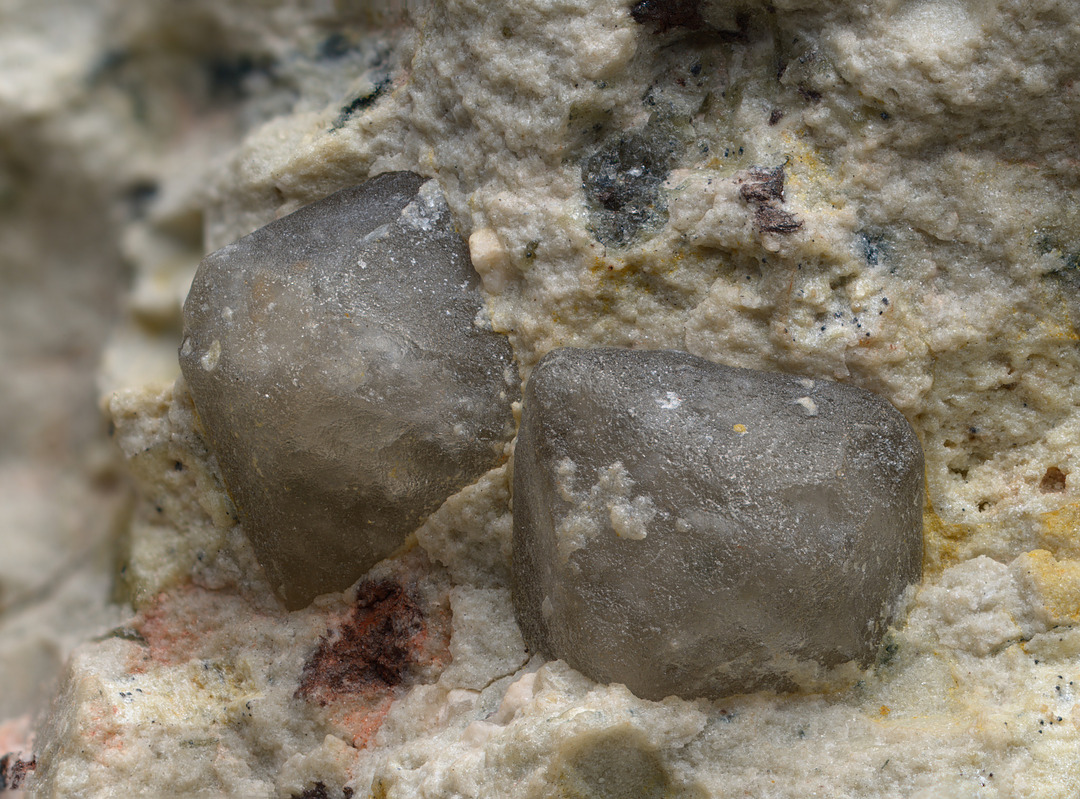
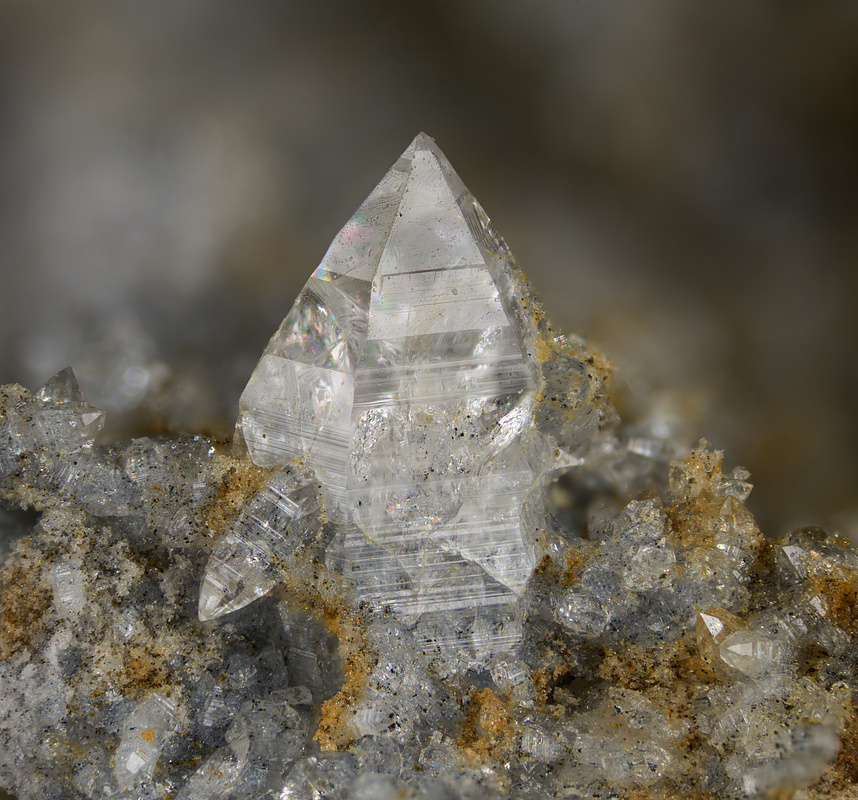
"Beta-quartz" is most commonly found in silica-rich volcanic rocks like rhyolite, in which it occurs as stubby, bipyramidal and usually dull and gray crystals/paramorphs embedded in the matrix. This has led people to believe that quartz crystals with a bipyramidal habit from other, non-volcanic localities grew as beta-quartz, and the habit is unfortunately called "beta-type" or similar.
However, "beta-quartz" that grows freely in cavities frequently forms elongated crystals that are very similar to quartz, or even as very thin, needle-like crystals Eg: https://www.mindat.org/photo-214061.html
Unique Identifiers
Mindat ID:
7395
Long-form identifier:
mindat:1:1:7395:6
Classification of Quartz-beta
4.DA.55
4 : OXIDES (Hydroxides, V[5,6] vanadates, arsenites, antimonites, bismuthites, sulfites, selenites, tellurites, iodates)
D : Metal: Oxygen = 1:2 and similar
A : With small cations: Silica family
4 : OXIDES (Hydroxides, V[5,6] vanadates, arsenites, antimonites, bismuthites, sulfites, selenites, tellurites, iodates)
D : Metal: Oxygen = 1:2 and similar
A : With small cations: Silica family
Physical Properties of Quartz-beta
Density:
2.5334 g/cm3 (Calculated)
Chemistry of Quartz-beta
Mindat Formula:
SiO2
Elements listed:
Crystallography of Quartz-beta
Crystal System:
Hexagonal
Class (H-M):
622 - Trapezohedral
Space Group:
P6422
Cell Parameters:
a = 4.9977 Å, c = 5.4601 Å
Ratio:
a:c = 1 : 1.093
Unit Cell V:
118.11 ų (Calculated from Unit Cell)
Synonyms of Quartz-beta
Other Language Names for Quartz-beta
German:Hochquarz
Relationship of Quartz-beta to other Species
Member of:
Other Members of Silica:
| Chibaite | SiO2 · n(CH4, C2H6, C3H8, i-C4H10) (n = 3/17 (max)) | Iso. m3(2/m3) : Fd3 |
| Coesite | SiO2 | Mon. 2/m : B2/b |
| Cristobalite | SiO2 | Tet. 422 : P41212 |
| 'Keatite' | SiO2 | Tet. 422 : P43212 |
| Lechatelierite | SiO2 | Amor. |
| Melanophlogite | 46SiO2 · 6(N2,CO2) · 2(CH4,N2) | Tet. 4/mmm(4/m2/m2/m) |
| Mogánite | SiO2 | Mon. 2/m |
| 'Opal-AG' | SiO2 · nH2O | |
| 'Opal-AN' | SiO2 · nH2O | |
| 'Opal-C' | SiO2 · nH2O | |
| 'Opal-CT' | SiO2 · nH2O | |
| Quartz | SiO2 | Trig. 32 : P3121 |
| Stishovite | SiO2 | Tet. 4/mmm(4/m2/m2/m) : P42/mnm |
| Tridymite | SiO2 | Tric. 1 |
| 'β-Cristobalite' | SiO2 | Iso. m3m(4/m32/m) : Fd3m |
| 'β-Tridymite' | SiO2 |
Common Associates
Associations Based on Photo Data:
| 5 photos of Quartz-beta associated with Calcite | CaCO3 |
| 2 photos of Quartz-beta associated with Pyroxene Group | ADSi2O6 |
| 1 photo of Quartz-beta associated with Hematite | Fe2O3 |
| 1 photo of Quartz-beta associated with 'Plume Agate' | SiO2 |
| 1 photo of Quartz-beta associated with 'Iris Agate' | SiO2 |
| 1 photo of Quartz-beta associated with 'δ-Quartz' | SiO2 |
| 1 photo of Quartz-beta associated with -unidentified- | |
| 1 photo of Quartz-beta associated with Pseudobrookite | Fe3+2Ti4+O5 |
Related Minerals - Strunz-mindat Grouping
| 4.DA. | Bosoite | SiO2 · nCxH2x+2 |
| 4.DA. | Chibaite | SiO2 · n(CH4, C2H6, C3H8, i-C4H10) (n = 3/17 (max)) |
| 4.DA. | 'Carbon Dioxide Ice' | CO2 |
| 4.DA.05 | Quartz | SiO2 |
| 4.DA.10 | Tridymite | SiO2 |
| 4.DA.10 | Opal | SiO2 · nH2O |
| 4.DA.15 | Cristobalite | SiO2 |
| 4.DA.20 | Mogánite | SiO2 |
| 4.DA.25 | Melanophlogite | 46SiO2 · 6(N2,CO2) · 2(CH4,N2) |
| 4.DA.30 | Lechatelierite | SiO2 |
| 4.DA.35 | Coesite | SiO2 |
| 4.DA.35 | Xiexiandeite | SiO2 |
| 4.DA.40 | Stishovite | SiO2 |
| 4.DA.45 | 'Keatite' | SiO2 |
| 4.DA.50 | Seifertite | SiO2 |
Other Information
Health Risks:
No information on health risks for this material has been entered into the database. You should always treat mineral specimens with care.
Internet Links for Quartz-beta
mindat.org URL:
https://www.mindat.org/min-7395.html
Please feel free to link to this page.
Please feel free to link to this page.
References for Quartz-beta
Reference List:
Drugman, Julien (1911) An example of Quartz twinned on the primary rhombohedron. Mineralogical Magazine and Journal of the Mineralogical Society, 16 (74) 112-117 doi:10.1180/minmag.1911.016.74.06
