
Opal-CT
A variety of Opal
This page is currently not sponsored. Click here to sponsor this page.



About Opal-CT
Formula:
SiO2 · nH2O
Member of:
Name:
C stands for cristobalite and T for tridymite.
The origin of the word "opal" is uncertain. It may be from the Sanskrit "upala", meaning "stone" or "precious stone" or from opalus, the ancient Latin name for the gem (Pliny the Elder, 75-79). Pliny may have also referred to the gem as paederos, but a modern commentary by Kostov (2008) questions if that name was actually applied to the opal in the modern sense.
The origin of the word "opal" is uncertain. It may be from the Sanskrit "upala", meaning "stone" or "precious stone" or from opalus, the ancient Latin name for the gem (Pliny the Elder, 75-79). Pliny may have also referred to the gem as paederos, but a modern commentary by Kostov (2008) questions if that name was actually applied to the opal in the modern sense.
Originally considered to be a hydrous form of silica composed of disordered Cristobalite and Tridymite, with water content of about 10 wt% (Segnit & Jones, 1971).
Wilson (2014) and Fröhlich (2020) found no evidence for the presence of cristobalite in some samples of this material, and Fröhlich found the material to be a mixture of non-crystalline (X-ray amorphous) material and poorly crystalline blades of low temperature tridymite. Sedimentary and hydrothermal opal-CT appear slightly different, with sedimentary opal-CT containing monoclinic tridymite and hydrothermal opal-CT containing possibly orthorhombic tridymite (Fröhlich, 2020). The hydrothermal opal-CT is optically fibrous and probably identical to the variety lussatite (Fröhlich, 2020). Curtis et al. (2019) also found some variability in opal-CT, with simple and complex varieties, after studying numerous samples, but they ascribe this difference at least partly to variations in cristobalite content, and also note it can grade into opal-A and opal-C.
Unpublished studies by R. Bottrill confirm that much of this material contains tridymite but no trace of cristobalite, and where it does it may be considered a mixture with opal-C.
Opal-CT can form from very low temperature sea floor environments to hydrothermal deposits to over 100degC, but with time and temperature can convert to chalcedony and more crystalline quartz.
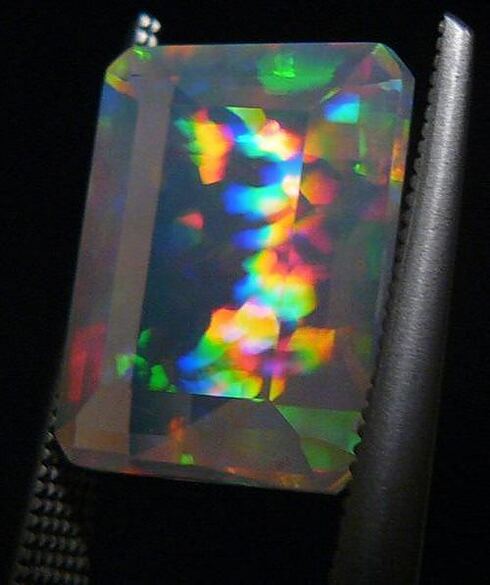
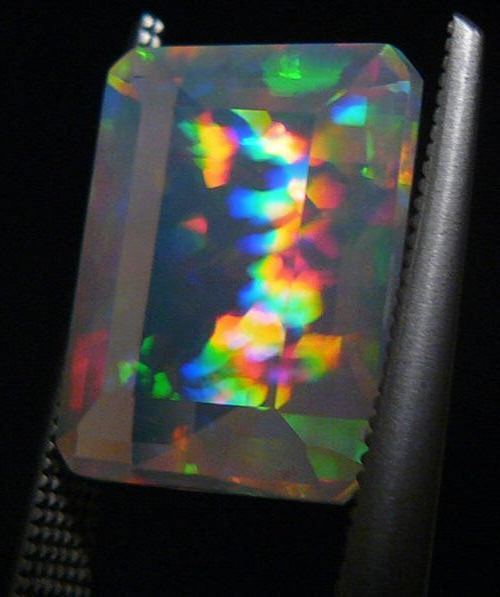
It can show a play of colour, e.g. in Ethiopian opals (Curtis et al., 2019).
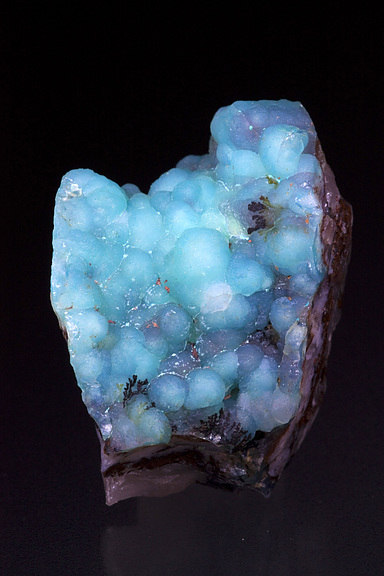
It typically consists of packed microscopic (~10-12 micron diameter) spheres (“lepispheres”) made up of tiny blades of monoclinic tridymite and amorphous silica (Frohlich, 2019).
Wilson (2014) and Fröhlich (2020) found no evidence for the presence of cristobalite in some samples of this material, and Fröhlich found the material to be a mixture of non-crystalline (X-ray amorphous) material and poorly crystalline blades of low temperature tridymite. Sedimentary and hydrothermal opal-CT appear slightly different, with sedimentary opal-CT containing monoclinic tridymite and hydrothermal opal-CT containing possibly orthorhombic tridymite (Fröhlich, 2020). The hydrothermal opal-CT is optically fibrous and probably identical to the variety lussatite (Fröhlich, 2020). Curtis et al. (2019) also found some variability in opal-CT, with simple and complex varieties, after studying numerous samples, but they ascribe this difference at least partly to variations in cristobalite content, and also note it can grade into opal-A and opal-C.
Unpublished studies by R. Bottrill confirm that much of this material contains tridymite but no trace of cristobalite, and where it does it may be considered a mixture with opal-C.
Opal-CT can form from very low temperature sea floor environments to hydrothermal deposits to over 100degC, but with time and temperature can convert to chalcedony and more crystalline quartz.
It can show a play of colour, e.g. in Ethiopian opals (Curtis et al., 2019).
It typically consists of packed microscopic (~10-12 micron diameter) spheres (“lepispheres”) made up of tiny blades of monoclinic tridymite and amorphous silica (Frohlich, 2019).
Unique Identifiers
Mindat ID:
32185 (as Opal-CT)
3004 (as Opal)
3004 (as Opal)
Long-form identifier:
mindat:1:1:32185:7 (as Opal-CT)
mindat:1:1:3004:1 (as Opal)
mindat:1:1:3004:1 (as Opal)
Similar Names
Pronunciation of Opal-CT
Pronunciation:
| Play | Recorded by | Country |
|---|---|---|
| Jolyon Ralph | United Kingdom |
Chemistry of Opal-CT
Mindat Formula:
SiO2 · nH2O
Elements listed:
Varieties of Opal-CT
| Lussatite | A variety of opal-CT, optically fibrous, probably with poorly crystalline orthorhombic tridymite, found in hydrothermal deposits (Fröhlich, 2020). "A form of silica, similar in structure to chalcedony, but having a low specific gravity, G = 2.04, near t... |
Relationship of Opal-CT to other Species
Member of:
Other Members of Silica:
| Chibaite | SiO2 · n(CH4, C2H6, C3H8, i-C4H10) (n = 3/17 (max)) | Iso. m3(2/m3) : Fd3 |
| Coesite | SiO2 | Mon. 2/m : B2/b |
| Cristobalite | SiO2 | Tet. 422 : P41212 |
| 'Keatite' | SiO2 | Tet. 422 : P43212 |
| Lechatelierite | SiO2 | Amor. |
| Melanophlogite | 46SiO2 · 6(N2,CO2) · 2(CH4,N2) | Tet. 4/mmm(4/m2/m2/m) |
| Mogánite | SiO2 | Mon. 2/m |
| 'Opal-AG' | SiO2 · nH2O | |
| 'Opal-AN' | SiO2 · nH2O | |
| 'Opal-C' | SiO2 · nH2O | |
| Quartz | SiO2 | Trig. 32 : P3121 |
| 'Quartz-beta' | SiO2 | Hex. 622 : P6422 |
| Stishovite | SiO2 | Tet. 4/mmm(4/m2/m2/m) : P42/mnm |
| Tridymite | SiO2 | Tric. 1 |
| 'β-Cristobalite' | SiO2 | Iso. m3m(4/m32/m) : Fd3m |
| 'β-Tridymite' | SiO2 |
Common Associates
Associations Based on Photo Data:
| 20 photos of Opal-CT associated with 'Bitumen' | |
| 12 photos of Opal-CT associated with Quartz | SiO2 |
| 8 photos of Opal-CT associated with 'Chalcedony' | SiO2 |
| 3 photos of Opal-CT associated with Calcite | CaCO3 |
| 3 photos of Opal-CT associated with 'Manganese Oxides' | |
| 3 photos of Opal-CT associated with 'Limonite' | |
| 3 photos of Opal-CT associated with Opal | SiO2 · nH2O |
| 1 photo of Opal-CT associated with Hematite | Fe2O3 |
| 1 photo of Opal-CT associated with 'Petrified Wood' | |
| 1 photo of Opal-CT associated with 'Prase Opal' | SiO2 · nH2O |
Other Information
Health Risks:
No information on health risks for this material has been entered into the database. You should always treat mineral specimens with care.
Opal-CT in petrology
An essential component of rock names highlighted in red, an accessory component in rock names highlighted in green.
Internet Links for Opal-CT
mindat.org URL:
https://www.mindat.org/min-32185.html
Please feel free to link to this page.
Please feel free to link to this page.
Search Engines:
Mineral Dealers:
References for Opal-CT
Reference List:
Jones, J. B., Segnit, E. R. (1971) The nature of opal I. nomenclature and constituent phases. Journal of the Geological Society of Australia, 18 (1) 57-68 doi:10.1080/00167617108728743
Elzea, J.M., Odom, I.E., Miles, W.J. (1994) Distinguishing well ordered opal-CT and opal-C from high temperature cristobalite by x-ray diffraction. Analytica Chimica Acta, 286 (1). 107-116 doi:10.1016/0003-2670(94)80182-7
Day, R., Jones, B. (2008) Variations in Water Content in Opal-A and Opal-CT from Geyser Discharge Aprons. Journal of Sedimentary Research, 78 (4) 301-315 doi:10.2110/jsr.2008.030
Wilson, M.J. (2014) The structure of opal-CT revisited. Journal of Non-Crystalline Solids, 405. 68-75 doi:10.1016/j.jnoncrysol.2014.08.052
Curtis, Neville J., Gascooke, Jason R., Johnston, Martin R., Pring, Allan (2019) A Review of the Classification of Opal with Reference to Recent New Localities. Minerals, 9 (5) 299 doi:10.3390/min9050299
Fröhlich, François (2020) The opal-CT nanostructure. Journal of Non-Crystalline Solids, 533. 119938 doi:10.1016/j.jnoncrysol.2020.119938
Lee, Seungyeol; Xu, Huifang; Xu, Hongwu; Xu, Wenqian (2025) Reexamination of the structure of nanomineral opal-CT using synchrotron X-ray diffraction, transmission electron microscopy, X-ray scattering structure factor, and pair distribution function analyses. American Mineralogist, 110 (5). doi:10.2138/am-2024-9333
Localities for Opal-CT
Showing 110 localities.
 symbol to view information about a locality.
The
symbol to view information about a locality.
The Locality List
 - This locality has map coordinates listed.
- This locality has estimated coordinates.
ⓘ - Click for references and further information on this occurrence.
? - Indicates mineral may be doubtful at this locality.
- This locality has map coordinates listed.
- This locality has estimated coordinates.
ⓘ - Click for references and further information on this occurrence.
? - Indicates mineral may be doubtful at this locality.
 - Good crystals or important locality for species.
 - World class for species or very significant.
(TL) - Type Locality for a valid mineral species.
(FRL) - First Recorded Locality for everything else (eg varieties).
- World class for species or very significant.
(TL) - Type Locality for a valid mineral species.
(FRL) - First Recorded Locality for everything else (eg varieties).
All localities listed without proper references should be considered as questionable.
Australia | |
| Rod Martin Collection |
| [var: Lussatite] Thiry et al. (1991) |
| Curtis +3 other references |
| Curtis +3 other references |
| Carr et al. (2021) |
Austria | |
| Pristacz et al. (2011) |
| Taucher (2012) |
| Postl et al. (1996) |
| www.markasit070752.ws24.cc (n.d.) |
| Taucher et al. (1998) |
| A.Weiß (1972) |
Brazil | |
| Costa et al. (2016) |
Bulgaria | |
| Zendelska et al. (2018) +1 other reference |
Canada | |
| Grema et al. (2024) |
Chile | |
| TESIS PARA OPTAR AL GRADO DE MAGÍSTER ... |
Costa Rica | |
| Mustoe et al. (2025) |
| Mustoe et al. (2025) |
| Mustoe et al. (2025) |
| Mustoe et al. (2025) | |
| Mustoe et al. (2025) |
| Mustoe et al. (2025) |
| Mustoe et al. (2025) | |
| Mustoe et al. (2025) | |
| Mustoe et al. (2025) | |
Czech Republic | |
| Kratochvíl |
| Koníčková et al. (2021) | |
| Koníčková Š. et al. (2016) |
| Trnka M (2006) |
Egypt | |
| Mahdy et al. (2026) |
Ethiopia | |
| Zhao +1 other reference |
Faroe Islands | |
| Caucia et al. (2013) |
| Caucia et al. (2013) |
France | |
| [var: Lussatite] Devouard et al. (2015) |
| [var: Lussatite] Devouard et al. (2015) | |
| Fermis (2022) |
| [var: Lussatite] Devouard et al. (2015) |
| [var: Lussatite] Devouard et al. (2015) | |
| Aimé Rudel : "Curiosités Géologiques ... |
| Remi Bornet Collection | |
| Remi Bornet Collection | |
| Remi Bornet Collection | |
| [var: Lussatite] Devouard et al. (2015) |
| Brunet (2016) |
| Econ Geol (1989) |
Georgia | |
| Makadze et al. (2026) |
Greece | |
| Voudouris (2005) |
| Helvaci et al. (1993) |
| Godelitsas +1 other reference |
Hungary | |
| Society of Economic Geologists Student Chapter University of Miskolc (2018) |
| Society of Economic Geologists Student Chapter University of Miskolc (2018) |
| Kiss et al. (2020) |
Iceland | |
| JONES et al. (2007) |
India | |
| Gotze +7 other references |
Indian Ocean | |
| Wang et al. (2017) |
| Wang et al. (2017) | |
Indonesia | |
| Mazot et al. (2007) |
Israel | |
| Sokol et al. (2014, November) |
Italy | |
| Napoleoni et al. (2021) |
| Ghiara M.R. et al. (1999) |
| Rielli et al. (2022) |
Japan | |
| T. Nakanishi et al. (2003) |
| Hayashi (2013) |
Jordan | |
| Pitty et al. (2010) |
| Khoury et al. (1985) |
Madagascar | |
| Popov et al. (2020) |
| Simoni et al. (2010) |
Mexico | |
| Forti (2006) |
| Fritsch et al. (2004) |
| Fritsch et al. (2004) |
| Curtis +3 other references | |
Namibia | |
| Saphira Minerals specimens |
| Gerhard Louw photo ID 983450 | |
New Zealand | |
| A. G. Reyes et al. (2004) |
| [var: Lussatite] Sutherland et al. (ed.) |
| Brathwaite et al. (2021) |
Pacific Ocean | |
| Pisciotto et al. (1992) |
| Hein et al. (2010) |
Peru | |
| Fritsch et al. (2004) |
| Dill et al. (1997) |
Poland | |
| University of Adelaide |
Russia | |
| Kyle et al. (2007) |
Serbia | |
| Miladinović et al. (2024) |
| Miladinović et al. (2024) | |
Slovakia | |
| Mesiarkinová et al. (2009) |
| Rusinová P. & Bačík P. (2013) |
Thailand | |
| Mustoe et al. (2022) |
Tunisia | |
| GALFATI et al. (2010) +1 other reference |
Turkey | |
| Çelik Karakaya et al. (2021) |
| Helvaci (1998) |
| Temel et al. (2010) | |
| Helvaci et al. (2000) +1 other reference |
| Sanogo et al. (2026) |
| Mutlu et al. (2005) |
UK | |
| Curtis +3 other references |
| Curtis +3 other references |
USA | |
| Gissler et al. (2024) |
| Eckel et al. (1997) |
| KellerLynn (2006) |
| Hennebois et al. (2025) |
| University of Adelaide - Tate Museum ... |
| Mustoe (2025) |
| Altaner et al. (1990) |
Venezuela | |
| Franco Urbani (2009) | |
Mars | |
| Morrison et al. (2024) |

Les Rois Mine, Mur-sur-Allier, Clermont-Ferrand, Puy-de-Dôme, Auvergne-Rhône-Alpes, France