
Brontesite
A valid IMA mineral species
This page is currently not sponsored. Click here to sponsor this page.


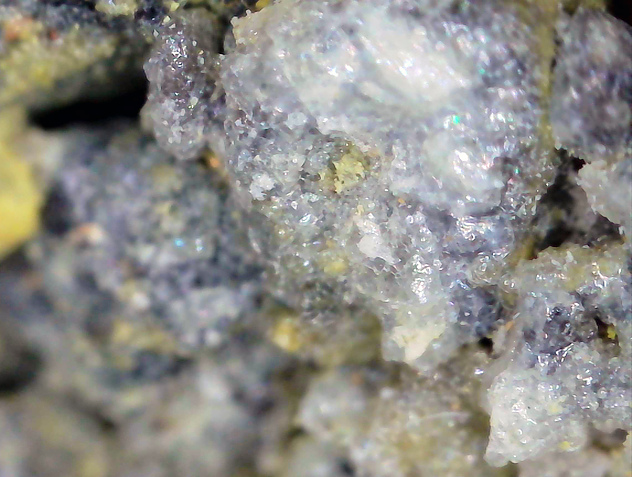
About Brontesite

Brontes, Arges, and Steropes
Formula:
(NH4)3PbCl5
Colour:
Colourless to white
Lustre:
Vitreous
Specific Gravity:
2.72
Crystal System:
Orthorhombic
Name:
Named in 2009 by Francesco Demartin, Carlo M. Gramaccioli, and Italo Campostrini for Brontes, one of the Cyclopes, and a son of Uranus.
This page provides mineralogical data about Brontesite.
Unique Identifiers
Mindat ID:
39208
Long-form identifier:
mindat:1:1:39208:6
Similar Names
| Barentsite | A valid IMA mineral species | Na7Al(HCO3)2(CO3)2F4 |
| Brandisite | A synonym of Clintonite |
IMA Classification of Brontesite
Approved
IMA Formula:
(N3-H4)3Pb2+Cl5
Approval year:
2008
First published:
2009
Classification of Brontesite
3.AA.
3 : HALIDES
A : Simple halides, without H2O
A : M:X = 1:1, 2:3, 3:5, etc.
3 : HALIDES
A : Simple halides, without H2O
A : M:X = 1:1, 2:3, 3:5, etc.
11.4.3.
11 : HALIDE COMPLEXES
4 : AmBX5·xH2O
11 : HALIDE COMPLEXES
4 : AmBX5·xH2O
Mineral Symbols
As of 2021 there are now IMA–CNMNC approved mineral symbols (abbreviations) for each mineral species, useful for tables and diagrams.
| Symbol | Source | Reference for Standard |
|---|---|---|
| Bte | IMA–CNMNC | Warr, L.N. (2021). IMA–CNMNC approved mineral symbols. Mineralogical Magazine, 85(3), 291-320. doi:10.1180/mgm.2021.43 |
Physical Properties of Brontesite
Vitreous
Colour:
Colourless to white
Streak:
White
Cleavage:
None Observed
Fracture:
None observed
Density:
2.72(1) g/cm3 (Measured) 2.728 g/cm3 (Calculated)
Optical Data of Brontesite
Type:
Biaxial
RI values:
n = 1.70(3)
Max. Birefringence:
δ = 0.000
Based on recorded range of RI values above.
Based on recorded range of RI values above.
Interference Colours:
The colours simulate birefringence patterns seen in thin section under crossed polars. They do not take into account mineral colouration or opacity.
Michel-Levy Bar The default colours simulate the birefringence range for a 30 µm thin-section thickness. Adjust the slider to simulate a different thickness.
Grain Simulation You can rotate the grain simulation to show how this range might look as you rotated a sample under crossed polars. Each grain retains its interference colour (retardation) while its brightness falls to black at extinction and reaches a maximum between extinction positions.
The colours simulate birefringence patterns seen in thin section under crossed polars. They do not take into account mineral colouration or opacity.
Michel-Levy Bar The default colours simulate the birefringence range for a 30 µm thin-section thickness. Adjust the slider to simulate a different thickness.
Grain Simulation You can rotate the grain simulation to show how this range might look as you rotated a sample under crossed polars. Each grain retains its interference colour (retardation) while its brightness falls to black at extinction and reaches a maximum between extinction positions.
Surface Relief:
High
Chemistry of Brontesite
Mindat Formula:
(NH4)3PbCl5
Element Weights:
Elements listed:
Common Impurities:
K,Br
Crystallography of Brontesite
Crystal System:
Orthorhombic
Class (H-M):
mmm(2/m2/m2/m) - Dipyramidal
Space Group:
Pnma
Cell Parameters:
a = 8.4351(9) Å, b = 15.7732(17) Å, c = 8.4446(9) Å
Ratio:
a:b:c = 0.535 : 1 : 0.535
Unit Cell V:
1123.5 ų
Z:
4
Morphology:
The habit is pseudotetragonal, tabular on {010}; the other most common forms are {110}, {011}, and {121}.
Twinning:
None observed.
Crystal Structure
Load
Unit Cell | Unit Cell Packed
2x2x2 | 3x3x3 | 4x4x4
Unit Cell | Unit Cell Packed
2x2x2 | 3x3x3 | 4x4x4
Show
Big Balls | Small Balls | Just Balls | Spacefill
Polyhedra Off | Si Polyhedra | All Polyhedra
Remove metal-metal sticks
Big Balls | Small Balls | Just Balls | Spacefill
Polyhedra Off | Si Polyhedra | All Polyhedra
Remove metal-metal sticks
Display Options
Black Background | White Background
Perspective On | Perspective Off
2D | Stereo | Red-Blue | Red-Cyan
Black Background | White Background
Perspective On | Perspective Off
2D | Stereo | Red-Blue | Red-Cyan
View
CIF File Best | x | y | z | a | b | c
CIF File Best | x | y | z | a | b | c
Rotation
Stop | Start
Stop | Start
Labels
Console Off | On | Grey | Yellow
Console Off | On | Grey | Yellow
Data courtesy of the American Mineralogist Crystal Structure Database. Click on an AMCSD ID to view structure
| ID | Species | Reference | Link | Year | Locality | Pressure (GPa) | Temp (K) |
|---|---|---|---|---|---|---|---|
| 0006299 | Brontesite | Demartin F, Gramaccioli C M, Campostrini I (2009) Brontesite, (NH4)3PbCl5, a new product of fumarolic activity from La Fossa Crater, Vulcano, Aeolian Islands, Italy The Canadian Mineralogist 47 1237-1243 |  | 2009 | La Fossa Crater, Vulcano, Aeolian Islands, Italy | 0 | 293 |
CIF Raw Data - click here to close
X-Ray Powder Diffraction
Powder Diffraction Data:
| d-spacing | Intensity |
|---|---|
| 3.067 Å | (100) |
| 2.710 Å | (78) |
| 2.421 Å | (75) |
| 2.211 Å | (60) |
| 2.020 Å | (80) |
| 1.910 Å | (78) |
| 1.491 Å | (75) |
| 1.457 Å | (65) |
Geological Environment
Paragenetic Mode(s):
| Paragenetic Mode | Earliest Age (Ga) |
|---|---|
| Stage 7: Great Oxidation Event | <2.4 |
| 45b : [Other oxidized fumarolic minerals] |
Type Occurrence of Brontesite
General Appearance of Type Material:
Aggregates of pseudotetragonal tabular crystals.
Place of Conservation of Type Material:
Reference Collection of Dipartimento di Chimica Strutturale e Stereochimica Inorganica of Università degli Studi di Milano, Milan, Italy.
Geological Setting of Type Material:
In an active medium-temperature (~250°C) intracrater fumarole on a pyroclastic breccia.
Associated Minerals at Type Locality:
Synonyms of Brontesite
Other Language Names for Brontesite
Dutch:Brontesiet
German:Brontesit
Common Associates
Associations Based on Photo Data:
| 3 photos of Brontesite associated with Alunite | KAl3(SO4)2(OH)6 |
| 3 photos of Brontesite associated with Adranosite | (NH4)4NaAl2(SO4)4Cl(OH)2 |
Related Minerals - Strunz-mindat Grouping
| 3.AA.05 | Marshite | CuI |
| 3.AA.05 | Nantokite | CuCl |
| 3.AA.05 | 'UM1999-11:I:CuS' | Cu(I,S) |
| 3.AA.05 | Miersite | (Ag,Cu)I |
| 3.AA.10 | Tocornalite | (Ag,Hg)I (?) |
| 3.AA.10 | Iodargyrite | AgI |
| 3.AA.15 | Bromargyrite | AgBr |
| 3.AA.15 | Chlorargyrite | AgCl |
| 3.AA.20 | Sylvite | KCl |
| 3.AA.20 | Halite | NaCl |
| 3.AA.20 | Villiaumite | NaF |
| 3.AA.20 | Carobbiite | KF |
| 3.AA.20 | Griceite | LiF |
| 3.AA.25 | 'UM1998-03-Cl:Tl' | TlCl |
| 3.AA.25 | Nataliyamalikite | TlI |
| 3.AA.25 | Lafossaite | Tl(Cl,Br) |
| 3.AA.25 | Salammoniac | NH4Cl |
| 3.AA.30 | Calomel | [Hg2]2+Cl2 |
| 3.AA.30 | Moschelite | [Hg2]2+I2 |
| 3.AA.30 | Kuzminite | HgBr |
| 3.AA.35 | Neighborite | NaMgF3 |
| 3.AA.35 | Parascandolaite | KMgF3 |
| 3.AA.40 | Javorieite | KFeCl3 |
| 3.AA.40 | Chlorocalcite | KCaCl3 |
| 3.AA.45 | Kolarite | PbTeCl2 |
| 3.AA.50 | Radhakrishnaite | PbTe3(Cl,S)2 |
| 3.AA.55 | Challacolloite | KPb2Cl5 |
| 3.AA.60 | Hephaistosite | TlPb2Cl5 |
| 3.AA.90 | Pseudocotunnite | K2PbCl4 |
Other Information
Notes:
The mineral is not hygroscopic and is stable in the open air.
Health Risks:
No information on health risks for this material has been entered into the database. You should always treat mineral specimens with care.
Internet Links for Brontesite
mindat.org URL:
https://www.mindat.org/min-39208.html
Please feel free to link to this page.
Please feel free to link to this page.
Search Engines:
External Links:
Mineral Dealers:
References for Brontesite
Localities for Brontesite
Showing 1 localities.
 symbol to view information about a locality.
The
symbol to view information about a locality.
The Locality List
 - This locality has map coordinates listed.
- This locality has estimated coordinates.
ⓘ - Click for references and further information on this occurrence.
? - Indicates mineral may be doubtful at this locality.
- This locality has map coordinates listed.
- This locality has estimated coordinates.
ⓘ - Click for references and further information on this occurrence.
? - Indicates mineral may be doubtful at this locality.
 - Good crystals or important locality for species.
 - World class for species or very significant.
(TL) - Type Locality for a valid mineral species.
(FRL) - First Recorded Locality for everything else (eg varieties).
- World class for species or very significant.
(TL) - Type Locality for a valid mineral species.
(FRL) - First Recorded Locality for everything else (eg varieties).
All localities listed without proper references should be considered as questionable.
Italy (TL) | |
| Demartin et al. (2009) |
Quick NavTopAbout BrontesiteUnique IdentifiersSimilar NamesIMA Classification Classification Mineral SymbolsPhysical Properties Optical Data Chemistry Crystallography Crystal StructureX-Ray Powder DiffractionGeological EnvironmentType Occurrence SynonymsOther LanguagesCommon AssociatesStrunz-MindatOther InformationInternet Links References Localities Locality List

La Fossa crater, Vulcano Island, Lipari, Eolie Islands, Metropolitan City of Messina, Sicily, Italy