
Hydronováčekite
A valid IMA mineral species - grandfathered
This page is currently not sponsored. Click here to sponsor this page.


About Hydronováčekite

Radim Nováček
Formula:
Mg(UO2)2(AsO4)2 · 12H2O
Colour:
Light yellow, straw yellow
Lustre:
Vitreous
Hardness:
2½
Crystal System:
Triclinic
Member of:
Name:
Originally named novacekite-I by Kurt Walenta in 1964, to denote a more hydrated species than the previously described novacekite, which he renamed to novacekite-II. The diacritical marks were added in 2008 (Burke). In 2022 the species was renamed from nováčekite-I to hydronováčekite.
The root name honors Radim Nováček [March 21, 1905 Ústí Nad Orlicí, Bohemia, Austria-Hungary - February 12, 1942 Mauthausen, Austria] mineralogist and analytical chemist, Charles University, Prague, Czech Republic.
The root name honors Radim Nováček [March 21, 1905 Ústí Nad Orlicí, Bohemia, Austria-Hungary - February 12, 1942 Mauthausen, Austria] mineralogist and analytical chemist, Charles University, Prague, Czech Republic.
Autunite Group.
Note: The use of the name nováčekite is inconsistent in the literature. There are two differently hydrated species (Walenta, 1964), one with 12 water molecules (nováčekite-I = the later hydronováčekite), the other with 10 water molecules (nováčekite-II = the later nováčekite). A further, still less hydrated species is metanováčekite.
Both (at that time) nováčekite-I and nováčekite-II are grandfathered species. Their crystal structures have been solved by Locock et al. (2004) using synthetic crystals; nováčekite-I is triclinic (P-1), with a 7.1594(5) Å, b 7.1610(5) Å, c 11.3146(7) Å, α 81.391(2)°, β 81.177(1)°, γ 88.884(1)°, while nováčekite-II is monoclinic (P21/n), with a 7.1328(11) Å, b 20.085(3) Å, c 7.1569(11) Å, β 90.585(3)°.
Hydronováčekite is very unstable under ambient conditions and quickly dehydrates to nováčekite, in part also to metanováčekite.
Most "nováčekite" specimens in collections seem to be either nováčekite or metanováčekite.
Note: The use of the name nováčekite is inconsistent in the literature. There are two differently hydrated species (Walenta, 1964), one with 12 water molecules (nováčekite-I = the later hydronováčekite), the other with 10 water molecules (nováčekite-II = the later nováčekite). A further, still less hydrated species is metanováčekite.
Both (at that time) nováčekite-I and nováčekite-II are grandfathered species. Their crystal structures have been solved by Locock et al. (2004) using synthetic crystals; nováčekite-I is triclinic (P-1), with a 7.1594(5) Å, b 7.1610(5) Å, c 11.3146(7) Å, α 81.391(2)°, β 81.177(1)°, γ 88.884(1)°, while nováčekite-II is monoclinic (P21/n), with a 7.1328(11) Å, b 20.085(3) Å, c 7.1569(11) Å, β 90.585(3)°.
Hydronováčekite is very unstable under ambient conditions and quickly dehydrates to nováčekite, in part also to metanováčekite.
Most "nováčekite" specimens in collections seem to be either nováčekite or metanováčekite.
Name Encoding
CP1252:
Hydronovácekite
Latin-1:
Hydronovácekite
ASCII-7:
Hydronovacekite
Unique Identifiers
Mindat ID:
2937
Long-form identifier:
mindat:1:1:2937:3
Classification of Hydronováčekite
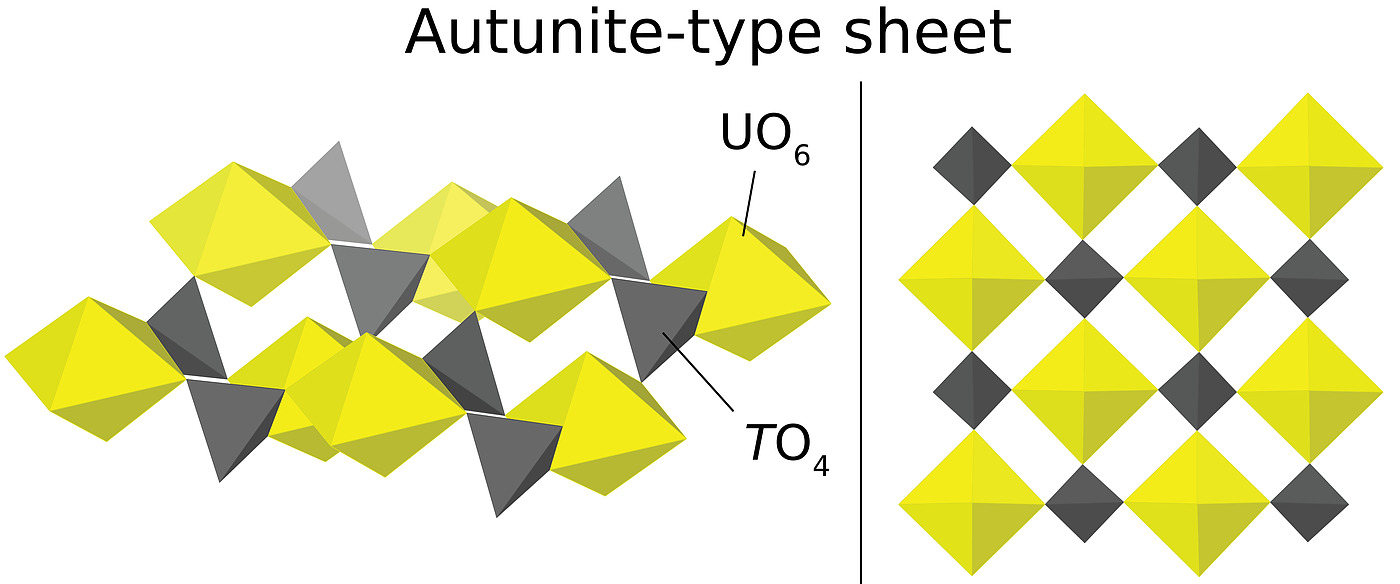
The autunite-type sheet
The autunite-type sheet found in members of the autunite group.
IMA Classification of Hydronováčekite
Approved, 'Grandfathered' (first described prior to 1959)
IMA status notes:
Renamed by the IMA
IMA Formula:
Mg(U6+O2)2(As5+O4)2·12H2O
First published:
1964
8.EB.05
8 : PHOSPHATES, ARSENATES, VANADATES
E : Uranyl phosphates and arsenates
B : UO2:RO4 = 1:1
8 : PHOSPHATES, ARSENATES, VANADATES
E : Uranyl phosphates and arsenates
B : UO2:RO4 = 1:1
40.2a.10.1
40 : HYDRATED NORMAL PHOSPHATES,ARSENATES AND VANADATES
2a : AB2(XO4)2·xH2O, containing (UO2)2+
40 : HYDRATED NORMAL PHOSPHATES,ARSENATES AND VANADATES
2a : AB2(XO4)2·xH2O, containing (UO2)2+
20.7.7
20 : Arsenates (also arsenates with phosphate, but without other anions)
7 : Arsenates of U
20 : Arsenates (also arsenates with phosphate, but without other anions)
7 : Arsenates of U
Mineral Symbols
As of 2021 there are now IMA–CNMNC approved mineral symbols (abbreviations) for each mineral species, useful for tables and diagrams.
| Symbol | Source | Reference for Standard |
|---|---|---|
| Nvč-I | IMA–CNMNC | Warr, L.N. (2021). IMA–CNMNC approved mineral symbols. Mineralogical Magazine, 85(3), 291-320. doi:10.1180/mgm.2021.43 |
Physical Properties of Hydronováčekite
Vitreous
Transparency:
Transparent
Colour:
Light yellow, straw yellow
Streak:
White, pale yellow
Hardness:
2½ on Mohs scale
Cleavage:
Perfect
Perfect on {001}, good on {100} and {010}. Less pronounced than the lower hydration levels (i.e. nováčekite and metanováčekite).
Perfect on {001}, good on {100} and {010}. Less pronounced than the lower hydration levels (i.e. nováčekite and metanováčekite).
Optical Data of Hydronováčekite
Type:
Uniaxial (-)
RI values:
nω = 1.62 - 1.641 nε = 1.62 - 1.625
Surface Relief:
High (positive)
Relative to Canada balsam mounting medium (n ≈ 1.537).
Relative to Canada balsam mounting medium (n ≈ 1.537).
This shows the grain boundary and Becke line effect under plane-polarised
light, based on the contrast between this mineral's average refractive
index and the mounting medium. It does not take into account mineral
colouration.
In focus
Interference Figure:
This shows the idealized uniaxial interference figure - the conoscopic
(convergent-light, Bertrand-lens-in) view, for a grain cut with the optic axis
centred and vertical. The coloured rings are isochromatics, computed with the
same physics as the Michel-Lévy bar above; the dark cross is the isogyre.
For a genuinely uniaxial mineral viewed this way, that cross stays perfectly stationary if you rotate the stage - unlike a biaxial mineral, where it splits apart on rotation. That invariance is itself the standard diagnostic test for telling uniaxial and biaxial minerals apart at the microscope.
For a genuinely uniaxial mineral viewed this way, that cross stays perfectly stationary if you rotate the stage - unlike a biaxial mineral, where it splits apart on rotation. That invariance is itself the standard diagnostic test for telling uniaxial and biaxial minerals apart at the microscope.
Comments:
Symmetry requires pseudo-uniaxial optical character.
Chemistry of Hydronováčekite
Mindat Formula:
Mg(UO2)2(AsO4)2 · 12H2O
Element Weights:
Crystallography of Hydronováčekite
Crystal System:
Triclinic
Class (H-M):
1 - Pinacoidal
Space Group:
P1
Cell Parameters:
a = 7.1594 Å, b = 7.161 Å, c = 11.3146 Å
α = 81.391°, β = 81.177°, γ = 88.884°
α = 81.391°, β = 81.177°, γ = 88.884°
Ratio:
a:b:c = 1 : 1 : 1.58
Unit Cell V:
566.76 ų (Calculated from Unit Cell)
Comment:
Pseudo-tetragonal (long axis ~22 A).
X-Ray Powder Diffraction
Powder Diffraction Data:
| d-spacing | Intensity |
|---|---|
| 10.2 Å | (10) |
| 6.80 Å | (4) |
| 5.06 Å | (8) |
| 3.58 Å | (9) |
| 3.35 Å | (5) |
| 2.52 Å | (3) |
| 2.26 Å | (3) |
Geological Environment
Paragenetic Mode(s):
| Paragenetic Mode | Earliest Age (Ga) |
|---|---|
| Stage 7: Great Oxidation Event | <2.4 |
| 47a : [Near-surface hydration of prior minerals] | |
| 47d : [Arsenates, antimonates, selenates, bismuthinates] | |
| 47f : [Uranyl (U⁶⁺) minerals] |
Type Occurrence of Hydronováčekite
Synonyms of Hydronováčekite
Other Language Names for Hydronováčekite
Relationship of Hydronováčekite to other Species
Member of:
Other Members of Autunite Group:
| Autunite | Ca(UO2)2(PO4)2 · 10-12H2O | Orth. mmm(2/m2/m2/m) : Pnma |
| Bassetite | Fe2+(UO2)2(PO4)2 · 10H2O | Mon. 2/m |
| Heinrichite | Ba(UO2)2(AsO4)2 · 10H2O | Mon. 2/m : P2/b |
| Kahlerite | Fe2+(UO2)2(AsO4)2 · 12H2O | Tet. 4/m : P42/n |
| Nováčekite | Mg(UO2)2(AsO4)2 · 10H2O | Mon. 2/m |
| Rauchite | Ni(UO2)2(AsO4)2 · 10H2O | Tric. 1 : P1 |
| Sabugalite | HAl(UO2)4(PO4)4 · 16H2O | Mon. 2/m : B2/m |
| Saléeite | Mg(UO2)2(PO4)2 · 10H2O | Mon. 2/m |
| Torbernite | Cu(UO2)2(PO4)2 · 12H2O | Tet. 4/mmm(4/m2/m2/m) : I4/mmm |
| Uranocircite | Ba(UO2)2(PO4)2 · 10H2O | Tet. |
| Uranospinite | Ca(UO2)2(AsO4)2 · 10H2O | Tet. 4/mmm(4/m2/m2/m) : P4/nmm |
| Zeunerite | Cu(UO2)2(AsO4)2 · 12H2O | Tet. 4/mmm(4/m2/m2/m) : I4/mmm |
Common Associates
Associations Based on Photo Data:
| 34 photos of Hydronováčekite associated with Gypsum | CaSO4 · 2H2O |
| 8 photos of Hydronováčekite associated with Calcite | CaCO3 |
| 8 photos of Hydronováčekite associated with Erythrite | Co3(AsO4)2 · 8H2O |
| 8 photos of Hydronováčekite associated with Umohoite | (UO2)MoO4 · 2H2O |
| 6 photos of Hydronováčekite associated with Quartz | SiO2 |
| 5 photos of Hydronováčekite associated with Sklodowskite | Mg(UO2)2(SiO3OH)2 · 6H2O |
| 5 photos of Hydronováčekite associated with Magnesite | MgCO3 |
| 4 photos of Hydronováčekite associated with Parauranophane | Ca(UO2)2(SiO3OH)2 · 5H2O |
| 4 photos of Hydronováčekite associated with Metaschoepite | (UO2)8O2(OH)12 · 10H2O |
| 3 photos of Hydronováčekite associated with Metaheinrichite | Ba(UO2)2(AsO4)2 · 8H2O |
Related Minerals - Strunz-mindat Grouping
| 8.EB. | Meta-autunite Group | A1-2(UO2)2(TO4)2 · 5-10H2O |
| 8.EB.05 | Rauchite | Ni(UO2)2(AsO4)2 · 10H2O |
| 8.EB.05 | Uranocircite | Ba(UO2)2(PO4)2 · 10H2O |
| 8.EB.05 | Uranospinite | Ca(UO2)2(AsO4)2 · 10H2O |
| 8.EB.05 | Zeunerite | Cu(UO2)2(AsO4)2 · 12H2O |
| 8.EB.05 | Metarauchite | Ni(UO2)2(AsO4)2 · 8H2O |
| 8.EB.05 | Heinrichite | Ba(UO2)2(AsO4)2 · 10H2O |
| 8.EB.05 | Kahlerite | Fe2+(UO2)2(AsO4)2 · 12H2O |
| 8.EB.05 | Torbernite | Cu(UO2)2(PO4)2 · 12H2O |
| 8.EB.05 | Nováčekite | Mg(UO2)2(AsO4)2 · 10H2O |
| 8.EB.05 | Autunite | Ca(UO2)2(PO4)2 · 10-12H2O |
| 8.EB.05 | Saléeite | Mg(UO2)2(PO4)2 · 10H2O |
| 8.EB.05 | Xiangjiangite | (Fe3+,Al)(UO2)4(PO4)2(SO4)2(OH) · 22H2O |
| 8.EB.10 | Bassetite | Fe2+(UO2)2(PO4)2 · 10H2O |
| 8.EB.10 | Lehnerite | Mn2+(UO2)2(PO4)2 · 8H2O |
| 8.EB.10 | Meta-autunite | Ca(UO2)2(PO4)2 · 6H2O |
| 8.EB.10 | Metasaléeite | Mg(UO2)2(PO4)2 · 8H2O |
| 8.EB.10 | Metauranocircite | Ba(UO2)2(PO4)2 · 7H2O |
| 8.EB.10 | Metauranospinite | Ca(UO2)2(AsO4)2 · 8H2O |
| 8.EB.10 | Metaheinrichite | Ba(UO2)2(AsO4)2 · 8H2O |
| 8.EB.10 | Metakahlerite | Fe2+(UO2)2(AsO4)2 · 8H2O |
| 8.EB.10 | Metakirchheimerite | Co(UO2)2(AsO4)2 · 8H2O |
| 8.EB.10 | Metanováčekite | Mg(UO2)2(AsO4)2 · 8H2O |
| 8.EB.10 | Metanatroautunite | Na(UO2)(PO4)(H2O)3 |
| 8.EB.10 | Metatorbernite | Cu(UO2)2(PO4)2 · 8H2O |
| 8.EB.10 | Metazeunerite | Cu(UO2)2(AsO4)2 · 8H2O |
| 8.EB.10 | Przhevalskite | Pb2(UO2)3(PO4)2(OH)4 · 3H2O |
| 8.EB.10 | 'Pseudo-autunite' | (H3O)4Ca2(UO2)2(PO4)4 · 5H2O |
| 8.EB.15 | Abernathyite | K(UO2)(AsO4) · 3H2O |
| 8.EB.15 | Uramphite | (NH4)2(UO2)2(PO4)2 · 6H2O |
| 8.EB.15 | Meta-ankoleite | K2(UO2)2(PO4)2 · 6H2O |
| 8.EB.15 | Natrouranospinite | Na2(UO2)2(AsO4)2 · 5H2O |
| 8.EB.15 | Trögerite | (H3O)(UO2)(AsO4) · 3H2O |
| 8.EB.15 | Chernikovite | (H3O)2(UO2)2(PO4)2 · 6H2O |
| 8.EB.15 | Uramarsite | (NH4)(UO2)(AsO4) · 3H2O |
| 8.EB.20 | Chistyakovaite | Al(UO2)2(AsO4)2(F,OH) · 6.5H2O |
| 8.EB.20 | Threadgoldite | Al(UO2)2(PO4)2(OH) · 8H2O |
| 8.EB.25 | Uranospathite | (Al,◻)(UO2)2(PO4)2F · 20(H2O,F) |
| 8.EB.25 | Arsenuranospathite | Al(UO2)2(AsO4)2F · 20H2O |
| 8.EB.30 | Vochtenite | (Fe2+,Mg)Fe3+(UO2)4(PO4)4(OH) · 12-13H2O |
| 8.EB.35 | Coconinoite | Fe3+2Al2(UO2)2(PO4)4(SO4)(OH)2 · 20H2O |
| 8.EB.40 | Ranunculite | HAl(UO2)(PO4)(OH)3 · 4H2O |
| 8.EB.45 | Triangulite | Al3(UO2)4(PO4)4(OH)5 · 5H2O |
| 8.EB.50 | Furongite | Al13(UO2)7(PO4)13(OH)14 · 58H2O |
| 8.EB.55 | Arsenosabugalite | H0.5Al0.5(UO2)2(AsO4)2 · 8H2O |
| 8.EB.55 | Sabugalite | HAl(UO2)4(PO4)4 · 16H2O |
| 8.EB.60 | Horákite | (Bi7O7OH)[(UO2)4(PO4)2(AsO4)2(OH)2] · 3.5H2O |
Radioactivity
Other Information
Health Risks:
No information on health risks for this material has been entered into the database. You should always treat mineral specimens with care.
Internet Links for Hydronováčekite
mindat.org URL:
https://www.mindat.org/min-2937.html
Please feel free to link to this page.
Please feel free to link to this page.
Search Engines:
External Links:
Mineral Dealers:
References for Hydronováčekite
Reference List:
Frondel, Clifford (1951) Studies of uranium minerals (IX): Saléeite and novacekite. American Mineralogist, 36 (9-10) 680-686
Stern, T. W., Annell, C. S. (1954) A second locality of novacekite. American Mineralogist, 39 (7-8) 675-676
Huang, W. T. (1956) Novacekite from the Wichita Mountains, Oklahoma. American Mineralogist, 41 (1-2) 152-153
Walenta, Kurt, Walenta, Kurt (1964) Beiträge zur Kenntnis seltener Arsenatmineralien unter besonderer Berücksichtigung von Vorkommen des Schwarzwaldes. 1. Folge. [Rare arsenate minerals with special consideration of occurrences in the Black Forest. Part I]. Tschermaks Mineralogische und Petrographische Mitteilungen, 9 (1). 111-174 doi:10.1007/bf01127780
Elton, N. J., Hooper, J. J., Jeal, A. E. (1994) Nováčekite and metanováčekite from Cornwall. Mineralogical Magazine, 58 (392) 513-514 doi:10.1180/minmag.1994.058.392.22
Locock, A. J., Burns, P. C., Flynn, T. M. (2004) Divalent transition metals and magnesium in structures that contain the autunite-type sheet. The Canadian Mineralogist, 42 (6) 1699-1718 doi:10.2113/gscanmin.42.6.1699
Localities for Hydronováčekite
Showing 57 localities.
 symbol to view information about a locality.
The
symbol to view information about a locality.
The Locality List
 - This locality has map coordinates listed.
- This locality has estimated coordinates.
ⓘ - Click for references and further information on this occurrence.
? - Indicates mineral may be doubtful at this locality.
- This locality has map coordinates listed.
- This locality has estimated coordinates.
ⓘ - Click for references and further information on this occurrence.
? - Indicates mineral may be doubtful at this locality.
 - Good crystals or important locality for species.
 - World class for species or very significant.
(TL) - Type Locality for a valid mineral species.
(FRL) - First Recorded Locality for everything else (eg varieties).
- World class for species or very significant.
(TL) - Type Locality for a valid mineral species.
(FRL) - First Recorded Locality for everything else (eg varieties).
All localities listed without proper references should be considered as questionable.
Austria | |
| Strasser (1989) |
| Strasser (1989) | |
Brazil | |
| Cassedanne et al. (1978) |
Czech Republic | |
| Hloušek et al. (2002) |
| Pauliš P. et al. (Kutna Hora, issue 1) |
| Plášil et al. (2006) | |
| Rojík (2005) |
| Rojík (2005) | |
| Sejkora (1994) |
| |
France | |
| - (1998) |
| Vajdak (2006) |
| - (1998) |
| Caubel (1997) +1 other reference |
| Henriot et al. (1998) |
| - (1998) | |
Germany | |
| Walenta (1992) |
| Walenta et al. (1961) +1 other reference |
| American Mineralogist: 76: 2021. |
| |
| Walenta (1992) | |
| Markl (1992) |
| |
| Walenta (1992) |
| |
| Der Aufschluss 2000 (2) |
| Aufschluss 69/ (7+8) +1 other reference |
| Weiß (1990) |
| Wittern (2001) |
| Schnorrer (1995) +1 other reference | |
| Frondel (1951) |
| Gröbner et al. (2006) | |
| Witzke et al. (1998) |
Italy | |
| Campostrini et al. (2005) |
Mexico | |
| Panczner (1987) |
| Panczner (1987) |
Morocco | |
| Favreau et al. (2006) |
| Favreau et al. (2006) | |
| Favreau et al. (2006) |
| Favreau et al. (2006) |
| Favreau et al. (2006) | |
South Africa | |
| Cairncross et al. (1995) |
Switzerland | |
| Stalder et al. (1998) |
UK | |
| Golley et al. (1995) |
USA | |
| - (2008) |
| Castor et al. (2004) |
| Castor et al. (2004) | |
| Am Min 39:675-676 +1 other reference |
| NMBMMR Memoir 15 Geology and Technology ... | |
| Northrop et al. (1996) | |
| |
| R&M 72:4 pp 252-264 +1 other reference |
| R&M 72:4 pp 252-264 +1 other reference |
| Nevada Bureau of Mines and Geology NBMG ... |
| Bullock (1981) |
Uzbekistan | |
| Frost et al. (2009) |
Quick NavTopAbout HydronováčekiteName EncodingUnique IdentifiersClassification IMA Classification Mineral SymbolsPhysical Properties Optical Data Chemistry Crystallography X-Ray Powder DiffractionGeological EnvironmentType Occurrence SynonymsOther LanguagesRelationshipsCommon AssociatesStrunz-MindatRadioactivityOther InformationInternet Links References Localities Locality List

Schmiedestollen dump, Wittichen, Schenkenzell, Rottweil, Freiburg Region, Baden-Württemberg, Germany