
Case Quarries, Portland, Middlesex County, Connecticut, USAi
| Regional Level Types | |
|---|---|
| Case Quarries | Group of Quarries (Abandoned) |
| Portland | - not defined - |
| Middlesex County | County |
| Connecticut | State |
| USA | Country |
This page is currently not sponsored. Click here to sponsor this page.




Latitude & Longitude (WGS84):
41° 37' 30'' North , 72° 34' 48'' West
Latitude & Longitude (decimal):
Type:
Group of Quarries (Abandoned) - last checked 2025
Köppen climate type:
Nearest Settlements:
| Place | Population | Distance |
|---|---|---|
| Cromwell | 13,750 (2017) | 6.4km |
| Lake Pocotopaug | 3,436 (2017) | 6.5km |
| Portland | 5,862 (2017) | 7.7km |
| East Hampton | 2,691 (2017) | 8.5km |
| Glastonbury Center | 7,387 (2017) | 8.6km |
Nearest Clubs:
Local clubs are the best way to get access to collecting localities
Local clubs are the best way to get access to collecting localities
| Club | Location | Distance |
|---|---|---|
| Lapidary and Mineral Society of Central Connecticut | Meriden, Connecticut | 21km |
| Bristol Gem & Mineral Club | Bristol, Connecticut | 31km |
| New Haven Mineral Club | New Haven, Connecticut | 46km |
The basic history and details are provided by Cameron et al (1954):
The Case prospects lie in the town of Portland, 4.5 miles N. 39° E. of the center of Portland village. To reach them from Portland travel eastward on State Highway 17A to its intersection with State Highway 17. Proceed 0.3 mile eastward on a paved town road, then turn left and travel northward about 1.3 miles, bearing right at two road forks. At this point turn left for 0.7 mile to an intersection. Proceed eastward 0.1 mile then turn northeastward on a poorly marked dirt road that leads into woodland just east of a farmhouse. Follow this road about 2,500 feet to the prospects.
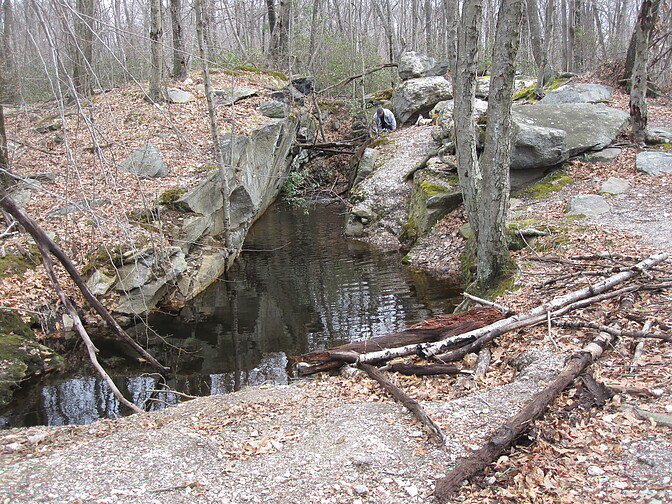
The property is owned by Myron N. Case, Rose Hill, Portland. The Worth Spar Co., Inc., of Cobalt quarried three pegmatites on the property for feldspar from 1933 to 1935. In the summer of 1939 Frank Bajorek of Portland mined the westernmost pegmatite (no. 1 quarry, pl. 43) for feldspar. The Worth Spar Co. prospected the no. 2 pegmatite for sheet mica in August and October 1942. The workings are opencuts that range from 60 to 110 feet in length, 7 to 45 feet in width and 10 to 25 feet in maximum depth. All are flooded.
The pegmatites were mapped by E. N. Cameron and V. E. Shainin in March 1943 and were studied periodically until December 1943 (fig. 130 and pl. 43). The U. S. Bureau of Mines and Geological Survey cooperated in surface and subsurface exploration of the pegmatites from May to November 1943. E. E. Maillot was in charge of the project for the Bureau of Mines and V. E. Shainin studied the subsurface geology for the Geo¬logical Survey. The no. 2 and 3 quarries were pumped, and 14 holes totaling 1,673.5 feet were made by diamond-drill.
The three pegmatites on the Case property lie within 500 feet of one another. They strike north to northeast and differ in direction and magnitude of dip. The pegmatites cut granite-gneiss (Monson gneiss), the foliation of which strikes generally northward and dips 20°-30° W.
The no. 1 pegmatite, westernmost of the group, is 5 to 7.5 feet thick, strikes N. 70 E. and dips 35°-45° SE. It has been quarried for about 100 feet along strike and to a maximum depth of 17 feet. It may have terminated upward a short distance above the rim of the workings. The pegmatite has a border zone 1/2 to 1 inch thick consisting of fine-grained granular quartz, [albite] plagioclase, [microcline] perthite, and beryl. The rest of the pegmatite (designated [microcline] perthite-quartz zone on pl. 43) consists of medium- to extremely coarse-grained [microcline] perthite and quartz, with subordinate [albite] plagioclase and muscovite, and accessory beryl, garnet, and columbite-tantalite. Muscovite forms small, colorless to gray-green, heavily stained books, irregularly distributed. In general, the texture of this material is progressively coarser toward the center of the pegmatite. There is no clearly defined quartz core exposed, but in places in the central part of the pegmatite there are irregular bodies of quartz, against which the [microcline] perthite crystals are euhedral. Offshoots of the quartz bodies extend outward across the surrounding pegmatite along fractures. In addition, veins of quartz occur along the contacts with wall rock. Debris left in the north end of the opencut suggests the presence of a small quartz core flanked by a [microcline] perthite-quartz zone similar to that of the no. 2 pegmatite described below.
High-grade [microcline] perthite constitutes at least 50 percent of the [microcline] perthite-quartz zone visible. Beryl occurs chiefly in the border zone and the outermost 12 to 18 inches of the [microcline] perthite-quartz zone, and is most abundant in the footwall part of the [microcline] perthite-quartz zone. The crystals range from 1/8 inch to 4 inches in length and from 1/16 inch to 3 inches in diameter. Measurements of all crystals in the cross-section of the pegmatite in the northern face of the quarry indicate a beryl content of 0.15 percent. However, the exposures available for measurement are few, and the accuracy of the figure obtained for grade is doubtful. Waste rock on the dump seemed to show considerably more beryl in material derived from the [microcline] perthite-quartz zone than is indicated by the crystal measurements. Measurements of beryl crystals in the footwall part of the border zone indicated 0.41 percent beryl.
The no. 2 pegmatite (mined in the no. 2 quarry) is a tabular lens that strikes N. 17° E. and dips 15° NW. At the surface, it has a strike length of 60 feet. It probably terminates beneath overburden less than 40 feet northward from the quarry. The south edge of the lens plunges southward from the open cut at a moderate angle. One hundred and eighty feet down dip from its surface outcrop, the inferred strike length of the pegmatite is 155 feet. The thickness of the body ranges from 10 feet at the surface to about 16 feet at a point 180 feet down dip.
The pegmatite is distinctly zoned. The border zone, 2 to 4 inches thick, is composed of fine-grained quartz, [microcline] perthite, and [albite] plagioclase, with accessory muscovite, garnet, beryl, and tourmaline. The wall zone, 2 to 6 inches thick, consists of medium-grained [microcline] perthite, [albite] plagioclase, and quartz, with accessory muscovite, beryl, and garnet. The intermediate zone, 1 to 4 feet thick, is similar to the wall zone but is composed chiefly of quartz and extremely coarse [microcline] perthite. The core averages 5 feet in thickness and is composed of coarsely crystalline milky quartz, accessory [microcline] perthite in scattered large, euhedral crystals, and rare beryl. [Microcline] Perthite crystals in the [microcline] perthite-quartz intermediate zone are euhedral against quartz of the core. The zonal structure was clearly recognizable in 3 of the 4 drill holes that intersected the pegmatite 1, 2, and 5. Cores from holes 5 and 7 were inadequate for the construction of logs.
Beryl occurs in the border and wall zones in scattered crystals ¼ to ¾ inches in diameter and as much as 3 inches long. Some crystals in the [microcline] perthite-quartz zone are 9 inches in diameter and 10 inches long. Measurements on exposures in the quarry (230 square feet) suggest that the average beryl content of the pegmatite is 0.34 percent. On the basis of this figure, and diamond drilling, 53 tons of beryl are indicated and 27 tons are inferred to lie beneath the surface to a depth of 180 feet clown the dip.
The percentage of high-grade feldspar in the no. 2 pegmatite is less than that in the no. 1 pegmatite but [microcline] perthite in the [microcline] perthite-quartz zone is mostly pure and separable by hand sorting.
The no. 3 pegmatite, northernmost of the group, is a tabular lens that strikes N. 25° to 48° E. and dips 63° to 71° NW. The crest of the lens plunges gently northward and southward from the quarry. The strike length of the pegmatite ranges from 70 feet at the surface to at least 350 feet at a level 120 feet down dip from the workings. Along strike the dike is thickest in the center (7 feet) and thins to less than 2 feet both north and south of the workings. The pegmatite was probably not intersected by drill hole 14. It is believed to terminate above the hole but below elevation 240 feet (pl. 43, sec. A-A’).
The dike exhibits a fairly distinct zonal structure in the no. 3 quarry. The border zone, ½ to 1 inch thick, is composed of quartz, [microcline] perthite, and [albite] plagioclase, with accessory black tourmaline, muscovite, beryl, and garnet. The wall zone, 1 to 2 feet thick, is irregular and in places absent. It is composed of quartz and [albite] plagioclase with various amounts of coarse-grained [microcline] perthite, subordinate muscovite, accessory beryl, tourmaline, and columbite-tantalite. The pegmatite inside the wall zone consists of coarse-grained [microcline] perthite and quartz with accessory beryl and [albite] plagioclase. There is no true quartz core, but irregular bodies of quartz are present in the quartz-[microcline] perthite zone. Neighboring [microcline] perthite crystals are euhedral against the quartz bodies. The zonal structure of the pegmatite was recognized in the diamond-drill hole cores, although it was less clearly defined than at the surface.
Beryl occurs in the border zone in crystals less than ¼ inch in diameter and 1 inch long, and in the wall zone crystals as much as 2 inches in diameter and 5 inches long. The footwall part of the wall zone appears to contain more beryl than the hanging-wall part, and the beryl crystals are larger. Counts made on the northern and southern faces of the quarry (250 square feet of pegmatite), before and after exploratory blasting, indicate an average beryl content of 0.22 percent. From this figure and data of the Bureau of Mines, 25 tons of beryl is indicated and 6 tons inferred to lie beneath the surface to a depth of 120 feet down the dip.
The Case nos. 2 and 3 pegmatites are inferred to contain slightly more than 100 tons of beryl, mostly in small crystals. Recovery by hand-cobbing would unquestionably be difficult. Each of the three pegmatites contains limited tonnages of high-grade, hand separable [microcline] perthite, and the no. 2 pegmatite probably contains at least 6,000 tons of coarse milky quartz that appears to be of high purity and could be separated readily by hand.
The property is owned by Myron N. Case, Rose Hill, Portland. The Worth Spar Co., Inc., of Cobalt quarried three pegmatites on the property for feldspar from 1933 to 1935. In the summer of 1939 Frank Bajorek of Portland mined the westernmost pegmatite (no. 1 quarry, pl. 43) for feldspar. The Worth Spar Co. prospected the no. 2 pegmatite for sheet mica in August and October 1942. The workings are opencuts that range from 60 to 110 feet in length, 7 to 45 feet in width and 10 to 25 feet in maximum depth. All are flooded.
The pegmatites were mapped by E. N. Cameron and V. E. Shainin in March 1943 and were studied periodically until December 1943 (fig. 130 and pl. 43). The U. S. Bureau of Mines and Geological Survey cooperated in surface and subsurface exploration of the pegmatites from May to November 1943. E. E. Maillot was in charge of the project for the Bureau of Mines and V. E. Shainin studied the subsurface geology for the Geo¬logical Survey. The no. 2 and 3 quarries were pumped, and 14 holes totaling 1,673.5 feet were made by diamond-drill.
The three pegmatites on the Case property lie within 500 feet of one another. They strike north to northeast and differ in direction and magnitude of dip. The pegmatites cut granite-gneiss (Monson gneiss), the foliation of which strikes generally northward and dips 20°-30° W.
The no. 1 pegmatite, westernmost of the group, is 5 to 7.5 feet thick, strikes N. 70 E. and dips 35°-45° SE. It has been quarried for about 100 feet along strike and to a maximum depth of 17 feet. It may have terminated upward a short distance above the rim of the workings. The pegmatite has a border zone 1/2 to 1 inch thick consisting of fine-grained granular quartz, [albite] plagioclase, [microcline] perthite, and beryl. The rest of the pegmatite (designated [microcline] perthite-quartz zone on pl. 43) consists of medium- to extremely coarse-grained [microcline] perthite and quartz, with subordinate [albite] plagioclase and muscovite, and accessory beryl, garnet, and columbite-tantalite. Muscovite forms small, colorless to gray-green, heavily stained books, irregularly distributed. In general, the texture of this material is progressively coarser toward the center of the pegmatite. There is no clearly defined quartz core exposed, but in places in the central part of the pegmatite there are irregular bodies of quartz, against which the [microcline] perthite crystals are euhedral. Offshoots of the quartz bodies extend outward across the surrounding pegmatite along fractures. In addition, veins of quartz occur along the contacts with wall rock. Debris left in the north end of the opencut suggests the presence of a small quartz core flanked by a [microcline] perthite-quartz zone similar to that of the no. 2 pegmatite described below.
High-grade [microcline] perthite constitutes at least 50 percent of the [microcline] perthite-quartz zone visible. Beryl occurs chiefly in the border zone and the outermost 12 to 18 inches of the [microcline] perthite-quartz zone, and is most abundant in the footwall part of the [microcline] perthite-quartz zone. The crystals range from 1/8 inch to 4 inches in length and from 1/16 inch to 3 inches in diameter. Measurements of all crystals in the cross-section of the pegmatite in the northern face of the quarry indicate a beryl content of 0.15 percent. However, the exposures available for measurement are few, and the accuracy of the figure obtained for grade is doubtful. Waste rock on the dump seemed to show considerably more beryl in material derived from the [microcline] perthite-quartz zone than is indicated by the crystal measurements. Measurements of beryl crystals in the footwall part of the border zone indicated 0.41 percent beryl.
The no. 2 pegmatite (mined in the no. 2 quarry) is a tabular lens that strikes N. 17° E. and dips 15° NW. At the surface, it has a strike length of 60 feet. It probably terminates beneath overburden less than 40 feet northward from the quarry. The south edge of the lens plunges southward from the open cut at a moderate angle. One hundred and eighty feet down dip from its surface outcrop, the inferred strike length of the pegmatite is 155 feet. The thickness of the body ranges from 10 feet at the surface to about 16 feet at a point 180 feet down dip.
The pegmatite is distinctly zoned. The border zone, 2 to 4 inches thick, is composed of fine-grained quartz, [microcline] perthite, and [albite] plagioclase, with accessory muscovite, garnet, beryl, and tourmaline. The wall zone, 2 to 6 inches thick, consists of medium-grained [microcline] perthite, [albite] plagioclase, and quartz, with accessory muscovite, beryl, and garnet. The intermediate zone, 1 to 4 feet thick, is similar to the wall zone but is composed chiefly of quartz and extremely coarse [microcline] perthite. The core averages 5 feet in thickness and is composed of coarsely crystalline milky quartz, accessory [microcline] perthite in scattered large, euhedral crystals, and rare beryl. [Microcline] Perthite crystals in the [microcline] perthite-quartz intermediate zone are euhedral against quartz of the core. The zonal structure was clearly recognizable in 3 of the 4 drill holes that intersected the pegmatite 1, 2, and 5. Cores from holes 5 and 7 were inadequate for the construction of logs.
Beryl occurs in the border and wall zones in scattered crystals ¼ to ¾ inches in diameter and as much as 3 inches long. Some crystals in the [microcline] perthite-quartz zone are 9 inches in diameter and 10 inches long. Measurements on exposures in the quarry (230 square feet) suggest that the average beryl content of the pegmatite is 0.34 percent. On the basis of this figure, and diamond drilling, 53 tons of beryl are indicated and 27 tons are inferred to lie beneath the surface to a depth of 180 feet clown the dip.
The percentage of high-grade feldspar in the no. 2 pegmatite is less than that in the no. 1 pegmatite but [microcline] perthite in the [microcline] perthite-quartz zone is mostly pure and separable by hand sorting.
The no. 3 pegmatite, northernmost of the group, is a tabular lens that strikes N. 25° to 48° E. and dips 63° to 71° NW. The crest of the lens plunges gently northward and southward from the quarry. The strike length of the pegmatite ranges from 70 feet at the surface to at least 350 feet at a level 120 feet down dip from the workings. Along strike the dike is thickest in the center (7 feet) and thins to less than 2 feet both north and south of the workings. The pegmatite was probably not intersected by drill hole 14. It is believed to terminate above the hole but below elevation 240 feet (pl. 43, sec. A-A’).
The dike exhibits a fairly distinct zonal structure in the no. 3 quarry. The border zone, ½ to 1 inch thick, is composed of quartz, [microcline] perthite, and [albite] plagioclase, with accessory black tourmaline, muscovite, beryl, and garnet. The wall zone, 1 to 2 feet thick, is irregular and in places absent. It is composed of quartz and [albite] plagioclase with various amounts of coarse-grained [microcline] perthite, subordinate muscovite, accessory beryl, tourmaline, and columbite-tantalite. The pegmatite inside the wall zone consists of coarse-grained [microcline] perthite and quartz with accessory beryl and [albite] plagioclase. There is no true quartz core, but irregular bodies of quartz are present in the quartz-[microcline] perthite zone. Neighboring [microcline] perthite crystals are euhedral against the quartz bodies. The zonal structure of the pegmatite was recognized in the diamond-drill hole cores, although it was less clearly defined than at the surface.
Beryl occurs in the border zone in crystals less than ¼ inch in diameter and 1 inch long, and in the wall zone crystals as much as 2 inches in diameter and 5 inches long. The footwall part of the wall zone appears to contain more beryl than the hanging-wall part, and the beryl crystals are larger. Counts made on the northern and southern faces of the quarry (250 square feet of pegmatite), before and after exploratory blasting, indicate an average beryl content of 0.22 percent. From this figure and data of the Bureau of Mines, 25 tons of beryl is indicated and 6 tons inferred to lie beneath the surface to a depth of 120 feet down the dip.
The Case nos. 2 and 3 pegmatites are inferred to contain slightly more than 100 tons of beryl, mostly in small crystals. Recovery by hand-cobbing would unquestionably be difficult. Each of the three pegmatites contains limited tonnages of high-grade, hand separable [microcline] perthite, and the no. 2 pegmatite probably contains at least 6,000 tons of coarse milky quartz that appears to be of high purity and could be separated readily by hand.
Exploratory drilling to estimate beryl resources was done by the U. S. Bureau of Mines (Boos, Maillot & Mosier, 1949), but commercial beryl production was not recommended, beryl removal being limited to subsequent decades of specimen collecting.
The beryl crystals are colored white, yellow, pale to deep green, and pale to deep blue, with the blue to green colors being typical. The vast majority of crystals are frozen in matrix, but a few pocket crystals are known.
During the fall of 1983 a fourth pegmatite was discovered in the middle of the other three (Cross, 1987), amazingly missed by all the earlier drilling. It mostly consists of a massive, milky quartz core a few meters thick, with a relatively narrow, fine to coarse-grained, albite-microcline-quartz-muscovite wall zone typically <0.2m thick. This pegmatite is very rich in beryl, and is worked by local mineral collectors for beryl crystals. It yields isolated or clusters of short hexagonal prisms, with pinacoids up to 15 cm across, terminated in the quartz core, where dozens of molds of removed beryls can be seen. These beryls have a subhedral, tapered "root" within the wall zone, with the crystals' c axes oriented subnormal to the steeply-dipping pegmatite contact. Cross (1987) reports individual crystals weighing over 22 kilograms.
Other pegmatite minerals, both common and rare, are reported in the references listed below. Particularly noteworthy are the bismuth mineral suite, small but usually excellent columbite-(Fe) crystals to 5 cm, sub to euhedral red-brown monazite-(Ce) crystals around 1 cm or so, and the very rare minerals liandratite and possibly petscheckite. These last two species are based on unpublished X-ray diffraction testing by Fred Davis.
The bismuth minerals occur together, being produced by successive weathering of primary bismuthinite, which occurs as lead-grey, metallic sectile masses. The bismite occurs here as tiny, light yellow or green massive fragments that are scaly or earthy. Bismutite reportedly is bright green and is found in thin scaly masses with a vitreous or pearly luster. Goethite is usually associated with them. Huff, Huff, & Vajdak (1996) report that pyrite is associated with the bismuthinite (apparently weathering into the goethite) and based on XRD and microprobe analyses, the bright green mineral reported as bismutite is bismutoferrite.
Collecting is allowed only via permit issued by the Connecticut DEEP to educational organizations (schools, mineral clubs, etc.).
https://portal.ct.gov/deep/geology/mineral-collecting
Select Mineral List Type
Standard Detailed Gallery Strunz Chemical ElementsCommodity List
This is a list of exploitable or exploited mineral commodities recorded from this region.Mineral List
Mineral list contains entries from the region specified including sub-localities31 valid minerals. 1 erroneous literature entry.
Detailed Mineral List:
| ⓘ Albite Formula: Na(AlSi3O8) Localities: Case Quarry No. 1, Case Quarries, Portland, Middlesex County, Connecticut, USA Case Quarries, Portland, Middlesex County, Connecticut, USA Case Quarry No. 3, Case Quarries, Portland, Middlesex County, Connecticut, USA Case Prospect No. 4, Case Quarries, Portland, Middlesex County, Connecticut, USA Case Quarry No. 2, Case Quarries, Portland, Middlesex County, Connecticut, USA Habit: anhedral Colour: white |
| ⓘ Almandine Formula: Fe2+3Al2(SiO4)3 Localities: Habit: Dodecahedral Colour: red to maroon Description: As small grains and more abundant in the wall zone but larger crystal to 3 cm found towards the middle of the pegmatite. |
| ⓘ Annite Formula: KFe2+3(AlSi3O10)(OH)2 Localities: Habit: anhedral tabular Colour: black Description: fka biotite |
| ⓘ Beryl Formula: Be3Al2(Si6O18) Localities: Case Quarry No. 1, Case Quarries, Portland, Middlesex County, Connecticut, USA Case Quarry No. 3, Case Quarries, Portland, Middlesex County, Connecticut, USA Case Quarries, Portland, Middlesex County, Connecticut, USA Case Prospect No. 4, Case Quarries, Portland, Middlesex County, Connecticut, USA Case Quarry No. 2, Case Quarries, Portland, Middlesex County, Connecticut, USA Habit: tapered to straight, subhedral prisms with pinacoid termination Colour: blue-green to yellow-green, rarely yellow Description: The crystals up to 10 cm long and up to 8 cm in diameter, usually stubby rather than long and thin. |
| ✪ Beryl var. Aquamarine Formula: Be3Al2Si6O18 Habit: hexagonal prisms with pinacoids Colour: blue-green to blue Description: Present in all the pegmatites, but particularly in the number 4 pegmatite where it occurs as isolated or clusters of short hexagonal prisms, with basal pinacoids up to 15 cm across, terminated in the quartz core, where dozens of molds of removed beryls can be seen. These beryls have a subhedral, tapered "root" within the wall zone, with the crystals' c axes oriented subnormal to the steeply-dipping pegmatite contact. Cross (1987) reports individual crystals weighing over 22 kilograms. |
| ⓘ Beryl var. Heliodor Formula: Be3Al2(Si6O18) Habit: elongated to short hexagonal prisms Colour: yellow Description: Much less common than the green and blue varieties. |
| ⓘ Bismite Formula: Bi2O3 Localities: Habit: coatings Colour: straw yellow Description: Associated with other bismuth minerals, as coatings on feldspar and quartz, an alteration product of bismutite. |
| ⓘ Bismuthinite Formula: Bi2S3 Localities: Case Prospect No. 4, Case Quarries, Portland, Middlesex County, Connecticut, USA Case Quarry No. 1, Case Quarries, Portland, Middlesex County, Connecticut, USA Case Quarry No. 2, Case Quarries, Portland, Middlesex County, Connecticut, USA Case Quarry No. 3, Case Quarries, Portland, Middlesex County, Connecticut, USA Case Quarries, Portland, Middlesex County, Connecticut, USA Habit: prismatic, platy masses Colour: metallic gray Description: Huff et al (1996): Bismuthinite “occurs intimately associated with minor pyrite in small veins in the pegmatite and in the quartz vein – thus providing the necessary elements for alteration into bright green bismutoferrite. This is the first confirmation of bismutoferrite in Connecticut.”
As platy masses to striated crystals typically with green and yellow secondaries, in rust-stained pegmatite due to oxidation of associated pyrite. |
| ⓘ Bismutite Formula: (BiO)2CO3 Localities: Case Prospect No. 4, Case Quarries, Portland, Middlesex County, Connecticut, USA Case Quarry No. 1, Case Quarries, Portland, Middlesex County, Connecticut, USA Case Quarry No. 2, Case Quarries, Portland, Middlesex County, Connecticut, USA Case Quarries, Portland, Middlesex County, Connecticut, USA Case Quarry No. 3, Case Quarries, Portland, Middlesex County, Connecticut, USA Habit: coatings Colour: straw yellow Description: yellow coatings on bismuthinite associated with bismutoferrite. |
| ⓘ Bismutoferrite Formula: Fe3+2Bi(SiO4)2(OH) Localities: Habit: coatings Colour: bright green Description: Associated with bismuthiniite and pyrite, which weathered to form this mineral and associated rusty stains and goethite in proximal matrix. |
| ⓘ Columbite-(Fe) Formula: Fe2+Nb2O6 Localities: Habit: tabular to elongated prisms Colour: black with iridescence Description: Found in all the pegmatites usually to a couple of cm, the crystals typically subhedral when in matrix, euhedral crystals from pockets very rare but can reach 3 cm. |
| ⓘ 'Columbite-Tantalite' Habit: blocky, tabular to elongated Colour: black with iridescence Description: Because the mineralogy of this pegmatite is fairly simple (and lacking significant Mn), crystals are most likely columbite-(Fe), see that entry for more info. SG measurements of some show at least that they are in the columbite range. |
| ⓘ Cordierite Formula: (Mg,Fe)2Al3(AlSi5O18) Localities: Habit: elongated prisms Colour: dark purple to gray (altered to gray-green on surface) Description: Crystals to a few cm long found in a coarse-grained phase (albite, quartz, cordierite, annite) of the Glastonbury Gneiss surrounding the pegmatites. Found in the dump for this quarry. |
| ⓘ Cuprobismutite Formula: Cu8AgBi13S24 Localities: Habit: prismatic Colour: gray-bluish-black metallic Description: Vajdak (1997): Cuprobismutite from Case Quarry, Portland, Middlesex County, Connecticut was found on several specimens self-collected by Russell C. Huff (Woodbury, CT) in 1995. The mineral occurs as prismatic crystals and blades a few mm long which is quite large for this rare mineral and is gray-bluish-black metallic. A very rare occurrence in pegmatite and a new mineral for Connecticut. It is associated with bismutoferrite which we have analyzed as a new mineral from there in 1995 and with yellow-green bismutite. |
| ⓘ Epidote Formula: (CaCa)(AlAlFe3+)O[Si2O7][SiO4](OH) Localities: Habit: elongated, striated, prismatic Colour: dark olive green Description: Crystals to a 4 cm long found in quartz-rich pods in the Glastonbury Gneiss surrounding the pegmatites. Found in the dump for this quarry. |
| ⓘ 'Feldspar Group' Habit: anhedral to subhedral blocky Colour: white, tan, pale pink Description: aka - microcline. A major rock-forming component of the pegmatites, the largest and best crystals terminate in the quartz cores and can reach over 20 cm. |
| ⓘ Fluorapatite Formula: Ca5(PO4)3F Localities: Habit: massive Colour: gray Fluorescence: yellow Description: Typically massive and inconspicuous, revealed by its yellow SW UV fluorescence. |
| ⓘ Goethite Formula: Fe3+O(OH) Localities: Habit: massive, earthy, coatings Colour: brown Description: From the oxidation of pyrite associated with bismuth minerals. |
| ⓘ 'Hornblende Root Name Group' Formula: ◻Ca2(Z2+4Z3+)(AlSi7O22)(OH,F,Cl)2 Habit: subhedral elongated prisms Colour: black Description: Rock-forming component of the host Glastonbury Gneiss. |
| ⓘ Liandratite Formula: U(Nb,Ta)2O8 |
| ⓘ 'Manganese Oxides' |
| ⓘ 'Manganese Oxides var. Manganese Dendrites' Localities: Habit: dendritic coatings Colour: black to dark brown |
| ⓘ Meta-autunite Formula: Ca(UO2)2(PO4)2 · 6H2O |
| ⓘ Metatorbernite Formula: Cu(UO2)2(PO4)2 · 8H2O |
| ⓘ Microcline Formula: K(AlSi3O8) Localities: Case Quarry No. 1, Case Quarries, Portland, Middlesex County, Connecticut, USA Case Quarries, Portland, Middlesex County, Connecticut, USA Case Quarry No. 3, Case Quarries, Portland, Middlesex County, Connecticut, USA Case Quarry No. 2, Case Quarries, Portland, Middlesex County, Connecticut, USA Case Prospect No. 4, Case Quarries, Portland, Middlesex County, Connecticut, USA Habit: anhedral to blocky subhedral Colour: white, tan, peach |
| ⓘ Monazite-(Ce) Formula: Ce(PO4) Localities: Habit: anhedral to subhedral wedge-shaped Colour: shades of brown Description: Many crystals and grains up to 3 cm were found using a scintillometer, otherwise they are too easily overlooked in the dumps. |
| ⓘ Muscovite Formula: KAl2(AlSi3O10)(OH)2 Localities: Case Quarries, Portland, Middlesex County, Connecticut, USA Case Quarry No. 1, Case Quarries, Portland, Middlesex County, Connecticut, USA Case Quarry No. 3, Case Quarries, Portland, Middlesex County, Connecticut, USA Case Quarry No. 2, Case Quarries, Portland, Middlesex County, Connecticut, USA Case Prospect No. 4, Case Quarries, Portland, Middlesex County, Connecticut, USA Habit: tabular Colour: silvery, gray-green, rum Description: Rarely in euhedral crystals, mostly cleavages of subhedral crystals to 20 cm. |
| ⓘ Opal Formula: SiO2 · nH2O Description: see Opal-AN variety. |
| ⓘ Opal var. Opal-AN Formula: SiO2 · nH2O Habit: coatings Description: Colorless coatings found only by their bright green SW UV fluorescence. |
| ⓘ Petscheckite Formula: UFe(Nb,Ta)2O8 |
| ⓘ Phosphuranylite Formula: KCa(H3O)3(UO2)7(PO4)4O4 · 8H2O References: Harold Moritz CollectionIdentified by Harold Moritz: Visual Identification |
| ⓘ Pyrite Formula: FeS2 Localities: Habit: anhedral Colour: brassy Description: Grains associated with bismuthinite and commonly weathered to goethite and reacted with bismuthinite to produce secondary bismutoferrite. |
| ⓘ 'Pyrochlore Group' Formula: A2Nb2(O,OH)6Z References: Harold Moritz CollectionIdentified by Harold Moritz: Visual Identification |
| ⓘ 'Pyrochlore Group var. Uranpyrochlore (of Hogarth 1977)' Formula: (Ca,U,Ce)2(Nb,Ti,Ta)2O6(OH,F) References: Harold Moritz CollectionIdentified by Harold Moritz: Visual Identification |
| ⓘ Formula: Mn4+O2 Description: No pyrolusite dendrite or staining in a granite pegmatite in the world has been verified as pyrolusite. The name was a mistake in the nineteenth century which has been widely publicized. References: |
| ⓘ Quartz Formula: SiO2 Localities: Case Quarry No. 1, Case Quarries, Portland, Middlesex County, Connecticut, USA Case Quarries, Portland, Middlesex County, Connecticut, USA Case Quarry No. 3, Case Quarries, Portland, Middlesex County, Connecticut, USA Case Quarry No. 2, Case Quarries, Portland, Middlesex County, Connecticut, USA Case Prospect No. 4, Case Quarries, Portland, Middlesex County, Connecticut, USA Habit: massive, anhedral Colour: colorless, milky, gray, smoky Description: Massive, rock-forming. Crystals not known from this quarry. |
| ⓘ Quartz var. Smoky Quartz Formula: SiO2 Habit: mostly massive, rarely prismatic Colour: gray Description: Overwhelmingly a rock-forming component of the pegmatites, but a few pocket crystals known. References: |
| ⓘ Samarskite-(Y) Formula: YFe3+Nb2O8 References: Harold Moritz CollectionIdentified by Harold Moritz: Visual Identification |
| ⓘ Schorl Formula: NaFe2+3Al6(Si6O18)(BO3)3(OH)3(OH) Localities: Habit: elongated prisms Colour: black Description: Usually as elongated subhedral prisms, poorly terminated, to a few cms. Typically found in the fine-grained wall zones and like the beryls oriented with their long axis sub-perpendicular to the contact with the host gneiss. |
| ⓘ Thorite Formula: Th(SiO4) References: Harold Moritz CollectionIdentified by Harold Moritz: Visual Identification |
| ⓘ Thorite var. Thorogummite Formula: (Th,U)(SiO4)1-x(OH)4x References: Harold Moritz CollectionIdentified by Harold Moritz: Visual Identification |
| ⓘ Uraninite Formula: UO2 |
| ⓘ Uranophane Formula: Ca(UO2)2(SiO3OH)2 · 5H2O References: Harold Moritz CollectionIdentified by Harold Moritz: Visual Identification |
| ⓘ Zircon Formula: Zr(SiO4) |
| ⓘ Zircon var. Cyrtolite Formula: Zr[(SiO4),(OH)4] References: Harold Moritz CollectionIdentified by Harold Moritz: Visual Identification |
Gallery:

List of minerals arranged by Strunz 10th Edition classification
| Group 2 - Sulphides and Sulfosalts | |||
|---|---|---|---|
| ⓘ | Bismuthinite | 2.DB.05 | Bi2S3 |
| ⓘ | Pyrite | 2.EB.05a | FeS2 |
| ⓘ | Cuprobismutite | 2.JA.10a | Cu8AgBi13S24 |
| Group 4 - Oxides and Hydroxides | |||
| ⓘ | Goethite | 4.00. | Fe3+O(OH) |
| ⓘ | 'Pyrochlore Group' | 4.00. | A2Nb2(O,OH)6Z |
| ⓘ | 'var. Uranpyrochlore (of Hogarth 1977)' | 4.00. | (Ca,U,Ce)2(Nb,Ti,Ta)2O6(OH,F) |
| ⓘ | Bismite | 4.CB.60 | Bi2O3 |
| ⓘ | Quartz | 4.DA.05 | SiO2 |
| ⓘ | var. Smoky Quartz | 4.DA.05 | SiO2 |
| ⓘ | Opal var. Opal-AN | 4.DA.10 | SiO2 · nH2O |
| ⓘ | 4.DA.10 | SiO2 · nH2O | |
| ⓘ | Pyrolusite ? | 4.DB.05 | Mn4+O2 |
| ⓘ | Samarskite-(Y) | 4.DB.25 | YFe3+Nb2O8 |
| ⓘ | Columbite-(Fe) | 4.DB.35 | Fe2+Nb2O6 |
| ⓘ | Liandratite | 4.DH.35 | U(Nb,Ta)2O8 |
| ⓘ | Petscheckite | 4.DH.35 | UFe(Nb,Ta)2O8 |
| ⓘ | Uraninite | 4.DL.05 | UO2 |
| Group 5 - Nitrates and Carbonates | |||
| ⓘ | Bismutite | 5.BE.25 | (BiO)2CO3 |
| Group 8 - Phosphates, Arsenates and Vanadates | |||
| ⓘ | Monazite-(Ce) | 8.AD.50 | Ce(PO4) |
| ⓘ | Fluorapatite | 8.BN.05 | Ca5(PO4)3F |
| ⓘ | Meta-autunite | 8.EB.10 | Ca(UO2)2(PO4)2 · 6H2O |
| ⓘ | Metatorbernite | 8.EB.10 | Cu(UO2)2(PO4)2 · 8H2O |
| ⓘ | Phosphuranylite | 8.EC.10 | KCa(H3O)3(UO2)7(PO4)4O4 · 8H2O |
| Group 9 - Silicates | |||
| ⓘ | Almandine | 9.AD.25 | Fe2+3Al2(SiO4)3 |
| ⓘ | Thorite | 9.AD.30 | Th(SiO4) |
| ⓘ | var. Thorogummite | 9.AD.30 | (Th,U)(SiO4)1-x(OH)4x |
| ⓘ | Zircon | 9.AD.30 | Zr(SiO4) |
| ⓘ | var. Cyrtolite | 9.AD.30 | Zr[(SiO4),(OH)4] |
| ⓘ | Uranophane | 9.AK.15 | Ca(UO2)2(SiO3OH)2 · 5H2O |
| ⓘ | Epidote | 9.BG.05a | (CaCa)(AlAlFe3+)O[Si2O7][SiO4](OH) |
| ⓘ | Beryl var. Aquamarine | 9.CJ.05 | Be3Al2Si6O18 |
| ⓘ | 9.CJ.05 | Be3Al2(Si6O18) | |
| ⓘ | var. Heliodor | 9.CJ.05 | Be3Al2(Si6O18) |
| ⓘ | Cordierite | 9.CJ.10 | (Mg,Fe)2Al3(AlSi5O18) |
| ⓘ | Schorl | 9.CK.05 | NaFe2+3Al6(Si6O18)(BO3)3(OH)3(OH) |
| ⓘ | Muscovite | 9.EC.15 | KAl2(AlSi3O10)(OH)2 |
| ⓘ | Annite | 9.EC.20 | KFe2+3(AlSi3O10)(OH)2 |
| ⓘ | Bismutoferrite | 9.ED.25 | Fe3+2Bi(SiO4)2(OH) |
| ⓘ | Microcline | 9.FA.30 | K(AlSi3O8) |
| ⓘ | Albite | 9.FA.35 | Na(AlSi3O8) |
| Unclassified | |||
| ⓘ | 'Feldspar Group' | - | |
| ⓘ | 'Hornblende Root Name Group' | - | ◻Ca2(Z2+4Z3+)(AlSi7O22)(OH,F,Cl)2 |
| ⓘ | 'Columbite-Tantalite' | - | |
| ⓘ | 'Manganese Oxides var. Manganese Dendrites' | - | |
| ⓘ | '' | - | |
List of minerals for each chemical element
| H | Hydrogen | |
|---|---|---|
| H | ⓘ Annite | KFe32+(AlSi3O10)(OH)2 |
| H | ⓘ Bismutoferrite | Fe23+Bi(SiO4)2(OH) |
| H | ⓘ Epidote | (CaCa)(AlAlFe3+)O[Si2O7][SiO4](OH) |
| H | ⓘ Goethite | Fe3+O(OH) |
| H | ⓘ Opal var. Opal-AN | SiO2 · nH2O |
| H | ⓘ Meta-autunite | Ca(UO2)2(PO4)2 · 6H2O |
| H | ⓘ Metatorbernite | Cu(UO2)2(PO4)2 · 8H2O |
| H | ⓘ Muscovite | KAl2(AlSi3O10)(OH)2 |
| H | ⓘ Opal | SiO2 · nH2O |
| H | ⓘ Phosphuranylite | KCa(H3O)3(UO2)7(PO4)4O4 · 8H2O |
| H | ⓘ Pyrochlore Group | A2Nb2(O,OH)6Z |
| H | ⓘ Schorl | NaFe32+Al6(Si6O18)(BO3)3(OH)3(OH) |
| H | ⓘ Thorite var. Thorogummite | (Th,U)(SiO4)1-x(OH)4x |
| H | ⓘ Uranophane | Ca(UO2)2(SiO3OH)2 · 5H2O |
| H | ⓘ Pyrochlore Group var. Uranpyrochlore (of Hogarth 1977) | (Ca,U,Ce)2(Nb,Ti,Ta)2O6(OH,F) |
| H | ⓘ Zircon var. Cyrtolite | Zr[(SiO4),(OH)4] |
| H | ⓘ Hornblende Root Name Group | ◻Ca2(Z42+Z3+)(AlSi7O22)(OH,F,Cl)2 |
| Be | Beryllium | |
| Be | ⓘ Beryl var. Aquamarine | Be3Al2Si6O18 |
| Be | ⓘ Beryl | Be3Al2(Si6O18) |
| Be | ⓘ Beryl var. Heliodor | Be3Al2(Si6O18) |
| B | Boron | |
| B | ⓘ Schorl | NaFe32+Al6(Si6O18)(BO3)3(OH)3(OH) |
| C | Carbon | |
| C | ⓘ Bismutite | (BiO)2CO3 |
| O | Oxygen | |
| O | ⓘ Albite | Na(AlSi3O8) |
| O | ⓘ Annite | KFe32+(AlSi3O10)(OH)2 |
| O | ⓘ Beryl var. Aquamarine | Be3Al2Si6O18 |
| O | ⓘ Almandine | Fe32+Al2(SiO4)3 |
| O | ⓘ Bismutoferrite | Fe23+Bi(SiO4)2(OH) |
| O | ⓘ Bismite | Bi2O3 |
| O | ⓘ Bismutite | (BiO)2CO3 |
| O | ⓘ Beryl | Be3Al2(Si6O18) |
| O | ⓘ Cordierite | (Mg,Fe)2Al3(AlSi5O18) |
| O | ⓘ Epidote | (CaCa)(AlAlFe3+)O[Si2O7][SiO4](OH) |
| O | ⓘ Columbite-(Fe) | Fe2+Nb2O6 |
| O | ⓘ Fluorapatite | Ca5(PO4)3F |
| O | ⓘ Goethite | Fe3+O(OH) |
| O | ⓘ Opal var. Opal-AN | SiO2 · nH2O |
| O | ⓘ Liandratite | U(Nb,Ta)2O8 |
| O | ⓘ Meta-autunite | Ca(UO2)2(PO4)2 · 6H2O |
| O | ⓘ Metatorbernite | Cu(UO2)2(PO4)2 · 8H2O |
| O | ⓘ Microcline | K(AlSi3O8) |
| O | ⓘ Monazite-(Ce) | Ce(PO4) |
| O | ⓘ Muscovite | KAl2(AlSi3O10)(OH)2 |
| O | ⓘ Opal | SiO2 · nH2O |
| O | ⓘ Petscheckite | UFe(Nb,Ta)2O8 |
| O | ⓘ Phosphuranylite | KCa(H3O)3(UO2)7(PO4)4O4 · 8H2O |
| O | ⓘ Pyrochlore Group | A2Nb2(O,OH)6Z |
| O | ⓘ Pyrolusite | Mn4+O2 |
| O | ⓘ Quartz | SiO2 |
| O | ⓘ Samarskite-(Y) | YFe3+Nb2O8 |
| O | ⓘ Schorl | NaFe32+Al6(Si6O18)(BO3)3(OH)3(OH) |
| O | ⓘ Quartz var. Smoky Quartz | SiO2 |
| O | ⓘ Thorite | Th(SiO4) |
| O | ⓘ Thorite var. Thorogummite | (Th,U)(SiO4)1-x(OH)4x |
| O | ⓘ Uraninite | UO2 |
| O | ⓘ Uranophane | Ca(UO2)2(SiO3OH)2 · 5H2O |
| O | ⓘ Pyrochlore Group var. Uranpyrochlore (of Hogarth 1977) | (Ca,U,Ce)2(Nb,Ti,Ta)2O6(OH,F) |
| O | ⓘ Zircon | Zr(SiO4) |
| O | ⓘ Beryl var. Heliodor | Be3Al2(Si6O18) |
| O | ⓘ Zircon var. Cyrtolite | Zr[(SiO4),(OH)4] |
| O | ⓘ Hornblende Root Name Group | ◻Ca2(Z42+Z3+)(AlSi7O22)(OH,F,Cl)2 |
| F | Fluorine | |
| F | ⓘ Fluorapatite | Ca5(PO4)3F |
| F | ⓘ Pyrochlore Group var. Uranpyrochlore (of Hogarth 1977) | (Ca,U,Ce)2(Nb,Ti,Ta)2O6(OH,F) |
| F | ⓘ Hornblende Root Name Group | ◻Ca2(Z42+Z3+)(AlSi7O22)(OH,F,Cl)2 |
| Na | Sodium | |
| Na | ⓘ Albite | Na(AlSi3O8) |
| Na | ⓘ Schorl | NaFe32+Al6(Si6O18)(BO3)3(OH)3(OH) |
| Mg | Magnesium | |
| Mg | ⓘ Cordierite | (Mg,Fe)2Al3(AlSi5O18) |
| Al | Aluminium | |
| Al | ⓘ Albite | Na(AlSi3O8) |
| Al | ⓘ Annite | KFe32+(AlSi3O10)(OH)2 |
| Al | ⓘ Beryl var. Aquamarine | Be3Al2Si6O18 |
| Al | ⓘ Almandine | Fe32+Al2(SiO4)3 |
| Al | ⓘ Beryl | Be3Al2(Si6O18) |
| Al | ⓘ Cordierite | (Mg,Fe)2Al3(AlSi5O18) |
| Al | ⓘ Epidote | (CaCa)(AlAlFe3+)O[Si2O7][SiO4](OH) |
| Al | ⓘ Microcline | K(AlSi3O8) |
| Al | ⓘ Muscovite | KAl2(AlSi3O10)(OH)2 |
| Al | ⓘ Schorl | NaFe32+Al6(Si6O18)(BO3)3(OH)3(OH) |
| Al | ⓘ Beryl var. Heliodor | Be3Al2(Si6O18) |
| Al | ⓘ Hornblende Root Name Group | ◻Ca2(Z42+Z3+)(AlSi7O22)(OH,F,Cl)2 |
| Si | Silicon | |
| Si | ⓘ Albite | Na(AlSi3O8) |
| Si | ⓘ Annite | KFe32+(AlSi3O10)(OH)2 |
| Si | ⓘ Beryl var. Aquamarine | Be3Al2Si6O18 |
| Si | ⓘ Almandine | Fe32+Al2(SiO4)3 |
| Si | ⓘ Bismutoferrite | Fe23+Bi(SiO4)2(OH) |
| Si | ⓘ Beryl | Be3Al2(Si6O18) |
| Si | ⓘ Cordierite | (Mg,Fe)2Al3(AlSi5O18) |
| Si | ⓘ Epidote | (CaCa)(AlAlFe3+)O[Si2O7][SiO4](OH) |
| Si | ⓘ Opal var. Opal-AN | SiO2 · nH2O |
| Si | ⓘ Microcline | K(AlSi3O8) |
| Si | ⓘ Muscovite | KAl2(AlSi3O10)(OH)2 |
| Si | ⓘ Opal | SiO2 · nH2O |
| Si | ⓘ Quartz | SiO2 |
| Si | ⓘ Schorl | NaFe32+Al6(Si6O18)(BO3)3(OH)3(OH) |
| Si | ⓘ Quartz var. Smoky Quartz | SiO2 |
| Si | ⓘ Thorite | Th(SiO4) |
| Si | ⓘ Thorite var. Thorogummite | (Th,U)(SiO4)1-x(OH)4x |
| Si | ⓘ Uranophane | Ca(UO2)2(SiO3OH)2 · 5H2O |
| Si | ⓘ Zircon | Zr(SiO4) |
| Si | ⓘ Beryl var. Heliodor | Be3Al2(Si6O18) |
| Si | ⓘ Zircon var. Cyrtolite | Zr[(SiO4),(OH)4] |
| Si | ⓘ Hornblende Root Name Group | ◻Ca2(Z42+Z3+)(AlSi7O22)(OH,F,Cl)2 |
| P | Phosphorus | |
| P | ⓘ Fluorapatite | Ca5(PO4)3F |
| P | ⓘ Meta-autunite | Ca(UO2)2(PO4)2 · 6H2O |
| P | ⓘ Metatorbernite | Cu(UO2)2(PO4)2 · 8H2O |
| P | ⓘ Monazite-(Ce) | Ce(PO4) |
| P | ⓘ Phosphuranylite | KCa(H3O)3(UO2)7(PO4)4O4 · 8H2O |
| S | Sulfur | |
| S | ⓘ Bismuthinite | Bi2S3 |
| S | ⓘ Cuprobismutite | Cu8AgBi13S24 |
| S | ⓘ Pyrite | FeS2 |
| Cl | Chlorine | |
| Cl | ⓘ Hornblende Root Name Group | ◻Ca2(Z42+Z3+)(AlSi7O22)(OH,F,Cl)2 |
| K | Potassium | |
| K | ⓘ Annite | KFe32+(AlSi3O10)(OH)2 |
| K | ⓘ Microcline | K(AlSi3O8) |
| K | ⓘ Muscovite | KAl2(AlSi3O10)(OH)2 |
| K | ⓘ Phosphuranylite | KCa(H3O)3(UO2)7(PO4)4O4 · 8H2O |
| Ca | Calcium | |
| Ca | ⓘ Epidote | (CaCa)(AlAlFe3+)O[Si2O7][SiO4](OH) |
| Ca | ⓘ Fluorapatite | Ca5(PO4)3F |
| Ca | ⓘ Meta-autunite | Ca(UO2)2(PO4)2 · 6H2O |
| Ca | ⓘ Phosphuranylite | KCa(H3O)3(UO2)7(PO4)4O4 · 8H2O |
| Ca | ⓘ Uranophane | Ca(UO2)2(SiO3OH)2 · 5H2O |
| Ca | ⓘ Pyrochlore Group var. Uranpyrochlore (of Hogarth 1977) | (Ca,U,Ce)2(Nb,Ti,Ta)2O6(OH,F) |
| Ca | ⓘ Hornblende Root Name Group | ◻Ca2(Z42+Z3+)(AlSi7O22)(OH,F,Cl)2 |
| Ti | Titanium | |
| Ti | ⓘ Pyrochlore Group var. Uranpyrochlore (of Hogarth 1977) | (Ca,U,Ce)2(Nb,Ti,Ta)2O6(OH,F) |
| Mn | Manganese | |
| Mn | ⓘ Pyrolusite | Mn4+O2 |
| Fe | Iron | |
| Fe | ⓘ Annite | KFe32+(AlSi3O10)(OH)2 |
| Fe | ⓘ Almandine | Fe32+Al2(SiO4)3 |
| Fe | ⓘ Bismutoferrite | Fe23+Bi(SiO4)2(OH) |
| Fe | ⓘ Cordierite | (Mg,Fe)2Al3(AlSi5O18) |
| Fe | ⓘ Epidote | (CaCa)(AlAlFe3+)O[Si2O7][SiO4](OH) |
| Fe | ⓘ Columbite-(Fe) | Fe2+Nb2O6 |
| Fe | ⓘ Goethite | Fe3+O(OH) |
| Fe | ⓘ Petscheckite | UFe(Nb,Ta)2O8 |
| Fe | ⓘ Pyrite | FeS2 |
| Fe | ⓘ Samarskite-(Y) | YFe3+Nb2O8 |
| Fe | ⓘ Schorl | NaFe32+Al6(Si6O18)(BO3)3(OH)3(OH) |
| Cu | Copper | |
| Cu | ⓘ Cuprobismutite | Cu8AgBi13S24 |
| Cu | ⓘ Metatorbernite | Cu(UO2)2(PO4)2 · 8H2O |
| Y | Yttrium | |
| Y | ⓘ Samarskite-(Y) | YFe3+Nb2O8 |
| Zr | Zirconium | |
| Zr | ⓘ Zircon | Zr(SiO4) |
| Zr | ⓘ Zircon var. Cyrtolite | Zr[(SiO4),(OH)4] |
| Nb | Niobium | |
| Nb | ⓘ Columbite-(Fe) | Fe2+Nb2O6 |
| Nb | ⓘ Liandratite | U(Nb,Ta)2O8 |
| Nb | ⓘ Petscheckite | UFe(Nb,Ta)2O8 |
| Nb | ⓘ Pyrochlore Group | A2Nb2(O,OH)6Z |
| Nb | ⓘ Samarskite-(Y) | YFe3+Nb2O8 |
| Nb | ⓘ Pyrochlore Group var. Uranpyrochlore (of Hogarth 1977) | (Ca,U,Ce)2(Nb,Ti,Ta)2O6(OH,F) |
| Ag | Silver | |
| Ag | ⓘ Cuprobismutite | Cu8AgBi13S24 |
| Ce | Cerium | |
| Ce | ⓘ Monazite-(Ce) | Ce(PO4) |
| Ce | ⓘ Pyrochlore Group var. Uranpyrochlore (of Hogarth 1977) | (Ca,U,Ce)2(Nb,Ti,Ta)2O6(OH,F) |
| Ta | Tantalum | |
| Ta | ⓘ Liandratite | U(Nb,Ta)2O8 |
| Ta | ⓘ Petscheckite | UFe(Nb,Ta)2O8 |
| Ta | ⓘ Pyrochlore Group var. Uranpyrochlore (of Hogarth 1977) | (Ca,U,Ce)2(Nb,Ti,Ta)2O6(OH,F) |
| Bi | Bismuth | |
| Bi | ⓘ Bismutoferrite | Fe23+Bi(SiO4)2(OH) |
| Bi | ⓘ Bismite | Bi2O3 |
| Bi | ⓘ Bismuthinite | Bi2S3 |
| Bi | ⓘ Bismutite | (BiO)2CO3 |
| Bi | ⓘ Cuprobismutite | Cu8AgBi13S24 |
| Th | Thorium | |
| Th | ⓘ Thorite | Th(SiO4) |
| Th | ⓘ Thorite var. Thorogummite | (Th,U)(SiO4)1-x(OH)4x |
| U | Uranium | |
| U | ⓘ Liandratite | U(Nb,Ta)2O8 |
| U | ⓘ Meta-autunite | Ca(UO2)2(PO4)2 · 6H2O |
| U | ⓘ Metatorbernite | Cu(UO2)2(PO4)2 · 8H2O |
| U | ⓘ Petscheckite | UFe(Nb,Ta)2O8 |
| U | ⓘ Phosphuranylite | KCa(H3O)3(UO2)7(PO4)4O4 · 8H2O |
| U | ⓘ Thorite var. Thorogummite | (Th,U)(SiO4)1-x(OH)4x |
| U | ⓘ Uraninite | UO2 |
| U | ⓘ Uranophane | Ca(UO2)2(SiO3OH)2 · 5H2O |
| U | ⓘ Pyrochlore Group var. Uranpyrochlore (of Hogarth 1977) | (Ca,U,Ce)2(Nb,Ti,Ta)2O6(OH,F) |
Localities in this Region
- Connecticut
- Middlesex County
- Portland
- Middlesex County
Other Regions, Features and Areas containing this locality
North AmericaContinent
North America PlateTectonic Plate
- Ganderia DomainDomain
- GranderiaPassive Margin
This page contains all mineral locality references listed on mindat.org. This does not claim to be a complete list. If you know of more minerals from this site, please register so you can add to our database. This locality information is for reference purposes only. You should never attempt to
visit any sites listed in mindat.org without first ensuring that you have the permission of the land and/or mineral rights holders
for access and that you are aware of all safety precautions necessary.
References
Cameron, Eugene N., Larrabee, David M., McNair, Andrew H., Page, James J., Stewart, Glen W., Shainin, Vincent E. (1954) Pegmatite Investigations, 1942-45, in New England. Geological Survey Professional Paper 255. US Geological Survey doi:10.3133/pp255
Schooner, Richard (1955) 90 Minerals from 1 Connecticut Hill. Rocks & Minerals, 30 (7-8). 351-358 doi:10.1080/00357529.1955.11767837
Stugard, Frederick Jr. (1958) Pegmatites of the Middletown area, Connecticut. Bulletin 1042q. US Geological Survey doi:10.3133/b1042q
Kosnar, Richard A. (1979) What's New in Colorado Minerals?. The Mineralogical Record, 10 (6) 329-332

Case Quarries, Portland, Middlesex County, Connecticut, USA