
Roncari Quarry, East Granby, Hartford County, Connecticut, USAi
| Regional Level Types | |
|---|---|
| Roncari Quarry | Quarry |
| East Granby | Town |
| Hartford County | County |
| Connecticut | State |
| USA | Country |
This page is currently not sponsored. Click here to sponsor this page.



Latitude & Longitude (WGS84):
41° 56' 16'' North , 72° 44' 21'' West
Latitude & Longitude (decimal):
Type:
Köppen climate type:
Nearest Settlements:
| Place | Population | Distance |
|---|---|---|
| Tariffville | 1,324 (2017) | 3.7km |
| Salmon Brook | 2,324 (2017) | 5.1km |
| Simsbury Center | 5,836 (2017) | 8.7km |
| Suffield Depot | 1,325 (2017) | 8.8km |
| Windsor Locks | 12,498 (2017) | 9.3km |
Nearest Clubs:
Local clubs are the best way to get access to collecting localities
Local clubs are the best way to get access to collecting localities
| Club | Location | Distance |
|---|---|---|
| Connecticut Valley Mineral Club | Springfield, Massachusetts | 22km |
| Bristol Gem & Mineral Club | Bristol, Connecticut | 34km |
| Lapidary and Mineral Society of Central Connecticut | Meriden, Connecticut | 45km |
Other/historical names associated with this locality:
Tilcon Quarry; Tilcon East Granby Quarry; Galasso Materials Quarry
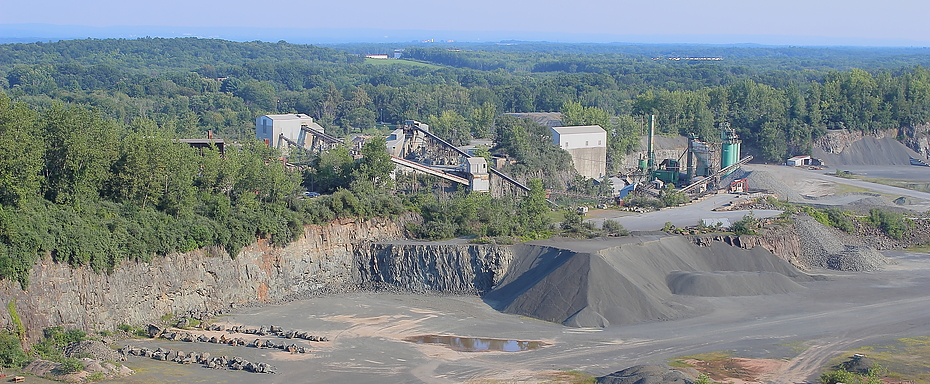
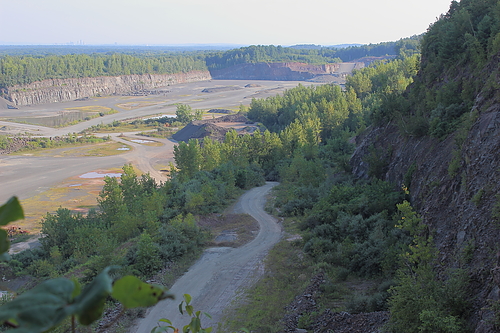
Quarry in the Jurassic (205 Ma) Holyoke Basalt. Mineralization occurs in gas vesicles (pockets) and in fault zones. Noted for excellent datolite, prehnite, babintonite, calcite and quartz crystals. Many minerals show replacement and/or pseudomorphing.
According to Walter and Dixon (2026), it was opened in 1951 by Angelo Roncari. It was sold to Tilcon Corp. in 1995 and then to Galasso Materials in 1997. Despite these changes, collectors still refer to it by its original name.
Excellent datolite specimens were collectable in the early decades of operation, such as these found by Larry Sidebottom in the 1960s:
https://www.mindat.org/photo-670143.html (an adjacent part went to the "British Museum")
https://www.mindat.org/photo-515562.html
Later, they were available from the Bentley family, who had permission to collect there starting in 1977. Ronald Earl Bentley donated this big datolite piece to the Houston Museum of Natural Science (Francis, 1995):
https://www.mindat.org/photo-1746216.html
Walter and Dixon (2026) describe a mineralized fault zone that was intersected in the northern part of the quarry in 2001. It produced a plethora of mineral specimens through 2005 in pockets typically 10 to 30 cm, but reaching up to 2 x 3 x 5 m. Many specimens have a matrix of heavily brecciated basalt cemented with fine-grained, tufa-like, layered calcite deposits. See also their detailed descriptions of all the minerals found there. As a result of these finds, they conclude that "the Roncari quarry has produced some of the finest basalt quarry specimens to be found along the east coast of North America."
According to Walter and Dixon (2026), it was opened in 1951 by Angelo Roncari. It was sold to Tilcon Corp. in 1995 and then to Galasso Materials in 1997. Despite these changes, collectors still refer to it by its original name.
Excellent datolite specimens were collectable in the early decades of operation, such as these found by Larry Sidebottom in the 1960s:
https://www.mindat.org/photo-670143.html (an adjacent part went to the "British Museum")
https://www.mindat.org/photo-515562.html
Later, they were available from the Bentley family, who had permission to collect there starting in 1977. Ronald Earl Bentley donated this big datolite piece to the Houston Museum of Natural Science (Francis, 1995):
https://www.mindat.org/photo-1746216.html
Walter and Dixon (2026) describe a mineralized fault zone that was intersected in the northern part of the quarry in 2001. It produced a plethora of mineral specimens through 2005 in pockets typically 10 to 30 cm, but reaching up to 2 x 3 x 5 m. Many specimens have a matrix of heavily brecciated basalt cemented with fine-grained, tufa-like, layered calcite deposits. See also their detailed descriptions of all the minerals found there. As a result of these finds, they conclude that "the Roncari quarry has produced some of the finest basalt quarry specimens to be found along the east coast of North America."
Select Mineral List Type
Standard Detailed Gallery Strunz Chemical ElementsCommodity List
This is a list of exploitable or exploited mineral commodities recorded at this locality.Mineral List
22 valid minerals. 2 erroneous literature entries.
* - Minerals that have never been found, but their existence is inferred in some way (e.g. from pseudomorphs)
Detailed Mineral List:
| ⓘ Anhydrite Formula: CaSO4 Habit: tabular voids Description: Tabular voids in later crystallized minerals (typically quartz and prehnite, rarely datolite) are very common here, as in all Connecticut trap rock quarries. Nearly all anhydrite in the basalt dissolved away leaving these voids, which can reach 15 cm. |
| ✪ 'Apophyllite Group' Formula: AB4[Si8O20]X · 8H2O Habit: tabular, in spherical aggregates Colour: white to creamy Description: Aggregates of tabular crystals can reach 3 to 4 cm. This habit is characteristic for this locality, other area trap rock quarries have bipyramidal crystals. |
| ⓘ Aragonite Formula: CaCO3 |
| ✪ Babingtonite Formula: Ca2Fe2+Fe3+Si5O14(OH) Habit: blocky to wedge-shaped, tabular Colour: black Description: Crystals to a little over 1 cm, aggregates to 3 cm, surfaces are mix of smooth and lustrous to rough textures. Commonly associated with prehnite, calcite and quartz. |
| ⓘ Formula: BaSO4 Description: Mistaken identification of calcite crystals twinned on a face of the shallow negative rhombohedron and showing much growth distortion so that they look tabular. |
| ✪ Calcite Formula: CaCO3 Habit: rhombohedral, scalenohedral, twins on {0001}, tabular butterfly twins on {01bar11} Colour: white, pale rose, yellow/orange from iron oxyhydroxides, reddish from hematite, olive from chlorite Fluorescence: orange-red (best in MW), pale yellow (LW) Description: A variety of forms and sizes occur, most commonly rhombohedral and scalenohedral to 25 cm. Rhombic overgrowths up to 4 cm on scalenohedral cores showing a pale rose color and frosty luster associated with sprays of needle quartz epimorphic on dissolved anhydrite. Twins on {0001} and tabular butterfly twins (face of the shallow negative rhombohedron {01bar11}) to 5mm or so also occur. References: Wolfe, C. W., Vilks, I. (1960) Pseudomorphes after datolite, prehnite and apophyllite from East Granby, Connecticut. American Mineralogist, 45 (3-4) 443-446 |
| ⓘ Celestine Formula: SrSO4 Habit: tabular, blocky, bladed, prismatic Colour: colorless to very pale blue Description: Crystals typically small, <2 cm. |
| ⓘ Chalcopyrite Formula: CuFeS2 Habit: simple disphenoid Colour: dull brown to brassy yellow Description: crystals to 1 cm. Late in the parageneses, typically on or included in calcite or quartz. |
| ⓘ 'Chlorite Group' Colour: olive green Description: Fine-grained coatings and/or replacements of other minerals like prehnite, fluorapophyllite-(K), datolite, calcite and quartz. EDS shows major Mg, Al, and Fe, suggesting an intermediate clinochlore-chamosite series species(XRD confirmed). |
| ⓘ Chrysocolla Formula: Cu2-xAlx(H2-xSi2O5)(OH)4 · nH2O, x < 1 Habit: coatings Colour: pale blue Description: Mostly as secondary coatings with malachite in rare places where copper minerals occur. |
| ✪ Datolite Formula: CaB(SiO4)(OH) Habit: complex prisms with chisel-point terminations Colour: pale apple green, colorless, reddish from hematite Description: Gas vesicles rich in well-formed, lustrous crystals lining the walls were once abundant. Never found singly. Crystals can reach to 5 cm, larger ones typically transparent, smaller crystals translucent to opaque - grading to porcelaineous crusts. Excellent specimens in major museums. Associated with fluorapophyllite-(K), quartz, hematite, rarely babingtonite. Commonly hosting thin, tabular anhydrite molds. |
| ⓘ Epidote Formula: (CaCa)(AlAlFe3+)O[Si2O7][SiO4](OH) Habit: tabular to acicular Colour: dark green to black Description: Typically as druses or inclusions in quartz (phantoms). Dark crystals can mimic babingtonite. |
| ✪ Fluorapophyllite-(K) Formula: KCa4(Si8O20)(F,OH) · 8H2O Habit: blocky to tabular, in spherical aggregates Colour: white to creamy Description: Spherical aggregates of blocky to tabular crystals can reach 3 to 4 cm. This habit is characteristic for this locality, other area trap rock quarries have mostly bipyramidal crystals. Lustrous and transparent in some cases. Many coated/replaced by fine-grained chlorite. |
| ⓘ Fluorite Formula: CaF2 Habit: octahedral Colour: purple Description: lustrous, octahedral to misshapen crystals to 1 cm |
| ⓘ Galena Formula: PbS Habit: skeletal cuboctahedral Colour: gray Description: A 12mm skeletal cuboctahedral crystal is known, associated with datolite and yellow calcite.
Also crude to well-formed crystals, some skeletal, to 1 cm. |
| ⓘ Goethite Formula: Fe3+O(OH) Colour: bown Description: Replacements of pyrite. |
| ⓘ Gypsum Formula: CaSO4 · 2H2O Habit: bladed to massive Colour: colorless, reddish from hematite Description: Two generations:
1 - transparent, colorless, bladed crystals to 3 cm, some doubly-terminated and colored by hematite.
2 - clear, colorless masses filling voids or as etched crystals to 5 cm. |
| ⓘ Gypsum var. Selenite Formula: CaSO4 · 2H2O References: |
| ✪ Hematite Formula: Fe2O3 Habit: coatings, botryoidal aggregates, rosettes Colour: specular to rusty-red, orange, black Description: Mostly as rusty-red coatings (to several mm) on datolite, prehnite, calcite and quartz, commonly on selective faces. As tiny blebs or as specular to rusty-red rosettes to several mm. As inclusions delineating phantoms or imparting a red color to the entire host crystal. Botryoidal to mammillary masses. |
| ⓘ Hematite var. Iron Rose Formula: Fe2O3 References: |
| ⓘ Hemimorphite Formula: Zn4Si2O7(OH)2 · H2O Habit: radiating prismatic Colour: white Description: low-luster, hemispheres of radiating prismatic crystals to 3 mm |
| ⓘ ' Formula: Ca2XFe3+2[Si2O6(OH)][SiO4](OH)2A Habit: isolated botryoidal or "bow-tie" radiating crystal aggregates. Colour: very dark green Description: Identified by Raman spectroscopy as pumpellyite. References: |
| ⓘ Malachite Formula: Cu2(CO3)(OH)2 Habit: massive to acicular Colour: green Description: Associated with chrysocolla. References: |
| ⓘ 'Manganese Oxides' References: |
| ⓘ 'Manganese Oxides var. Manganese Dendrites' References: |
| ⓘ 'Petroleum var. Bitumen' Habit: amorphous Colour: black Description: Brittle, glassy, conchoidal fracture with sharp edges. Found in faults and pockets. Dessicated residue from the upward migration of crude oil from stratigraphically lower, petroleum-rich black shales in the Shuttle Meadow Formation. References: |
| ✪ Prehnite Formula: Ca2Al2Si3O10(OH)2 Habit: Botryoidal to conical aggregates of tabular crystals Colour: various shades of green, rarely white to yellow Description: In vugs up to 1 meter across, commonly hosting tabular anhydrite molds. References: Wolfe, C. W., Vilks, I. (1960) Pseudomorphes after datolite, prehnite and apophyllite from East Granby, Connecticut. American Mineralogist, 45 (3-4) 443-446 |
| ✪ 'Pumpellyite Group' Formula: Ca2XZ2[Si2O6(OH)][SiO4](OH)2A Habit: microfibrous botryoids, crusts, bowties Colour: blue-green, dark olive green to black Description: Druses and coatings and microcrystalline aggregates lining vesicles, rarely on top of other minerals.
Few specimens have been confirmed by analyses to differentiate it from several other possible pumpellyite group minerals. |
| ⓘ 'Pumpellyite Subgroup' Formula: Ca2XAl2[Si2O6(OH)][SiO4](OH)2A Habit: isolated botryoidal or "bow-tie" radiating crystal aggregates. Colour: very dark green Description: As late-forming micro-crystal aggregates in pockets. Thought to be julgoldite but identified as pumpellyite using Raman spectroscopy by Paul Bartholomew, U. of New Haven, 2014. References: |
| ⓘ Pyrite Formula: FeS2 Habit: octahedral and cuboctahedral Description: crystals to several millimeters, some altered to goethite. |
| ✪ Quartz Formula: SiO2 Habit: elongated prismatic, Cumberland habit, "cactus" habit, Herkimer-style Colour: colorless, milky, smoky, black, pale to deep shades of purple, reddish from hematite Description: Typically associated with calcite, datolite or prehnite, crystals range from tiny needly ones epimorphing dissolved elondated anhydrite crystals resulting in sparkling columns to 25 cm long, to single prismatic crystals to 15 cm. Cumberland habit crystals typcially up to 1-2 cm found in groups or singly. Herkimer-style crystals, "cactus" crystals and many other habits, some coated with a frost of later quartz. Some crystals replaced/coated with fine-grained chlorite. Fluid inclusion voids. Aggregates commonly host tabular anhydrite molds. Mammilary masses coating voids, with calcite layers on top. |
| ⓘ Quartz var. Amethyst Formula: SiO2 |
| ⓘ Quartz var. Milky Quartz Formula: SiO2 References: |
| ⓘ Quartz var. Smoky Quartz Formula: SiO2 References: |
| ⓘ Sphalerite Formula: ZnS Colour: amber to dark brown Description: Poorly developed crystals and aggregates to 5 cm. |
| ⓘ 'Stilbite Subgroup' Formula: M6-7[Al8-9Si27-28O72] · nH2O References: |
| ✪ Stilpnomelane Formula: K4Fe2+48[Si64Al8]O164(OH)52 · nH2O Habit: velvety to micaceous coatings Colour: golden brown to green Description: Velvety to micaceous, greasy masses and coatings on quartz, calcite, prehnite, etc. very similar to the Serling Mine, New York material. |
Gallery:

List of minerals arranged by Strunz 10th Edition classification
| Group 2 - Sulphides and Sulfosalts | |||
|---|---|---|---|
| ⓘ | Sphalerite | 2.CB.05a | ZnS |
| ⓘ | Chalcopyrite | 2.CB.10a | CuFeS2 |
| ⓘ | Galena | 2.CD.10 | PbS |
| ⓘ | Pyrite | 2.EB.05a | FeS2 |
| Group 3 - Halides | |||
| ⓘ | Fluorite | 3.AB.25 | CaF2 |
| Group 4 - Oxides and Hydroxides | |||
| ⓘ | Goethite | 4.00. | Fe3+O(OH) |
| ⓘ | Hematite | 4.CB.05 | Fe2O3 |
| ⓘ | var. Iron Rose | 4.CB.05 | Fe2O3 |
| ⓘ | Quartz var. Amethyst | 4.DA.05 | SiO2 |
| ⓘ | 4.DA.05 | SiO2 | |
| ⓘ | var. Smoky Quartz | 4.DA.05 | SiO2 |
| ⓘ | var. Milky Quartz | 4.DA.05 | SiO2 |
| Group 5 - Nitrates and Carbonates | |||
| ⓘ | Calcite | 5.AB.05 | CaCO3 |
| ⓘ | Aragonite | 5.AB.15 | CaCO3 |
| ⓘ | Malachite | 5.BA.10 | Cu2(CO3)(OH)2 |
| Group 7 - Sulphates, Chromates, Molybdates and Tungstates | |||
| ⓘ | Anhydrite ? | 7.AD.30 | CaSO4 |
| ⓘ | Baryte ? | 7.AD.35 | BaSO4 |
| ⓘ | Celestine | 7.AD.35 | SrSO4 |
| ⓘ | Gypsum | 7.CD.40 | CaSO4 · 2H2O |
| ⓘ | var. Selenite | 7.CD.40 | CaSO4 · 2H2O |
| Group 9 - Silicates | |||
| ⓘ | Datolite | 9.AJ.20 | CaB(SiO4)(OH) |
| ⓘ | Hemimorphite | 9.BD.10 | Zn4Si2O7(OH)2 · H2O |
| ⓘ | Epidote | 9.BG.05a | (CaCa)(AlAlFe3+)O[Si2O7][SiO4](OH) |
| ⓘ | Babingtonite | 9.DK.05 | Ca2Fe2+Fe3+Si5O14(OH) |
| ⓘ | Prehnite | 9.DP.20 | Ca2Al2Si3O10(OH)2 |
| ⓘ | Fluorapophyllite-(K) | 9.EA.15 | KCa4(Si8O20)(F,OH) · 8H2O |
| ⓘ | Chrysocolla | 9.ED.20 | Cu2-xAlx(H2-xSi2O5)(OH)4 · nH2O, x < 1 |
| ⓘ | Stilpnomelane | 9.EG.40 | K4Fe2+48[Si64Al8]O164(OH)52 · nH2O |
| Unclassified | |||
| ⓘ | 'Apophyllite Group' | - | AB4[Si8O20]X · 8H2O |
| ⓘ | 'Chlorite Group' | - | |
| ⓘ | 'Pumpellyite Subgroup' | - | Ca2XAl2[Si2O6(OH)][SiO4](OH)2A |
| ⓘ | 'Stilbite Subgroup' | - | M6-7[Al8-9Si27-28O72] · nH2O |
| ⓘ | 'Petroleum var. Bitumen' | - | |
| ⓘ | 'Manganese Oxides var. Manganese Dendrites' | - | |
| ⓘ | '' | - | |
| ⓘ | 'Pumpellyite Group' | - | Ca2XZ2[Si2O6(OH)][SiO4](OH)2A |
| ⓘ | 'Julgoldite Subgroup' ? | - | Ca2XFe3+2[Si2O6(OH)][SiO4](OH)2A |
List of minerals for each chemical element
| H | Hydrogen | |
|---|---|---|
| H | ⓘ Apophyllite Group | AB4[Si8O20]X · 8H2O |
| H | ⓘ Babingtonite | Ca2Fe2+Fe3+Si5O14(OH) |
| H | ⓘ Chrysocolla | Cu2-xAlx(H2-xSi2O5)(OH)4 · nH2O, x < 1 |
| H | ⓘ Datolite | CaB(SiO4)(OH) |
| H | ⓘ Epidote | (CaCa)(AlAlFe3+)O[Si2O7][SiO4](OH) |
| H | ⓘ Fluorapophyllite-(K) | KCa4(Si8O20)(F,OH) · 8H2O |
| H | ⓘ Goethite | Fe3+O(OH) |
| H | ⓘ Gypsum | CaSO4 · 2H2O |
| H | ⓘ Hemimorphite | Zn4Si2O7(OH)2 · H2O |
| H | ⓘ Malachite | Cu2(CO3)(OH)2 |
| H | ⓘ Prehnite | Ca2Al2Si3O10(OH)2 |
| H | ⓘ Pumpellyite Subgroup | Ca2XAl2[Si2O6(OH)][SiO4](OH)2A |
| H | ⓘ Stilbite Subgroup | M6-7[Al8-9Si27-28O72] · nH2O |
| H | ⓘ Stilpnomelane | K4Fe482+[Si64Al8]O164(OH)52 · nH2O |
| H | ⓘ Gypsum var. Selenite | CaSO4 · 2H2O |
| H | ⓘ Pumpellyite Group | Ca2XZ2[Si2O6(OH)][SiO4](OH)2A |
| H | ⓘ Julgoldite Subgroup | Ca2XFe23+[Si2O6(OH)][SiO4](OH)2A |
| B | Boron | |
| B | ⓘ Datolite | CaB(SiO4)(OH) |
| C | Carbon | |
| C | ⓘ Aragonite | CaCO3 |
| C | ⓘ Calcite | CaCO3 |
| C | ⓘ Malachite | Cu2(CO3)(OH)2 |
| O | Oxygen | |
| O | ⓘ Quartz var. Amethyst | SiO2 |
| O | ⓘ Anhydrite | CaSO4 |
| O | ⓘ Apophyllite Group | AB4[Si8O20]X · 8H2O |
| O | ⓘ Aragonite | CaCO3 |
| O | ⓘ Babingtonite | Ca2Fe2+Fe3+Si5O14(OH) |
| O | ⓘ Baryte | BaSO4 |
| O | ⓘ Calcite | CaCO3 |
| O | ⓘ Celestine | SrSO4 |
| O | ⓘ Chrysocolla | Cu2-xAlx(H2-xSi2O5)(OH)4 · nH2O, x < 1 |
| O | ⓘ Datolite | CaB(SiO4)(OH) |
| O | ⓘ Epidote | (CaCa)(AlAlFe3+)O[Si2O7][SiO4](OH) |
| O | ⓘ Fluorapophyllite-(K) | KCa4(Si8O20)(F,OH) · 8H2O |
| O | ⓘ Goethite | Fe3+O(OH) |
| O | ⓘ Gypsum | CaSO4 · 2H2O |
| O | ⓘ Hematite | Fe2O3 |
| O | ⓘ Hemimorphite | Zn4Si2O7(OH)2 · H2O |
| O | ⓘ Malachite | Cu2(CO3)(OH)2 |
| O | ⓘ Prehnite | Ca2Al2Si3O10(OH)2 |
| O | ⓘ Pumpellyite Subgroup | Ca2XAl2[Si2O6(OH)][SiO4](OH)2A |
| O | ⓘ Quartz | SiO2 |
| O | ⓘ Quartz var. Smoky Quartz | SiO2 |
| O | ⓘ Stilbite Subgroup | M6-7[Al8-9Si27-28O72] · nH2O |
| O | ⓘ Stilpnomelane | K4Fe482+[Si64Al8]O164(OH)52 · nH2O |
| O | ⓘ Gypsum var. Selenite | CaSO4 · 2H2O |
| O | ⓘ Quartz var. Milky Quartz | SiO2 |
| O | ⓘ Hematite var. Iron Rose | Fe2O3 |
| O | ⓘ Pumpellyite Group | Ca2XZ2[Si2O6(OH)][SiO4](OH)2A |
| O | ⓘ Julgoldite Subgroup | Ca2XFe23+[Si2O6(OH)][SiO4](OH)2A |
| F | Fluorine | |
| F | ⓘ Fluorapophyllite-(K) | KCa4(Si8O20)(F,OH) · 8H2O |
| F | ⓘ Fluorite | CaF2 |
| Al | Aluminium | |
| Al | ⓘ Chrysocolla | Cu2-xAlx(H2-xSi2O5)(OH)4 · nH2O, x < 1 |
| Al | ⓘ Epidote | (CaCa)(AlAlFe3+)O[Si2O7][SiO4](OH) |
| Al | ⓘ Prehnite | Ca2Al2Si3O10(OH)2 |
| Al | ⓘ Pumpellyite Subgroup | Ca2XAl2[Si2O6(OH)][SiO4](OH)2A |
| Al | ⓘ Stilbite Subgroup | M6-7[Al8-9Si27-28O72] · nH2O |
| Al | ⓘ Stilpnomelane | K4Fe482+[Si64Al8]O164(OH)52 · nH2O |
| Si | Silicon | |
| Si | ⓘ Quartz var. Amethyst | SiO2 |
| Si | ⓘ Apophyllite Group | AB4[Si8O20]X · 8H2O |
| Si | ⓘ Babingtonite | Ca2Fe2+Fe3+Si5O14(OH) |
| Si | ⓘ Chrysocolla | Cu2-xAlx(H2-xSi2O5)(OH)4 · nH2O, x < 1 |
| Si | ⓘ Datolite | CaB(SiO4)(OH) |
| Si | ⓘ Epidote | (CaCa)(AlAlFe3+)O[Si2O7][SiO4](OH) |
| Si | ⓘ Fluorapophyllite-(K) | KCa4(Si8O20)(F,OH) · 8H2O |
| Si | ⓘ Hemimorphite | Zn4Si2O7(OH)2 · H2O |
| Si | ⓘ Prehnite | Ca2Al2Si3O10(OH)2 |
| Si | ⓘ Pumpellyite Subgroup | Ca2XAl2[Si2O6(OH)][SiO4](OH)2A |
| Si | ⓘ Quartz | SiO2 |
| Si | ⓘ Quartz var. Smoky Quartz | SiO2 |
| Si | ⓘ Stilbite Subgroup | M6-7[Al8-9Si27-28O72] · nH2O |
| Si | ⓘ Stilpnomelane | K4Fe482+[Si64Al8]O164(OH)52 · nH2O |
| Si | ⓘ Quartz var. Milky Quartz | SiO2 |
| Si | ⓘ Pumpellyite Group | Ca2XZ2[Si2O6(OH)][SiO4](OH)2A |
| Si | ⓘ Julgoldite Subgroup | Ca2XFe23+[Si2O6(OH)][SiO4](OH)2A |
| S | Sulfur | |
| S | ⓘ Anhydrite | CaSO4 |
| S | ⓘ Baryte | BaSO4 |
| S | ⓘ Celestine | SrSO4 |
| S | ⓘ Chalcopyrite | CuFeS2 |
| S | ⓘ Galena | PbS |
| S | ⓘ Gypsum | CaSO4 · 2H2O |
| S | ⓘ Pyrite | FeS2 |
| S | ⓘ Sphalerite | ZnS |
| S | ⓘ Gypsum var. Selenite | CaSO4 · 2H2O |
| K | Potassium | |
| K | ⓘ Fluorapophyllite-(K) | KCa4(Si8O20)(F,OH) · 8H2O |
| K | ⓘ Stilpnomelane | K4Fe482+[Si64Al8]O164(OH)52 · nH2O |
| Ca | Calcium | |
| Ca | ⓘ Anhydrite | CaSO4 |
| Ca | ⓘ Aragonite | CaCO3 |
| Ca | ⓘ Babingtonite | Ca2Fe2+Fe3+Si5O14(OH) |
| Ca | ⓘ Calcite | CaCO3 |
| Ca | ⓘ Datolite | CaB(SiO4)(OH) |
| Ca | ⓘ Epidote | (CaCa)(AlAlFe3+)O[Si2O7][SiO4](OH) |
| Ca | ⓘ Fluorapophyllite-(K) | KCa4(Si8O20)(F,OH) · 8H2O |
| Ca | ⓘ Fluorite | CaF2 |
| Ca | ⓘ Gypsum | CaSO4 · 2H2O |
| Ca | ⓘ Prehnite | Ca2Al2Si3O10(OH)2 |
| Ca | ⓘ Pumpellyite Subgroup | Ca2XAl2[Si2O6(OH)][SiO4](OH)2A |
| Ca | ⓘ Gypsum var. Selenite | CaSO4 · 2H2O |
| Ca | ⓘ Pumpellyite Group | Ca2XZ2[Si2O6(OH)][SiO4](OH)2A |
| Ca | ⓘ Julgoldite Subgroup | Ca2XFe23+[Si2O6(OH)][SiO4](OH)2A |
| Fe | Iron | |
| Fe | ⓘ Babingtonite | Ca2Fe2+Fe3+Si5O14(OH) |
| Fe | ⓘ Chalcopyrite | CuFeS2 |
| Fe | ⓘ Epidote | (CaCa)(AlAlFe3+)O[Si2O7][SiO4](OH) |
| Fe | ⓘ Goethite | Fe3+O(OH) |
| Fe | ⓘ Hematite | Fe2O3 |
| Fe | ⓘ Pyrite | FeS2 |
| Fe | ⓘ Stilpnomelane | K4Fe482+[Si64Al8]O164(OH)52 · nH2O |
| Fe | ⓘ Hematite var. Iron Rose | Fe2O3 |
| Fe | ⓘ Julgoldite Subgroup | Ca2XFe23+[Si2O6(OH)][SiO4](OH)2A |
| Cu | Copper | |
| Cu | ⓘ Chalcopyrite | CuFeS2 |
| Cu | ⓘ Chrysocolla | Cu2-xAlx(H2-xSi2O5)(OH)4 · nH2O, x < 1 |
| Cu | ⓘ Malachite | Cu2(CO3)(OH)2 |
| Zn | Zinc | |
| Zn | ⓘ Hemimorphite | Zn4Si2O7(OH)2 · H2O |
| Zn | ⓘ Sphalerite | ZnS |
| Sr | Strontium | |
| Sr | ⓘ Celestine | SrSO4 |
| Ba | Barium | |
| Ba | ⓘ Baryte | BaSO4 |
| Pb | Lead | |
| Pb | ⓘ Galena | PbS |
Mindat Articles
"Barf" Datolite by Paul GilmoreOther Regions, Features and Areas containing this locality
North AmericaContinent
North America PlateTectonic Plate
- Ganderia DomainDomain
- GranderiaPassive Margin
This page contains all mineral locality references listed on mindat.org. This does not claim to be a complete list. If you know of more minerals from this site, please register so you can add to our database. This locality information is for reference purposes only. You should never attempt to
visit any sites listed in mindat.org without first ensuring that you have the permission of the land and/or mineral rights holders
for access and that you are aware of all safety precautions necessary.
References
Wolfe, C. W., Vilks, I. (1960) Pseudomorphes after datolite, prehnite and apophyllite from East Granby, Connecticut. American Mineralogist, 45 (3-4) 443-446
Weber, Marcelle H., Sullivan, Earle C. (1995) Connecticut Mineral Locality Index. Rocks & Minerals, 70 (6) 396-409 doi:10.1080/00357529.1995.11761569p.398

Roncari Quarry, East Granby, Hartford County, Connecticut, USA