
Boyleston Quarry, Barrhead, East Renfrewshire, Scotland, UKi
| Regional Level Types | |
|---|---|
| Boyleston Quarry | Quarry (Abandoned) |
| Barrhead | Town |
| East Renfrewshire | Council Area |
| Scotland | Country |
| UK | Country |
This page is currently not sponsored. Click here to sponsor this page.



Latitude & Longitude (WGS84):
55° 48' 25'' North , 4° 24' 30'' West
Latitude & Longitude (decimal):
UK National Grid Reference:
NS495597
Type:
Quarry (Abandoned) - last checked 2020
Köppen climate type:
Other/historical names associated with this locality:
Renfrewshire
An abandoned basalt quarry.
Contains three thick lava flows of the Clyde Plateau.
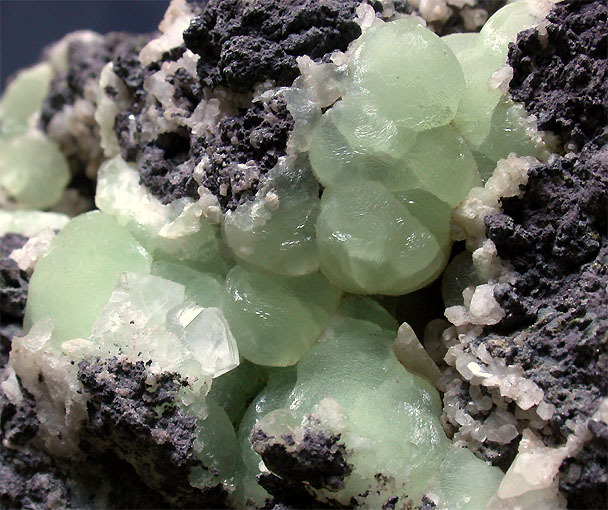
Known for copper minerals greenockite as well as native copper, and a variety of zeolites and associated minerals such as excellent specimens of prehnite.
Sampling of rocks and minerals from this quarry may only take place in accordance with the Geological Code to facilitate education and research.
Select Mineral List Type
Standard Detailed Gallery Strunz Chemical ElementsMineral List
28 valid minerals.
Rock Types Recorded
Note: data is currently VERY limited. Please bear with us while we work towards adding this information!
Select Rock List Type
Alphabetical List Tree DiagramDetailed Mineral List:
| ⓘ Acanthite Formula: Ag2S References: |
| ⓘ Albite Formula: Na(AlSi3O8) Habit: Meikle (1989): "Albite occurs as reddish-brown trapezohedral crystals less than 10 mm in size, and as crystal groups pseudomorphing analcime. The crystals are a composite of clear albite with contained brown or reddish-brown earthy volcanic ash. In small cavities clear, transparent crystals of albite occur as random individual plates <0.1 x 0.8 mm with a square termination, or as doubly-terminated tapering coffin-shaped crystals <0.1 x 1 mm. In addition, small cavities in altered lava contain small radial groupings of clear, transparent albite crystals <0.1 x 0.5 mm, with single, tapering terminations." References: |
| ⓘ Analcime Formula: Na(AlSi2O6) · H2O References: |
| ⓘ Augite Formula: (CaxMgyFez)(Mgy1Fez1)Si2O6 |
| ⓘ Baryte Formula: BaSO4 Habit: Meikle (1989): "Barite is present in a single occurrence closely associated with native copper, cuprite, and malachite, and also in prehnite-lined cavities in the tuffaceous horizon, as layered and interlocking groups of large, <2 mm thick, clear to white crystal tablets. In incompletely filled cavities barite is discoloured grey by admixed volcanic ash, but where cavities are completely filled it is only in the centre of the cavity that the crystals are discoloured. In one case the crystals taper uniformly in the same direction thus creating an appearance on cleaved faces of a radial structure." |
| ⓘ Bornite ? Formula: Cu5FeS4 |
| ⓘ Calcite Formula: CaCO3 References: |
| ⓘ 'Chabazite' Habit: Meikle (1989): "Chabazite is found only very rarely, forming small, clear, transparent, single, or penetration-twinned crystals <0.4 mm, associated in one specimen with a cavity (40 x 50 mm) filled with clear and malachite-coated or stained, nailhead crystals of calcite «3.5 x 6 mm). In this specimen the dull red tuffaceous matrix is intermixed with, and partly coated by, chalcopyrite altering to chalcocite and/or possible bornite." References: |
| ⓘ Chalcocite Formula: Cu2S Habit: Meikle (1989): "Chalcocite is found only in the highly copper charged tuffaceous rocks, forming small, <0.5 x 1 mm, hemihedral, striated, dull to lustrous equant crystals, associated with native copper, cuprite, and malachite. It also occurs massively in the same environment, as a lustrous opaque, black, brittle, glassy, or pitchy phase." |
| ⓘ Chalcopyrite Formula: CuFeS2 Habit: Meikle (1989): "Chalcopyrite is only rarely found. It is present in a single occurrence in a cavity, forming a 1 - 1.5 mm thick layer, coating botryoidal surfaces of reddish-brown ash-impregnated prehnite. Also, it forms small, <3 mm, tarnished groups of complexly twinned crystals distributed over the surface of small prehnite botryoids and is coated by chrysocolla or goethite. Rarely, it is found altering to earthy chalcocite and/or covellite." |
| ⓘ 'Chlorite Group' References: |
| ⓘ Chrysocolla Formula: Cu2-xAlx(H2-xSi2O5)(OH)4 · nH2O, x < 1 References: |
| ⓘ Covellite Formula: CuS Habit: Meikle (1989): "Covellite is very rare at Boyleston Quarry. It is found on prehnite, as small blue-black to indigo blue, dull metallic, hexagonal crystals «0.5 mm). Some crystals are truncated by pyramidal terminations. Occasionally it is partly coated with chrysocolla, as well as being accompanied by chrysocolla crystals pseudomorphous after covellite, along with small hemispheres and spherules (<0.5 mm) of malachite." |
| ⓘ Cuprite Formula: Cu2O Habit: Meikle (1989): "Cuprite occurs with native copper and malachite in a mixture of prehnite, calcite, and analcime, which fills joints (<25 mm) in dense, fine-grained lava , as well as in small (2-3 mm), infrequent cavities. The cuprite form ranges from blood-red adamantine, transparent, cubo-octahedral crystals (<0.3 mm), through to crimson transparent elongated bladed crystals (<0.03 x 0.25 mm). In addition, it is also present as hair-like masses (variety chalcotrichite) (<11 x 13 mm), as well as metallic deep-red or dull-grey (<1 x 3 mm), or dull, earthy, brick-red to orange masses (<15 x 35 x 75 mm). The latter often include small bright hackly masses and crystals (<0.5 mm) of native copper and are frequently bordered by a layer of malachite." References: |
| ⓘ Cuprite var. Chalcotrichite Formula: Cu2O |
| ⓘ Erythrite ? Formula: Co3(AsO4)2 · 8H2O Description: "May be a mistaken reference to orthoclase (var. erythrite)" (Meikle, 1989) |
| ⓘ 'Fayalite-Forsterite Series' References: |
| ⓘ Goethite Formula: Fe3+O(OH) References: |
| ⓘ Greenockite Formula: CdS Description: Meikle (1989): "The occurrence of greenockite at Boyleston Quarry was noted by Dana (1892), while Heddle (1901) detailed it from here also, occurring with prehnite, natrolite, and chrysocolla. Houston (1912) noted these records but provided no further details, and so far as is known there is no other record of greenockite having been found at Boyleston this century. Further, greenockite has not been encountered during the present investigations, although it was identified in the 1970s in excavations for the M8 motorway adjacent to the Bishopton railway tunnel, the original type locality for the mineral (Jameson, 1840), and again on several occasions since then from Loanhead Quarry, near Beith, in the same form and association (see Meikle, 1989). In both cases the mode of formation is similar to that at Boyleston Quarry, so accordingly there seems no reason to doubt the recorded occurrence of greenockite from Boyleston. Indeed, the preservation of the now derelict quarry must mean that Boyleston is still a potential collecting site for this very rare mineral." |
| ⓘ Hematite Formula: Fe2O3 Habit: Meikle (1989): "Occasionally hematite, as minute micaceous flakes with a lustrous metallic and bright copper colour, is present as a coating uniformly covering the surfaces of glassy, white, analcime crystals. It also occurs as dull, metallic brown-grey botryoids or granular to earthy, reddish coatings in cavities in the tuffaceous rocks, where it is associated with chalcopyrite, chalcocite, and possible bornite." |
| ⓘ 'Heulandite Subgroup' Formula: (Na/Ca/K)5-6[Al8-9 Si27-28 O72] · nH2O |
| ⓘ Laumontite Formula: CaAl2Si4O12 · 4H2O References: |
| ⓘ Malachite Formula: Cu2(CO3)(OH)2 References: |
| ⓘ Native Copper Formula: Cu References: |
| ⓘ Native Silver Formula: Ag Habit: Meikle (1989): Native silver is rare, although it formed with some local abundance on, and partly in, pale yellow, translucent prehnite. In addition, it may also extend across, or into, small (<15 mm) cavities in the prehnite. Even more rarely it occurs within, or on, adjacent calcite. The base of the prehnite is generally opaque and whitish in colour, and frequently is distinctly banded parallel to the surface by malachite staining developed from a thin brownish-green copper-impregnated layer within the prehnite. Occasionally well-crystallized native copper is found on the prehnite. The native silver is also well-crystallized, and is generally very bright and lustrous but with an iridescent tarnish developing upon exposure. The crystals, though small, exhibit a variety of forms, from the simple or modified single (<0.15 mm) and twinned (0.35 x 0.25 x 0.15 mm) cubes, to elongated symmetrical or unequal bi-pyramidal forms of square, or nearly square, section (<0.4 x 1 mm). The latter are frequently extended at one end into filiform silver (<1.25 mm). More commonly, however, the elongated crystals, <9 mm long, are approximately square in section (<0.14 mm). One specimen was observed with 12 sides, tapering in thickness from 0.15 to 0.06 mm, while a second forms a complex cruciform twin. Other unusual forms are complex and appear to be 13 multiple crystals in parallel growth from a common base; one such specimen is 3.4 x 0.4 x 0.1 mm. Upwards of 50 individual crystals have been recovered from a relatively small volume of rock. The reference above to 'local abundance' is illustrated by one specimen, measuring 30 x 40 x 20 mm in size, carrying 12 individual crystals." |
| ⓘ Natrolite Formula: Na2Al2Si3O10 · 2H2O References: |
| ⓘ Orthoclase Formula: K(AlSi3O8) Description: Listed as "Orthoclase (var. Erythrite)" in both references. |
| ⓘ Prehnite Formula: Ca2Al2Si3O10(OH)2 References: |
| ⓘ Quartz Formula: SiO2 References: |
| ⓘ Saponite Formula: Ca0.25(Mg,Fe)3((Si,Al)4O10)(OH)2 · nH2O References: |
| ⓘ Saponite var. Bowlingite Formula: Ca0.25(Mg,Fe)3((Si,Al)4O10)(OH)2 · nH2O |
| ⓘ Scolecite Formula: CaAl2Si3O10 · 3H2O |
| ⓘ Talc Formula: Mg3Si4O10(OH)2 Habit: Meikle (1989): "Talc is extremely rare, found only in a single specimen, as small bundles and aggregates (<4 mm) of very small pearly, clear to white plates and lamellae. It is closely associated with botryoidal malachite and intimately mixed with greenish-black, earthy chalcocite, and small clear subhedral masses of quartz. Optical examination indicates a 2V angle of about 5° and hence the mineral is thought to be talc (confirmed by X-ray diffraction; A. Livingstone, personal communication.)" |
| ⓘ Thomsonite-Ca Formula: NaCa2[Al5Si5O20] · 6H2O |
| ⓘ 'Thomsonite Subgroup' References: |

List of minerals arranged by Strunz 10th Edition classification
| Group 1 - Elements | |||
|---|---|---|---|
| ⓘ | Native Copper | 1.AA.05 | Cu |
| ⓘ | Native Silver | 1.AA.05 | Ag |
| Group 2 - Sulphides and Sulfosalts | |||
| ⓘ | Chalcocite | 2.BA.05 | Cu2S |
| ⓘ | Bornite ? | 2.BA.15 | Cu5FeS4 |
| ⓘ | Acanthite | 2.BA.35 | Ag2S |
| ⓘ | Covellite | 2.CA.05a | CuS |
| ⓘ | Chalcopyrite | 2.CB.10a | CuFeS2 |
| ⓘ | Greenockite | 2.CB.45 | CdS |
| Group 4 - Oxides and Hydroxides | |||
| ⓘ | Goethite | 4.00. | Fe3+O(OH) |
| ⓘ | Cuprite var. Chalcotrichite | 4.AA.10 | Cu2O |
| ⓘ | 4.AA.10 | Cu2O | |
| ⓘ | Hematite | 4.CB.05 | Fe2O3 |
| ⓘ | Quartz | 4.DA.05 | SiO2 |
| Group 5 - Nitrates and Carbonates | |||
| ⓘ | Calcite | 5.AB.05 | CaCO3 |
| ⓘ | Malachite | 5.BA.10 | Cu2(CO3)(OH)2 |
| Group 7 - Sulphates, Chromates, Molybdates and Tungstates | |||
| ⓘ | Baryte | 7.AD.35 | BaSO4 |
| Group 8 - Phosphates, Arsenates and Vanadates | |||
| ⓘ | Erythrite ? | 8.CE.40 | Co3(AsO4)2 · 8H2O |
| Group 9 - Silicates | |||
| ⓘ | Augite | 9.DA.15 | (CaxMgyFez)(Mgy1Fez1)Si2O6 |
| ⓘ | Prehnite | 9.DP.20 | Ca2Al2Si3O10(OH)2 |
| ⓘ | Talc | 9.EC.05 | Mg3Si4O10(OH)2 |
| ⓘ | Saponite | 9.EC.45 | Ca0.25(Mg,Fe)3((Si,Al)4O10)(OH)2 · nH2O |
| ⓘ | var. Bowlingite | 9.EC.45 | Ca0.25(Mg,Fe)3((Si,Al)4O10)(OH)2 · nH2O |
| ⓘ | Chrysocolla | 9.ED.20 | Cu2-xAlx(H2-xSi2O5)(OH)4 · nH2O, x < 1 |
| ⓘ | Orthoclase | 9.FA.30 | K(AlSi3O8) |
| ⓘ | Albite | 9.FA.35 | Na(AlSi3O8) |
| ⓘ | Natrolite | 9.GA.05 | Na2Al2Si3O10 · 2H2O |
| ⓘ | Scolecite | 9.GA.05 | CaAl2Si3O10 · 3H2O |
| ⓘ | Thomsonite-Ca | 9.GA.10 | NaCa2[Al5Si5O20] · 6H2O |
| ⓘ | Analcime | 9.GB.05 | Na(AlSi2O6) · H2O |
| ⓘ | Laumontite | 9.GB.10 | CaAl2Si4O12 · 4H2O |
| Unclassified | |||
| ⓘ | 'Chabazite' | - | |
| ⓘ | 'Chlorite Group' | - | |
| ⓘ | 'Heulandite Subgroup' | - | (Na/Ca/K)5-6[Al8-9 Si27-28 O72] · nH2O |
| ⓘ | 'Fayalite-Forsterite Series' | - | |
| ⓘ | 'Thomsonite Subgroup' | - | |
List of minerals for each chemical element
| H | Hydrogen | |
|---|---|---|
| H | ⓘ Analcime | Na(AlSi2O6) · H2O |
| H | ⓘ Chrysocolla | Cu2-xAlx(H2-xSi2O5)(OH)4 · nH2O, x < 1 |
| H | ⓘ Erythrite | Co3(AsO4)2 · 8H2O |
| H | ⓘ Goethite | Fe3+O(OH) |
| H | ⓘ Heulandite Subgroup | (Na/Ca/K)5-6[Al8-9 Si27-28 O72] · nH2O |
| H | ⓘ Laumontite | CaAl2Si4O12 · 4H2O |
| H | ⓘ Malachite | Cu2(CO3)(OH)2 |
| H | ⓘ Natrolite | Na2Al2Si3O10 · 2H2O |
| H | ⓘ Prehnite | Ca2Al2Si3O10(OH)2 |
| H | ⓘ Saponite | Ca0.25(Mg,Fe)3((Si,Al)4O10)(OH)2 · nH2O |
| H | ⓘ Scolecite | CaAl2Si3O10 · 3H2O |
| H | ⓘ Talc | Mg3Si4O10(OH)2 |
| H | ⓘ Thomsonite-Ca | NaCa2[Al5Si5O20] · 6H2O |
| H | ⓘ Saponite var. Bowlingite | Ca0.25(Mg,Fe)3((Si,Al)4O10)(OH)2 · nH2O |
| C | Carbon | |
| C | ⓘ Calcite | CaCO3 |
| C | ⓘ Malachite | Cu2(CO3)(OH)2 |
| O | Oxygen | |
| O | ⓘ Albite | Na(AlSi3O8) |
| O | ⓘ Analcime | Na(AlSi2O6) · H2O |
| O | ⓘ Augite | (CaxMgyFez)(Mgy1Fez1)Si2O6 |
| O | ⓘ Baryte | BaSO4 |
| O | ⓘ Calcite | CaCO3 |
| O | ⓘ Cuprite var. Chalcotrichite | Cu2O |
| O | ⓘ Chrysocolla | Cu2-xAlx(H2-xSi2O5)(OH)4 · nH2O, x < 1 |
| O | ⓘ Cuprite | Cu2O |
| O | ⓘ Erythrite | Co3(AsO4)2 · 8H2O |
| O | ⓘ Goethite | Fe3+O(OH) |
| O | ⓘ Hematite | Fe2O3 |
| O | ⓘ Heulandite Subgroup | (Na/Ca/K)5-6[Al8-9 Si27-28 O72] · nH2O |
| O | ⓘ Laumontite | CaAl2Si4O12 · 4H2O |
| O | ⓘ Malachite | Cu2(CO3)(OH)2 |
| O | ⓘ Natrolite | Na2Al2Si3O10 · 2H2O |
| O | ⓘ Orthoclase | K(AlSi3O8) |
| O | ⓘ Prehnite | Ca2Al2Si3O10(OH)2 |
| O | ⓘ Quartz | SiO2 |
| O | ⓘ Saponite | Ca0.25(Mg,Fe)3((Si,Al)4O10)(OH)2 · nH2O |
| O | ⓘ Scolecite | CaAl2Si3O10 · 3H2O |
| O | ⓘ Talc | Mg3Si4O10(OH)2 |
| O | ⓘ Thomsonite-Ca | NaCa2[Al5Si5O20] · 6H2O |
| O | ⓘ Fayalite-Forsterite Series | |
| O | ⓘ Saponite var. Bowlingite | Ca0.25(Mg,Fe)3((Si,Al)4O10)(OH)2 · nH2O |
| Na | Sodium | |
| Na | ⓘ Albite | Na(AlSi3O8) |
| Na | ⓘ Analcime | Na(AlSi2O6) · H2O |
| Na | ⓘ Heulandite Subgroup | (Na/Ca/K)5-6[Al8-9 Si27-28 O72] · nH2O |
| Na | ⓘ Natrolite | Na2Al2Si3O10 · 2H2O |
| Na | ⓘ Thomsonite-Ca | NaCa2[Al5Si5O20] · 6H2O |
| Mg | Magnesium | |
| Mg | ⓘ Augite | (CaxMgyFez)(Mgy1Fez1)Si2O6 |
| Mg | ⓘ Saponite | Ca0.25(Mg,Fe)3((Si,Al)4O10)(OH)2 · nH2O |
| Mg | ⓘ Talc | Mg3Si4O10(OH)2 |
| Mg | ⓘ Fayalite-Forsterite Series | |
| Mg | ⓘ Saponite var. Bowlingite | Ca0.25(Mg,Fe)3((Si,Al)4O10)(OH)2 · nH2O |
| Al | Aluminium | |
| Al | ⓘ Albite | Na(AlSi3O8) |
| Al | ⓘ Analcime | Na(AlSi2O6) · H2O |
| Al | ⓘ Chrysocolla | Cu2-xAlx(H2-xSi2O5)(OH)4 · nH2O, x < 1 |
| Al | ⓘ Heulandite Subgroup | (Na/Ca/K)5-6[Al8-9 Si27-28 O72] · nH2O |
| Al | ⓘ Laumontite | CaAl2Si4O12 · 4H2O |
| Al | ⓘ Natrolite | Na2Al2Si3O10 · 2H2O |
| Al | ⓘ Orthoclase | K(AlSi3O8) |
| Al | ⓘ Prehnite | Ca2Al2Si3O10(OH)2 |
| Al | ⓘ Saponite | Ca0.25(Mg,Fe)3((Si,Al)4O10)(OH)2 · nH2O |
| Al | ⓘ Scolecite | CaAl2Si3O10 · 3H2O |
| Al | ⓘ Thomsonite-Ca | NaCa2[Al5Si5O20] · 6H2O |
| Al | ⓘ Saponite var. Bowlingite | Ca0.25(Mg,Fe)3((Si,Al)4O10)(OH)2 · nH2O |
| Si | Silicon | |
| Si | ⓘ Albite | Na(AlSi3O8) |
| Si | ⓘ Analcime | Na(AlSi2O6) · H2O |
| Si | ⓘ Augite | (CaxMgyFez)(Mgy1Fez1)Si2O6 |
| Si | ⓘ Chrysocolla | Cu2-xAlx(H2-xSi2O5)(OH)4 · nH2O, x < 1 |
| Si | ⓘ Heulandite Subgroup | (Na/Ca/K)5-6[Al8-9 Si27-28 O72] · nH2O |
| Si | ⓘ Laumontite | CaAl2Si4O12 · 4H2O |
| Si | ⓘ Natrolite | Na2Al2Si3O10 · 2H2O |
| Si | ⓘ Orthoclase | K(AlSi3O8) |
| Si | ⓘ Prehnite | Ca2Al2Si3O10(OH)2 |
| Si | ⓘ Quartz | SiO2 |
| Si | ⓘ Saponite | Ca0.25(Mg,Fe)3((Si,Al)4O10)(OH)2 · nH2O |
| Si | ⓘ Scolecite | CaAl2Si3O10 · 3H2O |
| Si | ⓘ Talc | Mg3Si4O10(OH)2 |
| Si | ⓘ Thomsonite-Ca | NaCa2[Al5Si5O20] · 6H2O |
| Si | ⓘ Fayalite-Forsterite Series | |
| Si | ⓘ Saponite var. Bowlingite | Ca0.25(Mg,Fe)3((Si,Al)4O10)(OH)2 · nH2O |
| S | Sulfur | |
| S | ⓘ Acanthite | Ag2S |
| S | ⓘ Baryte | BaSO4 |
| S | ⓘ Bornite | Cu5FeS4 |
| S | ⓘ Chalcopyrite | CuFeS2 |
| S | ⓘ Chalcocite | Cu2S |
| S | ⓘ Covellite | CuS |
| S | ⓘ Greenockite | CdS |
| K | Potassium | |
| K | ⓘ Heulandite Subgroup | (Na/Ca/K)5-6[Al8-9 Si27-28 O72] · nH2O |
| K | ⓘ Orthoclase | K(AlSi3O8) |
| Ca | Calcium | |
| Ca | ⓘ Augite | (CaxMgyFez)(Mgy1Fez1)Si2O6 |
| Ca | ⓘ Calcite | CaCO3 |
| Ca | ⓘ Heulandite Subgroup | (Na/Ca/K)5-6[Al8-9 Si27-28 O72] · nH2O |
| Ca | ⓘ Laumontite | CaAl2Si4O12 · 4H2O |
| Ca | ⓘ Prehnite | Ca2Al2Si3O10(OH)2 |
| Ca | ⓘ Saponite | Ca0.25(Mg,Fe)3((Si,Al)4O10)(OH)2 · nH2O |
| Ca | ⓘ Scolecite | CaAl2Si3O10 · 3H2O |
| Ca | ⓘ Thomsonite-Ca | NaCa2[Al5Si5O20] · 6H2O |
| Ca | ⓘ Saponite var. Bowlingite | Ca0.25(Mg,Fe)3((Si,Al)4O10)(OH)2 · nH2O |
| Fe | Iron | |
| Fe | ⓘ Augite | (CaxMgyFez)(Mgy1Fez1)Si2O6 |
| Fe | ⓘ Bornite | Cu5FeS4 |
| Fe | ⓘ Chalcopyrite | CuFeS2 |
| Fe | ⓘ Goethite | Fe3+O(OH) |
| Fe | ⓘ Hematite | Fe2O3 |
| Fe | ⓘ Saponite | Ca0.25(Mg,Fe)3((Si,Al)4O10)(OH)2 · nH2O |
| Fe | ⓘ Fayalite-Forsterite Series | |
| Fe | ⓘ Saponite var. Bowlingite | Ca0.25(Mg,Fe)3((Si,Al)4O10)(OH)2 · nH2O |
| Co | Cobalt | |
| Co | ⓘ Erythrite | Co3(AsO4)2 · 8H2O |
| Cu | Copper | |
| Cu | ⓘ Bornite | Cu5FeS4 |
| Cu | ⓘ Chalcopyrite | CuFeS2 |
| Cu | ⓘ Chalcocite | Cu2S |
| Cu | ⓘ Cuprite var. Chalcotrichite | Cu2O |
| Cu | ⓘ Chrysocolla | Cu2-xAlx(H2-xSi2O5)(OH)4 · nH2O, x < 1 |
| Cu | ⓘ Covellite | CuS |
| Cu | ⓘ Cuprite | Cu2O |
| Cu | ⓘ Native Copper | Cu |
| Cu | ⓘ Malachite | Cu2(CO3)(OH)2 |
| As | Arsenic | |
| As | ⓘ Erythrite | Co3(AsO4)2 · 8H2O |
| Ag | Silver | |
| Ag | ⓘ Acanthite | Ag2S |
| Ag | ⓘ Native Silver | Ag |
| Cd | Cadmium | |
| Cd | ⓘ Greenockite | CdS |
| Ba | Barium | |
| Ba | ⓘ Baryte | BaSO4 |
Mindat Articles
Report from Boyleston Quarry (Scotland) by Dagmara LesiowOther Regions, Features and Areas containing this locality
British and Irish IslesGroup of Islands
Eurasian PlateTectonic Plate
- CaledonidesOrogenic Belt
EuropeContinent
UK
- Scotland
- ⭔StrathclydeRegion
This page contains all mineral locality references listed on mindat.org. This does not claim to be a complete list. If you know of more minerals from this site, please register so you can add to our database. This locality information is for reference purposes only. You should never attempt to
visit any sites listed in mindat.org without first ensuring that you have the permission of the land and/or mineral rights holders
for access and that you are aware of all safety precautions necessary.
References
books.google.be (n.d.) https://books.google.be/books?id=5WEYTb9UAwQC&pg=PA273&lpg=PA273&dq=boylestone+quarry+barrhead&source=bl&ots=UUl22-2l43&sig=ACfU3U2d5OMojMPuG1fx9RMEe4id7AN-cA&hl=nl&sa=X&ved=2ahUKEwiAzY3uwdTpAhVBDOwKHTMKD0o4ChDoATAGegQICRAB#v=onepage&q=boylestone%20quarry%20barrhead&f=false
www.dailyrecord.co.uk (n.d.) https://www.dailyrecord.co.uk/news/local-news/girl-plunges-off-rock-face-2566993
www.barrheadnews.com (n.d.) https://www.barrheadnews.com/news/15205193.greenbelt-land-near-boylestone-quarry-barrhead-identified-for-new-100-home-development/
Heddle, (1887) On the Occurrence of Greenockite at a New Locality. Mineralogical Magazine and Journal of the Mineralogical Society, 7 (34) 133-137 doi:10.1180/minmag.1887.007.34.04

Boyleston Quarry, Barrhead, East Renfrewshire, Scotland, UK