
Whitesmith Mine, Strontian, Fort William and Ardnamurchan, Highland, Scotland, UKi
| Regional Level Types | |
|---|---|
| Whitesmith Mine | Mine |
| Strontian | Village |
| Fort William and Ardnamurchan | Ward |
| Highland | Council Area |
| Scotland | Country |
| UK | Country |
This page is currently not sponsored. Click here to sponsor this page.



Latitude & Longitude (WGS84):
56° 44' 2'' North , 5° 33' 33'' West
Latitude & Longitude (decimal):
UK National Grid Reference:
NM823659
Type:
Köppen climate type:
Nearest Settlements:
| Place | Population | Distance |
|---|---|---|
| Ballachulish | 650 (2017) | 26.5km |
| Fort William | 5,830 (2017) | 28.7km |
| Caol | 3,220 (2017) | 30.2km |
| Dunbeg | 610 (2017) | 32.9km |
| Mallaig | 780 (2017) | 34.1km |
Other/historical names associated with this locality:
Argyllshire
An open-cut barite-lead-zinc-silver mine owned by Minworth Ltd.'s subsidiary Strontian Minerals.
At Whitesmith Mine, the Strontian Main Vein is developed within an east-west trending 'crush zone' in the Ardgour Granite Gneiss. The crush zone also hosts a suite of metasomatised Permo-Carboniferous dykes which predate the mineral veins. These altered dykes and the veins are cut, often at a high angle, by a suite of later mafic dykes of early Tertiary age.
Whitesmith Mine is named for John Whitesmith, who worked at Strontian in the first half of the eighteenth century. The mine is wrongly identified on Ordnance Survey maps, which position it near to the ruined baryte mine processing plant. A review of eighteenth and nineteenth-century plans and surveys of the area shows that this is not the case.
Whitesmith Mine worked the Strontian Main Vein via a shallow adit driven from the east (the entrance, now obliterated, was at ca. NM 8287 6588) and a series of shafts. The deepest of these, Whim Shaft (NM 8231 6595) at the west end of the sett, is in excess of 100 fathoms according to Russell (1919). The eastern workings of Whitesmith Mine were obliterated in the 1980s by the baryte mining operation, but the western workings remain much as they were abandoned in the nineteenth century. The position of the Old Sump Crosscut (NM 8249 6593), Whin Dyke Shaft (NM 8251 6593) and Hugh's Shaft (NM 8239 6594), which are marked on Ball's (1807) estate plan can still be identified along an opencut that runs east-west for about 300 m.
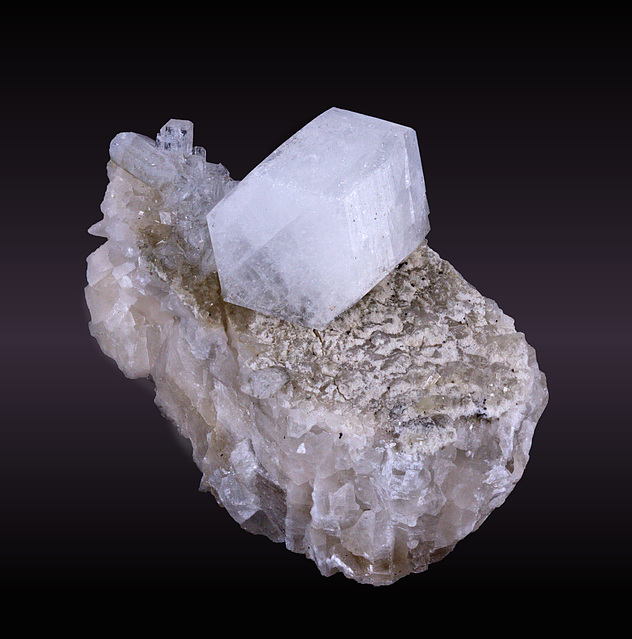
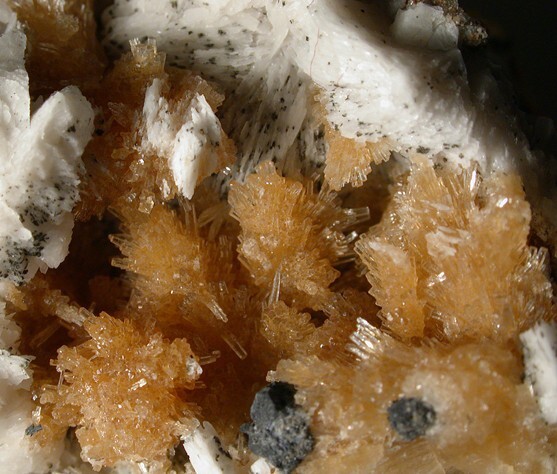
The mineralisation comprises major calcite and baryte with significant quantities of the base metal sulphides galena and sphalerite. These are typically deposited in a rhythmic sequence parallel to the vein walls, often producing a well defined symmetrical filling where the veins are narrow (where the veins are wider the textures are often much more complex). In some areas, the north wall of the vein is made up of brecciated clasts of gneiss, the interstices of which are coated in drusy brown brewsterite. Brewsterite also occurs in cavities and fractures in the vein, where it is sometimes associated with radiating groups of crystalline strontianite. Harmotome is relatively rare, although it occasionally occurs as characteristic white blocky crystals in cavities and fractures. The zeolite-group minerals and most of the strontianite are part of a late-stage fracture assemblage that post-dates the major vein mineralisation. At Whitesmith Mine, this assemblage also includes ancylite-(Ce), chamosite, minor calcite and kainosite-(Y) (described recently by Green and McCallum, 2005) and heulandite.
Select Mineral List Type
Standard Detailed Gallery Strunz Chemical ElementsMineral List
18 valid minerals.
Rock Types Recorded
Note: data is currently VERY limited. Please bear with us while we work towards adding this information!
Select Rock List Type
Alphabetical List Tree DiagramDetailed Mineral List:
| ⓘ Ancylite-(Ce) Formula: CeSr(CO3)2(OH) · H2O References: |
| ⓘ Baryte Formula: BaSO4 |
| ⓘ Brewsterite-Sr Formula: Sr(Al2Si6)O16 · 5H2O |
| ⓘ 'Brewsterite Subgroup' Habit: drusy References: |
| ⓘ Calcite Formula: CaCO3 Habit: hexagonal 'nailheads' References: |
| ⓘ Chamosite Formula: Fe2+5Al(AlSi3O)10(OH)8 References: |
| ⓘ Erythrite Formula: Co3(AsO4)2 · 8H2O |
| ⓘ Galena Formula: PbS |
| ⓘ Harmotome Formula: Ba2(Si12Al4)O32 · 12H2O |
| ⓘ Hemimorphite Formula: Zn4Si2O7(OH)2 · H2O |
| ⓘ Heulandite-Ba Formula: (Ba,Ca,K)5(Si27Al9)O72 · 22H2O |
| ⓘ Heulandite-Sr Formula: (Sr,Na,Ca)5(Si27Al9)O72 · 24H2O References: |
| ⓘ 'Heulandite Subgroup' Formula: (Na/Ca/K)5-6[Al8-9 Si27-28 O72] · nH2O Habit: blocky; coffin-shaped Colour: colourless Description: Heulandite was first found at Whitesmith Mine by the well-known mineral dealer Richard Barstow (1947 - 1982), who made his one and only trip to the locality with his long-standing collecting partner David Lloyd late in 1979 (David Lloyd, personal communication). Barstow and Lloyd collected 'brewsterite' specimens along the length of the old open cut, but when they were unwrapped and examined, a few looked a little different. They were identified as heulandite, a mineral not previously known from Strontian. Most of the specimens were sold, but Barstow and Lloyd retained the two best for their personal collections. They display blocky colourless crystals up to about 8 mm in length, with a slightly pearly lustre, in cavities with hexagonal 'nailhead' calcite, cubooctahedral pyrite and occasional brewsterite. References: |
| ⓘ Hydrozincite Formula: Zn5(CO3)2(OH)6 References: |
| ⓘ Kainosite-(Y) Formula: Ca2Y2(SiO3)4(CO3) · H2O References: |
| ⓘ Pyrite Formula: FeS2 Habit: cubooctahedra References: |
| ⓘ Quartz Formula: SiO2 |
| ⓘ Sphalerite Formula: ZnS |
| ✪ Strontianite Formula: SrCO3 Habit: acicular Colour: brown References: |
| ⓘ Titanite Formula: CaTi(SiO4)O |
Gallery:

List of minerals arranged by Strunz 10th Edition classification
| Group 2 - Sulphides and Sulfosalts | |||
|---|---|---|---|
| ⓘ | Sphalerite | 2.CB.05a | ZnS |
| ⓘ | Galena | 2.CD.10 | PbS |
| ⓘ | Pyrite | 2.EB.05a | FeS2 |
| Group 4 - Oxides and Hydroxides | |||
| ⓘ | Quartz | 4.DA.05 | SiO2 |
| Group 5 - Nitrates and Carbonates | |||
| ⓘ | Calcite | 5.AB.05 | CaCO3 |
| ⓘ | Strontianite | 5.AB.15 | SrCO3 |
| ⓘ | Hydrozincite | 5.BA.15 | Zn5(CO3)2(OH)6 |
| ⓘ | Ancylite-(Ce) | 5.DC.05 | CeSr(CO3)2(OH) · H2O |
| Group 7 - Sulphates, Chromates, Molybdates and Tungstates | |||
| ⓘ | Baryte | 7.AD.35 | BaSO4 |
| Group 8 - Phosphates, Arsenates and Vanadates | |||
| ⓘ | Erythrite | 8.CE.40 | Co3(AsO4)2 · 8H2O |
| Group 9 - Silicates | |||
| ⓘ | Titanite | 9.AG.15 | CaTi(SiO4)O |
| ⓘ | Hemimorphite | 9.BD.10 | Zn4Si2O7(OH)2 · H2O |
| ⓘ | Kainosite-(Y) | 9.CF.10 | Ca2Y2(SiO3)4(CO3) · H2O |
| ⓘ | Chamosite | 9.EC.55 | Fe2+5Al(AlSi3O)10(OH)8 |
| ⓘ | Harmotome | 9.GC.10 | Ba2(Si12Al4)O32 · 12H2O |
| ⓘ | Heulandite-Sr | 9.GE.05 | (Sr,Na,Ca)5(Si27Al9)O72 · 24H2O |
| ⓘ | Heulandite-Ba | 9.GE.05 | (Ba,Ca,K)5(Si27Al9)O72 · 22H2O |
| ⓘ | Brewsterite-Sr | 9.GE.20 | Sr(Al2Si6)O16 · 5H2O |
| Unclassified | |||
| ⓘ | 'Brewsterite Subgroup' | - | |
| ⓘ | 'Heulandite Subgroup' | - | (Na/Ca/K)5-6[Al8-9 Si27-28 O72] · nH2O |
List of minerals for each chemical element
| H | Hydrogen | |
|---|---|---|
| H | ⓘ Ancylite-(Ce) | CeSr(CO3)2(OH) · H2O |
| H | ⓘ Chamosite | Fe52+Al(AlSi3O)10(OH)8 |
| H | ⓘ Erythrite | Co3(AsO4)2 · 8H2O |
| H | ⓘ Harmotome | Ba2(Si12Al4)O32 · 12H2O |
| H | ⓘ Hemimorphite | Zn4Si2O7(OH)2 · H2O |
| H | ⓘ Heulandite Subgroup | (Na/Ca/K)5-6[Al8-9 Si27-28 O72] · nH2O |
| H | ⓘ Hydrozincite | Zn5(CO3)2(OH)6 |
| H | ⓘ Kainosite-(Y) | Ca2Y2(SiO3)4(CO3) · H2O |
| H | ⓘ Brewsterite-Sr | Sr(Al2Si6)O16 · 5H2O |
| H | ⓘ Heulandite-Sr | (Sr,Na,Ca)5(Si27Al9)O72 · 24H2O |
| H | ⓘ Heulandite-Ba | (Ba,Ca,K)5(Si27Al9)O72 · 22H2O |
| C | Carbon | |
| C | ⓘ Ancylite-(Ce) | CeSr(CO3)2(OH) · H2O |
| C | ⓘ Calcite | CaCO3 |
| C | ⓘ Hydrozincite | Zn5(CO3)2(OH)6 |
| C | ⓘ Kainosite-(Y) | Ca2Y2(SiO3)4(CO3) · H2O |
| C | ⓘ Strontianite | SrCO3 |
| O | Oxygen | |
| O | ⓘ Ancylite-(Ce) | CeSr(CO3)2(OH) · H2O |
| O | ⓘ Baryte | BaSO4 |
| O | ⓘ Calcite | CaCO3 |
| O | ⓘ Chamosite | Fe52+Al(AlSi3O)10(OH)8 |
| O | ⓘ Erythrite | Co3(AsO4)2 · 8H2O |
| O | ⓘ Harmotome | Ba2(Si12Al4)O32 · 12H2O |
| O | ⓘ Hemimorphite | Zn4Si2O7(OH)2 · H2O |
| O | ⓘ Heulandite Subgroup | (Na/Ca/K)5-6[Al8-9 Si27-28 O72] · nH2O |
| O | ⓘ Hydrozincite | Zn5(CO3)2(OH)6 |
| O | ⓘ Kainosite-(Y) | Ca2Y2(SiO3)4(CO3) · H2O |
| O | ⓘ Quartz | SiO2 |
| O | ⓘ Strontianite | SrCO3 |
| O | ⓘ Titanite | CaTi(SiO4)O |
| O | ⓘ Brewsterite-Sr | Sr(Al2Si6)O16 · 5H2O |
| O | ⓘ Heulandite-Sr | (Sr,Na,Ca)5(Si27Al9)O72 · 24H2O |
| O | ⓘ Heulandite-Ba | (Ba,Ca,K)5(Si27Al9)O72 · 22H2O |
| Na | Sodium | |
| Na | ⓘ Heulandite Subgroup | (Na/Ca/K)5-6[Al8-9 Si27-28 O72] · nH2O |
| Na | ⓘ Heulandite-Sr | (Sr,Na,Ca)5(Si27Al9)O72 · 24H2O |
| Al | Aluminium | |
| Al | ⓘ Chamosite | Fe52+Al(AlSi3O)10(OH)8 |
| Al | ⓘ Harmotome | Ba2(Si12Al4)O32 · 12H2O |
| Al | ⓘ Heulandite Subgroup | (Na/Ca/K)5-6[Al8-9 Si27-28 O72] · nH2O |
| Al | ⓘ Brewsterite-Sr | Sr(Al2Si6)O16 · 5H2O |
| Al | ⓘ Heulandite-Sr | (Sr,Na,Ca)5(Si27Al9)O72 · 24H2O |
| Al | ⓘ Heulandite-Ba | (Ba,Ca,K)5(Si27Al9)O72 · 22H2O |
| Si | Silicon | |
| Si | ⓘ Chamosite | Fe52+Al(AlSi3O)10(OH)8 |
| Si | ⓘ Harmotome | Ba2(Si12Al4)O32 · 12H2O |
| Si | ⓘ Hemimorphite | Zn4Si2O7(OH)2 · H2O |
| Si | ⓘ Heulandite Subgroup | (Na/Ca/K)5-6[Al8-9 Si27-28 O72] · nH2O |
| Si | ⓘ Kainosite-(Y) | Ca2Y2(SiO3)4(CO3) · H2O |
| Si | ⓘ Quartz | SiO2 |
| Si | ⓘ Titanite | CaTi(SiO4)O |
| Si | ⓘ Brewsterite-Sr | Sr(Al2Si6)O16 · 5H2O |
| Si | ⓘ Heulandite-Sr | (Sr,Na,Ca)5(Si27Al9)O72 · 24H2O |
| Si | ⓘ Heulandite-Ba | (Ba,Ca,K)5(Si27Al9)O72 · 22H2O |
| S | Sulfur | |
| S | ⓘ Baryte | BaSO4 |
| S | ⓘ Galena | PbS |
| S | ⓘ Pyrite | FeS2 |
| S | ⓘ Sphalerite | ZnS |
| K | Potassium | |
| K | ⓘ Heulandite Subgroup | (Na/Ca/K)5-6[Al8-9 Si27-28 O72] · nH2O |
| K | ⓘ Heulandite-Ba | (Ba,Ca,K)5(Si27Al9)O72 · 22H2O |
| Ca | Calcium | |
| Ca | ⓘ Calcite | CaCO3 |
| Ca | ⓘ Heulandite Subgroup | (Na/Ca/K)5-6[Al8-9 Si27-28 O72] · nH2O |
| Ca | ⓘ Kainosite-(Y) | Ca2Y2(SiO3)4(CO3) · H2O |
| Ca | ⓘ Titanite | CaTi(SiO4)O |
| Ca | ⓘ Heulandite-Sr | (Sr,Na,Ca)5(Si27Al9)O72 · 24H2O |
| Ca | ⓘ Heulandite-Ba | (Ba,Ca,K)5(Si27Al9)O72 · 22H2O |
| Ti | Titanium | |
| Ti | ⓘ Titanite | CaTi(SiO4)O |
| Fe | Iron | |
| Fe | ⓘ Chamosite | Fe52+Al(AlSi3O)10(OH)8 |
| Fe | ⓘ Pyrite | FeS2 |
| Co | Cobalt | |
| Co | ⓘ Erythrite | Co3(AsO4)2 · 8H2O |
| Zn | Zinc | |
| Zn | ⓘ Hemimorphite | Zn4Si2O7(OH)2 · H2O |
| Zn | ⓘ Hydrozincite | Zn5(CO3)2(OH)6 |
| Zn | ⓘ Sphalerite | ZnS |
| As | Arsenic | |
| As | ⓘ Erythrite | Co3(AsO4)2 · 8H2O |
| Sr | Strontium | |
| Sr | ⓘ Ancylite-(Ce) | CeSr(CO3)2(OH) · H2O |
| Sr | ⓘ Strontianite | SrCO3 |
| Sr | ⓘ Brewsterite-Sr | Sr(Al2Si6)O16 · 5H2O |
| Sr | ⓘ Heulandite-Sr | (Sr,Na,Ca)5(Si27Al9)O72 · 24H2O |
| Y | Yttrium | |
| Y | ⓘ Kainosite-(Y) | Ca2Y2(SiO3)4(CO3) · H2O |
| Ba | Barium | |
| Ba | ⓘ Baryte | BaSO4 |
| Ba | ⓘ Harmotome | Ba2(Si12Al4)O32 · 12H2O |
| Ba | ⓘ Heulandite-Ba | (Ba,Ca,K)5(Si27Al9)O72 · 22H2O |
| Ce | Cerium | |
| Ce | ⓘ Ancylite-(Ce) | CeSr(CO3)2(OH) · H2O |
| Pb | Lead | |
| Pb | ⓘ Galena | PbS |
Other Regions, Features and Areas containing this locality
British and Irish IslesGroup of Islands
Eurasian PlateTectonic Plate
- Laurentia ProvinceCraton
EuropeContinent
This page contains all mineral locality references listed on mindat.org. This does not claim to be a complete list. If you know of more minerals from this site, please register so you can add to our database. This locality information is for reference purposes only. You should never attempt to
visit any sites listed in mindat.org without first ensuring that you have the permission of the land and/or mineral rights holders
for access and that you are aware of all safety precautions necessary.

Whitesmith Mine, Strontian, Fort William and Ardnamurchan, Highland, Scotland, UK