
Bentorite
A valid IMA mineral species
This page is currently not sponsored. Click here to sponsor this page.


About Bentorite
Formula:
Ca6Cr2(SO4)3(OH)12 · 26H2O
Cr(III) may be partly replaced by Al.
Colour:
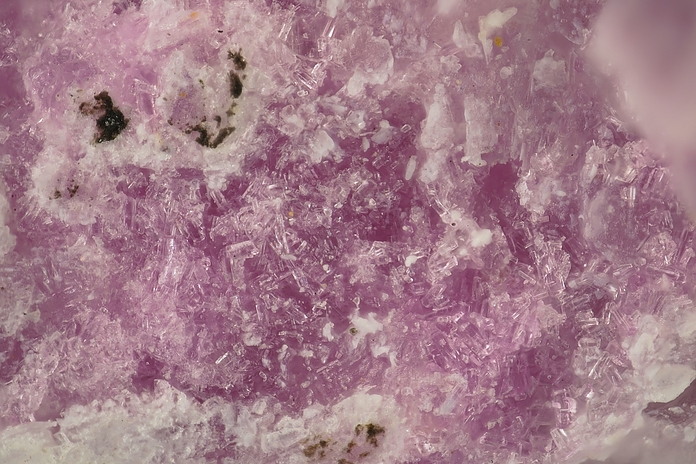
Violet to rose-purple
Lustre:
Resinous, Waxy, Earthy
Hardness:
2
Specific Gravity:
2.025
Crystal System:
Trigonal
Member of:
Name:
Named in 1977 by Shulamit Gross in honor of Professor Yaakov K. Ben-Tor [February 13, 1910 Königsberg, East Prussia, Germany - October 29, 2002 La Jolla, California, USA], petrologist and geologist, Scripps Institute of Oceanography, University of California, San Diego, California, USA and Department head of Geology, Hebrew University, Jerusalem, Israel from 1954-1966, for his contributions to the geology and mineralogy of Israel and the Middle East.
Type Locality:
Ettringite Group.
The Cr(III) analogue of ettringite.
Type locality: The late Gary Weinberger, who first found bentorite and sent it to a mineralogist for characterization, said that his discovery was made a short hike from the road "near" Arad.
Not to be confused with bentonite.
The Cr(III) analogue of ettringite.
Type locality: The late Gary Weinberger, who first found bentorite and sent it to a mineralogist for characterization, said that his discovery was made a short hike from the road "near" Arad.
Not to be confused with bentonite.
Unique Identifiers
Mindat ID:
627
Long-form identifier:
mindat:1:1:627:7
Similar Names
| Bentonite | A rock subtype |
IMA Classification of Bentorite
Classification of Bentorite
7.DG.15
7 : SULFATES (selenates, tellurates, chromates, molybdates, wolframates)
D : Sulfates (selenates, etc.) with additional anions, with H2O
G : With large and medium-sized cations; with NO3, CO3, B(OH)4, SiO4 or IO3
7 : SULFATES (selenates, tellurates, chromates, molybdates, wolframates)
D : Sulfates (selenates, etc.) with additional anions, with H2O
G : With large and medium-sized cations; with NO3, CO3, B(OH)4, SiO4 or IO3
31.10.2.2
31 : HYDRATED SULFATES CONTAINING HYDROXYL OR HALOGEN
10 : Miscellaneous
31 : HYDRATED SULFATES CONTAINING HYDROXYL OR HALOGEN
10 : Miscellaneous
25.4.14
25 : Sulphates
4 : Sulphates of Ca, Sr and Ba
25 : Sulphates
4 : Sulphates of Ca, Sr and Ba
Mineral Symbols
As of 2021 there are now IMA–CNMNC approved mineral symbols (abbreviations) for each mineral species, useful for tables and diagrams.
| Symbol | Source | Reference for Standard |
|---|---|---|
| Bto | IMA–CNMNC | Warr, L.N. (2021). IMA–CNMNC approved mineral symbols. Mineralogical Magazine, 85(3), 291-320. doi:10.1180/mgm.2021.43 |
Physical Properties of Bentorite
Resinous, Waxy, Earthy
Transparency:
Transparent
Comment:
Originally said to be vitreous
Colour:
Violet to rose-purple
Streak:
Very pale purple
Hardness:
2 on Mohs scale
Tenacity:
Brittle
Cleavage:
Perfect
{1010} perfect; {0001} good
{1010} perfect; {0001} good
Fracture:
Sub-Conchoidal
Density:
2.025 g/cm3 (Measured) 2.021 g/cm3 (Calculated)
Optical Data of Bentorite
Type:
Uniaxial (+)
RI values:
nω = 1.478 nε = 1.484
Birefringence:
0.006
Max. Birefringence:
δ = 0.006
Based on recorded range of RI values above.
Based on recorded range of RI values above.
Interference Colours:
The colours simulate birefringence patterns seen in thin section under crossed polars. They do not take into account mineral colouration or opacity.
Michel-Levy Bar The default colours simulate the birefringence range for a 30 µm thin-section thickness. Adjust the slider to simulate a different thickness.
Grain Simulation You can rotate the grain simulation to show how this range might look as you rotated a sample under crossed polars. Each grain retains its interference colour (retardation) while its brightness falls to black at extinction and reaches a maximum between extinction positions.
The colours simulate birefringence patterns seen in thin section under crossed polars. They do not take into account mineral colouration or opacity.
Michel-Levy Bar The default colours simulate the birefringence range for a 30 µm thin-section thickness. Adjust the slider to simulate a different thickness.
Grain Simulation You can rotate the grain simulation to show how this range might look as you rotated a sample under crossed polars. Each grain retains its interference colour (retardation) while its brightness falls to black at extinction and reaches a maximum between extinction positions.
Surface Relief:
Moderate (negative)
Relative to Canada balsam mounting medium (n ≈ 1.537).
Relative to Canada balsam mounting medium (n ≈ 1.537).
This shows the grain boundary and Becke line effect under plane-polarised
light, based on the contrast between this mineral's average refractive
index and the mounting medium. It does not take into account mineral
colouration.
In focus
Interference Figure:
This shows the idealized uniaxial interference figure - the conoscopic
(convergent-light, Bertrand-lens-in) view, for a grain cut with the optic axis
centred and vertical. The coloured rings are isochromatics, computed with the
same physics as the Michel-Lévy bar above; the dark cross is the isogyre.
For a genuinely uniaxial mineral viewed this way, that cross stays perfectly stationary if you rotate the stage - unlike a biaxial mineral, where it splits apart on rotation. That invariance is itself the standard diagnostic test for telling uniaxial and biaxial minerals apart at the microscope.
For a genuinely uniaxial mineral viewed this way, that cross stays perfectly stationary if you rotate the stage - unlike a biaxial mineral, where it splits apart on rotation. That invariance is itself the standard diagnostic test for telling uniaxial and biaxial minerals apart at the microscope.
Optical Extinction:
Parallel
Pleochroism:
Visible
Comments:
O = colorless; E = pale violet purple
Comments:
Absorption E > O
Chemistry of Bentorite
Mindat Formula:
Ca6Cr2(SO4)3(OH)12 · 26H2O
Cr(III) may be partly replaced by Al.
Cr(III) may be partly replaced by Al.
Element Weights:
Crystallography of Bentorite
Crystal System:
Trigonal
Class (H-M):
3m - Ditrigonal Pyramidal
Space Group:
P31c
Cell Parameters:
a = 11.1927 (5) Å, c = 21.7121(5) Å
Ratio:
a:c = 1 : 1.94
Unit Cell V:
2,355.60 ų (Calculated from Unit Cell)
Z:
2
Morphology:
Euhedral crystals very rare. Minute crystals (<< 1 mm) show first- and second-order prisms.
Twinning:
{1010}
X-Ray Powder Diffraction
Loading XRD data...
Data courtesy of RRUFF project at University of Arizona, used with permission.
Powder Diffraction Data:
| d-spacing | Intensity |
|---|---|
| 10.6 Å | (1) |
| 9.656 Å | (100) |
| 6.110 Å | (4) |
| 5.592 Å | (40) |
| 4.980 Å | (4) |
| 4.640 Å | (3) |
| 4.290 Å | (3) |
| 4.030 Å | (3) |
| 3.890 Å | (8) |
| 3.650 Å | (6) |
| 3.600 Å | (10) |
| 3.470 Å | (6) |
| 3.230 Å | (10) |
| 3.020 Å | (5) |
| 2.772 Å | (10) |
| 2.680 Å | (3) |
| 2.610 Å | (3) |
| 2.560 Å | (6) |
| 2.486 Å | (3) |
| 2.410 Å | (3) |
| 2.400 Å | (3) |
| 2.359 Å | (6) |
| 2.206 Å | (8) |
| 2.156 Å | (4) |
| 1.942 Å | (20) |
| 1.908 Å | (5) |
| 1.766 Å | (3) |
| 1.714 Å | (3) |
| 1.671 Å | (3) |
| 1.656 Å | (3) |
| 1.622 Å | (6) |
| 1.515 Å | (6) |
Comments:
ICDD 33-248
Geological Environment
Paragenetic Mode(s):
| Paragenetic Mode | Earliest Age (Ga) |
|---|---|
| High-? alteration and/or metamorphism | |
| 31 : Thermally altered carbonate, phosphate, and iron formations | |
| Stage 10a: Neoproterozoic oxygenation/terrestrial biosphere | <0.6 |
| 51 : Pyrometamorphic minerals (see also #54 and #56) | <0.36 |
Type Occurrence of Bentorite
General Appearance of Type Material:
Fine-grained deep purple to light rosey purple masses and veinlet filling.
Place of Conservation of Type Material:
Geochemistry Department, Geological Survey of Israel, Jerusalem, Israel, number SG644.
Fairleigh-Dickinson University, Madison, New Jersey, USA.
Fairleigh-Dickinson University, Madison, New Jersey, USA.
Geological Setting of Type Material:
Auto-metamorphosed marble: Hatrurim Formation.
Associated Minerals at Type Locality:
Synonyms of Bentorite
Other Language Names for Bentorite
Relationship of Bentorite to other Species
Member of:
Other Members of Ettringite Group:
| Buryatite | Ca3(Si,Fe3+,Al)(SO4)B(OH)4(OH,O)6 · 12H2O | Trig. 3m : P31c |
| Carraraite | Ca3(SO4)[Ge(OH)6](CO3) · 12H2O | Hex. |
| Charlesite | Ca6(Al,Si)2(SO4)2[B(OH)4](OH,O)12 · 26H2O | Trig. 3m : P31c |
| Chiyokoite | Ca3Si(CO3)[B(OH)4]O (OH)5 · 12H2O | Hex. 6 : P63 |
| Ettringite | Ca6Al2(SO4)3(OH)12 · 26H2O | Trig. 3m : P31c |
| Hielscherite | Ca3Si(SO4)(SO3)(OH)6 · 11H2O | Hex. 6 : P63 |
| Imayoshiite | Ca3Al(CO3)[B(OH)4](OH)6 · 12H2O | Hex. 6/mmm(6/m2/m2/m) : P63/mmc |
| Jouravskite | Ca3Mn4+(SO4)(CO3)(OH)6 · 12H2O | Hex. 6 : P63 |
| Kottenheimite | Ca 3Si(SO4)2(OH)6 · 12H2O | Hex. 6/m : P63/m |
| Micheelsenite | (Ca2Y)Al(PO3OH)(CO3)(OH)6 · 12H2O | Hex. 6 : P63 |
| Siwaqaite | Ca6Al2(CrO4)3(OH)12 · 26H2O | Trig. 3m : P31c |
| Sturmanite | Ca6Fe3+2(SO4)2.5[B(OH)4](OH)12 · 25H2O | Trig. 3m : P31c |
| Tatarinovite | Ca3Al(SO4)[B(OH)4](OH)6 · 12H2O | Hex. 6 : P63 |
| Thaumasite | Ca3(SO4)[Si(OH)6](CO3) · 12H2O | Hex. 6 : P63 |
| 'UM2008-07-CO:AlBCaHSSi' | Ca6(Al,Si)2(CO3,SO4)2[B(OH)4](OH,O)12 · 26H2O | |
| 'Unnamed (possible Mn(IV) analogue of Sturmanite)' | Ca6Mn4+2(SO4)2[B(OH)4](OH)10O2 · nH2O |
Common Associates
Associations Based on Photo Data:
| 6 photos of Bentorite associated with Portlandite | Ca(OH)2 |
| 1 photo of Bentorite associated with Volkonskoite | Ca0.3(Cr,Mg,Fe)2((Si,Al)4O10)(OH)2 · 4H2O |
| 1 photo of Bentorite associated with Ettringite | Ca6Al2(SO4)3(OH)12 · 26H2O |
Related Minerals - Strunz-mindat Grouping
| 7.DG. | Mathesiusite | K5(UO2)4(SO4)4(VO5) · 4H2O |
| 7.DG.05 | Darapskite | Na3(SO4)(NO3) · H2O |
| 7.DG.10 | Clinoungemachite | (Na, K, Fe, SO4) |
| 7.DG.10 | Humberstonite | Na7K3Mg2(SO4)6(NO3)2 · 6H2O |
| 7.DG.10 | Ungemachite | K3Na8Fe(SO4)6(NO3)2 · 6H2O |
| 7.DG.15 | Chiyokoite | Ca3Si(CO3)[B(OH)4]O (OH)5 · 12H2O |
| 7.DG.15 | Kottenheimite | Ca 3Si(SO4)2(OH)6 · 12H2O |
| 7.DG.15 | Hielscherite | Ca3Si(SO4)(SO3)(OH)6 · 11H2O |
| 7.DG.15 | Jouravskite | Ca3Mn4+(SO4)(CO3)(OH)6 · 12H2O |
| 7.DG.15 | Thaumasite | Ca3(SO4)[Si(OH)6](CO3) · 12H2O |
| 7.DG.15 | Carraraite | Ca3(SO4)[Ge(OH)6](CO3) · 12H2O |
| 7.DG.15 | Ettringite | Ca6Al2(SO4)3(OH)12 · 26H2O |
| 7.DG.15 | Birunite | Ca18(SiO3)8.5(CO3)8.5SO4 · 15H2O(?) |
| 7.DG.15 | Siwaqaite | Ca6Al2(CrO4)3(OH)12 · 26H2O |
| 7.DG.15 | Buryatite | Ca3(Si,Fe3+,Al)(SO4)B(OH)4(OH,O)6 · 12H2O |
| 7.DG.15 | Charlesite | Ca6(Al,Si)2(SO4)2[B(OH)4](OH,O)12 · 26H2O |
| 7.DG.15 | Tatarinovite | Ca3Al(SO4)[B(OH)4](OH)6 · 12H2O |
| 7.DG.15 | Imayoshiite | Ca3Al(CO3)[B(OH)4](OH)6 · 12H2O |
| 7.DG.15 | Sturmanite | Ca6Fe3+2(SO4)2.5[B(OH)4](OH)12 · 25H2O |
| 7.DG.20 | Rapidcreekite | Ca2(SO4)(CO3) · 4H2O |
| 7.DG.25 | Tatarskite | Ca6Mg2(SO4)2(CO3)2(OH)4Cl4 · 7H2O |
| 7.DG.30 | Nakauriite | Cu8(SO4)4(CO3)(OH)6 · 48H2O |
| 7.DG.35 | Chessexite | (Na,K)4Ca2(Mg,Zn)3Al8(SO4)10(SiO4)2 · 40H2O |
| 7.DG.40 | Fuenzalidaite | K6(Na,K)4Na6Mg10(SO4)12(IO3)12 · 12H2O |
| 7.DG.40 | Carlosruizite | K6(Na,K)4Na6Mg10(SeO4)12(IO3)12 · 12H2O |
| 7.DG.45 | 'Chelyabinskite' | (Ca,Mg)3(SO4,CO3)2[Si(OH)6] · 9H2O (?) |
| 7.DG.55 | Ramazzoite | [Mg8Cu12(PO4)(CO3)4(OH)24(H2O)20][(H0.33SO4)3(H2O)36] |
| 7.DG.60 | Witzkeite | Na4K4Ca(NO3)2(SO4)4 · 2H2O |
Fluorescence of Bentorite
Not fluorescent in UV
Other Information
Health Risks:
No information on health risks for this material has been entered into the database. You should always treat mineral specimens with care.
Internet Links for Bentorite
mindat.org URL:
https://www.mindat.org/min-627.html
Please feel free to link to this page.
Please feel free to link to this page.
Search Engines:
External Links:
Mineral Dealers:
References for Bentorite
Reference List:
Fleischer, Michael, Cabri, Louis J. (1981) New Mineral Names. American Mineralogist, 66 (5-6) 637-639
Seryotkin, Yurii V., Sokol, Ella V., Kokh, Svetlana N., Murashko, Mikhail N. (2017) Natural Cr3+-rich ettringite: occurrence, properties, and crystal structure. Physics and Chemistry of Minerals, 45 (3). 279-292 doi:10.1007/s00269-017-0917-y[Cr/(Cr + Al) ratios up to 0.40–0.50]
Localities for Bentorite
Showing 6 localities.
 symbol to view information about a locality.
The
symbol to view information about a locality.
The Locality List
 - This locality has map coordinates listed.
- This locality has estimated coordinates.
ⓘ - Click for references and further information on this occurrence.
? - Indicates mineral may be doubtful at this locality.
- This locality has map coordinates listed.
- This locality has estimated coordinates.
ⓘ - Click for references and further information on this occurrence.
? - Indicates mineral may be doubtful at this locality.
 - Good crystals or important locality for species.
 - World class for species or very significant.
(TL) - Type Locality for a valid mineral species.
(FRL) - First Recorded Locality for everything else (eg varieties).
- World class for species or very significant.
(TL) - Type Locality for a valid mineral species.
(FRL) - First Recorded Locality for everything else (eg varieties).
All localities listed without proper references should be considered as questionable.
Israel | |
| Juroszek et al. (2019) |
| Skrzyńska et al. (2024) |
| collected Oct. 2024 by Michael J. ... +1 other reference | |
Middle East (TL) | |
| Gross (1977) |
Palestine | |
| Sokol et al. (2011) |
| - (n.d.) +3 other references |
Quick NavTopAbout BentoriteUnique IdentifiersSimilar NamesIMA Classification Classification Mineral SymbolsPhysical Properties Optical Data Chemistry Crystallography X-Ray Powder DiffractionGeological EnvironmentType Occurrence SynonymsOther LanguagesRelationshipsCommon AssociatesStrunz-MindatFluorescence Other InformationInternet Links References Localities Locality List

Hatrurim Formation, Middle East