
Aurorite
A valid IMA mineral species
This page is currently not sponsored. Click here to sponsor this page.

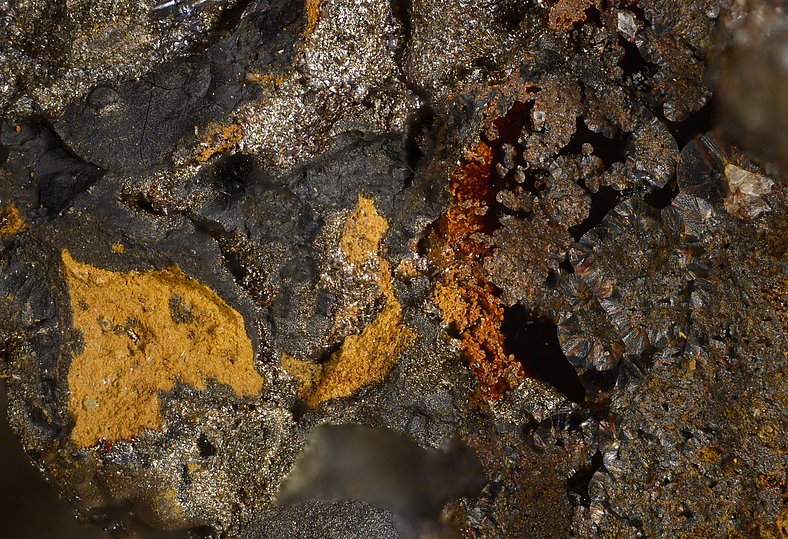

About Aurorite
Formula:
Mn2+Mn4+3O7 · 3H2O
Colour:
Black, pale brown in transmitted light at the edges of very thin, platy grains
Lustre:
Metallic
Hardness:
2 - 3
Specific Gravity:
3.81 (Calculated)
Crystal System:
Trigonal
Member of:
Name:
Named in 1967 by Arthur S. Radtke, Charles M. Taylor, and Donnel Foster Hewett for the type locality.
This page provides mineralogical data about Aurorite.
Unique Identifiers
Mindat ID:
428
Long-form identifier:
mindat:1:1:428:8
IMA Classification of Aurorite
Classification of Aurorite
4.FL.20
4 : OXIDES (Hydroxides, V[5,6] vanadates, arsenites, antimonites, bismuthites, sulfites, selenites, tellurites, iodates)
F : Hydroxides (without V or U)
L : Hydroxides with H2O +- (OH); sheets of edge-sharing octahedra
4 : OXIDES (Hydroxides, V[5,6] vanadates, arsenites, antimonites, bismuthites, sulfites, selenites, tellurites, iodates)
F : Hydroxides (without V or U)
L : Hydroxides with H2O +- (OH); sheets of edge-sharing octahedra
Dana 7th ed.:
7.8.2.2
7.8.2.2
7 : MULTIPLE OXIDES
8 : AB3X7
7 : MULTIPLE OXIDES
8 : AB3X7
7.18.12
7 : Oxides and Hydroxides
18 : Oxides of Mn
7 : Oxides and Hydroxides
18 : Oxides of Mn
Mineral Symbols
As of 2021 there are now IMA–CNMNC approved mineral symbols (abbreviations) for each mineral species, useful for tables and diagrams.
| Symbol | Source | Reference for Standard |
|---|---|---|
| Aro | IMA–CNMNC | Warr, L.N. (2021). IMA–CNMNC approved mineral symbols. Mineralogical Magazine, 85(3), 291-320. doi:10.1180/mgm.2021.43 |
Physical Properties of Aurorite
Metallic
Transparency:
Opaque
Colour:
Black, pale brown in transmitted light at the edges of very thin, platy grains
Hardness:
2 - 3 on Mohs scale
Density:
3.81 g/cm3 (Calculated)
Optical Data of Aurorite
Type:
Biaxial
Anisotropism:
Yellow-grey to brownish grey
Bireflectance:
Strong, cream-white to medium black
Reflectivity:
| Wavelength | R1 (%) | R2 (%) |
|---|---|---|
| 400nm | 10.4% | 36.5% |
| 420nm | 10.3% | 35.3% |
| 440nm | 10.2% | 34.0% |
| 460nm | 9.99% | 32.4% |
| 480nm | 9.67% | 30.6% |
| 500nm | 9.49% | 29.2% |
| 520nm | 9.31% | 27.8% |
| 540nm | 9.16% | 26.6% |
| 560nm | 9.11% | 25.6% |
| 580nm | 8.93% | 24.9% |
| 600nm | 8.88% | 24.5% |
| 620nm | 8.87% | 24.0% |
| 640nm | 8.85% | 23.7% |
| 660nm | 8.84% | 23.4% |
| 680nm | 8.82% | 22.9% |
| 700nm | 8.80% | 22.7% |
Graph shows reflectance levels at different wavelengths (in nm). Peak reflectance is 36.5%.
R1 shown in black, R2 shown in red
Chemistry of Aurorite
Mindat Formula:
Mn2+Mn4+3O7 · 3H2O
Elements listed:
Crystallography of Aurorite
Crystal System:
Trigonal
Class (H-M):
3 - Pyramidal
Space Group:
R3
Cell Parameters:
a = 7.514 Å, c = 20.734 Å
Ratio:
a:c = 1 : 2.759
Unit Cell V:
1,013.81 ų (Calculated from Unit Cell)
Z:
6
Comment:
Could be R-3.
X-Ray Powder Diffraction
Loading XRD data...
Data courtesy of RRUFF project at University of Arizona, used with permission.
Powder Diffraction Data:
| d-spacing | Intensity |
|---|---|
| 6.94 Å | (100) |
| 6.20 Å | (20) |
| 4.06 Å | (50) |
| 3.46 Å | (70) |
| 3.29 Å | (20) |
| 3.20 Å | (10) |
| 2.76 Å | (30) |
| 2.70 Å | (5) |
| 2.54 Å | (50) |
| 2.45 Å | (40) |
| 2.40 Å | (40) |
| 2.23 Å | (50) |
| 2.13 Å | (30) |
| 1.98 Å | (5) |
| 1.899 Å | (40) |
| 1.841 Å | (20) |
| 1.795 Å | (30) |
| 1.748 Å | (5) |
| 1.712 Å | (10) |
| 1.668 Å | (5) |
| 1.563 Å | (5) |
| 1.560 Å | (50) |
| 1.508 Å | (20) |
| 1.429 Å | (50) |
| 1.398 Å | (5) |
| 1.321 Å | (10) |
| 1.277 Å | (10) |
| 1.234 Å | (5) |
| 1.204 Å | (10) |
| 1.144 Å | (10) |
| 1.119 Å | (5) |
| 1.064 Å | (20) |
| 1.036 Å | (10) |
Comments:
ICDD 19-88 (note subsequent change in crystal system). The pattern is nearly indistinguishable from those of Chalcophanite and Jianshuiite. Recorded on type material (Aurora Mine, Hamilton, Nevada).
Geological Environment
Paragenetic Mode(s):
| Paragenetic Mode | Earliest Age (Ga) |
|---|---|
| Stage 7: Great Oxidation Event | <2.4 |
| 47a : [Near-surface hydration of prior minerals] | |
| 47e : [Vanadates, chromates, manganates] |
Type Occurrence of Aurorite
General Appearance of Type Material:
Small, irregular masses and platy or scaly grains, to 8 µm
Geological Setting of Type Material:
In veinlets filling microfractures in manganoan calcite
Associated Minerals at Type Locality:
Synonyms of Aurorite
Other Language Names for Aurorite
Relationship of Aurorite to other Species
Member of:
Other Members of Chalcophanite Group:
| Chalcophanite | ZnMn4+3O7 · 3H2O | Trig. 3 : R3 |
| Ernienickelite | NiMn3O7 · 3H2O | Trig. 3 : R3 |
| Jianshuiite | (Mg,Mn,Ca)Mn3O7 · 3H2O | Trig. 3 : R3 |
Common Associates
Associations Based on Photo Data:
| 18 photos of Aurorite associated with 'Manganese-bearing Calcite' | (Ca,Mn)CO3 |
| 13 photos of Aurorite associated with Cryptomelane | K(Mn4+7Mn3+)O16 |
| 11 photos of Aurorite associated with Calcite | CaCO3 |
| 3 photos of Aurorite associated with Chlorargyrite | AgCl |
| 1 photo of Aurorite associated with Pyrolusite | Mn4+O2 |
| 1 photo of Aurorite associated with Chalcophanite | ZnMn4+3O7 · 3H2O |
| 1 photo of Aurorite associated with Goethite | Fe3+O(OH) |
| 1 photo of Aurorite associated with Quartz | SiO2 |
Related Minerals - Strunz-mindat Grouping
| 4.FL. | Trébeurdenite | Fe2+2Fe3+4O2(OH)10CO3 · 3H2O |
| 4.FL. | Mariakrite | [Ca4Al2(OH)12(H2O)4][Fe2S4] |
| 4.FL.05 | Muskoxite | Mg7Fe4O13 · 10H2O |
| 4.FL.05 | Jamborite | Ni2+1-xCo3+x(OH)2-x(SO4)x · nH2O |
| 4.FL.05 | Mössbauerite | Fe3+6O4(OH)8[CO3] · 3H2O |
| 4.FL.05 | Meixnerite | Mg6Al2(OH)16(OH)2 · 4H2O |
| 4.FL.05 | Woodallite | Mg6Cr2(OH)16Cl2 · 4H2O |
| 4.FL.05 | Fougèrite | Fe2+4Fe3+2(OH)12[CO3] · 3H2O |
| 4.FL.05 | Dritsite | Li2Al4(OH)12Cl2 · 3H2O |
| 4.FL.05 | Rotemite | Ca4Cr2(OH)12Cl2 · 4H2O |
| 4.FL.05 | Iowaite | Mg6Fe3+2(OH)16Cl2 · 4H2O |
| 4.FL.10 | Hydrocalumite | Ca4Al2(OH)12(Cl,CO3,OH)2 · 4H2O |
| 4.FL.15 | Kuzelite | Ca4Al2(OH)12[SO4] · 6H2O |
| 4.FL.20 | Jianshuiite | (Mg,Mn,Ca)Mn3O7 · 3H2O |
| 4.FL.20 | Ernienickelite | NiMn3O7 · 3H2O |
| 4.FL.20 | Chalcophanite | ZnMn4+3O7 · 3H2O |
| 4.FL.25 | Woodruffite | Zn2+x/2(Mn4+1-xMn3+x)O2 · yH2O |
| 4.FL.30 | Asbolane | (Ni,Co)2-xMn4+(O,OH)4 · nH2O |
| 4.FL.30 va | 'Lampadite' | Cu, Mn, O, H |
| 4.FL.35 | Buserite | Na4Mn14O27 · 21H2O |
| 4.FL.40 | Takanelite | (Mn,Ca)Mn4O9 · H2O |
| 4.FL.40 | Ranciéite | (Ca,Mn2+)0.2(Mn4+,Mn3+)O2 · 0.6H2O |
| 4.FL.45 | Birnessite | (Na,Ca)0.5(Mn4+,Mn3+)2O4 · 1.5H2O |
| 4.FL.55 | Cianciulliite | Mn(Mg,Mn)2Zn2(OH)10 · 2-4H2O |
| 4.FL.60 | Jensenite | Cu3[TeO6] · 2H2O |
| 4.FL.65 | Leisingite | Cu2MgTe6+O6 · 6H2O |
| 4.FL.70 | Magnesiohongruiite-(Fe3+) | (Mg2Fe3+)Fe3+NbO7(OH) |
| 4.FL.70 | Akdalaite | Al10O14(OH)2 |
| 4.FL.75 | Cafetite | CaTi2O5 · H2O |
| 4.FL.80 | Mourite | UMo5O12(OH)10 |
| 4.FL.85 | Deloryite | Cu4(UO2)(MoO4)2(OH)6 |
| 4.FL.90 | Lagalyite | Ca2xMn1-xO2 · 1.5-2H2O |
| 4.FL.95 | 'Tunnerite' | |
| 4.FL.100 | Carbocalumite | Ca4Al2(OH)12(CO3) · 6H2O |
| 4.FL.100 | Mampsisite | Ca4Al2(CO3)(OH)12 · 5H2O |
Other Information
Health Risks:
No information on health risks for this material has been entered into the database. You should always treat mineral specimens with care.
Internet Links for Aurorite
mindat.org URL:
https://www.mindat.org/min-428.html
Please feel free to link to this page.
Please feel free to link to this page.
Search Engines:
External Links:
Mineral Dealers:
References for Aurorite
Reference List:
Radtke, Arthur S., Taylor, Charles M., Hewett, D. F. (1967) Aurorite, argentian todorokite, and hydrous silver-bearing lead manganese oxide. Economic Geology, 62 (2) 186-206 doi:10.2113/gsecongeo.62.2.186(Abs. in American Mineralogist (1967) 52, 1581)
Criddle, A. J., Stanley, C. J. (1993) Data file. In Quantitative Data File for Ore Minerals. Springer Netherlands. p.1-635. doi:10.1007/978-94-011-1486-8_1p.29
Localities for Aurorite
Showing 26 localities.
 symbol to view information about a locality.
The
symbol to view information about a locality.
The Locality List
 - This locality has map coordinates listed.
- This locality has estimated coordinates.
ⓘ - Click for references and further information on this occurrence.
? - Indicates mineral may be doubtful at this locality.
- This locality has map coordinates listed.
- This locality has estimated coordinates.
ⓘ - Click for references and further information on this occurrence.
? - Indicates mineral may be doubtful at this locality.
 - Good crystals or important locality for species.
 - World class for species or very significant.
(TL) - Type Locality for a valid mineral species.
(FRL) - First Recorded Locality for everything else (eg varieties).
- World class for species or very significant.
(TL) - Type Locality for a valid mineral species.
(FRL) - First Recorded Locality for everything else (eg varieties).
All localities listed without proper references should be considered as questionable.
Australia | |
| Peter Elliott |
| V. Peisley & P. Elliott in prep |
| |
| Francis et al. (2012) |
Austria | |
| Kolitsch (2013) |
China | |
| Baisheng Zhang (1998) |
| Yongwei Li et al. (2010) |
Egypt | |
| Salama et al. (2012) |
Greece | |
| |
Japan | |
| The Mineral Species of Japan (5th ed) +1 other reference |
Poland | |
| Kruszewski et al. (2019) |
Slovakia | |
| Mikuš et al. (2026) |
South Africa | |
| Cairncross et al. (1995) |
USA | |
| Anthony et al. (1995) |
| Anthony et al. (1995) |
| Anthony et al. (1995) |
| Anthony et al. (1995) |
| Cousins (1972) +1 other reference |
| Carlos et al. (1993) +1 other reference |
| Castor et al. (2004) |
| - (2005) |
| Castor et al. (2004) |
| Castor et al. (2004) | |
| Radtke et al. (1967) +1 other reference |
| Castor et al. (2004) | |
| Dunn (1995) |
Quick NavTopAbout AuroriteUnique IdentifiersIMA Classification Classification Mineral SymbolsPhysical Properties Optical Data Chemistry Crystallography X-Ray Powder DiffractionGeological EnvironmentType Occurrence SynonymsOther LanguagesRelationshipsCommon AssociatesStrunz-MindatOther InformationInternet Links References Localities Locality List

Aurora mine, Summit area, Treasure Hill, Silver Belt, White Pine Mining District, White Pine County, Nevada, USA