
Jamborite
A valid IMA mineral species
This page is currently not sponsored. Click here to sponsor this page.


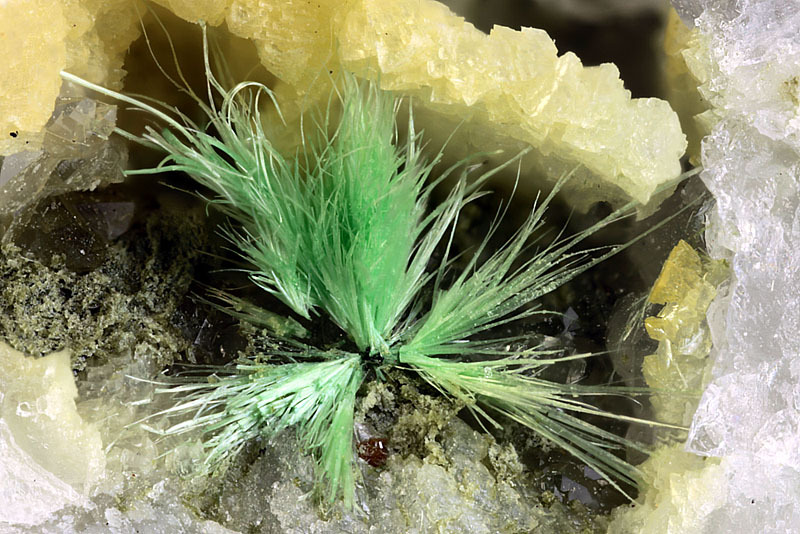

About Jamborite

John L. Jambor
Formula:
Ni2+1-xCo3+x(OH)2-x(SO4)x · nH2O
where [x≤1/3; n≤(1-x)]
Colour:
Green
Specific Gravity:
2.67
Crystal System:
Trigonal
Name:
Named in 1973 by Noris Morandi and Giorgio Dalrio in honor of John Leslie Jambor [1936–January 18, 2008 Vancouver, British Columbia, Canada], Canadian mineralogist, Geological Survey of Canada, Ottawa and CANMET, Ottawa, (1960-1993), Professor of Mineralogy (1994-2000), University of Waterloo, Waterloo, Ontario, and co-editor of the Canadian Mineralogist (1975-1977). Jambor is one of the most prolific investigators of Canadian type minerals, who described or participated in the description of 31 new species.
Co-Type Localities:
ⓘ Ca' dei Ladri (Silla), Gaggio Montano, Metropolitan City of Bologna, Emilia-Romagna, Italy
ⓘ Monteacuto Ragazza, Grizzana Morandi, Metropolitan City of Bologna, Emilia-Romagna, Italy
ⓘ Sasso delle Lucine, Castelluccio di Moscheda, Montese, Modena Province, Emilia-Romagna, Italy
ⓘ Rio Vesale, Vesale, Sestola, Modena Province, Emilia-Romagna, Italy
ⓘ Monteacuto Ragazza, Grizzana Morandi, Metropolitan City of Bologna, Emilia-Romagna, Italy
ⓘ Sasso delle Lucine, Castelluccio di Moscheda, Montese, Modena Province, Emilia-Romagna, Italy
ⓘ Rio Vesale, Vesale, Sestola, Modena Province, Emilia-Romagna, Italy
As part of the recent re-evaluation of the nomenclature of the hydrotalcite supergroup (Mills et al., 2012), jamborite was identified as a questionable species which needs further investigation. Subsequently, it was redefined in 2014 as a valid species (IMA 14-E). Jamborite lies outside the hydrotalcite supergroup as defined by Mills et al. (2012).
NOTE:
Jamborite is a redefined mineral species, and what has been referred to as jamborite in the literature pre-2015 may no longer fit into the redefinition. Andrew G. Christy comments on this at the message board [See: http://www.mindat.org/forum.php?read,6,55404,393341#msg-393341] : "1. Jamborite is a valid mineral species, but rather different from the original description. It is a basic sulfate with a layered structure that is not quite a member of the hydrotalcite supergroup, but bears close resemblances to those minerals and also to mooreite, etc. There is no sulfide in it, but in addition to Ni2+, there is a small amount of a trivalent cation which appears to be Co3+; the need for relatively high Co and low Fe probably explains the rarity of the species. 2. Most green coatings on millerite are probably hydrohonessite; honessite appears to be rarer, and hydrates readily to hydrohonessite".
According to the recent compositional and structural redefinition of jamborite (Bindi et al., 2015), the neotype specimen comes from Rio Vesale, Italy.
https://www.mindat.org/loc-267598.html
NOTE:
Jamborite is a redefined mineral species, and what has been referred to as jamborite in the literature pre-2015 may no longer fit into the redefinition. Andrew G. Christy comments on this at the message board [See: http://www.mindat.org/forum.php?read,6,55404,393341#msg-393341] : "1. Jamborite is a valid mineral species, but rather different from the original description. It is a basic sulfate with a layered structure that is not quite a member of the hydrotalcite supergroup, but bears close resemblances to those minerals and also to mooreite, etc. There is no sulfide in it, but in addition to Ni2+, there is a small amount of a trivalent cation which appears to be Co3+; the need for relatively high Co and low Fe probably explains the rarity of the species. 2. Most green coatings on millerite are probably hydrohonessite; honessite appears to be rarer, and hydrates readily to hydrohonessite".
According to the recent compositional and structural redefinition of jamborite (Bindi et al., 2015), the neotype specimen comes from Rio Vesale, Italy.
https://www.mindat.org/loc-267598.html
Unique Identifiers
Mindat ID:
2070
Long-form identifier:
mindat:1:1:2070:7
IMA Classification of Jamborite
Approved
IMA status notes:
Redefined by the IMA
IMA Formula:
Ni2+1-xCo3+x(OH)2-x(S6+O4)x·nH2O [x ≤ 1/3; n ≤ (1-x)]
Approval year:
1971
First published:
1973
Approval history:
Redefined BY IMA 2014 as a valid species (IMA 14-E).
Classification of Jamborite
4.FL.05
4 : OXIDES (Hydroxides, V[5,6] vanadates, arsenites, antimonites, bismuthites, sulfites, selenites, tellurites, iodates)
F : Hydroxides (without V or U)
L : Hydroxides with H2O +- (OH); sheets of edge-sharing octahedra
4 : OXIDES (Hydroxides, V[5,6] vanadates, arsenites, antimonites, bismuthites, sulfites, selenites, tellurites, iodates)
F : Hydroxides (without V or U)
L : Hydroxides with H2O +- (OH); sheets of edge-sharing octahedra
6.3.8.1
6 : HYDROXIDES AND OXIDES CONTAINING HYDROXYL
3 : X(OH)3
6 : HYDROXIDES AND OXIDES CONTAINING HYDROXYL
3 : X(OH)3
7.22.4
7 : Oxides and Hydroxides
22 : Oxides of Ni
7 : Oxides and Hydroxides
22 : Oxides of Ni
Mineral Symbols
As of 2021 there are now IMA–CNMNC approved mineral symbols (abbreviations) for each mineral species, useful for tables and diagrams.
| Symbol | Source | Reference for Standard |
|---|---|---|
| Jbr | IMA–CNMNC | Warr, L.N. (2021). IMA–CNMNC approved mineral symbols. Mineralogical Magazine, 85(3), 291-320. doi:10.1180/mgm.2021.43 |
Physical Properties of Jamborite
Transparency:
Translucent
Colour:
Green
Density:
2.67 g/cm3 (Measured) 2.69 g/cm3 (Calculated)
Optical Data of Jamborite
Type:
Uniaxial (-)
RI values:
nω = 1.607 nε = 1.602
Max. Birefringence:
δ = 0.005
Based on recorded range of RI values above.
Based on recorded range of RI values above.
Interference Colours:
The colours simulate birefringence patterns seen in thin section under crossed polars. They do not take into account mineral colouration or opacity.
Michel-Levy Bar The default colours simulate the birefringence range for a 30 µm thin-section thickness. Adjust the slider to simulate a different thickness.
Grain Simulation You can rotate the grain simulation to show how this range might look as you rotated a sample under crossed polars. Each grain retains its interference colour (retardation) while its brightness falls to black at extinction and reaches a maximum between extinction positions.
The colours simulate birefringence patterns seen in thin section under crossed polars. They do not take into account mineral colouration or opacity.
Michel-Levy Bar The default colours simulate the birefringence range for a 30 µm thin-section thickness. Adjust the slider to simulate a different thickness.
Grain Simulation You can rotate the grain simulation to show how this range might look as you rotated a sample under crossed polars. Each grain retains its interference colour (retardation) while its brightness falls to black at extinction and reaches a maximum between extinction positions.
Surface Relief:
Moderate (positive)
Relative to Canada balsam mounting medium (n ≈ 1.537).
Relative to Canada balsam mounting medium (n ≈ 1.537).
This shows the grain boundary and Becke line effect under plane-polarised
light, based on the contrast between this mineral's average refractive
index and the mounting medium. It does not take into account mineral
colouration.
In focus
Interference Figure:
This shows the idealized uniaxial interference figure - the conoscopic
(convergent-light, Bertrand-lens-in) view, for a grain cut with the optic axis
centred and vertical. The coloured rings are isochromatics, computed with the
same physics as the Michel-Lévy bar above; the dark cross is the isogyre.
For a genuinely uniaxial mineral viewed this way, that cross stays perfectly stationary if you rotate the stage - unlike a biaxial mineral, where it splits apart on rotation. That invariance is itself the standard diagnostic test for telling uniaxial and biaxial minerals apart at the microscope.
For a genuinely uniaxial mineral viewed this way, that cross stays perfectly stationary if you rotate the stage - unlike a biaxial mineral, where it splits apart on rotation. That invariance is itself the standard diagnostic test for telling uniaxial and biaxial minerals apart at the microscope.
Chemistry of Jamborite
Mindat Formula:
Ni2+1-xCo3+x(OH)2-x(SO4)x · nH2O
where [x≤1/3; n≤(1-x)]
where [x≤1/3; n≤(1-x)]
Crystallography of Jamborite
Crystal System:
Trigonal
Class (H-M):
3m(32/m) - Hexagonal Scalenohedral
Space Group:
R3m
Setting:
R3m
Cell Parameters:
a = 3.068 Å, c = 23.298 Å
Ratio:
a:c = 1 : 7.594
Unit Cell V:
189.92 ų (Calculated from Unit Cell)
Z:
3
Comment:
Data from Bindi et al. (2015)
Crystal Structure
Load
Unit Cell | Unit Cell Packed
2x2x2 | 3x3x3 | 4x4x4
Unit Cell | Unit Cell Packed
2x2x2 | 3x3x3 | 4x4x4
Show
Big Balls | Small Balls | Just Balls | Spacefill
Polyhedra Off | Si Polyhedra | All Polyhedra
Remove metal-metal sticks
Big Balls | Small Balls | Just Balls | Spacefill
Polyhedra Off | Si Polyhedra | All Polyhedra
Remove metal-metal sticks
Display Options
Black Background | White Background
Perspective On | Perspective Off
2D | Stereo | Red-Blue | Red-Cyan
Black Background | White Background
Perspective On | Perspective Off
2D | Stereo | Red-Blue | Red-Cyan
View
CIF File Best | x | y | z | a | b | c
CIF File Best | x | y | z | a | b | c
Rotation
Stop | Start
Stop | Start
Labels
Console Off | On | Grey | Yellow
Console Off | On | Grey | Yellow
Data courtesy of the American Mineralogist Crystal Structure Database. Click on an AMCSD ID to view structure
| ID | Species | Reference | Link | Year | Locality | Pressure (GPa) | Temp (K) |
|---|---|---|---|---|---|---|---|
| 0015762 | Jamborite | Glemser O, Einerhand J (1950) Die struktur hoherer nickelhydroxyde Zeitschrift fur Anorganische und Allgemeine Chemie 261 43-51 | 1950 | synthetic | 0 | 293 | |
| 0015761 | Jamborite | Glemser O, Einerhand J (1950) Die struktur hoherer nickelhydroxyde Zeitschrift fur Anorganische und Allgemeine Chemie 261 43-51 | 1950 | synthetic | 0 | 293 | |
| 0015760 | Jamborite | Glemser O, Einerhand J (1950) Die struktur hoherer nickelhydroxyde Zeitschrift fur Anorganische und Allgemeine Chemie 261 43-51 | 1950 | synthetic | 0 | 293 | |
| 0015759 | Jamborite | Glemser O, Einerhand J (1950) Die struktur hoherer nickelhydroxyde Zeitschrift fur Anorganische und Allgemeine Chemie 261 43-51 | 1950 | synthetic | 0 | 293 |
CIF Raw Data - click here to close
X-Ray Powder Diffraction
Powder Diffraction Data:
| d-spacing | Intensity |
|---|---|
| 7.78 Å | (100) |
| 2.592 Å | (60) |
| 1.530 Å | (50) |
| 3.89 Å | (40) |
| 1.500 Å | (30) |
| 2.320 Å | (10) |
| 1.321 Å | (10) |
Comments:
Italy. Data from the type description.
Geological Environment
Paragenetic Mode(s):
| Paragenetic Mode | Earliest Age (Ga) |
|---|---|
| Stage 7: Great Oxidation Event | <2.4 |
| 47a : [Near-surface hydration of prior minerals] | |
| 47b : [Sulfates and sulfites] |
Type Occurrence of Jamborite
Co-Type Localities:
ⓘ Ca' dei Ladri (Silla), Gaggio Montano, Metropolitan City of Bologna, Emilia-Romagna, Italy
ⓘ Monteacuto Ragazza, Grizzana Morandi, Metropolitan City of Bologna, Emilia-Romagna, Italy
ⓘ Sasso delle Lucine, Castelluccio di Moscheda, Montese, Modena Province, Emilia-Romagna, Italy
ⓘ Rio Vesale, Vesale, Sestola, Modena Province, Emilia-Romagna, Italy
ⓘ Monteacuto Ragazza, Grizzana Morandi, Metropolitan City of Bologna, Emilia-Romagna, Italy
ⓘ Sasso delle Lucine, Castelluccio di Moscheda, Montese, Modena Province, Emilia-Romagna, Italy
ⓘ Rio Vesale, Vesale, Sestola, Modena Province, Emilia-Romagna, Italy
General Appearance of Type Material:
Green coatings and pseudomorphs after millerite. Aggregates of parallel fibers and lamellae.
Place of Conservation of Type Material:
Museo dell’Istituto di Mineralogia e Petrografia dell’
Università, Bologna, Italy.
Università, Bologna, Italy.
Geological Setting of Type Material:
In small cavities in ophiolitic rocks, forming pseudomorphs after millerite.
Associated Minerals at Type Locality:
Synonyms of Jamborite
Other Language Names for Jamborite
Common Associates
Associations Based on Photo Data:
| 27 photos of Jamborite associated with Millerite | NiS |
| 13 photos of Jamborite associated with Quartz | SiO2 |
| 6 photos of Jamborite associated with Dolomite | CaMg(CO3)2 |
| 6 photos of Jamborite associated with Vaesite | NiS2 |
| 5 photos of Jamborite associated with Calcite | CaCO3 |
| 3 photos of Jamborite associated with Jaipurite | CoS |
| 3 photos of Jamborite associated with Maucherite | Ni11As8 |
| 3 photos of Jamborite associated with Goethite | Fe3+O(OH) |
| 3 photos of Jamborite associated with Népouite | Ni3Si2O5(OH)4 |
| 3 photos of Jamborite associated with Chalcopyrite | CuFeS2 |
Related Minerals - Strunz-mindat Grouping
| 4.FL. | Trébeurdenite | Fe2+2Fe3+4O2(OH)10CO3 · 3H2O |
| 4.FL. | Mariakrite | [Ca4Al2(OH)12(H2O)4][Fe2S4] |
| 4.FL.05 | Muskoxite | Mg7Fe4O13 · 10H2O |
| 4.FL.05 | Mössbauerite | Fe3+6O4(OH)8[CO3] · 3H2O |
| 4.FL.05 | Meixnerite | Mg6Al2(OH)16(OH)2 · 4H2O |
| 4.FL.05 | Woodallite | Mg6Cr2(OH)16Cl2 · 4H2O |
| 4.FL.05 | Fougèrite | Fe2+4Fe3+2(OH)12[CO3] · 3H2O |
| 4.FL.05 | Dritsite | Li2Al4(OH)12Cl2 · 3H2O |
| 4.FL.05 | Rotemite | Ca4Cr2(OH)12Cl2 · 4H2O |
| 4.FL.05 | Iowaite | Mg6Fe3+2(OH)16Cl2 · 4H2O |
| 4.FL.10 | Hydrocalumite | Ca4Al2(OH)12(Cl,CO3,OH)2 · 4H2O |
| 4.FL.15 | Kuzelite | Ca4Al2(OH)12[SO4] · 6H2O |
| 4.FL.20 | Jianshuiite | (Mg,Mn,Ca)Mn3O7 · 3H2O |
| 4.FL.20 | Ernienickelite | NiMn3O7 · 3H2O |
| 4.FL.20 | Aurorite | Mn2+Mn4+3O7 · 3H2O |
| 4.FL.20 | Chalcophanite | ZnMn4+3O7 · 3H2O |
| 4.FL.25 | Woodruffite | Zn2+x/2(Mn4+1-xMn3+x)O2 · yH2O |
| 4.FL.30 | Asbolane | (Ni,Co)2-xMn4+(O,OH)4 · nH2O |
| 4.FL.30 va | 'Lampadite' | Cu, Mn, O, H |
| 4.FL.35 | Buserite | Na4Mn14O27 · 21H2O |
| 4.FL.40 | Takanelite | (Mn,Ca)Mn4O9 · H2O |
| 4.FL.40 | Ranciéite | (Ca,Mn2+)0.2(Mn4+,Mn3+)O2 · 0.6H2O |
| 4.FL.45 | Birnessite | (Na,Ca)0.5(Mn4+,Mn3+)2O4 · 1.5H2O |
| 4.FL.55 | Cianciulliite | Mn(Mg,Mn)2Zn2(OH)10 · 2-4H2O |
| 4.FL.60 | Jensenite | Cu3[TeO6] · 2H2O |
| 4.FL.65 | Leisingite | Cu2MgTe6+O6 · 6H2O |
| 4.FL.70 | Magnesiohongruiite-(Fe3+) | (Mg2Fe3+)Fe3+NbO7(OH) |
| 4.FL.70 | Akdalaite | Al10O14(OH)2 |
| 4.FL.75 | Cafetite | CaTi2O5 · H2O |
| 4.FL.80 | Mourite | UMo5O12(OH)10 |
| 4.FL.85 | Deloryite | Cu4(UO2)(MoO4)2(OH)6 |
| 4.FL.90 | Lagalyite | Ca2xMn1-xO2 · 1.5-2H2O |
| 4.FL.95 | 'Tunnerite' | |
| 4.FL.100 | Carbocalumite | Ca4Al2(OH)12(CO3) · 6H2O |
| 4.FL.100 | Mampsisite | Ca4Al2(CO3)(OH)12 · 5H2O |
Other Information
Notes:
Insoluble in water but slowly soluble in cold dilute HCl without any visible reaction.
Health Risks:
No information on health risks for this material has been entered into the database. You should always treat mineral specimens with care.
Internet Links for Jamborite
mindat.org URL:
https://www.mindat.org/min-2070.html
Please feel free to link to this page.
Please feel free to link to this page.
Search Engines:
External Links:
Mineral Dealers:
References for Jamborite
Reference List:
Morandi, N., Dalrio, and G. (1973) Jamborite: a new nickel hydroxide mineral from the northern Apennines, Italy. American Mineralogist, 58 (9-10) 835-839
Mills, S. J.; Christy, A. G.; Génin, J.-M. R.; Kameda, T.; Colombo, F. (2012) Nomenclature of the hydrotalcite supergroup: natural layered double hydroxides. Mineralogical Magazine, 76 (5). 1289-1336 doi:10.1180/minmag.2012.076.5.10
Williams, P. A., Hatert, F., Pasero, M., Mills, S. J. (2014) New minerals and nomenclature modifications approved in 2014, CNMNC Newsletter No 21. Mineralogical Magazine, 78 (4) 797-804 doi:10.1180/minmag.2014.078.4.03
Localities for Jamborite
Showing 51 localities.
 symbol to view information about a locality.
The
symbol to view information about a locality.
The Locality List
 - This locality has map coordinates listed.
- This locality has estimated coordinates.
ⓘ - Click for references and further information on this occurrence.
? - Indicates mineral may be doubtful at this locality.
- This locality has map coordinates listed.
- This locality has estimated coordinates.
ⓘ - Click for references and further information on this occurrence.
? - Indicates mineral may be doubtful at this locality.
 - Good crystals or important locality for species.
 - World class for species or very significant.
(TL) - Type Locality for a valid mineral species.
(FRL) - First Recorded Locality for everything else (eg varieties).
- World class for species or very significant.
(TL) - Type Locality for a valid mineral species.
(FRL) - First Recorded Locality for everything else (eg varieties).
All localities listed without proper references should be considered as questionable.
Quick NavTopAbout JamboriteUnique IdentifiersIMA Classification Classification Mineral SymbolsPhysical Properties Optical Data Chemistry Crystallography Crystal StructureX-Ray Powder DiffractionGeological EnvironmentType Occurrence SynonymsOther LanguagesCommon AssociatesStrunz-MindatOther InformationInternet Links References Localities Locality List

Le Ferriere, Rio Ardenza, Livorno, Livorno Province, Tuscany, Italy