
Vaughanite
A valid IMA mineral species
This page is currently not sponsored. Click here to sponsor this page.
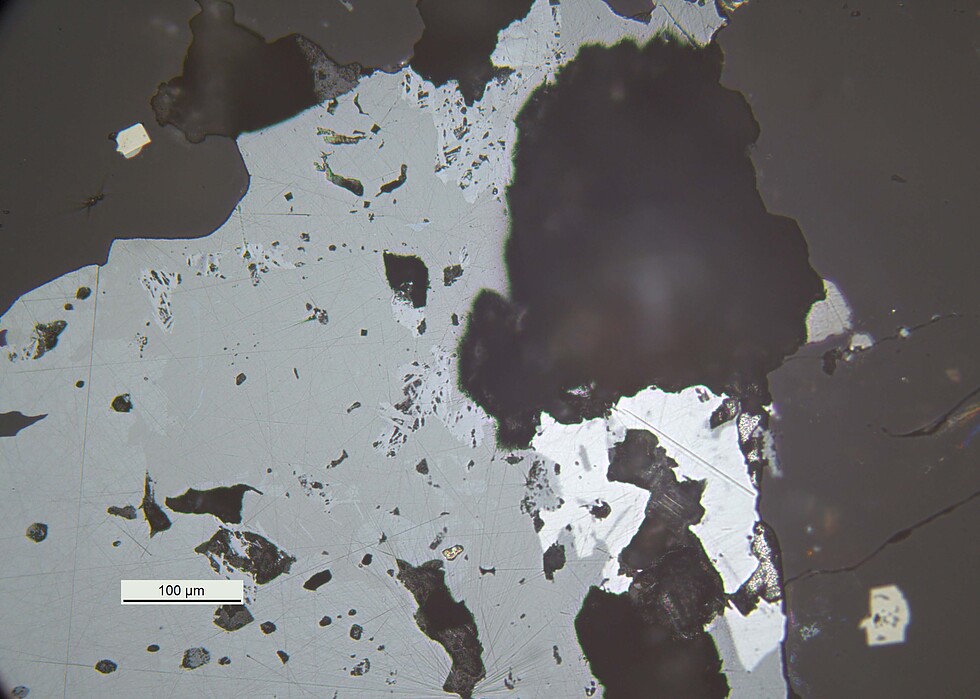
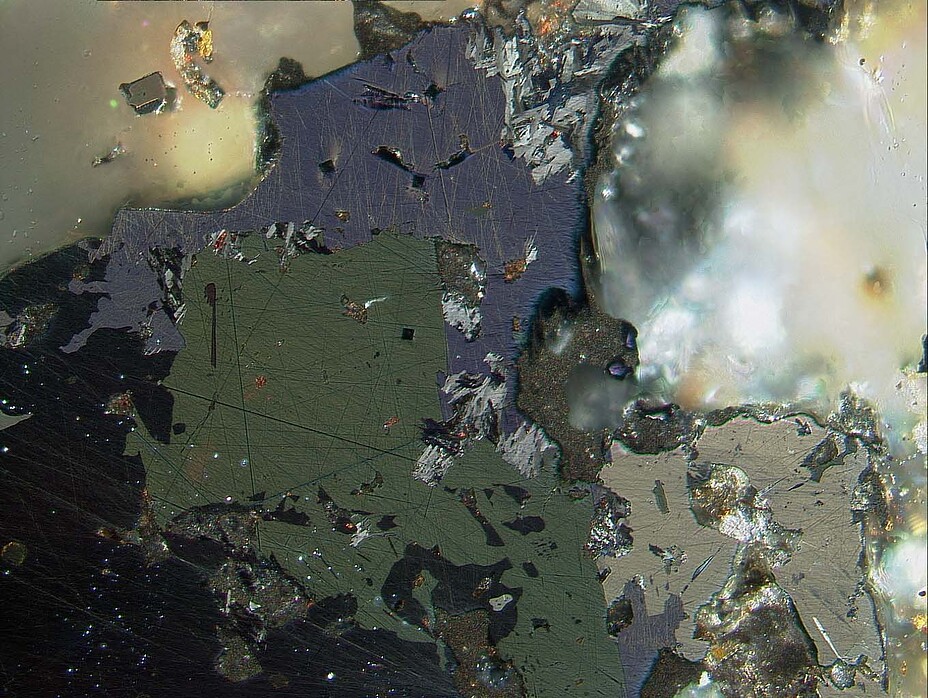
About Vaughanite

David J. Vaughan
Formula:
TlHgSb4S7
Colour:
Light gray
Lustre:
Metallic
Hardness:
3 - 3½
Specific Gravity:
5.56 (Calculated)
Crystal System:
Triclinic
Name:
Named in honor of David John Vaughan (b. 1946), chair in mineralogy, University of Manchester, England, for his many outstanding contributions to ore mineralogy and ore microscopy.
This page provides mineralogical data about Vaughanite.
Unique Identifiers
Mindat ID:
4162
Long-form identifier:
mindat:1:1:4162:7
IMA Classification of Vaughanite
Approved
IMA Formula:
Tl1+Hg1+Sb3+4S2-7
Approval year:
1987
First published:
1989
Classification of Vaughanite
2.LA.20
2 : SULFIDES and SULFOSALTS (sulfides, selenides, tellurides; arsenides, antimonides, bismuthides; sulfarsenites, sulfantimonites, sulfbismuthites, etc.)
L : Unclassified Sulfosalts
A : Without essential Pb
2 : SULFIDES and SULFOSALTS (sulfides, selenides, tellurides; arsenides, antimonides, bismuthides; sulfarsenites, sulfantimonites, sulfbismuthites, etc.)
L : Unclassified Sulfosalts
A : Without essential Pb
3.8.15.1
3 : SULFOSALTS
8 : 1 < ø < 2
3 : SULFOSALTS
8 : 1 < ø < 2
5.5.15
5 : Sulphosalts - Sulpharsenites and Sulphobismuthites (those containing Sn, Ge,or V are in Section 6)
5 : Sulpharsenites etc. of Tl
5 : Sulphosalts - Sulpharsenites and Sulphobismuthites (those containing Sn, Ge,or V are in Section 6)
5 : Sulpharsenites etc. of Tl
Mineral Symbols
As of 2021 there are now IMA–CNMNC approved mineral symbols (abbreviations) for each mineral species, useful for tables and diagrams.
| Symbol | Source | Reference for Standard |
|---|---|---|
| Vgh | IMA–CNMNC | Warr, L.N. (2021). IMA–CNMNC approved mineral symbols. Mineralogical Magazine, 85(3), 291-320. doi:10.1180/mgm.2021.43 |
Physical Properties of Vaughanite
Metallic
Transparency:
Opaque
Colour:
Light gray
Streak:
Black
Hardness:
3 - 3½ on Mohs scale
Hardness:
VHN25=100 - 115 kg/mm2 - Vickers
Tenacity:
Brittle
Cleavage:
None Observed
Parting:
Weak
Density:
5.56 g/cm3 (Calculated)
Optical Data of Vaughanite
Anisotropism:
Moderate to strong: purple, purplish brown-gray, brownish yellow, greenish yellow, sage-green, bluish green, dark blue-bottle-green.
Bireflectance:
Weak to moderate
Reflectivity:
| Wavelength | R1 (%) | R2 (%) |
|---|---|---|
| 400nm | 35.2% | 41.0% |
| 420nm | 35.1% | 40.8% |
| 440nm | 34.6% | 40.2% |
| 460nm | 33.9% | 39.4% |
| 480nm | 33.3% | 39.1% |
| 500nm | 32.8% | 39.1% |
| 520nm | 32.5% | 39.4% |
| 540nm | 32.0% | 39.4% |
| 560nm | 31.4% | 39.2% |
| 580nm | 30.9% | 38.8% |
| 600nm | 30.4% | 38.5% |
| 620nm | 30.1% | 37.9% |
| 640nm | 29.7% | 36.9% |
| 660nm | 29.2% | 35.9% |
| 680nm | 28.6% | 35.9% |
| 700nm | 28.0% | 34.2% |
Graph shows reflectance levels at different wavelengths (in nm). Peak reflectance is 41.0%.
R1 shown in black, R2 shown in red
Colour in reflected light:
Pale gray
Internal Reflections:
Blood red - rare
Pleochroism:
Weak
Comments:
Slightly greenish grey to a slightly darker bluish grey
Comments:
When immersed in oil (ND 1.515), the bireflectance and reflectance pleochroism are enhanced.
Chemistry of Vaughanite
Mindat Formula:
TlHgSb4S7
Element Weights:
Elements listed:
Crystallography of Vaughanite
Crystal System:
Triclinic
Cell Parameters:
a = 9.012(3) Å, b = 13.223(3) Å, c = 5.906(2) Å
α = 93.27(3)°, β = 95.05(4)°, γ = 109.16(3)°
α = 93.27(3)°, β = 95.05(4)°, γ = 109.16(3)°
Ratio:
a:b:c = 0.682 : 1 : 0.447
Unit Cell V:
659.46 ų
Z:
2
Morphology:
Anhedral grains, to 200 µm.
Comment:
Point Group: 1 or 1; Space Group: P1 or P1.
X-Ray Powder Diffraction
Powder Diffraction Data:
| d-spacing | Intensity |
|---|---|
| 4.343 Å | (30) |
| 4.204 Å | (100) |
| 3.313 Å | (60) |
| 2.749 Å | (40) |
| 2.315 Å | (30) |
Comments:
Five strongest lines from type material
Geological Environment
Paragenetic Mode(s):
| Paragenetic Mode | Earliest Age (Ga) |
|---|---|
| High-? alteration and/or metamorphism | |
| 33 : Minerals deposited by hydrothermal metal-rich fluids (see also [#12]) |
Type Occurrence of Vaughanite
General Appearance of Type Material:
Massive aggregates to 450 µm.
Place of Conservation of Type Material:
British Museum of Natural History, London, UK, BM 1987,95, polished section E.1220.
National Mineral Collection, Geological Survey of Canada, Ottawa, Ontario, Canada, NMC 65497.
National Mineral Collection, Geological Survey of Canada, Ottawa, Ontario, Canada, NMC 65497.
Geological Setting of Type Material:
epithermal gold deposit
Associated Minerals at Type Locality:
Synonyms of Vaughanite
Other Language Names for Vaughanite
Common Associates
Associations Based on Photo Data:
Related Minerals - Strunz-mindat Grouping
| 2.LA. | Thunderbayite | TlAg3Au3Sb7S6 |
| 2.LA. | Auerbakhite | MnTl2As2S5 |
| 2.LA. | Biagioniite | Tl2SbS2 |
| 2.LA. | Ferrofettelite | [Ag6As2S7][Ag10FeAs2S8] |
| 2.LA. | Gladkovskyite | MnTlAs3S6 |
| 2.LA.10 | Dervillite | Ag2AsS2 |
| 2.LA.15 | Daomanite | CuPtAsS2 |
| 2.LA.25 | Criddleite | TlAg2Au3Sb10S10 |
| 2.LA.30 | Fettelite | [Ag6As2S7][Ag10HgAs2S8] |
| 2.LA.35 | Chaméanite | (Cu,Fe)4As(Se,S)4 |
| 2.LA.40 | Arcubisite | Ag6CuBiS4 |
| 2.LA.45 | Mgriite | Cu3AsSe3 |
| 2.LA.50 | Benleonardite | [Ag6(Sb,As)2S6Te][Ag9Cu(S,Te)2Te2] |
| 2.LA.55 | Tsnigriite | Ag9SbTe3S3 |
| 2.LA.60 | Borovskite | Pd3SbTe4 |
| 2.LA.65 | Jonassonite | AuBi5S4 |
| 2.LA.65 | Nuwaite | Ni6GeS2 |
| 2.LA.65 | Butianite | Ni6SnS2 |
| 2.LA.70 | Raberite | Tl5Ag4As6SbS15 |
| 2.LA.75 | Spaltiite | Tl2Cu2As2S5 |
Other Information
Health Risks:
Contains thallium and mercury - always wash hands after handling. Avoid inhaling dust when handling or breaking. Never lick or ingest.
Internet Links for Vaughanite
mindat.org URL:
https://www.mindat.org/min-4162.html
Please feel free to link to this page.
Please feel free to link to this page.
Search Engines:
External Links:
Mineral Dealers:
References for Vaughanite
Reference List:
Harris, Donald C., Roberts, Andrew C., Criddle, Alan J. (1989) Vaughanite, TlHgSb4S7, a new mineral from Hemlo, Ontario, Canada. Mineralogical Magazine, 53 (369) 79-83 doi:10.1180/minmag.1989.053.369.08
Localities for Vaughanite
Showing 2 localities.
 symbol to view information about a locality.
The
symbol to view information about a locality.
The Locality List
 - This locality has map coordinates listed.
- This locality has estimated coordinates.
ⓘ - Click for references and further information on this occurrence.
? - Indicates mineral may be doubtful at this locality.
- This locality has map coordinates listed.
- This locality has estimated coordinates.
ⓘ - Click for references and further information on this occurrence.
? - Indicates mineral may be doubtful at this locality.
 - Good crystals or important locality for species.
 - World class for species or very significant.
(TL) - Type Locality for a valid mineral species.
(FRL) - First Recorded Locality for everything else (eg varieties).
- World class for species or very significant.
(TL) - Type Locality for a valid mineral species.
(FRL) - First Recorded Locality for everything else (eg varieties).
All localities listed without proper references should be considered as questionable.
Canada | |
| Harris et al. (1989) +3 other references |
| Harris et al. (1989) +1 other reference |
Quick NavTopAbout VaughaniteUnique IdentifiersIMA Classification Classification Mineral SymbolsPhysical Properties Optical Data Chemistry Crystallography X-Ray Powder DiffractionGeological EnvironmentType Occurrence SynonymsOther LanguagesCommon AssociatesStrunz-MindatOther InformationInternet Links References Localities Locality List

Golden Giant Mine, Hemlo gold deposit, Bomby Township, Thunder Bay District, Ontario, Canada