
Tiragalloite
A valid IMA mineral species
This page is currently not sponsored. Click here to sponsor this page.


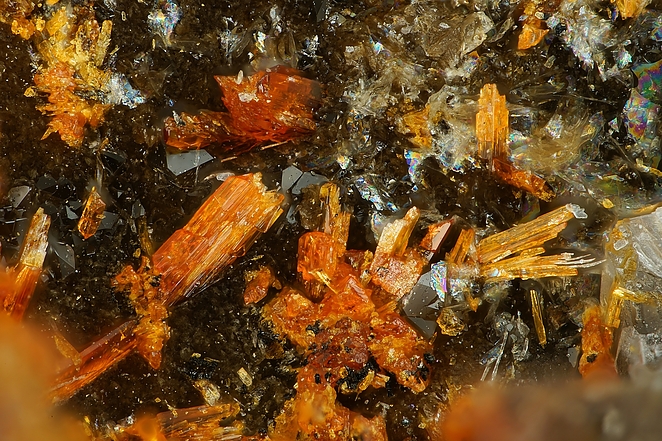
About Tiragalloite

Paolo Onofrio Tiragallo
Formula:
Mn2+4As5+Si3O12(OH)
Colour:
Orange, brownish orange
Lustre:
Sub-Adamantine
Specific Gravity:
3.84
Crystal System:
Monoclinic
Name:
Named after Paolo Onofrio Tiragallo (1905, Carro, La Spezia, Liguria, Italy - 1987), distinguished amateur mineralogist. Conservator and curator of the mineralogical collection of the University of Genoa.
Type Locality:
Tiragalloite belongs to a rare class of compounds with As atoms replacing Si atoms in silicate anions, the so-called arsenosilicates (analoguous to the more common alumosilicates and borosilicates, in which Si atoms are replaced by Al atoms and B atoms, respectively). It contains isolated chains consisting of one (ASO4) tetrahedron and three (SiO4) tetrahedra, which are linked by sharing corners. One oxygen atom is protonated, resulting in the anion formula (HAsSi3O13)8-. The tetrahedral sites in the anion are ordered in that the As atoms are only found at the end of the chains, and there is exactly one As atom in each anion.
Unique Identifiers
Mindat ID:
3974
Long-form identifier:
mindat:1:1:3974:7
IMA Classification of Tiragalloite
Approved
Approval year:
1979
First published:
1980
Classification of Tiragalloite
9.BJ.25
9 : SILICATES (Germanates)
B : Sorosilicates
J : Sorosilicates with Si3O10, Si4O11, etc. anions; cations in octahedral [6] and greater coordination
9 : SILICATES (Germanates)
B : Sorosilicates
J : Sorosilicates with Si3O10, Si4O11, etc. anions; cations in octahedral [6] and greater coordination
57.2.1.1
57 : SOROSILICATES Si3O10 Groups and Larger Noncyclic Groups
2 : Insular Si3O10 and Larger Noncyclic Groups with [Si4O13] groups
57 : SOROSILICATES Si3O10 Groups and Larger Noncyclic Groups
2 : Insular Si3O10 and Larger Noncyclic Groups with [Si4O13] groups
17.7.7
17 : Silicates Containing other Anions
7 : Silicates with vanadate, arsenate or antimonate
17 : Silicates Containing other Anions
7 : Silicates with vanadate, arsenate or antimonate
Mineral Symbols
As of 2021 there are now IMA–CNMNC approved mineral symbols (abbreviations) for each mineral species, useful for tables and diagrams.
| Symbol | Source | Reference for Standard |
|---|---|---|
| Tga | IMA–CNMNC | Warr, L.N. (2021). IMA–CNMNC approved mineral symbols. Mineralogical Magazine, 85(3), 291-320. doi:10.1180/mgm.2021.43 |
Physical Properties of Tiragalloite
Sub-Adamantine
Transparency:
Transparent, Translucent
Colour:
Orange, brownish orange
Cleavage:
Distinct/Good
Good on {100}.
Good on {100}.
Parting:
Distinct parting, normal to elongation.
Density:
3.84(6) g/cm3 (Measured) 3.829 g/cm3 (Calculated)
Comment:
Measured by flotation in dilute Clerici solution at room temperature. The calculated density for a pure end-member is 3.860.
Optical Data of Tiragalloite
Type:
Biaxial (+)
RI values:
nα = 1.745(5) nβ = 1.751(3) nγ = 1.760(5)
2V:
Measured: 38° to 46°, Calculated: 80°
Max. Birefringence:
δ = 0.015
Based on recorded range of RI values above.
Based on recorded range of RI values above.
Interference Colours:
The colours simulate birefringence patterns seen in thin section under crossed polars. They do not take into account mineral colouration or opacity.
Michel-Levy Bar The default colours simulate the birefringence range for a 30 µm thin-section thickness. Adjust the slider to simulate a different thickness.
Grain Simulation You can rotate the grain simulation to show how this range might look as you rotated a sample under crossed polars.
The colours simulate birefringence patterns seen in thin section under crossed polars. They do not take into account mineral colouration or opacity.
Michel-Levy Bar The default colours simulate the birefringence range for a 30 µm thin-section thickness. Adjust the slider to simulate a different thickness.
Grain Simulation You can rotate the grain simulation to show how this range might look as you rotated a sample under crossed polars.
Surface Relief:
Moderate
Dispersion:
strong
Pleochroism:
Not Visible
Comments:
a ≃ α, b = β, c ≃ γ.
The angle between a and the cleavage pole is 5-6°.
Elongation is positive.
The angle between a and the cleavage pole is 5-6°.
Elongation is positive.
Chemistry of Tiragalloite
Mindat Formula:
Mn2+4As5+Si3O12(OH)
Element Weights:
Common Impurities:
Ti,Al,V,Fe,Ca,Na,K
Crystallography of Tiragalloite
Crystal System:
Monoclinic
Class (H-M):
2/m - Prismatic
Cell Parameters:
a = 6.6702(2) Å, b = 19.9336(7) Å, c = 7.5759(2) Å
β = 95.518(1)°
β = 95.518(1)°
Ratio:
a:b:c = 0.335 : 1 : 0.38
Unit Cell V:
1,002.63 ų (Calculated from Unit Cell)
Z:
4
Twinning:
Visible under the microscope. Symmetric, with the twin plane coincident with the cleavage plane.
Comment:
Space group P21/n. Nagashima et al. (2010) give a = 6.6783(1), b = 19.9075(3), c = 7.5750(1) Å, β = 95.475(1)°. The lower c value in the latter is also confirmed by SXRD studies of samples from Austria (Uwe Kolitsch, unpubl. data). also see Callegari 2020
Crystal Structure
Load
Unit Cell | Unit Cell Packed
2x2x2 | 3x3x3 | 4x4x4
Unit Cell | Unit Cell Packed
2x2x2 | 3x3x3 | 4x4x4
Show
Big Balls | Small Balls | Just Balls | Spacefill
Polyhedra Off | Si Polyhedra | All Polyhedra
Remove metal-metal sticks
Big Balls | Small Balls | Just Balls | Spacefill
Polyhedra Off | Si Polyhedra | All Polyhedra
Remove metal-metal sticks
Display Options
Black Background | White Background
Perspective On | Perspective Off
2D | Stereo | Red-Blue | Red-Cyan
Black Background | White Background
Perspective On | Perspective Off
2D | Stereo | Red-Blue | Red-Cyan
View
CIF File Best | x | y | z | a | b | c
CIF File Best | x | y | z | a | b | c
Rotation
Stop | Start
Stop | Start
Labels
Console Off | On | Grey | Yellow
Console Off | On | Grey | Yellow
Data courtesy of the American Mineralogist Crystal Structure Database. Click on an AMCSD ID to view structure
| ID | Species | Reference | Link | Year | Locality | Pressure (GPa) | Temp (K) |
|---|---|---|---|---|---|---|---|
| 0019902 | Tiragalloite | Nagashima M, Armbruster T (2010) Ardennite, tiragalloite and medaite: structural control of (As5+,V5+,Si4+)O4 tetrahedra in silicates Mineralogical Magazine 74 55-71 | 2010 | Gambatesa mine, Val Graveglia, Liguria, Italy | 0 | 293 | |
| 0009690 | Tiragalloite | Gramaccioli C M, Pilati T, Liborio G (1979) Structure of a manganese(II) arsenatotrisilicate, Mn4[AsSi3O12(OH)]: The presence of a new tetrapolyphosphate-like anion Acta Crystallographica B35 2287-2291 |  | 1979 | Molinello, near Chiavari, Liguria, | 0 | 293 |
CIF Raw Data - click here to close
Epitaxial Relationships of Tiragalloite
Epitaxial Minerals:
| 'Rhodonite' | CaMn3Mn[Si5O15] |
Epitaxy Comments:
(010)[001]tir // (010)[100]rho (Roth & Meisser, 2011)
X-Ray Powder Diffraction
Powder Diffraction Data:
| d-spacing | Intensity |
|---|---|
| 3.258 Å | (100) |
| 3.151 Å | (73) |
| 3.034 Å | (72) |
| 3.003 Å | (72) |
| 2.608 Å | (65) |
| 2.489 Å | (58) |
| 2.736 Å | (54) |
Geological Environment
Paragenetic Mode(s):
| Paragenetic Mode | Earliest Age (Ga) |
|---|---|
| Near-surface Processes | |
| 22 : Hydration and low-? subsurface aqueous alteration (see also #23) |
Type Occurrence of Tiragalloite
General Appearance of Type Material:
Small orange grains enclosed in brownish to orange veinlets, about one millimeter thick, cutting a black Mn ore made up mainly of quartz and braunite. The grains never show as idiomorphic crystals. They are typically <0.4 mm but rarely 1.5 mm. They are
Place of Conservation of Type Material:
University of Rome, Rome, Italy, 24314.
Municipal Museum of Natural History, Milan, Italy.
University of Oslo, Oslo, Norway.
Municipal Museum of Natural History, Milan, Italy.
University of Oslo, Oslo, Norway.
Geological Setting of Type Material:
Veinlets cutting manganese ore.
Associated Minerals at Type Locality:
Synonyms of Tiragalloite
Other Language Names for Tiragalloite
Common Associates
Associations Based on Photo Data:
| 9 photos of Tiragalloite associated with Rhodonite | CaMn3Mn[Si5O15] |
| 3 photos of Tiragalloite associated with Rhodochrosite | MnCO3 |
| 2 photos of Tiragalloite associated with Arsenmedaite | Mn2+6 As5+Si5O18(OH) |
| 2 photos of Tiragalloite associated with Albite | Na(AlSi3O8) |
| 2 photos of Tiragalloite associated with Hematite | Fe2O3 |
| 2 photos of Tiragalloite associated with K Feldspar | |
| 2 photos of Tiragalloite associated with Quartz | SiO2 |
| 1 photo of Tiragalloite associated with Medaite | Mn2+6V5+Si5O18(OH) |
| 1 photo of Tiragalloite associated with Arseniopleite | NaCaMnMn2(AsO4)3 |
| 1 photo of Tiragalloite associated with Sarkinite | Mn2+2(AsO4)(OH) |
Related Minerals - Strunz-mindat Grouping
| 9.BJ. | Arsenmedaite | Mn2+6 As5+Si5O18(OH) |
| 9.BJ.05 | Orientite | Ca8Mn3+10(SiO4)3(Si3O10)3(OH)10 · 4H2O |
| 9.BJ.10 | Rosenhahnite | HCa3[Si3O9(OH)] |
| 9.BJ.15 | Trabzonite | Ca4(Si3O9)(OH)2 |
| 9.BJ.20 | Thalénite-(Y) | Y3Si3O10F |
| 9.BJ.30 | Medaite | Mn2+6V5+Si5O18(OH) |
| 9.BJ.35 | Strontioruizite | Sr2Mn3+2Si4O11(OH)4 · 2H2O |
| 9.BJ.35 | Ruizite | Ca2Mn3+2[Si4O11(OH)2](OH)2 · 2H2O |
| 9.BJ.35 | Taniajacoite | SrCaMn3+2Si4O11(OH)4 · 2H2O |
| 9.BJ.40 | Ardennite-(As) | Mn2+4Al4(AlMg)(AsO4)(SiO4)2(Si3O10)(OH)6 |
| 9.BJ.40 | Kannanite | Ca4Al4(AlMg)(VO4)(SiO4)2(Si3O10)(OH)6 |
| 9.BJ.40 | Alpeite | Ca4Mn3+2Al2(Mn3+Mg)(SiO4)2(Si3O10)(V5+O4)(OH)6 |
| 9.BJ.40 | Ardennite-(V) | Mn2+4Al4(AlMg)(VO4)(SiO4)2(Si3O10)(OH)6 |
| 9.BJ.45 | Kilchoanite | Ca6(SiO4)(Si3O10) |
| 9.BJ.50 | Prismatine | (◻,Fe,Mg)(Mg,Al,Fe)5Al4Si2(Si,Al)2(B,Si,Al)(O,OH,F)22 |
| 9.BJ.50 | Kornerupine | Mg3Al6(Si,Al,B)5O21(OH) |
| 9.BJ.55 | Zunyite | Al13Si5O20(OH,F)18Cl |
| 9.BJ.60 | Hubeite | Ca2Mn2+Fe3+Si4O12(OH) · 2H2O |
| 9.BJ.65 | Cassagnaite | (Ca,Mn2+)4(Fe3+,Mn3+,Al)4(V3+,Mg,Al)2(Si3O10)(SiO4)2(OH,O)8 |
| 9.BJ.70 | Pavlovskyite | Ca8(SiO4)2(Si3O10) |
Other Information
Notes:
Slightly soluble in HNO3, giving the solution a light pink color, and insoluble in HCl or H2SO4.
Health Risks:
No information on health risks for this material has been entered into the database. You should always treat mineral specimens with care.
Internet Links for Tiragalloite
mindat.org URL:
https://www.mindat.org/min-3974.html
Please feel free to link to this page.
Please feel free to link to this page.
Search Engines:
External Links:
Mineral Dealers:
References for Tiragalloite
Reference List:
Gramaccioli, C. M., Pilati, T., Liborio, G. (1979) Structure of a manganese(II) arsenatotrisilicate, Mn4[AsSi3O12(OH)]: the presence of a new tetrapolyphosphate-like anion. Acta Crystallographica Section B Structural Crystallography and Crystal Chemistry, 35 (10) 2287-2291 doi:10.1107/s0567740879009158
Gramaccioli, Carlo Maria, Griffin, William L., Mottana, Annibale (1980) Tiragalloite, Mn4[AsSi3O12(OH)], a new mineral and the first example of arsenatotrisilicate. American Mineralogist, 65 (9-10) 947-952
Nagashima, M., Armbruster, T. (2010) Ardennite, tiragalloite and medaite: structural control of (As5+,V5+,Si4+)O4 tetrahedra in silicates. Mineralogical Magazine, 74 (1) 55-71 doi:10.1180/minmag.2010.074.1.55
Callegari, Athos Maria; Boiocchi, Massimo; Zema, Michele; Tarantino, Serena Chiara (2020) Structure refinement and new crystal-chemical data for tiragalloite (Mn2+3.86Ca0.10)Σ3.96(As5+0.85V5+0.02Si0.19)Σ1.06Si3O12(OH) from the Scerscen glacier, Val Malenco, Italy. Periodico di Mineralogia, 89 (1). 77-87 doi:10.2451/2020PM900
Localities for Tiragalloite
Showing 23 localities.
 symbol to view information about a locality.
The
symbol to view information about a locality.
The Locality List
 - This locality has map coordinates listed.
- This locality has estimated coordinates.
ⓘ - Click for references and further information on this occurrence.
? - Indicates mineral may be doubtful at this locality.
- This locality has map coordinates listed.
- This locality has estimated coordinates.
ⓘ - Click for references and further information on this occurrence.
? - Indicates mineral may be doubtful at this locality.
 - Good crystals or important locality for species.
 - World class for species or very significant.
(TL) - Type Locality for a valid mineral species.
(FRL) - First Recorded Locality for everything else (eg varieties).
- World class for species or very significant.
(TL) - Type Locality for a valid mineral species.
(FRL) - First Recorded Locality for everything else (eg varieties).
All localities listed without proper references should be considered as questionable.
Austria | |
| Kolitsch et al. (2021) |
| Kolitsch et al. (2019) |
| Brandstätter et al. (2015) | |
| Abrecht (1990) |
Italy | |
| Cenki-Tok et al. (2006) |
| Redazionale (2005) |
| 415. +3 other references |
| Pipino (1984) |
| Castellaro et al. (2023) |
| Analyses of Anthony Kampf of Natural ... +1 other reference |
| Analyses of Anthony Kampf of Natural ... |
| |
| Callegari et al. (1992) +6 other references | |
| Bedogné et al. (1994) | |
| Bracco R. (2014) +3 other references |
| Piccoli et al. (2007) +1 other reference |
| Piccoli et al. (2007) | |
Japan | |
| Fujiwara et al. (2005) +1 other reference |
Slovakia | |
| Martin Števko & Pavol Myšľan +1 other reference |
Spain | |
| Dill et al. (2023) |
Switzerland | |
| Brugger (2006) |
| Stalder et al. (1998) +2 other references |
| Ansermet et al. (2025) |
Quick NavTopAbout TiragalloiteUnique IdentifiersIMA Classification Classification Mineral SymbolsPhysical Properties Optical Data Chemistry Crystallography Crystal StructureEpitaxial Relationships X-Ray Powder DiffractionGeological EnvironmentType Occurrence SynonymsOther LanguagesCommon AssociatesStrunz-MindatOther InformationInternet Links References Localities Locality List

Scerscen Valley, Lanzada, Sondrio Province, Lombardy, Italy