
Aeschynite-(Nd)
A valid IMA mineral species
This page is currently not sponsored. Click here to sponsor this page.


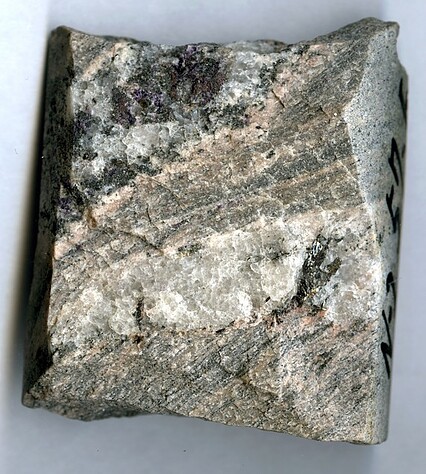
About Aeschynite-(Nd)
Formula:
Nd(TiNb)O6
Previously given as (Nd,Ln,Ca)(Ti,Nb)2(O,OH)6. Redefined in 2025.
Colour:
Dark to pale brown, brownish black
Lustre:
Adamantine
Hardness:
5 - 6
Specific Gravity:
4.6 - 5.04
Crystal System:
Orthorhombic
Member of:
Name:
For its relationship to Aeschynite-(Ce), with Neodymium as the dominant rare-earth element.
Forms as tabular and prismatic crystals, up to several mm, and as equigranular and radiating crystal clusters, or massive.
Unique Identifiers
Mindat ID:
38
Long-form identifier:
mindat:1:1:38:9
Similar Names
| Aeschynite | A synonym | |
| Aeschynite-(Ce) | A valid IMA mineral species - grandfathered | Ce(TiNb)O6 |
| Aeschynite-(Ce)-Aeschynite-(Y) Series | A solid-solution series between two end-member minerals | |
| Aeschynite-(Y) | A valid IMA mineral species - grandfathered | Y(TiNb)O6 |
| Aeschynite-(Y)-Tantalaeschynite-(Y) Series | A solid-solution series between two end-member minerals | |
| Æschynitt-(Ce)-Nioboæschynitt-(Ce) Serien | A synonym of 'Aeschynite-(Ce)-Nioboaeschynite-(Ce) Series' |
IMA Classification of Aeschynite-(Nd)
Approved
IMA Formula:
Nd(Nb,Ti)2(O,OH)6
Classification of Aeschynite-(Nd)
4.DF.05
4 : OXIDES (Hydroxides, V[5,6] vanadates, arsenites, antimonites, bismuthites, sulfites, selenites, tellurites, iodates)
D : Metal: Oxygen = 1:2 and similar
F : With large (+- medium-sized) cations; dimers and trimers of edgesharing octahedra
4 : OXIDES (Hydroxides, V[5,6] vanadates, arsenites, antimonites, bismuthites, sulfites, selenites, tellurites, iodates)
D : Metal: Oxygen = 1:2 and similar
F : With large (+- medium-sized) cations; dimers and trimers of edgesharing octahedra
8.3.6.5
8 : MULTIPLE OXIDES CONTAINING NIOBIUM,TANTALUM OR TITANIUM
3 : AB2O6
8 : MULTIPLE OXIDES CONTAINING NIOBIUM,TANTALUM OR TITANIUM
3 : AB2O6
18.2.14
18 : Niobates and Tantalates
2 : Niobates and tantalates containing rare earths but not U
18 : Niobates and Tantalates
2 : Niobates and tantalates containing rare earths but not U
Mineral Symbols
As of 2021 there are now IMA–CNMNC approved mineral symbols (abbreviations) for each mineral species, useful for tables and diagrams.
Please only use the official IMA–CNMNC symbol. Older variants are listed for historical use only.
Please only use the official IMA–CNMNC symbol. Older variants are listed for historical use only.
| Symbol | Source | Reference for Standard |
|---|---|---|
| Aes-Nd | IMA–CNMNC | Warr, L.N. (2021). IMA–CNMNC approved mineral symbols. Mineralogical Magazine, 85(3), 291-320. doi:10.1180/mgm.2021.43 |
| Aes | The Canadian Mineralogist (2019) | The Canadian Mineralogist (2019) The Canadian Mineralogist list of symbols for rock- and ore-forming minerals (December 30, 2019). download |
Physical Properties of Aeschynite-(Nd)
Adamantine
Transparency:
Transparent, Translucent
Colour:
Dark to pale brown, brownish black
Comment:
yellowish orange to reddish orange in thin section; dark grey in reflected light.
Streak:
Light yellowish brown
Hardness:
5 - 6 on Mohs scale
Tenacity:
Brittle
Cleavage:
None Observed
Fracture:
Conchoidal
Density:
4.6 - 5.04 g/cm3 (Measured)
Optical Data of Aeschynite-(Nd)
Type:
Isotropic
RI values:
n = 2.1 - 2.4
2V:
Measured: 78° to 82°
Surface Relief:
Very High (positive)
Relative to Canada balsam mounting medium (n ≈ 1.537).
Relative to Canada balsam mounting medium (n ≈ 1.537).
This shows the grain boundary and Becke line effect under plane-polarised
light, based on the contrast between this mineral's average refractive
index and the mounting medium. It does not take into account mineral
colouration.
In focus
Dispersion:
weak to strong
Colour in reflected light:
dark grey
Pleochroism:
Visible
Chemistry of Aeschynite-(Nd)
Mindat Formula:
Nd(TiNb)O6
Previously given as (Nd,Ln,Ca)(Ti,Nb)2(O,OH)6. Redefined in 2025.
Previously given as (Nd,Ln,Ca)(Ti,Nb)2(O,OH)6. Redefined in 2025.
Element Weights:
Elements listed:
Crystallography of Aeschynite-(Nd)
Crystal System:
Orthorhombic
Class (H-M):
mmm(2/m2/m2/m) - Dipyramidal
Comment:
Metamict, space group nd
X-Ray Powder Diffraction
Powder Diffraction Data:
| d-spacing | Intensity |
|---|---|
| 1.53 Å | (6) |
| 1.575 Å | (7) |
| 1.95 Å | (6) |
| 2.64 Å | (5) |
| 2.93 Å | (10) |
| 3.00 Å | (9) |
| 5.45 Å | (5) |
Locality:
Comments:
Material from Bayan Obo, China, after heating at 800 °C; before heating, only one line at 2.03 A was observed
Geological Environment
Paragenetic Mode(s):
| Paragenetic Mode | Earliest Age (Ga) |
|---|---|
| Stage 4b: Highly evolved igneous rocks | >3.0 |
| 34 : Complex granite pegmatites |
Geological Setting:
In veins in slate and metamorphosed dolostone.
Type Occurrence of Aeschynite-(Nd)
General Appearance of Type Material:
as tabular and prismatic crystals to several mm, as equigranular and radiating clusters, also massive
Geological Setting of Type Material:
veins in slate and metamorphosed dolostone
Associated Minerals at Type Locality:
Synonyms of Aeschynite-(Nd)
Aeschynite (in part)
Other Language Names for Aeschynite-(Nd)
Dutch:Aeschyniet-(Nd)
French:Aeschynite-(Nd)
German:Aeschynit-(Nd)
Italian:Aeschynite-(Nd)
Norwegian:Æschynitt-(Nd)
Russian:Эшинит-(Nd)
Simplified Chinese:钕易解石
Spanish:Eschinita-(Nd)
Relationship of Aeschynite-(Nd) to other Species
Member of:
Other Members of Aeschynite Group:
| Aeschynite-(Ce) | Ce(TiNb)O6 | Orth. mmm(2/m2/m2/m) : Pmna |
| Aeschynite-(Y) | Y(TiNb)O6 | Orth. mmm(2/m2/m2/m) : Pmna |
| Rynersonite | CaTa2O6 | Orth. mmm(2/m2/m2/m) |
| Tantalaeschynite-(Ce) | Ce(TiTa)O6 | Orth. mmm(2/m2/m2/m) : Pnma |
| Tantalaeschynite-(Y) | Y(TiTa)O6 | Orth. mmm(2/m2/m2/m) |
| 'UM2001-09-O:CaNbREESiTiY' | (Ca,Y,REE)(Ti,Nb,Si)2(O,OH)6 | |
| Vigezzite | CaNb2O6 | Orth. mmm(2/m2/m2/m) : Pnma |
| Yulinite | SrNb2O6 | Mon. 2/m : P21/b |
Common Associates
Associations Based on Photo Data:
| 1 photo of Aeschynite-(Nd) associated with Zircon | Zr(SiO4) |
| 1 photo of Aeschynite-(Nd) associated with Quartz | SiO2 |
| 1 photo of Aeschynite-(Nd) associated with Aegirine | NaFe3+Si2O6 |
| 1 photo of Aeschynite-(Nd) associated with Ferriallanite-(Ce) | (CaCe)(Fe3+AlFe2+)O[Si2O7][SiO4](OH) |
| 1 photo of Aeschynite-(Nd) associated with Fluorite | CaF2 |
Related Minerals - Strunz-mindat Grouping
| 4.DF.05 | Aeschynite-(Ce) | Ce(TiNb)O6 |
| 4.DF.05 | Aeschynite-(Y) | Y(TiNb)O6 |
| 4.DF.05 | Tantalaeschynite-(Y) | Y(TiTa)O6 |
| 4.DF.05 | Vigezzite | CaNb2O6 |
| 4.DF.05 | Rynersonite | CaTa2O6 |
| 4.DF.05 | Yulinite | SrNb2O6 |
| 4.DF.10 | Changbaiite | PbNb2O6 |
| 4.DF.15 | Murataite-(Y) | (Y,Na)6Zn(Zn,Fe3+)4(Ti,Nb,Na)12O29(O,F,OH)10F4 |
Other Information
Magnetism:
Non-Magnetic
Notes:
Radioactive.
The mineral is readily soluble in warm HCl,
H2SO4, H3PO4 and weakly in HNO3.
The mineral is readily soluble in warm HCl,
H2SO4, H3PO4 and weakly in HNO3.
Health Risks:
No information on health risks for this material has been entered into the database. You should always treat mineral specimens with care.
Internet Links for Aeschynite-(Nd)
mindat.org URL:
https://www.mindat.org/min-38.html
Please feel free to link to this page.
Please feel free to link to this page.
Search Engines:
External Links:
Mineral Dealers:
References for Aeschynite-(Nd)
Localities for Aeschynite-(Nd)
Showing 15 localities.
 symbol to view information about a locality.
The
symbol to view information about a locality.
The Locality List
 - This locality has map coordinates listed.
- This locality has estimated coordinates.
ⓘ - Click for references and further information on this occurrence.
? - Indicates mineral may be doubtful at this locality.
- This locality has map coordinates listed.
- This locality has estimated coordinates.
ⓘ - Click for references and further information on this occurrence.
? - Indicates mineral may be doubtful at this locality.
 - Good crystals or important locality for species.
 - World class for species or very significant.
(TL) - Type Locality for a valid mineral species.
(FRL) - First Recorded Locality for everything else (eg varieties).
- World class for species or very significant.
(TL) - Type Locality for a valid mineral species.
(FRL) - First Recorded Locality for everything else (eg varieties).
All localities listed without proper references should be considered as questionable.
Canada | |
| ontariominerals.com |
| Beland et al. (2021) |
China | |
| Yi-Li et al. (2023) |
| Peishan Zhang and Kejie Tao (1982) +1 other reference | |
Czech Republic | |
| Pauliš P. et al. (Kutna Hora, issue 1) |
| Pauliš P. et al. (Kutna Hora, issue 1) | |
| Pauliš P. et al. (Kutna Hora, issue 1) |
Hungary | |
| Balassa et al. (2026) |
Mexico | |
| Wittmann A (2022) |
Romania | |
| Szakáll et al. (2010) |
Russia | |
| webmineral.ru (2020) +1 other reference |
| |
| Pekov (1998) |
South Korea | |
| Pavel M. Kartashov (n.d.) |
Quick NavTopAbout Aeschynite-(Nd)Unique IdentifiersSimilar NamesIMA Classification Classification Mineral SymbolsPhysical Properties Optical Data Chemistry Crystallography X-Ray Powder DiffractionGeological EnvironmentType Occurrence SynonymsOther LanguagesRelationshipsCommon AssociatesStrunz-MindatOther InformationInternet Links References Localities Locality List

Chungju deposit, Mt. Eorae, Joongwon-gun, Chungju City, North Chungcheong Province, South Korea