
Danburite
A valid IMA mineral species - grandfathered
This page is currently not sponsored. Click here to sponsor this page.
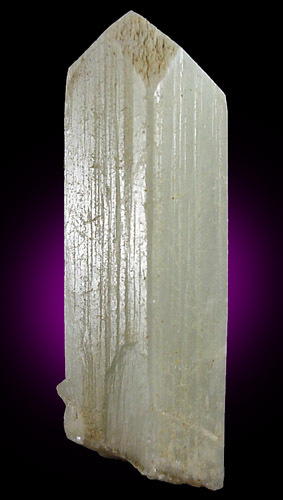


About Danburite

Danbury, Connecticut in 1875
Formula:
CaB2Si2O8
Colour:
Pale yellow, yellowish-brown, colourless
Lustre:
Vitreous, Greasy
Hardness:
7 - 7½
Specific Gravity:
2.93 - 3.02
Crystal System:
Orthorhombic
Name:
For the type locality at Danbury, Connecticut, USA.
Type Locality:
The calcium analogue of Maleevite and Pekovite.
The paracelsian topology might invoke alternatively grouping - "paracelsian group" - also comprising danburite, pekovite, maleevite, hurlbutite and strontiohurlbutite.
 Visit gemdat.org for gemological information about Danburite.
The paracelsian topology might invoke alternatively grouping - "paracelsian group" - also comprising danburite, pekovite, maleevite, hurlbutite and strontiohurlbutite.
Visit gemdat.org for gemological information about Danburite.Unique Identifiers
Mindat ID:
1218
Long-form identifier:
mindat:1:1:1218:4
IMA Classification of Danburite
Approved, 'Grandfathered' (first described prior to 1959)
First published:
1839
Classification of Danburite
9.FA.65
9 : SILICATES (Germanates)
F : Tektosilicates without zeolitic H2O
A : Tektosilicates without additional non-tetrahedral anions
9 : SILICATES (Germanates)
F : Tektosilicates without zeolitic H2O
A : Tektosilicates without additional non-tetrahedral anions
56.3.1.1
56 : SOROSILICATES Si2O7 Groups, With Additional O, OH, F and H2O
3 : Si2O7 Groups and O, OH, F, and H2O with[Si2O7] with borate groups
56 : SOROSILICATES Si2O7 Groups, With Additional O, OH, F and H2O
3 : Si2O7 Groups and O, OH, F, and H2O with[Si2O7] with borate groups
17.5.11
17 : Silicates Containing other Anions
5 : Borosilicates
17 : Silicates Containing other Anions
5 : Borosilicates
Mineral Symbols
As of 2021 there are now IMA–CNMNC approved mineral symbols (abbreviations) for each mineral species, useful for tables and diagrams.
Please only use the official IMA–CNMNC symbol. Older variants are listed for historical use only.
Please only use the official IMA–CNMNC symbol. Older variants are listed for historical use only.
| Symbol | Source | Reference for Standard |
|---|---|---|
| Dbu | IMA–CNMNC | Warr, L.N. (2021). IMA–CNMNC approved mineral symbols. Mineralogical Magazine, 85(3), 291-320. doi:10.1180/mgm.2021.43 |
| Dbr | The Canadian Mineralogist (2019) | The Canadian Mineralogist (2019) The Canadian Mineralogist list of symbols for rock- and ore-forming minerals (December 30, 2019). download |
Physical Properties of Danburite
Vitreous, Greasy
Transparency:
Transparent, Translucent
Colour:
Pale yellow, yellowish-brown, colourless
Streak:
White
Hardness:
7 - 7½ on Mohs scale
Tenacity:
Brittle
Cleavage:
Poor/Indistinct
Indistinct on {001}
Indistinct on {001}
Fracture:
Irregular/Uneven, Sub-Conchoidal
Density:
2.93 - 3.02 g/cm3 (Measured) 2.99 g/cm3 (Calculated)
Optical Data of Danburite
Type:
Biaxial (+/-)
RI values:
nα = 1.627 - 1.633 nβ = 1.63 - 1.636 nγ = 1.633 - 1.639
2V:
Measured: 88° to 90°, Calculated: 88°
Max. Birefringence:
δ = 0.006
Based on recorded range of RI values above.
Based on recorded range of RI values above.
Interference Colours:
The colours simulate birefringence patterns seen in thin section under crossed polars. They do not take into account mineral colouration or opacity.
Michel-Levy Bar The default colours simulate the birefringence range for a 30 µm thin-section thickness. Adjust the slider to simulate a different thickness.
Grain Simulation You can rotate the grain simulation to show how this range might look as you rotated a sample under crossed polars. Each grain retains its interference colour (retardation) while its brightness falls to black at extinction and reaches a maximum between extinction positions.
The colours simulate birefringence patterns seen in thin section under crossed polars. They do not take into account mineral colouration or opacity.
Michel-Levy Bar The default colours simulate the birefringence range for a 30 µm thin-section thickness. Adjust the slider to simulate a different thickness.
Grain Simulation You can rotate the grain simulation to show how this range might look as you rotated a sample under crossed polars. Each grain retains its interference colour (retardation) while its brightness falls to black at extinction and reaches a maximum between extinction positions.
Surface Relief:
High (positive)
Relative to Canada balsam mounting medium (n ≈ 1.537).
Relative to Canada balsam mounting medium (n ≈ 1.537).
This shows the grain boundary and Becke line effect under plane-polarised
light, based on the contrast between this mineral's average refractive
index and the mounting medium. It does not take into account mineral
colouration.
In focus
Interference Figure:
This shows the idealized biaxial acute bisectrix (Bxa) interference figure
- the conoscopic view for a grain cut perpendicular to the acute bisectrix, using
this mineral's 2V. The two small white dots mark the melatopes - the points
where the two optic axes emerge - and are shown only when they fall within the
field of view. The coloured bands are isochromatics, and the dark bands are
isogyres.
Rotate the stage: at 0°/90° the isogyres form a cross through the melatopes; at 45° they pull apart into curved hyperbolas. That splitting on rotation - absent in a uniaxial figure - is the standard diagnostic test for telling biaxial minerals from uniaxial ones. If 2V is large, the melatopes may fall outside the field of view, as they often do at the microscope too.
Rotate the stage: at 0°/90° the isogyres form a cross through the melatopes; at 45° they pull apart into curved hyperbolas. That splitting on rotation - absent in a uniaxial figure - is the standard diagnostic test for telling biaxial minerals from uniaxial ones. If 2V is large, the melatopes may fall outside the field of view, as they often do at the microscope too.
Dispersion:
r < v strong
Chemistry of Danburite
Mindat Formula:
CaB2Si2O8
Element Weights:
Elements listed:
Common Impurities:
Fe,Mn,Al,Mg,Sr,Na
Crystallography of Danburite
Crystal System:
Orthorhombic
Class (H-M):
mmm(2/m2/m2/m) - Dipyramidal
Cell Parameters:
a = 8.038(3) Å, b = 8.752(5) Å, c = 7.730 Å
Ratio:
a:b:c = 0.918 : 1 : 0.883
Unit Cell V:
543.79 ų (Calculated from Unit Cell)
Z:
4
Morphology:
Prismatic crystals, disseminated masses.
Comment:
Space Group: Pnam:
Crystallographic forms of Danburite
Crystal Atlas:
Image Loading
Click on an icon to view

Danburite no.40 - {110} - Goldschmidt (1913-1926)
3d models and HTML5 code kindly provided by
www.smorf.nl.
Toggle
Edge Lines | Miller Indices | Axes
Transparency
Opaque | Translucent | Transparent
View
Along a-axis | Along b-axis | Along c-axis | Start rotation | Stop rotation
Edge Lines | Miller Indices | Axes
Transparency
Opaque | Translucent | Transparent
View
Along a-axis | Along b-axis | Along c-axis | Start rotation | Stop rotation
Crystal Structure
Load
Unit Cell | Unit Cell Packed
2x2x2 | 3x3x3 | 4x4x4
Unit Cell | Unit Cell Packed
2x2x2 | 3x3x3 | 4x4x4
Show
Big Balls | Small Balls | Just Balls | Spacefill
Polyhedra Off | Si Polyhedra | All Polyhedra
Remove metal-metal sticks
Big Balls | Small Balls | Just Balls | Spacefill
Polyhedra Off | Si Polyhedra | All Polyhedra
Remove metal-metal sticks
Display Options
Black Background | White Background
Perspective On | Perspective Off
2D | Stereo | Red-Blue | Red-Cyan
Black Background | White Background
Perspective On | Perspective Off
2D | Stereo | Red-Blue | Red-Cyan
View
CIF File Best | x | y | z | a | b | c
CIF File Best | x | y | z | a | b | c
Rotation
Stop | Start
Stop | Start
Labels
Console Off | On | Grey | Yellow
Console Off | On | Grey | Yellow
Data courtesy of the American Mineralogist Crystal Structure Database. Click on an AMCSD ID to view structure
| ID | Species | Reference | Link | Year | Locality | Pressure (GPa) | Temp (K) |
|---|---|---|---|---|---|---|---|
| 0010951 | Danburite | Sugiyama K, Takeuchi Y (1985) Unusual thermal expansion of a B-O-bond in the structure of danburite CaB2Si2O8 Zeitschrift fur Kristallographie 173 293-304 |  | 1985 | Toroku mine, Miyazaki Prefecture, Japan | 0 | 293 |
| 0010950 | Danburite | Sugiyama K, Takeuchi Y (1985) Unusual thermal expansion of a B-O-bond in the structure of danburite CaB2Si2O8 Zeitschrift fur Kristallographie 173 293-304 | | 1985 | Toroku mine, Miyazaki Prefecture, Japan | 0 | 293 |
| 0010949 | Danburite | Sugiyama K, Takeuchi Y (1985) Unusual thermal expansion of a B-O-bond in the structure of danburite CaB2Si2O8 Zeitschrift fur Kristallographie 173 293-304 | | 1985 | Toroku mine, Miyazaki Prefecture, Japan | 0 | 293 |
| 0010948 | Danburite | Sugiyama K, Takeuchi Y (1985) Unusual thermal expansion of a B-O-bond in the structure of danburite CaB2Si2O8 Zeitschrift fur Kristallographie 173 293-304 | | 1985 | Toroku mine, Miyazaki Prefecture, Japan | 0 | 293 |
| 0010947 | Danburite | Sugiyama K, Takeuchi Y (1985) Unusual thermal expansion of a B-O-bond in the structure of danburite CaB2Si2O8 Zeitschrift fur Kristallographie 173 293-304 | | 1985 | Toroku mine, Miyazaki Prefecture, Japan | 0 | 293 |
| 0010946 | Danburite | Sugiyama K, Takeuchi Y (1985) Unusual thermal expansion of a B-O bond in the structure of danburite CaB2Si2O8 Zeitschrift fur Kristallographie 173 293-304 | | 1985 | Toroku mine, Miyazaki Prefecture, Japan | 0 | 293 |
| 0000395 | Danburite | Phillips M W, Gibbs G V, Ribbe P H (1974) The crystal structure of danburite: A comparison with anorthite, albite, and reedmergnerite American Mineralogist 59 79-85 | | 1974 | 0 | 293 | |
| 0017950 | Danburite | Dunbar C, Machatschki F (1931) The structure of danburite, CaB2Si2O8 _cod_database_code 1011048 Zeitschrift fur Kristallographie 76 133-145 | 1931 | 0 | 293 |
CIF Raw Data - click here to close
X-Ray Powder Diffraction
Loading XRD data...
Data courtesy of RRUFF project at University of Arizona, used with permission.
Powder Diffraction Data:
| d-spacing | Intensity |
|---|---|
| 3.57 Å | (100) |
| 2.961 Å | (80) |
| 2.743 Å | (65) |
| 2.655 Å | (55) |
| 2.729 Å | (40) |
| 1.435 Å | (40) |
| 3.65 Å | (35) |
Comments:
Maglovec Hill, Presov, Slovakia
Geological Environment
Paragenetic Mode(s):
| Paragenetic Mode | Earliest Age (Ga) |
|---|---|
| Stage 4a: Earth’s earliest continental crust | >4.4-3.0 |
| 19 : Granitic intrusive rocks | |
| Near-surface Processes | |
| 25 : Evaporites (prebiotic) | |
| High-? alteration and/or metamorphism | |
| 31 : Thermally altered carbonate, phosphate, and iron formations | |
| 32 : Ba/Mn/Pb/Zn deposits, including metamorphic deposits | |
| Stage 5: Initiation of plate tectonics | <3.5-2.5 |
| 40 : Regional metamorphism (greenschist, amphibolite, granulite facies) |
Geological Setting:
Granite and metamorphosed carbonates, evaporites.
Type Occurrence of Danburite
General Appearance of Type Material:
Scattered, subhedral, thick tabular, tan to brown crystals up to 2.5 cm in size in white, coarse-grained albite with lesser gray quartz. Crystals range from translucent to fractured and corroded.
Place of Conservation of Type Material:
No designated type material.
Geological Setting of Type Material:
Apparently dolomite-rich, high-grade metamorphic rock (outcrop lost).
Associated Minerals at Type Locality:
Synonyms of Danburite
Other Language Names for Danburite
Common Associates
Associations Based on Photo Data:
| 168 photos of Danburite associated with Calcite | CaCO3 |
| 97 photos of Danburite associated with Quartz | SiO2 |
| 44 photos of Danburite associated with Pyrite | FeS2 |
| 42 photos of Danburite associated with Datolite | CaB(SiO4)(OH) |
| 33 photos of Danburite associated with 'Citrine' | SiO2 |
| 18 photos of Danburite associated with Tourmaline | AD3G6(T6O18)(BO3)3X3Z |
| 18 photos of Danburite associated with Chalcopyrite | CuFeS2 |
| 18 photos of Danburite associated with 'Amethyst' | SiO2 |
| 17 photos of Danburite associated with Sphalerite | ZnS |
| 11 photos of Danburite associated with Fluorite | CaF2 |
Related Minerals - Strunz-mindat Grouping
| 9.FA. | Bonaccorsiite | KK2Na3(Al6Si36)O84 |
| 9.FA. | Hexacelsian | BaAl2Si2O8 |
| 9.FA. | Wodegongjieite | KCa3(Al7Si9)O32 |
| 9.FA.05 | Panunzite | (K,Na)AlSiO4 |
| 9.FA.05 | Yoshiokaite | (Ca,Na)[Al(Al,Si)O4] |
| 9.FA.05 | Nepheline | Na3K(Al4Si4O16) |
| 9.FA.05 | Trinepheline | NaAlSiO4 |
| 9.FA.05 | Davidsmithite | (Ca,◻)2Na6Al8Si8O32 |
| 9.FA.05 | Kaliophilite | KAlSiO4 |
| 9.FA.05 | Kalsilite | KAlSiO4 |
| 9.FA.05 | 'Carnegieite' | NaAlSiO4 |
| 9.FA.05 | Megakalsilite | KAlSiO4 |
| 9.FA.05 | Trikalsilite | K2NaAl3(SiO4)3 |
| 9.FA.10 | Malinkoite | NaBSiO4 |
| 9.FA.15 | Virgilite | LiAlSi2O6 |
| 9.FA.25 | Lisitsynite | KBSi2O6 |
| 9.FA.30 | Ferrisanidine | K[Fe3+Si3O8] |
| 9.FA.30 | Buddingtonite | (NH4)(AlSi3O8) |
| 9.FA.30 | Rubicline | Rb(AlSi3O8) |
| 9.FA.30 | 'Monalbite' | NaAlSi3O8 |
| 9.FA.30 | Microcline | K(AlSi3O8) |
| 9.FA.30 va | 'Germanate-celsian' | BaAl2Ge2O8 |
| 9.FA.30 | Celsian | Ba(Al2Si2O8) |
| 9.FA.30 | Sanidine | K(AlSi3O8) |
| 9.FA.30 | Orthoclase | K(AlSi3O8) |
| 9.FA.35 | Reedmergnerite | NaBSi3O8 |
| 9.FA.35 | Albite | Na(AlSi3O8) |
| 9.FA.35 | Anorthite | Ca(Al2Si2O8) |
| 9.FA.40 | Paracelsian | Ba(Al2Si2O8) |
| 9.FA.45 | Svyatoslavite | Ca(Al2Si2O8) |
| 9.FA.45 | Kumdykolite | Na(AlSi3O8) |
| 9.FA.50 | Slawsonite | Sr(Al2Si2O8) |
| 9.FA.55 | Lisetite | CaNa2Al4Si4O16 |
| 9.FA.60 | Stronalsite | Na2SrAl4Si4O16 |
| 9.FA.60 | Banalsite | Na2BaAl4Si4O16 |
| 9.FA.65 | Maleevite | BaB2Si2O8 |
| 9.FA.65 | Pekovite | SrB2Si2O8 |
| 9.FA.70 | Liebermannite | KAlSi3O8 |
| 9.FA.70 | Lingunite | NaAlSi3O8 |
| 9.FA.70 | Stöfflerite | CaAl2Si2O8 |
| 9.FA.75 | Pfaffenbergite | KNa3(Al4Si12)O32 |
| 9.FA.75 | Kokchetavite | K(AlSi3O8) |
Fluorescence of Danburite
Charcas, Mexico crystals commonly fluoresce blue under SW or LW toward the clear terminations. Lower opaque portions may fluoresce yellow, green or both. Similar response from some Ural Mountains crystals. Weak white under SW or LW from Cristalmayu, Bolivia. Material from the type locality fluoresces moderately bright pale yellow to cream under SW, MW and LW.
Other Information
Thermal Behaviour:
Heated alone, before the blowpipe, it phosphoresces and fuses slowly, without swelling, into a white blebby, transparent glass (fusability scale 3.5), coloring the flame green due to boron. On cooling the glass becomes milky-white. With borax, it melts with effervescence into a transparent globule.
In a closed tube, it gives off some moisture, and phosphoresces brilliantly with a reddish yellow light.
In a closed tube, it gives off some moisture, and phosphoresces brilliantly with a reddish yellow light.
Notes:
Slightly soluble in HCl, sufficiently so to give the reaction for boric acid with turmeric paper. Powdered danburite is slowly soluble.
Health Risks:
No information on health risks for this material has been entered into the database. You should always treat mineral specimens with care.
Danburite in petrology
An essential component of rock names highlighted in red, an accessory component in rock names highlighted in green.
Internet Links for Danburite
mindat.org URL:
https://www.mindat.org/min-1218.html
Please feel free to link to this page.
Please feel free to link to this page.
Search Engines:
External Links:
Mineral Dealers:
References for Danburite
Reference List:
Lindbloom, J. T., Gibbs, G. V., Ribbe, and P. H. (1974) The crystal structure of hurlbutite: A comparison with danburite and anorthite. American Mineralogist, 59 (11-12) 1267-1271
Shannon, Robert D., Shannon, Ruth C., Medenbach, Olaf, Fischer, Reinhard X. (2002) Refractive Index and Dispersion of Fluorides and Oxides. Journal of Physical and Chemical Reference Data, 31 (4) 931-970 doi:10.1063/1.1497384
Huong, Le, Otter, Laura, Förster, Michael, Hauzenberger, Christoph, Krenn, Kurt, Alard, Olivier, Macholdt, Dorothea, Weis, Ulrike, Stoll, Brigitte, Jochum, Klaus (2018) Femtosecond Laser Ablation-ICP-Mass Spectrometry and CHNS Elemental Analyzer Reveal Trace Element Characteristics of Danburite from Mexico, Tanzania, and Vietnam. Minerals, 8 (6) 234 doi:10.3390/min8060234
Localities for Danburite
Showing 186 localities.
 symbol to view information about a locality.
The
symbol to view information about a locality.
The Locality List
 - This locality has map coordinates listed.
- This locality has estimated coordinates.
ⓘ - Click for references and further information on this occurrence.
? - Indicates mineral may be doubtful at this locality.
- This locality has map coordinates listed.
- This locality has estimated coordinates.
ⓘ - Click for references and further information on this occurrence.
? - Indicates mineral may be doubtful at this locality.
 - Good crystals or important locality for species.
 - World class for species or very significant.
(TL) - Type Locality for a valid mineral species.
(FRL) - First Recorded Locality for everything else (eg varieties).
- World class for species or very significant.
(TL) - Type Locality for a valid mineral species.
(FRL) - First Recorded Locality for everything else (eg varieties).
All localities listed without proper references should be considered as questionable.
Quick NavTopAbout DanburiteUnique IdentifiersIMA Classification Classification Mineral SymbolsPhysical Properties Optical Data Chemistry Crystallography Crystallographic forms Crystal StructureX-Ray Powder DiffractionGeological EnvironmentType Occurrence SynonymsOther LanguagesCommon AssociatesStrunz-MindatFluorescence Other InformationDanburite in petrologyInternet Links References Localities Locality List

Toroku Mine, Takachiho, Nishiusuki District, Miyazaki Prefecture, Japan